engine PORSCHE 911 TURBO 2014 6.G Service Manual
[x] Cancel search | Manufacturer: PORSCHE, Model Year: 2014, Model line: 911 TURBO, Model: PORSCHE 911 TURBO 2014 6.GPages: 300, PDF Size: 10.61 MB
Page 141 of 300
Instrument Panel and Multi-Function Display 139
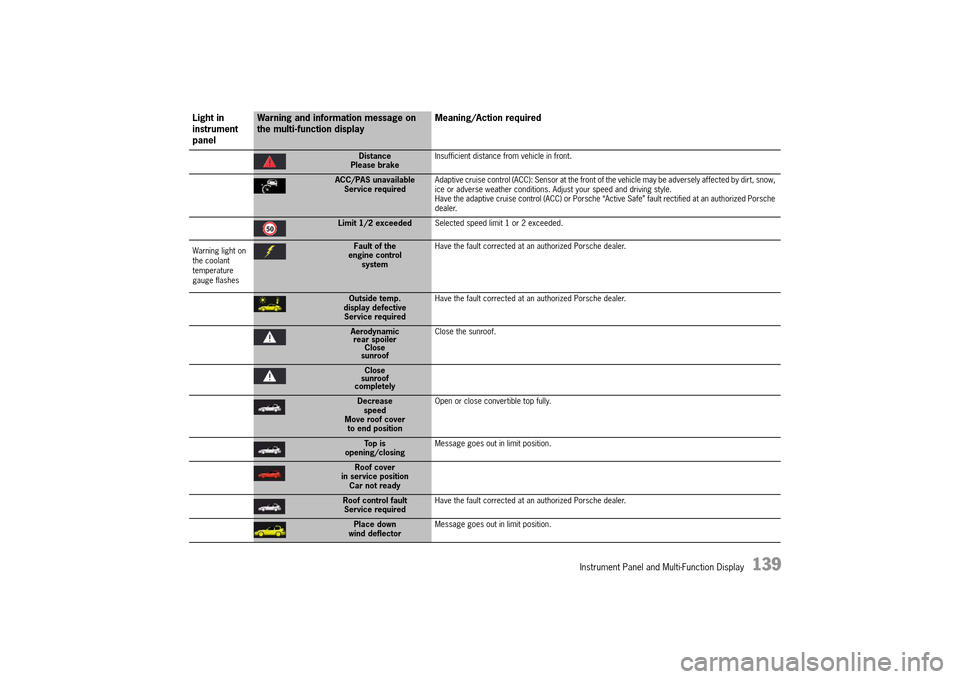
Distance Please brake Insufficient distance from vehicle in front.
ACC/PAS unavailable Service required Adaptive cruise control (ACC): Sensor at the front of the vehicle may be adversely affected by dirt, snow, ice or adverse weather conditions. Adjust your speed and driving style. Have the adaptive cruise control (ACC) or Porsche “Active Safe” fault rectified at an authorized Porsche dealer.
Limit 1/2 exceeded Selected speed limit 1 or 2 exceeded.
Warning light on the coolant temperature gauge flashes
Fault of the engine controlsystem
Have the fault corrected at an authorized Porsche dealer.
Outside temp. display defectiveService required
Have the fault corrected at an authorized Porsche dealer.
Aerodynamic rear spoilerClose sunroof
Close the sunroof.
Close sunroof completely
Decrease speedMove roof cover to end position
Open or close convertible top fully.
Top is opening/closing Message goes out in limit position.
Roof cover in service positionCar not ready
Roof control faultService required Have the fault corrected at an authorized Porsche dealer.
Place down wind deflector Message goes out in limit position.
Light in instrument panel
Warning and information message on the multi-function display Meaning/Action required
14_991_Turbo_21.book Seite 139 Mittwoch, 9. April 2014 2:19 14
Page 147 of 300
Driving and Driving Safety 145
Driving and Driving Safety
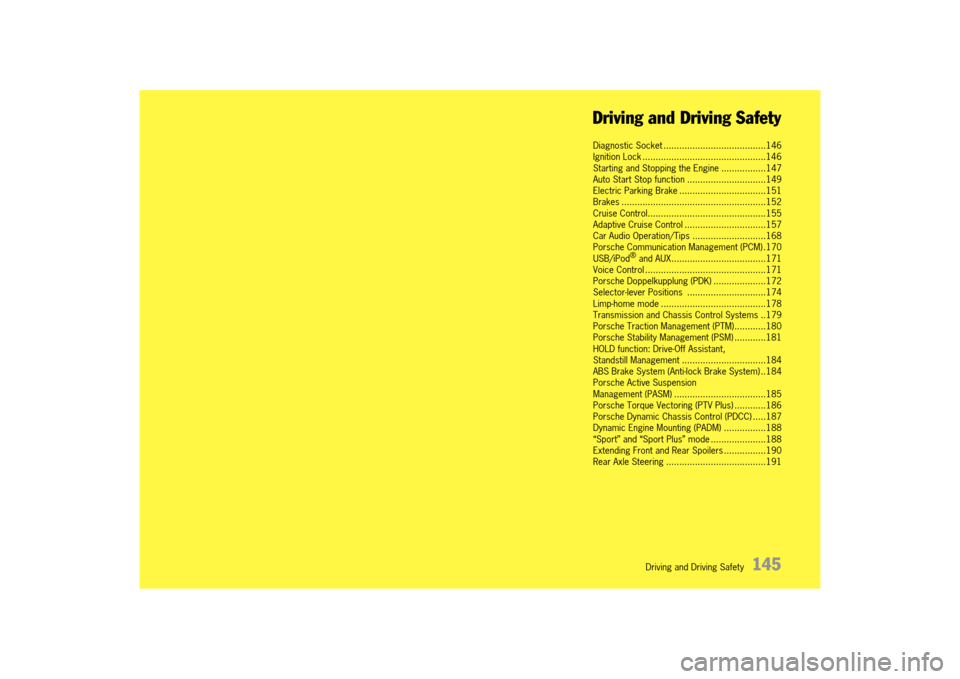
Diagnostic Socket .......................................146 Ignition Lock ...............................................146Starting and Stopping the Engine .................147Auto Start Stop function ..............................149Electric Parking Brake .................................151Brakes .......................................................152Cruise Control.............................................155Adaptive Cruise Control ...............................157Car Audio Operation/Tips ............................168Porsche Communication Management (PCM) .170USB/iPod® and AUX....................................171Voice Control ..............................................171Porsche Doppelkupplung (PDK) ....................172Selector-lever Positions ..............................174Limp-home mode ........................................178Transmission and Chassis Control Systems ..179Porsche Traction Management (PTM)............180Porsche Stability Management (PSM) ............181HOLD function: Drive-Off Assistant, Standstill Management ................................184ABS Brake System (Anti-lock Brake System) ..184Porsche Active Suspension Management (PASM) ...................................185Porsche Torque Vectoring (PTV Plus) ............186Porsche Dynamic Chassis Control (PDCC) .....187Dynamic Engine Mounting (PADM) ................188“Sport” and “Sport Plus” mode .....................188Extending Front and Rear Spoilers ................190Rear Axle Steering ......................................191
14_991_Turbo_21.book Seite 145 Mittwoch, 9. April 2014 2:19 14
Page 148 of 300
146 Driving and Driving Safety
Diagnostic Socket
External equipment or devices (e.g. navigation units, head-up displays, etc.) connected to the diagnostic socket can impair the function of the vehicle systems.fDo not connect any equipment or devices to the diagnostic socket.
Loose equipment/devices or hanging cables in the driver's footwell can obstruct clearance around the pedals or become caught between the pedals when braking or changing direction.fDo not place any equipment/devices or cables in the driver's footwell.
The diagnostic socket is for connecting diagnostic equipment in qualified specialist workshops.
Operating external equipment or devices (e.g. navigation units, head-up displays, etc.) from the diagnostic socket when the ignition is switched off will run down the battery. If the vehicle is parked for an extended period, the battery can discharge fully and be damaged (exhaustive discharge).fDo not connect any equipment or devices to the diagnostic socket.
Ignition Lock
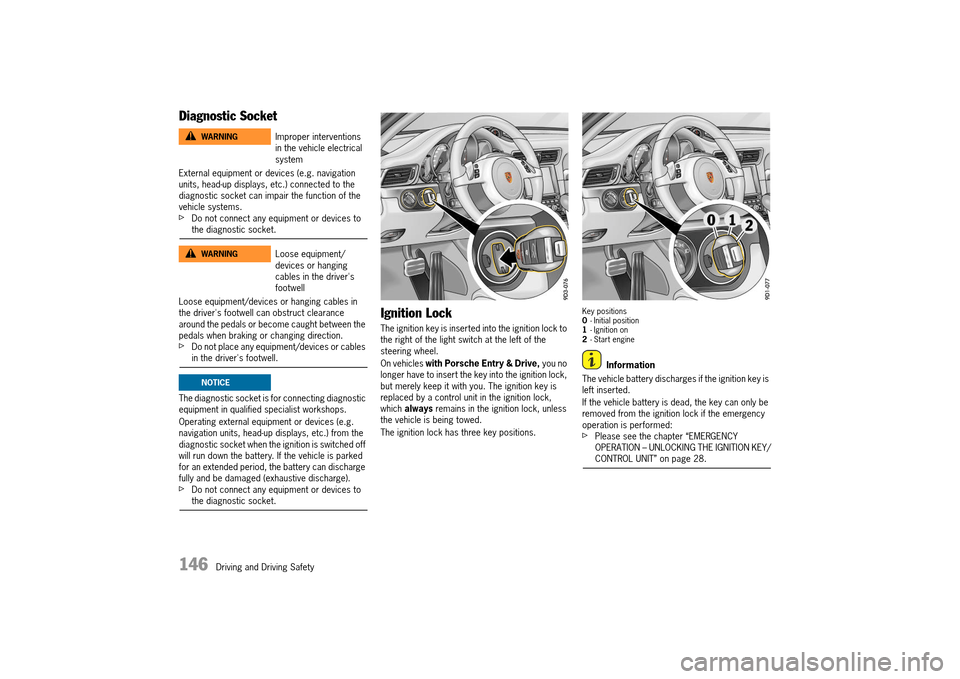
The ignition key is inserted into the ignition lock to the right of the light switch at the left of the steering wheel.
On vehicles with Porsche Entry & Drive, you no longer have to insert the key into the ignition lock, but merely keep it with you. The ignition key is replaced by a control unit in the ignition lock, which always remains in the ignition lock, unless the vehicle is being towed.
The ignition lock has three key positions.
Key positions 0 - Initial position 1 - Ignition on 2 - Start engine
Information
The vehicle battery discharges if the ignition key is left inserted.
If the vehicle battery is dead, the key can only be removed from the ignition lock if the emergency operation is performed: fPlease see the chapter “EMERGENCY OPERATION – UNLOCKING THE IGNITION KEY/CONTROL UNIT” on page 28.
Improper interventions in the vehicle electrical system
Loose equipment/ devices or hanging cables in the driver's footwell
WARNINGh
WARNINGh
NOTICE
14_991_Turbo_21.book Seite 146 Mittwoch, 9. April 2014 2:19 14
Page 149 of 300
Driving and Driving Safety 147
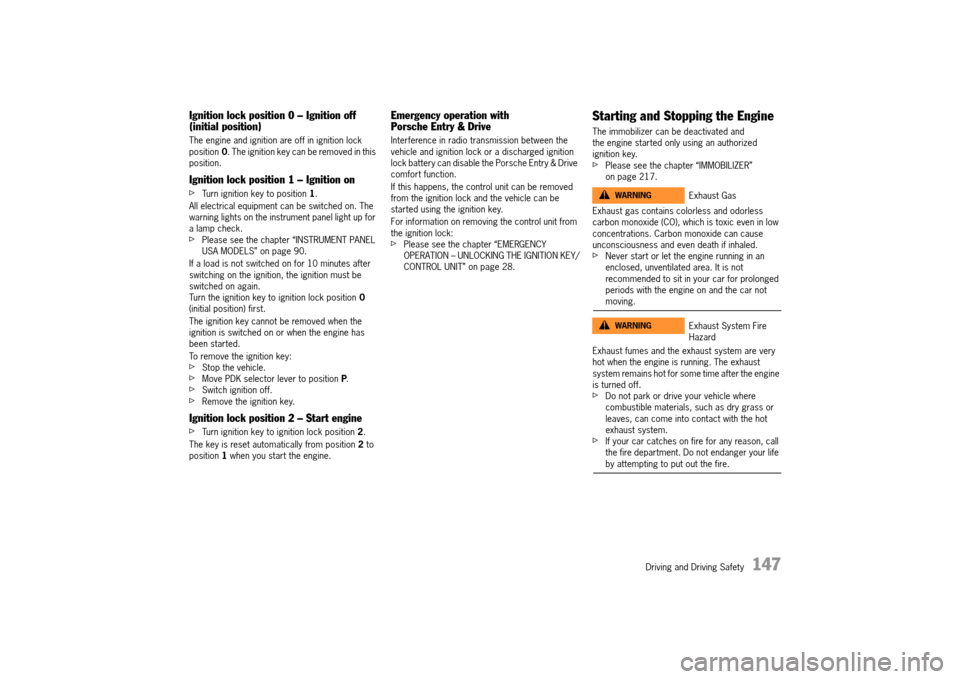
Ignition lock position 0 – Ignition off (initial position)
The engine and ignition are off in ignition lock position 0. The ignition key can be removed in this position.
Ignition lock position 1 – Ignition on
fTurn ignition key to position 1.
All electrical equipment can be switched on. The warning lights on the instrument panel light up for a lamp check.fPlease see the chapter “INSTRUMENT PANEL USA MODELS” on page 90.
If a load is not switched on for 10 minutes after switching on the ignition, the ignition must be switched on again. Turn the ignition key to ignition lock position 0 (initial position) first.
The ignition key cannot be removed when the ignition is switched on or when the engine has been started.
To remove the ignition key: fStop the vehicle.fMove PDK selector lever to position P.fSwitch ignition off.fRemove the ignition key.
Ignition lock position 2 – Start engine
fTurn ignition key to ignition lock position 2.
The key is reset automatically from position 2 to position 1 when you start the engine.
Emergency operation with Porsche Entry & Drive
Interference in radio transmission between the vehicle and ignition lock or a discharged ignition lock battery can disable the Porsche Entry & Drive comfort function.
If this happens, the control unit can be removed from the ignition lock and the vehicle can be started using the ignition key.
For information on removing the control unit from the ignition lock: fPlease see the chapter “EMERGENCY OPERATION – UNLOCKING THE IGNITION KEY/CONTROL UNIT” on page 28.
Starting and Stopping the Engine
The immobilizer can be deactivated and the engine started only using an authorized ignition key.fPlease see the chapter “IMMOBILIZER” on page 217.
Exhaust gas contains colorless and odorless carbon monoxide (CO), which is toxic even in low concentrations. Carbon monoxide can cause unconsciousness and even death if inhaled.fNever start or let the engine running in an enclosed, unventilated area. It is not recommended to sit in your car for prolonged periods with the engine on and the car not moving.
Exhaust fumes and the exhaust system are very hot when the engine is running. The exhaust system remains hot for some time after the engine is turned off.fDo not park or drive your vehicle where combustible materials, such as dry grass or leaves, can come into contact with the hot exhaust system.fIf your car catches on fire for any reason, call the fire department. Do not endanger your life by attempting to put out the fire.
Exhaust Gas
Exhaust System Fire Hazard
WARNINGh
WARNINGh
14_991_Turbo_21.book Seite 147 Mittwoch, 9. April 2014 2:19 14
Page 150 of 300
148 Driving and Driving Safety
An unattended vehicle with a running engine is potentially hazardous. If warning lights come on to indicate improper operation, no one would be present to observe the light and turn off the engine.fNever leave the engine idling unattended.
Starting the vehicle
fOperate the footbrake.fMove PDK selector lever to the P or N position.fDo not press the accelerator pedal.The engine control unit will provide the correct starting mixture.fTurn the ignition key or control unit (Porsche Entry & Drive) to ignition lock position 2. The starting process is carried out and completed automatically as soon as ignition lock position 2 (start engine) is reached. The ignition key or control unit is reset automatically to ignition lock position 1 (ignition on).fDo not operate the starter for more than approx. 10 seconds. If necessary, repeat the starting procedure after a pause of approx. 10 seconds. Turn the ignition key back to ignition lock position 0 (initial position) first. The first operation of the starter is ended automatically when the engine starts.If the engine does not start, subsequent starter operations will not be ended automatically.fDo not warm up the engine when stationary. Drive off immediately. Avoid high revs and full throttle until the engine has reached operating temperature.
fIf the vehicle battery power is too weak, the engine can be started with jump leads.
For information on jump-lead starting: fPlease see the chapter “EXTERNAL POWER SUPPLY, EMERGENCY STARTING WITH JUMPER CABLES” on page 273.
Information
To ensure a good battery charge condition, thereby ensuring that the battery will start the engine, all electrical loads that are not required should be switched off when the ignition is switched on and when engine revs are low (in traffic jams, in city traffic or in lines).
Stopping
fOnly remove the ignition key when the vehicle is stationary.fOnly switch the ignition off when the vehicle is stationary, as there is no power steering and brake booster assistance when the engine is switched off.fWhen leaving the vehicle, always remove the ignition key, apply the electric parking brake and engage selector-lever position P. The control unit always remains in the ignition lock on vehicles with Porsche Entry & Drive.
Engine components become very hot when the engine is running.fBefore working on any part in the engine compartment, turn the engine off and let it cool down sufficiently.
The exhaust pipe is hot when the engine is running and remains hot for some time after the vehicle is turned off. fTo prevent injury, make a point of noting where your vehicle’s exhaust pipe is, avoid placing your legs near the exhaust pipe when loading and unloading cargo in the rear, and closely supervise children around the vehicle during time when the exhaust pipe could be hot. A hot exhaust pipe can cause painful skin burns.
Radiator fan
The fan can start running depending on the temperature, even with the engine switched off.fExercise extreme care that parts of the body, articles of clothing or jewelry do not get caught in the radiator fan. fExercise extreme caution when working in the area of the radiator fans.
For information on radiator fans:fPlease see the chapter “RADIATOR FAN, ENGINE COMPARTMENT BLOWERS” on page 221.
NOTICE
Hot Engine PartsWARNINGh
Hot Exhaust Tailpipe
Radiator Fan
WARNINGh
WARNINGh
14_991_Turbo_21.book Seite 148 Mittwoch, 9. April 2014 2:19 14
Page 151 of 300
Driving and Driving Safety 149
Auto Start Stop function
The engine stops automatically when the vehicle is
stopped, e.g. at traffic lights or in a traffic jam, if all the preconditions for stopping the engine automatically are met. The engine can also stop automatically
during a stop at walking pace. The Auto Start Stop function thus helps to save fuel.
The ignition stays on even when the engine switches off automatically. All safety functions are still available.
Preconditions for stopping the engine automatically
– Auto Start Stop function switched on. – Engine compartment lid closed.– Brake pedal pressed– Move PDK selector lever to the D, N or P position, or to a manually selected transmission range 1 or 2. – Engine, transmission and air conditioning are at operating temperature.– Battery has reached its target voltage.– Vehicle was driven at a speed of more than approx. 1 mph (2 km/h) for at least 1.5 seconds since the engine last stopped automatically.
Information
When the ignition is on, the battery is discharged. If the vehicle is parked for an extended period, the battery can discharge fully and be damaged (exhaustive discharge).
Stopping the engine
The Auto Start Stop function stops the engine once the vehicle stops moving or during the stopping process.1. Use the footbrake to stop the vehicle. 2. Keep the footbrake pressed. orMove PDK selector lever to position P.
Information
– The engine can also be stopped subsequently (not immediately after the vehicle comes to a stop) if the exceptions are set aside and the preconditions for stopping the engine automatically continue to be met.fPlease see the chapter “EXCEPTIONS FOR THE AUTO START STOP FUNCTION” on page 150.– When adaptive cruise control is switched on, the engine stops automatically when the vehicle is stationary if the vehicle in front also comes to a stop.
Starting the engine
The Auto Start Stop function starts the engine:fIn PDK selector-lever position D, N or manually selected transmission range 1 or 2: Release the footbrake.orPress the accelerator.orMove the steering wheel.orMove PDK selector lever to position R.
You can drive off normally.
Information
When adaptive cruise control is switched on, the engine starts automatically if the following preconditions are met:– The vehicle in front drives off.orThe accelerator is pressed.orSpeed and distance control is resumed using the control stalk (position 4, RESUME).fPlease see the chapter “INTERRUPTING AND RESUMING CRUISE CONTROL AND DISTANCE CONTROL” on page 164.– Switching off adaptive cruise control starts the engine automatically and the vehicle moves (crawls) when in gear.
14_991_Turbo_21.book Seite 149 Mittwoch, 9. April 2014 2:19 14
Page 152 of 300
150 Driving and Driving Safety
Information
The engine will start automatically in certain situations, e.g. if the vehicle starts rolling, if air conditioning causes reduced comfort, or if the brake vacuum is reduced.The engine is stopped again automatically if the preconditions for stopping the engine automatically are then met again.
Exceptions for the Auto Start Stop function
The Auto Start Stop function is deactivated e.g.: – When Sport mode is activated.– When PSM is off.– In maneuvering mode.– When A/C MAX mode is activated.– When the “Windshield defrost” function is active. – At altitudes above approx. 9,843 ft. (3,000 meters)
For information on switching on and off the Auto Start Stop function:fPlease see the chapter “SWITCHING AUTO START STOP FUNCTION AND COASTING MODE ON AND OFF” on page 150.
The Auto Start Stop function is available with limited functionality in the following situations, e.g.:– If the air conditioning or passenger compartment heating is operated at a high setting or if the defrost function is run for long time periods.– If the battery charging condition is low.– On upward or downward slopes.– During internal vehicle test procedures, e.g. automatic engine checks.
Information
If one of these situations arises after the engine has stopped automatically, the engine can be restarted automatically.
Reaction after leaving the vehicle (selector-lever position D or N selected)
If the vehicle is left after an automatic stop when PDK selector-lever position D or N is engaged, an automatic engine start is executed to remind the driver that the Auto Start Stop function is still active.
In selector-lever position D, the electric parking brake is additionally engaged.
The brake warning light on the instrument panel and the indicator light on the switch light up.fPlease see the chapter “OVERVIEW OF WARNING AND INFORMATION MESSAGES” on page 129.
Reaction after leaving the vehicle (selector-lever position P selected)
If the vehicle is left after an automatic stop when PDK selector-lever position P is engaged, in order to open the garage door, for example, no automatic engine start is executed. Auto Start Stop mode is resumed if the driver closes the driver’s door and presses the brake within 30 seconds of leaving the vehicle.
If one of these requirements is not met, the engine has to be started manually. The
message “ Please start engine manually” will appear on the multi-function display in the instrument panel.fPlease see the chapter “OVERVIEW OF WARNING AND INFORMATION MESSAGES” on page 129.
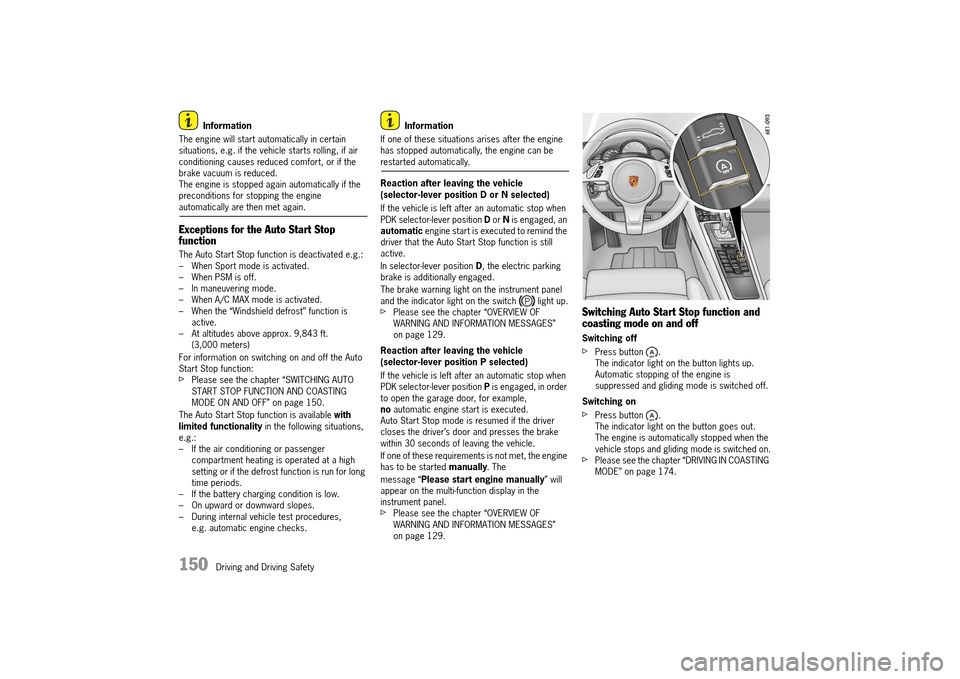
Switching Auto Start Stop function and coasting mode on and off
Switching off
fPress button . The indicator light on the button lights up.Automatic stopping of the engine is suppressed and gliding mode is switched off.
Switching on
fPress button . The indicator light on the button goes out.The engine is automatically stopped when the vehicle stops and gliding mode is switched on.fPlease see the chapter “DRIVING IN COASTING MODE” on page 174.
14_991_Turbo_21.book Seite 150 Mittwoch, 9. April 2014 2:19 14
Page 153 of 300
Driving and Driving Safety 151
Auto Start Stop function display
If the engine was stopped automatically by the Auto Start Stop function, the indicator light on the multi-function display in the instrument panel will light up green.
If the Auto Stop function is not available or if no driver is detected in the vehicle after the engine has stopped automatically (driver’s seat belt not fastened or driver’s door open), the indicator light on the multi-function display in the instrument panel will light up yellow when the vehicle is stationary.
The Auto Start Stop system has detected that: – At least one precondition for stopping the engine automatically is not met.
or – There is at least one exception for the Auto Start Stop function.fPlease see the chapter “PRECONDITIONS FOR STOPPING THE ENGINE AUTOMATICALLY” on page 149.fPlease see the chapter “EXCEPTIONS FOR THE AUTO START STOP FUNCTION” on page 150.
Information
If the indicator light in the multi-function display continuously lights up yellow when the vehicle is stopped and if the engine does not stop regularly when the vehicle is stopped despite the fact that the preconditions for stopping the engine automatically are met, have the Auto Start Stop system checked the next time you visit the workshop.
Fault reporting
If there is a fault, the warning message “ Start/ Stop operation deactivated ” will appear on the multi-function display in the instrument panel.fHave the fault corrected at an authorized Porsche dealer.
Electric Parking Brake
The electric parking brake acts on the rear wheels and serves to secure the vehicle while parked.
Applying the parking brake
fPress switch .The brake warning light on the instrument panel lights up.
For information on indicator lights and warning lights on the instrument panel: fPlease see the chapter “INSTRUMENT PANEL USA MODELS” on page 90.
Automatic engine stop and restart readiness
No engine stop or restart readiness
14_991_Turbo_21.book Seite 151 Mittwoch, 9. April 2014 2:19 14
Page 154 of 300
152 Driving and Driving Safety
Releasing the parking brake
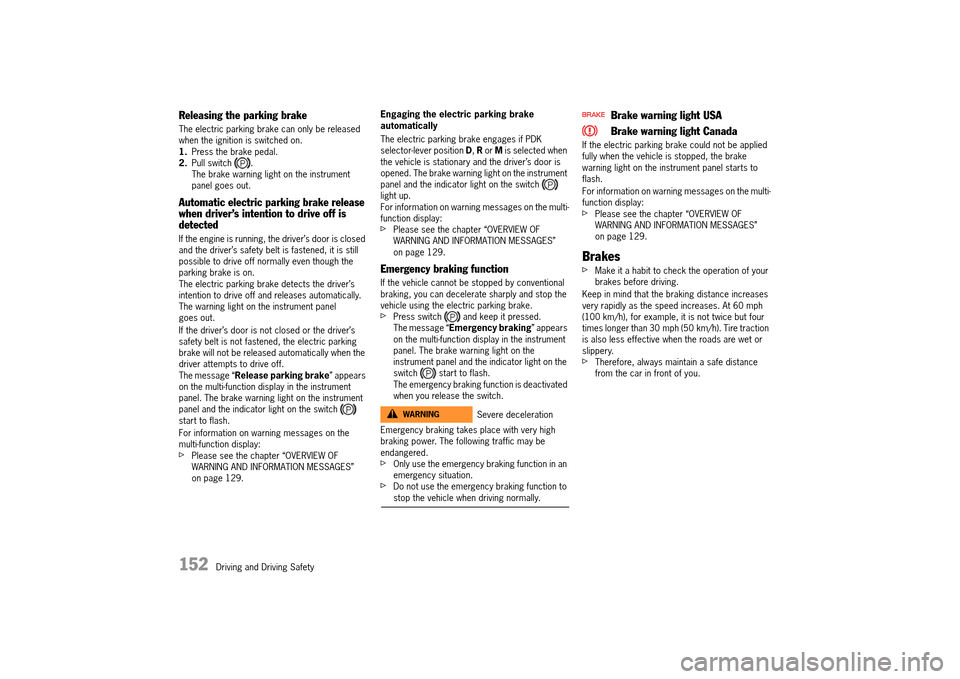
The electric parking brake can only be released when the ignition is switched on.1. Press the brake pedal. 2. Pull switch . The brake warning light on the instrument panel goes out.
Automatic electric parking brake release when driver’s intention to drive off is detected
If the engine is running, the driver’s door is closed and the driver’s safety belt is fastened, it is still possible to drive off normally even though the parking brake is on.The electric parking brake detects the driver’s intention to drive off and releases automatically.The warning light on the instrument panel goes out.
If the driver’s door is not closed or the driver’s safety belt is not fastened, the electric parking brake will not be released automatically when the driver attempts to drive off.The message “ Release parking brake” appears on the multi-function display in the instrument panel. The brake warning light on the instrument panel and the indicator light on the switch start to flash.
For information on warning messages on the multi-function display: fPlease see the chapter “OVERVIEW OF WARNING AND INFORMATION MESSAGES” on page 129.
Engaging the electric parking brake automatically
The electric parking brake engages if PDK selector-lever position D, R or M is selected when the vehicle is stationary and the driver’s door is opened. The brake warning light on the instrument panel and the indicator light on the switch light up. For information on warning messages on the multi-function display: fPlease see the chapter “OVERVIEW OF WARNING AND INFORMATION MESSAGES” on page 129.
Emergency braking function
If the vehicle cannot be stopped by conventional braking, you can decelerate sharply and stop the vehicle using the electric parking brake.fPress switch and keep it pressed.The message “ Emergency braking” appears on the multi-function display in the instrument panel. The brake warning light on the instrument panel and the indicator light on the switch start to flash.The emergency braking function is deactivated when you release the switch.
Emergency braking takes place with very high braking power. The following traffic may be endangered.fOnly use the emergency braking function in an emergency situation.fDo not use the emergency braking function to stop the vehicle when driving normally.
Brake warning light USA
Brake warning light Canada
If the electric parking brake could not be applied fully when the vehicle is stopped, the brake warning light on the instrument panel starts to flash.
For information on warning messages on the multi- function display: fPlease see the chapter “OVERVIEW OF WARNING AND INFORMATION MESSAGES” on page 129.
Brakes
fMake it a habit to check the operation of your brakes before driving.
Keep in mind that the braking distance increases very rapidly as the speed increases. At 60 mph (100 km/h), for example, it is not twice but four times longer than 30 mph (50 km/h). Tire traction is also less effective when the roads are wet or slippery.fTherefore, always maintain a safe distance from the car in front of you.
Severe decelerationWARNINGh
14_991_Turbo_21.book Seite 152 Mittwoch, 9. April 2014 2:19 14
Page 156 of 300
154 Driving and Driving Safety
fBefore descending a steep grade, reduce speed and shift the transmission into a lower gear to control speed. fDo not “ride the brakes” by resting your foot on the pedal when not intending to apply brake pressure.fDo not hold the pedal down too long or too often. This could cause the brakes to overheat and lose braking power.
Brake booster
The brake booster assists braking only when the engine is running.
When the car is moving while the engine is not running, or if the brake booster is defective, more pressure on the brake pedal is required to bring the car to a stop.
Moisture, road salt or grit on brakes affects braking. Brakes will dry after a few cautious brake applications.
Driving through water may reduce the traction. Moisture on brakes from road water, car wash, or a coating of road salt or grit may affect braking efficiency.fCautiously apply brakes to test and dry the brakes after exposure to road water, etc.
The brake booster is ready for operation only while the engine is running. If the engine is switched off or there is a defect in the brake booster, much greater force has to be applied to the pedal when braking. fVehicles with defective brakes must not be towed and must be transported on a flat bed.
For information on towing:fPlease see the chapter “TOWING” on page 278.
Brake wear
Your car has excellent brakes, but they are still subject to wear. The rate at which they wear depends on how the brakes are used.fHave the brake system inspected at the intervals recommended in your Maintenance Booklet.
Brake system warning light
You can check the functionality of the brake system warning light by switching the ignition to the “On” position (position 1) and verifying that the warning light illuminates.
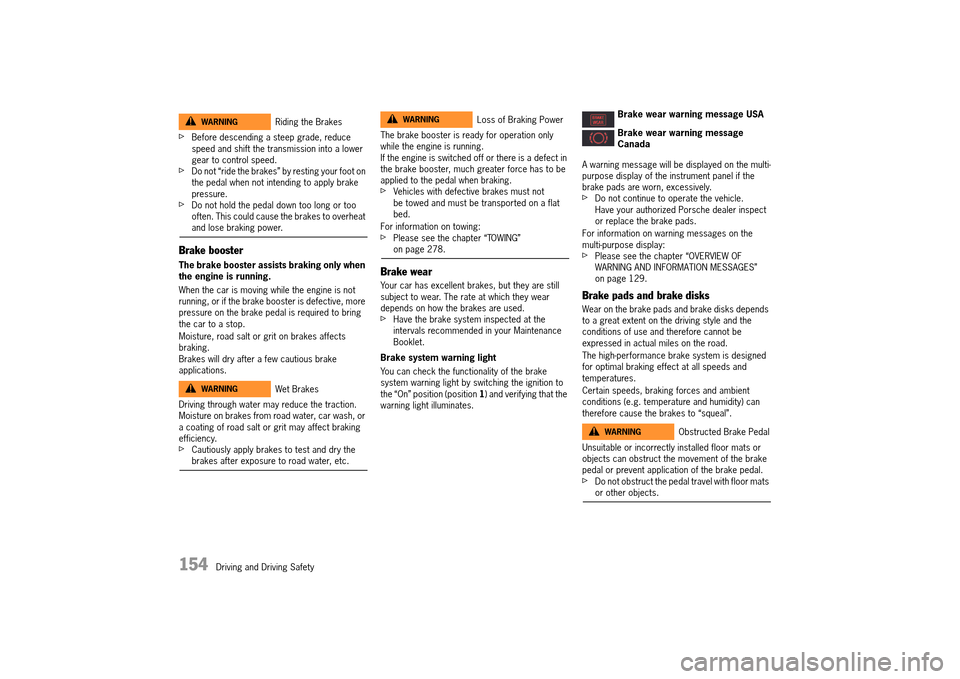
A warning message will be displayed on the multi- purpose display of the instrument panel if the brake pads are worn, excessively.fDo not continue to operate the vehicle.Have your authorized Porsche dealer inspect or replace the brake pads.
For information on warning messages on the multi-purpose display:fPlease see the chapter “OVERVIEW OF WARNING AND INFORMATION MESSAGES” on page 129.
Brake pads and brake disks
Wear on the brake pads and brake disks depends to a great extent on the driving style and the conditions of use and therefore cannot be expressed in actual miles on the road.
The high-performance brake system is designed for optimal braking effect at all speeds and temperatures.
Certain speeds, braking forces and ambient conditions (e.g. temperature and humidity) can therefore cause the brakes to “squeal”.
Unsuitable or incorrectly installed floor mats or objects can obstruct the movement of the brake pedal or prevent application of the brake pedal.fDo not obstruct the pedal travel with floor mats or other objects.
Riding the Brakes
Wet Brakes
WARNINGh
WARNINGh
Loss of Braking PowerWARNINGhBrake wear warning message USA
Brake wear warning message Canada
Obstructed Brake PedalWARNINGh
14_991_Turbo_21.book Seite 154 Mittwoch, 9. April 2014 2:19 14