ECU PORSCHE CAYMAN 2006 1.G User Guide
[x] Cancel search | Manufacturer: PORSCHE, Model Year: 2006, Model line: CAYMAN, Model: PORSCHE CAYMAN 2006 1.GPages: 280, PDF Size: 4.89 MB
Page 123 of 280

Controls, Instruments
123
Welcome Home LightingSwitching onfMove light switch to the HOME position.
For improved visibility and security when you get
in and out of the car, the fog lights and the tail
lights remain on for a certain period of time:
–When you get out of the car, the lights are
turned on for approx. 30 seconds after the
door is opened. The off-delay time resumes
when the vehicle is locked.
On vehicles with the Sport Chrono Plus
package, the PCM can be used to set the off-
delay time. This setting also changes the
lighting period for unlocking the vehicle.
Please observe the chapter “Individual
Memory” in the separate PCM operating
instructions.
The lights are turned on for approx. 30 seconds
when the vehicle is unlocked.
The lights go out if the ignition is switched on or
when leaving the Welcome Home lighting
If the ignition key is withdrawn and the door is ope-
ned while the lights (not the parking light left/right)
are on, a gong warns of possible battery dis-
charge.
In some countries, differences are possible
due to provisions of law.
Automatic Headlight Beam
Adjustment Vehicles with Litronic headlights feature auto-
matic headlight beam adjustment.
When the ignition is switched on, the level of the
headlight beam automatically changes in accord-
ance with the vehicle load.
The level of the headlight beam is automatically
kept constant during acceleration and braking.
Checking operation
1. Switch the low beam on.
2. Switch ignition on.
The light beam first dips all the way down and
is then adapted to the vehicle load.
The level of the low beam rises perceptibly
when the high beam is switched on.
If these test items are not met, the headlight beam
adjustment must be checked by an authorized
Porsche dealer.
Page 125 of 280
Controls, Instruments
125
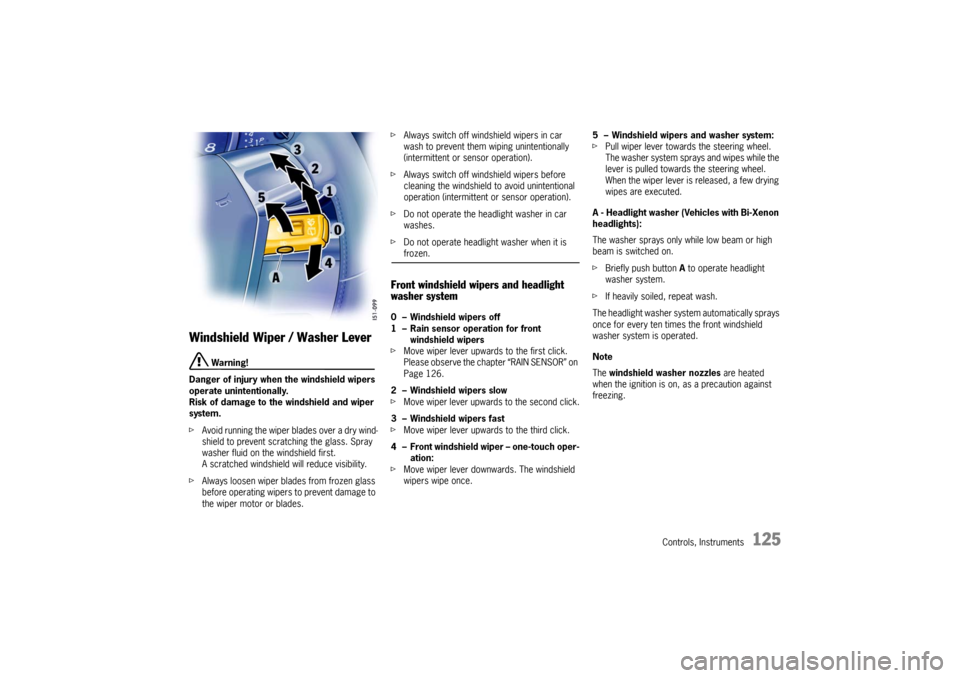
Windshield Wiper / Washer Lever
Warning!
Danger of injury when the windshield wipers
operate unintentionally.
Risk of damage to the windshield and wiper
system.
fAvoid running the wiper blades over a dry wind-
shield to prevent scratching the glass. Spray
washer fluid on the windshield first.
A scratched windshield will reduce visibility.
fAlways loosen wiper blades from frozen glass
before operating wipers to prevent damage to
the wiper motor or blades. fAlways switch off windshield wipers in car
wash to prevent them wiping unintentionally
(intermittent or sensor operation).
fAlways switch off windshield wipers before
cleaning the windshield to avoid unintentional
operation (intermittent or sensor operation).
fDo not operate the headlight washer in car
washes.
fDo not operate headlight washer when it is
frozen.
Front windshield wipers and headlight
washer system0 – Windshield wipers off
1 – Rain sensor operation for front
windshield wipers
fMove wiper lever upwards to the first click.
Please observe the chapter “RAIN SENSOR” on
Page 126.
2 – Windshield wipers slow
fMove wiper lever upwards to the second click.
3 – Windshield wipers fast
fMove wiper lever upwards to the third click.
4 – Front windshield wiper – one-touch oper-
ation:
fMove wiper lever downwards. The windshield
wipers wipe once.5 – Windshield wipers and washer system:
fPull wiper lever towards the steering wheel.
The washer system sprays and wipes while the
lever is pulled towards the steering wheel.
When the wiper lever is released, a few drying
wipes are executed.
A - Headlight washer (Vehicles with Bi-Xenon
headlights):
The washer sprays only while low beam or high
beam is switched on.
fBriefly push button A to operate headlight
washer system.
fIf heavily soiled, repeat wash.
The headlight washer system automatically sprays
once for every ten times the front windshield
washer system is operated.
Note
The windshield washer nozzles are heated
when the ignition is on, as a precaution against
freezing.
Page 141 of 280

Controls, Instruments
141
Storage in the passenger
compartment
Warning!
Danger of injury during braking, rapid
direction changes or in an accident.
fDo not carry items of luggage or objects in the
passenger compartment unsecured.
fDo not transport any heavy objects in the oddments trays.
Additional storage possibilities–in the doors,
– in the door sill next to the passenger's seat,
– in the center console,
– clothes hook on back of seat backrest,
– oddments tray with coin holder between seats,
– glove compartment with CD and pen holder,
– side storage compartments behind the seats,
Oddments tray between the seatsOpening
fPress release button and lift the lid.
There is a coin holder and socket in the
forward part of the oddments tray.
fPlease observe the chapter “SOCKETS” on
Page 140.
Page 142 of 280

142
Controls, Instruments
Glove compartment
Warning!
Danger of injury by the glove compartment
lid in case of an accident.
fKeep the glove compartment lid closed while driving. Opening
fPull the catch and open the lid.
Locking
fLock the catch to secure the contents against
unauthorized access.
CD holderOccupied drawers are indicated by a red window.
Opening drawers
fPush the button of the drawer you wish to
open.
Closing drawers
fFold up drawer and close until it engages. Pen holderfA pen can be clipped in on the right side of the
CD holder.
Page 144 of 280

144
Controls, Instruments
Pulling cupholder outfPull out holder (arrow).
fInsert container.
fCarefully slide holder inwards to adjust it to the
container size.Closing cupholderfPush cupholder drawer in.
fOpen panel in the middle.
fClose and engage the cupholder.
fClose panel in the middle.
Side storage compartments behind the
seats
Warning!
Danger of injury during braking, rapid direc-
tion changes or in an accident.
fDo not carry items of luggage or objects in the
passenger compartment unsecured.
fDo not transport any heavy objects in the odd-ments trays. Opening
fLift lid on the handhold.
Page 148 of 280

148
Controls, Instruments
Opening front luggage compartment lid
Caution!
Risk of damage to luggage compartment lid
or windshield wipers.
fMake sure that the windshield wipers are not folded out forwards when opening the lid.
fRaise lid slightly and unlatch the safety catch
with the lever (arrow).
Closing front and rear luggage
compartment lid fLower the lid and close it.
fPush the lid closed with the palm of your hand
in the area of the lock.
Check that the lid has correctly engaged in the
lock.
Warning!
Risk of loss of control or an accident, result-
ing in serious personal injury or death.
fShould you notice at any time while driving that
one of the lids is not secured properly, please
stop immediately in a suitable place and close
it. The front lid may fly up impairing vision.
Page 149 of 280

Controls, Instruments
149
Front Luggage Compartment Access covers(on vehicles with DVD navigation or CD changer)
Opening
fGrasp access cover A or B at the handle and
open.
fThe drive for DVD navigation and the CD
changer can be found behind the access
cover B.
Caution!
Risk of damage.
fDo not store any heavy, damp or heat-sensitive objects behind the access covers.
Tool boxOpening
fUnlock turn-locks C.
fOpen tool box and place it on the floor of the
luggage compartment.
E- Adapter for security wheel bolts
F- Tire filling compressor
G-Towing hook
H-Tool kit
I-Tire sealantClosing
fInsert tool box into the guide pegs in the
luggage compartment floor.
fClose tool box and lock the turn-locks C.
Page 151 of 280

Controls, Instruments
151
Rear Luggage CompartmentService flapfPress catch button on the service flap and
open flap.
A - Topping up engine oil.
B - Checking coolant level or topping up.
Luggage net, tie-down rings
Warning!
Danger of injury during braking, rapid direc-
tion changes or in an accident.
fDo not carry items of luggage or objects in the
passenger compartment unsecured.
Secure load against sliding.
fDo not transport heavy objects under the lug-gage net. fHang the luggage net on the 4 tie-down rings
around the engine cover or in the rear luggage
compartment.
Page 152 of 280

152
Controls, Instruments
Cargo partition
Warning!
Danger of injury during braking, rapid direc-
tion changes or in an accident.
fDo not carry items of luggage or objects in the
passenger compartment unsecured.
Secure load against sliding using the cargo partition.
Removing the cargo partition
1. Turn both turn-locks to “Lock open” from the
passenger compartment.2. Lift the cargo partition somewhat from the lug-
gage compartment and disengage on both si-
des from the upper hooks B and hold.3. Put cargo partition at an angle and lift out from
the lower mounts A.
Page 162 of 280

162
Controls, Instruments
Roof Transport SystemfPlease follow the separate instructions for
fitting the Roof Transport System.
fOnly use Roof Transport Systems from the
Porsche Tequipment product range or Roof
Transport Systems which have been tested
and approved for your car by Porsche.
Fitting normal commercially available luggage
racks is not possible.
The Porsche Roof Transport System allows you
to carry various sports and hobby equipment.
Your Porsche partner will be pleased to tell you
about the various different uses of the Roof
Transport System.
Safety notes!
fRisk of damage to the paint on the rear lid.
Only open the rear lid if this cannot touch the
load.
fCompletely remove the Roof Transport System
before using an automatic car wash -- risk of
damage to the vehicle!
fDo not exceed the maximum permitted
payload of 132lbs. (60 kg), the maximum
permitted gross weight and the maximum
permitted axle loads.
Please observe the chapter “WEIGHTS” on
Page 272.
fDistribute load evenly, storing heavy items as
low as possible. Items of luggage must not
project beyond the side of the load area.
fFix and secure every item to the basic carrier
with a rope or lashing strap (do not use elastic
rubber tensioners).
fBefore every journey, and at regular intervals
during long trips, check that Roof Transport
System and load are secure. Re-tighten if
necessary and secure additionally by locking.
When the Roof Transport System is loaded, the
maximum speed depends on the nature, size and
weight of the load being carried.
fBut never drive faster than 90 mph
(140 km/h).fWith the basic carrier fitted and no load, do
not exceed a maximum speed of 110 mph
(180 km/h).
Driving, braking and steerin g b e h a v i o r c h a n g e d u e
to the higher center of gravity and the greater
wind-resistant area. You should adapt your driving
style appropriately.
Since fuel consumption and noise are increased
with the Roof Transport System fitted, it should
not remain on the vehicle if not in use.