Speed PORSCHE CAYMAN 2010 1.G Owner's Manual
[x] Cancel search | Manufacturer: PORSCHE, Model Year: 2010, Model line: CAYMAN, Model: PORSCHE CAYMAN 2010 1.GPages: 284, PDF Size: 5.94 MB
Page 65 of 284

Operation, Safety
63
Porsche Stability Management
(PSM)PSM is an active control system for stabilization of
the vehicle approaching the performance limits of
driving maneuvers.
Warning!
Risk of an accident, resulting in serious per-
sonal injury or death.
The increased control that is provided should
not induce you to take greater risks with your
safety. The limits dictated by the laws of
physics cannot be overcome, even with PSM.
The risk of accidents due to inappropriate
speed cannot be reduced, even by PSM.
The driver bears the responsibility for all
driving maneuvers.
f Adapt your driving style to the prevailing road
and weather conditions.
fObey all traffic laws.
Sensors at the wheels, brakes, steering system
and engine continuously measure:
–Speed
– Direction of travel (steering angle)
– Lateral acceleration
– Rate of turn about the vertical axis
– Longitudinal acceleration PSM uses these values to determine the direction
of travel indicated by the driver.
PSM intervenes and helps to correct the course if
the actual direction of motion deviates from the
chosen course (steering-wheel position):
It brakes individual wheels as needed. In addition,
the engine power may be manipulated in order to
stabilize the vehicle.
The events below inform the driver of PSM control
operations and warn him/her to adapt his/her
driving style to the road conditions:
– The multifunctional in
formation light on the
instrument panel flashes.
– Hydraulic noises can be heard.
– The vehicle decelerate s and steering-wheel
forces are altered as the PSM controls the
brakes.
– Reduced engine power.
– The brake pedal pulsates and its position is changed during braking.
In order to achieve full vehicle deceleration,
foot pressure must be increased after the
brake pedal has begun vibrating.
Examples of PSM control operations– If the front wheels of the vehicle drift on a
bend, the rear wheel on the inside of the bend
is braked and the engine power is reduced if
necessary.
– If the rear of the vehicle swings out on a bend, the front wheel on the outside of the bend is
braked.Additional braking functions– Pre-filling the brake system:The brake system is prepared for possible
subsequent emergency braking if the acceler-
ator pedal is released suddenly and quickly.
The brake system is prefilled and the brake
pads are already applied gently to the brake
discs.
– Brake booster: In the event of an emergency braking operation
where the pedal force is insufficient, a brake
booster provides the braking pressure neces-
sary for maximum deceleration at all 4 wheels.Advantages of PSM– Best possible traction and lane-holding ability in all driving situations – even on road surfaces
with varying friction.
Page 67 of 284

Operation, Safety
65
Sport modeA sportier car set-up is obtained when Sport or
Sport Plus mode is switched on.
PSM interventions are later than in Normal mode;
the vehicle can be maneuverd with greater agility
at its performance limits, without dispensing with
the assistance of PSM in emergency situations.
This helps to achieve optimal lap times, particu-
larly on race circuits and a dry road surface.
– The multifunctional light on the instrument panel lights up for a lamp check when the
ignition is switched on.
– The light indicates a control operation by flashing, including when PSM is switched off
(brake control in the ev ent of one-sided wheel
spin).
– In conjunction with a message on the on-board computer, the light indicates that PSM is
switched off.
An acoustic signal also sounds.
– The light indicates a faul t in conjunction with a
message on the on-board computer.
PSM is out of order. f
Please have the fault remedied at an author-
ized Porsche dealer.
f Please see the chapter “PUTTING VEHICLE
INTO OPERATION” on Page 241.
Towingf Please see the chapter “TOWING” on
Page 259.Checks on test standsBrake tests
Brake tests must be performed only on plate-type
test stands or roller test stands.
The ignition must be switched off.
The following limit values must not be exceeded
on roller test stands:
– Testing speed 5 mph (8 km/h)
– Test duration 20 seconds
Handbrake tests
Handbrake tests on the roller test stand must be
performed only with the ignition switched off .
PSM multifunctional light
Page 69 of 284

Operation, Safety
67
Rear Spoiler The rear spoiler improves driving stability, espe-
cially at higher speeds.
Warning!
Risk of accident, resulting in serious perso-
nal injury or death.
If the spoiler cannot be extended, driving sta-
bility will be adversel y affected by increased
rear axle lift, which could lead to loss of con-
trol.
f Adapt your driving style and speed to the
changed driving conditions.
f Have the fault remedied at an authorized
Porsche dealer.
Risk of injury during manual retraction or
extension of the spoiler with the vehicle
stationary.
f Make sure that no persons or objects are
within the range of movement of the rear
spoiler.
Risk of damage from pushing the vehicle by
the rear spoiler.
f Do not push the vehicle at the rear spoiler.
Automatic control
(automatic mode)The rear spoiler extends at approx. 75 mph
(120 km/h) and retracts again at approx. 50 mph
(80 km/h).
If the automatic control fails, the warning light
lights up.
The warning light in the on-board computer lights
up when the rear spoiler does not extend over
75 mph (120 km/h) or its end position is not
reached.
Manual control
(manual mode)When the ignition is on, the rear spoiler can be
extended and retracted manually using the button
in the center console.
Note
When the rear spoiler is extended manually, the au-
tomatic control does not operate and the rear
spoiler must be manually retracted.
Warning light
Page 70 of 284

68
Operation, Safety
Extending
f
Press button briefly.
The spoiler extends to its final position.
The light-emitting diode in the button lights up.
The rear spoiler remains extended even after
switching off ignition.
Retracting
f at speeds between 0 and 20 mph
(0 and 30 km/h):
Press and hold button until the rear spoiler has
reached its final position.
The light-emitting diode in the button goes out.
The rear spoiler changes to automatic mode. f
at speeds between 20 and 60 mph
(30 and 100 km/h):
Press button briefly.
The rear spoiler retracts, the light-emitting
diode in the b utton goes out.
The rear spoiler changes to automatic mode.
f at speeds over 60 mph (100 km/h):
Press button briefly.
The rear spoiler remains extended, the light-
emitting diode in the button goes out.
The rear spoiler changes to automatic mode.
Manually retracting an extended rear spoiler
after switching on the ignition again
1. Press button briefly. The light-emitting diode in the button lights up.
The rear spoiler is now in manual mode.
2. Press and hold button until the rear spoiler has reached its final position.
The light-emitting diode in the button goes out.
The rear spoiler changes to automatic mode.
Fixed rear spoiler
Caution!
Risk of damage to rear spoiler.
f Please consult the operator before using auto-
matic car washes.
fDo not push the vehicle by the spoiler.
Page 73 of 284
Operation, Safety
71
Limits of ultrasonic measurement
The parking assistant system cannot detect:
– sound-absorbing obstacles (e.g. powder snow),
– sound-reflecting obstacles (e.g. glass surfac- es, flat painted surfaces)
– and very thin obstacles.
– Other ultrasound sources (e.g. pneumatic brakes of other vehicles, jackhammers) can
interfere with detection of obstacles.
Fault indication
The parking assistant system indicates a fault in
two ways:
– After reverse gear has been selected, the short signal tone is followed by a continuous
tone of the same pitch:
This indicates that sensors are soiled or cov-
ered with ice.
– After reverse gear has been selected, the short signal tone is followed by a continuous
tone with a much lower pitch:
This indicates a general system fault.
Please have the fault remedied at an author-
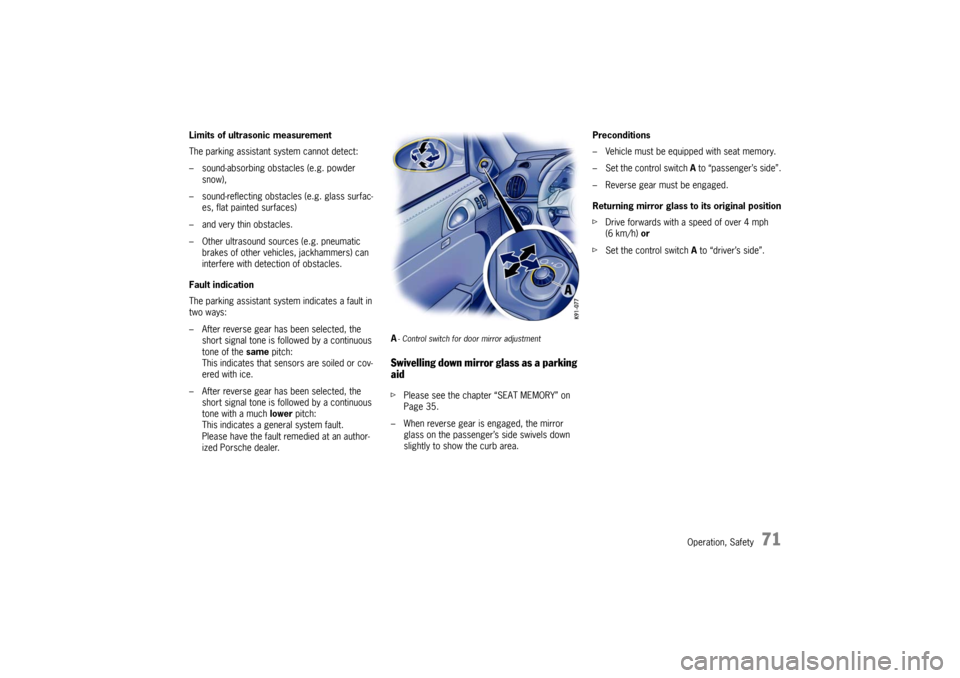
ized Porsche dealer. A
- Control switch for door mirror adjustment Swivelling down mirror glass as a parking
aidf
Please see the chapter “SEAT MEMORY” on
Page 35.
– When reverse gear is engaged, the mirror glass on the passenger’s side swivels down
slightly to show the curb area. Preconditions
– Vehicle must be equipped with seat memory.
– Set the control switch
A to “passenger’s side”.
– Reverse gear must be engaged.
Returning mirror glass to its original position
f Drive forwards with a speed of over 4 mph
(6 km/h) or
f Set the control switch A to “driver’s side”.
Page 77 of 284

Operation, Safety
75
Starting Procedures fPlease see the chapter “IMMOBILIZER” on
Page 15.
f Please see the chapter “EMISSION CONTROL
SYSTEM” on Page 198.
Warning!
Serious injury or death may result if you are
involved in a collision without having fas-
tened the safety belts.
f Fasten safety belts before driving away. Before starting the engine fApply the footbrake.
f Manual transmission:
Fully depress the clutch pedal and put the gear-
shift lever into neutral.
The clutch pedal must be depressed fully
before the starter will engage.
f In vehicles with PDK transmission:
Move PDK selector lever to position P or N.
Temperature sensors on the engine automatically
provide the correct fuel/air mixture required for
starting.
Therefore, it is not necessary to depress the
accelerator pedal while starting a cold or a
warm engine.
Starting the enginef Turn ignition key to ignition lock position 2.
f As soon as the engine st arts, release the igni-
tion key.
The first operation of the starter is ended automat-
ically when the engine starts.
If the engine does not start, subsequent starter
operations will not be ended automatically.
If the engine fails to start after 10 or 15 seconds
of cranking:
f Wait about 10 seconds before engaging the
starter again.
f When starting the engine, be ready to drive
immediately.
Drive vehicle at moderate speeds and avoid
engine speeds above 4,200 rpm during the
first 5 minutes.
f Do not let the engine idle to warm up.
Danger!
Engine exhaust fumes have many compo-
nents which you can smell. They also contain
carbon monoxide (CO), which is a colorless
and odorless gas.
Carbon monoxide can cause unconscious-
ness and even death if inhaled.
f Never start or let the engine run in an
enclosed, unventilated area.
It is not recommended to sit in your car for prolonged periods with the engine on and the
car not moving.
An unattended vehicle with a running engine
is potentially hazardous.
If warning lights shoul d come on to indicate
improper operation, they would go unno-
ticed.
f Never leave the engine idling unattended.
Danger of fire.
f Do not park or operate the vehicle in areas
where the hot exhaust system may come in
contact with dry grass, brush, fuel spill or oth-
er flammable material.
f If your car catches on fire for any reason, call
the fire department.
Do not endanger your life by attempting to put
out the fire.
Risk of burn injury when standing near or
coming into contact with the exhaust pipe.
The exhaust pipe is hot when the vehicle is running
and remains hot for some time after the vehicle is
turned off.
f To prevent injury, make a point of noting where
your vehicle’s exhaust pipe is, avoid placing
your legs near the exhaust pipe, and closely
supervise children around the vehicle when the
exhaust pipe could be hot.
A hot exhaust pipe can cause serious burns.
Page 78 of 284

76
Operation, Safety
Stopping Engine fTurn key back to position 3.
f Do not stop engine immediately after hard or
extended driving.
Keep engine running at increased idle for
about two minutes to prevent excessive heat
build-up before turning off engine.
f To avoid discharging the battery, always re-
move the ignition key from the ignition lock.
f When leaving the car, always remove the igni-
tion key, apply the parking brake and engage
1st gear or reverse gear on vehicles with man-
ual transmission or move the selector lever to
position P on vehicles with PDK transmission.
f Engage the steering lock by moving the steer-
ing wheel to the left or right.
Turn the steering wheel to the locking position
before you switch off the engine so that you
don’t have to exert your self when locking or
unlocking the steering.
Warning!
Danger of injury. Hot engine compartment
components can burn skin on contact.
f Before working on any part in the engine
compartment, turn the engine off and let it cool
down sufficiently. Risk of burn injury when standing near or
coming into contact with the exhaust pipe.
The exhaust pipe is hot wh
en the vehicle is running
and remains hot for some time after the vehicle is
turned off.
f To prevent injury, make a point of noting where
your vehicle’s exhaust pipe is, avoid placing
your legs near the exhaust pipe, and closely
supervise children around the vehicle when the
exhaust pipe could be hot.
A hot exhaust pipe can cause serious burns.
Engine-compartment blower,
radiator fan The radiator and radiator fans are in the front of
the car.
The engine-compartment bl ower is mounted in the
engine compartment.
Warning!
Risk of injury.
After the engine is switched off, the engine-
compartment temperature is monitored for
approx. 30 minutes.
During this period, and depending on tem-
perature, the engine-compartment blower
may continue to run or start to run.
f Carry out work in these areas only with the en-
gine off, the ignition off, and exercise extreme
caution. Risk of injury. The radiator fans in the front
end of the car may be operating or
unexpectedly start operating when the
engine is switched on.
f
Carry out work in these areas only with the en-
gine switched off.
Automatic garage door The ignition system in your Porsche may interfere
with your electronically operated garage door.
fTo check this, drive your Porsche close to the
garage door. Make sure not to interfere with
the operating range of the door.
f Run the engine at different speeds.
f If the garage door opens or closes without you
operating the garage door unit in your car,
contact the dealer who installed the automatic
garage door to have the frequency and/or
coding of the garage door signal changed or
modified.
Page 80 of 284

78
Operation, SafetyWarning chime
If the ignition key is withdrawn and the door is
opened while the lights (not the Welcome Home
lighting) are on, a
chime warns of possible bat-
tery discharge.
In some countries, differences are possible
due to provisions of law.
Daytime driving lightsThe daytime driving lights are integrated in the
front auxiliary headlights. These lights are
switched on only when the engine is running and
with the light switch in the positions OFF or HOME.
Low beam headlights must be switched on when
driving through tunnels or at dusk, for example.
Operation of the daytime driving lights may vary
depending on country-specific regulations.
Canada only:
In addition to the auxiliary headlights the parking
lights are switched on.
USA only:
The daytime driving lights can be deactivated in
the on-board computer.
f Please see the chapter “ON-BOARD
COMPUTER (BC)” on Page 134.
Vehicles with the Sport Chrono Package Plus
Further individual light functions are available in ve-
hicles with the Sport Chrono Package Plus.
f Please observe the chapter “Individual Memo-
ry” in the separate PCM operating instructions.Cornering lightThe dynamic cornering light is activated above
speeds of 6 mph (10 km/h).
Light Switch on Vehicles with
Bi-Xenon HeadlightsLights switched off
Daytime driving lights are switched on
when the engine is running.
Welcome Home Function
Daytime driving lights are switched on
when the engine is running.
Parking lights , side marker lights,
license plate light, instrument illumina-
tion, daytime driving lights switched off
Canada: daytime driving lights switched
on
Low beam, high beam
Only with ignition on,
daytime driving lights switched off
Rear fog light
Pull switch to second click.
Indicator light on.
Page 85 of 284
Operation, Safety
83
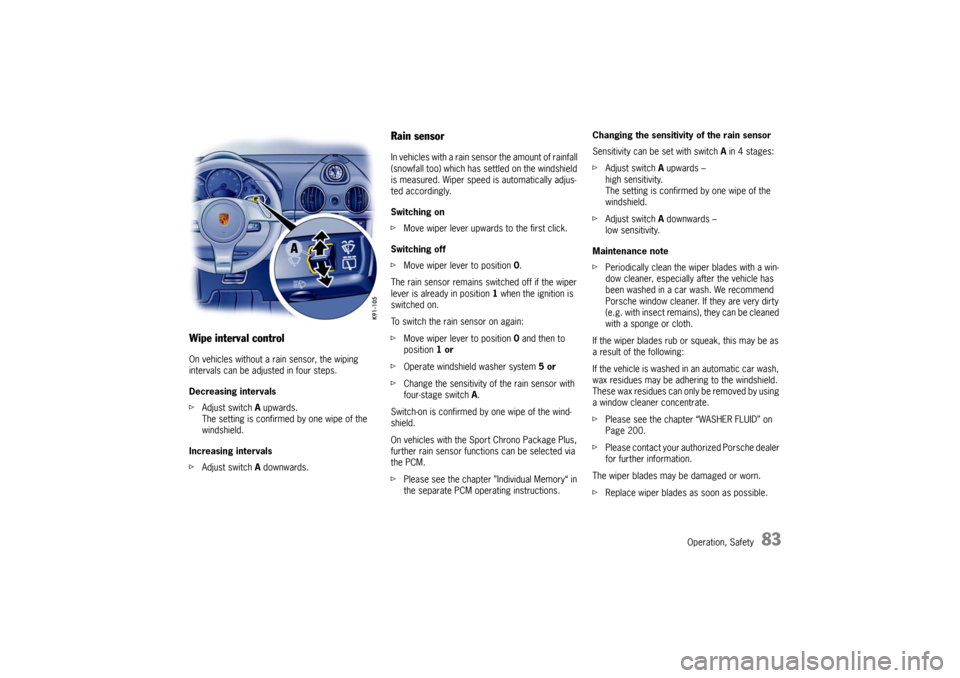
Wipe interval controlOn vehicles without a rain sensor, the wiping
intervals can be adjusted in four steps.
Decreasing intervals
fAdjust switch A upwards.
The setting is confirmed by one wipe of the
windshield.
Increasing intervals
f Adjust switch A downwards.
Rain sensorIn vehicles with a rain sensor the amount of rainfall
(snowfall too) which has se ttled on the windshield
is measured. Wiper speed is automatically adjus-
ted accordingly.
Switching on
f Move wiper lever upwards to the first click.
Switching off
f Move wiper lever to position 0.
The rain sensor remains switched off if the wiper
lever is already in position 1 when the ignition is
switched on.
To switch the rain sensor on again:
f Move wiper lever to position 0 and then to
position 1 or
f Operate windshield washer system 5 or
f Change the sensitivity of the rain sensor with
four-stage switch A.
Switch-on is confirmed by one wipe of the wind-
shield.
On vehicles with the Sport Chrono Package Plus,
further rain sensor functi ons can be selected via
the PCM.
f Please see the chapter ”Individual Memory“ in
the separate PCM operating instructions. Changing the sensitivity of the rain sensor
Sensitivity can be set with switch
A in 4 stages:
f Adjust switch A upwards –
high sensitivity.
The setting is confirmed by one wipe of the
windshield.
f Adjust switch A downwards –
low sensitivity.
Maintenance note
f Periodically clean the wiper blades with a win-
dow cleaner, especially after the vehicle has
been washed in a car wash. We recommend
Porsche window cleaner. If they are very dirty
(e.g. with insect remains), they can be cleaned
with a sponge or cloth.
If the wiper blades rub or squeak, this may be as
a result of the following:
If the vehicle is washed in an automatic car wash,
wax residues may be adhering to the windshield.
These wax residues can only be removed by using
a window cleaner concentrate.
f Please see the chapter “WASHER FLUID” on
Page 200.
f Please contact your auth orized Porsche dealer
for further information.
The wiper blades may be damaged or worn.
f Replace wiper blades as soon as possible.
Page 86 of 284
84
Operation, Safety
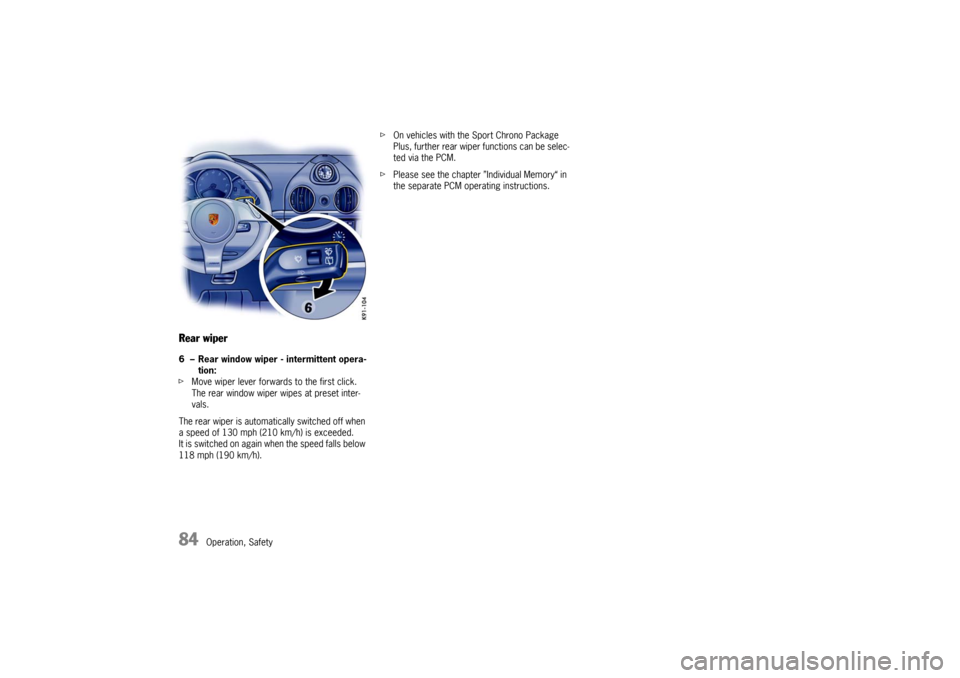
Rear wiper6 – Rear window wiper - intermittent opera-tion:
f Move wiper lever forwards to the first click.
The rear window wiper wipes at preset inter-
vals.
The rear wiper is automatically switched off when
a speed of 130 mph (210 km/h) is exceeded.
It is switched on again when the speed falls below
118 mph (190 km/h). f
On vehicles with the Sport Chrono Package
Plus, further rear wiper functions can be selec-
ted via the PCM.
f Please see the chapter ”Individual Memory“ in
the separate PCM operating instructions.