lock Ram 1500 2020 Manual Online
[x] Cancel search | Manufacturer: RAM, Model Year: 2020, Model line: 1500, Model: Ram 1500 2020Pages: 674, PDF Size: 32.69 MB
Page 265 of 674
SAFETY 263
(Continued)
Your vehicle may also be designed to perform any of these
other functions in response to the Enhanced Accident
Response System:
• Turn off the Fuel Filter Heater, Turn off the HVAC BlowerMotor, Close the HVAC Circulation Door
• Cut off battery power to the: • Engine
• Electric Motor (if equipped)
• Electric power steering
• Brake booster
• Electric park brake
• Automatic transmission gear selector
• Horn
• Front wiper
• Headlamp washer pump
NOTE:
After an accident, remember to cycle the ignition to the STOP
(OFF/LOCK) position and remove the key from the ignition
switch to avoid draining the battery. Carefully check the
vehicle for fuel leaks in the engine compartment and on the
ground near the engine compartment and fuel tank before
resetting the system and starting the engine. If there are no
fuel leaks or damage to the vehicle electrical devices (e.g. headlights) after an accident, reset the system by following
the procedure described below. If you have any doubt,
contact an authorized dealer.
Enhanced Accident Response System Reset Procedure
In order to reset the Enhanced Accident Response System
functions after an event, the ignition switch must be changed
from ignition START or ON/RUN to ignition OFF. Carefully
check the vehicle for fuel leaks in the engine compartment
and on the ground near the engine compartment and fuel
tank before resetting the system and starting the engine.
Maintaining Your Air Bag System
WARNING!
• Modifications to any part of the air bag system could cause it to fail when you need it. You could be injured
if the air bag system is not there to protect you. Do not
modify the components or wiring, including adding
any kind of badges or stickers to the steering wheel hub
trim cover or the upper passenger side of the instru -
ment panel. Do not modify the front bumper, vehicle
body structure, or add aftermarket side steps or
running boards.
4
2020_DT_1500_OM_US.book Page 263
Page 277 of 674
SAFETY 275
Center Tether Anchorage Over Head Rest
LATCH-compatible child restraint systems will be equipped
with a rigid bar or a flexible strap on each side. Each will
have a hook or connector to attach to the lower anchorage
and a way to tighten the connection to the anchorage.
Forward-facing child restraints and some rear-facing child
restraints will also be equipped with a tether strap. The
tether strap will have a hook at the end to attach to the top
tether anchorage and a way to tighten the strap after it is
attached to the anchorage. Center Seat LATCH
All Quad Cabs Or Crew Cab Full Bench Rear Seat: No
Lower Center LATCH Anchorages Available
Crew Cab Split Bench Rear Seat: Center LATCH Anchor
-
ages Available
If a child restraint installed in the center position blocks the
seat belt webbing or buckle for the outboard position, do not
use that outboard position. If a child seat in the center posi -
tion blocks the outboard LATCH anchors or seat belt, do not
install a child seat in that outboard position.
WARNING!
• Do not install a child restraint in the center position using the LATCH system. This position is not approved
for installing child seats using the LATCH attachments.
You must use the seat belt and tether anchor to install a
child seat in the center seating position.
• Never use the same lower anchorage to attach more than one child restraint. Please refer to “To Install A
LATCH-Compatible Child Restraint” for typical instal -
lation instructions.
4
2020_DT_1500_OM_US.book Page 275
Page 278 of 674

276 SAFETY
Always follow the directions of the child restraint manu-
facturer when installing your child restraint. Not all child
restraint systems will be installed as described here.
To Install A LATCH-Compatible Child Restraint
If the selected seating position has a Switchable Automatic
Locking Retractor (ALR) seat belt, stow the seat belt,
following the instructions below. See the section “Installing
Child Restraints Using the Vehicle Seat Belt” to check what
type of seat belt each seating position has.
1. Loosen the adjusters on the lower straps and on the tether strap of the child seat so that you can more easily attach
the hooks or connectors to the vehicle anchorages.
2. Place the child seat between the lower anchorages for that seating position. For some second row seats, you may
need to recline the seat and / or raise the head restraint (if
adjustable) to get a better fit. If the rear seat can be moved
forward and rearward in the vehicle, you may wish to move it to its rear-most position to make room for the
child seat. You may also move the front seat forward to
allow more room for the child seat.
3. Attach the lower hooks or connectors of the child restraint to the lower anchorages in the selected seating position.
4. If the child restraint has a tether strap, connect it to the top tether anchorage. See the section “Installing Child
Restraints Using the Top Tether Anchorage” for direc -
tions to attach a tether anchor.
5. Tighten all of the straps as you push the child restraint rearward and downward into the seat. Remove slack in
the straps according to the child restraint manufacturer’s
instructions.
6. Test that the child restraint is installed tightly by pulling back and forth on the child seat at the belt path. It should
not move more than 1 inch (25.4 mm) in any direction.
How To Stow An Unused Switchable-ALR (ALR) Seat
Belt:
When using the LATCH attaching system to install a child
restraint, stow all ALR seat belts that are not being used by
other occupants or being used to secure child restraints. An
unused belt could injure a child if they play with it and acci -
WARNING!
Never use the same lower anchorage to attach more than
one child restraint. Please refer to “To Install A
LATCH-Compatible Child Restraint” for typical
installation instructions.
2020_DT_1500_OM_US.book Page 276
Page 279 of 674

SAFETY 277
dentally lock the seat belt retractor. Before installing a child
restraint using the LATCH system, buckle the seat belt
behind the child restraint and out of the child’s reach. If the
buckled seat belt interferes with the child restraint installa-
tion, instead of buckling it behind the child restraint, route
the seat belt through the child restraint belt path and then
buckle it. Do not lock the seat belt. Remind all children in the
vehicle that the seat belts are not toys and that they should
not play with them. Installing Child Restraints Using The Vehicle Seat Belt
Child restraint systems are designed to be secured in vehicle
seats by lap belts or the lap belt portion of a lap/shoulder
belt.
The seat belts in the passenger seating positions are
equipped with a Switchable Automatic Locking Retractor
(ALR) that is designed to keep the lap portion of the seat belt
tight around the child restraint so that it is not necessary to
use a locking clip. The ALR retractor can be “switched” into
a locked mode by pulling all of the webbing out of the
retractor and then letting the webbing retract back into the
retractor. If it is locked, the ALR will make a clicking noise
while the webbing is pulled back into the retractor.
WARNING!
• Improper installation of a child restraint to the LATCH anchorages can lead to failure of the restraint. The child
could be badly injured or killed. Follow the child
restraint manufacturer’s directions exactly when
installing an infant or child restraint.
• Child restraint anchorages are designed to withstand only those loads imposed by correctly-fitted child
restraints. Under no circumstances are they to be used
for adult seat belts, harnesses, or for attaching other
items or equipment to the vehicle.
WARNING!
• Improper installation or failure to properly secure a child restraint can lead to failure of the restraint. The
child could be badly injured or killed.
• Follow the child restraint manufacturer’s directions exactly when installing an infant or child restraint.
4
2020_DT_1500_OM_US.book Page 277
Page 280 of 674
278 SAFETY
Refer to the “Automatic Locking Mode” description in
“Switchable Automatic Locking Retractors (ALR)” under
“Occupant Restraint Systems” for additional information on
ALR.
Please see the table below and the following sections for
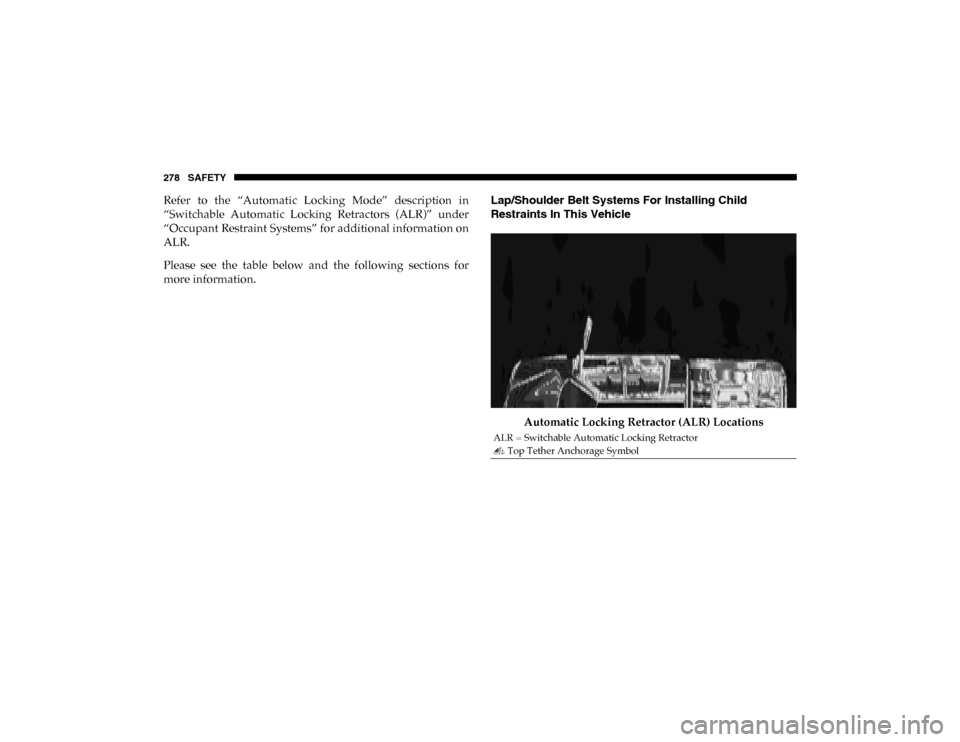
more information.Lap/Shoulder Belt Systems For Installing Child
Restraints In This Vehicle
Automatic Locking Retractor (ALR) Locations
ALR = Switchable Automatic Locking Retractor Top Tether Anchorage Symbol
2020_DT_1500_OM_US.book Page 278
Page 282 of 674

280 SAFETY
Installing A Child Restraint With A Switchable Automatic
Locking Retractor (ALR):
Child restraint systems are designed to be secured in vehicle
seats by lap belts or the lap belt portion of a lap/shoulder
belt.
1. Place the child seat in the center of the seating position.For some second row seats, you may need to recline the
seat and/or raise the head restraint (if adjustable) to get a
better fit. If the rear seat can be moved forward and rear -
ward in the vehicle, you may wish to move it to its
rear-most position to make room for the child seat. You
may also move the front seat forward to allow more room
for the child seat.
2. Pull enough of the seat belt webbing from the retractor to pass it through the belt path of the child restraint. Do not
twist the belt webbing in the belt path. 3. Slide the latch plate into the buckle until you hear a
“click.”
4. Pull on the webbing to make the lap portion tight against the child seat.
5. To lock the seat belt, pull down on the shoulder part of the belt until you have pulled all the seat belt webbing out
of the retractor. Then, allow the webbing to retract back
into the retractor. As the webbing retracts, you will hear
a clicking sound. This means the seat belt is now in the
Automatic Locking mode.
6. Try to pull the webbing out of the retractor. If it is locked, you should not be able to pull out any webbing. If the
retractor is not
locked, repeat step 5.
7. Finally, pull up on any excess webbing to tighten the lap portion around the child restraint while you push the
child restraint rearward and downward into the vehicle
seat.
8. If the child restraint has a top tether strap and the seating position has a top tether anchorage, connect the tether
strap to the anchorage and tighten the tether strap. Refer
to “Installing Child Restraints Using the Top Tether
Anchorage” in this section for directions to attach a tether
anchor.
WARNING!
• Improper installation or failure to properly secure a child restraint can lead to failure of the restraint. The
child could be badly injured or killed.
• Follow the child restraint manufacturer’s directions exactly when installing an infant or child restraint.
2020_DT_1500_OM_US.book Page 280
Page 291 of 674

Periodic Safety Checks You Should Make Outside
The Vehicle
Tires
Examine tires for excessive tread wear and uneven wear
patterns. Check for stones, nails, glass, or other objects
lodged in the tread or sidewall. Inspect the tread for cuts and
cracks. Inspect sidewalls for cuts, cracks, and bulges. Check
the wheel bolts for tightness. Check the tires (including
spare) for proper cold inflation pressure.
Lights
Have someone observe the operation of brake lights and
exterior lights while you work the controls. Check turn
signal and high beam indicator lights on the instrument
panel.Door Latches
Check for proper closing, latching, and locking.
Fluid Leaks
Check area under the vehicle after overnight parking for
fuel, coolant, oil, or other fluid leaks. Also, if gasoline fumes
are detected or if fuel, or brake fluid leaks are suspected, the
cause should be located and corrected immediately.
4
2020_DT_1500_OM_US.book Page 289
SAFETY 289
Page 292 of 674
290
(Continued)
STARTING AND OPERATING
STARTING THE ENGINE
Before starting your vehicle, adjust your seat, adjust both
inside and outside mirrors, and fasten your seat belt.
The starter should not be operated for more than 10-second
intervals. Waiting a few seconds between such intervals will
protect the starter from overheating.
WARNING!
• When leaving the vehicle, always make sure the keyless ignition node is in the "OFF" mode, remove the
key fob from the vehicle and lock the vehicle.
• Never leave children alone in a vehicle, or with access to an unlocked vehicle. Allowing children to be in a
vehicle unattended is dangerous for a number of
reasons. A child or others could be seriously or fatally
injured. Children should be warned not to touch the
parking brake, brake pedal or the gear selector.
• Do not leave the key fob in or near the vehicle, or in alocation accessible to children, and do not leave the
ignition of a vehicle equipped with Keyless
Enter-N-Go in the ACC or ON/RUN mode. A child
could operate power windows, other controls, or move
the vehicle.
• Do not leave children or animals inside parked vehicles in hot weather. Interior heat build-up may cause
serious injury or death.
WARNING! (Continued)
2020_DT_1500_OM_US.book Page 290
Page 293 of 674

STARTING AND OPERATING 291
Automatic Transmission
Start the engine with the transmission in PARK position.
Apply the brake before shifting into any driving range.
NOTE:
• This vehicle is equipped with a transmission shift inter-
locking system. The brake pedal must be pressed to shift
out of PARK.
• If equipped with an 8-speed transmission, starting the vehicle in NEUTRAL is not possible unless the Manual
Park Release has been activated. For the Manual Park
Release operation refer to Manual Park Release in “In Case
Of Emergency”.
Tip Start Feature
Do not press the accelerator. Cycle the ignition switch briefly
to the START position and release it. The starter motor will
continue to run and will automatically disengage when the
engine is running.
Keyless Enter-N-Go — Ignition
Keyless Push Button Ignition
This feature allows the driver to operate the ignition switch
with the push of a button, as long as the Remote Start/
Keyless Enter-N-Go key fob is in the passenger compart -
ment.
5
2020_DT_1500_OM_US.book Page 291
Page 298 of 674
296 STARTING AND OPERATING
If the engine has been flooded, it may start to run, but not
have enough power to continue running when the ignition
button/key is released. If this occurs, continue cranking with
the accelerator pedal pushed all the way to the floor. Release
the accelerator pedal and the ignition button/key once the
engine is running smoothly.
If the engine shows no sign of starting after a 10 second
period of engine cranking with the accelerator pedal held to
the floor, wait 10 to 15 seconds, then repeat the “Normal
Starting” procedure.
Cold Weather Operation (Below –22°F Or −30°C)
To ensure reliable starting at these temperatures, use of an
externally powered electric engine block heater (available
from your authorized dealer) is recommended.
After Starting
The idle speed is controlled automatically, and it will
decrease as the engine warms up.
ENGINE BLOCK HEATER — IF EQUIPPED
The engine block heater warms the engine, and permits
quicker starts in cold weather. Connect the cord to a stan-
dard 110-115 Volt AC electrical outlet with a grounded,
three-wire extension cord.
The engine block heater cord is routed under the hood on the
passenger side of the vehicle near the right head lamp
assembly. It is located between the front grill and the radi -
ator, but underneath the black upper seal.
• If the vehicle has a discharged battery, booster cables
may be used to obtain a start from a booster battery or
the battery in another vehicle. This type of start can be
dangerous if done improperly. Refer to “Jump Starting
Procedure” in “In Case Of Emergency” for further
information.
CAUTION!
To prevent damage to the starter, do not crank the engine
for more than 10 seconds at a time. Wait 10 to 15 seconds
before trying again.
WARNING! (Continued)
WARNING!
Remember to disconnect the engine block heater cord
before driving. Damage to the 110-115 Volt electrical
cord could cause electrocution.
2020_DT_1500_OM_US.book Page 296