recommended oil RAM 1500 2021 User Guide
[x] Cancel search | Manufacturer: RAM, Model Year: 2021, Model line: 1500, Model: RAM 1500 2021Pages: 496, PDF Size: 20.89 MB
Page 428 of 496
426SERVICING AND MAINTENANCE
AUTOMATIC TRANSMISSION
Special Additives
FCA strongly recommends against using any
special additives in the transmission. Automatic
Transmission Fluid (ATF) is an engineered
product and its performance may be impaired
by supplemental additives. Therefore, do not
add any fluid additives to the transmission.
Avoid using transmission sealers as they may
adversely affect seals.
Fluid Level Check
The fluid level is preset at the factory and does
not require adjustment under normal operating
conditions. Routine fluid level checks are not
required, therefore the transmission has no
dipstick. An authorized dealer can check your
transmission fluid level using special service
tools. If you notice fluid leakage or transmission
malfunction, visit an authorized dealer
immediately to have the transmission fluid level
checked. Operating the vehicle with an
improper fluid level can cause severe
transmission damage.
Fluid And Filter Changes
Under normal operating conditions, the fluid
installed at the factory will provide satisfactory
lubrication for the life of the vehicle.
Routine fluid and filter changes are not
required. However, change the fluid and filter if
the fluid becomes contaminated (with water,
etc.), or if the transmission is disassembled for
any reason.
Selection Of Lubricant
It is important to use the proper transmission
fluid to ensure optimum transmission performance and life. Use only the
recommended transmission fluid
Úpage 478.
It is important to maintain the transmission fluid
at the correct level using the recommended
fluid. No chemical flushes should be used in any
transmission; only the approved lubricant
should be used.
REAR AXLE AND 4X4 FRONT DRIVING
A
XLE FLUID LEVEL
For normal service, periodic fluid level checks
are not required. When the vehicle is serviced
for other reasons the exterior surfaces of the
axle assembly should be inspected. If gear oil
leakage is suspected inspect the fluid level
Ú page 478. This inspection should be made
with the vehicle in a level position.
The fluid level should be even with the bottom
of the fill hole (within 1/4 in (6.4 mm) of edge of
hole) for the front axle and rear axle.
CAUTION!
Do not use chemical flushes in your
transmission as the chemicals can damage
your transmission components. Such damage
is not covered by the New Vehicle Limited
Warranty.
CAUTION!
If a transmission fluid leak occurs, visit an
authorized dealer immediately. Severe
transmission damage may occur. An
authorized dealer has the proper tools to
adjust the fluid level accurately.CAUTION!
Using a transmission fluid other than the
manufacturer’s recommended fluid may
cause deterioration in transmission shift
quality and/or torque converter shudder
Ú page 478.
21_DT_OM_EN_USC_t.book Page 426
Page 455 of 496

SERVICING AND MAINTENANCE453
(Continued)
NOTE:
Wheel Valve Stem must be replaced as well
when installing new tires due to wear and tear
in existing tires.
Keep dismounted tires in a cool, dry place with
as little exposure to light as possible. Protect
tires from contact with oil, grease, and gasoline.
Replacement Tires
The tires on your new vehicle provide a balance
of many characteristics. They should be
inspected regularly for wear and correct cold
tire inflation pressures. FCA strongly
recommends that you use tires equivalent to
the originals in size, quality and performance
when replacement is needed Ú page 452. Refer to the Tire and Loading Information
placard or the Vehicle Certification Label for the
size designation of your tire. The Load Index and
Speed Symbol for your tire will be found on the
original equipment tire sidewall.
For more information relating to the Load Index
and Speed Symbol of a tire Ú
page 444.
It is recommended to replace the two front tires
or two rear tires as a pair. Replacing just one tire
can seriously affect your vehicle’s handling. If
you ever replace a wheel, make sure that the
wheel’s specifications match those of the
original wheels.
It is recommended you contact an authorized
tire dealer or original equipment dealer with any
questions you may have on tire specifications or
capability. Failure to use equivalent
replacement tires may adversely affect the
safety, handling, and ride of your vehicle.
WARNING!
Tires and the spare tire should be replaced after
six years, regardless of the remaining tread.
Failure to follow this warning can result in sud -
den tire failure. You could lose control and have
a collision resulting in serious injury or death.
WARNING!
Do not use a tire, wheel size, load rating, or
speed rating other than that specified for
your vehicle. Some combinations of unap -
proved tires and wheels may change
suspension dimensions and performance
characteristics, resulting in changes to
steering, handling, and braking of your
vehicle. This can cause unpredictable
handling and stress to steering and
suspension components. You could lose
control and have a collision resulting in
serious injury or death. Use only the tire and
wheel sizes with load ratings approved for
your vehicle.
Never use a tire with a smaller load index or
capacity, other than what was originally
equipped on your vehicle. Using a tire with
a smaller load index could result in tire
overloading and failure. You could lose
control and have a collision.
8
21_DT_OM_EN_USC_t.book Page 453
Page 467 of 496
SERVICING AND MAINTENANCE465
Seat Belt Maintenance
Do not bleach, dye or clean the belts with
chemical solvents or abrasive cleaners. This will
weaken the fabric.
If the belts need cleaning, use a mild soap
solution or lukewarm water. Do not remove the
belts from the vehicle to wash them. Dry with a
soft cloth.
Sun damage can also weaken the fabric.
Replace the belts if they appear frayed or worn
or if the buckles do not work properly.
NOTE:
If the belts retract slowly, inspect the upper
turning loop for soiling. If soiling is present,
clean with a wet soft cloth until all residue is
removed.
PLASTIC AND COATED PARTS
Use Mopar Total Clean to clean vinyl upholstery.
Cleaning Plastic Instrument Cluster
Lenses
The lenses in front of the instruments in this
vehicle are molded in clear plastic. When
cleaning the lenses, care must be taken to
avoid scratching the plastic.
Clean with a wet soft cloth. A mild soap solution
may be used, but do not use high alcohol
content or abrasive cleaners. If soap is used,
wipe clean with a clean damp cloth. Dry with a
soft cloth.
LEATHER SURFACES
Mopar Total Clean is specifically recommended
for leather upholstery.
Your leather upholstery can be best preserved
by regular cleaning with a damp soft cloth.
Small particles of dirt can act as an abrasive
and damage the leather upholstery and should
be removed promptly with a damp cloth.
Stubborn soils can be removed easily with a soft
cloth and Mopar Total Clean. Care should be
taken to avoid soaking your leather upholstery
with any liquid. Please do not use polishes, oils,
cleaning fluids, solvents, detergents, or
ammonia-based cleaners to clean your leather
upholstery.
WARNING!
A frayed or torn belt could rip apart in a
collision and leave you with no protection.
Inspect the belt system periodically, checking
for cuts, frays, or loose parts. Damaged parts
must be replaced immediately. Do not
disassemble or modify the system. Seat belt
assemblies must be replaced after a collision
if they have been damaged (i.e., bent
retractor, torn webbing, etc.).
CAUTION!
Direct contact of air fresheners, insect
repellents, suntan lotions, or hand sani -
tizers to the plastic, painted, or decorated
surfaces of the interior may cause perma -
nent damage. Wipe away immediately.
Damage caused by these type of products
may not be covered by your New Vehicle
Limited Warranty.
8
21_DT_OM_EN_USC_t.book Page 465
Page 469 of 496

467
TECHNICAL SPECIFICATIONS
VEHICLE IDENTIFICATION NUMBER
The Vehicle Identification Number (VIN) is found
on the left front corner of the instrument panel,
visible through the windshield.
Vehicle Identification Number
NOTE:
It is illegal to remove or alter the VIN.
BRAKE SYSTEM
If power assist is lost for any reason (for
example, repeated brake applications with the
engine off), the brakes will still function.
However, you will experience a substantial
increase in braking effort to stop the vehicle.
If either the front or rear hydraulic system loses
normal braking capability, the remaining
system will still function with some loss of
overall braking effectiveness. This will be
evident by increased pedal travel during
application, greater pedal force required to slow
or stop, and the “Brake Warning Light” and the
“ABS Warning Light” will activate during brake
use.
WHEEL AND TIRE TORQUE SPECIFICATIONS
Proper lug nut/bolt torque is very important to
ensure that the wheel is properly mounted to
the vehicle. Any time a wheel has been removed
and reinstalled on the vehicle, the lug nuts/
bolts should be torqued using a properly
calibrated torque wrench using a six sided (hex)
deep wall socket.
TORQUE SPECIFICATIONS
**Use only authorized dealer recommended lug nuts/
bolts and clean or remove any dirt or oil before tightening.
Lug Nut/ Bolt
Torque Lug Nut/
Bolt Type **Lug
Nut/Bolt Size Lug Nut/
Bolt
Socket Size
130
Ft-Lbs
(176 N·m) Cone
M14 x
1.50 22 mm
9
21_DT_OM_EN_USC_t.book Page 467
Page 470 of 496

468TECHNICAL SPECIFICATIONS
NOTE:
Do not oil wheel studs. For chrome wheels, do
not substitute with chrome plated wheel nuts.
Inspect the wheel mounting surface prior to
mounting the tire and remove any corrosion or
loose particles.
Wheel Mounting Surface
Tighten the lug nuts/bolts in a star pattern until
each nut/bolt has been tightened twice. Ensure
that the socket is fully engaged on the lug nut/
bolt (do not insert it halfway).
After 25 miles (40 km), check the lug nut/bolt torque to be sure that all the lug nuts/bolts are
properly seated against the wheel.
Four, Five, And Six Lug Nuts/Bolts Torque Pattern
FUEL REQUIREMENTS — GASOLINE ENGINE
While operating on gasoline with the required
octane number, hearing a light knocking sound
from the engine is not a cause for concern.
However, if the engine is heard making a heavy
knocking sound, see a dealer immediately. Use
of gasoline with a lower than recommended octane number can cause engine failure and
may void or not be covered by the New Vehicle
Limited Warranty.
Poor quality gasoline can cause problems such
as hard starting, stalling, and hesitations. If you
experience these symptoms, try another brand
of gasoline before considering service for the
vehicle.
3.6L ENGINE
Do not use E-85 flex fuel or ethanol blends
greater than 15% in this engine.
This engine is designed to meet all
emissions regulations and provide
optimum fuel economy and
performance when using high quality
unleaded “Regular” gasoline having a posted
octane number of 87 as specified by the (R+M)/
2 method. The use of higher octane “Premium”
gasoline is not required, as it will not provide
any benefit over “Regular” gasoline in these
engines.WARNING!
To avoid the risk of forcing the vehicle off the
jack, do not tighten the lug nuts/bolts fully
until the vehicle has been lowered. Failure to
follow this warning may result in personal
injury.
21_DT_OM_EN_USC_t.book Page 468
Page 474 of 496

472TECHNICAL SPECIFICATIONS
BIODIESEL FUEL REQUIREMENTS
A maximum blend of 5% biodiesel meeting
ASTM specification D975 is recommended for
use with your diesel engine. If frequent
operation with Biodiesel blends that are
between 6% and 20% (B6–B20) is desired, the
maintenance schedule is subject to shorter
intervals.
The oil and filter change along with fuel filter
replacement is subject to shorter intervals
when operating your engine on biodiesel
greater than 5%. Do not use biodiesel greater
than 20%.
For regular use of biodiesel blends between 6%
and 20% (B6–B20) it is important that you
understand and comply with these
requirements. For further direction
Úpage 403. Biodiesel is a fuel produced from renewable
resources typically derived from animal fat,
rapeseed oil (Rapeseed Methyl Ester (RME)
base), or soybean oil (Soy Methyl Ester (SME or
SOME) base).
Biodiesel fuel has inherent limitations which
require that you understand and adhere to the
following requirements if you use blends of
Biodiesel between 6% and 20% (B6–B20).
There are no unique restrictions for the use of
B5.
Biodiesel Fuel Properties — Low Ambient
Temperatures
Biodiesel fuel may gel or solidify at low ambient
temperatures, which may pose problems for
both storage and operation. Precautions can be
necessary at low ambient temperatures, such
as storing the fuel in a heated building or a
heated storage tank, or using cold temperature
additives.
CAUTION!
Failure to comply with Oil Change
requirements for vehicles operating on
biodiesel blends between 6% and 20%
(B6–B20) will result in premature engine
wear. Such wear is not covered by the New
Vehicle Limited Warranty.
CAUTION!
Use of blends greater than 20% is not
approved. Use of blends greater than 20%
can result in engine damage. Such damage is
not covered by the New Vehicle Limited
Warranty.
CAUTION!
In the event that the vehicle is filled with
biodiesel and not used for more than a
month, the fuel should either be used up by
driving (up to quarter tank) and filled with
standard diesel blends with less than 5% that
is normally available. This will help prevent
the fuel filter clogging and potential damage
to the fuel injection system due to degraded
biodiesel, which is not covered by the New
Vehicle Limited Warranty.
21_DT_OM_EN_USC_t.book Page 472
Page 477 of 496
TECHNICAL SPECIFICATIONS475
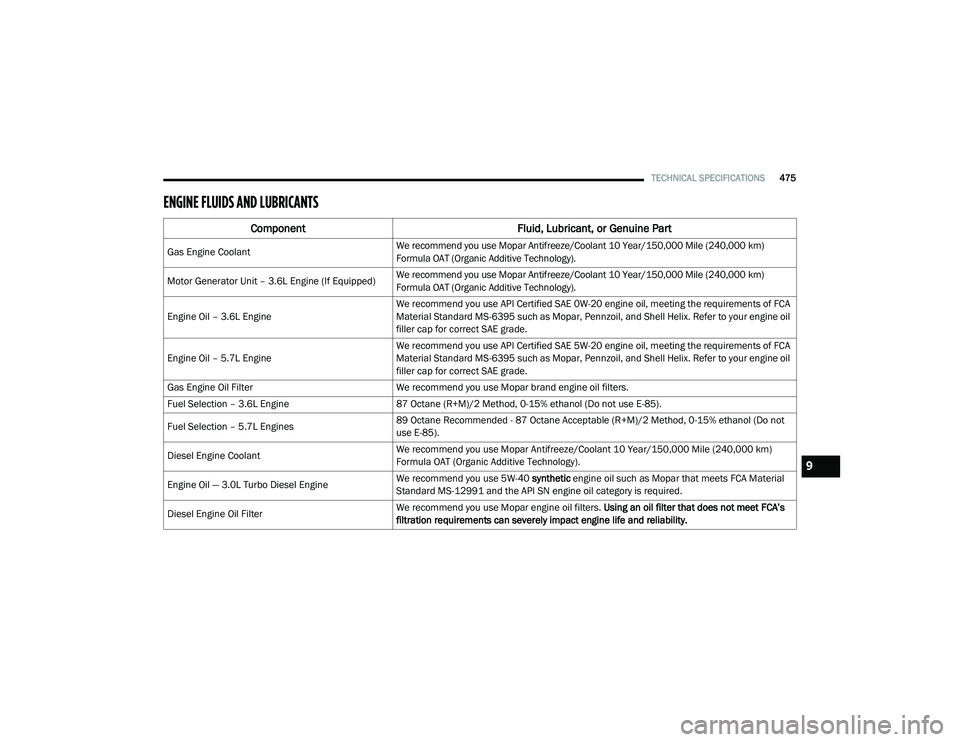
ENGINE FLUIDS AND LUBRICANTS
Component Fluid, Lubricant, or Genuine Part
Gas Engine CoolantWe recommend you use Mopar Antifreeze/Coolant 10 Year/150,000 Mile (240,000 km)
Formula OAT (Organic Additive Technology).
Motor Generator Unit – 3.6L Engine (If Equipped) We recommend you use Mopar Antifreeze/Coolant 10 Year/150,000 Mile (240,000 km)
Formula OAT (Organic Additive Technology).
Engine Oil – 3.6L Engine We recommend you use API Certified SAE 0W-20 engine oil, meeting the requirements of FCA
Material Standard MS-6395 such as Mopar, Pennzoil, and Shell Helix. Refer to your engine oil
filler cap for correct SAE grade.
Engine Oil – 5.7L Engine We recommend you use API Certified SAE 5W-20 engine oil, meeting the requirements of FCA
Material Standard MS-6395 such as Mopar, Pennzoil, and Shell Helix. Refer to your engine oil
filler cap for correct SAE grade.
Gas Engine Oil Filter We recommend you use Mopar brand engine oil filters.
Fuel Selection – 3.6L Engine 87 Octane (R+M)/2 Method, 0-15% ethanol (Do not use E-85).
Fuel Selection – 5.7L Engines 89 Octane Recommended - 87 Octane Acceptable (R+M)/2 Method, 0-15% ethanol (Do not
use E-85).
Diesel Engine Coolant We recommend you use Mopar Antifreeze/Coolant 10 Year/150,000 Mile (240,000 km)
Formula OAT (Organic Additive Technology).
Engine Oil — 3.0L Turbo Diesel Engine We recommend you use 5W-40
synthetic engine oil such as Mopar that meets FCA Material
Standard MS-12991 and the API SN engine oil category is required.
Diesel Engine Oil Filter We recommend you use Mopar engine oil filters.
Using an oil filter that does not meet FCA’s
filtration requirements can severely impact engine life and reliability.
9
21_DT_OM_EN_USC_t.book Page 475
Page 478 of 496
476TECHNICAL SPECIFICATIONS
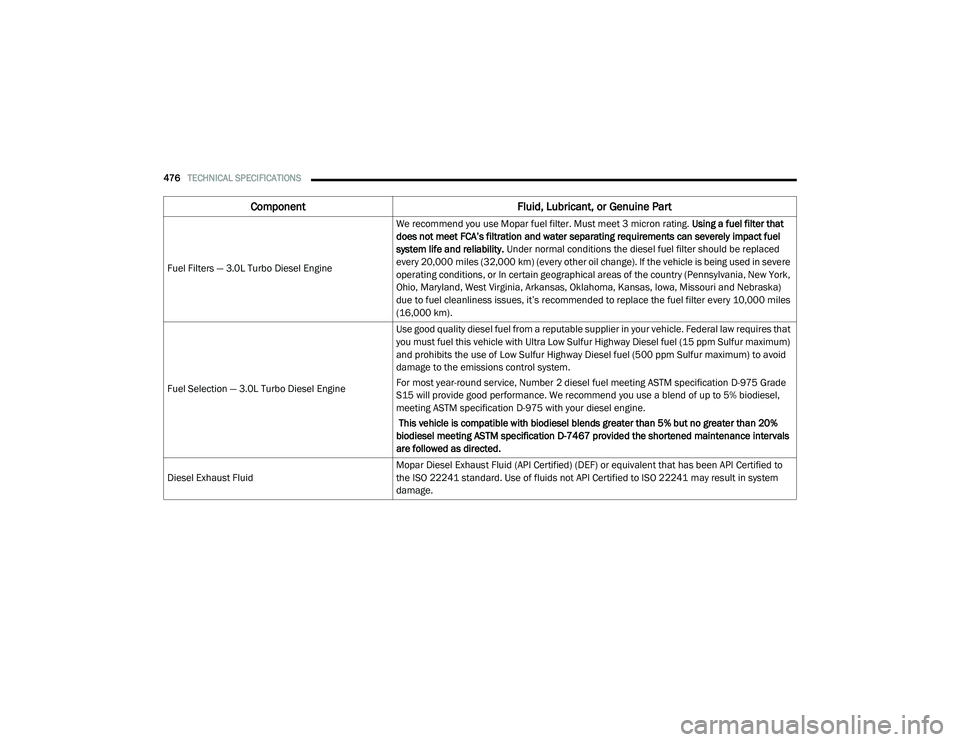
Fuel Filters — 3.0L Turbo Diesel Engine We recommend you use Mopar fuel filter. Must meet 3 micron rating. Using a fuel filter that
does not meet FCA’s filtration and water separating requirements can severely impact fuel
system life and reliability.
Under normal conditions the diesel fuel filter should be replaced
every 20,000 miles (32,000 km) (every other oil change). If the vehicle is being used in severe
operating conditions, or In certain geographical areas of the country (Pennsylvania, New York,
Ohio, Maryland, West Virginia, Arkansas, Oklahoma, Kansas, Iowa, Missouri and Nebraska)
due to fuel cleanliness issues, it’s recommended to replace the fuel filter every 10,000 miles
(16,000 km).
Fuel Selection — 3.0L Turbo Diesel Engine Use good quality diesel fuel from a reputable supplier in your vehicle. Federal law requires that
you must fuel this vehicle with Ultra Low Sulfur Highway Diesel fuel (15 ppm Sulfur maximum)
and prohibits the use of Low Sulfur Highway Diesel fuel (500 ppm Sulfur maximum) to avoid
damage to the emissions control system.
For most year-round service, Number 2 diesel fuel meeting ASTM specification D-975 Grade
S15 will provide good performance. We recommend you use a blend of up to 5% biodiesel,
meeting ASTM specification D-975 with your diesel engine.
This vehicle is compatible with biodiesel blends greater than 5% but no greater than 20%
biodiesel meeting ASTM specification D-7467 provided the shortened maintenance intervals
are followed as directed.
Diesel Exhaust Fluid Mopar Diesel Exhaust Fluid (API Certified) (DEF) or equivalent that has been API Certified to
the ISO 22241 standard. Use of fluids not API Certified to ISO 22241 may result in system
damage.
Component
Fluid, Lubricant, or Genuine Part
21_DT_OM_EN_USC_t.book Page 476