air condition RAM 1500 2021 Owner's Manual
[x] Cancel search | Manufacturer: RAM, Model Year: 2021, Model line: 1500, Model: RAM 1500 2021Pages: 496, PDF Size: 20.89 MB
Page 155 of 496

STARTING AND OPERATING153
If exceptional circumstances should make it
necessary to engage the parking brake while
the vehicle is in motion, maintain upward
pressure on the EPB switch for as long as
engagement is desired. The BRAKE telltale light
will illuminate, and a continuous chime will
sound. The rear stop lamps will also be
illuminated automatically while the vehicle
remains in motion.
To disengage the parking brake while the
vehicle is in motion, release the switch. If the
vehicle is brought to a complete stop using the
parking brake, when the vehicle reaches
approximately 3 mph, (5 km/h) the parking
brake will remain engaged. In the unlikely event of a malfunction of the EPB
system, a yellow EPB fault light will illuminate.
This may be accompanied by the BRAKE telltale
light flashing. In this event, urgent service of the
EPB system is required. Do not rely on the
parking brake to hold the vehicle stationary.
Auto Park Brake
The Electric Park Brake (EPB) can be
programmed to be applied automatically
whenever the vehicle is at a standstill and the
automatic transmission is placed in PARK. Auto
Park Brake is enabled and disabled by
customer selection through the customer
programmable features section of the Uconnect
Settings Ú
page 245.
Any single Auto Park Brake application can be
bypassed by pushing the EPB switch to the
release position while the transmission is
placed in PARK.
SafeHold
SafeHold is a safety feature of the Electric Park
Brake (EPB) system that will engage the parking
brake automatically if the vehicle is left
unsecured while the ignition is in ON/RUN. The parking brake will automatically engage if
all of the following conditions are met:
The vehicle is at a standstill.
There is no attempt to press the brake pedal
and accelerator pedal.
The seat belt is unbuckled.
The driver door is open.
SafeHold can be temporarily bypassed by
pushing the EPB switch while the driver door is
open. Once manually bypassed, SafeHold will
be enabled again once the vehicle reaches
12 mph (20 km/h) or the ignition is turned to
the OFF position and back to ON again.
Brake Service Mode
We recommend having your brakes serviced by
an authorized dealer. You should only make
repairs for which you have the knowledge and
the right equipment. You should only enter
Brake Service Mode during brake service.
When servicing your rear brakes, it may be
necessary for you or your technician to push the
rear piston into the rear caliper bore. With the
Electric Park Brake (EPB) system, this can only
be done after retracting the EPB actuator.
WARNING!
Driving the vehicle with the parking brake
engaged, or repeated use of the parking
brake to slow the vehicle may cause serious
damage to the brake system. Be sure the
parking brake is fully disengaged before
driving; failure to do so can lead to brake
failure and a collision.
4
21_DT_OM_EN_USC_t.book Page 153
Page 167 of 496
STARTING AND OPERATING165
NOTE:
Do not attempt to make a shift while only the
front or rear wheels are spinning. This could
cause damage to driveline components.
When operating your vehicle in 4WD Low, the
engine speed is approximately three times that
of the 2WD, 4WD Auto or 4WD High positions
at a given road speed. Take care not to
overspeed the engine and do not exceed
25 mph (40 km/h).
Proper operation of four-wheel drive vehicles
depends on tires of equal size, type and
circumference on each wheel. Any difference in
tire size can cause damage to the drivetrain.
Because four-wheel drive provides improved
traction, there is a tendency to exceed safe
turning and stopping speeds. Do not go faster
than road conditions permit.
Shifting Procedure
If any of the requirements to select a new
transfer case position have not been met,
then the transfer case will not shift. The posi -
tion indicator light for the previous position
will remain on and the newly selected posi -
tion indicator light will continue to flash until
all the requirements for the selected position
have been met.
If all the requirements to select a new
transfer case position have been met, then
the current position indicator light will turn off
and the selected position indicator light will
flash until the transfer case completes the
shift. When the shift is complete, the position
indicator light for the selected position will
stop flashing and remain on.
ACTIVE-LEVEL FOUR CORNER AIR
SUSPENSION SYSTEM — IF EQUIPPED
DESCRIPTION
The air suspension system provides full time
load leveling capability along with the benefit of
being able to adjust vehicle height by using the
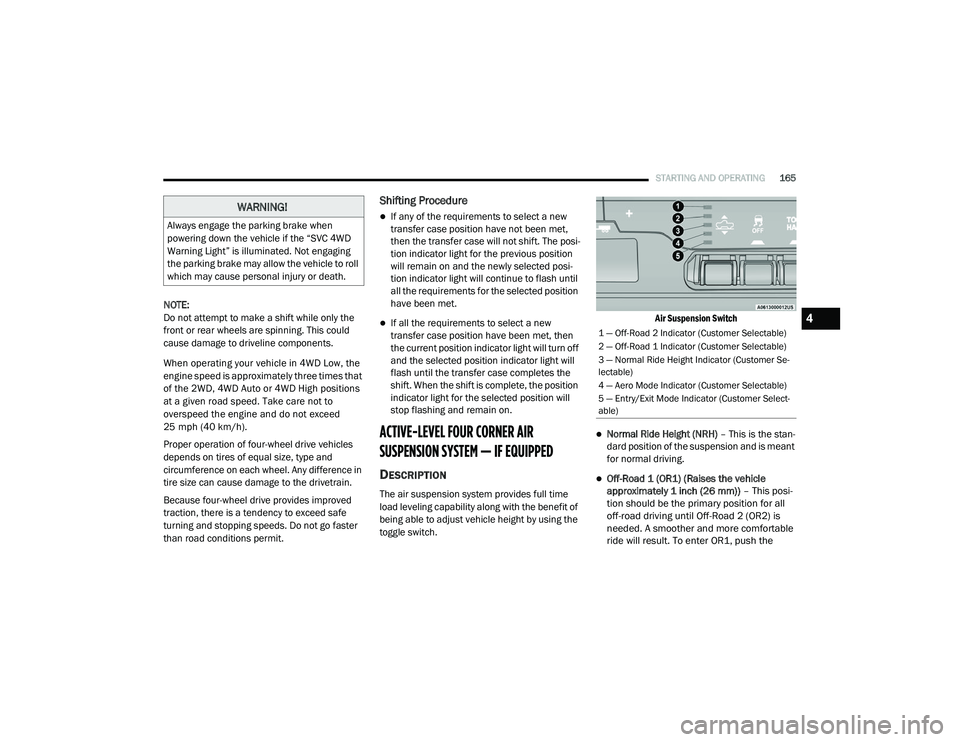
toggle switch.
Air Suspension Switch
Normal Ride Height (NRH)
– This is the stan-
dard position of the suspension and is meant
for normal driving.
Off-Road 1 (OR1) (Raises the vehicle
approximately 1 inch (26 mm)) – This posi-
tion should be the primary position for all
off-road driving until Off-Road 2 (OR2) is
needed. A smoother and more comfortable
ride will result. To enter OR1, push the
WARNING!
Always engage the parking brake when
powering down the vehicle if the “SVC 4WD
Warning Light” is illuminated. Not engaging
the parking brake may allow the vehicle to roll
which may cause personal injury or death.
1 — Off-Road 2 Indicator (Customer Selectable)
2 — Off-Road 1 Indicator (Customer Selectable)
3 — Normal Ride Height Indicator (Customer Se -
lectable)
4 — Aero Mode Indicator (Customer Selectable)
5 — Entry/Exit Mode Indicator (Customer Select -
able)
4
21_DT_OM_EN_USC_t.book Page 165
Page 170 of 496

168STARTING AND OPERATING
Wheel Alignment Mode
Before performing a wheel alignment, this
mode must be enabled Úpage 237.
Protection Strategy
In order to “protect” the air suspension system,
the vehicle will disable load leveling as required
(suspension overloaded, battery charge low,
etc.). Load leveling will automatically resume as
soon as system operation requirements are
met. See an authorized dealer if system does
not resume.
NOTE:
For towing with air suspension Ú page 214.
INSTRUMENT CLUSTER DISPLAY
M
ESSAGES
When the appropriate conditions exist, a
message will appear in the instrument cluster
display Ú page 114.
An audible chime will be heard whenever a
system error has been detected.
See an authorized dealer for system service if
normal operation does not resume.
OPERATION
Air Suspension Switch
The indicator lamps 1 through 5 will illuminate
to show the current position of the vehicle.
Flashing indicator lamps will show a position
which the system is working to achieve. When
raising, if multiple indicator lamps are flashing,
the highest flashing indicator lamp is the
position the system is working to achieve. When
lowering, if multiple indicators are flashing, the
lowest solid indicator lamp is the position the
system is working to achieve.
Pushing the height selector up once will move
the suspension one position higher from the
current position, assuming all conditions are
met (i.e. key in ON/RUN position, engine
running, speed below threshold, etc). The height selector switch can be pushed up
multiple times, each push will raise the
requested level by one position up to a
maximum position of OR2 or the highest
position allowed based on current conditions
(i.e. vehicle speed, etc).
Pushing the height selector down once will
move the suspension one position lower from
the current level, assuming all conditions are
met (i.e. key in ON/RUN position, engine
running, doors closed, speed below threshold,
etc). The height selector switch can be pushed
down multiple times, each push will lower the
requested level by one position down to a
minimum of Entry/Exit Mode or the lowest
position allowed based on current conditions
(i.e. vehicle speed, etc.)
Automatic height changes will occur based on
vehicle speed and the current vehicle height.
The indicator lamps and instrument cluster
display messages will operate the same for
automatic changes and user requested
changes.
21_DT_OM_EN_USC_t.book Page 168
Page 173 of 496

STARTING AND OPERATING171
This system uses a lifting and lowering pattern
which keeps the headlights from incorrectly
shining into oncoming traffic. When raising the
vehicle, the rear of the vehicle will move up first
and then the front. When lowering the vehicle,
the front will move down first and then the rear.
After the engine is turned off, it may be noticed
that the air suspension system operates briefly;
this is normal. The system is correcting the
position of the vehicle to ensure a proper
appearance.
To assist with changing a spare tire, the air
suspension system has a feature which allows
the automatic leveling to be disabled
Úpage 237.
NOTE:
If equipped with a touchscreen radio, all
enabling/disabling of air suspension features
must be done through the radio Ú page 237.AIR SUSPENSION MODES
The Air Suspension system has multiple modes
to protect the system in unique situations:
AERO Mode
To improve aerodynamics, the air suspension
system has a feature which will put the vehicle
into AERO height automatically Úpage 114.
Tire Jack Mode
To assist with changing a tire, the air
suspension system has a feature which allows
the automatic leveling to be disabled
Ú page 237.
Transport Mode
For towing your vehicle with four wheels off the
road, the air suspension system has a feature
which will put the vehicle into Entry/Exit height
and disable the automatic load leveling system
Ú page 237.
Wheel Alignment Mode
Before performing a wheel alignment, this
mode must be enabled Ú page 237.Protection Strategy
In order to “protect” the air suspension system,
the vehicle will disable load leveling as required
(suspension overloaded, battery charge low,
etc.). Load leveling will automatically resume as
soon as system operation requirements are
met. See an authorized dealer if system does
not resume.
NOTE:
For towing with air suspension Ú
page 214.
INSTRUMENT CLUSTER DISPLAY
M
ESSAGES
When the appropriate conditions exist, a
message will appear in the instrument cluster
display Ú page 114.
An audible chime will be heard whenever a
system error has been detected.
See an authorized dealer for system service if
normal operation does not resume.
WARNING!
The air suspension system uses a high
pressure volume of air to operate the system.
To avoid personal injury or damage to the
system, see an authorized dealer for service.
4
21_DT_OM_EN_USC_t.book Page 171
Page 174 of 496

172STARTING AND OPERATING
OPERATION
Air Suspension Switch
The indicator lamps 1 through 4 will illuminate
to show the current position of the vehicle.
Flashing indicator lamps will show a position
which the system is working to achieve. When
raising or lowering, the flashing indicator lamp
is the position the system is working to achieve.
Pushing the height selector switch up once will
move the suspension one position higher from
the current position, assuming all conditions
are met (i.e. key in ON/RUN position, engine
running, speed below threshold, etc). The
height selector switch can be pushed up
multiple times, each push will raise the
requested level by one position up to a maximum position of OR or the highest position
allowed based on current conditions (i.e.
vehicle speed, etc).
Pushing the height selector switch down once
will move the suspension one position lower
from the current level, assuming all conditions
are met (i.e. key in ON/RUN position, engine
running, doors closed, speed below threshold,
etc). The height selector switch can be pushed
down multiple times, each push will lower the
requested level by one position down to a
minimum of Entry/Exit Mode or the lowest
position allowed based on current conditions
(i.e. vehicle speed, etc.)
Automatic height changes will occur based on
vehicle speed and the current vehicle height.
The indicator lamps and instrument cluster
display messages will operate the same for
automatic changes and user requested
changes.
Off-Road 1 (OR1) – Indicator lamps 4, 3, 2,
and 1 will be illuminated when the vehicle is
in OR1.
Normal Ride Height (NRH) – Indicator lamps
4, 3, and 2 will be illuminated when the
vehicle is in this position.
Aero Mode – Indicator lamps 4 and 3 will be
illuminated when the vehicle is in this posi
-
tion.
Entry/Exit Mode – Indicator lamp 4 will be
illuminated when the vehicle is in Entry Exit
Mode. Entry/Exit mode can be requested up
to 33 mph (53 km/h). If vehicle speed is reduced to, and kept below, 15 mph
(24 km/h) indicator lamp 3 will flash and
indicator lamp 4 will remain solid until
Entry/Exit Mode is achieved at which point
indicator lamp 3 will turn off.
Transport Mode – No indicator lamps will be
illuminated. Transport Mode is disabled by
driving the vehicle.
Tire/Jack Mode – Indicator lamps 4 and 1 will
be illuminated. Tire/Jack Mode is disabled by
driving the vehicle.
Wheel Alignment Mode – Indicator lamps 2,
3, and 4 will be illuminated. Wheel Alignment
Mode is disabled by driving the vehicle.
21_DT_OM_EN_USC_t.book Page 172
Page 177 of 496

STARTING AND OPERATING175
FUEL SAVER TECHNOLOGY 5.7L ENGINES
ONLY — IF EQUIPPED
This feature offers improved fuel economy by
shutting off four of the engine's eight cylinders
during light load and cruise conditions. The
system is automatic with no driver inputs or
additional driving skills required.
NOTE:
This system may take some time to return to full
functionality after a battery disconnect.
STOP/START SYSTEM — IF EQUIPPED
The Stop/Start function is developed to save
fuel and reduce emissions. The system will stop
the engine automatically during a vehicle stop if
the required conditions are met. Releasing the
brake pedal or shifting out of DRIVE will
automatically restart the engine.
Vehicles equipped with eTorque contain a
heavy duty motor generator and an additional
hybrid electric battery to store energy from
vehicle deceleration for use on engine startup
after a stop as well as providing launch torque
assist.
AUTOSTOP MODE
The Stop/Start feature is enabled after every
normal customer engine start. It will remain in
STOP/START NOT READY until you drive
forward with a vehicle speed greater than
2 mph (3 km/h). At that time, the system will
go into STOP/START READY.
To Activate The Autostop Mode, The Following
Must Occur:
1. The system must be in STOP/START READY
state. A STOP/START READY message will
be displayed in the instrument cluster
within the Stop/Start section
Ú
page 114.
2. The vehicle must be completely stopped.
3. The transmission gear selector must be in DRIVE and the brake pedal pressed.
The engine will shut down, the tachometer will
move to the zero position and the stop/start
telltale will illuminate indicating you are in an
Autostop. While in an Autostop, the Climate
Controls system may automatically adjust
airflow to maintain cabin comfort. Customer
settings will be maintained upon return to an
engine running condition.
POSSIBLE REASONS THE ENGINE DOES
N
OT AUTOSTOP
Prior to engine shut down, the system will check
many safety and comfort conditions to see if
they are fulfilled. In following situations, the
engine will not Autostop:
Driver’s seat belt is not buckled
Driver’s door is not closed
The vehicle is on a steep grade
Cabin heating or cooling is in process and an
acceptable cabin temperature has not been
achieved
HVAC is set to full defrost mode at a high
blower speed
Engine has not reached normal operating
temperature
Engine temperature too high
The battery is charging
The transmission is not in DRIVE
Hood is open
Transfer case is in 4WD LOW
4
21_DT_OM_EN_USC_t.book Page 175
Page 213 of 496
STARTING AND OPERATING211
DIESEL EXHAUST FLUID
Your vehicle is equipped with a Selective
Catalytic Reduction (SCR) system to meet diesel
emissions standards required by the
Environmental Protection Agency.
The purpose of the SCR system is to reduce
levels of oxides of nitrogen (NO
x) emitted from
engines that are harmful to our health and the
environment to a near-zero level. A small
quantity of Diesel Exhaust Fluid (DEF) is
injected into the exhaust upstream of a catalyst
where, when vaporized, converts smog-forming
NO
x into harmless nitrogen (N2) and water
vapor (H
2O), two natural components of the air
we breathe.
DIESEL EXHAUST FLUID STORAGE
Diesel Exhaust Fluid (DEF) is considered a very
stable product with a long shelf life. If DEF is
kept in temperatures between 10° and 90°F
(-12° and 32°C), it will last a minimum of one
year.
DEF may freeze at temperatures at or below
12°F (-11°C). The system has been designed to
operate in this environment. NOTE:
When working with DEF, it is important to know
that:
Any containers or parts that come into
contact with DEF must be DEF compatible
(plastic or stainless steel). Copper, brass,
aluminum, iron or non-stainless steel should
be avoided as they are subject to corrosion
by DEF.
If DEF is spilled, it should be wiped up
completely.
ADDING DIESEL EXHAUST FLUID
The Diesel Exhaust Fluid (DEF) gauge (located
on the instrument cluster) will display the level
of DEF remaining in the tank Ú
page 109.
NOTE:
Driving conditions (altitude, vehicle speed,
load, etc.) will effect the amount of DEF that
is used in your vehicle.
Outside temperature can affect DEF
consumption. In cold conditions, 12°F
(-11°C) and below, the DEF gauge may take
longer to operate as intended. This is a
normal function of the system.
There is an electric heater inside the DEF
tank that automatically works when neces -
sary. And if the DEF supply does freeze, the
truck will operate normally until it thaws.
Diesel Exhaust Fluid (DEF) Fill Procedure
NOTE:
For the correct fluid type Ú page 475.
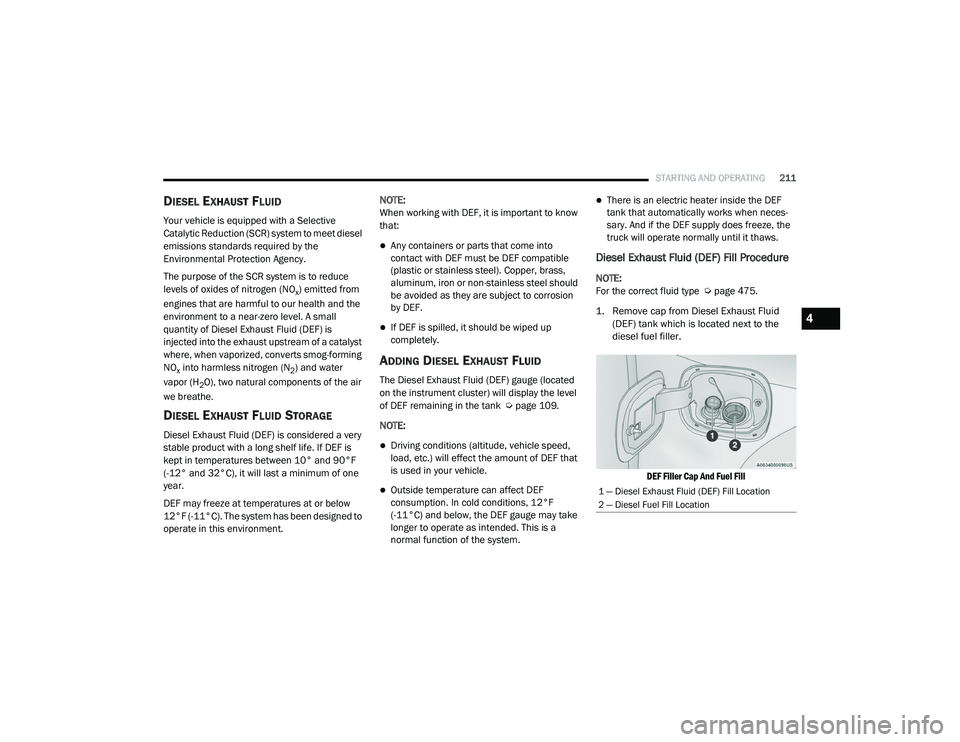
1. Remove cap from Diesel Exhaust Fluid (DEF) tank which is located next to the
diesel fuel filler.
DEF Filler Cap And Fuel Fill
1 — Diesel Exhaust Fluid (DEF) Fill Location
2 — Diesel Fuel Fill Location
4
21_DT_OM_EN_USC_t.book Page 211
Page 229 of 496
STARTING AND OPERATING227
Hazard switch is activated
Any button on the key fob is pushed
Ignition button is pushed
High Beam stalk position is changed
Sequence is canceled in the instrument
cluster
TOWING TIPS
Before towing, practice turning, stopping, and
backing up the trailer in an area located away
from heavy traffic.
Automatic Transmission
The DRIVE range can be selected when towing.
The transmission controls include a drive
strategy to avoid frequent shifting when towing.
However, if frequent shifting does occur while in
DRIVE, select TOW/HAUL mode or select a lower
gear range (using the Electronic Range Select
(ERS) shift control).
NOTE:
Using TOW/HAUL mode or selecting a lower
gear range (using the ERS shift control) while
operating the vehicle under heavy loading
conditions will improve performance and extend transmission life by reducing excessive
shifting and heat build up. This action will also
provide better engine braking.
Tow/Haul Mode
To reduce potential for automatic transmission
overheating, activate TOW/HAUL mode when
driving in hilly areas, or select a lower gear
range (using the (ERS) shift control) on more
severe grades.
Cruise Control — If Equipped
Do not use on hilly terrain or with heavy
loads.
When using the Cruise Control, if you experi
-
ence speed drops greater than 10 mph
(16 km/h), disengage until you can get back
to cruising speed.
Use Cruise Control in flat terrain and with
light loads to maximize fuel efficiency.
Air Suspension System
To aid in attaching/detaching the trailer from
the vehicle, the air suspension system can be
used Ú page 165. NOTE:
The vehicle must remain in the engine running
position while attaching a trailer for proper
leveling of the air suspension system.
SNOWPLOW
Snowplow Prep Packages are available as a
factory installed option. These packages
include components necessary to equip your
vehicle with a snowplow.
NOTE:
Before installation of a snowplow it is highly
recommended that the owner/installer obtain
and follow the recommendations contained
within the current Body Builders Guide. See an
authorized dealer, installer or snowplow manu
-
facturer for this information. There are unique
electrical systems that must be connected to
properly ensure operator safety and prevent
overloading vehicle systems.
4
21_DT_OM_EN_USC_t.book Page 227
Page 231 of 496

STARTING AND OPERATING229
OVER THE ROAD OPERATION WITH
S
NOWPLOW ATTACHED
The blade restricts air flow to the radiator and
causes the engine to operate at higher than
normal temperatures. Therefore, when
transporting the plow, angle the blade
completely and position it as low as road or
surface conditions permit. Do not exceed
40 mph (64 km/h). The operator should always
maintain a safe stopping distance and allow
adequate passing clearance.
OPERATING TIPS
Under ideal snow plowing conditions, 20 mph
(32 km/h) should be maximum operating
speed. The operator should be familiar with the
area and surface to be cleaned. Reduce speed
and use extreme caution when plowing
unfamiliar areas or under poor visibility.
GENERAL MAINTENANCE
Snowplows should be maintained in
accordance with the plow manufacturer's
instructions.
Keep all snowplow electrical connections and
battery terminals clean and free of corrosion.
When plowing snow, to avoid transmission and
drivetrain damage, the following precautions
should be observed:
Operate with transfer case in 4WD Low when
plowing small or congested areas where
speeds are not likely to exceed 15 mph
(24 km/h). At higher speeds operate in 4WD
High.
Vehicles with automatic transmissions
should use 4WD Low when plowing deep or
heavy snow for extended periods of time to
avoid transmission overheating.
Do not shift the transmission unless the
engine has returned to idle and wheels have
stopped. Make a practice of stepping on the
brake pedal while shifting the transmission.
4
21_DT_OM_EN_USC_t.book Page 229
Page 232 of 496
230STARTING AND OPERATING
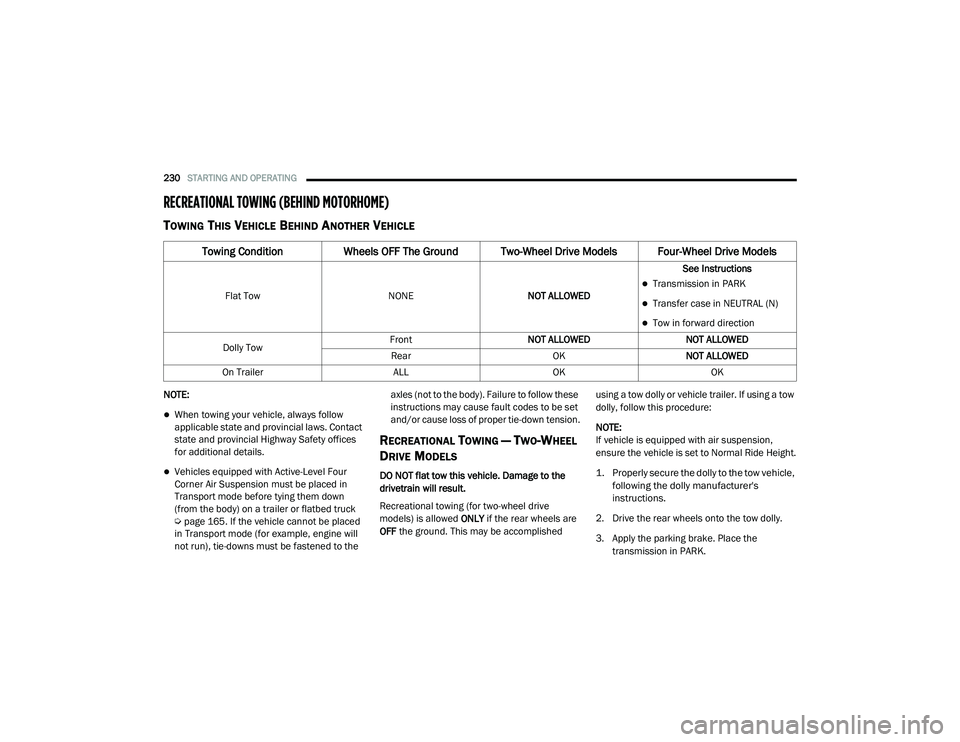
RECREATIONAL TOWING (BEHIND MOTORHOME)
TOWING THIS VEHICLE BEHIND ANOTHER VEHICLE
NOTE:
When towing your vehicle, always follow
applicable state and provincial laws. Contact
state and provincial Highway Safety offices
for additional details.
Vehicles equipped with Active-Level Four
Corner Air Suspension must be placed in
Transport mode before tying them down
(from the body) on a trailer or flatbed truck
Úpage 165. If the vehicle cannot be placed
in Transport mode (for example, engine will
not run), tie-downs must be fastened to the axles (not to the body). Failure to follow these
instructions may cause fault codes to be set
and/or cause loss of proper tie-down tension.
RECREATIONAL TOWING — TWO-WHEEL
D
RIVE MODELS
DO NOT flat tow this vehicle. Damage to the
drivetrain will result.
Recreational towing (for two-wheel drive
models) is allowed ONLY if the rear wheels are
OFF the ground. This may be accomplished using a tow dolly or vehicle trailer. If using a tow
dolly, follow this procedure:
NOTE:
If vehicle is equipped with air suspension,
ensure the vehicle is set to Normal Ride Height.
1. Properly secure the dolly to the tow vehicle,
following the dolly manufacturer's
instructions.
2. Drive the rear wheels onto the tow dolly.
3. Apply the parking brake. Place the transmission in PARK.
Towing Condition Wheels OFF The Ground Two-Wheel Drive Models Four-Wheel Drive Models
Flat Tow NONENOT ALLOWED See InstructionsTransmission in PARK
Transfer case in NEUTRAL (N)
Tow in forward direction
Dolly Tow Front
NOT ALLOWED NOT ALLOWED
Rear OKNOT ALLOWED
On Trailer ALLOKOK
21_DT_OM_EN_USC_t.book Page 230