weight RAM 1500 2022 Owners Manual
[x] Cancel search | Manufacturer: RAM, Model Year: 2022, Model line: 1500, Model: RAM 1500 2022Pages: 496, PDF Size: 18.03 MB
Page 8 of 496
6
TRAILER CAMERAS — IF EQUIPPED ................. 203 Trailer Surround View Camera System —
If Equipped..................................................... 203
AUX Camera — If Equipped ........................... 206
REFUELING THE VEHICLE — GASOLINE
ENGINE ................................................................. 207
REFUELING THE VEHICLE — DIESEL
ENGINE ................................................................. 208
Avoid Using Contaminated Fuel ................... 208
Bulk Fuel Storage — Diesel Fuel................... 209
Diesel Exhaust Fluid ...................................... 209Diesel Exhaust Fluid Storage........................ 209
Adding Diesel Exhaust Fluid ......................... 209
VEHICLE LOADING ............................................... 211
Gross Vehicle Weight Rating (GVWR) .......... 211
Payload .......................................................... 211
Gross Axle Weight Rating (GAWR) ................ 211
Tire Size.......................................................... 212
Rim Size ......................................................... 212
Inflation Pressure .......................................... 212
Curb Weight ................................................... 212Loading .......................................................... 212
TRAILER TOWING ................................................ 212
Common Towing Definitions ......................... 213Trailer Hitch Type and Maximum Trailer
Weight ............................................................ 216
Trailer Towing Weights
(Maximum Trailer Weight Ratings) ............... 217 Trailer And Tongue Weight............................ 217
Trailer Reverse Steering Control .................. 217
Towing Requirements .................................. 219
Towing Tips ................................................... 225
SNOWPLOW......................................................... 225
Before Plowing............................................... 226
Snowplow Prep Package Model
Availability ...................................................... 226
Over The Road Operation With Snowplow
Attached......................................................... 226
Operating Tips ............................................... 226
General Maintenance ................................... 226
RECREATIONAL TOWING
(BEHIND MOTORHOME) .................................... 227
Towing This Vehicle Behind Another
Vehicle ........................................................... 227
Recreational Towing — Two-Wheel
Drive Models.................................................. 228
Recreational Towing — Four-Wheel
Drive Models.................................................. 228
DRIVING TIPS ....................................................... 230
Driving On Slippery Surfaces ....................... 230
Driving Through Water ................................. 231
Off-Road Driving Tips .................................... 232
MULTIMEDIA
UCONNECT SYSTEMS .......................................... 233
CYBERSECURITY .................................................. 233
UCONNECT SETTINGS ........................................ 234Customer Programmable Features ............ 235
UCONNECT INTRODUCTION................................ 259
System Overview .......................................... 259Safety And General Information .................. 261
UCONNECT MODES ............................................. 262
Steering Wheel Audio Controls..................... 262Radio Mode .................................................. 262Media Mode ................................................. 270
Phone Mode ................................................. 272
CONNECTED VEHICLE SERVICES —
IF EQUIPPED ........................................................ 282
Is My Vehicle Connected? ............................ 282
Introduction To Connected Vehicle
Services ........................................................ 283
Getting Started With Connected Vehicle
Services ........................................................ 284
Using SiriusXM Guardian™ .......................... 286
Manage My SiriusXM Guardian™
Account .......................................................... 297
22_DT_OM_EN_USC_t.book Page 6
Page 13 of 496

11
SYMBOLS KEY
If you do not read this entire Owner’s Manual, you may miss important
information. Observe all Cautions and Warnings.
VAN CONVERSIONS/CAMPERS
The New Vehicle Limited Warranty does not apply to body modifications or
special equipment installed by van conversion/camper manufacturers/body
builders. US residents refer to the Warranty Information, Section 2.1.C.
Canadian residents refer to the “What Is Not Covered” section of the Warranty
Information. Such equipment includes video monitors, DVD/Blu-Ray™,
heaters, stoves, refrigerators, etc. For warranty coverage and service on these
items, contact the applicable manufacturer.
CONSUMER INFORMATION — TRUCK-CAMPER LOADING
This information is provided in fulfillment of the requirement by the United
States Government, Department of Transportation, National Highway Traffic
Safety Administration, that “every manufacturer of trucks that are capable of
accommodating slide-in campers, manufactured on or after April 1, 1973 shall
provide... at the time of original purchase to the first person who purchases the
truck”... information on Truck Camper Loading.
A slide-in camper document is provided in your vehicle’s glove compartment
that contains your Vehicle Identification Number, truck model, cargo weight
rating, and the forward/rearward limit of a camper. To obtain additional
dimensional and technical specifications for your vehicle, please visit
https://www.ramtrucks.com.
Figure 1 illustrates the dimensions describing the forward and rearward limits
of the zone in which the Center of Gravity (CG) of a slide-in camper must be
located, to provide satisfactory vehicle handling and to prevent overload of the
front and rear axles.
Figure 2 illustrates a proper match between truck and camper.
WARNING!
These statements are against operating
procedures that could result in a collision, bodily
injury and/or death.
CAUTION! These statements are against procedures that
could result in damage to your vehicle.
NOTE: A suggestion which will improve installation,
operation, and reliability. If not followed, may
result in damage.
TIP: General ideas/solutions/suggestions on easier
use of the product or functionality.
PAGE REFERENCE
ARROW Follow this reference for additional information on
a particular feature.
FOOTNOTE Supplementary and relevant information
pertaining to the topic.
1
22_DT_OM_EN_USC_t.book Page 11
Page 15 of 496
13
When the truck is used to carry a slide-in camper, the total cargo load of the
truck consists of the manufacturer’s camper weight figure, the weight of
installed additional camper equipment not included in the manufacturer’s
camper weight figure, the weight of camper cargo, and the weight of
passengers in the camper. The total cargo load should not exceed the truck’s
cargo weight rating and the camper’s CG should fall within the truck’s
recommended CG zone when installed.
Secure loose items to prevent weight shifts that could affect the balance of
your vehicle. When the truck camper is loaded, drive to a scale and weigh the
front and rear wheels separately, to determine axle loads. Individual axle loads
should not exceed either of the Gross Axle Weight Ratings (GAWR). The total of
the axle loads should not exceed the Gross Vehicle Weight Rating (GVWR).
If weight ratings are exceeded, move or remove items to get the total weight
below the ratings.
NOTE:These ratings are also provided on the vehicle certification label located on
the driver’s side B-pillar. See Ú page 211 for more information.
For any additional instructions, please contact your conversion/camper
manufacturer or an authorized dealer.
VEHICLE MODIFICATIONS/ALTERATIONS SYMBOL GLOSSARY
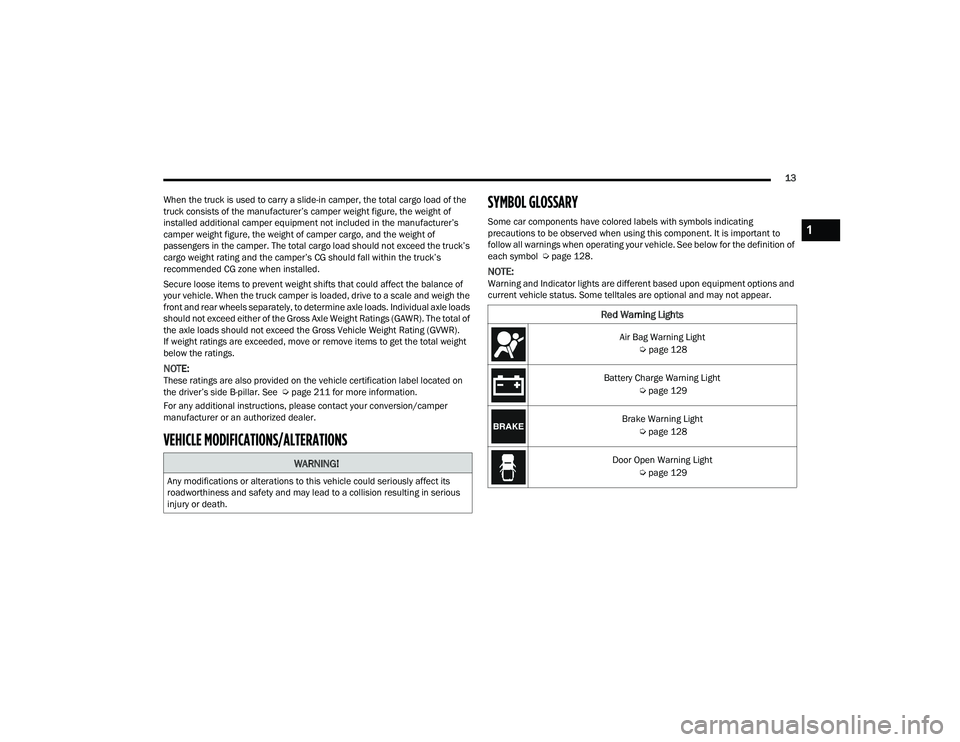
Some car components have colored labels with symbols indicating
precautions to be observed when using this component. It is important to
follow all warnings when operating your vehicle. See below for the definition of
each symbol Ú
page 128.
NOTE:Warning and Indicator lights are different based upon equipment options and
current vehicle status. Some telltales are optional and may not appear.
WARNING!
Any modifications or alterations to this vehicle could seriously affect its
roadworthiness and safety and may lead to a collision resulting in serious
injury or death.
Red Warning Lights
Air Bag Warning Light
Úpage 128
Battery Charge Warning Light Úpage 129
Brake Warning Light Úpage 128
Door Open Warning Light Úpage 129
1
22_DT_OM_EN_USC_t.book Page 13
Page 72 of 496
70GETTING TO KNOW YOUR VEHICLE
(Continued)
Center Storage Compartment —
If Equipped
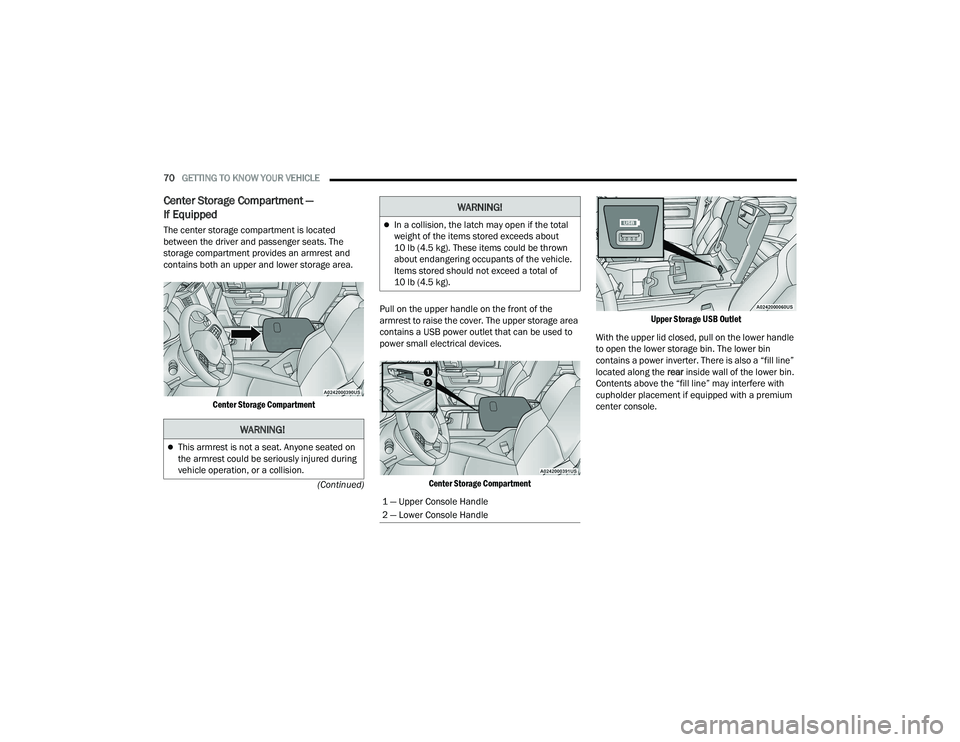
The center storage compartment is located
between the driver and passenger seats. The
storage compartment provides an armrest and
contains both an upper and lower storage area.
Center Storage Compartment
Pull on the upper handle on the front of the
armrest to raise the cover. The upper storage area
contains a USB power outlet that can be used to
power small electrical devices.
Center Storage Compartment Upper Storage USB Outlet
With the upper lid closed, pull on the lower handle
to open the lower storage bin. The lower bin
contains a power inverter. There is also a “fill line”
located along the rear inside wall of the lower bin.
Contents above the “fill line” may interfere with
cupholder placement if equipped with a premium
center console.
WARNING!
This armrest is not a seat. Anyone seated on
the armrest could be seriously injured during
vehicle operation, or a collision.
In a collision, the latch may open if the total
weight of the items stored exceeds about
10 lb (4.5 kg). These items could be thrown
about endangering occupants of the vehicle.
Items stored should not exceed a total of
10 lb (4.5 kg).
1 — Upper Console Handle
2 — Lower Console Handle
WARNING!
22_DT_OM_EN_USC_t.book Page 70
Page 94 of 496
92GETTING TO KNOW YOUR VEHICLE
(Continued)
PICKUP BOX
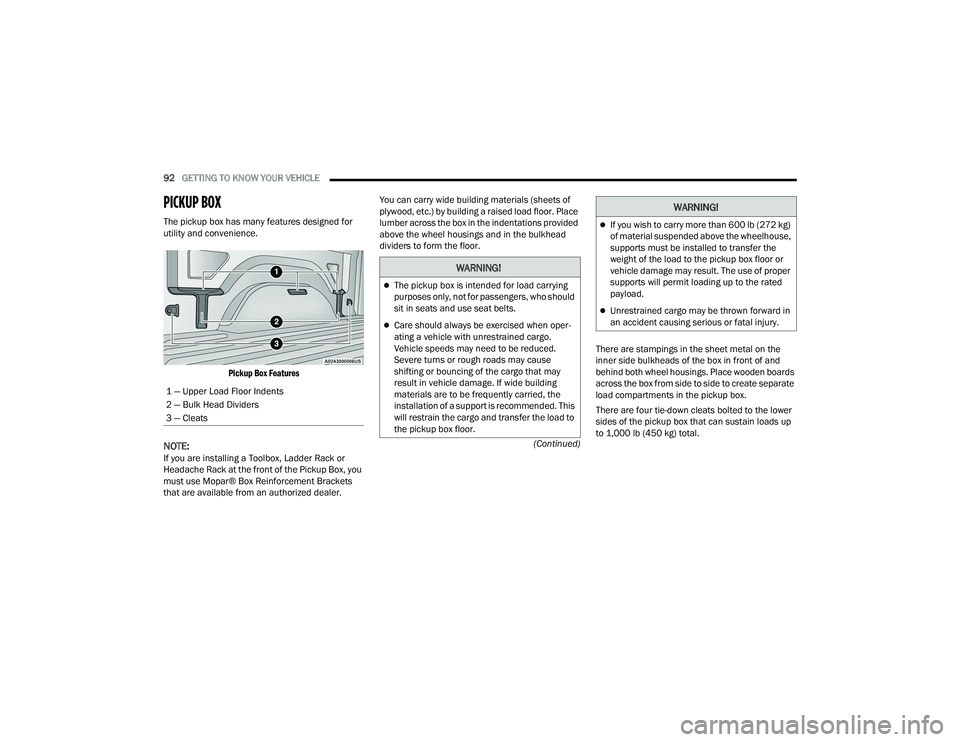
The pickup box has many features designed for
utility and convenience.
Pickup Box Features
NOTE:If you are installing a Toolbox, Ladder Rack or
Headache Rack at the front of the Pickup Box, you
must use Mopar® Box Reinforcement Brackets
that are available from an authorized dealer. You can carry wide building materials (sheets of
plywood, etc.) by building a raised load floor. Place
lumber across the box in the indentations provided
above the wheel housings and in the bulkhead
dividers to form the floor.
There are stampings in the sheet metal on the
inner side bulkheads of the box in front of and
behind both wheel housings. Place wooden boards
across the box from side to side to create separate
load compartments in the pickup box.
There are four tie-down cleats bolted to the lower
sides of the pickup box that can sustain loads up
to 1,000 lb (450 kg) total.
1 — Upper Load Floor Indents
2 — Bulk Head Dividers
3 — Cleats
WARNING!
The pickup box is intended for load carrying
purposes only, not for passengers, who should
sit in seats and use seat belts.
Care should always be exercised when oper
-
ating a vehicle with unrestrained cargo.
Vehicle speeds may need to be reduced.
Severe turns or rough roads may cause
shifting or bouncing of the cargo that may
result in vehicle damage. If wide building
materials are to be frequently carried, the
installation of a support is recommended. This
will restrain the cargo and transfer the load to
the pickup box floor.
If you wish to carry more than 600 lb (272 kg)
of material suspended above the wheelhouse,
supports must be installed to transfer the
weight of the load to the pickup box floor or
vehicle damage may result. The use of proper
supports will permit loading up to the rated
payload.
Unrestrained cargo may be thrown forward in
an accident causing serious or fatal injury.
WARNING!
22_DT_OM_EN_USC_t.book Page 92
Page 97 of 496
GETTING TO KNOW YOUR VEHICLE95
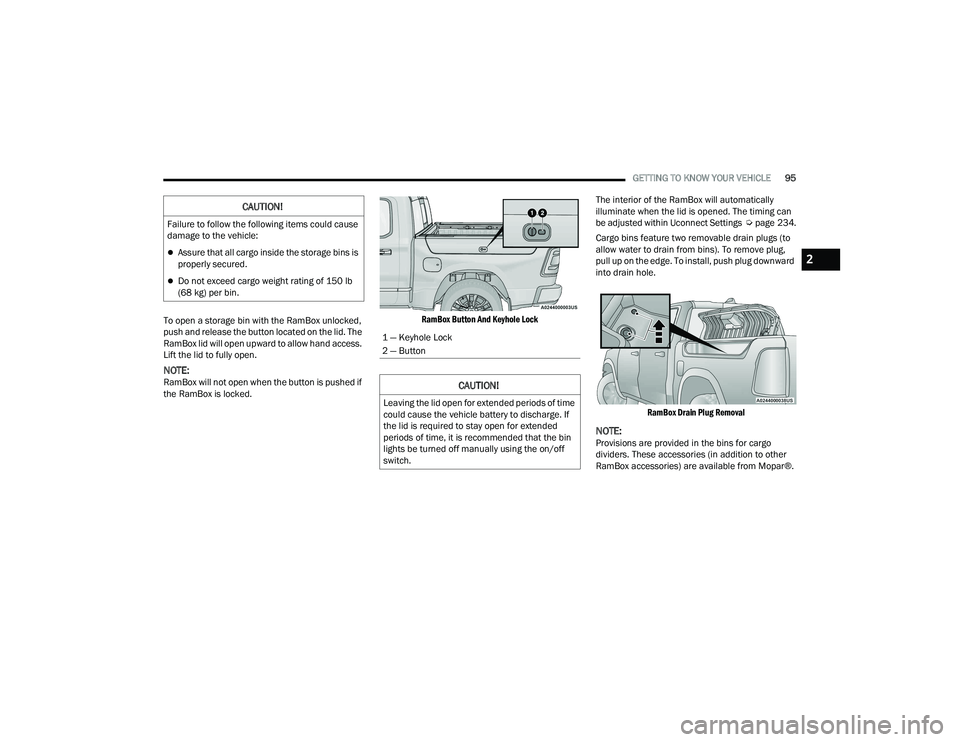
To open a storage bin with the RamBox unlocked,
push and release the button located on the lid. The
RamBox lid will open upward to allow hand access.
Lift the lid to fully open.
NOTE:RamBox will not open when the button is pushed if
the RamBox is locked.
RamBox Button And Keyhole Lock
The interior of the RamBox will automatically
illuminate when the lid is opened. The timing can
be adjusted within Uconnect Settings
Úpage 234.
Cargo bins feature two removable drain plugs (to
allow water to drain from bins). To remove plug,
pull up on the edge. To install, push plug downward
into drain hole.
RamBox Drain Plug Removal
NOTE:Provisions are provided in the bins for cargo
dividers. These accessories (in addition to other
RamBox accessories) are available from Mopar®.
CAUTION!
Failure to follow the following items could cause
damage to the vehicle:
Assure that all cargo inside the storage bins is
properly secured.
Do not exceed cargo weight rating of 150 lb
(68 kg) per bin.
1 — Keyhole Lock
2 — Button
CAUTION!
Leaving the lid open for extended periods of time
could cause the vehicle battery to discharge. If
the lid is required to stay open for extended
periods of time, it is recommended that the bin
lights be turned off manually using the on/off
switch.
2
22_DT_OM_EN_USC_t.book Page 95
Page 103 of 496
GETTING TO KNOW YOUR VEHICLE101
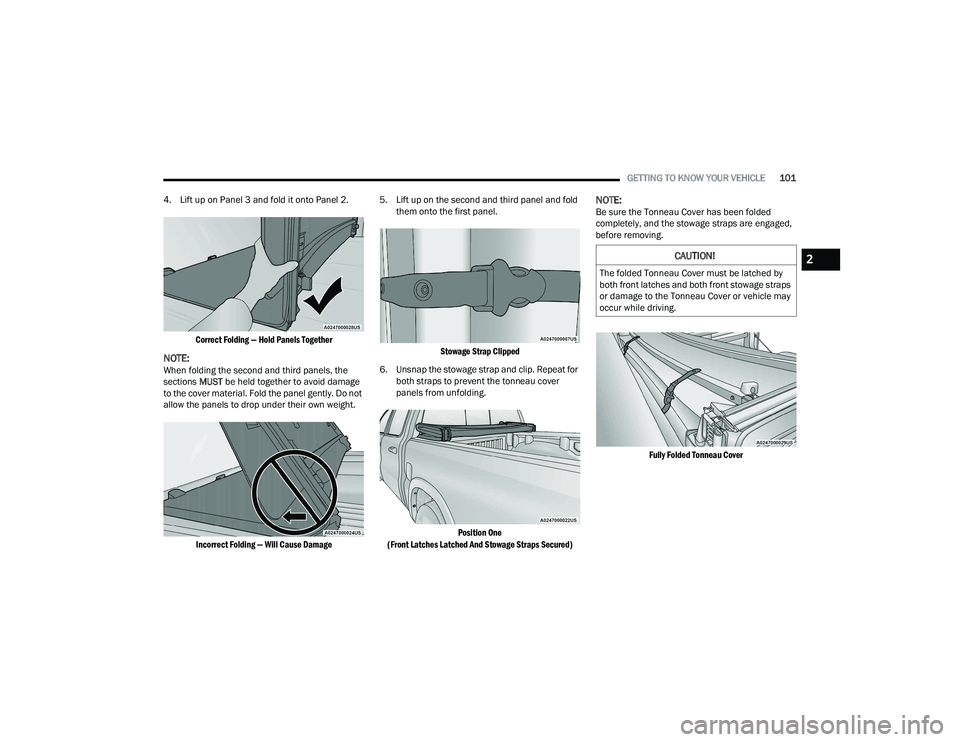
4. Lift up on Panel 3 and fold it onto Panel 2.
Correct Folding — Hold Panels Together
NOTE:When folding the second and third panels, the
sections MUST be held together to avoid damage
to the cover material. Fold the panel gently. Do not
allow the panels to drop under their own weight.
Incorrect Folding — Will Cause Damage
5. Lift up on the second and third panel and fold
them onto the first panel.
Stowage Strap Clipped
6. Unsnap the stowage strap and clip. Repeat for both straps to prevent the tonneau cover
panels from unfolding.
Position One
(Front Latches Latched And Stowage Straps Secured)
NOTE:Be sure the Tonneau Cover has been folded
completely, and the stowage straps are engaged,
before removing.
Fully Folded Tonneau Cover
CAUTION!
The folded Tonneau Cover must be latched by
both front latches and both front stowage straps
or damage to the Tonneau Cover or vehicle may
occur while driving.
2
22_DT_OM_EN_USC_t.book Page 101
Page 106 of 496

104GETTING TO KNOW YOUR VEHICLE
Pull Handle Downward
4. Pull down on the handle to ensure the Slide Locking Lever is fully engaged. Do this for both
the left and right side.
5. Unclip the stowage straps, and re-snap them to the bow. 6. Unfold the Tonneau Cover to the second panel
position.
Incorrect Folding — Will Cause Damage
NOTE:When folding the second and third panels, the
sections MUST be held together to avoid damage
to the cover material. Fold the panel gently. Do not
allow the panels to drop under their own weight.
Second Panel Position
NOTE:Unfold the panel gently, and do not allow the
panels to drop under their own weight.
22_DT_OM_EN_USC_t.book Page 104
Page 152 of 496

150STARTING AND OPERATING
ENGINE BREAK-IN RECOMMENDATIONS —
GASOLINE ENGINE
A long break-in period is not required for the engine
and drivetrain (transmission and axle) in your
vehicle.
Drive moderately during the first 300 miles
(500 km). After the initial 60 miles (100 km),
speeds up to 50 or 55 mph (80 or 90 km/h) are
desirable.
While cruising, brief full-throttle acceleration within
the limits of local traffic laws contributes to a good
break-in. Wide-open throttle acceleration in low
gear can be detrimental and should be avoided.
The engine oil installed in the engine at the factory
is a high-quality energy conserving type lubricant.
Oil changes should be consistent with anticipated
climate conditions under which vehicle operations
will occur. For the recommended viscosity and
quality grades Ú page 473.
NOTE:A new engine may consume some oil during its first
few thousand miles (kilometers) of operation. This
should be considered a normal part of the break-in
and not interpreted as a problem. Please check
your oil level with the engine oil indicator often
during the break-in period. Add oil as required.
ENGINE BREAK-IN RECOMMENDATIONS —
DIESEL ENGINE
The diesel engine does not require a break-in
period due to its construction. Normal operation is
allowed, providing the following recommendations
are followed:
Warm up the engine before placing it under
load.
Do not operate the engine at idle for prolonged
periods.
Observe vehicle oil pressure and temperature
indicators.
Check the coolant and oil levels frequently.
Vary throttle position at highway speeds when
carrying or towing significant weight.
NOTE:Light duty operation such as light trailer towing or
no load operation will extend the time before the
engine is at full efficiency. Reduced fuel economy
and power may be seen at this time. The engine oil installed in the engine at the factory
is a high-quality energy conserving type lubricant.
Oil changes should be consistent with anticipated
climate conditions under which vehicle operations
will occur. For the recommended viscosity and
quality grades Ú
page 473.
NOTE:NON-DETERGENT OR STRAIGHT MINERAL OILS
MUST NEVER BE USED.
PARKING BRAKE
ELECTRIC PARK BRAKE (EPB)
Your vehicle is equipped with an EPB that offers
simple operation, and some additional features
that make the parking brake more convenient and
useful.
The parking brake is primarily intended to prevent
the vehicle from rolling while parked. Before
leaving the vehicle, make sure that the parking
brake is applied. Also, be certain to leave the
transmission in PARK.
You can engage the parking brake in two ways:
Manually, by applying the parking brake switch.
Automatically, by enabling the Auto Park Brake
feature in the Customer Programmable
Features section of the Uconnect settings.
CAUTION!
Never use Non-Detergent Oil or Straight Mineral
Oil in the engine or damage may result.
22_DT_OM_EN_USC_t.book Page 150
Page 213 of 496

STARTING AND OPERATING211
3. Stop filling the DEF tank immediately when any of the following happen: DEF stops flowing
from the fill bottle into the DEF tank, DEF
splashes out the filler neck, or a DEF pump
nozzle automatically shuts off.
4. Reinstall cap onto DEF tank.
Filling The Def Tank In Cold Climates
Your vehicle is equipped with an automatic DEF
heating system. This allows the DEF injection
system to operate properly at temperatures below
12°F (-11°C). If your vehicle is not in operation for
an extended period of time with temperatures
below 12°F (-11°C), the DEF in the tank may
freeze. Do not overfill the DEF tank. If the tank is
overfilled and freezes, it could be damaged.
Extra care should be taken when filling with
portable containers to avoid overfilling. Keep an
eye on the DEF gauge in your instrument cluster.
You may safely add a maximum of 2 gallons
(7.6 Liters) when your DEF gauge is reading at
the half mark.
VEHICLE LOADING
GROSS VEHICLE WEIGHT RATING
(GVWR)
The GVWR is the total permissible weight of your
vehicle including driver, passengers, vehicle,
options and cargo. The label also specifies
maximum capacities of front and rear Gross Axle
Weight Rating (GAWR). Total load must be limited
so GVWR and front and rear GAWR are not
exceeded.
PAYLOAD
The payload of a vehicle is defined as the allowable
load weight a truck can carry, including the weight
of the driver, all passengers, options and cargo.
GROSS AXLE WEIGHT RATING (GAWR)
The GAWR is the maximum permissible load on the
front and rear axles. The load must be distributed
in the cargo area so that the GAWR of each axle is
not exceeded.
Each axle GAWR is determined by the components
in the system with the lowest load carrying capacity
(axle, springs, tires or wheels). Heavier axles or
suspension components sometimes specified by
purchasers for increased durability does not
necessarily increase the vehicle's GVWR.
When DEF is spilled, clean the area immedi -
ately with water and use an absorbent mate -
rial to soak up the spills on the ground.
Do not attempt to start your engine if DEF is
accidentally added to the diesel fuel tank as it
can result in severe damage to your engine,
including but not limited to failure of the fuel
pump and injectors.
Never add anything other than DEF to the tank
– especially any form of hydrocarbon such as
diesel fuel, fuel system additives, gasoline, or
any other petroleum-based product. Even a
very small amount of these, less than
100 parts per million or less than 1 oz. per
78 gallons (295 liters) will contaminate the
entire DEF system and will require replace -
ment. If owners use a container, funnel or
nozzle when refilling the tank, it should either
be new or one that has only been used for
adding DEF. Mopar® provides an attachable
nozzle with its DEF for this purpose.
CAUTION!
4
22_DT_OM_EN_USC_t.book Page 211