tires Ram 2500 2020 Owner's Guide
[x] Cancel search | Manufacturer: RAM, Model Year: 2020, Model line: 2500, Model: Ram 2500 2020Pages: 553, PDF Size: 21.99 MB
Page 250 of 553

248STARTING AND OPERATING
vehicle. Refer to “Recreational Towing” in
“Starting And Operating” for further informa -
tion.
4L
Four-Wheel Drive Low Range — This range locks
the front and rear driveshafts together forcing
the front and rear wheels to rotate at the same
speed. Additional traction and maximum pulling
power for loose, slippery road surfaces only. Do
not exceed 25 mph (40 km/h).
This transfer case is intended to be driven in the
2H position for normal street and highway
conditions such as dry, hard surfaced roads.
When additional traction is required, the 4H and
4L positions can be used to lock the front and
rear driveshafts together and force the front
and rear wheels to rotate at the same speed.
This is accomplished by simply moving the gear
selector to the desired positions once the
appropriate speed and gear requirements are
met. Refer to “Shifting Procedure – Manually
Shifted Transfer Case” in this section for further
information.
The 4H and 4L positions are intended for loose,
slippery road surfaces only. Driving in the 4H
and 4L positions on dry, hard surfaced roads may cause increased tire wear and damage to
the driveline components.
The “Transfer Case Position Indicator Light” in
the instrument cluster will alert the driver that
the vehicle is in four-wheel drive and that the
front and rear driveshafts are locked together.
This light will illuminate when the transfer case
is shifted into either the 4H or 4L position. There
is no light for the 2H or NEUTRAL positions on
some models.
When operating your vehicle in 4L, the engine
speed is approximately three times that of the
2H or 4H positions at a given road speed. Take
care not to overspeed the engine and do not
exceed 25 mph (40 km/h).
Proper operation of four-wheel drive vehicles
depends on tires of equal size, type and circum
-
ference on each wheel. Any difference will
adversely affect shifting and can cause damage
to the drivetrain.
NOTE:
Do not attempt to make a shift while only the
front or rear wheels are spinning, as this can
cause damage to driveline components. Because four-wheel drive provides improved
traction, there is a tendency to exceed safe
turning and stopping speeds. Do not go faster
than road conditions permit.
NOTE:
Delayed shifts out of four-wheel drive may be
experienced due to uneven tire wear, low or
uneven tire pressures, excessive vehicle
loading, or cold temperatures.
WARNING!
You or others could be injured or killed if you
leave the vehicle unattended with the transfer
case in the NEUTRAL position without first
fully engaging the parking brake. The transfer
case NEUTRAL position disengages both the
front and rear drive shafts from the
powertrain and will allow the vehicle to roll,
even if the transmission is in PARK. The
parking brake should always be applied when
the driver is not in the vehicle.
20_DJD2_OM_EN_USC_t.book Page 248
Page 255 of 553

STARTING AND OPERATING253
The locking axles are controlled by the axle
locker switch.
Under normal driving conditions, the switch
should be left in the AXLE UNLOCK position.
NOTE:
Even when the axles are in the AXLE UNLOCK
position, the limited slip differential in the rear
axle still provides torque biasing capability for
moderate low traction environments.
During the command to lock the axle, the indi -
cator light will flash until the axle is locked. After
the lock command has been successfully
executed, the light will remain on solid.
To lock the rear axle, place the vehicle in 4WD
LOW, 4WD HIGH or 2WD. Refer to “Four Wheel
Drive Operation” in “Starting And Operating” for
further information. Push the REAR LOCK
button while traveling less than 10 mph (16 km/h). The RR indicator light will remain on
when the rear axle is locked.
NOTE:
Left to right wheel speed difference may be
necessary to allow the axle to fully lock. If the
indicator light is flashing after placing the switch
in the REAR LOCK or FRONT/REAR LOCK posi
-
tion, drive the vehicle in a turn or on loose gravel
to expedite the locking action.
To lock the front axle, push the FRONT/REAR
LOCK button while traveling less than 10 mph
(16 km/h) in 4WD LOW. The indicator light will
be solid when the front axle is locked.
NOTE:
The rear axle must be locked before the front
axle will lock. When both the axles are locked, to unlock the
front axle, push the REAR LOCK button while in
4WD LOW. The FRONT/REAR LOCK indicator
light will go out when the axle is unlocked.
NOTE:
The axle lockers could be torque locked due to
side to side loads on the axle. Driving slowly
while turning the steering wheel from a left
hand turn to a right hand turn or driving in
REVERSE for a short distance may be required
to release the torque lock and unlock the axles.
To unlock the rear axle, push the AXLE UNLOCK
button. The REAR LOCK indicator light will go
out when the rear axle is unlocked.
STABILIZER/SWAY BAR SYSTEM — POWER
WAGON ONLY
Your vehicle is equipped with an electronic
disconnecting stabilizer/sway bar. This system
allows greater front suspension travel in
off-road situations.
Due to the use of taller springs, this vehicle has
an increased ride height of approximately
1.9 inches (48.3 mm) in the front and
1.5 inches (38.1 mm) in the rear. A major
Do not try to lock the rear axle if the vehicle
is stuck and the tires are spinning. You can
damage drivetrain components. Lock the
rear axle before attempting situations or
navigating terrain, which could possibly
cause the vehicle to become stuck.
CAUTION! (Continued)
WARNING!
Do not use the locked axle position for normal
driving. A locked front axle is intended for
off-road driving only. Locking the front axle
during on-road driving will reduce the steering
ability. This could cause a collision and you
may be seriously injured.5
20_DJD2_OM_EN_USC_t.book Page 253
Page 258 of 553

256STARTING AND OPERATING
firm grip on the steering wheel and maintain a
good driving posture. Avoid sudden accelera -
tions, turns or braking. In most cases there are
no road signs, posted speed limits or signal
lights. Therefore you will need to use your own
good judgment on what is safe and what isn't.
When on a trail you should always be looking
ahead for surface obstacles and changes in
terrain. The key is to plan your future driving
route while remembering what you are currently
driving over.
When To Use Low Range
When driving off-road, shift into 4WD LOW for
additional traction or to improve handling and
control on slippery or difficult terrain. Due to the lower gearing, low range will allow the engine to
operate in a higher power range. This will allow
you to idle over obstacles and down hills, with
improved control and less effort. Also, use 4WD
LOW in rain, ice, snow, mud, and sand to get
heavy loads rolling, improve traction, or when
-
ever 4WD HIGH traction will not do the job.
Driving In Snow, Mud And Sand
There is a drastic reduction in traction when
driving in snow, mud or sand. The vehicle will be
less responsive to steering, acceleration and
braking inputs. Therefore you should accelerate
slowly, leave greater stopping distances and
avoid abrupt vehicle maneuvers. You want to
keep a slow constant steady pace. The key is to
maintain the vehicle's momentum.
Snow – In heavy snow or for additional
control and traction at slower speeds, shift
the transmission to a low gear and shift the
transfer case to 4WD LOW if necessary. Do
not shift to a lower gear than necessary to
maintain headway. Over-revving the engine
can spin the wheels and traction will be lost.
If you start to slow to a stop, try turning your
steering wheel no more than a quarter turn
quickly back and forth, while still applying throttle. This will allow the tires to get a fresh
"bite" and help maintain your momentum.
Mud
– Deep mud creates a great deal of
suction around the tires and is very difficult to
get through. You should use 4WD LOW with a
gear low enough to maintain your momentum
without shifting. If you start to slow to a stop,
try turning your steering wheel no more than
a quarter turn quickly back and forth for addi -
tional traction. Mud holes pose an increased
threat of vehicle damage and getting stuck.
They are normally full of debris from previous
vehicles getting stuck. As a good practice
before entering any mud hole, get out and
determine how deep it is, if there are any
hidden obstacles and if the vehicle can be
safely recovered if stuck.
Sand – Soft sand is very difficult to travel
through with full tire pressure. When crossing
soft sandy spots in a trail, maintain your
vehicle's momentum and do not stop. The
WARNING!
Always wear your seat belt and firmly tie down
cargo. Unsecured cargo can become
projectiles in an off-road situation.
CAUTION!
Never park your vehicle over dry grass or
other combustible materials. The heat from
your vehicle exhaust system could cause a
fire.
CAUTION!
On icy or slippery roads, do not downshift at
high engine RPMs or vehicle speeds because
engine braking may cause skidding and loss
of control.
20_DJD2_OM_EN_USC_t.book Page 256
Page 259 of 553

STARTING AND OPERATING257
key to driving in soft sand is using the appro -
priate tire pressure, accelerating slowly,
avoiding abrupt maneuvers and maintaining
the vehicle's momentum. If you are going to
be driving on large soft sandy areas or dunes,
reduce your tire pressure to a minimum of
15 psi (103 kPa) to allow for a greater tire
surface area. Reduced tire pressure will dras -
tically improve your traction and handling,
while driving on the soft sand, but you must
return the tires to normal air pressure before
driving on pavement or other hard surfaces.
Be sure you have a way to air the tires back
up prior to reducing the pressure.
Crossing Obstacles (Rocks And Other High
Points)
While driving off road, you will encounter many
types of terrain. These varying types of terrain
bring different types of obstacles. Before
proceeding review the path ahead to determine the correct approach and your ability to safely
recover the vehicle if something goes wrong.
Keeping a firm grip on the steering wheel, bring
the vehicle to a complete stop and then inch the
vehicle forward until it makes contact with the
object. Apply the throttle lightly while holding a
light brake pressure and ease the vehicle up
and over the object.
Using A Spotter
There are many times where it is hard to see the
obstacle or determine the correct path. Deter
-
mining the correct path can be extremely diffi -
cult when you are confronting many obstacles.
In these cases have someone guide you over,
through, or around the obstacle. Have the
person stand a safe distance in front of you
where they can see the obstacle, watch your
tires and undercarriage, and guide you through.
Crossing Large Rocks
When approaching large rocks, choose a path
which ensures you drive over the largest with your tires. This will lift your undercarriage over
the obstacle. The tread of the tire is tougher and
thicker than the side wall and is designed to
take the abuse. Always look ahead and make
every effort to cross the large rocks with your
tires.
Crossing A Ravine, Gully, Ditch, Washout Or
Rut
When crossing a ravine, gully, ditch, washout or
a large rut, the angled approach is the key to
maintaining your vehicle's mobility. Approach
these obstacles at a 45-degree angle and let
each tire go through the obstacle inde
-
pendently. You need to use caution when
crossing large obstacles with steep sides. Do
not attempt to cross any large obstacle with
steep sides at an angle great enough to put the
vehicle at risk of a rollover. If you get caught in
a rut, dig a small trench to the right or left at a
45-degree angle ahead of the front tires. Use
CAUTION!
Reduced tire pressures may cause tire
unseating and total loss of air pressure. To
reduce the risk of tire unseating, while at a
reduced tire pressure, reduce your speed and
avoid sharp turns or abrupt maneuvers.
WARNING!
Crossing obstacles can cause abrupt steering
system loading which could cause you to
loose control of your vehicle.
CAUTION!
Never attempt to straddle a rock that is
large enough to strike your axles or under -
carriage.
Never attempt to drive over a rock which is
large enough to contact the door sills.5
20_DJD2_OM_EN_USC_t.book Page 257
Page 260 of 553

258STARTING AND OPERATING
the removed dirt to fill the rut ahead of the
turnout you just created. You should now be
able to drive out following the trench you just
created at a 45-degree angle.
Crossing Logs
To cross a log, approach it at a slight angle
(approximately 10 to 15 degrees). This allows
one front tire to be on top of the log while the
other just starts to climb the log. While climbing
the log, modulate your brake and accelerator to
avoid spinning the log out from under your tires.
Then ease the vehicle off the log using your
brakes.
Getting High Centered
If you get hung up or high centered on an object,
get out of the vehicle and try to determine what
the vehicle is hung up on, where it is contacting
the underbody and what is the best direction to
recover the vehicle. Depending on what you are
in contact with, jack the vehicle up and place a
few rocks under the tires so the weight is off of
the high point when you let the vehicle down.
You can also try rocking the vehicle or winching
the vehicle off the object.
Hill Climbing
Hill climbing requires good judgment and a
good understanding of your abilities and your
vehicle's limitations. Hills can cause serious
problems. Some are just too steep to climb and
should not be attempted. You should always
feel confident with the vehicle and your abilities. You should always climb hills straight up and
down. Never attempt to climb a hill on an angle.
Before Climbing A Steep Hill
– As you
approach a hill consider its grade or steep -
ness. Determine if it is too steep. Look to see
what the traction is on the hill side trail. Is the
trail straight up and down? What is on top
and the other side? Are there ruts, rocks,
branches or other obstacles on the path?
Can you safely recover the vehicle if some -
thing goes wrong? If everything looks good
and you feel confident, then change trans-
mission into a lower gear, shift the transfer
case into 4WD LOW and proceed with
caution. You should use first gear and 4WD
LOW for very steep hills.
Driving Uphill – Once you have determined
your ability to proceed and have shifted into
the appropriate gear, line your vehicle up for
the straightest possible run. Accelerate with
an easy constant throttle and apply more
power as you start up the hill. Do not race
forward into a steep grade, the abrupt
change of grade could cause you to lose
control. If the front end begins to bounce,
ease off the throttle slightly to bring all four
tires back on the ground. As you approach
the crest of the hill ease off the throttle and
WARNING!
There is an increased risk of rollover when
crossing an obstacle, at any angle, with steep
sides.
CAUTION!
Do not attempt to cross a log with a greater
diameter than the running ground clearance
or the vehicle will become high centered.
CAUTION!
Winching or rocking the vehicle off hard
objects increases the risk of underbody
damage.
20_DJD2_OM_EN_USC_t.book Page 258
Page 261 of 553

STARTING AND OPERATING259
slowly proceed over the top. If the wheels
start to slip as you approach the crest of a
hill, ease off the accelerator and maintain
headway by turning the steering wheel no
more than a quarter turn quickly back and
forth. This will provide a fresh "bite" into the
surface and will usually provide enough trac -
tion to complete the climb. If you do not make
it to the top, place the vehicle in REVERSE
and back straight down the grade using
engine resistance along with the vehicle
brakes.
Driving Downhill – Before driving down a
steep hill you need to determine if it is too
steep for a safe descent. What is the surface
traction? Is the grade too steep to maintain a
slow controlled descent? Are there obsta -
cles? Is it a straight descent? Is there plenty
of distance at the base of the hill to regain
control if the vehicle descends too fast? If
you feel confident in your ability to proceed then make sure you are in 4WD LOW with the
transmission in FIRST gear (manually select
FIRST gear on automatic transmissions) and
proceed with caution. Allow engine braking to
control the descent and apply your brakes if
necessary, but do not allow the tires to lock.
Driving Across An Incline
– If at all possible
avoid driving across an incline. If it is neces -
sary, know your vehicle's abilities. Driving
across an incline places more weight on the
downhill wheels, which increases the possi -
bilities of a downhill slide or rollover. Make
sure the surface has good traction with firm
and stable soils. If possible transverse the
incline at an angle heading slightly up or
down.
If You Stall Or Begin To Lose Headway – If you
stall or begin to lose headway while climbing
a steep hill, allow your vehicle to come to a
stop and immediately apply the brake.
Restart the engine and shift into REVERSE.
Back slowly down the hill allowing the
compression braking of the engine and trans -
mission to help regulate your speed. If the
brakes are required to control vehicle speed,
apply them lightly and avoid locking or skid-
ding the tires.
WARNING!
Never attempt to climb a hill at an angle or
turn around on a steep grade. Driving across
an incline increases the risk of a roll over,
which may result in severe injury or death.
WARNING!
Do not descend a steep grade in NEUTRAL.
Use vehicle brakes in conjunction with engine
braking. Descending a grade too fast could
cause you to lose control and be seriously
injured or killed.
WARNING!
Driving across an incline increases the risk of
a rollover, which may result in severe injury.
WARNING!
If the engine stalls or you lose headway or
cannot make it to the top of a steep hill or
grade, never attempt to turn around. To do so
may result in tipping and rolling the vehicle,
which may result in severe injury. Always back
carefully straight down a hill in REVERSE.
Never back down a hill in NEUTRAL using only
the vehicle brakes. Never drive diagonally
across a hill, always drive straight up or down.
5
20_DJD2_OM_EN_USC_t.book Page 259
Page 263 of 553

STARTING AND OPERATING261
around your tires putting you and your vehicle
in jeopardy. There is still a high risk of
personal injury and vehicle damage with
slower water currents in depths greater than
the vehicle's running ground clearance. You
should never attempt to cross flowing water
which is deeper than the vehicle's running
ground clearance. Even the slowest current
can push the heaviest vehicle downstream
out of control if the water is deep enough to
push on the large surface area of the
vehicle's body. Before you proceed deter -
mine the speed of the current, the water's
depth, approach angle, bottom condition and
if there are any obstacles, then cross at an
angle heading slightly upstream using the
low and slow technique.Airing Down For Off-Road Driving
Running lower tire pressure off-road can
improve your ride comfort and vehicle traction.
Reducing the tire air pressure allows the tire to
bulge slightly, improving its surface area for
better flotation and ability to mold or form to the
ground contour. Different terrain, tires, and
vehicles require different tire pressure. Hard
surfaces like rock and heavier vehicles require
higher pressures than softer surfaces such as
sand and lighter vehicles. You will need to
experiment to determine what is right for your
situation. It is easier and faster to let air out
than it is to replace it. Start high and lower it as
required. Remember you must return the tires
to normal air pressure before driving on road or
at highway conditions. Be sure you have a way
to return the tires to their normal on road air
pressure.
Vehicle Recovery
If you drive off-road, you may encounter a situa-
tion where you will need to recover your vehicle.
Vehicle recovery should always be given consid -
eration before attempting a questionable
obstacle. You should never go off-road driving
without the ability to recover your vehicle from a
situation. Having another vehicle with you
usually works best for most situations. The first
thing to do is assess the situation. Why are you
stuck? Are you hung up on something? Would it
be easier to go forward or to go backward? Can
you still move the vehicle? Is there an anchor
point to winch to? Are you alone or do you have
another vehicle to help? Is there high risk of
vehicle damage during the recovery process?
Answering these questions will help you deter -
mine the best method of recovery. If you can still
move the vehicle slightly and the only issue is
slick ground, then rock cycling your vehicle
would be the first choice. If you have ample
room, an additional vehicle and there is low risk
of vehicle impact on the surroundings, then
using a tow strap to the vehicle tow hooks would
be fast and easy. If the vehicle is severely hung
up or in a situation where great care needs to be
taken during the recovery, then nothing can do
the job better than a winch. If you are severely
WARNING!
Never drive through fast moving deep water. It
can push your vehicle downstream, sweeping
it out of control. This could put you and your
passengers at risk of injury or drowning.
CAUTION!
Reduced tire pressure increases the risk of
tire damage and may cause tire unseating
with total loss of air pressure. To reduce the
risk of tire unseating, while at a reduced tire
pressure, drive at slower speeds and avoid
sharp turns or abrupt maneuvers.
5
20_DJD2_OM_EN_USC_t.book Page 261
Page 264 of 553

262STARTING AND OPERATING
hung up on something you should jack the
vehicle up and stack something under the
wheels to allow the vehicle to roll off the object
without causing further damage. This should be
tried before attempting any recovery method.
Rock Cycling Your Vehicle – Rock cycling your
vehicle is one of the easiest, fastest and
most commonly used methods. This simply
involves shifting your vehicle from DRIVE to
REVERSE, while applying throttle after each
shift. During this process, for additional trac -
tion, try turning your steering wheel quickly
left and right no more than a quarter turn. If
you are stuck in mud, sand, or snow try spin -
ning your tires during this process to clean
the debris from the tread and improve the
traction. You want to create a rocking motion
with the vehicle. This helps build vehicle
momentum, which hopefully gets you out.
Remember to ease off and on the accelerator before and after the shift. If after a few rock
cycles your vehicle is not free, stop and try
another method of recovery. Continuous rock
cycling will only cause unnecessary damage
to your vehicle and the environment.
Using The Tow Hooks With A Tow Strap
– Tow
straps are a quick and easy way to recover
your vehicle from minor situations if you have
a secondary vehicle which is not stuck. The
tow hooks on your vehicle are designed to
take the abusive force generated during
vehicle recovery. Do not use the bumper or
any other vehicle component as an attach -
ment point. Using tow straps requires coordi -
nation between the two drivers. Good
communication and line of sight are required
for a safe recovery. First connect the tow
strap to the correct attachment points on both vehicles. There should be a least 20 to
30 feet (6 to 9 meters) between the vehicles
to allow for a safe recovery. If necessary join
two tow straps together using a 1.5 inch hard
wood dowel. This will keep the straps from
becoming knotted and is safer than using a
clevis pin if the strap breaks. Next have the
tow vehicle backup, leaving two to three feet
worth of slack in the strap. Then the tow
vehicle, using light throttle, should accelerate
tightening the strap providing the pulling
force needed to free the vehicle. The vehicle
being recovered should assist in the
recovery, at the time of the snap, by slowly
spinning the tires in the same direction as
the pulling vehicle. After the vehicle becomes
free, the driver of the previously stuck vehicle
should signal they are free and should hit
their brakes stopping both vehicles. The
driver of the pulling vehicle should let off the
throttle without using the brakes, once
signaled by the other driver. This sequence is
important to avoid having the recovered
vehicle hit the pulling vehicle.
CAUTION!
Pulling the vehicle off an obstacle, without
first clearing the object, may result in
additional underbody damage.
CAUTION!
Damage can occur when spinning your tires
at an excessive high speed. Do not spin your
tires faster than an indicated 30 mph
(48 km/h).
20_DJD2_OM_EN_USC_t.book Page 262
Page 265 of 553

STARTING AND OPERATING263
Winching (Refer To “Winch Operation” For
Additional Information) – Winching is most
commonly used in the following situations:
there is no support vehicle available, a high
controlled force is required to recover the
vehicle, there is a high risk of environmental
or vehicle damage, or where nothing else
seems to work. A winch can deliver a high
pulling force with a great deal of control. It
allows you to walk the vehicle out of the situ -
ation in a slow controlled manner. This
control works well for avoiding further vehicle
damage. Once you decide it is time to use the
winch look for a good anchor point. It needs
to be strong enough to hold more than the vehicle's weight and provide a direction of
pull as straight as possible. Use block and
tackle if necessary to improve the angle of
pull or increase the winch's pulling force. If
the anchor point is a tree use a strap around
its base and hook the cable to the strap. If it
is another vehicle, then place that vehicle in
PARK and block the front tires. If you cannot
find an anchor point within reach try using
your spare tire by burying it. Once you have
determined an anchor point hook up the
cable, ensuring there are a least five wraps of
cable left on the drum, and place a floor mat
or something else over the strung out cable.
Placing something over the strung out cable
helps keep the cable on the ground if it
breaks. Next, place the vehicle in FIRST gear
and apply a very light throttle as you power
the winch in. Be careful not to allow slack in
the cable as you recover the vehicle. Do not
try to guide the cable into the drum. If it starts
to bunch up on one end, let it. You can
re-spool the cable afterwards. Never use a
winch cable as a tow strap and always stand
back while winching.
After Driving Off-Road
Off-road operation puts more stress on your
vehicle than does most on-road driving. After
going off-road, it is always a good idea to check
for damage. That way you can get any problems
taken care of right away and have your vehicle
ready when you need it.
Completely inspect the underbody of your
vehicle. Check tires, body structure, steering,
suspension, and exhaust system for damage.
Inspect the radiator for mud and debris and
clean as required.
WARNING!
Never use tow straps with end hooks or link
two straps with a clevis pin. These heavy
metal objects could become projectiles if a
strap breaks, which could cause severe
injury. Never leave more than 2 to 3 feet
(0.60 to 1 meter) of slack in the strap. More
slack than this greatly increases the risk of
injury and vehicle damage. Always keep
everyone at least 30 feet (9 meters) away
from a strapping or winching situation.
WARNING!
Winch cables are under high tension when in
use and can become a projectile if they fail.
Never stand over or straddle the winch cable.
Never jerk or overload the winch cable. Never
stand in front of the vehicle while winching.
Failure to follow these instructions can result
in serious or fatal injury.
5
20_DJD2_OM_EN_USC_t.book Page 263
Page 308 of 553
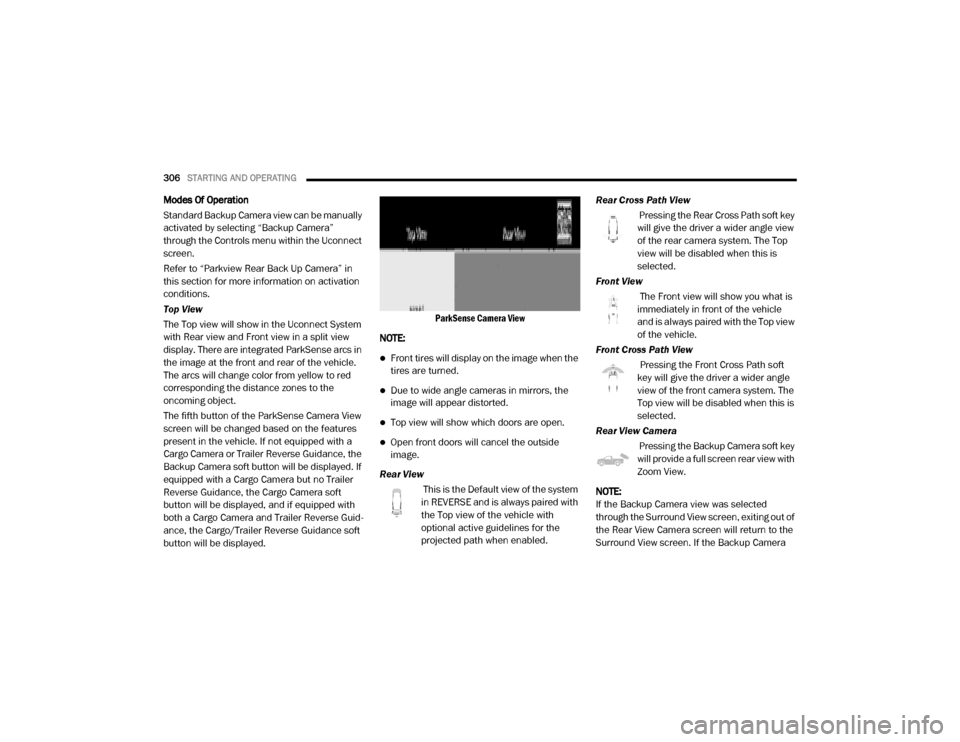
306STARTING AND OPERATING
Modes Of Operation
Standard Backup Camera view can be manually
activated by selecting “Backup Camera”
through the Controls menu within the Uconnect
screen.
Refer to “Parkview Rear Back Up Camera” in
this section for more information on activation
conditions.
Top View
The Top view will show in the Uconnect System
with Rear view and Front view in a split view
display. There are integrated ParkSense arcs in
the image at the front and rear of the vehicle.
The arcs will change color from yellow to red
corresponding the distance zones to the
oncoming object.
The fifth button of the ParkSense Camera View
screen will be changed based on the features
present in the vehicle. If not equipped with a
Cargo Camera or Trailer Reverse Guidance, the
Backup Camera soft button will be displayed. If
equipped with a Cargo Camera but no Trailer
Reverse Guidance, the Cargo Camera soft
button will be displayed, and if equipped with
both a Cargo Camera and Trailer Reverse Guid -
ance, the Cargo/Trailer Reverse Guidance soft
button will be displayed.
ParkSense Camera View
NOTE:
Front tires will display on the image when the
tires are turned.
Due to wide angle cameras in mirrors, the
image will appear distorted.
Top view will show which doors are open.
Open front doors will cancel the outside
image.
Rear View This is the Default view of the system
in REVERSE and is always paired with
the Top view of the vehicle with
optional active guidelines for the
projected path when enabled. Rear Cross Path View
Pressing the Rear Cross Path soft key
will give the driver a wider angle view
of the rear camera system. The Top
view will be disabled when this is
selected.
Front View The Front view will show you what is
immediately in front of the vehicle
and is always paired with the Top view
of the vehicle.
Front Cross Path View Pressing the Front Cross Path soft
key will give the driver a wider angle
view of the front camera system. The
Top view will be disabled when this is
selected.
Rear View Camera Pressing the Backup Camera soft key
will provide a full screen rear view with
Zoom View.
NOTE:
If the Backup Camera view was selected
through the Surround View screen, exiting out of
the Rear View Camera screen will return to the
Surround View screen. If the Backup Camera
20_DJD2_OM_EN_USC_t.book Page 306