seats Ram 3500 2020 Owner's Guide
[x] Cancel search | Manufacturer: RAM, Model Year: 2020, Model line: 3500, Model: Ram 3500 2020Pages: 568
Page 202 of 568
200SAFETY
some rear-facing child restraints will also be
equipped with a tether strap. The tether strap
will have a hook at the end to attach to the top
tether anchorage and a way to tighten the strap
after it is attached to the anchorage.
Center Seat LATCH
Regular Cab Or Crew Cab Full Bench Rear Seat:
No Lower Center LATCH Anchorages Available Crew Cab Split Bench Rear Seat Or Mega Cab
Rear Seat: Center LATCH Anchorages Available
If a child restraint installed in the center
position blocks the seat belt webbing or buckle
for the outboard position, do not use that
outboard position. If a child seat in the center
position blocks the outboard LATCH anchors or
seat belt, do not install a child seat in that
outboard position.
Always follow the directions of the child
restraint manufacturer when installing your
child restraint. Not all child restraint systems
will be installed as described here.
To Install A LATCH-Compatible Child
Restraint
If the selected seating position has a
Switchable Automatic Locking Retractor (ALR)
seat belt, stow the seat belt, following the
instructions below. See the section “Installing
Child Restraints Using the Vehicle Seat Belt” to
check what type of seat belt each seating
position has.
1. Loosen the adjusters on the lower straps
and on the tether strap of the child seat so
that you can more easily attach the hooks
or connectors to the vehicle anchorages.
2. Place the child seat between the lower anchorages for that seating position. If the
second row seat can be reclined, you may
recline the seat and/or raise the head
restraint (if adjustable) to get a better fit. If
the rear seat can be moved forward and
rearward in the vehicle, you may wish to
move it to its rear-most position to make
room for the child seat. You may also move
the front seat forward to allow more room
for the child seat.
WARNING!
Do not install a child restraint in the center
position using the LATCH system. This posi -
tion is not approved for installing child seats
using the LATCH attachments. You must use
the seat belt and tether anchor to install a
child seat in the center seating position.
Never use the same lower anchorage to
attach more than one child restraint. Please
refer to “To Install A LATCH-Compatible Child
Restraint” for typical installation instruc -
tions.
WARNING!
Never use the same lower anchorage to
attach more than one child restraint. Please
refer to “To Install A LATCH-Compatible Child
Restraint” for typical installation instructions.
20_DJD2_OM_EN_USC_t.book Page 200
Page 204 of 568
202SAFETY
Installing Child Restraints Using The
Vehicle Seat Belt
Child restraint systems are designed to be
secured in vehicle seats by lap belts or the lap
belt portion of a lap/shoulder belt.
The seat belts in the passenger seating
positions are equipped with either a Switchable
Automatic Locking Retractor (ALR) or a cinching
latch plate or both. Both types of seat belts are
designed to keep the lap portion of the seat belt
tight around the child restraint so that it is not
necessary to use a locking clip. The ALR
retractor can be “switched” into a locked mode
by pulling all of the webbing out of the retractor
and then letting the webbing retract back into
the retractor. If it is locked, the ALR will make a
clicking noise while the webbing is pulled back into the retractor. Refer to the “Automatic
Locking Mode” description in “Switchable
Automatic Locking Retractors (ALR)” under
“Occupant Restraint Systems” for additional
information on ALR. The cinching latch plate is
designed to hold the lap portion of the seat belt
tight when webbing is pulled tight and straight
through a child restraint’s belt path.
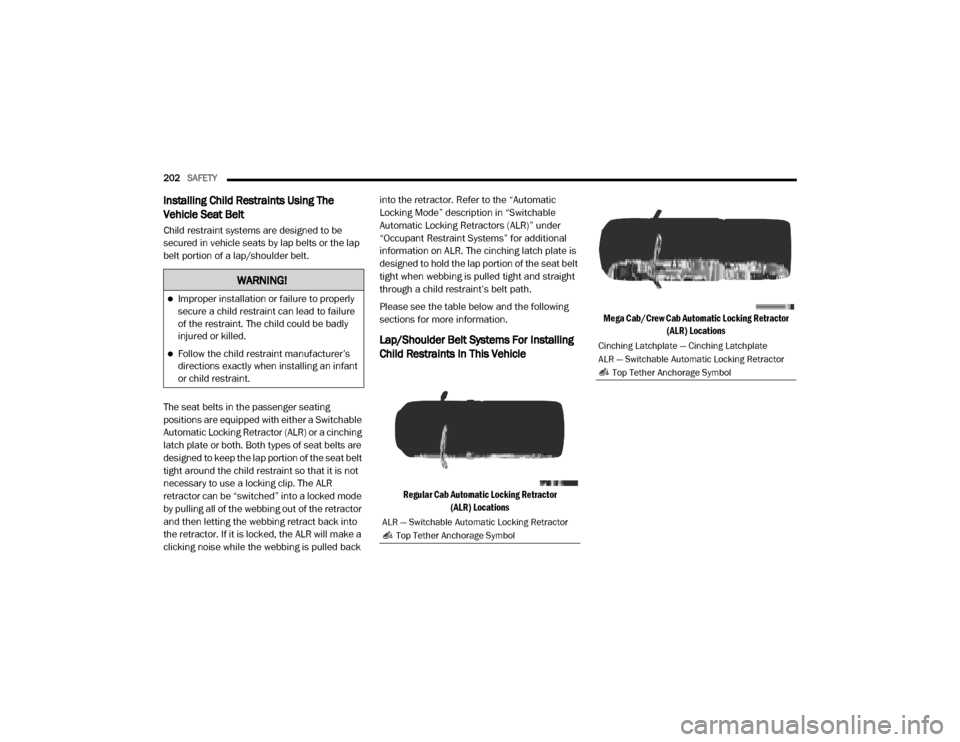
Please see the table below and the following
sections for more information.
Lap/Shoulder Belt Systems For Installing
Child Restraints In This Vehicle
Regular Cab Automatic Locking Retractor
(ALR) Locations Mega Cab/Crew Cab Automatic Locking Retractor
(ALR) Locations
WARNING!
Improper installation or failure to properly
secure a child restraint can lead to failure
of the restraint. The child could be badly
injured or killed.
Follow the child restraint manufacturer’s
directions exactly when installing an infant
or child restraint.
ALR — Switchable Automatic Locking Retractor
Top Tether Anchorage Symbol
Cinching Latchplate — Cinching Latchplate
ALR — Switchable Automatic Locking Retractor Top Tether Anchorage Symbol
20_DJD2_OM_EN_USC_t.book Page 202
Page 206 of 568

204SAFETY
Installing A Child Restraint With A
Switchable Automatic Locking Retractor
(ALR):
Child restraint systems are designed to be
secured in vehicle seats by lap belts or the lap
belt portion of a lap/shoulder belt.
1. For Mega and Crew Cab Models
Place the child seat in the center of the
seating position. If the second row seat can
be reclined, you may recline the seat and/or
raise the head restraint (if adjustable) to get
a better fit. If the rear seat can be moved
forward and rearward in the vehicle, you
may wish to move it to its rear-most position
to make room for the child seat. You may
also move the front seat forward to allow
more room for the child seat. For Regular Cab Models
Place the child seat in the center of the
seating position. Move the vehicle seat as
far rearward as possible to keep the child as
far from the passenger air bag as possible.
2. Pull enough of the seat belt webbing from the retractor to pass it through the belt path
of the child restraint. Do not twist the belt
webbing in the belt path.
3. Slide the latch plate into the buckle until you hear a “click.”
4. Pull on the webbing to make the lap portion tight against the child seat.
5. To lock the seat belt, pull down on the shoulder part of the belt until you have
pulled all the seat belt webbing out of the
retractor. Then, allow the webbing to retract
back into the retractor. As the webbing
retracts, you will hear a clicking sound. This
means the seat belt is now in the Automatic
Locking mode. 6. Try to pull the webbing out of the retractor.
If it is locked, you should not be able to pull
out any webbing. If the retractor is not
locked, repeat step 5.
7. Finally, pull up on any excess webbing to tighten the lap portion around the child
restraint while you push the child restraint
rearward and downward into the vehicle
seat.
8. If the child restraint has a top tether strap and the seating position has a top tether
anchorage, connect the tether strap to the
anchorage and tighten the tether strap. See
the section “Installing Child Restraints
Using the Top Tether Anchorage” for
directions to attach a tether anchor.
9. Test that the child restraint is installed tightly by pulling back and forth on the child
seat at the belt path. It should not move
more than 1 inch (25.4 mm) in any
direction.
Any seat belt system will loosen with time, so
check the belt occasionally, and pull it tight if
necessary.
WARNING!
Improper installation or failure to properly
secure a child restraint can lead to failure
of the restraint. The child could be badly
injured or killed.
Follow the child restraint manufacturer’s
directions exactly when installing an infant
or child restraint.
20_DJD2_OM_EN_USC_t.book Page 204
Page 207 of 568
SAFETY205
Installing A Child Restraint With A Cinching
Latch Plate (CINCH) — If Equipped:
Child restraint systems are designed to be
secured in vehicle seats by lap belts or the lap
belt portion of a lap/shoulder belt.
1. Place the child seat in the center of the
seating position. If the second row seat can
be reclined, you may recline the seat and/
or raise the head restraint (if adjustable) to
get a better fit. If the rear seat can be
moved forward and rearward in the
vehicle, you may wish to move it to its
rear-most position to make room for the
child seat. You may also move the front
seat forward to allow more room for the
child seat.
2. Next, pull enough of the seat belt webbing
from the retractor to pass it through the belt
path of the child restraint. Do not twist the
belt webbing in the belt path.
3. Slide the latch plate into the buckle until you hear a “click.”
4. Finally, pull up on any excess webbing to tighten the lap portion around the child
restraint while you push the child restraint
rearward and downward into the vehicle
seat.
5. If the child restraint has a top tether strap and the seating position has a top tether
anchorage, connect the tether strap to the
anchorage and tighten the tether strap. See
the section “Installing Child Restraints
Using the Top Tether Anchorage” for
directions to attach a tether anchor.
6. Test that the child restraint is installed tightly by pulling back and forth on the child
seat at the belt path. It should not move
more than 1 inch (25.4 mm) in any
direction. Any seat belt system will loosen with time, so
check the belt occasionally, and pull it tight if
necessary.
If the buckle or the cinching latch plate is too
close to the belt path opening of the child
restraint, you may have trouble tightening the
seat belt. If this happens, disconnect the latch
plate from the buckle and twist the short
buckle-end belt up to three full turns to shorten
it. Insert the latch plate into the buckle with the
release button facing out, away from the child
restraint. Repeat steps 4 to 6, above, to
complete the installation of the child restraint.
If the belt still cannot be tightened after you
shorten the buckle, disconnect the latch plate
from the buckle, turn the buckle around one
half turn, and insert the latch plate into the
buckle again. If you still cannot make the child
restraint installation tight, try a different seating
position.
WARNING!
Improper installation or failure to properly
secure a child restraint can lead to failure
of the restraint. The child could be badly
injured or killed.
Follow the child restraint manufacturer’s
directions exactly when installing an infant
or child restraint.
4
20_DJD2_OM_EN_USC_t.book Page 205
Page 208 of 568
206SAFETY
Installing Child Restraints Using The Top
Tether Anchorage
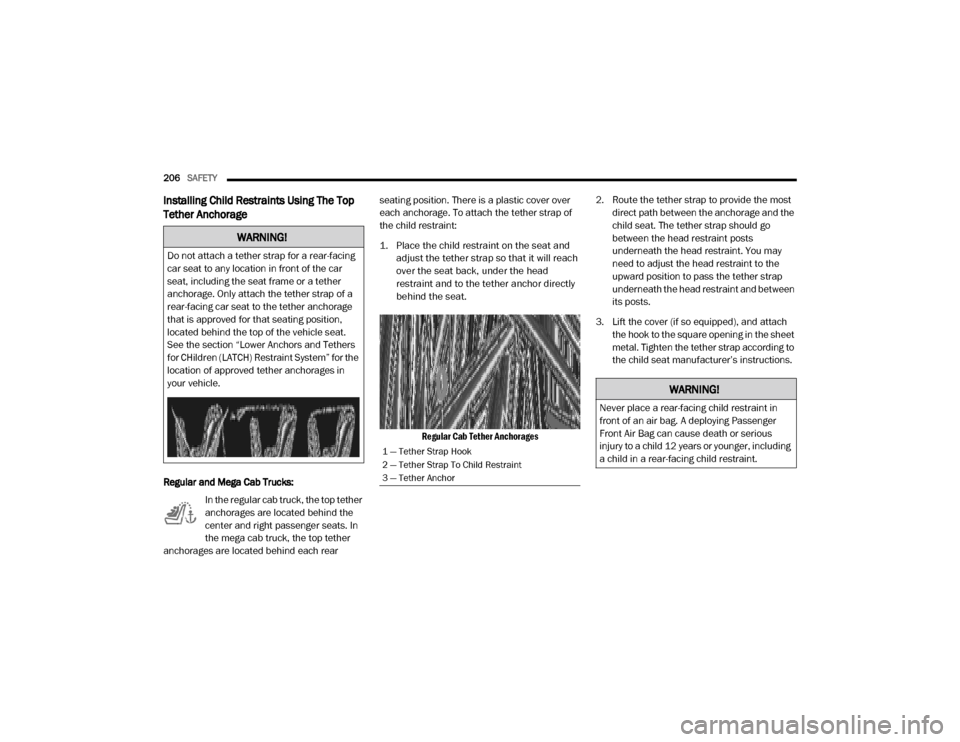
Regular and Mega Cab Trucks:
In the regular cab truck, the top tether
anchorages are located behind the
center and right passenger seats. In
the mega cab truck, the top tether
anchorages are located behind each rear seating position. There is a plastic cover over
each anchorage. To attach the tether strap of
the child restraint:
1. Place the child restraint on the seat and
adjust the tether strap so that it will reach
over the seat back, under the head
restraint and to the tether anchor directly
behind the seat.
Regular Cab Tether Anchorages
2. Route the tether strap to provide the most
direct path between the anchorage and the
child seat. The tether strap should go
between the head restraint posts
underneath the head restraint. You may
need to adjust the head restraint to the
upward position to pass the tether strap
underneath the head restraint and between
its posts.
3. Lift the cover (if so equipped), and attach the hook to the square opening in the sheet
metal. Tighten the tether strap according to
the child seat manufacturer’s instructions.
WARNING!
Do not attach a tether strap for a rear-facing
car seat to any location in front of the car
seat, including the seat frame or a tether
anchorage. Only attach the tether strap of a
rear-facing car seat to the tether anchorage
that is approved for that seating position,
located behind the top of the vehicle seat.
See the section “Lower Anchors and Tethers
for CHildren (LATCH) Restraint System” for the
location of approved tether anchorages in
your vehicle.
1 — Tether Strap Hook
2 — Tether Strap To Child Restraint
3 — Tether Anchor
WARNING!
Never place a rear-facing child restraint in
front of an air bag. A deploying Passenger
Front Air Bag can cause death or serious
injury to a child 12 years or younger, including
a child in a rear-facing child restraint.
20_DJD2_OM_EN_USC_t.book Page 206
Page 209 of 568
SAFETY207
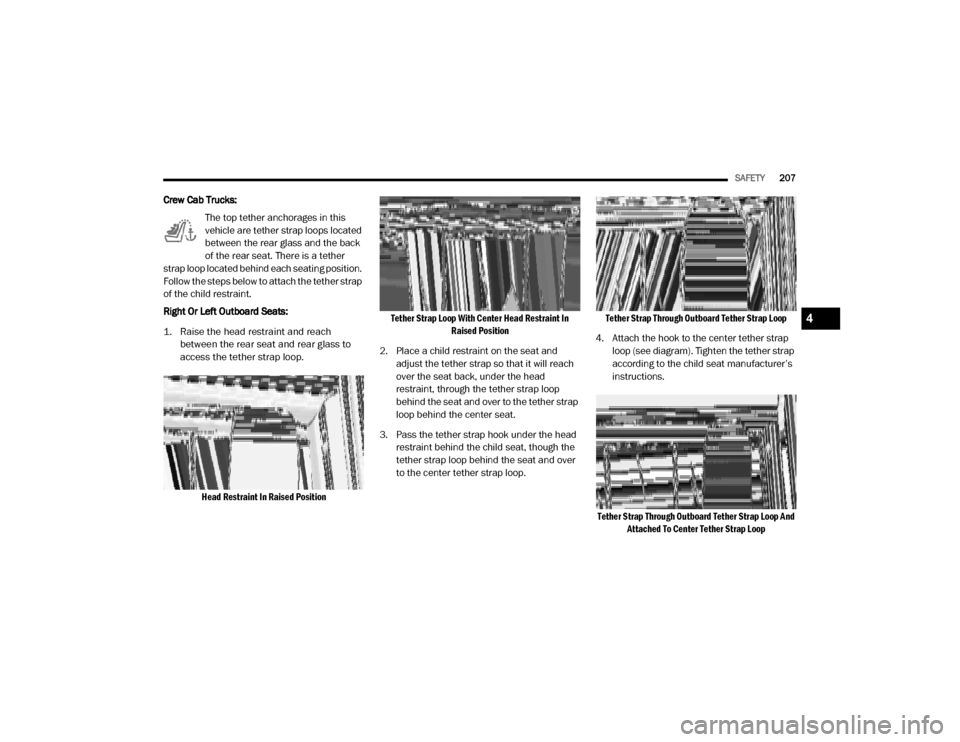
Crew Cab Trucks:
The top tether anchorages in this
vehicle are tether strap loops located
between the rear glass and the back
of the rear seat. There is a tether
strap loop located behind each seating position.
Follow the steps below to attach the tether strap
of the child restraint.
Right Or Left Outboard Seats:
1. Raise the head restraint and reach between the rear seat and rear glass to
access the tether strap loop.
Head Restraint In Raised Position Tether Strap Loop With Center Head Restraint In
Raised Position
2. Place a child restraint on the seat and adjust the tether strap so that it will reach
over the seat back, under the head
restraint, through the tether strap loop
behind the seat and over to the tether strap
loop behind the center seat.
3. Pass the tether strap hook under the head restraint behind the child seat, though the
tether strap loop behind the seat and over
to the center tether strap loop.
Tether Strap Through Outboard Tether Strap Loop
4. Attach the hook to the center tether strap loop (see diagram). Tighten the tether strap
according to the child seat manufacturer’s
instructions.
Tether Strap Through Outboard Tether Strap Loop And Attached To Center Tether Strap Loop
4
20_DJD2_OM_EN_USC_t.book Page 207
Page 210 of 568
208SAFETY
NOTE:
If there are child seats in both of the outboard
(left and right) seating positions, the tether
strap hooks of both child seats should be
connected to the center tether strap loop. This
is the correct way to tether two outboard child
seats.
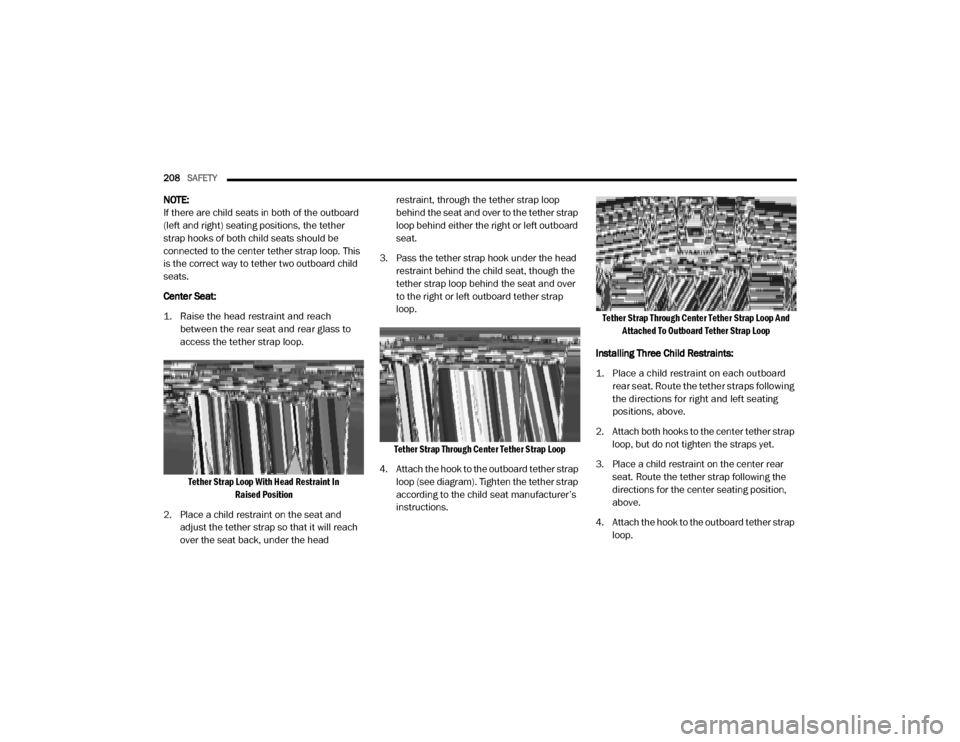
Center Seat:
1. Raise the head restraint and reach
between the rear seat and rear glass to
access the tether strap loop.
Tether Strap Loop With Head Restraint In Raised Position
2. Place a child restraint on the seat and adjust the tether strap so that it will reach
over the seat back, under the head restraint, through the tether strap loop
behind the seat and over to the tether strap
loop behind either the right or left outboard
seat.
3. Pass the tether strap hook under the head restraint behind the child seat, though the
tether strap loop behind the seat and over
to the right or left outboard tether strap
loop.
Tether Strap Through Center Tether Strap Loop
4. Attach the hook to the outboard tether strap loop (see diagram). Tighten the tether strap
according to the child seat manufacturer’s
instructions.
Tether Strap Through Center Tether Strap Loop And
Attached To Outboard Tether Strap Loop
Installing Three Child Restraints:
1. Place a child restraint on each outboard rear seat. Route the tether straps following
the directions for right and left seating
positions, above.
2. Attach both hooks to the center tether strap loop, but do not tighten the straps yet.
3. Place a child restraint on the center rear seat. Route the tether strap following the
directions for the center seating position,
above.
4. Attach the hook to the outboard tether strap loop.
20_DJD2_OM_EN_USC_t.book Page 208
Page 211 of 568

SAFETY209
(Continued)
(Continued)
5. Tighten the tether straps according to the
child seat manufacturer’s instructions,
tightening the right and left tether straps
before the center tether strap.
Outboard And Center Seating Positions Shown
TRANSPORTING PETS
Air Bags deploying in the front seat could harm
your pet. An unrestrained pet will be thrown
about and possibly injured, or injure a
passenger during panic braking or in a collision.
Pets should be restrained in the rear seat (if
equipped) in pet harnesses or pet carriers that
are secured by seat belts.
SAFETY TIPS
TRANSPORTING PASSENGERS
NEVER TRANSPORT PASSENGERS IN THE
CARGO AREA.
EXHAUST GAS
WARNING!
An incorrectly anchored tether strap could
lead to increased head motion and
possible injury to the child. Use only the
anchorage position directly behind the child
seat to secure a child restraint top tether
strap.
If your vehicle is equipped with a split rear
seat, make sure the tether strap does not
slip into the opening between the seat -
backs as you remove slack in the strap.
WARNING!
Do not leave children or animals inside
parked vehicles in hot weather. Interior
heat build-up may cause serious injury or
death.
It is extremely dangerous to ride in a cargo
area, inside or outside of a vehicle. In a
collision, people riding in these areas are
more likely to be seriously injured or killed.
Do not allow people to ride in any area of
your vehicle that is not equipped with seats
and seat belts.
Be sure everyone in your vehicle is in a seat
and using a seat belt properly.
WARNING!
Exhaust gases can injure or kill. They contain
carbon monoxide (CO), which is colorless and
odorless. Breathing it can make you
unconscious and can eventually poison you.
To avoid breathing (CO), follow these safety
tips:
Do not run the engine in a closed garage or
in confined areas any longer than needed
to move your vehicle in or out of the area.
If you are required to drive with the trunk/
liftgate/rear doors open, make sure that all
windows are closed and the climate control
BLOWER switch is set at high speed. DO
NOT use the recirculation mode.
WARNING! (Continued)
4
20_DJD2_OM_EN_USC_t.book Page 209
Page 362 of 568
360IN CASE OF EMERGENCY
F2530 Amp Pink –Front Wiper
F26 —–Spare
F27 —–Spare
F28 20 Amp Blue –Trailer Tow Backup Lights – If Equipped
F29 20 Amp Blue –Trailer Tow Parking Lights – If Equipped
F30 30 Amp Pink –Trailer Tow Receptacle / Trailer Tow (Separate E-Brake) /
Trailer Tow
F31 ––Spare
F32 ––Spare
F33 20 Amp Blue –Trans Control Module – If Equipped
F34 30 Amp Pink –Vehicle System Interface Module #2 – If Equipped
F35 30 Amp Pink –Sunroof – If Equipped
F36 30 Amp Pink –Electric Back Light – If Equipped
F37 30 Amp Pink –Diesel Frame / Fuel Heater #2– If Equipped
F38 30 Amp Pink –Integrated Trailer Brake Module – If Equipped
F39 ––Spare
F40 –10 Amp Red Ventilated Seats – If Equipped
F41 –10 Amp Red Active Grille Shutter / Active Air Dam – If Equipped
F42 –20 Amp Yellow Horn
F43 –15 Amp Blue Heated Steering Wheel – If Equipped
F44 –10 Amp Red Diagnostic Port
CavityCartridge Fuse Micro Fuse Description
20_DJD2_OM_EN_USC_t.book Page 360
Page 452 of 568

450SERVICING AND MAINTENANCE
INTERIORS
SEATS AND FABRIC PARTS
Use Mopar Total Clean to clean fabric
upholstery and carpeting.
Stain Repel Fabric Cleaning Procedure — If
Equipped
Stain Repel seats may be cleaned in the
following manner:
Remove as much of the stain as possible by
blotting with a clean, dry towel.
Blot any remaining stain with a clean, damp
towel.
For tough stains, apply Mopar Total Clean, or
a mild soap solution to a clean, damp cloth
and remove stain. Use a fresh, damp towel to
remove soap residue.
For grease stains, apply Mopar Multi-Purpose
Cleaner to a clean, damp cloth and remove
stain. Use a fresh, damp towel to remove
soap residue.
Do not use any harsh solvents or any other
form of protectants on Stain Repel products.
Seat Belt Maintenance
Do not bleach, dye or clean the belts with
chemical solvents or abrasive cleaners. This will
weaken the fabric. Sun damage can also
weaken the fabric.
If the belts need cleaning, use a mild soap
solution or lukewarm water. Do not remove the
belts from the vehicle to wash them. Dry with a
soft cloth.
Replace the belts if they appear frayed or worn
or if the buckles do not work properly.
NOTE:
If the belts retract slowly, inspect the upper
turning loop for soiling. If soiling is present,
clean with a wet soft cloth until all residue is
removed.
PLASTIC AND COATED PARTS
Use Mopar Total Clean to clean vinyl upholstery.
WARNING!
Do not use volatile solvents for cleaning
purposes. Many are potentially flammable,
and if used in closed areas they may cause
respiratory harm.
WARNING!
A frayed or torn belt could rip apart in a
collision and leave you with no protection.
Inspect the belt system periodically, checking
for cuts, frays, or loose parts. Damaged parts
must be replaced immediately. Do not
disassemble or modify the system. Seat belt
assemblies must be replaced after a collision
if they have been damaged (i.e., bent
retractor, torn webbing, etc.).
CAUTION!
Direct contact of air fresheners, insect
repellents, suntan lotions, or hand sani -
tizers to the plastic, painted, or decorated
surfaces of the interior may cause perma -
nent damage. Wipe away immediately.
Damage caused by these type of products
may not be covered by your New Vehicle
Limited Warranty.
20_DJD2_OM_EN_USC_t.book Page 450