fuel Ram 3500 Chassis Cab 2019 Service Manual
[x] Cancel search | Manufacturer: RAM, Model Year: 2019, Model line: 3500 Chassis Cab, Model: Ram 3500 Chassis Cab 2019Pages: 607, PDF Size: 10.72 MB
Page 434 of 607

432 SERVICING AND MAINTENANCE
system and adjacent body areas for broken, damaged, dete-
riorated, or mispositioned parts. Open seams or loose
connections could permit exhaust fumes to seep into the
passenger compartment. In addition, have the exhaust
system inspected each time the vehicle is raised for lubrica -
tion or oil change. Replace as required.
Under normal operating conditions, the catalytic converter
will not require maintenance. However, it is important to
keep the engine properly tuned to assure proper catalyst
operation and prevent possible catalyst damage.
NOTE:
Intentional tampering with emissions control systems can
result in civil penalties being assessed against you.
WARNING!
• Exhaust gases can injure or kill. They contain carbon monoxide (CO), which is colorless and odorless.
Breathing it can make you unconscious and can eventu -
ally poison you. To avoid breathing CO, refer to “Safety
Tips” in “Safety” for further information.
• A hot exhaust system can start a fire if you park over materials that can burn. Such materials might be grass
or leaves coming into contact with your exhaust system.
Do not park or operate your vehicle in areas where your
exhaust system can contact anything that can burn.
CAUTION!
• The catalytic converter requires the use of unleaded fuel only. Leaded gasoline will destroy the effective -
ness of the catalyst as an emissions control device and
may seriously reduce engine performance and cause
serious damage to the engine.
• Damage to the catalytic converter can result if your vehicle is not kept in proper operating condition. In the
event of engine malfunction, particularly involving
engine misfire or other apparent loss of performance,
have your vehicle serviced promptly. Continued opera -
tion of your vehicle with a severe malfunction could
cause the converter to overheat, resulting in possible
damage to the converter and vehicle.
Page 456 of 607
454 SERVICING AND MAINTENANCE
(Continued)
Tires — General Information
Tire Pressure
Proper tire inflation pressure is essential to the safe and satis-
factory operation of your vehicle. Four primary areas are
affected by improper tire pressure:
• Safety
• Fuel Economy
• Tread Wear
• Ride Comfort and Vehicle Stability
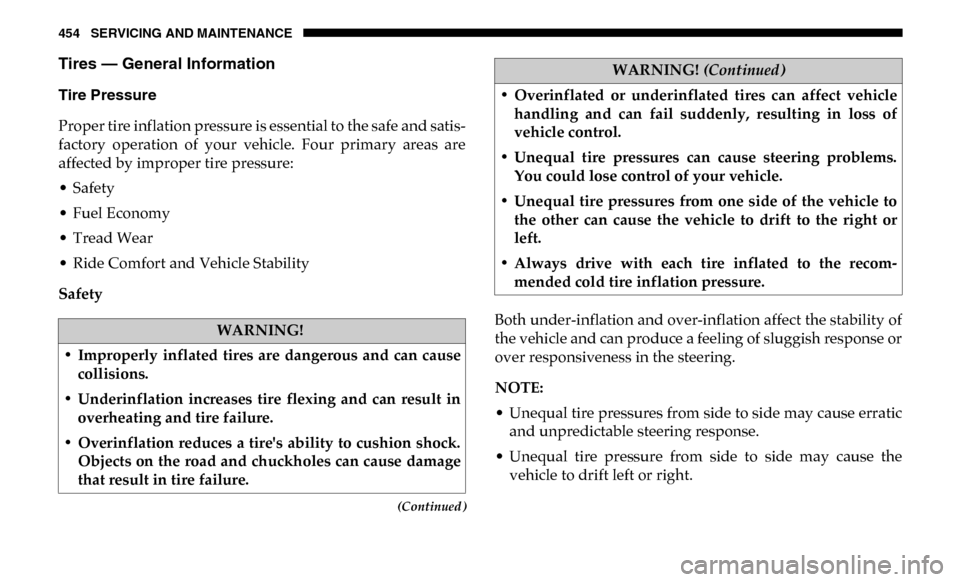
Safety
Both under-inflation and over-inflation affect the stability of
the vehicle and can produce a feeling of sluggish response or
over responsiveness in the steering.
NOTE:
• Unequal tire pressures from side to side may cause erraticand unpredictable steering response.
• Unequal tire pressure from side to side may cause the vehicle to drift left or right.
WARNING!
• Improperly inflated tires are dangerous and can cause collisions.
• Underinflation increases tire flexing and can result in overheating and tire failure.
• Overinflation reduces a tire's ability to cushion shock. Objects on the road and chuckholes can cause damage
that result in tire failure.
• Overinflated or underinflated tires can affect vehiclehandling and can fail suddenly, resulting in loss of
vehicle control.
• Unequal tire pressures can cause steering problems. You could lose control of your vehicle.
• Unequal tire pressures from one side of the vehicle to the other can cause the vehicle to drift to the right or
left.
• Always drive with each tire inflated to the recom -
mended cold tire inflation pressure.
WARNING! (Continued)
Page 457 of 607

SERVICING AND MAINTENANCE 455
Fuel Economy
Underinflated tires will increase tire rolling resistance
resulting in higher fuel consumption.
Tread Wear
Improper cold tire inflation pressures can cause abnormal
wear patterns and reduced tread life, resulting in the need
for earlier tire replacement.
Ride Comfort And Vehicle Stability
Proper tire inflation contributes to a comfortable ride.
Over-inflation produces a jarring and uncomfortable ride.
Tire Inflation Pressures
The proper cold tire inflation pressure is listed on the driver's
side B-Pillar or rear edge of the driver's side door.
At least once a month:
• Check and adjust tire pressure with a good qualitypocket-type pressure gauge. Do not make a visual judge -
ment when determining proper inflation. Tires may look
properly inflated even when they are under-inflated.
• Inspect tires for signs of tire wear or visible damage. Inflation pressures specified on the placard are always “cold
tire inflation pressure”. Cold tire inflation pressure is
defined as the tire pressure after the vehicle has not been
driven for at least three hours, or driven less than 1 mile
(1.6 km) after sitting for a minimum of three hours. The cold
tire inflation pressure must not exceed the maximum infla
-
tion pressure molded into the tire sidewall.
Check tire pressures more often if subject to a wide range of
outdoor temperatures, as tire pressures vary with tempera -
ture changes.
Tire pressures change by approximately 1 psi (7 kPa) per 12°F
(7°C) of air temperature change. Keep this in mind when
checking tire pressure inside a garage, especially in the Winter.
Example: If garage temperature = 68°F (20°C) and the
outside temperature = 32°F (0°C) then the cold tire inflation
pressure should be increased by 3 psi (21 kPa), which equals
1 psi (7 kPa) for every 12°F (7°C) for this outside temperature
condition. CAUTION!
After inspecting or adjusting the tire pressure, always
reinstall the valve stem cap. This will prevent moisture
and dirt from entering the valve stem, which could
damage the valve stem.
7
Page 481 of 607

TECHNICAL SPECIFICATIONS 479
The wheel nuts should then be tightened to recommended
torque. Tighten the wheel nuts to final torque in increments.
Progress around the bolt circle, tightening the wheel nut
opposite to the wheel nut just previously tightened until
final torque is achieved.
FUEL REQUIREMENTS
6.4L Engine
Do not use E-85 flex fuel or ethanol blends greater than 15%
in this engine.This engines is designed to meet all emissions regu -
lations and provide satisfactory fuel economy and
performance when using high quality unleaded
gasoline having a posted octane number range of 87 to 89 as
specified by the (R+M)/2 method. The use of 89 octane
“Plus” gasoline is recommended for optimum performance
and fuel economy. While operating on gasoline with an octane number of 87,
hearing a light knocking sound from the engine is not a cause
for concern. However, if the engine is heard making a heavy
knocking sound, see your dealer immediately. Use of gaso
-
line with an octane number lower than 87 can cause engine
failure and may void or not be covered by the New Vehicle
Limited Warranty.
Poor quality gasoline can cause problems such as hard
starting, stalling, and hesitations. If you experience these
symptoms, try another brand of gasoline before considering
service for the vehicle.
Reformulated Gasoline
Many areas of the country require the use of cleaner burning
gasoline referred to as “Reformulated Gasoline”. Reformu-
lated gasoline contains oxygenates and are specifically
blended to reduce vehicle emissions and improve air quality.
The use of reformulated gasoline is recommended. Properly
blended reformulated gasoline will provide improved
performance and durability of engine and fuel system
components.
WARNING!
To avoid the risk of forcing the vehicle off the jack, do
not tighten the lug nuts/bolts fully until the vehicle has
been lowered. Failure to follow this warning may result
in personal injury.
8
Page 482 of 607
480 TECHNICAL SPECIFICATIONS
Materials Added To Fuel
Besides using unleaded gasoline with the proper octane
rating, gasolines that contain detergents, corrosion and
stability additives are recommended. Using gasolines that
have these additives will help improve fuel economy, reduce
emissions, and maintain vehicle performance.Designated TOP TIER Detergent Gasoline contains a
higher level of detergents to further aide in mini -
mizing engine and fuel system deposits. When avail -
able, the usage of TOP TIER Detergent gasoline is
recommended. Visit www.toptiergas.com for a list of TOP
TIER Detergent Gasoline Retailers.
Indiscriminate use of fuel system cleaning agents should be
avoided. Many of these materials intended for gum and
varnish removal may contain active solvents or similar
ingredients. These can harm fuel system gasket and
diaphragm materials.
Gasoline/Oxygenate Blends
Some fuel suppliers blend unleaded gasoline with oxygen -
ates such as ethanol.
Problems that result from using gasoline containing more
than 15% ethanol (E-15) or gasoline containing methanol are
not the responsibility of the manufacturer and may void or
not be covered under New Vehicle Limited Warranty.
CAUTION!
DO NOT use E-85, gasoline containing methanol, or
gasoline containing more than 15% ethanol (E-15). Use of
these blends may result in starting and drivability
problems, damage critical fuel system components, cause
emissions to exceed the applicable standard, and/or
cause the Malfunction Indicator Light to illuminate.
Please observe pump labels as they should clearly
communicate if a fuel contains greater than 15% ethanol
(E-15).
Page 483 of 607

TECHNICAL SPECIFICATIONS 481
(Continued)
Do Not Use E-85 In Non-Flex Fuel Vehicles
Non-Flex Fuel Vehicles (FFV) are compatible with gasoline
containing up to 15% ethanol (E-15). Use of gasoline with
higher ethanol content may void the New Vehicle Limited
Warranty.
If a Non-FFV vehicle is inadvertently fueled with E-85 fuel,
the engine will have some or all of these symptoms:
• Operate in a lean mode.
• OBD II Malfunction Indicator Light on.
• Poor engine performance.
• Poor cold start and cold drivability.
• Increased risk for fuel system component corrosion.
CNG And LP Fuel System Modifications
Modifications that allow the engine to run on Compressed
Natural Gas (CNG) or Liquid Propane (LP) may result in
damage to the engine, emissions, and fuel system compo-
nents. Problems that result from running CNG or LP are not
the responsibility of the manufacturer and may void or not
be covered under the New Vehicle Limited Warranty.
MMT In Gasoline
Methylcyclopentadienyl Manganese Tricarbonyl (MMT) is a
manganese-containing metallic additive that is blended into
some gasoline to increase octane. Gasoline blended with
MMT provides no performance advantage beyond gasoline
of the same octane number without MMT. Gasoline blended
with MMT reduces spark plug life and reduces emissions
system performance in some vehicles. The manufacturer
recommends that gasoline without MMT be used in your
vehicle. The MMT content of gasoline may not be indicated
on the gasoline pump; therefore, you should ask your gaso -
line retailer whether the gasoline contains MMT. MMT is
prohibited in Federal and California reformulated gasoline.
Fuel System Cautions
CAUTION!
Follow these guidelines to maintain your vehicle’s
performance:
• The use of leaded gasoline is prohibited by Federal law. Using leaded gasoline can impair engine perfor -
mance and damage the emissions control system.
8
Page 484 of 607

482 TECHNICAL SPECIFICATIONS
NOTE:
Intentional tampering with the emissions control system can
result in civil penalties being assessed against you.
Carbon Monoxide Warnings
• An out-of-tune engine or certain fuel or ignitionmalfunctions can cause the catalytic converter to over -
heat. If you notice a pungent burning odor or some
light smoke, your engine may be out of tune or
malfunctioning and may require immediate service.
Contact an authorized dealer for service assistance.
• The use of fuel additives, which are now being sold as octane enhancers, is not recommended. Most of these
products contain high concentrations of methanol. Fuel
system damage or vehicle performance problems
resulting from the use of such fuels or additives is not
the responsibility of the manufacturer and may void or
not be covered under the New Vehicle Limited
Warranty. CAUTION!
(Continued)WARNING!
Carbon monoxide (CO) in exhaust gases is deadly.
Follow the precautions below to prevent carbon
monoxide poisoning:
• Do not inhale exhaust gases. They contain carbon monoxide, a colorless and odorless gas, which can kill.
Never run the engine in a closed area, such as a garage,
and never sit in a parked vehicle with the engine
running for an extended period. If the vehicle is
stopped in an open area with the engine running for
more than a short period, adjust the ventilation system
to force fresh, outside air into the vehicle.
• Guard against carbon monoxide with proper mainte -
nance. Have the exhaust system inspected every time
the vehicle is raised. Have any abnormal conditions
repaired promptly. Until repaired, drive with all side
windows fully open.
Page 485 of 607

TECHNICAL SPECIFICATIONS 483
FLUID CAPACITIES
U.S.Metric
Fuel (Approximate)
Standard Rear Tank 52 Gallons197 Liters
Optional Midship Tank 22 Gallons83 Liters
Engine Oil With Filter
6.4L Engine (We recommend you use SAE 0W-40, Synthetic API Certified) 7 Quarts 6.6 Liters
Cooling System
6.4L Engine (We recommend you use Mopar Antifreeze/Coolant 10 Year/
150,000 Mile Formula). 16.6 Quarts
15.7 Liters
8
Page 486 of 607

484 TECHNICAL SPECIFICATIONS
FLUIDS AND LUBRICANTS
Engine
ComponentFluid, Lubricant, or Genuine Part
Engine Coolant We recommend you use Mopar Antifreeze/Coolant
10–Year/150,000 Mile Formula OAT (Organic Additive
Technology).
Engine Oil – 6.4L Engine For best performance and maximum protection under all
types of operating conditions, the manufacturer only
recommends full synthetic engine oils that meet the
American Petroleum Institute (API) categories of SN. The
manufacturer recommends the use of Pennzoil Ultra 0W-40
or equivalent Mopar engine oil meeting the requirements of
FCA Material Standard MS-12633 for use in all operating
temperatures.
Engine Oil Filter – 6.4L Engine We recommend you use Mopar Engine Oil Filters.
Spark Plugs – 6.4L Engine We recommend you use Mopar Spark Plugs.
Fuel Selection – 6.4L Engine 89 Octane Recommended - 87 Octane Acceptable, 0-15%
Ethanol.
Page 493 of 607

MULTIMEDIA 491
Display
After pressing the “Display” button on the touchscreen, the following settings will be available.
Units — If Equipped
After pressing “Units” on the touchscreen, the following will be available:Setting Name
Selectable Options
Display Mode AutoManual
Set Language English, Français, Español
Touchscreen Beep OnOff
Fuel Saver Display OnOff
NOTE:
The “Fuel Saver Display” feature will allow you to enable fuel saver mode and will be displayed in the instrument cluster
display.
Setting Name Selectable Options
Units USMetric Custom
Speed MPH km/h
Distance mi km
Fuel Consumption MPG (UG)MPG (UK) L/100 km km/L
Pressure psikPa bar
9