trailer RAM CHASSIS CAB 2019 Repair Manual
[x] Cancel search | Manufacturer: RAM, Model Year: 2019, Model line: CHASSIS CAB, Model: RAM CHASSIS CAB 2019Pages: 607, PDF Size: 12.68 MB
Page 386 of 607

384 IN CASE OF EMERGENCY
F34 30 Amp Pink – Vehicle System Interface Module #2 – If Equipped
(HD Only)
SSV (DS 1500 Only)
F35 30 Amp Pink – Sunroof – If Equipped
F36 30 Amp Pink – Electric Back Light – If Equipped
F37 30 Amp Pink – Fuel Heater #2, Aux Relay 2 – If Equipped (HD Only)
SSV (DS 1500 Only)
F38 30 Amp Pink – Integrated Trailer Brake Module – If Equipped
(HD Only)
Power Inverter 115V AC – If Equipped (DS 1500 Only)
F39 20 Amp Blue
– Power Outlet – SSV Only
F40 – 10 Amp Red Ventilated Seats – If Equipped (HD Only)
F41 – 10 Amp Red Active Grille Shutter / Active Air Dam – If Equipped
F42 – 20 Amp Yellow Horn
F43 – 15 Amp Blue Heated Steering Wheel – If Equipped (HD Only)
F44 – 10 Amp Red Diagnostic Port
F46 – 10 Amp Red Upfitters Relay Coil – If Equipped (HD Only)
Spare (DS 1500 Only)
F49 – 10 Amp Red Instrument Panel Cluster / HVAC (DS 1500 Only)
Instrument Cluster / MOD CSG (HD Only)Cavity Cartridge Fuse Micro Fuse Description
Page 387 of 607

IN CASE OF EMERGENCY 385
F50 – 20 Amp Yellow Air Suspension Control Module – If Equipped
F51 – 10 Amp Red Ignition Node Module / Keyless Ignition Node Module,
Radio Frequency Hub Module / Electric Steering
Column Lock - If Equipped
F52 – 5 Amp Tan Battery Sensor
F53 – 20 Amp Yellow Trailer Tow – Left Turn/Stop Lights - If Equipped
F54 – 20 Amp Yellow Non Memory Adjustable Pedals - If Equipped
F56 – 15 Amp Blue Additional Diesel Content - If Equipped (DS 1500 Only)
F57 – 20 Amp Yellow TCM/PCM / Solenoid Trans Pressure SW (RFE Trans
Only) – If Equipped (HD Only)
Transmission (DS 1500 Only)
F58 – 10 Amp Red Bed Lighting (LED) – If Equipped (HD Only)
F60 – 15 Amp Blue Underhood Lamp / TCM – If Equipped (DS 1500 Only)
F61 – 10 Amp Red UREA Sensor / PM Sensor – If Equipped (DS 1500 LD
Diesel & Cummins Diesel)
F62 – 10 Amp Red Air Conditioning Clutch
F63 – 20 Amp Yellow Ignition Coils (Gas), Ignition Coils Capacitors (Gas) /
Short Runner Valve Actuator / Urea Heater Control
Unit (DS 1500 LD Diesel) / RLY Coil Feed-SCR (DS 1500
LD Diesel)Cavity Cartridge Fuse Micro Fuse Description
6
Page 390 of 607

388 IN CASE OF EMERGENCY
F80 – 10 Amp Red Universal Garage Door Opener / Compass /
Anti-Intrusion Module (DS 1500 Only)
ASSY Overhead Console / SW Assist / SW 911 – If
Equipped (HD Only)
F81 – 20 Amp Yellow Trailer Tow Right Turn / Stop Lights - If Equipped
F82 – 10 Amp Red Steering Column Control Module / Cruise Control
F83 – – No Connection
F84 – 15 Amp Blue ASBM / HVAC / ICS / Rear Heated Seat Switches
F85 – 10 Amp Red Airbag Module
F86 – 10 Amp Red Airbag Module
F87 – 10 Amp Red Air Suspension / ITBM / Steering Column Control
Module / MOD Gateway CAN-C Trailer TPM (HD
Only)
Air Suspension / Trailer Tow / DC/DC Converter
(Voltage Stabilizer) / Steering Column Control Module
/ Occupant Classification Sensor (DS 1500 Only)
F88 – 15 Amp Blue Instrument Panel Cluster
F90/F91 – 20 Amp Yellow IGN or BATT Customer Selectable – If Equipped
(HD Only)
Power Outlet (Rear Seats) Customer Selectable (DS 1500
Only)
F93 – 20 Amp Yellow Cigar Lighter - If EquippedCavity Cartridge Fuse Micro Fuse Description
Page 391 of 607

IN CASE OF EMERGENCY 389
F94 – 10 Amp Red Shift-By-Wire / Transfer Case Switch (DS 1500 Only)
Shift-By-Wire / Transfer Case Switch / Module TPM
Trailer (HD Only) / Module Gateway Can-C Trailer
TPM (HD Only)
F95 – 10 Amp Red Rearview Camera / Park Assist / CHMSL Camera /
Blind Spot Sensor / Surround View Camera (HD Only)
Rear Camera / Park Assist / Blind Spot Sensor /
Compass (DS 1500 Only)
F96 – 10 Amp Red Rear Seat Heater Switch / Trunk Lamp With Flashlamp
Charger / Truck Lamp - If Equipped (DS 1500 Only)
Trailer Camera – If Equipped (HD Only)
F97 – 25 Amp Clear Rear Heated Seats And Heated Steering Wheel – If
Equipped (DS 1500 Only)
F97 – 20 Amp Yellow Front Heated Seat Passenger – If Equipped (HD Only)
F98 – 25 Amp Clear Front Heated Seats – If Equipped (DS 1500 Only)
F98 – 20 Amp Yellow Front Heated Seat Driver – If Equipped (HD Only)
F99 – 10 Amp Red HVAC / DASM (DS 1500 Only)
HVAC / In-Car Temperature Sensor / CSG MOD /
Humidity Sensor (HD Only)
F100 – 10 Amp Red Upfitters – If Equipped (HD Only)
F101 – 15 Amp Blue SSV Only
F101 – 20 Amp Yellow Rear Heated Seat Right (HD Only)Cavity Cartridge Fuse Micro Fuse Description
6
Page 412 of 607

410
SERVICING AND MAINTENANCESCHEDULED SERVICING
Your vehicle is equipped with an automatic oil change indicator
system. The oil change indicator system will remind you that it
is time to take your vehicle in for scheduled maintenance.
Based on engine operation conditions, the oil change indi -
cator message will illuminate. This means that service is
required for your vehicle. Operating conditions such as
frequent short-trips, trailer tow, extremely hot or cold
ambient temperatures, and E85 fuel usage will influence
when the “Oil Change Required” message is displayed.
Severe Operating Conditions can cause the change oil
message to illuminate as early as 3,500 miles (5,600 km) since
last reset. Have your vehicle serviced as soon as possible,
within the next 500 miles (805 km).
Your authorized dealer will reset the oil change indicator
message after completing the scheduled oil change. If a sched -
uled oil change is performed by someone other than your autho -
rized dealer, the message can be reset by referring to the steps
described under “Instrument Cluster Display” in “Getting To
Know Your Instrument Panel” for further information. Gasoline Engines:
Under no circumstances should oil change intervals exceed
8,000 miles (13,000 km), twelve months or 350 hours of
engine run time, whichever comes first. The 350 hours of
engine run or idle time is generally only a concern for fleet
customers.
Severe Duty:
Change Engine Oil at 4,000 miles (6,500 km) or 350 hours of
engine run time if the vehicle is operated in a dusty and off
road environment or is operated predominately at idle or
very low engine RPM’s. This type of vehicle use is consid -
ered Severe Duty.
Page 414 of 607

412 SERVICING AND MAINTENANCE
Mileage or time passed
(whichever comes first)
20,000
30,000
40,000
50,000
60,000
70,000
80,000
90,000
100,000
110,000
120,000
130,000
140,000
150,000Or Years: 2 3 4 5 6 7 8 9 10 11 12 13 14 15
Or Kilometers:
32,000
48,000
64,000
80,000
96,000
112,000
128,000
144,000
160,000
176,000
192,000
208,000
224,000
240,000Additional Inspections
Inspect the CV/Universal joints. X X X X X
Inspect front suspension, tie rod
ends, and replace if necessary. X
X X X X X X
Inspect the front and rear axle
surfaces. If gear oil leakage is
suspected, check the fluid level.
If using your vehicle for police,
taxi, fleet, off-road or frequent
trailer towing, change axle fluid. X X X X X X X
Inspect the brake linings,
parking brake function. X X X X X X X
Additional Maintenance
Replace engine air filter. X X X X X
Replace spark plugs. 1
X
Page 415 of 607

SERVICING AND MAINTENANCE 413
Flush and replace the engine
coolant at 10 years or 150,000 miles
(240,000 km) whichever comes first. X X
Change the automatic transmission
fluid (AS66RC Transmission Only). X X X
Change the automatic transmission
fluid and sump filter (AS66RC
Transmission Only). X X
Inspect the transfer case fluid,
change for any of the following:
police, taxi, fleet, or frequent
trailer towing. X X X X X
Change the transfer case fluid. X
Inspect and replace PCV valve if
necessary. X
1. The spark plug change interval is mileage based only, yearly intervals do not apply. Mileage or time passed
(whichever comes first)
20,000
30,000
40,000
50,000
60,000
70,000
80,000
90,000
100,000
110,000
120,000
130,000
140,000
150,000Or Years: 2 3 4 5 6 7 8 9 10 11 12 13 14 15
Or Kilometers:
32,000
48,000
64,000
80,000
96,000
112,000
128,000
144,000
160,000
176,000
192,000
208,000
224,000
240,000 7
Page 453 of 607
SERVICING AND MAINTENANCE 451
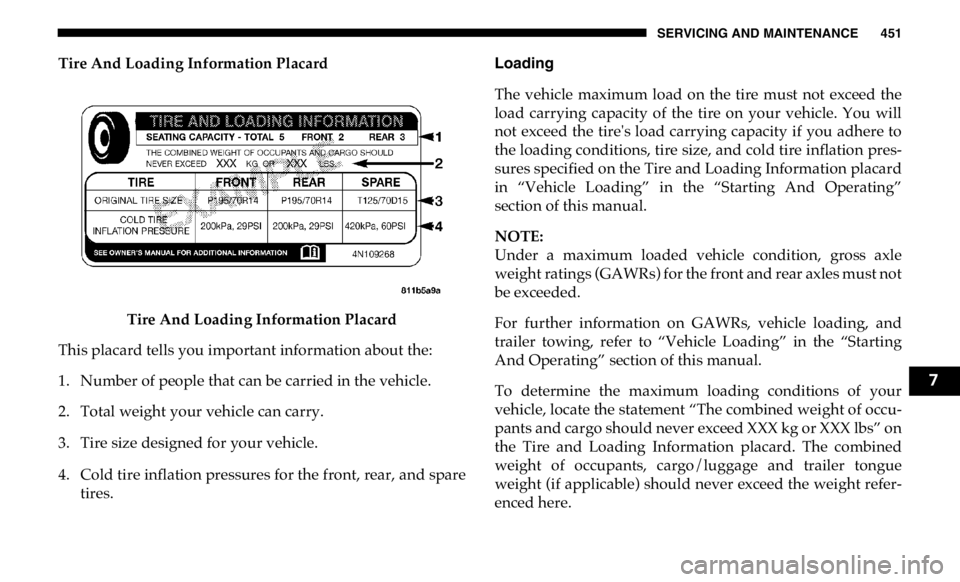
Tire And Loading Information Placard
Tire And Loading Information Placard
This placard tells you important information about the:
1. Number of people that can be carried in the vehicle.
2. Total weight your vehicle can carry.
3. Tire size designed for your vehicle.
4. Cold tire inflation pressures for the front, rear, and spare
tires. Loading
The vehicle maximum load on the tire must not exceed the
load carrying capacity of the tire on your vehicle. You will
not exceed the tire's load carrying capacity if you adhere to
the loading conditions, tire size, and cold tire inflation pres -
sures specified on the Tire and Loading Information placard
in “Vehicle Loading” in the “Starting And Operating”
section of this manual.
NOTE:
Under a maximum loaded vehicle condition, gross axle
weight ratings (GAWRs) for the front and rear axles must not
be exceeded.
For further information on GAWRs, vehicle loading, and
trailer towing, refer to “Vehicle Loading” in the “Starting
And Operating” section of this manual.
To determine the maximum loading conditions of your
vehicle, locate the statement “The combined weight of occu -
pants and cargo should never exceed XXX kg or XXX lbs” on
the Tire and Loading Information placard. The combined
weight of occupants, cargo/luggage and trailer tongue
weight (if applicable) should never exceed the weight refer -
enced here. 7
Page 454 of 607

452 SERVICING AND MAINTENANCE
Steps For Determining Correct Load Limit—
(1) Locate the statement “The combined weight of occu -
pants and cargo should never exceed XXX kg or XXX lbs.”
on your vehicle's placard.
(2) Determine the combined weight of the driver and
passengers that will be riding in your vehicle.
(3) Subtract the combined weight of the driver and
passengers from XXX kg or XXX lbs.
(4) The resulting figure equals the available amount of
cargo and luggage load capacity. For example, if “XXX”
amount equals 1400 lbs. and there will be five 150 lb
passengers in your vehicle, the amount of available cargo
and luggage load capacity is 650 lbs. (1400-750 (5x150) =
650 lbs.)
(5) Determine the combined weight of luggage and cargo
being loaded on the vehicle. That weight may not safely
exceed the available cargo and luggage load capacity
calculated in Step 4. (6) If your vehicle will be towing a trailer, load from your
trailer will be transferred to your vehicle. Consult this
manual to determine how this reduces the available cargo
and luggage load capacity of your vehicle.
Metric Example For Load Limit
For example, if “XXX” amount equals 635 kg and there will
be five 68 kg passengers in your vehicle, the amount of avail -
able cargo and luggage load capacity is 295 kg (635-340
(5x68) = 295 kg) as shown in step 4.
NOTE:
• If your vehicle will be towing a trailer, load from your
trailer will be transferred to your vehicle. The following
table shows examples on how to calculate total load,
cargo/luggage, and towing capacities of your vehicle with
varying seating configurations and number and size of
occupants. This table is for illustration purposes only and
may not be accurate for the seating and load carry capacity
of your vehicle.
• For the following example, the combined weight of occu -
pants and cargo should never exceed 865 lbs (392 kg).
Page 459 of 607

SERVICING AND MAINTENANCE 457
Run Flat Tires — If Equipped
Run Flat tires allow you the capability to drive 50 miles
(80 km) at 50 mph (80 km/h) after a rapid loss of inflation
pressure. This rapid loss of inflation is referred to as the Run
Flat mode. A Run Flat mode occurs when the tire inflation
pressure is of/or below 14 psi (96 kPa). Once a Run Flat tire
reaches the run flat mode it has limited driving capabilities
and needs to be replaced immediately. A Run Flat tire is not
repairable. When a run flat tire is changed after driving with
underinflated tire condition, please replace the TPM sensor
as it is not designed to be reused when driven under run flat
mode (14 psi (96 kPa)) condition.
NOTE:
TPM Sensor must be replaced after driving the vehicle on a
flat tire condition.
It is not recommended driving a vehicle loaded at full
capacity or to tow a trailer while a tire is in the run flat mode.
See the tire pressure monitoring section for more informa -
tion. Tire Spinning
When stuck in mud, sand, snow, or ice conditions, do not
spin your vehicle's wheels above 30 mph (48 km/h) or for
longer than 30 seconds continuously without stopping.
Refer to “Freeing A Stuck Vehicle” in “In Case Of Emer -
gency” for further information.
WARNING!
Fast spinning tires can be dangerous. Forces generated
by excessive wheel speeds may cause tire damage or
failure. A tire could explode and injure someone. Do not
spin your vehicle's wheels faster than 30 mph (48 km/h)
for more than 30 seconds continuously when you are
stuck, and do not let anyone near a spinning wheel, no
matter what the speed.
7