brake RAM CHASSIS CAB 2021 Owners Manual
[x] Cancel search | Manufacturer: RAM, Model Year: 2021, Model line: CHASSIS CAB, Model: RAM CHASSIS CAB 2021Pages: 463, PDF Size: 21.5 MB
Page 351 of 463

IN CASE OF EMERGENCY349
To Reset The Manual Park Release:
1. Push the locking tab to the right, to unlock
the lever.
2. Rotate the Manual Park Release lever forward to its original position, until the
locking tab snaps into place to secure the
lever.
3. Pull gently on the tether strap to confirm that the lever is locked in its stowed
position.
4. Re-install the access cover.
FREEING A STUCK VEHICLE
If your vehicle becomes stuck in mud, sand, or
snow, it can often be moved using a rocking
motion. Turn the steering wheel right and left to
clear the area around the front wheels. Then shift
back and forth between DRIVE (D) and REVERSE
(R), while gently pressing the accelerator. Use the
least amount of accelerator pedal pressure that
will maintain the rocking motion, without
spinning the wheels or racing the engine.
NOTE:
For trucks equipped with an 8–speed trans
-
mission, shifts between DRIVE and REVERSE
can only be achieved at wheel speeds of
5 mph (8 km/h) or less. Whenever the trans -
mission remains in NEUTRAL (N) for more
than two seconds, you must press the brake
pedal to engage DRIVE or REVERSE.
Push the ESC OFF switch, to place the
Electronic Stability Control (ESC) system in
“Partial Off” mode, before rocking the vehicle
Ú
page 274. Once the vehicle has been freed,
push the ESC OFF switch again to restore ESC
On mode.
WARNING!
Fast spinning tires can be dangerous. Forces
generated by excessive wheel speeds may
cause damage, or even failure, of the axle and
tires. A tire could explode and injure someone.
Do not spin your vehicle's wheels faster than
30 mph (48 km/h) or for longer than
30 seconds continuously without stopping
when you are stuck and do not let anyone near
a spinning wheel, no matter what the speed.
CAUTION!
Racing the engine or spinning the wheels
may lead to transmission overheating and
failure. Allow the engine to idle with the
transmission in NEUTRAL for at least one
minute after every five rocking-motion
cycles. This will minimize overheating and
reduce the risk of transmission failure during
prolonged efforts to free a stuck vehicle.
When “rocking” a stuck vehicle by shifting
between DRIVE and REVERSE, do not spin
the wheels faster than 15 mph (24 km/h), or drivetrain damage may result.
Revving the engine or spinning the wheels
too fast may lead to transmission over -
heating and failure. It can also damage the
tires. Do not spin the wheels above 30 mph
(48 km/h) while in gear (no transmission
shifting occurring).
7
21_DPF_OM_EN_USC_t.book Page 349
Page 355 of 463
353
SERVICING AND MAINTENANCE
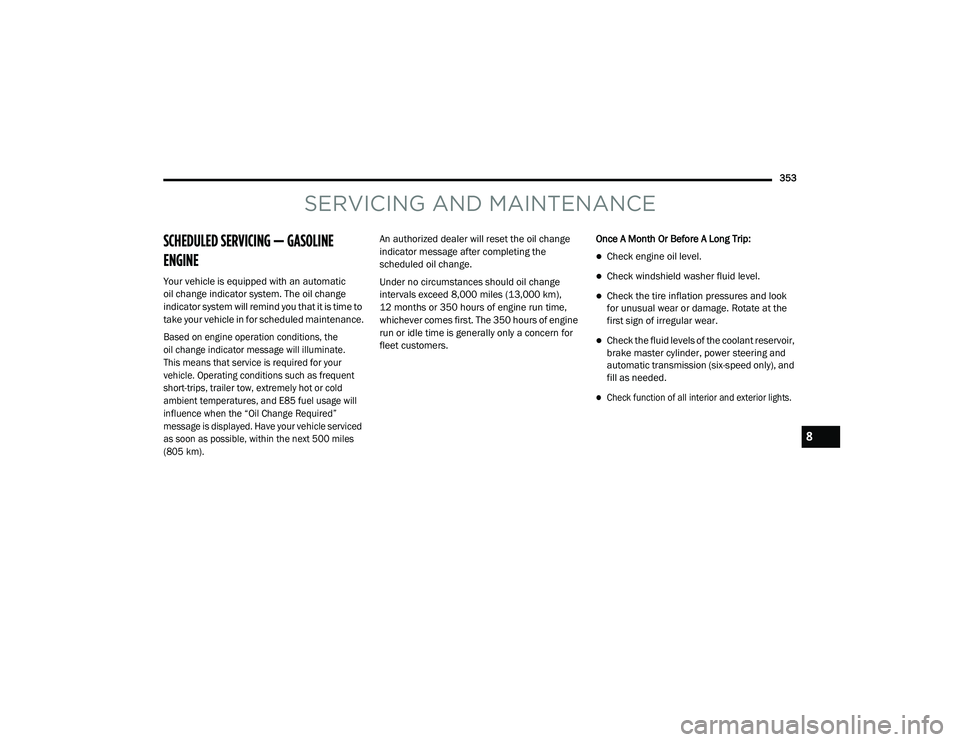
SCHEDULED SERVICING — GASOLINE
ENGINE
Your vehicle is equipped with an automatic
oil change indicator system. The oil change
indicator system will remind you that it is time to
take your vehicle in for scheduled maintenance.
Based on engine operation conditions, the
oil change indicator message will illuminate.
This means that service is required for your
vehicle. Operating conditions such as frequent
short-trips, trailer tow, extremely hot or cold
ambient temperatures, and E85 fuel usage will
influence when the “Oil Change Required”
message is displayed. Have your vehicle serviced
as soon as possible, within the next 500 miles
(805 km).
An authorized dealer will reset the oil change
indicator message after completing the
scheduled oil change.
Under no circumstances should oil change
intervals exceed 8,000 miles (13,000 km),
12 months or 350 hours of engine run time,
whichever comes first. The 350 hours of engine
run or idle time is generally only a concern for
fleet customers.
Once A Month Or Before A Long Trip:
Check engine oil level.
Check windshield washer fluid level.
Check the tire inflation pressures and look
for unusual wear or damage. Rotate at the
first sign of irregular wear.
Check the fluid levels of the coolant reservoir,
brake master cylinder, power steering and
automatic transmission (six-speed only), and
fill as needed.
Check function of all interior and exterior lights.
8
21_DPF_OM_EN_USC_t.book Page 353
Page 356 of 463
354SERVICING AND MAINTENANCE
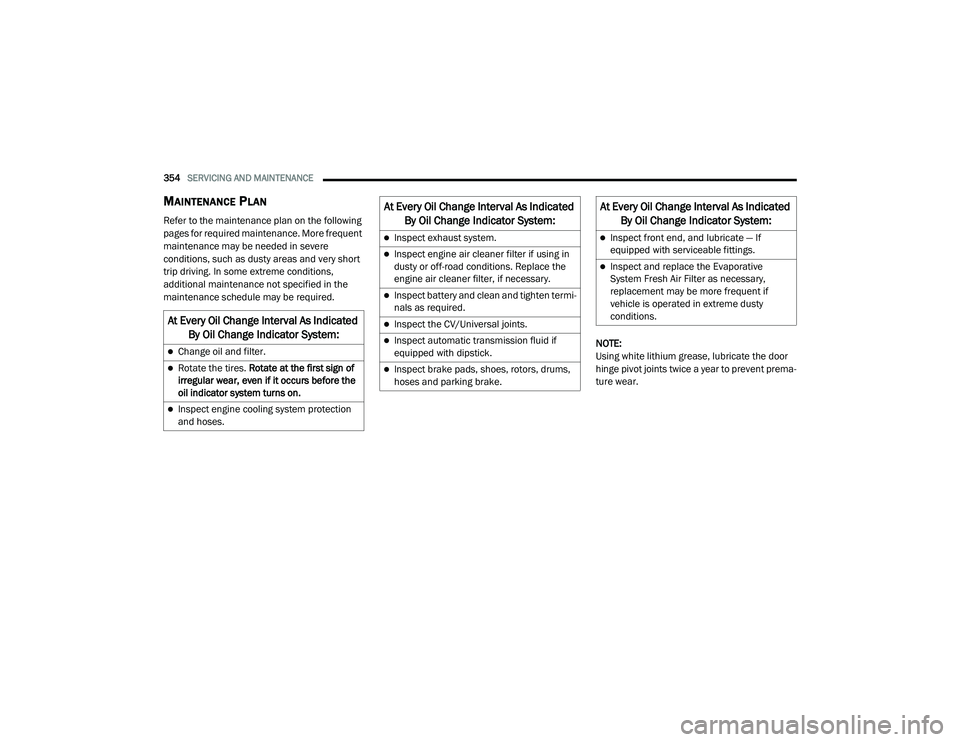
MAINTENANCE PLAN
Refer to the maintenance plan on the following
pages for required maintenance. More frequent
maintenance may be needed in severe
conditions, such as dusty areas and very short
trip driving. In some extreme conditions,
additional maintenance not specified in the
maintenance schedule may be required.
NOTE:
Using white lithium grease, lubricate the door
hinge pivot joints twice a year to prevent prema-
ture wear.
At Every Oil Change Interval As Indicated By Oil Change Indicator System:
Change oil and filter.
Rotate the tires. Rotate at the first sign of
irregular wear, even if it occurs before the
oil indicator system turns on.
Inspect engine cooling system protection
and hoses.
Inspect exhaust system.
Inspect engine air cleaner filter if using in
dusty or off-road conditions. Replace the
engine air cleaner filter, if necessary.
Inspect battery and clean and tighten termi -
nals as required.
Inspect the CV/Universal joints.
Inspect automatic transmission fluid if
equipped with dipstick.
Inspect brake pads, shoes, rotors, drums,
hoses and parking brake.
At Every Oil Change Interval As Indicated
By Oil Change Indicator System:
Inspect front end, and lubricate — If
equipped with serviceable fittings.
Inspect and replace the Evaporative
System Fresh Air Filter as necessary,
replacement may be more frequent if
vehicle is operated in extreme dusty
conditions.
At Every Oil Change Interval As Indicated By Oil Change Indicator System:
21_DPF_OM_EN_USC_t.book Page 354
Page 357 of 463
SERVICING AND MAINTENANCE355
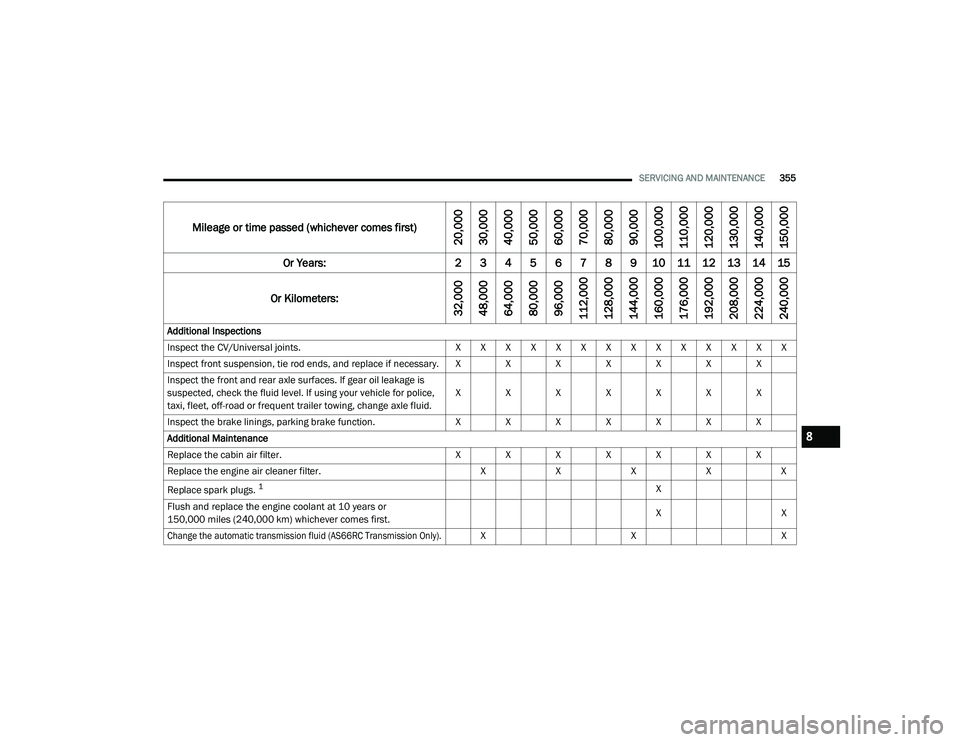
Mileage or time passed (whichever comes first)
20,000
30,000
40,000
50,000
60,000
70,000
80,000
90,000
100,000
110,000
120,000
130,000
140,000
150,000
Or Years: 2 3 4 5 6 7 8 9 10 11 12 13 14 15
Or Kilometers:
32,000
48,000
64,000
80,000
96,000
112,000
128,000
144,000
160,000
176,000
192,000
208,000
224,000
240,000
Additional Inspections
Inspect the CV/Universal joints. X X X X X X X X X X X X X X
Inspect front suspension, tie rod ends, and replace if necessary. X X X X X X X
Inspect the front and rear axle surfaces. If gear oil leakage is
suspected, check the fluid level. If using your vehicle for police,
taxi, fleet, off-road or frequent trailer towing, change axle fluid. X X X X X X X
Inspect the brake linings, parking brake function. X X X X X X X
Additional Maintenance
Replace the cabin air filter. X X X X X X X
Replace the engine air cleaner filter. XXXXX
Replace spark plugs.
1X
Flush and replace the engine coolant at 10 years or
150,000 miles (240,000 km) whichever comes first. X
X
Change the automatic transmission fluid (AS66RC Transmission Only).
XXX
8
21_DPF_OM_EN_USC_t.book Page 355
Page 359 of 463

SERVICING AND MAINTENANCE357
SCHEDULED SERVICING — DIESEL ENGINE
Required Maintenance Intervals
Refer to the maintenance plan on the following
pages for the required maintenance intervals.
More frequent maintenance may be needed in
severe conditions, such as dusty areas and very
short trip driving. In some extreme conditions,
additional maintenance not specified in the
maintenance schedule may be required.
At Each Stop For Fuel
Check the engine oil level at least 30 minutes
after a fully warmed engine is shut off. Checking
the oil level while the vehicle is on level ground
will improve the accuracy of the oil level
reading. Add oil only when the level is at or
below the ADD or MIN mark. Once A Month
Inspect the batteries, and clean and tighten
the terminals as required.
Check the fluid levels of the coolant reservoir,
brake master cylinder, and automatic trans-
mission, and add as needed.
At Each Oil Change
Change the engine oil filter.
Inspect the exhaust system.
Inspect engine air cleaner filter. Replace the
engine air cleaner filter, if necessary.
Inspect the CV/Universal joints.
Check the coolant level, hoses, and clamps.
Inspect front end, and lubricate — If equipped
with serviceable fittings.
Inspect and replace the Evaporative System
Fresh Air Filter as necessary, replacement
may be more frequent if vehicle is operated
in extreme dusty conditions. Inspection and service should also be
performed anytime a malfunction is observed or
suspected. Retain all receipts.
NOTE:
Using white lithium grease, lubricate the door
hinge pivot joints twice a year to prevent prema-
ture wear.
OIL CHANGE INDICATOR SYSTEM —
C
UMMINS DIESEL
Your vehicle is equipped with an engine oil
change indicator system. This system will alert
you when it is time to change your engine oil by
displaying the words “Oil Change Due” in your
instrument cluster display. The oil change
reminder will remind the owner to change the
engine oil every 15,000 miles (24,000 km) or
500 hours, whichever comes first, except for the
Chassis Cab models configured with optional
B20 capability that are using greater than 5%
levels of biodiesel, which are 12,500 miles
(20,000 km) or 400 hours, whichever comes
first. Failure to change the engine oil per the
maintenance schedule can result in internal
engine damage.
CAUTION!
Failure to perform the required maintenance
items may result in damage to the vehicle.
8
21_DPF_OM_EN_USC_t.book Page 357
Page 362 of 463

360SERVICING AND MAINTENANCE
Inspect engine air cleaner
filter, replace if necessary. 2X X X X X X X X X X
Inspect the front suspension,
tie rod ends and boot seals for
cracks or leaks and all parts
for damage, wear, improper
looseness or end play; replace
if necessary. X X X X X X X X X
X
Inspect the brake linings. XXXXX X
Inspect and adjust parking
brake. X
XXXX X
Inspect drive belt; replace as
necessary. X
XXXX X
Inspect wheel bearings. XXXX X
Additional Maintenance
Replace the cabin air filter. XXXXX X
Mileage or time passed
(whichever comes first):
7,500
15,000
22,500
30,000
37,500
45,000
52,500
60,000
67,500
75,000
82,500
90,000
97,500
105,000
112,500
120,000
127,500
135,000
142,500
150,000
Or Months: 6 12 18 24 30 36 42 48 54 60 66 72 78 84 90 96 102 108 114
120
Or Kilometers:
12,000
24,000
36,000
48,000
60,000
72,000
84,000
96,000
108,000
120,000
132,000
144,000
156,000
168,000
180,000
192,000
204,000
216,000
228,000
240,000
21_DPF_OM_EN_USC_t.book Page 360
Page 366 of 463

364SERVICING AND MAINTENANCE
ENGINE COMPARTMENT
6.4L ENGINE
1 — Engine Coolant Pressure Cap 6 — Battery
2 — Engine Coolant Pressure Reservoir 7 — Engine Air Cleaner Filter
3 — Engine Oil Fill 8 — Power Steering Reservoir Cap
4 — Engine Oil Dipstick 9 — Power Distribution Center (Fuses)
5 — Brake Fluid Reservoir Cap 10 — Washer Fluid Reservoir Cap
21_DPF_OM_EN_USC_t.book Page 364
Page 367 of 463
SERVICING AND MAINTENANCE365
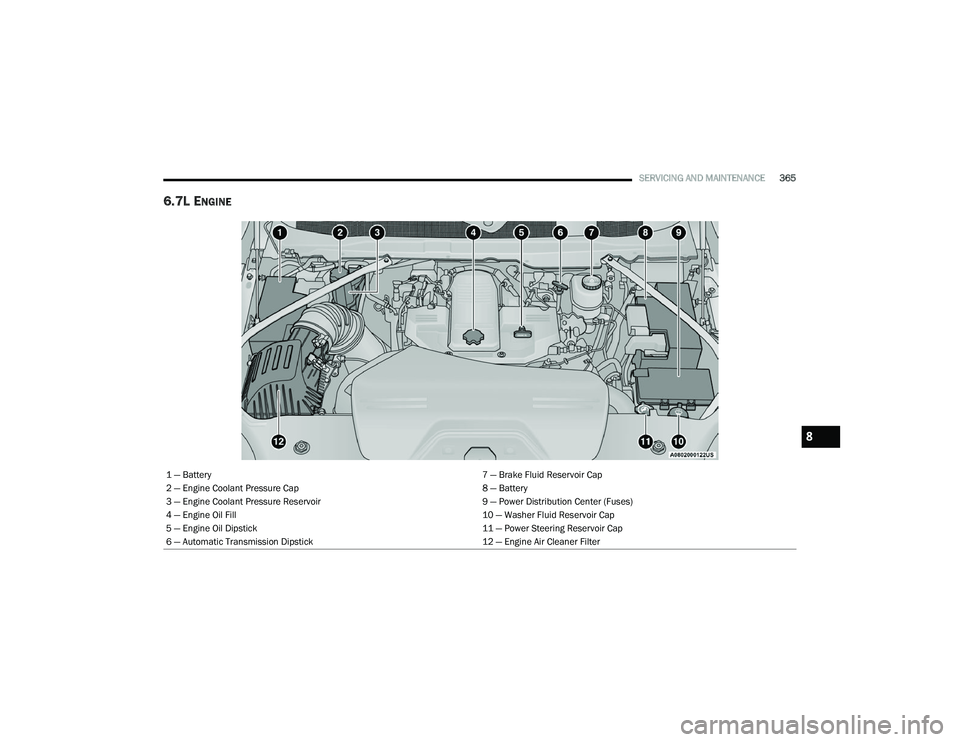
6.7L ENGINE
1 — Battery 7 — Brake Fluid Reservoir Cap
2 — Engine Coolant Pressure Cap 8 — Battery
3 — Engine Coolant Pressure Reservoir 9 — Power Distribution Center (Fuses)
4 — Engine Oil Fill 10 — Washer Fluid Reservoir Cap
5 — Engine Oil Dipstick 11 — Power Steering Reservoir Cap
6 — Automatic Transmission Dipstick 12 — Engine Air Cleaner Filter
8
21_DPF_OM_EN_USC_t.book Page 365
Page 381 of 463

SERVICING AND MAINTENANCE379
Use of biodiesel mixture in excess of 20% can
negatively impact the fuel filter's ability to
separate water from the fuel, resulting in
high pressure fuel system corrosion or
damage.
Ethanol blends are not recommended or
approved for use with your Cummins diesel
engine.
In addition, commercially available fuel addi -
tives are not necessary for the proper opera -
tion of your Cummins diesel engine.
INTERVENTION REGENERATION
S
TRATEGY — MESSAGE PROCESS FLOW
The Cummins diesel engine meets all
Environmental Protection Agency (EPA) Heavy
Duty Diesel Engine Emissions Standards,
resulting in one of the lowest emitting diesel
engines ever produced.
To achieve these emissions standards, your
vehicle is equipped with a state-of-the-art engine
and exhaust system. The engine and exhaust
after-treatment system work together to achieve
the EPA Heavy Duty Diesel Engine Emissions
Standards. These systems are seamlessly
integrated into your vehicle and managed by the Cummins Powertrain Control Module (PCM).
The PCM manages engine combustion to allow
the exhaust system’s catalyst to trap and burn
Particulate Matter (PM) pollutants, with no input
or interaction on your part.
If the engine is allowed to idle or the truck is
driven on low engine speed drive cycles for more
than two hours, the system will automatically
enter an emissions operating mode that will
increase the engine idle speed to 900 RPM
(1,050 RPM for Chassis Cab). While in this mode,
which is designed to help maintain the Diesel
Particulate Filter, the engine idle speed will return
to normal when the brake pedal is applied.
A small change in engine tone or a slight change
in engine performance while accelerating may
also be noticeable at speeds below 20 mph
(32 km/h). This operating mode may last for up
to an hour of idle time, or around 20 minutes of
driving time.
Additionally, your vehicle has the ability to alert
you to additional maintenance required on your
truck or engine Ú
page 90.
DIESEL EXHAUST FLUID
Diesel Exhaust Fluid (DEF) sometimes known
simply by the name of its active component,
UREA—is a key component of Selective Catalytic
Reduction (SCR) systems, which help diesel
vehicles meet stringent emission regulations.
DEF is a liquid reducing agent that reacts with
engine exhaust in the presence of a catalyst to
convert smog-forming nitrogen oxides (NOx)
into harmless nitrogen and water vapor
Úpage 440.
You can receive assistance in locating DEF in
the United States by calling 866-RAM-INFO
(866-726-4636). In Canada call
1–800–465–2001 (English) or
1–800–387–9983 (French)
WARNING!
A hot exhaust system can start a fire if you
park over materials that can burn. Such
materials might be grass or leaves coming
into contact with your exhaust system. Do not
park or operate your vehicle in areas where
your exhaust system can contact anything
that can burn.
8
21_DPF_OM_EN_USC_t.book Page 379
Page 389 of 463
SERVICING AND MAINTENANCE387
(Continued)
BRAKE SYSTEM
In order to ensure brake system performance,
all brake system components should be
inspected periodically Ú page 354.
Fluid Level Check — Brake Master Cylinder
The fluid level of the master cylinder should be
checked when performing under the hood
service or immediately if the brake system
warning lamp indicates system failure.
If necessary, add fluid to bring level within the
designated marks on the side of the reservoir of the
brake master cylinder. Be sure to clean the top of
the master cylinder area before removing cap.
With disc brakes the fluid level can be expected
to fall as the brake linings wear. However, an
unexpected drop in fluid level may be caused by
a leak and a system check should be conducted.
For further information Ú
page 444.
AUTOMATIC TRANSMISSION
Special Additives
The manufacturer strongly recommends against
using any special additives in the transmission.
Automatic Transmission Fluid (ATF) is an
engineered product and its performance may be
impaired by supplemental additives. Therefore,
do not add any fluid additives to the transmission.
The only exception to this policy is the use of special
dyes for diagnosing fluid leaks in six-speed
transmissions. Avoid using transmission sealers as
they may adversely affect seals.
WARNING!
Riding the brakes can lead to brake failure
and possibly a collision. Driving with your foot
resting or riding on the brake pedal can result
in abnormally high brake temperatures,
excessive lining wear, and possible brake
damage. You would not have your full braking
capacity in an emergency.WARNING!
Use only manufacturer's recommended
brake fluid Úpage 444. Using the wrong
type of brake fluid can severely damage
your brake system and/or impair its perfor -
mance. The proper type of brake fluid for
your vehicle is also identified on the original
factory installed hydraulic master cylinder
reservoir.
To avoid contamination from foreign matter
or moisture, use only new brake fluid or fluid
that has been in a tightly closed container.
Keep the master cylinder reservoir cap
secured at all times. Brake fluid in a open
container absorbs moisture from the air
resulting in a lower boiling point. This may
cause it to boil unexpectedly during hard or
prolonged braking, resulting in sudden brake
failure. This could result in a collision.
Overfilling the brake fluid reservoir can
result in spilling brake fluid on hot engine
parts, causing the brake fluid to catch fire.
Brake fluid can also damage painted and
vinyl surfaces, care should be taken to
avoid its contact with these surfaces.
Do not allow petroleum based fluid to
contaminate the brake fluid. Brake seal
components could be damaged, causing
partial or complete brake failure. This could
result in a collision.
WARNING! (Continued)
8
21_DPF_OM_EN_USC_t.book Page 387