remove seats RENAULT ALASKAN 2017 User Guide
[x] Cancel search | Manufacturer: RENAULT, Model Year: 2017, Model line: ALASKAN, Model: RENAULT ALASKAN 2017Pages: 340, PDF Size: 6.93 MB
Page 41 of 340

5. Shorten the rigid attachment to have the child
restraint firmly tightened; press downward ➄
and rearward ➅firmly in the centre of the child
restraint with your knee to compress the vehicle
seat cushion and seatback. Adjustable
seatbacks should be positioned to ensure full
contact between child restraint and seatback.
6. If the child restraint is equipped with atop tether
strap, route the top tether strap and secure the
tether strap to the tether anchor point. (See
“Child restraint anchorage (where fitted)” earlier
in this section.)
If the child restraint is equipped with other anti-
rotation devices such as support legs, use them
instead of (or together with) the top tether strap
following the child restraint manufacturer’s in-
structions.
7. Test the child restraint before you place the child in it ➆.P
ush the child restraint from side to side
and tug it forward to make sure that it is held
securely in place. 8. Check to make sure that the child restraint is
properly secured prior to each use. If the child
restraint is loose, repeat steps 1through 7.
Rear-facing child restraints:
Be sure to follow the child restraint manufacturer’s
instructions for the proper use of your child restraint.
Follow these steps to install arear-facing child re-
straint on the second row outboard seats using
ISOFIX:
1. Remove the head restraint on the seat.
2. Position the child restraint on the seat ➁.
3. Secure the child restraint anchor attachments to the ISOFIX lower anchors ➂. 4. Shorten the rigid attachment to have the child
restraint firmly tightened. To compress the ve-
hicle seat cushion and seatback, firmly press
downward ➃and rearward
j4a in the centre of
the child restraint with your hand.
If there is any contact between the child restraint
and the front seat, slide the front seat forward
until contact no longer occurs.
If the child restraint is equipped with other anti-
rotation devices such as support legs, use them
following the child restraint manufacturer’s in-
structions. NIC2413
Step 7 NP A1525
Step 2, and 3 NP A1409
Step 4
Safety —seats, seat belts and supplemental restraint system 1-23
Page 42 of 340

5. Test the child restraint before you place the child
in it ➄.P
ush the child restraint from side to side
and tug it forward to make sure that it is held
securely in place.
6. Check to make sure that the child restraint is properly secured prior to each use. If the child
restraint is loose, repeat steps 1through 5. CHILD RESTRAINT INSTALLATION
USING THREE-POINT TYPE SEAT
BELT
Installation on rear seats (Double Cab
models)
Front-facing child restraint:
Be sure to follow the manufacturer’s instructions for
the proper use of your child restraint. Follow these
steps to install
afront-facing child restraint on the
rear seats using three-point type seat belt without
automatic locking mode:
1. Position the child restraint on the seat ➀.Ifa
ny
contact occurs between the child restraint and
the front seat, slide the front seat forward until
contact no longer occurs.
Remove the head restraint to obtain the correct child restraint fit.
Once removed, store the head restraint in ase-
cure location. 2. Route the seat belt tongue through the child re-
straint and insert it into the buckle ➁until you
hear and feel the latch engage.
3. To prevent slack in the seat belt webbing, it is necessary to secure the seat belt in place with
locking devices attached to the child restraint. NP A1410
Step 5 SSS0758AZ
Front-facing: Step 1 SSS0493AZ
Front-facing: Step 2
SSS0647AZ
Front-facing: Step 4
1-24 Safety —seats, seat belts and supplemental restraint system
Page 43 of 340
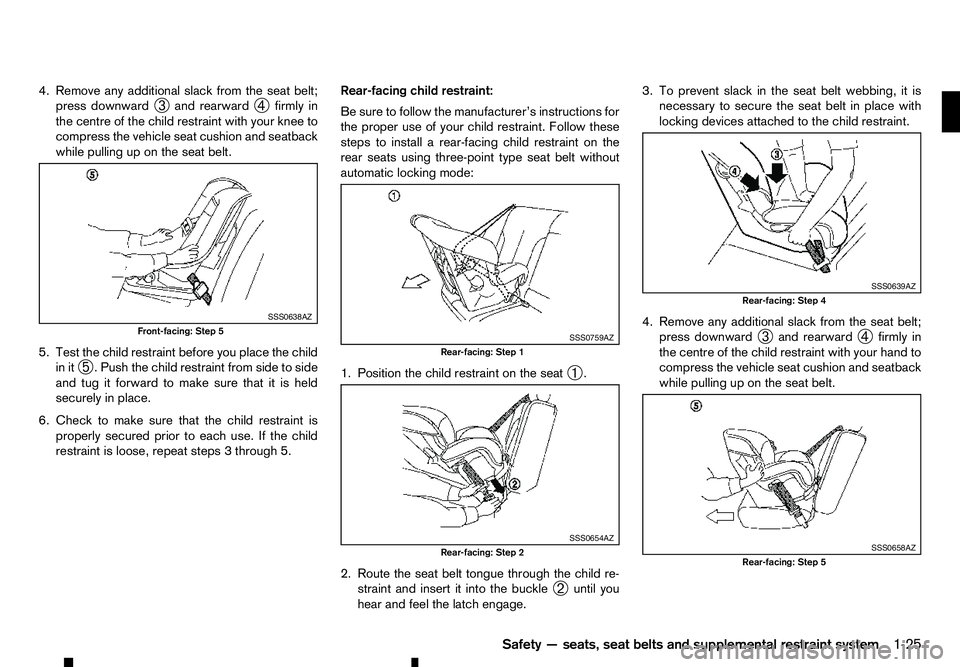
4. Remove any additional slack from the seat belt;
press downward ➂and rearward
➃firmly in
the centre of the child restraint with your knee to
compress the vehicle seat cushion and seatback
while pulling up on the seat belt.
5. Test the child restraint before you place the child in it ➄.P
ush the child restraint from side to side
and tug it forward to make sure that it is held
securely in place.
6. Check to make sure that the child restraint is properly secured prior to each use. If the child
restraint is loose, repeat steps 3through 5. Rear-facing child restraint:
Be sure to follow the manufacturer’s instructions for
the proper use of your child restraint. Follow these
steps to install
arear-facing child restraint on the
rear seats using three-point type seat belt without
automatic locking mode:
1. Position the child restraint on the seat ➀.
2. Route the seat belt tongue through the child re- straint and insert it into the buckle ➁until you
hear and feel the latch engage. 3. To prevent slack in the seat belt webbing, it is
necessary to secure the seat belt in place withlocking devices attached to the child restraint.
4. Remove any additional slack from the seat belt; press downward ➂and rearward
➃firmly in
the centre of the child restraint with your hand to
compress the vehicle seat cushion and seatback
while pulling up on the seat belt. SSS0638AZ
Front-facing: Step 5
SSS0759AZ
Rear-facing: Step 1
SSS0654AZ
Rear-facing: Step 2 SSS0639AZ
Rear-facing: Step 4
SSS0658AZ
Rear-facing: Step 5
Safety —seats, seat belts and supplemental restraint system 1-25
Page 45 of 340
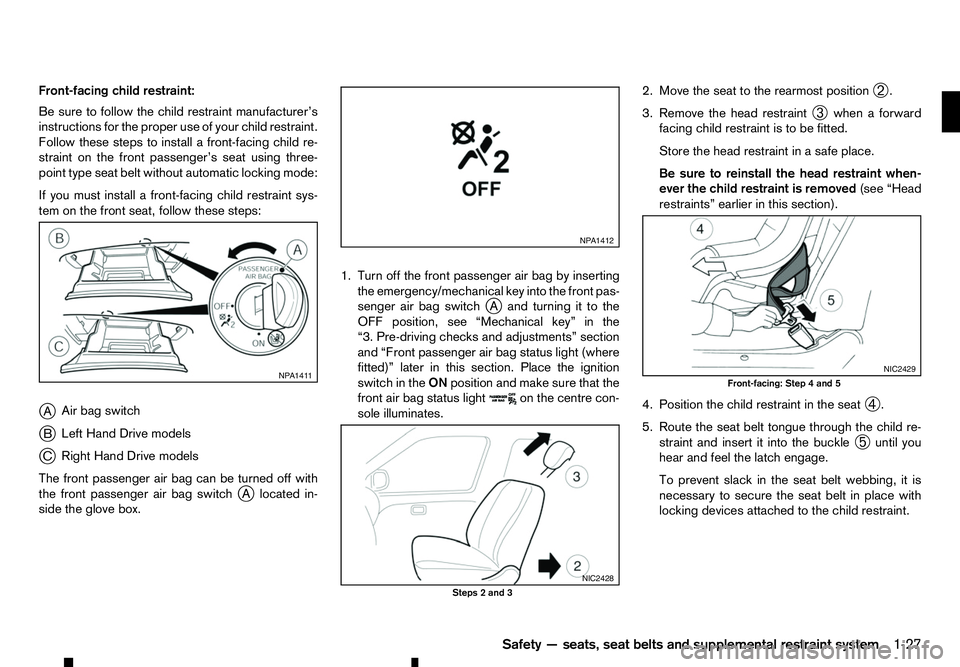
Front-facing child restraint:
Be sure to follow the child restraint manufacturer’s
instructions for the proper use of your child restraint.
Follow these steps to install afront-facing child re-
straint on the front passenger’s seat using three-
point type seat belt without automatic locking mode:
If you must install afront-facing child restraint sys-
tem on the front seat, follow these steps:
j A Air bag switch
j B Left Hand Drive models
j C Right Hand Drive models
The front passenger air bag can be turned off with
the front passenger air bag switch j
Al ocated in-
side the glove box. 1. Turn off the front passenger air bag by inserting
the emergency/mechanical key into the front pas-
senger air bag switch jAa nd turning it to the
OFF position, see “Mechanical key” in the
“3. Pre-driving checks and adjustments” section
and “Front passenger air bag status light (where
fitted)” later in this section. Place the ignition
switch in the ONposition and make sure that the
front air bag status light on the centre con-
sole illuminates. 2. Move the seat to the rearmost position
➁.
3. Remove the head restraint ➂when
aforward
facing child restraint is to be fitted.
Store the head restraint in asafe place.
Be sure to reinstall the head restraint when-
ever the child restraint is removed (see “Head
restraints” earlier in this section).
4. Position the child restraint in the seat ➃.
5. Route the seat belt tongue through the child re- straint and insert it into the buckle ➄until you
hear and feel the latch engage.
To prevent slack in the seat belt webbing, it is
necessary to secure the seat belt in place with
locking devices attached to the child restraint. NP A1411 NP A1412
NIC2428
Steps 2and 3 NIC2429
Front-facing: Step
4and 5
Safety —seats, seat belts and supplemental restraint system 1-27
Page 46 of 340
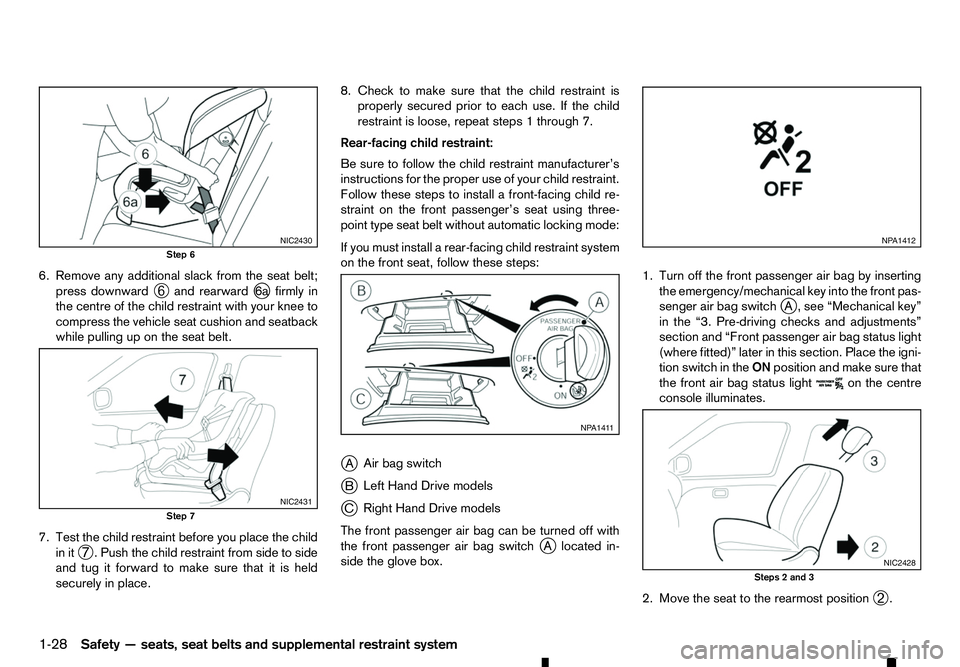
6. Remove any additional slack from the seat belt;
press downward ➅and rearward
j6a firmly in
the centre of the child restraint with your knee to
compress the vehicle seat cushion and seatback
while pulling up on the seat belt.
7. Test the child restraint before you place the child in it ➆.P
ush the child restraint from side to side
and tug it forward to make sure that it is held
securely in place. 8. Check to make sure that the child restraint is
properly secured prior to each use. If the child
restraint is loose, repeat steps 1through 7.
Rear-facing child restraint:
Be sure to follow the child restraint manufacturer’s
instructions for the proper use of your child restraint.
Follow these steps to install afront-facing child re-
straint on the front passenger’s seat using three-
point type seat belt without automatic locking mode:
If you must install arear-facing child restraint system
on the front seat, follow these steps:
j A Air bag switch
j B Left Hand Drive models
j C Right Hand Drive models
The front passenger air bag can be turned off with
the front passenger air bag switch jAl ocated in-
side the glove box. 1. Turn off the front passenger air bag by inserting
the emergency/mechanical key into the front pas-
senger air bag switch jA, see “Mechanical key”
in the “3. Pre-driving checks and adjustments”
section and “Front passenger air bag status light
(where fitted)” later in this section. Place the igni-
tion switch in the ONposition and make sure that
the front air bag status light on the centre
console illuminates.
2. Move the seat to the rearmost position ➁. NIC2430
Step 6
NIC2431
Step 7 NP A1411 NP A1412
NIC2428
Steps 2and 3
1-28 Safety —seats, seat belts and supplemental restraint system
Page 52 of 340
•
The seat belts and the supplemental side-im-
pact air bags and supplemental curtain side-
impact air bags are most effective when you are sitting well back and upright in the seat.
The supplemental side-impact air bags and
supplemental curtain side-impact air bags in-
flate with great force. If you and your passen-
gers are unrestrained, leaning forward, sitting
sideways, or out of position in any way, you
and your passengers are at greater risk of
injury or death in an accident.
• Do not allow anyone to place their hands, legs
or face near the supplemental side-impact air
bags and supplemental curtain side-impact
air bags located on the sides of the seatback
of the front seats or near the side roof rails.
Do not allow anyone sitting in the front seats
or rear outboard seats to extend their hands
out of the windows or lean against the doors.
Some examples of dangerous riding positions
are shown in the illustrations.
• When sitting in the rear seats, do not hold
onto the seatback of the front seats. If the
supplemental side-impact air bags and
supplemental curtain side-impact air bags in-
flate, you may be seriously injured. Be espe-
cially careful with children, who should always
be properly restrained.
• Do not use seat covers on the front seatbacks.
They may interfere with the supplemental
side-impact air bag inflations. •
Do not attach the key with heavy objects, hard
objects or objects with sharp edges. This may
cause injury if the supplemental knee air bag
inflates.
Pre-tensioner seat belt system
(where fitted)
The pre-tensioner seat belt system may activate with the supplemental air bag system in certain types of
collisions. Working with the front seat belt retrac-
tors and anchors, it helps tighten the seat belt the
instant the vehicle becomes involved in certain types
of collisions, helping to restrain front seat occupants.
(See “Seat belts” earlier in this section.)
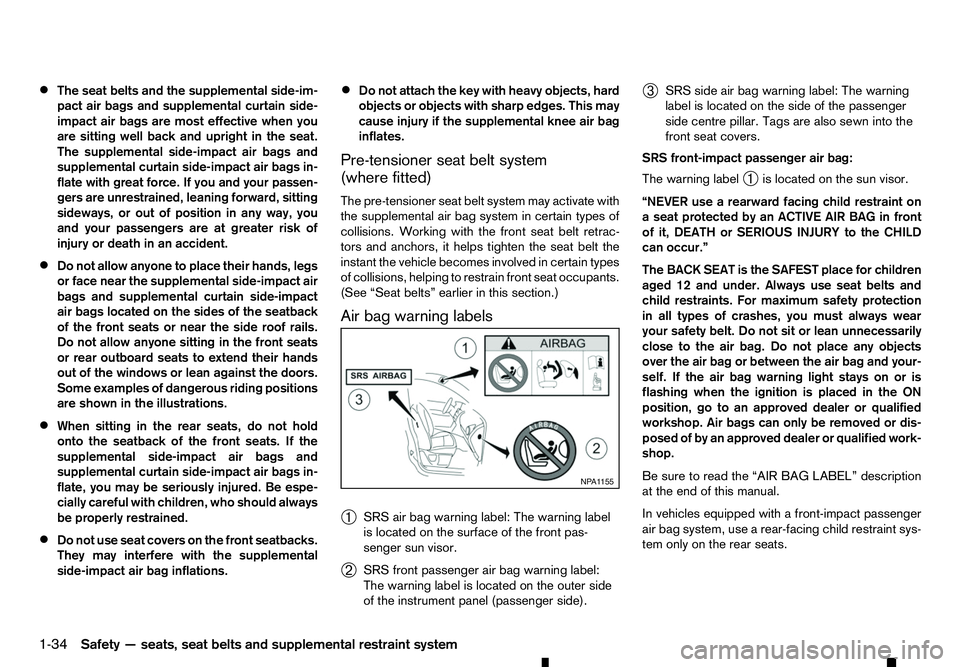
Air bag warning labels
➀ SRS air bag warning label: The warning label
is located on the surface of the front pas-
senger sun visor.
➁ SRS front passenger air bag warning label:
The warning label is located on the outer side
of the instrument panel (passenger side). ➂
SRS side air bag warning label: The warning
label is located on the side of the passenger
side centre pillar. Tags are also sewn into the
front seat covers.
SRS front-impact passenger air bag:
The warning label ➀is located on the sun visor.
“NEVER use arearward facing child restraint on
as eat protected by an ACTIVE AIR BAG in front
of it, DEATH or SERIOUS INJURY to the CHILD
can occur.”
The BACK SEAT is the SAFEST place for children
aged 12 and under. Always use seat belts and
child restraints. For maximum safety protection
in all types of crashes, you must always wear
your safety belt. Do not sit or lean unnecessarily
close to the air bag. Do not place any objects
over the air bag or between the air bag and your-
self. If the air bag warning light stays on or is
flashing when the ignition is placed in the ON
position, go to an approved dealer or qualified
workshop. Air bags can only be removed or dis-
posed of by an approved dealer or qualified work-
shop.
Be sure to read the “AIR BAG LABEL” description
at the end of this manual.
In vehicles equipped with afront-impact passenger
air bag system, use arear-facing child restraint sys-
tem only on the rear seats. NP A1155
1-34 Safety —seats, seat belts and supplemental restraint system
Page 273 of 340
GLASS
Use glass cleaner to remove smoke and dust film
from the glass surfaces. It is normal for glass to
become coated with afilm after the vehicle is parked
in the hot sun. Glass cleaner and asoft cloth will
easily remove this film.
UNDERBODY
In areas where road salt is used in the winter, it is
necessary to clean the vehicle’s underbody regu-
larly in order to prevent dirt and salt from building up
and causing the acceleration of corrosion on the
underbody and suspension.
Before the winter and again in the spring, the under- seal must be checked and, if necessary, re-treated.
WHEELS
• Wash the wheels when washing the vehicle to
maintain their appearance.
• Clean the inner side of the wheels when the
wheel is changed or the underside of the vehicle
is washed.
• Do not use abrasive cleaners when washing the
wheels.
• Inspect wheel rims regularly for dents or corro-
sion. This may cause loss of pressure or damage
the tyre bead.
• RENAULT recommends that the road wheels be
waxed to protect against road salt in areas where
it is used during winter. ALUMINIUM ALLOY WHEELS
Wash the wheels regularly with
asponge damp-
ened in amild soap solution, especially during win-
ter in areas where road salt is used. The salt residue
from road salt could discolour the wheels if it is not
washed off regularly.
CAUTION
Follow the directions below to avoid staining or
discolouring the wheels:
• Do not use
acleaner that uses strong acid or
alkali contents to clean the wheels.
• Do not apply wheel cleaners to the wheels
when they are hot. The wheel temperature
should be the same as ambient temperature.
• Rinse the wheel to completely remove the
cleaner within 15 minutes after the cleaner is
applied.
CHROME PARTS
Clean all chrome parts regularly with anon abrasive
chrome polish to maintain the finish. Occasionally remove loose dust from the interior
trim, plastic parts and seats using
avacuum cleaner
or soft bristled brush. Wipe the vinyl and leather sur-
faces with aclean, soft cloth dampened in mild soap
solution, then wipe clean with adry, soft cloth.
Regular care and cleaning is required in order to
maintain the appearance of the leather.
Before using any fabric protector, read the manu-
facturer’s recommendations. Some fabric protec-
tors contain chemicals that may stain or bleach the
seat material.
Use asoft cloth dampened only with water to clean
the meter and gauge lens covers.
CAUTION
• Never use benzene, thinner or any similar ma-
terial.
• Small dirt particles can be abrasive and dam-
aging to leather surfaces and should be re-
moved promptly. Do not use saddle soap, car
waxes, polishes, oils, cleaning fluids,
solvents, detergents or ammonia-based
cleaners as they damage the natural leather
finish.
• Never use fabric protectors unless recom-
mended by the manufacturer.
• Do not use glass or plastic cleaner on meter
or gauge lens covers. It may damage the lens
covers.
CLEANING INTERIOR
Appearance and care 7-3
Page 274 of 340
AIR FRESHENERS
Most air fresheners use asolvent that could affect
the vehicle interior. If you use an air freshener, take
the following precautions:
• Hanging-type air fresheners can cause perma-
nent discoloration when they contact vehicle in-
terior surfaces. Place the air freshener in
aloca-
tion that allows it to hang free and not contact an
interior surface.
• Liquid-type air fresheners typically clip on the
vents. These products can cause immediate
damage and discoloration when spilled on inte-
rior surfaces.
Carefully read and follow the manufacturer’s instruc-
tions before using air fresheners.
FLOOR MATS
The use of floor mats (where fitted) can extend the
life of your vehicle carpet and make it easier to clean
the interior. Regardless of what mats are used, be
sure they are fitted for your vehicle and are properly
positioned in the foot well to prevent interference
with pedal operation. Mats should be maintained
with regular cleaning and replaced if they become
excessively worn. Floor mat positioning aid
This vehicle includes floor mat brackets to act as a
floor mat positioning aid.
Position the mat by placing the floor mat bracket
hook through the floor mat grommet hole while cen-
tering the mat in the foot area.
Periodically check that the mats are properly posi-
tioned.
GLASS
Use glass cleaner to remove smoke and dust film
from the glass surfaces. It is normal for glass to
become coated with afilm after the vehicle is parked
in the hot sun. Glass cleaner and asoft cloth will
easily remove this film.
CAUTION
When cleaning the inside of the windows, do not
use sharp-edged tools, abrasive cleaners or chlo- rine-based disinfectant cleaners. They could
damage the electrical conductors, such as radio
antenna elements or rear window defogger ele-
ments.
SEAT BELTS WARNING
• Do not allow wet seat belts to roll up in the
retractor.
• Never use bleach, dye or chemical solvents to
clean the seat belts, since these materials
may severely weaken the seat belt webbing.
The seat belts can be cleaned by wiping them with
as ponge dampened in amild soap solution.
Allow the belts to dry completely in the shade before
using them. (See “Seat belts” in the “1. Safety —
seats, seat belts and supplemental restraint system”
section.) JV A0022XZ
Example
7-4 Appearance and care