belt RENAULT ALASKAN 2017 Owner's Manual
[x] Cancel search | Manufacturer: RENAULT, Model Year: 2017, Model line: ALASKAN, Model: RENAULT ALASKAN 2017Pages: 340, PDF Size: 6.93 MB
Page 34 of 340
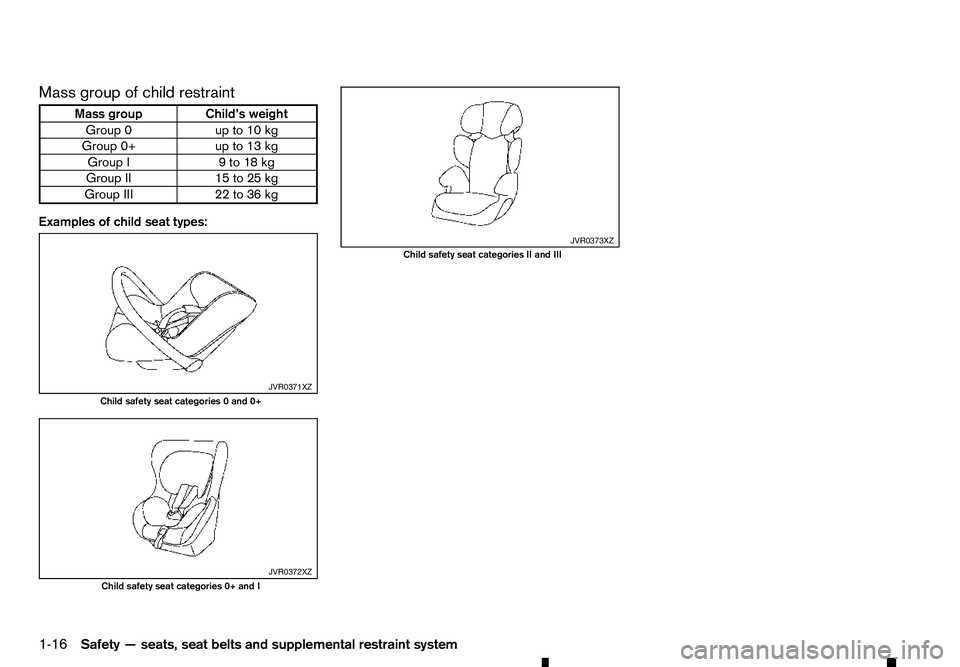
Mass group of child restraint
Mass group Child’s weight
Group 0u pto10kg
Group 0+ up to 13 kg
Group I9 to 18 kg
Group II 15 to 25 kg
Group III 22 to 36 kg
Examples of child seat types: JVR0371XZ
Child safety seat categories
0and 0+ JVR0372XZ
Child safety seat categories 0+ and I JVR0373XZ
Child safety seat categories II and III
1-16 Safety —seats, seat belts and supplemental restraint system
Page 35 of 340
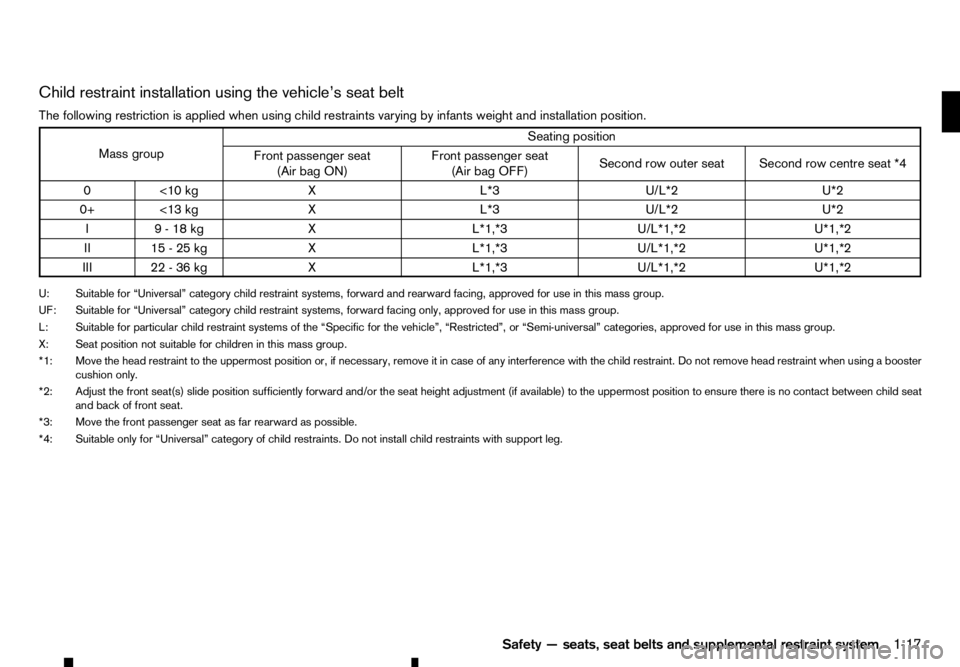
Child restraint installation using the vehicle’s seat belt
The following restriction is applied when using child restraints varying by infants weight and installation position. Mass group
Seating position
Front passenger seat (Air bag ON) Front passenger seat
(Air bag OFF) Second row outer seat Second row centre seat *4
0< 10 kg XL *3U/L*2 U*2
0+ <13 kg XL *3U/L*2 U*2
I9 -18kgX L*1,*3U/L*1,*2 U*1,*2
II 15 -25kgX L*1,*3U/L*1,*2 U*1,*2
III 22 -36kgX L*1,*3U/L*1,*2 U*1,*2
U: Suitable for “Universal” category child restraint systems, forward and rearward facing, approved for use in this mass group.
UF: Suitable for “Universal” category child restraint systems, forward facing only, approved for use in this mass group.
L: Suitable for particular child restraint systems of the “Specific for the vehicle”, “Restricted”, or “Semi-universal” categories, approved for use in this mass group. X: Seat position not suitable for children in this mass group.
*1: Move the head restraint to the uppermost position or, if necessary, remove it in case of any interference with the child restraint. Do not remove head restraint when using abooster
cushion only.
*2: Adjust the front seat(s) slide position sufficiently forward and/or the seat height adjustment (if available) to the uppermost position to ensure there is no contact between child seat and back of front seat.
*3: Move the front passenger seat as far rearward as possible.
*4: Suitable only for “Universal” category of child restraints. Do not install child restraints with support leg.
Safety—seats, seat belts and supplemental restraint system 1-17
Page 36 of 340
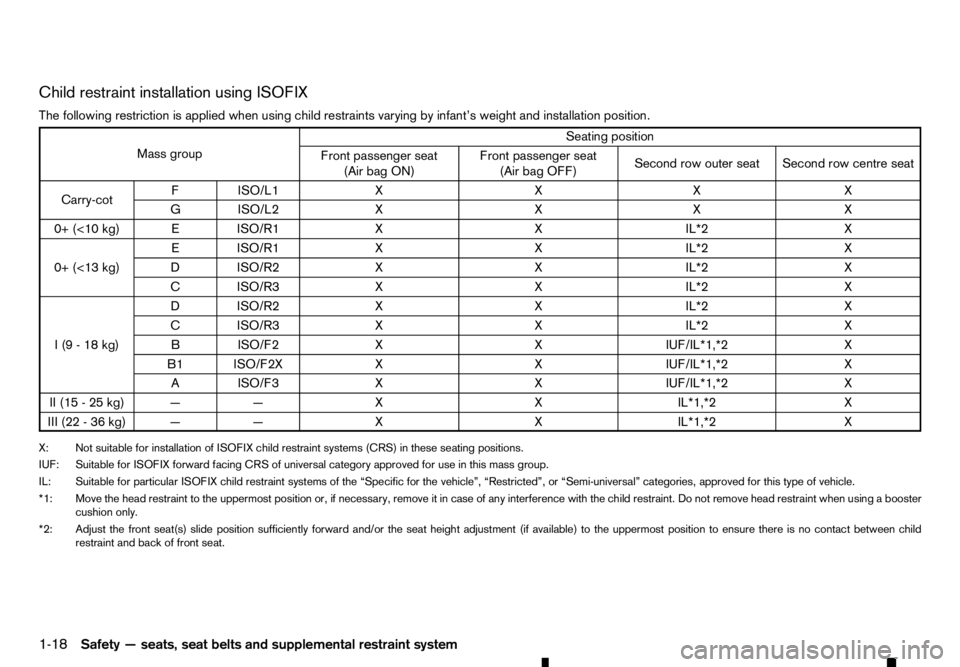
Child restraint installation using ISOFIX
The following restriction is applied when using child restraints varying by infant’s weight and installation position. Mass group
Seating position
Front passenger seat (Air bag ON) Front passenger seat
(Air bag OFF) Second row outer seat Second row centre seat
Carry-cot FI
SO/L1 XX XX
GI SO/L2 XX XX
0+ (<10 kg) EISO/R1 XX IL*2X
0+ (<13 kg) EI
SO/R1 XX IL*2X
DI SO/R2 XX IL*2X
CI SO/R3 XX IL*2X
I(9-18k g) DI
SO/R2 XX IL*2X
CI SO/R3 XX IL*2X
BI SO/F2 XX IUF/IL*1,*2X
B1 ISO/F2X XX IUF/IL*1,*2X
AI SO/F3 XX IUF/IL*1,*2X
II (15 -25kg) —— XX IL*1,*2X
III (22 -36kg) —— XX IL*1,*2X
X: Not suitable for installation of ISOFIX child restraint systems (CRS) in these seating positions.
IUF: Suitable for ISOFIX forward facing CRS of universal category approved for use in this mass group.
IL: Suitable for particular ISOFIX child restraint systems of the “Specific for the vehicle”, “Restricted”, or “Semi-universal” categories, approved for this type of vehicle.
*1: Move the head restraint to the uppermost position or, if necessary, remove it in case of any interference with the child restraint. Do not remove head restraint when using abooster
cushion only.
*2: Adjust the front seat(s) slide position sufficiently forward and/or the seat height adjustment (if available) to the uppermost position to ensure there is no contact between child restraint and back of front seat.
1-18 Safety —seats, seat belts and supplemental restraint system
Page 37 of 340
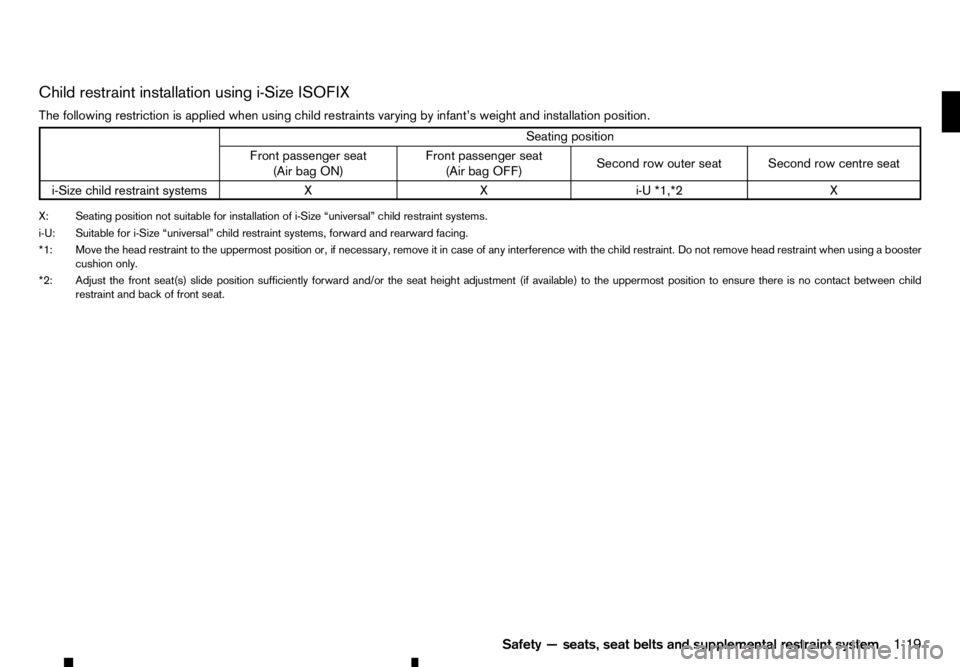
Child restraint installation using i-Size ISOFIX
The following restriction is applied when using child restraints varying by infant’s weight and installation position. Seating position
Front passenger seat (Air bag ON) Front passenger seat
(Air bag OFF) Second row outer seat Second row centre seat
i-Size child restraint systems XX i-U *1,*2X
X: Seating position not suitable for installation of i-Size “universal” child restraint systems.
i-U: Suitable for i-Size “universal” child restraint systems, forward and rearward facing.
*1: Move the head restraint to the uppermost position or, if necessary, remove it in case of any interference with the child restraint. Do not remove head restraint when using abooster
cushion only.
*2: Adjust the front seat(s) slide position sufficiently forward and/or the seat height adjustment (if available) to the uppermost position to ensure there is no contact between child restraint and back of front seat.
Safety—seats, seat belts and supplemental restraint system 1-19
Page 38 of 340
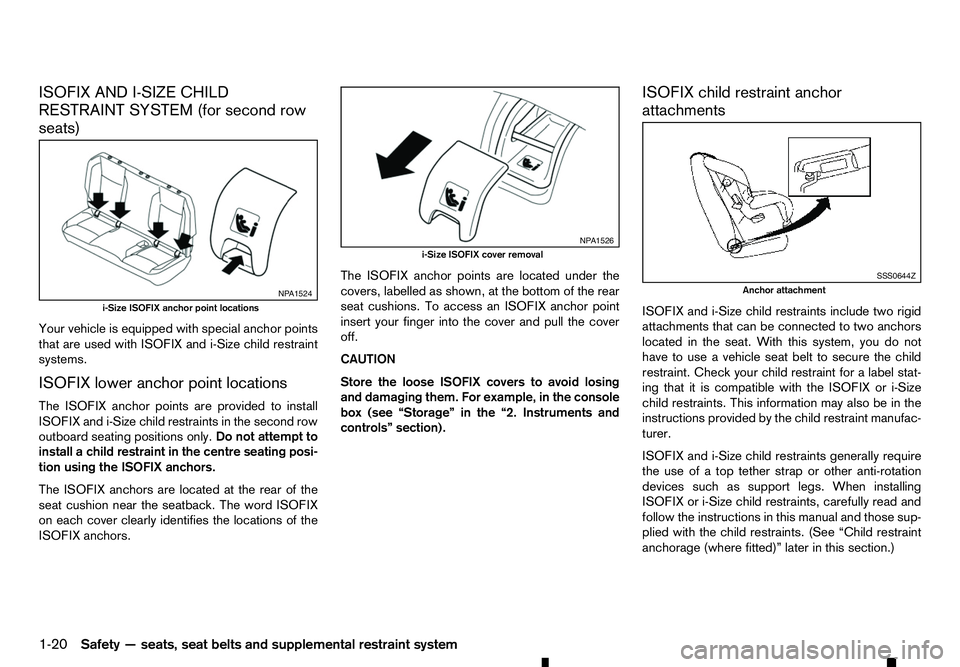
ISOFIX AND I-SIZE CHILD
RESTRAINT SYSTEM (for second row
seats)
Your vehicle is equipped with special anchor points
that are used with ISOFIX and i-Size child restraint
systems.
ISOFIX lower anchor point locations
The ISOFIX anchor points are provided to install
ISOFIX and i-Size child restraints in the second row
outboard seating positions only. Do not attempt to
install achild restraint in the centre seating posi-
tion using the ISOFIX anchors.
The ISOFIX anchors are located at the rear of the
seat cushion near the seatback. The word ISOFIX
on each cover clearly identifies the locations of the
ISOFIX anchors. The ISOFIX anchor points are located under the
covers, labelled as shown, at the bottom of the rear
seat cushions. To access an ISOFIX anchor point
insert your finger into the cover and pull the cover
off.
CAUTION
Store the loose ISOFIX covers to avoid losing
and damaging them. For example, in the console
box (see “Storage” in the “2. Instruments and
controls” section).ISOFIX child restraint anchor
attachments
ISOFIX and i-Size child restraints include two rigid
attachments that can be connected to two anchors
located in the seat. With this system, you do not
have to use
avehicle seat belt to secure the child
restraint. Check your child restraint for alabel stat-
ing that it is compatible with the ISOFIX or i-Size
child restraints. This information may also be in the
instructions provided by the child restraint manufac-
turer.
ISOFIX and i-Size child restraints generally require the use of atop tether strap or other anti-rotation
devices such as support legs. When installing
ISOFIX or i-Size child restraints, carefully read and
follow the instructions in this manual and those sup-
plied with the child restraints. (See “Child restraint
anchorage (where fitted)” later in this section.) NP A1524
i-Size ISOFIX anchor point locations NP A1526
i-Size ISOFIX cover removal SSS0644Z
Anchor attachment
1-20 Safety —seats, seat belts and supplemental restraint system
Page 39 of 340
CHILD RESTRAINT ANCHORAGE
(where fitted)
Your vehicle is designed to accommodate achild
restraint system on the rear seat. When installing a
child restraint system, carefully read and follow the instructions in this manual and those supplied with
the child restraint system. WARNING
Child restraint anchorages are designed to with-
stand only those loads imposed by correctly fit-
ted child restraints. Under no circumstances are
they to be used for adult seat belts, harnesses or
for attaching other items or equipment to the
vehicle. Doing so could damage the child re-
straint anchorages. The child restraint will not be
properly installed using the damaged anchorage,
and achild could be seriously injured or killed in
ac ollision.
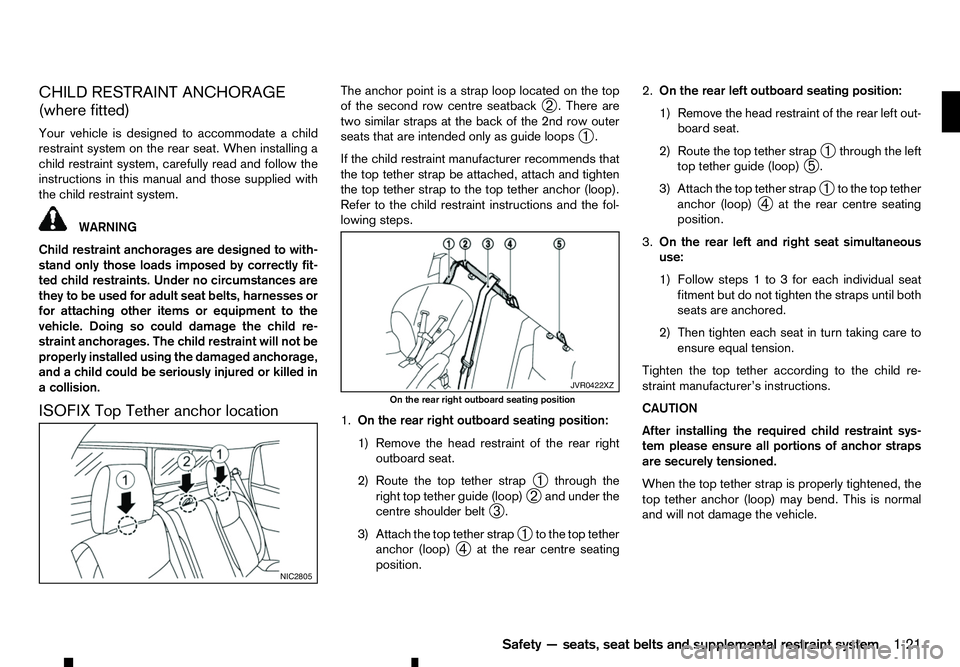
ISOFIX Top Tether anchor location The anchor point is
astrap loop located on the top
of the second row centre seatback ➁.T
here are
two similar straps at the back of the 2nd row outer
seats that are intended only as guide loops ➀.
If the child restraint manufacturer recommends that
the top tether strap be attached, attach and tighten
the top tether strap to the top tether anchor (loop).
Refer to the child restraint instructions and the fol-
lowing steps.
1. On the rear right outboard seating position:
1) Remove the head restraint of the rear right
outboard seat.
2) Route the top tether strap ➀through the
right top tether guide (loop) ➁and under the
centre shoulder belt ➂.
3) Attach the top tether strap ➀to the top tether
anchor (loop) ➃at the rear centre seating
position. 2.
On the rear left outboard seating position:
1) Remove the head restraint of the rear left out-
board seat.
2) Route the top tether strap ➀through the left
top tether guide (loop) ➄.
3) Attach the top tether strap ➀to the top tether
anchor (loop) ➃at the rear centre seating
position.
3. On the rear left and right seat simultaneous
use:
1) Follow steps 1to3for each individual seat
fitment but do not tighten the straps until both
seats are anchored.
2) Then tighten each seat in turn taking care to ensure equal tension.
Tighten the top tether according to the child re-
straint manufacturer’s instructions.
CAUTION
After installing the required child restraint sys-
tem please ensure all portions of anchor straps
are securely tensioned.
When the top tether strap is properly tightened, the
top tether anchor (loop) may bend. This is normal
and will not damage the vehicle. NIC2805 JVR0422XZ
On the rear right outboard seating position
Safety—seats, seat belts and supplemental restraint system 1-21
Page 40 of 340
CHILD RESTRAINT INSTALLATION
USING ISOFIX WARNING
• Attach ISOFIX and i-Size child restraints only
at the specified locations. For the ISOFIX
lower anchor locations, see “ISOFIX lower an-
chor point locations” earlier in this section. If
ac hild restraint is not secured properly, your
child could be seriously injured or killed in an
accident.
• Do not install child restraints that require the
use of
atop tether strap to seating positions
that do not have atop tether anchor.
• Do not secure
achild restraint in the centre
rear seating position using the ISOFIX lower
anchors. The child restraint will not be se-
cured properly.
• Inspect the lower anchors by inserting your
fingers into the lower anchor area and feeling
to make sure there are no obstructions over the ISOFIX anchors, such as seat belt web-
bing or seat cushion material. The child re-
straint will not be secured properly if the
ISOFIX anchors are obstructed.
• Child restraint anchorages are designed to
withstand only those loads imposed by cor-
rectly fitted child restraints. Under no circum-
stance are they to be used for adult seat belts,
harnesses or for attaching other items or
equipment to the vehicle. Doing so could damage the child restraint anchorages. The
child restraint will not be properly installed
using the damaged anchorage, and
achild
could be seriously injured or killed in acolli-
sion.
Installation on rear outboard seats
Front-facing child restraints:
Be sure to follow the child restraint manufacturer’s
instructions for the proper use of your child restraint.
Follow these steps to install afront-facing child re-
straint on the second row outboard seats using
ISOFIX:
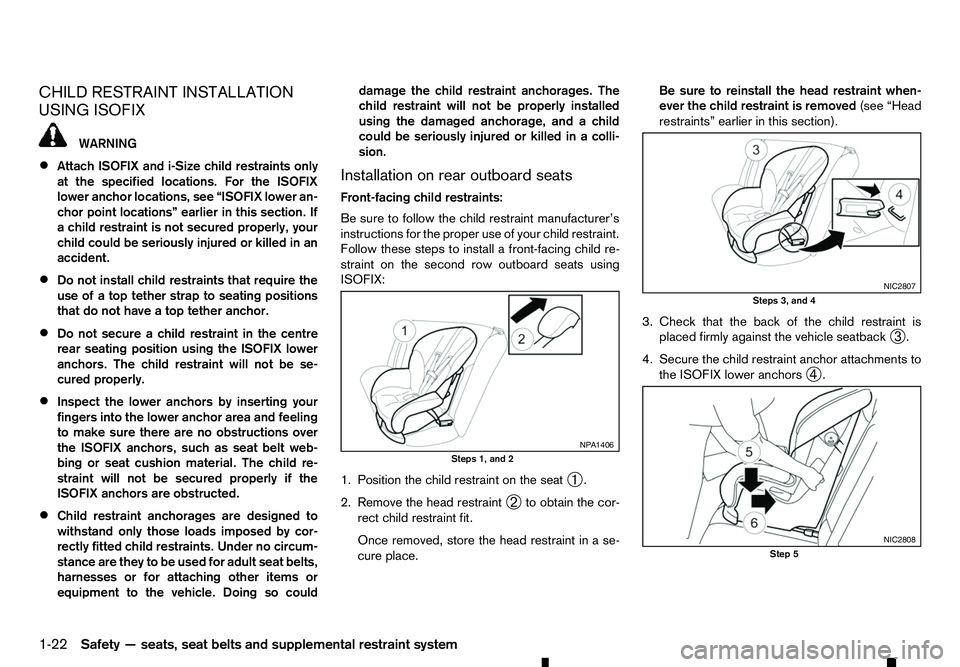
1. Position the child restraint on the seat ➀.
2. Remove the head restraint ➁to obtain the cor-
rect child restraint fit.
Once removed, store the head restraint in ase-
cure place. Be sure to reinstall the head restraint when-
ever the child restraint is removed
(see “Head
restraints” earlier in this section).
3. Check that the back of the child restraint is placed firmly against the vehicle seatback ➂.
4. Secure the child restraint anchor attachments to the ISOFIX lower anchors ➃. NP A1406
Steps 1, and 2 NIC2807
Steps 3, and 4
NIC2808
Step 5
1-22 Safety —seats, seat belts and supplemental restraint system
Page 41 of 340

5. Shorten the rigid attachment to have the child
restraint firmly tightened; press downward ➄
and rearward ➅firmly in the centre of the child
restraint with your knee to compress the vehicle
seat cushion and seatback. Adjustable
seatbacks should be positioned to ensure full
contact between child restraint and seatback.
6. If the child restraint is equipped with atop tether
strap, route the top tether strap and secure the
tether strap to the tether anchor point. (See
“Child restraint anchorage (where fitted)” earlier
in this section.)
If the child restraint is equipped with other anti-
rotation devices such as support legs, use them
instead of (or together with) the top tether strap
following the child restraint manufacturer’s in-
structions.
7. Test the child restraint before you place the child in it ➆.P
ush the child restraint from side to side
and tug it forward to make sure that it is held
securely in place. 8. Check to make sure that the child restraint is
properly secured prior to each use. If the child
restraint is loose, repeat steps 1through 7.
Rear-facing child restraints:
Be sure to follow the child restraint manufacturer’s
instructions for the proper use of your child restraint.
Follow these steps to install arear-facing child re-
straint on the second row outboard seats using
ISOFIX:
1. Remove the head restraint on the seat.
2. Position the child restraint on the seat ➁.
3. Secure the child restraint anchor attachments to the ISOFIX lower anchors ➂. 4. Shorten the rigid attachment to have the child
restraint firmly tightened. To compress the ve-
hicle seat cushion and seatback, firmly press
downward ➃and rearward
j4a in the centre of
the child restraint with your hand.
If there is any contact between the child restraint
and the front seat, slide the front seat forward
until contact no longer occurs.
If the child restraint is equipped with other anti-
rotation devices such as support legs, use them
following the child restraint manufacturer’s in-
structions. NIC2413
Step 7 NP A1525
Step 2, and 3 NP A1409
Step 4
Safety —seats, seat belts and supplemental restraint system 1-23
Page 42 of 340

5. Test the child restraint before you place the child
in it ➄.P
ush the child restraint from side to side
and tug it forward to make sure that it is held
securely in place.
6. Check to make sure that the child restraint is properly secured prior to each use. If the child
restraint is loose, repeat steps 1through 5. CHILD RESTRAINT INSTALLATION
USING THREE-POINT TYPE SEAT
BELT
Installation on rear seats (Double Cab
models)
Front-facing child restraint:
Be sure to follow the manufacturer’s instructions for
the proper use of your child restraint. Follow these
steps to install
afront-facing child restraint on the
rear seats using three-point type seat belt without
automatic locking mode:
1. Position the child restraint on the seat ➀.Ifa
ny
contact occurs between the child restraint and
the front seat, slide the front seat forward until
contact no longer occurs.
Remove the head restraint to obtain the correct child restraint fit.
Once removed, store the head restraint in ase-
cure location. 2. Route the seat belt tongue through the child re-
straint and insert it into the buckle ➁until you
hear and feel the latch engage.
3. To prevent slack in the seat belt webbing, it is necessary to secure the seat belt in place with
locking devices attached to the child restraint. NP A1410
Step 5 SSS0758AZ
Front-facing: Step 1 SSS0493AZ
Front-facing: Step 2
SSS0647AZ
Front-facing: Step 4
1-24 Safety —seats, seat belts and supplemental restraint system
Page 43 of 340
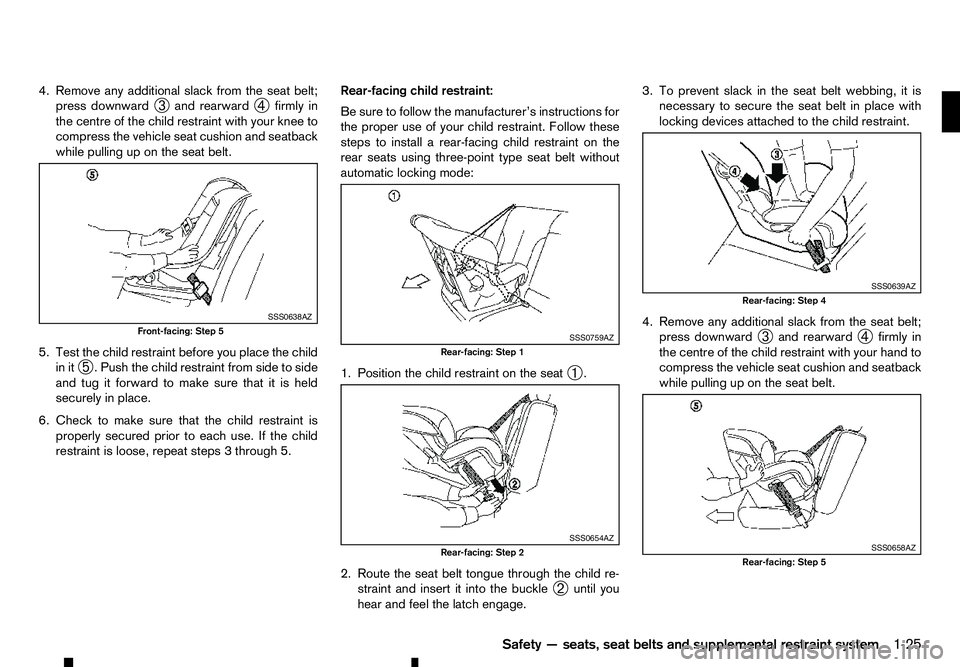
4. Remove any additional slack from the seat belt;
press downward ➂and rearward
➃firmly in
the centre of the child restraint with your knee to
compress the vehicle seat cushion and seatback
while pulling up on the seat belt.
5. Test the child restraint before you place the child in it ➄.P
ush the child restraint from side to side
and tug it forward to make sure that it is held
securely in place.
6. Check to make sure that the child restraint is properly secured prior to each use. If the child
restraint is loose, repeat steps 3through 5. Rear-facing child restraint:
Be sure to follow the manufacturer’s instructions for
the proper use of your child restraint. Follow these
steps to install
arear-facing child restraint on the
rear seats using three-point type seat belt without
automatic locking mode:
1. Position the child restraint on the seat ➀.
2. Route the seat belt tongue through the child re- straint and insert it into the buckle ➁until you
hear and feel the latch engage. 3. To prevent slack in the seat belt webbing, it is
necessary to secure the seat belt in place withlocking devices attached to the child restraint.
4. Remove any additional slack from the seat belt; press downward ➂and rearward
➃firmly in
the centre of the child restraint with your hand to
compress the vehicle seat cushion and seatback
while pulling up on the seat belt. SSS0638AZ
Front-facing: Step 5
SSS0759AZ
Rear-facing: Step 1
SSS0654AZ
Rear-facing: Step 2 SSS0639AZ
Rear-facing: Step 4
SSS0658AZ
Rear-facing: Step 5
Safety —seats, seat belts and supplemental restraint system 1-25