belt RENAULT ALASKAN 2017 Owner's Guide
[x] Cancel search | Manufacturer: RENAULT, Model Year: 2017, Model line: ALASKAN, Model: RENAULT ALASKAN 2017Pages: 340, PDF Size: 6.93 MB
Page 44 of 340
5. Test the child restraint before you place the child
in it ➄.P
ush the child restraint from side to side
and tug it forward to make sure that it is held
securely in place.
6. Check to make sure that the child restraint is properly secured prior to each use. If the child
restraint is loose, repeat steps 3through 5.
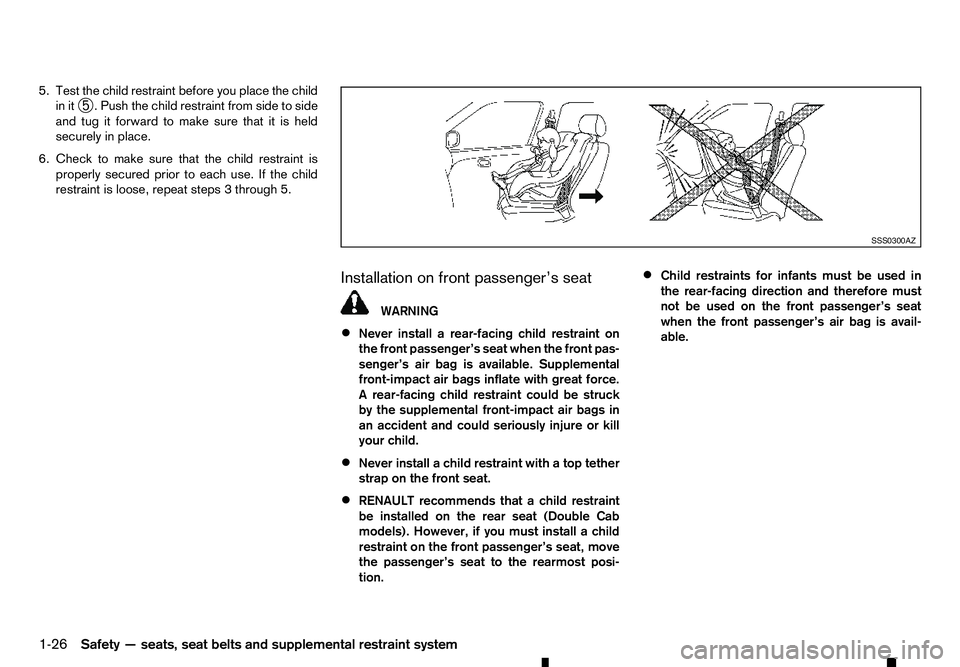
Installation on front passenger’s seat WARNING
• Never install
arear-facing child restraint on
the front passenger’s seat when the front pas-
senger’s air bag is available. Supplemental
front-impact air bags inflate with great force.
Ar ear-facing child restraint could be struck
by the supplemental front-impact air bags in
an accident and could seriously injure or kill
your child.
• Never install
achild restraint with atop tether
strap on the front seat.
• RENAULT recommends that
achild restraint
be installed on the rear seat (Double Cab
models). However, if you must install achild
restraint on the front passenger’s seat, move
the passenger’s seat to the rearmost posi-
tion. •
Child restraints for infants must be used in
the rear-facing direction and therefore must
not be used on the front passenger’s seat
when the front passenger’s air bag is avail-
able. SSS0300AZ
1-26 Safety —seats, seat belts and supplemental restraint system
Page 45 of 340
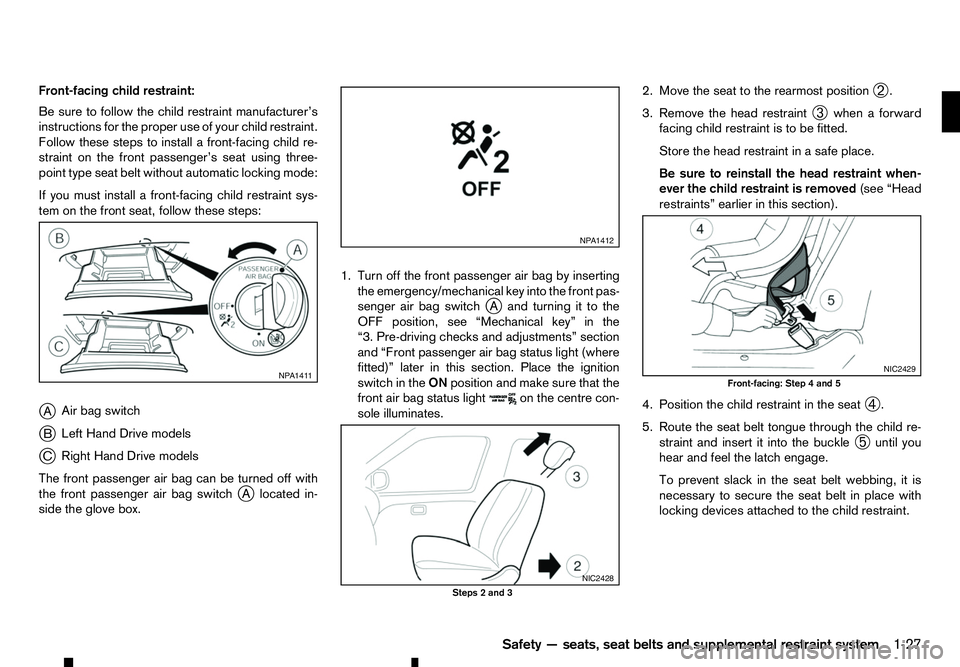
Front-facing child restraint:
Be sure to follow the child restraint manufacturer’s
instructions for the proper use of your child restraint.
Follow these steps to install afront-facing child re-
straint on the front passenger’s seat using three-
point type seat belt without automatic locking mode:
If you must install afront-facing child restraint sys-
tem on the front seat, follow these steps:
j A Air bag switch
j B Left Hand Drive models
j C Right Hand Drive models
The front passenger air bag can be turned off with
the front passenger air bag switch j
Al ocated in-
side the glove box. 1. Turn off the front passenger air bag by inserting
the emergency/mechanical key into the front pas-
senger air bag switch jAa nd turning it to the
OFF position, see “Mechanical key” in the
“3. Pre-driving checks and adjustments” section
and “Front passenger air bag status light (where
fitted)” later in this section. Place the ignition
switch in the ONposition and make sure that the
front air bag status light on the centre con-
sole illuminates. 2. Move the seat to the rearmost position
➁.
3. Remove the head restraint ➂when
aforward
facing child restraint is to be fitted.
Store the head restraint in asafe place.
Be sure to reinstall the head restraint when-
ever the child restraint is removed (see “Head
restraints” earlier in this section).
4. Position the child restraint in the seat ➃.
5. Route the seat belt tongue through the child re- straint and insert it into the buckle ➄until you
hear and feel the latch engage.
To prevent slack in the seat belt webbing, it is
necessary to secure the seat belt in place with
locking devices attached to the child restraint. NP A1411 NP A1412
NIC2428
Steps 2and 3 NIC2429
Front-facing: Step
4and 5
Safety —seats, seat belts and supplemental restraint system 1-27
Page 46 of 340
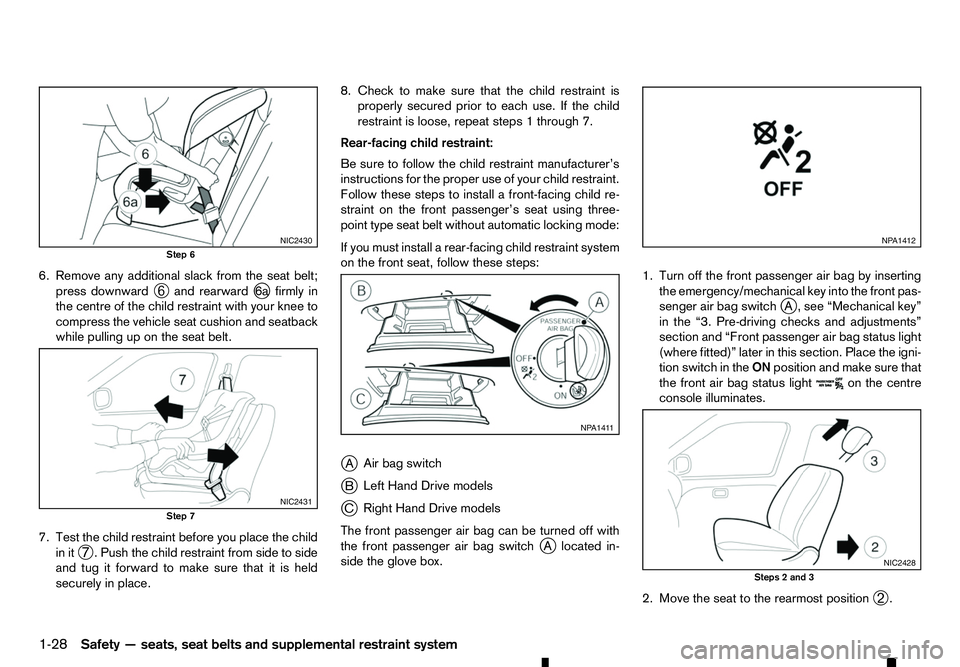
6. Remove any additional slack from the seat belt;
press downward ➅and rearward
j6a firmly in
the centre of the child restraint with your knee to
compress the vehicle seat cushion and seatback
while pulling up on the seat belt.
7. Test the child restraint before you place the child in it ➆.P
ush the child restraint from side to side
and tug it forward to make sure that it is held
securely in place. 8. Check to make sure that the child restraint is
properly secured prior to each use. If the child
restraint is loose, repeat steps 1through 7.
Rear-facing child restraint:
Be sure to follow the child restraint manufacturer’s
instructions for the proper use of your child restraint.
Follow these steps to install afront-facing child re-
straint on the front passenger’s seat using three-
point type seat belt without automatic locking mode:
If you must install arear-facing child restraint system
on the front seat, follow these steps:
j A Air bag switch
j B Left Hand Drive models
j C Right Hand Drive models
The front passenger air bag can be turned off with
the front passenger air bag switch jAl ocated in-
side the glove box. 1. Turn off the front passenger air bag by inserting
the emergency/mechanical key into the front pas-
senger air bag switch jA, see “Mechanical key”
in the “3. Pre-driving checks and adjustments”
section and “Front passenger air bag status light
(where fitted)” later in this section. Place the igni-
tion switch in the ONposition and make sure that
the front air bag status light on the centre
console illuminates.
2. Move the seat to the rearmost position ➁. NIC2430
Step 6
NIC2431
Step 7 NP A1411 NP A1412
NIC2428
Steps 2and 3
1-28 Safety —seats, seat belts and supplemental restraint system
Page 47 of 340
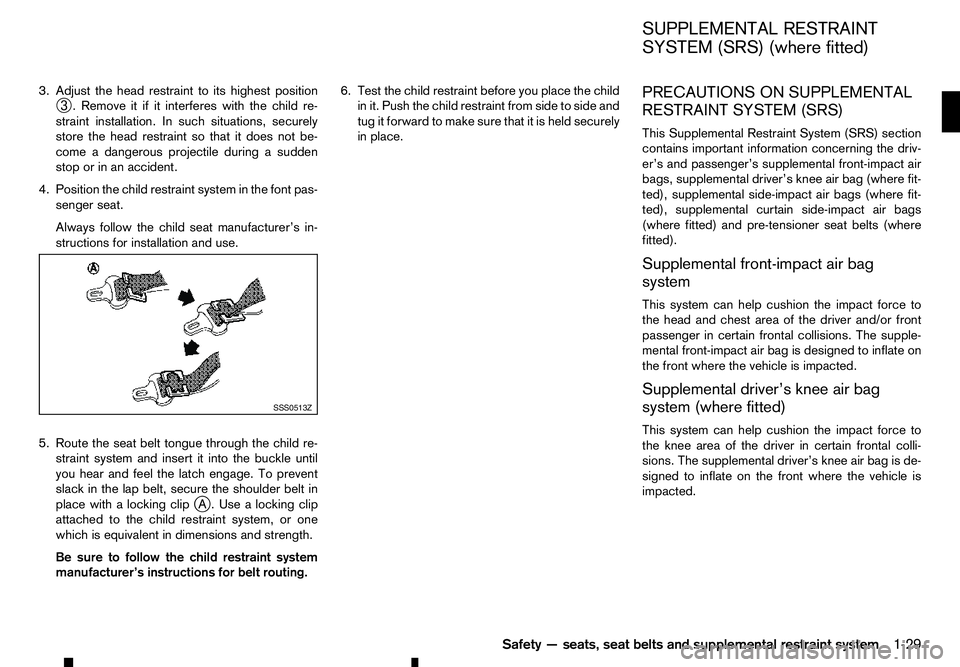
3. Adjust the head restraint to its highest position
➂ .R
emove it if it interferes with the child re-
straint installation. In such situations, securely
store the head restraint so that it does not be-
come adangerous projectile during asudden
stop or in an accident.
4. Position the child restraint system in the font pas- senger seat.
Always follow the child seat manufacturer’s in-
structions for installation and use.
5. Route the seat belt tongue through the child re- straint system and insert it into the buckle until
you hear and feel the latch engage. To prevent
slack in the lap belt, secure the shoulder belt in
place with alocking clip j
A. Use alocking clip
attached to the child restraint system, or one
which is equivalent in dimensions and strength.
Be sure to follow the child restraint system
manufacturer’s instructions for belt routing. 6. Test the child restraint before you place the child
in it. Push the child restraint from side to side and
tug it forward to make sure that it is held securely
in place. PRECAUTIONS ON SUPPLEMENTAL
RESTRAINT SYSTEM (SRS)
This Supplemental Restraint System (SRS) section
contains important information concerning the driv-
er’s and passenger’s supplemental front-impact air
bags, supplemental driver’s knee air bag (where fit-
ted), supplemental side-impact air bags (where fit-
ted), supplemental curtain side-impact air bags
(where fitted) and pre-tensioner seat belts (where
fitted).
Supplemental front-impact air bag
system
This system can help cushion the impact force to
the head and chest area of the driver and/or front
passenger in certain frontal collisions. The supple-
mental front-impact air bag is designed to inflate on
the front where the vehicle is impacted.
Supplemental driver’s knee air bag
system (where fitted)
This system can help cushion the impact force to
the knee area of the driver in certain frontal colli-
sions. The supplemental driver’s knee air bag is de-
signed to inflate on the front where the vehicle is
impacted.SSS0513Z SUPPLEMENTAL RESTRAINT
SYSTEM (SRS) (where fitted)
Safety —seats, seat belts and supplemental restraint system 1-29
Page 48 of 340
Supplemental side-impact air bag
system (where fitted)
This system can help cushion the impact force to
the chest and pelvis area of the driver and front pas-
senger in certain side-impact collisions. The supple-
mental side-impact air bag is designed to inflate on
the side where the vehicle is impacted.
Supplemental curtain side-impact air
bag system (where fitted)
This system can help cushion the impact force to
the head of the driver and passengers in front seat-
ing positions and rear outboard seating positions
(where fitted) in certain side-impact collisions. The
supplemental curtain side-impact air bag is designed
to inflate on the side where the vehicle is impacted.
The SRS is designed to supplementthe accident
protection provided by the driver’s and passenger’s
seat belts and is notdesigned to substitutefor
them. The SRS can help save lives and reduce seri-
ous injuries. However, inflating air bags may cause
abrasions or other injuries. Air bags do not provide
protection to the lower body. Seat belts should al-
ways be correctly worn and the occupants should
always be seated asuitable distance away from the
steering wheel, instrument panel and door finishers.
(See “Seat belts” earlier in this section.) The air
bags inflate quickly in order to help protect the oc-
cupants. The force of the air bags inflating can in-
crease the risk of injury if the occupants are too
close to, or are against, the air bag modules during
inflation. The air bags will deflate quickly after de-
ployment. The SRS operates only when the ignition switch
is in the ON position.
When the ignition switch is in the ON position,
the SRS air bag warning light illuminates for
about
7seconds and then turns off. This indi-
cates that the SRS is operational. (See “Warning
lights, indicator lights and audible reminders” in
the “2. Instruments and controls” section.)
1-30 Safety —seats, seat belts and supplemental restraint system
Page 49 of 340
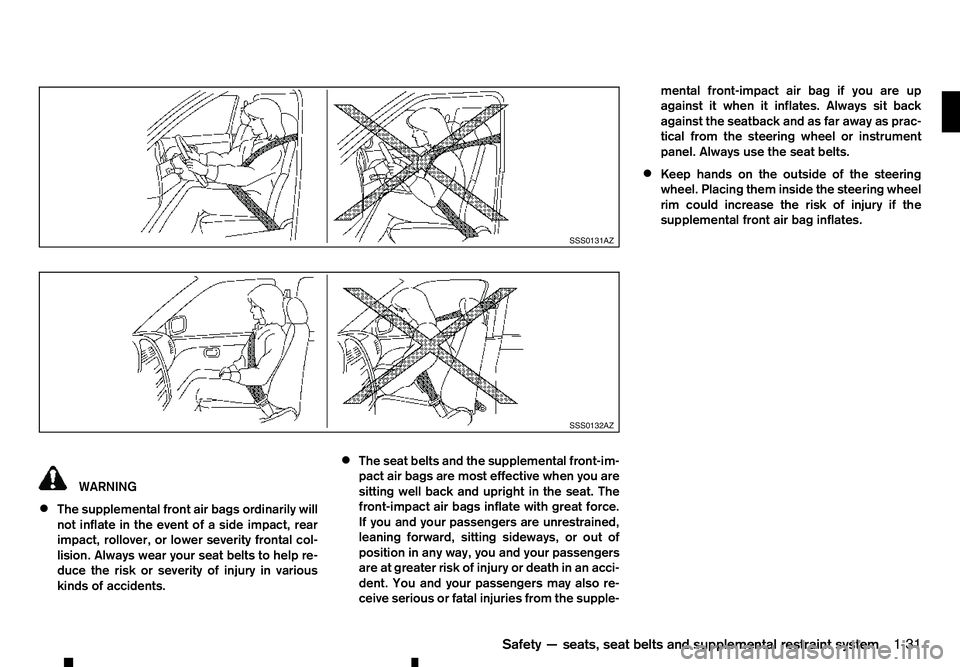
WARNING
• The supplemental front air bags ordinarily will
not inflate in the event of aside impact, rear
impact, rollover, or lower severity frontal col-
lision. Always wear your seat belts to help re-
duce the risk or severity of injury in various
kinds of accidents. •
The seat belts and the supplemental front-im-
pact air bags are most effective when you are
sitting well back and upright in the seat. The
front-impact air bags inflate with great force.
If you and your passengers are unrestrained,
leaning forward, sitting sideways, or out of
position in any way, you and your passengers
are at greater risk of injury or death in an acci-
dent. You and your passengers may also re-
ceive serious or fatal injuries from the supple- mental front-impact air bag if you are up
against it when it inflates. Always sit back against the seatback and as far away as prac-
tical from the steering wheel or instrument
panel. Always use the seat belts.
• Keep hands on the outside of the steering
wheel. Placing them inside the steering wheel
rim could increase the risk of injury if the
supplemental front air bag inflates. SSS0131AZ
SSS0132AZ
Safety —seats, seat belts and supplemental restraint system
1-31
Page 50 of 340
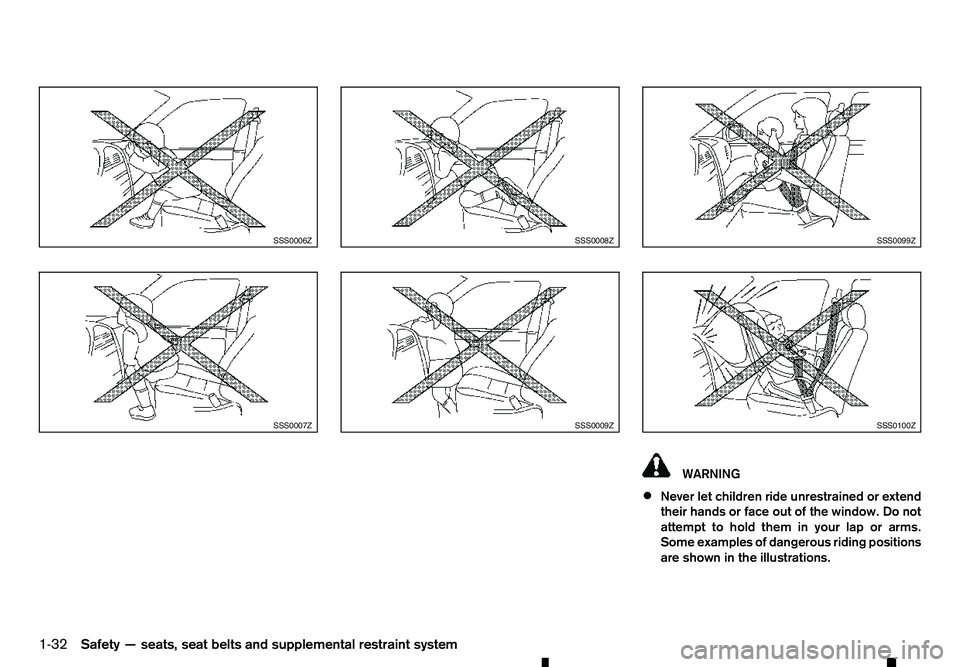
WARNING
• Never let children ride unrestrained or extend
their hands or face out of the window. Do not
attempt to hold them in your lap or arms.
Some examples of dangerous riding positions
are shown in the illustrations. SSS0006Z
SSS0007Z SSS0008Z
SSS0009Z SSS0099Z
SSS0100Z
1-32 Safety —seats, seat belts and supplemental restraint system
Page 51 of 340
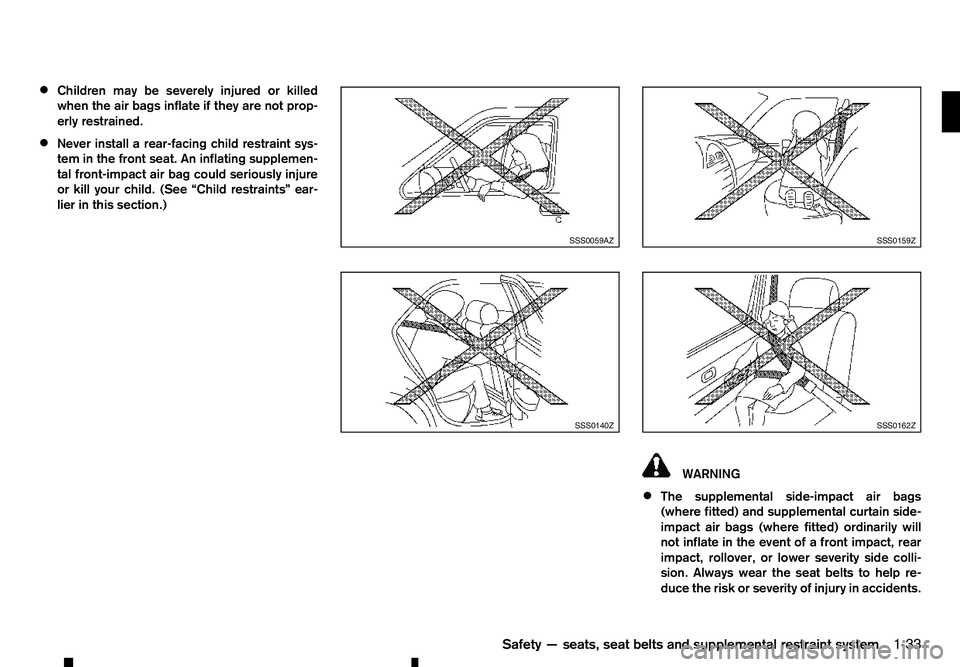
•
Children may be severely injured or killed
when the air bags inflate if they are not prop-
erly restrained.
• Never install
arear-facing child restraint sys-
tem in the front seat. An inflating supplemen-
tal front-impact air bag could seriously injure
or kill your child. (See “Child restraints” ear-
lier in this section.) WARNING
• The supplemental side-impact air bags
(where fitted) and supplemental curtain side-
impact air bags (where fitted) ordinarily will
not inflate in the event of afront impact, rear
impact, rollover, or lower severity side colli-
sion. Always wear the seat belts to help re-
duce the risk or severity of injury in accidents. SSS0059AZ
SSS0140Z SSS0159Z
SSS0162Z
Safety —seats, seat belts and supplemental restraint system
1-33
Page 52 of 340
•
The seat belts and the supplemental side-im-
pact air bags and supplemental curtain side-
impact air bags are most effective when you are sitting well back and upright in the seat.
The supplemental side-impact air bags and
supplemental curtain side-impact air bags in-
flate with great force. If you and your passen-
gers are unrestrained, leaning forward, sitting
sideways, or out of position in any way, you
and your passengers are at greater risk of
injury or death in an accident.
• Do not allow anyone to place their hands, legs
or face near the supplemental side-impact air
bags and supplemental curtain side-impact
air bags located on the sides of the seatback
of the front seats or near the side roof rails.
Do not allow anyone sitting in the front seats
or rear outboard seats to extend their hands
out of the windows or lean against the doors.
Some examples of dangerous riding positions
are shown in the illustrations.
• When sitting in the rear seats, do not hold
onto the seatback of the front seats. If the
supplemental side-impact air bags and
supplemental curtain side-impact air bags in-
flate, you may be seriously injured. Be espe-
cially careful with children, who should always
be properly restrained.
• Do not use seat covers on the front seatbacks.
They may interfere with the supplemental
side-impact air bag inflations. •
Do not attach the key with heavy objects, hard
objects or objects with sharp edges. This may
cause injury if the supplemental knee air bag
inflates.
Pre-tensioner seat belt system
(where fitted)
The pre-tensioner seat belt system may activate with the supplemental air bag system in certain types of
collisions. Working with the front seat belt retrac-
tors and anchors, it helps tighten the seat belt the
instant the vehicle becomes involved in certain types
of collisions, helping to restrain front seat occupants.
(See “Seat belts” earlier in this section.)
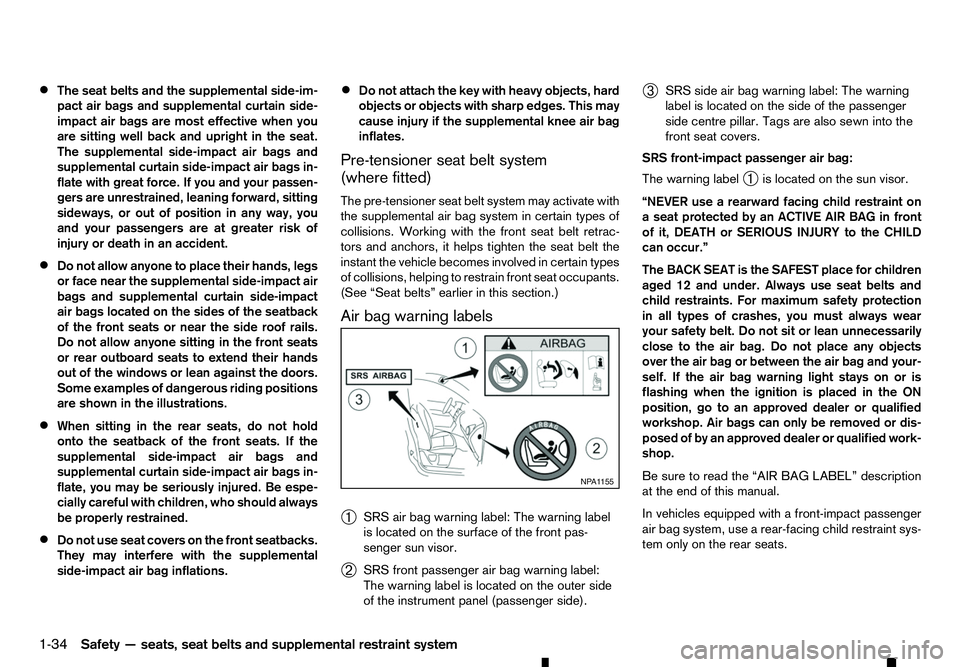
Air bag warning labels
➀ SRS air bag warning label: The warning label
is located on the surface of the front pas-
senger sun visor.
➁ SRS front passenger air bag warning label:
The warning label is located on the outer side
of the instrument panel (passenger side). ➂
SRS side air bag warning label: The warning
label is located on the side of the passenger
side centre pillar. Tags are also sewn into the
front seat covers.
SRS front-impact passenger air bag:
The warning label ➀is located on the sun visor.
“NEVER use arearward facing child restraint on
as eat protected by an ACTIVE AIR BAG in front
of it, DEATH or SERIOUS INJURY to the CHILD
can occur.”
The BACK SEAT is the SAFEST place for children
aged 12 and under. Always use seat belts and
child restraints. For maximum safety protection
in all types of crashes, you must always wear
your safety belt. Do not sit or lean unnecessarily
close to the air bag. Do not place any objects
over the air bag or between the air bag and your-
self. If the air bag warning light stays on or is
flashing when the ignition is placed in the ON
position, go to an approved dealer or qualified
workshop. Air bags can only be removed or dis-
posed of by an approved dealer or qualified work-
shop.
Be sure to read the “AIR BAG LABEL” description
at the end of this manual.
In vehicles equipped with afront-impact passenger
air bag system, use arear-facing child restraint sys-
tem only on the rear seats. NP A1155
1-34 Safety —seats, seat belts and supplemental restraint system
Page 53 of 340
When installing
achild restraint system in your ve-
hicle, always follow the child restraint system manu-
facturer’s instructions for installation. For additional
information, see “Child restraints” earlier in this sec-
tion.
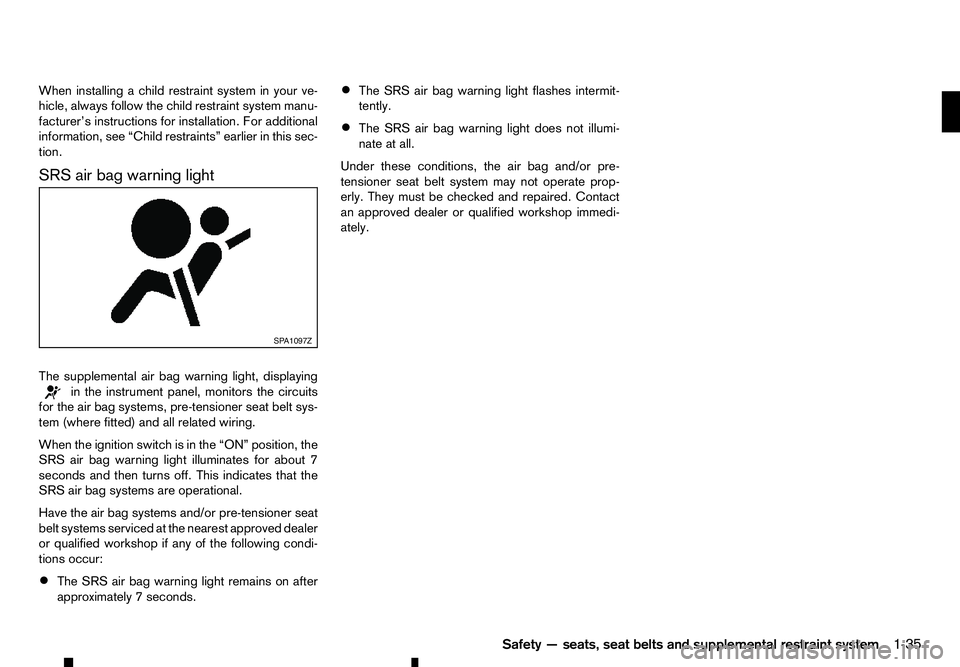
SRS air bag warning light
The supplemental air bag warning light, displaying in the instrument panel, monitors the circuits
for the air bag systems, pre-tensioner seat belt sys-
tem (where fitted) and all related wiring.
When the ignition switch is in the “ON” position, the
SRS air bag warning light illuminates for about 7
seconds and then turns off. This indicates that the
SRS air bag systems are operational.
Have the air bag systems and/or pre-tensioner seat
belt systems serviced at the nearest approved dealer
or qualified workshop if any of the following condi-
tions occur:
• The SRS air bag warning light remains on after
approximately
7seconds. •
The SRS air bag warning light flashes intermit-
tently.
• The SRS air bag warning light does not illumi-
nate at all.
Under these conditions, the air bag and/or pre-
tensioner seat belt system may not operate prop-
erly. They must be checked and repaired. Contact
an approved dealer or qualified workshop immedi-
ately. SP A1097Z
Safety—seats, seat belts and supplemental restraint system 1-35