four wheel drive RENAULT ALASKAN 2017 Owner's Manual
[x] Cancel search | Manufacturer: RENAULT, Model Year: 2017, Model line: ALASKAN, Model: RENAULT ALASKAN 2017Pages: 340, PDF Size: 6.93 MB
Page 231 of 340
WARNING
AT model: If the 4WD mode indicator is “OFF” or
the ATP warning light is “ON”, this indicates that
the automatic transmission P(Park) position will
not function and could result in the vehicle mov-
ing unexpectedly, causing serious personal in-
jury or property damage. Always set the parking
brake.
CAUTION
To avoid vehicle damage:
• Do not operate the 4WD mode switch when
cornering, reversing or if the rear wheels are
spinning freely. The vehicle must be moving
straight ahead.
• Do not move the shift lever (AT model) or
release the clutch pedal (MT model) when the
4LO indicator is blinking. Failure to do this
may cause the gears to grind and damaging
the powertrain.
• MT model: Do not accelerate rapidly from a
stopped position when the 4LO indicator is
blinking. Drive straight ahead at
alow speed
until the 4LO indicator is lit. The 4LO indicator
blinks when shifting between <4LO> and
<4H>.
• If the 4WD warning light comes on, perform
the following procedure:
1) Turn off the engine.
2) Start the engine. 3) Check if the 4WD warning light comes on.
If the 4WD warning light is still on after following
the above procedure, have the system checked
and serviced immediately by an approved dealer
or qualified workshop.
The transfer case 4WD mode switch is used to
select either Two-Wheel Drive (2WD) or
Four-Wheel Drive (4WD) depending on the driving
conditions. Turn the 4WD mode switch to select a drive mode (<2WD>, <4H> or <4LO>).
To change into or out of 4LO mode:
1. The vehicle MUST BE standing still.
2. Depress the clutch pedal (MT model) and the brake pedal and move the shift lever to N(Neu-
tral).
3. Depress and turn the 4WD mode switch to change into or out of <4LO>. WARNING
• When parking, apply the parking brake before
stopping the engine and make sure that the
4WD mode indicator is on and that the ATP
warning light or ATP warning message is off,
otherwise, the vehicle could unexpectedly
move even if the automatic transmission is in
the P(Park) position.
• The 4LO indicator must stop blinking and re-
main on or turn off before shifting the trans-
mission into gear. The vehicle may move un- expectedly if the shift lever is shifted from the
N(
Neutral) position to any other gear while
the 4LO indicator is blinking.
CAUTION
• Never turn the 4WD mode switch between
<4LO> and <4H> while driving.
• The <4H> drive mode provides greater power
and traction. Avoid excessive speed as it will
cause increased fuel consumption and higher
oil temperatures, and could damage power
train components. Speeds over 100 km/h (60
MPH) in <4H> are not recommended.
• The <4LO> drive mode provides maximum
power and traction. Avoid raising vehicle
speed excessively. The maximum speed is
approximately 50 km/h (30 MPH).
• The 4WD mode switch can be turned between
<2WD> and <4H> while driving straight ahead.
Do not turn the 4WD mode switch while mak-
ing
aturn or reversing.
• Do not turn the 4WD mode switch between
<2WD> and <4H> while driving on steep
downhill grades. Use the engine brake and
low transmission gears for engine braking.
• Do not turn the 4WD mode switch between
<2WD> and <4H> with the rear wheels spin-
ning.
Starting and driving 5-29
Page 233 of 340
hicle straight, accelerate or decelerate or
move the vehicle in reverse, then shift the
4WD mode switch.
• If the 4WD warning light comes on or 4WD Er-
ror warning (where fitted) appears, the 4WD
mode indicator turns off.
4WD WARNING
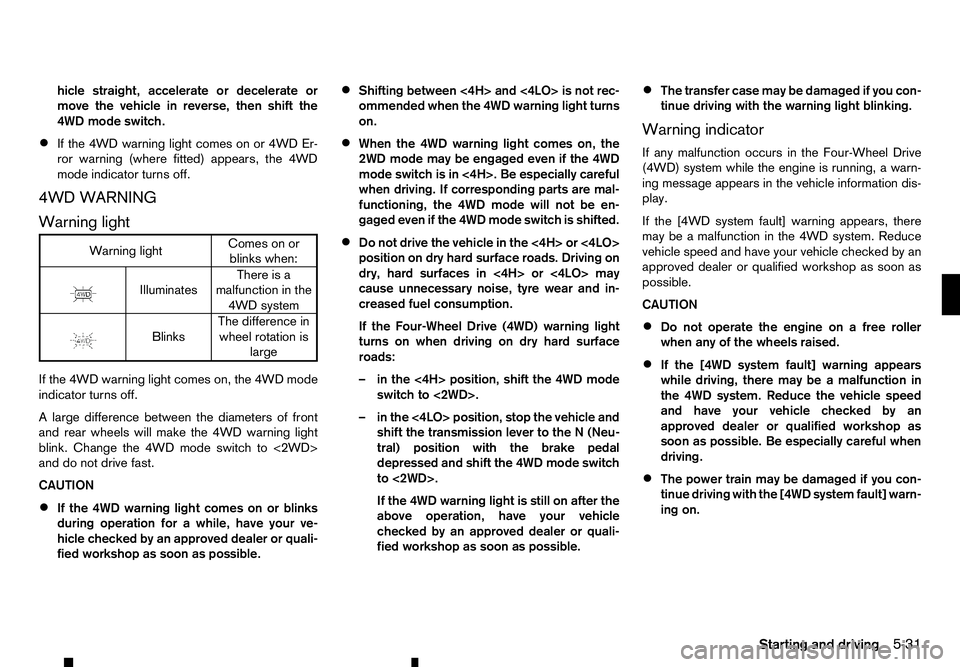
Warning light Warning light
Comes on or
blinks when:
m Illuminates
There
is a
malfunction in the
4WD system
m Blinks
The
difference in
wheel rotation is large
If the 4WD warning light comes on, the 4WD mode
indicator turns off.
Al arge difference between the diameters of front
and rear wheels will make the 4WD warning light
blink. Change the 4WD mode switch to <2WD>
and do not drive fast.
CAUTION
• If the 4WD warning light comes on or blinks
during operation for
awhile, have your ve-
hicle checked by an approved dealer or quali-
fied workshop as soon as possible. •
Shifting between <4H> and <4LO> is not rec-
ommended when the 4WD warning light turns
on.
• When the 4WD warning light comes on, the
2WD mode may be engaged even if the 4WD
mode switch is in <4H>. Be especially careful
when driving. If corresponding parts are mal-
functioning, the 4WD mode will not be en-
gaged even if the 4WD mode switch is shifted.
• Do not drive the vehicle in the <4H> or <4LO>
position on dry hard surface roads. Driving on
dry, hard surfaces in <4H> or <4LO> may
cause unnecessary noise, tyre wear and in-
creased fuel consumption.
If the Four-Wheel Drive (4WD) warning light
turns on when driving on dry hard surface
roads:
–i nthe <4H> position, shift the 4WD mode
switch to <2WD>.
–i nthe <4LO> position, stop the vehicle and
shift the transmission lever to the N(Neu-
tral) position with the brake pedal
depressed and shift the 4WD mode switch
to <2WD>.
If the 4WD warning light is still on after the
above operation, have your vehicle
checked by an approved dealer or quali-
fied workshop as soon as possible. •
The transfer case may be damaged if you con-
tinue driving with the warning light blinking.
Warning indicator
If any malfunction occurs in the Four-Wheel Drive
(4WD) system while the engine is running, awarn-
ing message appears in the vehicle information dis-
play.
If the [4WD system fault] warning appears, there
may be amalfunction in the 4WD system. Reduce
vehicle speed and have your vehicle checked by an
approved dealer or qualified workshop as soon as
possible.
CAUTION
• Do not operate the engine on
afree roller
when any of the wheels raised.
• If the [4WD system fault] warning appears
while driving, there may be
amalfunction in
the 4WD system. Reduce the vehicle speed
and have your vehicle checked by an
approved dealer or qualified workshop as
soon as possible. Be especially careful when
driving.
• The power train may be damaged if you con-
tinue driving with the [4WD system fault] warn-
ing on.
Starting and driving 5-31
Page 234 of 340
TYRE RECOMMENDATION FOR 4WD
CAUTION
• Always use tyres of the same size, brand, con-
struction (bias, bias-belted or radial), and
tread pattern on all four wheels. Failure to do
so may result in acircumference difference
between tyres on the front and rear axles,
which will cause excessive tyre wear and may damage the transmission, transfer case and
differential gears.
• ONLY use spare tyres specified for the Four-
Wheel Drive (4WD) models.
If excessive tyre wear is found, it is recommended
that all four tyres be replaced with tyres of the same
size, brand, construction and tread pattern. The tyre
pressure and wheel alignment should also be
checked and corrected as necessary. Contact an
approved dealer or qualified workshop.
Snow tyres
If you install snow tyres, they must also be of the
same size, brand, construction and tread pattern on
all four wheels.
Tyre inflation pressure
Periodically check the pressures of all tyres, includ-
ing the spare, with agauge while at aservice sta-
tion. If necessary, adjust to the specified pressure.
Tyre pressures are shown on the tyre placard af-
fixed to the driver’s side centre pillar or rear access
door. Tyre rotation
RENAULT recommends that tyres should be rotated
every 5,000 km (3,000 miles).
Snow chains
Snow chains must be installed only on the rear
wheels and not on the front wheels.
Do not drive with snow chains on paved roads that are clear of snow. Driving with chains in such condi-
tions can cause damage to the various mechanisms of the vehicle due to overstress. When driving on
clear paved roads, be sure to change to Two-Wheel
Drive (2WD) mode. The rear differential lock is designed to transmit en-
gine power to the left and right rear wheels equally.
If your vehicle is stuck in sand, snow, mud, etc. or
one wheel is off the ground and the differential lock
is not on, engine power is transmitted to the wheel
with least resistance causing it to spin, leaving insuf-
ficient traction on the other wheel. The rear differen-
tial lock allows the left and right wheels to rotate as
au
nit, enabling your vehicle to free itself.
To lock the rear differential gear:
1) Stop the vehicle completely.
2) Turn the 4WD mode switch to the 4LO position. For operation of the 4WD mode switch, see
“Four-Wheel Drive (4WD) (where fitted)” earlier
in this section.
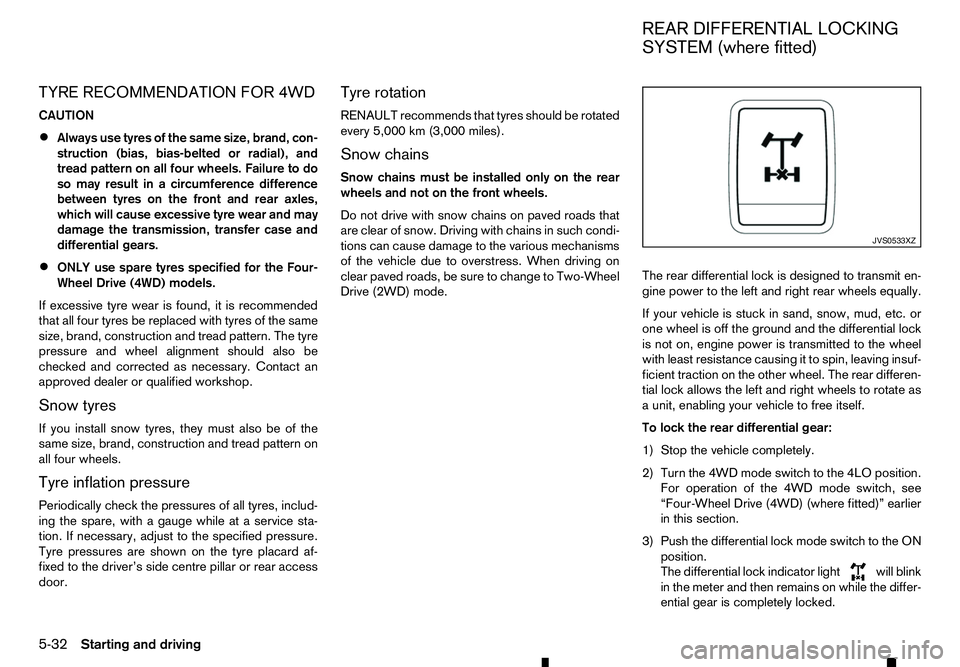
3) Push the differential lock mode switch to the ON position.
The differential lock indicator light will blink
in the meter and then remains on while the differ-
ential gear is completely locked. JVS0533XZ
REAR DIFFERENTIAL LOCKING
SYSTEM (where fitted)
5-32 Starting and driving
Page 236 of 340
•
When driving on extremely inclined surfaces
such as higher banked corners, the ESP sys-
tem may not operate properly and the ESP
warning light may illuminate. Do not drive
on these types of roads.
• When driving on an unstable surface such as
at urntable, ferry, elevator or ramp, the ESP
warning light may illuminate. This is not a
malfunction. Restart the engine after driving
onto astable surface.
• If wheels or tyres other than the RENAULT
recommended ones are used, the ESP sys-
tem may not operate properly and the ESP
warning light may illuminate.
• The ESP system is not
asubstitute for winter
tyres or tyre chains on asnow covered road.
The Electronic Stability Programme (ESP) system
uses various sensors to monitor driver inputs and
vehicle motion. Under certain driving conditions, the
ESP system performs the following functions:
• Controls brake pressure to reduce wheel slip on
one slipping drive wheel so power is transferred
to
an on slipping drive wheel on the same axle.
• Controls brake pressure and engine output to
reduce drive wheel slip based on vehicle speed
(traction control function). •
Controls brake pressure at individual wheels and
engine output to help the driver maintain control
of the vehicle in the following conditions:
–u
ndersteer (vehicle tends to not follow the
steered path despite increased steering in-
put)
–o versteer (vehicle tends to spin due to cer-
tain road or driving conditions).
The ESP system can help the driver to maintain con-
trol of the vehicle, but it cannot prevent loss of ve-
hicle control in all driving situations.
When the ESP system operates, the ESP warning
light in the instrument panel flashes so note the
following:
• The road may be slippery or the system may
determine some action is required to help the
vehicle on the steered path.
• You may feel
apulsation in the brake pedal and
hear anoise or vibration from under the bonnet.
This is normal and indicates that the ESP system
is working properly.
• Adjust your speed and driving to the road condi-
tions.
If am alfunction occurs in the system, the ESP warn-
ing light illuminates in the instrument panel. The
ESP system automatically turns off.
The ESP OFF switch is used to turn off the ESP
system. The ESP off indicator light illuminates
to indicate the ESP system is off. When the ESP
OFF switch is used to turn off the system, the ESP system still operates to prevent one drive wheel from
slipping by transferring power to
anon slipping drive
wheel. The ESP warning light flashes if this
occurs. All other ESP functions are off and the ESP
warning light will not flash. The ESP system is
automatically reset to on when the ignition switch is
placed in the OFFposition then back to the ONposi-
tion.
When the <4LO> position is selected with the Four-
Wheel Drive (4WD) mode switch, the ESP system
is disabled and the ESP OFF indicator light illumi-
nates.
See “Warning lights, indicator lights and audible
reminders” in the “2. Instruments and controls” sec-
tion and “Four-Wheel Drive (4WD) (where fitted)”
earlier in this section.
The computer has abuilt-in diagnostic feature that
tests the system each time you start the engine and
move the vehicle forward or in reverse at aslow
speed. When the self-test occurs, you may hear a
“clunk” noise and/or feel apulsation in the brake
pedal. This is normal and is not an indication of a
malfunction.
5-34 Starting and driving
Page 252 of 340
While driving on
aslippery surface, be careful when
braking, accelerating or downshifting. Abrupt brak-
ing or acceleration could cause the wheels to skid
and result in an accident.
Wet brakes
When the vehicle is washed or driven through wa-
ter, the brakes may get wet. As aresult, your brak-
ing distance will be longer and the vehicle may pull
to one side during braking.
To dry the brakes, drive the vehicle at asafe speed
while lightly depressing the footbrake pedal to heat
up the brakes. Do this until the brakes return to nor-
mal. Avoid driving the vehicle at high speeds until
the brakes function correctly.
Parking brake running-in
Break in the parking brake shoes whenever the
stopping effect of the parking brake is weakened or
whenever the parking brake shoes and/or drums/
rotors are replaced, in order to assure the best brak-
ing performance.
This procedure is described in the vehicle service
manual and can be performed by an approved dealer
or qualified workshop.
ANTI-LOCK BRAKING SYSTEM (ABS) WARNING
The Anti-lock Braking System (ABS) is
asophis-
ticated device, but it cannot prevent accidents
resulting from careless or dangerous driving
techniques. It can help maintain vehicle control during braking on slippery surfaces. Remember
that stopping distances on slippery surfaces will
be longer than on normal surfaces even with ABS.
Stopping distances may also be longer on rough,
gravel or snow covered roads, or if you are using
tyre chains. Always maintain
asafe distance from
the vehicle in front of you. Ultimately, the driver
is responsible for safety.
Tyre type and condition may also affect braking
effectiveness.
• When replacing tyres, install the specified size
of tyres on all four wheels.
• When installing
aspare tyre, make sure that it
is the proper size and type as specified on the
tyre placard. (See “Vehicle identification” in
the “9. Technical information” section.)
• For detailed information, see “Tyres and
wheels” in the “9. Technical information” sec-
tion.
The Anti-lock Braking System (ABS) controls the
brakes so the wheels do not lock during hard brak-
ing or when braking on slippery surfaces. The sys-
tem detects the rotation speed at each wheel and
varies the brake fluid pressure to prevent each wheel
from locking and sliding. By preventing each wheel
from locking, the system helps the driver maintain
steering control and helps to minimise swerving and
spinning on slippery surfaces. Using system
Depress the brake pedal and hold it down. Depress
the brake pedal with firm steady pressure, but do
not pump the brakes. The ABS will operate to pre-
vent the wheels from locking up. Steer the vehicle to
avoid obstacles. WARNING
Do not pump the brake pedal. Doing so may re-
sult in increased stopping distances.
Self-test feature
The ABS includes electronic sensors, electric
pumps, hydraulic solenoids and acomputer. The
computer has abuilt-in diagnostic feature that tests
the system each time you start the engine and move
the vehicle at alow speed in forward or reverse.
When the self-test occurs, you may hear a“clunk”
noise and/or feel apulsation in the brake pedal. This
is normal and does not indicate amalfunction. If the
computer senses amalfunction, it switches the ABS
off and illuminates the ABS warning light on the
instrument panel. The brake system then operates
normally, but without anti-lock assistance. If the ABS
warning light illuminates during the self-test or while
driving, have the vehicle checked by an approved
dealer or qualified workshop.
Normal operation
The ABS operates at speeds above 5to10km/h (3
to 6M PH). The speed varies according to road con-
ditions.
5-50 Starting and driving
Page 253 of 340
When the ABS senses that one or more wheels are
close to locking up, the actuator rapidly applies and
releases hydraulic pressure. This action is similar to
pumping the brakes very quickly. You may feel a
pulsation in the brake pedal and hear anoise from
under the bonnet or feel avibration from the actua-
tor when it is operating. This is normal and indicates
that the ABS is operating properly. However, the
pulsation may indicate that road conditions are haz-
ardous and extra care is required while driving.
When the differential lock (where fitted) is engaged,
the ABS warning light illuminates. This indicates that
the anti-lock function is not fully operating. (See
“Rear differential locking system (where fitted)” ear-
lier in this section for the rear differential lock func-
tion.) WARNING
• Whatever the condition, drive with caution.
Accelerate and decelerate with great care. If
accelerating or decelerating too fast, the drive
wheels will lose even more traction.
• Allow more stopping distance in cold weather
driving. Braking should be started sooner than
on dry pavement.
• Keep at
agreater distance from the vehicle in
front of you on slippery roads.
• Wet ice (0°C, 32°F and freezing rain), very cold
snow and ice can be slick and very difficult to
drive on. The vehicle will have
alot less trac-
tion or grip under these conditions. Try to
avoid driving on wet ice until the road is salted
or sanded.
• Watch for slippery spots (glaring ice). These
may appear on an otherwise clear road in
shaded areas. If
apatch of ice is seen ahead,
brake before reaching it. Try not to brake while
actually on the ice, and avoid any sudden
steering manoeuvres.
• Do not use cruise control on slippery roads.
• Snow can trap dangerous exhaust gas under
your vehicle. Keep snow clear of the exhaust
pipe and from around your vehicle. BATTERY
If the battery is not fully charged during extremely
cold weather conditions, the battery fluid may freeze
and damage the battery. To maintain maximum effi-
ciency, the battery should be checked regularly. For
details, see “Battery” in the “8. Maintenance and
do-it-yourself” section of this manual.
ENGINE COOLANT
If the vehicle is to be left outside without anti-freeze,
drain the cooling system, including the engine block.
Refill before operating the vehicle. For details, see
“Engine cooling system” in the “8. Maintenance and
do-it-yourself” section of this manual.
TYRE EQUIPMENT
1. If you have snow tyres installed on the front/rear
wheels of your vehicle, they should be of the
same size, loading range, construction and type
(bias, bias-belted or radial) as the rear/front tyres.
2. If the vehicle is to be operated in severe winter conditions, snow tyres should be installed on all
four wheels.
3. For additional traction on icy roads, studded tyres may be used. However, some countries, prov-
inces and states prohibit their use. Check local,
state and provincial laws before installing stud-
ded tyres.
Skid and traction capabilities of studded snow
tyres, on wet or dry surfaces, may be poorer
than that of non-studded snow tyres.
COLD WEATHER DRIVING
Starting and driving5-51
Page 267 of 340
4.
Automatic transmission model:
Move the shift lever to the P(Park) position.
Manual transmission model:
Move the shift lever to the N(Neutral) position.
DO NOT STOP THE ENGINE.
5. Open all the windows.
6. Turn off the air conditioner. Move the tempera- ture control to maximum hot and the fan control
to high speed.
7. Get out from the vehicle.
8. Visually inspect and listen for steam or coolant escaping from the radiator before opening the
bonnet. Wait until no steam or coolant can be
seen before proceeding.
9. Open the engine bonnet.
10. Visually inspect if the cooling fan is running.
11. Visually inspect the radiator and radiator hoses for leakage. If the cooling fan is not running or
the coolant is leaking, stop the engine.
12. After the engine cools down, check the coolant level in the reservoir with the engine running.
Do not open the radiator or coolant reservoir
cap.
13. Add coolant to the reservoir if necessary.
Have your vehicle inspected/repaired at an
approved dealer or qualified workshop. When towing your vehicle, local regulations for tow-
ing must be followed. Incorrect towing equipment
could damage your vehicle. To assure proper tow-
ing and to prevent accidental damage to your ve-
hicle, RENAULT recommends that you have profes-
sional road assistance personnel tow your vehicle. It
is advisable to have the professional road assistant
carefully read the following precautions.
TOWING PRECAUTIONS
• Be sure that the transmission, steering system
and powertrain are in working condition before
towing. If any units are damaged, the vehicle
must be towed using
adolly or flatbed tow truck.
(Two- Wheel Drive (2WD) model)
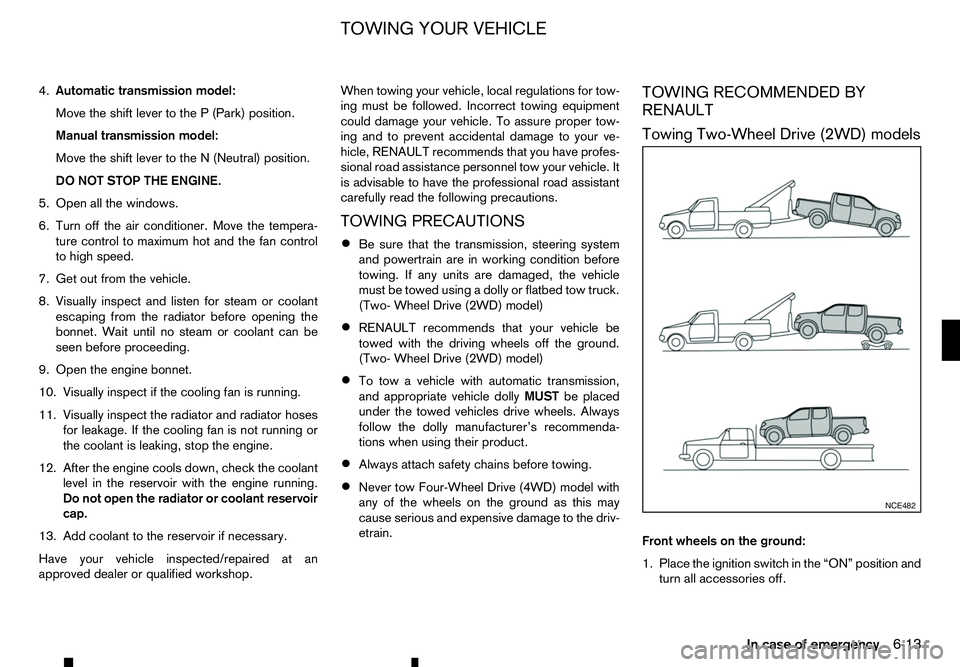
• RENAULT recommends that your vehicle be
towed with the driving wheels off the ground.
(Two- Wheel Drive (2WD) model)
• To tow
avehicle with automatic transmission,
and appropriate vehicle dolly MUSTbe placed
under the towed vehicles drive wheels. Always
follow the dolly manufacturer’s recommenda-
tions when using their product.
• Always attach safety chains before towing.
• Never tow Four-Wheel Drive (4WD) model with
any of the wheels on the ground as this may
cause serious and expensive damage to the driv-
etrain. TOWING RECOMMENDED BY
RENAULT
Towing Two-Wheel Drive (2WD) models
Front wheels on the ground:
1. Place the ignition switch in the “ON” position and
turn all accessories off. NCE482
TOWING YOUR VEHICLE
In case of emergency6-13
Page 269 of 340
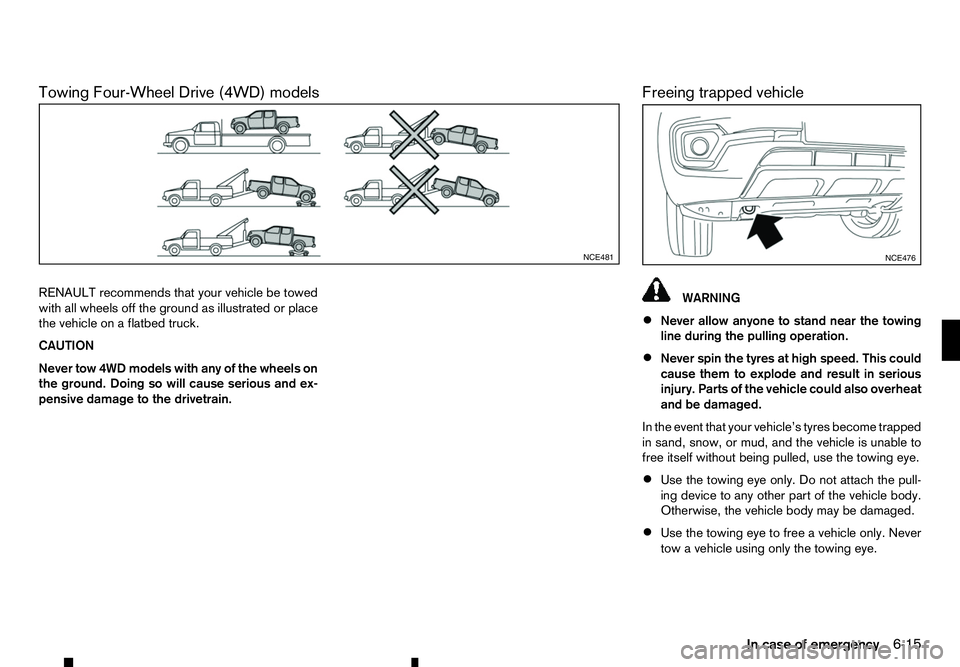
Towing Four-Wheel Drive (4WD) models
RENAULT recommends that your vehicle be towed
with all wheels off the ground as illustrated or place
the vehicle on aflatbed truck.
CAUTION
Never tow 4WD models with any of the wheels on
the ground. Doing so will cause serious and ex-
pensive damage to the drivetrain. Freeing trapped vehicle WARNING
• Never allow anyone to stand near the towing
line during the pulling operation.
• Never spin the tyres at high speed. This could
cause them to explode and result in serious
injury. Parts of the vehicle could also overheat
and be damaged.
In the event that your vehicle’s tyres become trapped
in sand, snow, or mud, and the vehicle is unable to
free itself without being pulled, use the towing eye.
• Use the towing eye only. Do not attach the pull-
ing device to any other part of the vehicle body.
Otherwise, the vehicle body may be damaged.
• Use the towing eye to free
avehicle only. Never
tow avehicle using only the towing eye. NCE481
NCE476
In case of emergency
6-15
Page 279 of 340
Lights*:
Clean the headlights on
aregular basis. Make sure
that the headlights, stop lights, tail lights, turn signal
lights, and other lights are all operating properly and
installed securely. Also check the aim of the head-
lights.
Tyres*:
Check the pressure with agauge often and always
prior to long distance trips. Adjust the pressure in all
tyres, including the spare, to the pressure specified.
Check carefully for damage, cuts or excessive wear.
Tyre rotation*:
In the case of Two-Wheel Drive (2WD), and where
front and rear tyres are the same size: tyres should
be rotated every 10,000 km (6,000 miles). Tyres
marked with directional indicators can only be ro-
tated between front and rear. Make sure that the
directional indicators point in the direction of wheel
rotation after the tyre rotation is completed.
In the case of the Four-Wheel Drive and All Wheel
Drive (4WD/AWD), and where front and rear tyres
are the same size: tyres should be rotated every
5,000 km (3,000 miles). Tyres marked with direc-
tional indicators can only be rotated between front
and rear. Make sure that the directional indicators
point in the direction of wheel rotation after the tyre
rotation is completed.
In the case that front tyres are different size from
rear tyres: tyres cannot be rotated.
The timing for tyre rotation may vary according to
your driving habits and the road surface conditions. Tyre Pressure Monitoring System (TPMS)
transmitter components (where fitted):
Replace the TPMS transmitter grommet seal, valve
core and cap when the tyres are replaced due to
wear or age.
Wheel alignment and balance:
If the vehicle should pull to either side while driving
on astraight and level road, or if you detect uneven
or abnormal tyre wear, there may be aneed for
wheel alignment. If the steering wheel or seat vi-
brates at normal highway speeds, wheel balancing
may be needed.
Windscreen:
Clean the windscreen on aregular basis. Check the
windscreen at least every six months for cracks or
other damage. Repair as necessary.
Wiper blades*:
Check for cracks or wear if not functioning cor-
rectly. Replace as necessary.
Inside vehicle
The maintenance items listed here should be
checked on aregular basis, such as when perform-
ing periodic maintenance, cleaning the vehicle, etc.
Accelerator pedal:
Check the pedal for smooth operation and make
sure that the pedal does not catch or require uneven
effort. Keep the floor mats away from the pedal. Brake pedal*:
Check the pedal for smooth operation and make
sure that it is the proper distance from the floor mat
when depressed fully. Check the brake booster
function. Be sure to keep the floor mats away from
the pedal.
Parking brake*:
Check the parking brake operation regularly. Check
that the lever (where fitted) or the pedal (where fit-
ted) has the proper travel. Also make sure that the
vehicle is held securely on
afairly steep hill when
only the parking brake is applied.
Seat belts:
Check that all parts of the seat belt system (for
example, buckles, anchors, adjusters and retrac-
tors) operate properly and smoothly, and are in-
stalled securely. Check the belt webbing for cuts,
fraying, wear or damage.
Steering wheel:
Check for changes in the steering condition, such
as excessive play, hard steering or strange noises.
Warning lights and chimes:
Make sure that all warning lights and chimes are
operating properly.
Windscreen defogger:
Check that the air comes out of the defogger outlets
properly and in good quantity when operating the
heater or air conditioner.
Maintenance and do-it-yourself 8-3
Page 302 of 340
If you have
aflat tyre, see “Flat tyre” in the “6. In
case of emergency” section.
TYRE INFLATION PRESSURE
Periodically check the pressure of the tyres, includ-
ing the spare. An incorrect tyre pressure may ad-
versely affect tyre life and vehicle handling. The tyre
pressure should be checked when tyres are COLD.
Tyres are considered COLD after the vehicle has
been parked for 3ormore hours, or driven less than
1.6 km (1 mile). COLD tyre pressures are shown on
the tyre placard.
Insufficient pressure can lead to an overheating of
the tyre and subsequent internal damage. At high
speeds, this could result in tread separation and
even bursting of the tyre.
TYPES OF TYRES
CAUTION
When changing or replacing tyres, be sure all
four tyres are of the same type (that is, summer,
all season or snow) and construction. An ap-
proved dealer or qualified workshop may be able
to help you with information about tyre type, size,
speed rating and availability.
Replacement tyres may have alower speed rating
than the factory equipped tyres, and they may not
match the potential maximum vehicle speed. Never
exceed the maximum speed rating of the tyre. All season tyres
RENAULT specifies all season tyres on some mod-
els to provide good performance all year, including
snowy and icy road conditions. All season tyres are
identified by ALL SEASON and/or M&S on the tyre
sidewall. Snow tyres have better snow traction than
all season tyres and may be more appropriate in
some areas.
Summer tyres
RENAULT specifies summer tyres on some models
to provide superior performance on dry roads. Sum-
mer tyre performance is substantially reduced in
snow and ice. Summer tyres do not have the tyre
traction rating M&S on the tyre sidewall.
If you plan to operate your vehicle in snowy or icy
conditions, RENAULT recommends the use of snow
or all season tyres on all four wheels.
Snow tyres
If snow tyres are needed, it is necessary to select
tyres equivalent in size and load rating to the original
equipment tyres. If you do not, it can adversely af-
fect the safety and handling of your vehicle.
Generally, snow tyres have lower speed ratings than
factory equipped tyres and may not match the po-
tential maximum vehicle speed. Never exceed the
maximum speed rating of the tyre. If you install snow
tyres, they must be the same size, brand, construc-
tion and tread pattern on all four wheels.
SDI1839Z
Vanity mirror light (where fitted)
TYRES AND WHEELS
8-26 Maintenance and do-it-yourself