tyre pressure RENAULT ALASKAN 2017 Owner's Guide
[x] Cancel search | Manufacturer: RENAULT, Model Year: 2017, Model line: ALASKAN, Model: RENAULT ALASKAN 2017Pages: 340, PDF Size: 6.93 MB
Page 302 of 340
If you have
aflat tyre, see “Flat tyre” in the “6. In
case of emergency” section.
TYRE INFLATION PRESSURE
Periodically check the pressure of the tyres, includ-
ing the spare. An incorrect tyre pressure may ad-
versely affect tyre life and vehicle handling. The tyre
pressure should be checked when tyres are COLD.
Tyres are considered COLD after the vehicle has
been parked for 3ormore hours, or driven less than
1.6 km (1 mile). COLD tyre pressures are shown on
the tyre placard.
Insufficient pressure can lead to an overheating of
the tyre and subsequent internal damage. At high
speeds, this could result in tread separation and
even bursting of the tyre.
TYPES OF TYRES
CAUTION
When changing or replacing tyres, be sure all
four tyres are of the same type (that is, summer,
all season or snow) and construction. An ap-
proved dealer or qualified workshop may be able
to help you with information about tyre type, size,
speed rating and availability.
Replacement tyres may have alower speed rating
than the factory equipped tyres, and they may not
match the potential maximum vehicle speed. Never
exceed the maximum speed rating of the tyre. All season tyres
RENAULT specifies all season tyres on some mod-
els to provide good performance all year, including
snowy and icy road conditions. All season tyres are
identified by ALL SEASON and/or M&S on the tyre
sidewall. Snow tyres have better snow traction than
all season tyres and may be more appropriate in
some areas.
Summer tyres
RENAULT specifies summer tyres on some models
to provide superior performance on dry roads. Sum-
mer tyre performance is substantially reduced in
snow and ice. Summer tyres do not have the tyre
traction rating M&S on the tyre sidewall.
If you plan to operate your vehicle in snowy or icy
conditions, RENAULT recommends the use of snow
or all season tyres on all four wheels.
Snow tyres
If snow tyres are needed, it is necessary to select
tyres equivalent in size and load rating to the original
equipment tyres. If you do not, it can adversely af-
fect the safety and handling of your vehicle.
Generally, snow tyres have lower speed ratings than
factory equipped tyres and may not match the po-
tential maximum vehicle speed. Never exceed the
maximum speed rating of the tyre. If you install snow
tyres, they must be the same size, brand, construc-
tion and tread pattern on all four wheels.
SDI1839Z
Vanity mirror light (where fitted)
TYRES AND WHEELS
8-26 Maintenance and do-it-yourself
Page 303 of 340
For additional traction on icy roads, studded tyres
may be used. However, some states and provinces
prohibit their use. Check local, state and provincial
laws before installing studded tyres. Skid and trac-
tion capabilities of studded snow tyres on wet or dry
surfaces may be poorer than that of non-studded
snow tyres.
Four-Wheel Drive (4WD) model
CAUTION
• Always use tyres of the same type, size, brand,
construction (bias, bias-belted or radial), and
tread pattern on all four wheels. Failure to do
so may result in
acircumference difference
between tyres on the front and rear axles
which will cause excessive tyre wear and may
damage the transmission, transfer case and
differential gears.
• ONLY use spare tyres specified for the 4WD
model.
If excessive tyre wear is found, it is recommended
that all four tyres be replaced with tyres of the same
size, brand, construction and tread pattern. The tyre
pressure and wheel alignment should also be
checked and corrected as necessary. Contact an
approved dealer or qualified workshop. TYRE CHAINS
Use of tyre chains may be prohibited according to
location. Check the local laws before installing tyre
chains. When installing tyre chains, make sure that
they are of proper size for the tyres on your vehicle
and are installed according to the chain manufactur-
er’s instructions.
Use chain tensioners when recommended by the
tyre chain manufacturer to ensure
atight fit. Loose
end links of the tyre chains must be secured or
removed to prevent the possibility of whipping ac-
tion damage to the wings or underbody. If possible,
avoid fully loading your vehicle when using tyre
chains. In addition, drive at areduced speed. Oth-
erwise, your vehicle may be damaged and/or ve-
hicle handling and performance may be adversely
affected.
Tyre chains must be installed only on the rear
wheels and not on the front wheels.
Do not drive with tyre chains on paved roads which
are clear of snow. Driving with chains in such condi-
tions can cause damage to the various mechanisms
of the vehicle due to some overstress. TYRE ROTATION
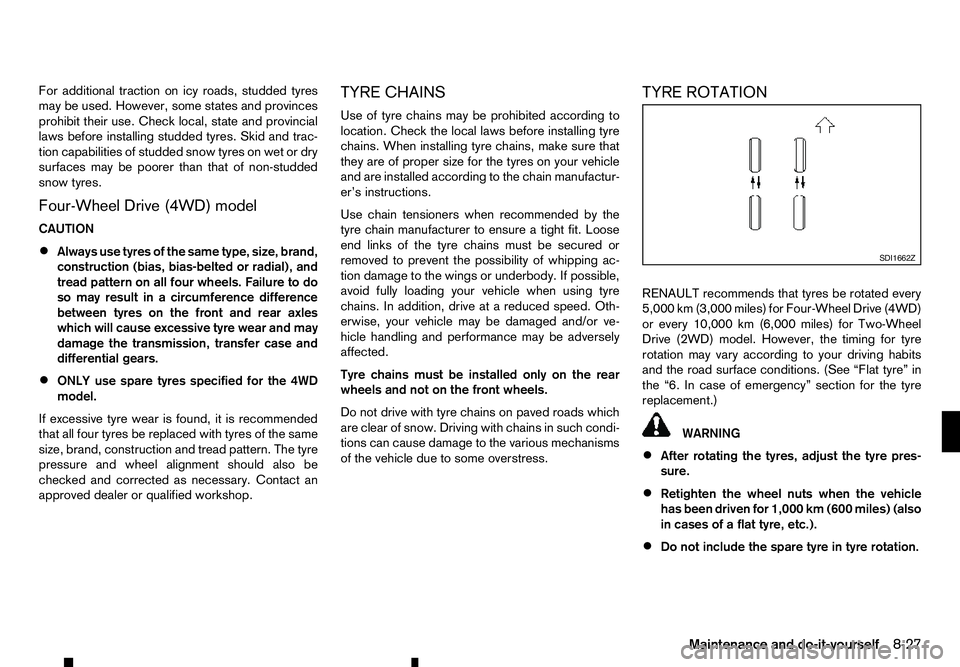
RENAULT recommends that tyres be rotated every
5,000 km (3,000 miles) for Four-Wheel Drive (4WD)
or every 10,000 km (6,000 miles) for Two-Wheel
Drive (2WD) model. However, the timing for tyre
rotation may vary according to your driving habits
and the road surface conditions. (See “Flat tyre” in
the “6. In case of emergency” section for the tyre
replacement.)
WARNING
• After rotating the tyres, adjust the tyre pres-
sure.
• Retighten the wheel nuts when the vehicle
has been driven for 1,000 km (600 miles) (also
in cases of
aflat tyre, etc.).
• Do not include the spare tyre in tyre rotation. SDI1662Z
Maintenance and do-it-yourself
8-27
Page 305 of 340
•
Never mount more than
1temporary spare tyre
at atime to the same vehicle.
• For tyre inflation pressure, apply same pressure
as specified for the axle the tyre is mounted on,
unless there is another indication on the tyre
placard. See, “Tyre placard” in the “9. Technical
information” section.
• Disable ESP when
atemporary spare wheel is
mounted. See, “Electronic Stability Programme
(ESP) system (where fitted)” in the “5. Starting
and driving” section.
• Never tow
atrailer when atemporary use only
spare tyre is mounted.
Maintenance and do-it-yourself8-29
Page 310 of 340
Tyre
Conventional Size
205R16C
110/108 S 255/70R16
111 T 255/60R18
112 T
Spare SizeConventional ConventionalConventional255/70R16
Road
wheel Conventional
Size
16×6 J1 6×7J1 8×7J
Offset mm
(in) 55 (2.17)
45 (1.77) 45 (1.77)
Spare Size
Conventional Conventional16×7J
Offset Conventional Conventional45 (1.77)
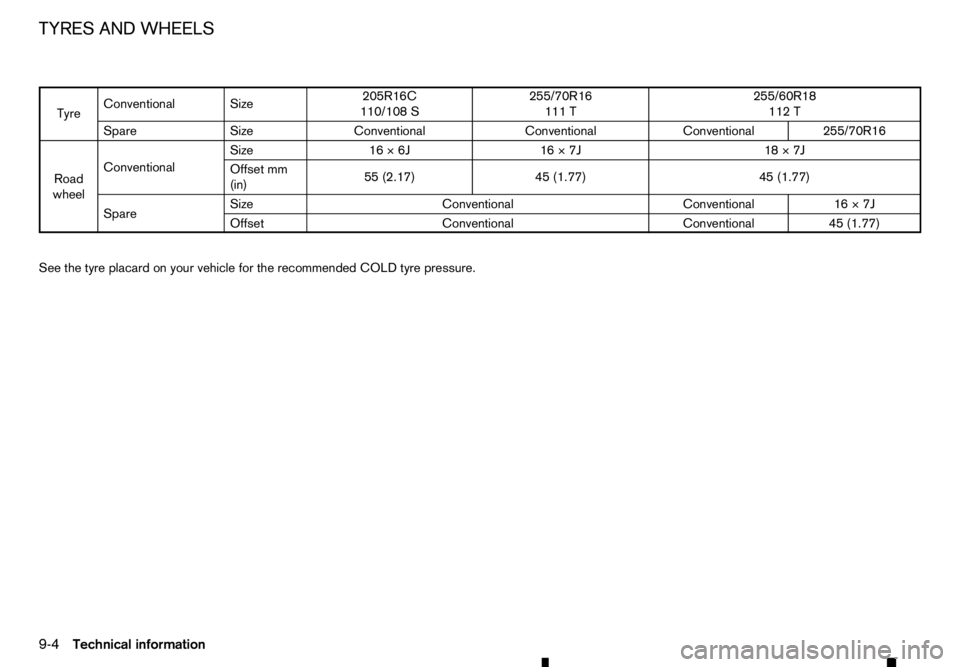
See the tyre placard on your vehicle for the recommended COLD tyre pressure.
TYRES AND WHEELS
9-4
Technical information
Page 314 of 340
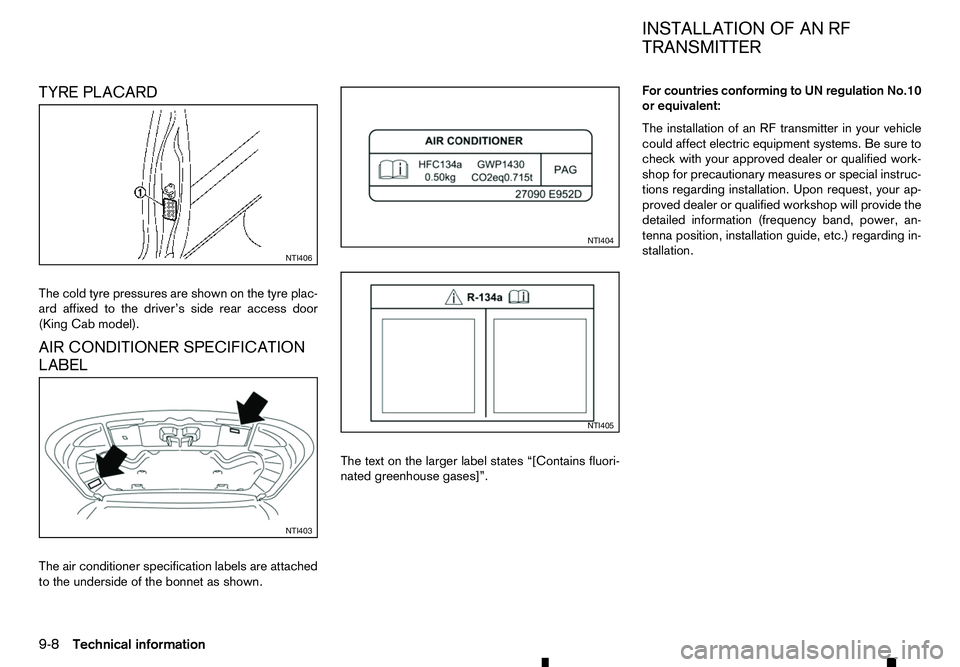
TYRE PLACARD
The cold tyre pressures are shown on the tyre plac-
ard affixed to the driver’s side rear access door
(King Cab model).
AIR CONDITIONER SPECIFICATION
LABEL
The air conditioner specification labels are attached
to the underside of the bonnet as shown. The text on the larger label states “[Contains fluori-
nated greenhouse gases]”.For countries conforming to UN regulation No.10
or equivalent:
The installation of an RF transmitter in your vehicle
could affect electric equipment systems. Be sure to
check with your approved dealer or qualified work-
shop for precautionary measures or special instruc-
tions regarding installation. Upon request, your ap-
proved dealer or qualified workshop will provide the
detailed information (frequency band, power, an-
tenna position, installation guide, etc.) regarding in-
stallation.NTI406
NTI403 NTI404
NTI405INSTALLATION OF AN RF
TRANSMITTER
9-8 Technical information
Page 331 of 340
Travelling ........................................................................V
....... 9-7
Turbocharger ........................................................................V
5-8
Turn signal
–R eplacement ................................................................. 8-23
Tyre Pressure Monitoring System (TPMS) ............................. 5-9
–M eter information .......................................................... 5-12
–R adio approval numbers .................................................. 9-9
–S ettings ........................................................................V
. 5-13
Tyres
–4 WD model ................................................................... 5-32
–A ge ........................................................................V
....... 8-28
–C old weather ................................................................ 5-51
–F lat tyre ........................................................................V
... 6-2
–I nflation pressure ........................................................... 8-26
–P lacard ........................................................................V
.... 9-8
–R epairing flat tyre ............................................................ 6-6
–R otation ........................................................................V
. 8-27
–S izes ........................................................................V
....... 9-4
–S now chains ................................................................. 8-27
–T ypes ........................................................................V
.... 8-26
–W ear and damage ......................................................... 8-28
–W heels and tyres .......................................................... 8-26
U Universal child restraints
–F ront and rear seats ...................................................... 1-15
V Vanity mirror
–L ights ........................................................................V
.... 2-45
Variable voltage control system ............................................ 8-17
Vehicle battery .................................................................... 8-13 Vehicle identification .............................................................. 9-7
–A
ir conditioner label ......................................................... 9-8
–E ngine serial number ....................................................... 9-7
–L abel ........................................................................V
....... 9-7
–N umber (VIN) (chassis number) ....................................... 9-7
–N umber (VIN) plate .......................................................... 9-7
–T yre placard .................................................................... 9-8
Vehicle security ................................................................... 5-49
–T heft warning system ..................................................... 3-15
Vents ........................................................................V
.......... 4-20
W Warning/indicator lights and audible reminders
–W arning lights ................................................................. 2-5
Wheels
–B locking ........................................................................V
.. 6-4
–C leaning ........................................................................V
.. 7-3
–I nstallation ....................................................................... 6-6
–R emoval ........................................................................V
.. 6-4
–S izes ........................................................................V
....... 9-4
–S towing ........................................................................V
... 6-6
Window washer fluid ........................................................... 8-11
Windows
–D efogger ....................................................................... 2-34
Windscreen
–W iper and washer switch .............................................. 2-34
Winter
–P recautions ................................................................... 5-51
–S pecial equipment ......................................................... 5-52
Wipers
–B lades replacement ....................................................... 8-17
–O peration (Windscreen) ................................................ 2-34
–W asher nozzle ............................................................... 8-16
–W indow washer cleaner fluid ......................................... 8-11
–W iper and washer switch .............................................. 2-34
Index10-9
Page 332 of 340
FUEL INFORMATION
Diesel engine*
M9T 2.3DCI engine:
Diesel fuel above 50 cetane and with less than 10
ppm of sulphur (EN590) must be used. * If two types of diesel fuel are available, use
summer or winter fuel properly according to
the following temperature conditions.
• Above −7°C (20°F) ... Summer type diesel fuel.
• Below −7°C (20°F) ... Winter type diesel fuel.
CAUTION
• Do not use home heating oil, petrol, or other
alternate fuels in your diesel engine. The use
of those or adding those to diesel fuel can
cause engine damage.
• Do not use summer fuel at temperatures be-
low −7°C (20°F). The cold temperatures will
cause wax to form in the fuel. As
aresult, it
may prevent the engine from running
smoothly.
TYRE COLD PRESSURE
See the tyre placard affixed to the driver’s side
centre pillar. PETROL STATION INFORMATION