brake RENAULT ALASKAN 2017 Service Manual
[x] Cancel search | Manufacturer: RENAULT, Model Year: 2017, Model line: ALASKAN, Model: RENAULT ALASKAN 2017Pages: 340, PDF Size: 6.93 MB
Page 241 of 340
WARNING
• Never rely solely on the hill start assist system
to prevent the vehicle from moving backward on ahill. Always drive carefully and attentively.
Depress the brake pedal when the vehicle is
stopped on asteep hill. Be especially careful
when stopped on ahill on frozen or muddy
roads. Failure to prevent the vehicle from roll-
ing backwards may result in aloss of control
of the vehicle and possible serious injury or
death.
• The hill start assist system is not designed to
hold the vehicle at
astandstill on ahill. De-
press the brake pedal when the vehicle is
stopped on asteep hill. Failure to do so may
cause the vehicle to roll backwards and may
result in acollision or serious personal injury.
• The hill start assist system may not prevent
the vehicle from rolling backwards on ahill
under all load or road conditions. Always be
prepared to depress the brake pedal to pre-
vent the vehicle from rolling backwards. Fail-
ure to do so may result in acollision or seri-
ous personal injury.
The hill start assist system automatically keeps the
brakes applied to help prevent the vehicle from roll-
ing backwards in the time it takes the driver to re-
lease the brake pedal and apply the accelerator
when the vehicle is stopped on ahill. The hill start assist system will operate automatically
under the following conditions:
• The transmission is shifted to
aforward or re-
verse gear.
• The vehicle is stopped completely on
ahill by
applying the brake.
The maximum holding time is 2seconds. After 2
seconds the vehicle will begin to roll back and the
hill start assist system will stop operating completely.
The hill start assist system will not operate when the
transmission is shifted to the N(Neutral) or P(Park)
position or on aflat and level road.
When the Electronic Stability Programme (ESP)
warning light illuminates in the meter, the hill start
assist system will not operate. (See “Electronic Sta-
bility Programme (ESP) system (where fitted)” ear-
lier in this section.) The cruise control system allows driving at constant
speeds without keeping your foot on the accelerator
pedal. WARNING
• The cruise control system ONLY maintains a
constant vehicle speed, it does not replace
the driver.
• Always observe the posted speed limits and
do not set the speed over them.
• Do not use the cruise control when driving
under the following conditions. Doing so
could cause
aloss of vehicle control and re-
sult in an accident.
–W hen it is not possible to keep the vehicle
at ac onstant speed
–W hen driving in heavy traffic
–W hen driving in traffic that varies speed
–W hen driving in windy areas
–W hen driving on winding or hilly roads
–W hen driving on slippery (rain, snow, ice,
etc.) roads
CAUTION
On manual Transmission (MT) model, do not shift
to the N(Neutral) position without depressing
the clutch pedal when the cruise control is oper-
HILL START ASSIST SYSTEM
(where fitted)
CRUISE CONTROL (where fitted)
Starting and driving 5-39
Page 243 of 340
Resuming at preset speed:
Push and release the
A.
The vehicle will resume the last set cruising speed
when the vehicle speed is over 40 km/h (25 MPH).
Changing acruising speed
Use any one of the following methods to change the
cruising speed.
Resetting to lower speed:
Use any one of the following methods to reset to a
lower speed.
• Slow the vehicle as normal using the footbrake
pedal.
When the vehicle reaches the desired cruising
speed, push and release the
j Bd ownwards.
The new set speed value will be displayed in the
top of the vehicle information display.
• Push and hold the
jBt ode-
crease the set speed in steps of 5km/h (3 MPH).
When the vehicle information display reaches
the desired speed, release the
for the setting to take effect.
• Quickly push and release the
j B. This will reduce the vehicle speed by about
1k m/h (1 MPH).
The new set speed value will be displayed in the
top of the vehicle information display. Resetting to higher speed:
Use any one of the following methods to reset to a
higher speed.
• Depress the accelerator pedal. When the ve-
hicle reaches the desired speed, push and re-
lease the
• Push and hold the
jAt oin-
crease the set speed in steps of 5km/h (3 MPH).
When the vehicle information display reaches the desired speed, release the
for the setting to take effect.
• Quickly push and release the
j A. This will increase the vehicle speed by about
1k m/h (1 MPH).
The new set speed value will be displayed in the
top of the vehicle information display.
Resuming at preset speed:
Push and release the
A.
The vehicle will resume the last set cruising speed
when the vehicle speed is over 40 km/h (25 MPH).
Passing another vehicle
Depress the accelerator pedal to accelerate. After
releasing the accelerator pedal, the vehicle will re-
turn to the previously set speed.
The set speed value ➄will flash until the vehicle
returns to the previously set speed. Cancelling cruising speed
Use any one of the following methods to cancel the
set speed.
•
Push the
➀.
• Tap the footbrake pedal.
• Push the cruise control MAIN switch
➁.T
he
indicator ➃will turn off.
Starting and driving 5-41
Page 244 of 340
The speed limiter allows you to set the desired ve-
hicle speed limit. While the speed limiter is acti-
vated, you can perform normal braking and accel-
eration, but the vehicle will not exceed the set speed.
When the vehicle reaches the set speed limit or if
the set speed limit is lower than the actual vehicle
speed, the accelerator pedal will not work until the
vehicle speed drops below the set speed limit.
When the actual vehicle speed exceeds the set
speed, an audible warning will be heard ashort time
after the set speed is exceeded and driver interven-
tion is not detected.
When the speed limiter is on the cruise control sys-
tem cannot be operated. WARNING
• The speed limiter will not automatically brake
the vehicle to the set speed limit.
• Always observe posted speed limits. Do not
set the speed above them.
• Always confirm the setting status of the speed
limiter in the vehicle information display.
• When the speed limiter is set, avoid hard ac-
celeration to reach the set limit to ensure that
the system can limit the speed of the vehicle
correctly.
• When additional floor mats are used, be sure
that they are correctly secured and that they
cannot interfere with the accelerator pedal. Mats not adapted to the vehicle may prevent
proper operation of the speed limiter.
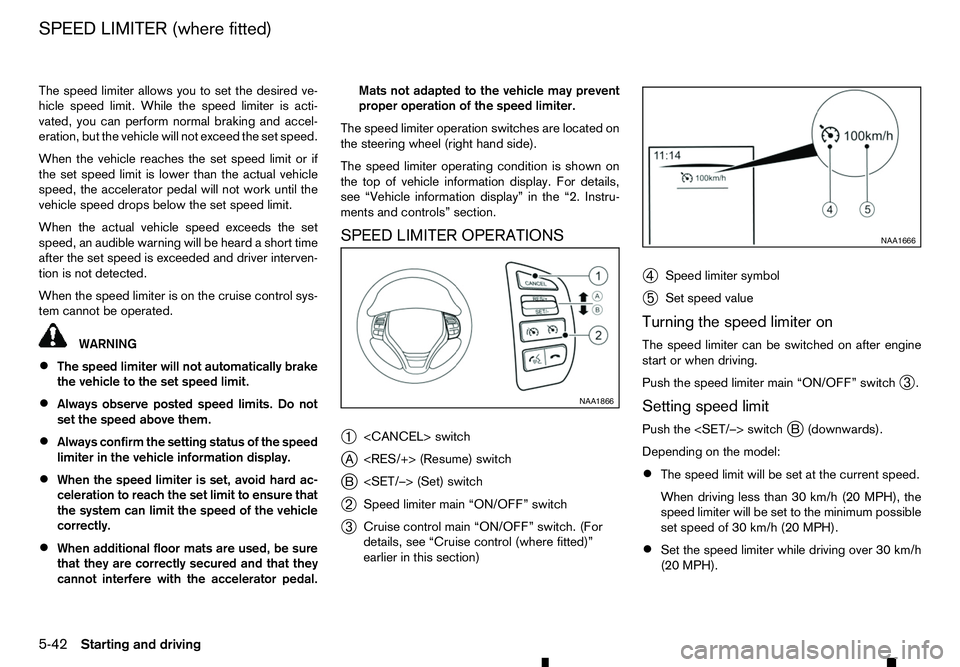
The speed limiter operation switches are located on
the steering wheel (right hand side).
The speed limiter operating condition is shown on
the top of vehicle information display. For details,
see “Vehicle information display” in the “2. Instru-
ments and controls” section.
SPEED LIMITER OPERATIONS
➀
j A
j B
➁ Speed limiter main “ON/OFF” switch
➂ Cruise control main “ON/OFF” switch. (For
details, see “Cruise control (where fitted)”
earlier in this section) ➃
Speed limiter symbol
➄ Set speed value
Turning the speed limiter on
The speed limiter can be switched on after engine
start or when driving.
Push the speed limiter main “ON/OFF” switch ➂.
Setting speed limit
Push the
Depending on the model:
• The speed limit will be set at the current speed.
When driving less than 30 km/h (20 MPH), the
speed limiter will be set to the minimum possible
set speed of 30 km/h (20 MPH).
• Set the speed limiter while driving over 30 km/h
(20 MPH). NAA1866 NAA1666
SPEED LIMITER (where fitted)
5-42 Starting and driving
Page 246 of 340
When the ignition switch is in the
OFFposition,
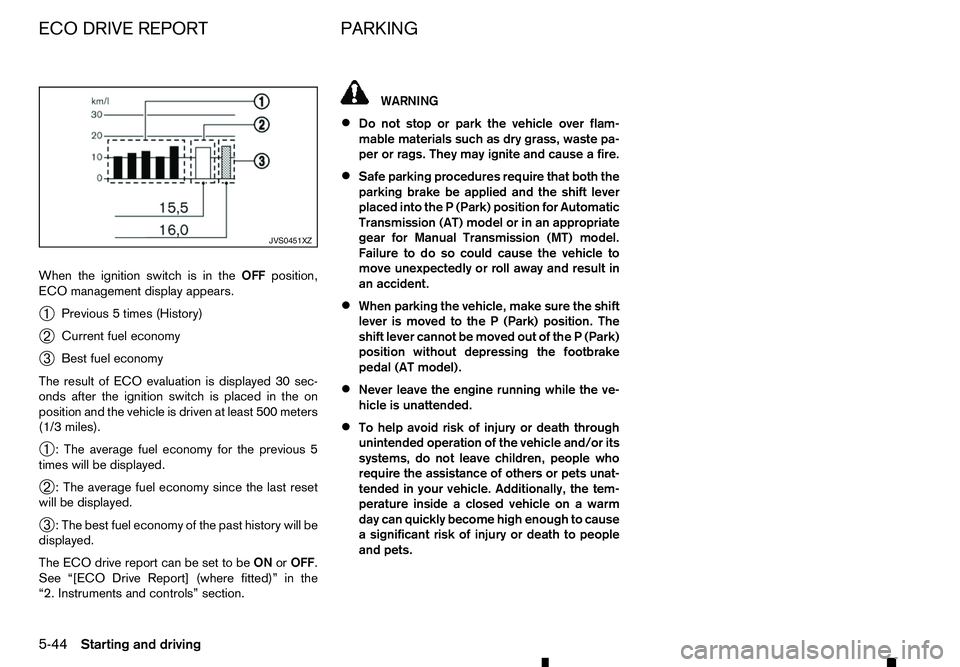
ECO management display appears.
➀ Previous
5times (History)
➁ Current fuel economy
➂ Best fuel economy
The result of ECO evaluation is displayed 30 sec-
onds after the ignition switch is placed in the on
position and the vehicle is driven at least 500 meters
(1/3 miles).
➀ :T
he average fuel economy for the previous 5
times will be displayed.
➁ :T
he average fuel economy since the last reset
will be displayed.
➂ :T
he best fuel economy of the past history will be
displayed.
The ECO drive report can be set to be ONorOFF.
See “[ECO Drive Report] (where fitted)” in the
“2. Instruments and controls” section. WARNING
• Do not stop or park the vehicle over flam-
mable materials such as dry grass, waste pa-
per or rags. They may ignite and cause afire.
• Safe parking procedures require that both the
parking brake be applied and the shift lever
placed into the
P(Park) position for Automatic
Transmission (AT) model or in an appropriate
gear for Manual Transmission (MT) model.
Failure to do so could cause the vehicle to
move unexpectedly or roll away and result in
an accident.
• When parking the vehicle, make sure the shift
lever is moved to the
P(Park) position. The
shift lever cannot be moved out of the P(Park)
position without depressing the footbrake
pedal (AT model).
• Never leave the engine running while the ve-
hicle is unattended.
• To help avoid risk of injury or death through
unintended operation of the vehicle and/or its systems, do not leave children, people who
require the assistance of others or pets unat-
tended in your vehicle. Additionally, the tem-
perature inside aclosed vehicle on awarm
day can quickly become high enough to cause
as ignificant risk of injury or death to people
and pets. JVS0451XZ
ECO DRIVE REPORT
PARKING
5-44 Starting and driving
Page 247 of 340
1. Firmly apply the parking brake.
2. Automatic Transmission (AT) model: Move the shift lever to the P(Park) position.
Manual Transmission (MT) model: Move the shift
lever to the R(Reverse) position. When parking
on an uphill grade, move the shift lever to the 1
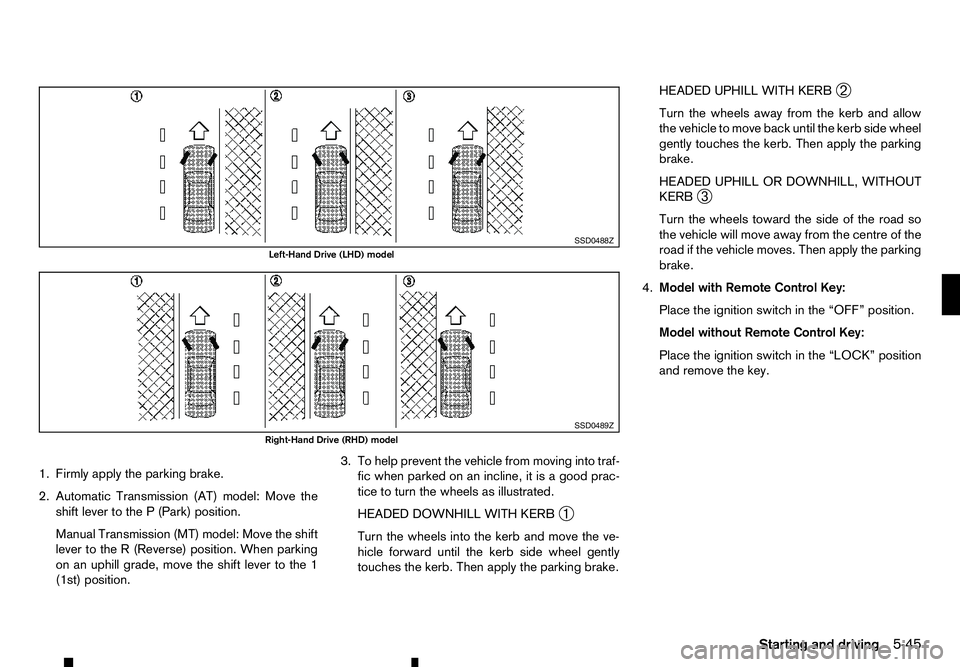
(1st) position. 3. To help prevent the vehicle from moving into traf-
fic when parked on an incline, it is agood prac-
tice to turn the wheels as illustrated.
HEADED DOWNHILL WITH KERB ➀
Turn the wheels into the kerb and move the ve-
hicle forward until the kerb side wheel gently
touches the kerb. Then apply the parking brake. HEADED UPHILL WITH KERB
➁
Turn the wheels away from the kerb and allow
the vehicle to move back until the kerb side wheel
gently touches the kerb. Then apply the parking
brake.
HEADED UPHILL OR DOWNHILL, WITHOUT
KERB ➂
Turn the wheels toward the side of the road so
the vehicle will move away from the centre of the
road if the vehicle moves. Then apply the parking
brake.
4. Model with Remote Control Key:
Place the ignition switch in the “OFF” position.
Model without Remote Control Key:
Place the ignition switch in the “LOCK” position
and remove the key. SSD0488Z
Left-Hand Drive (LHD) model
SSD0489Z
Right-Hand Drive (RHD) model
Starting and driving5-45
Page 248 of 340
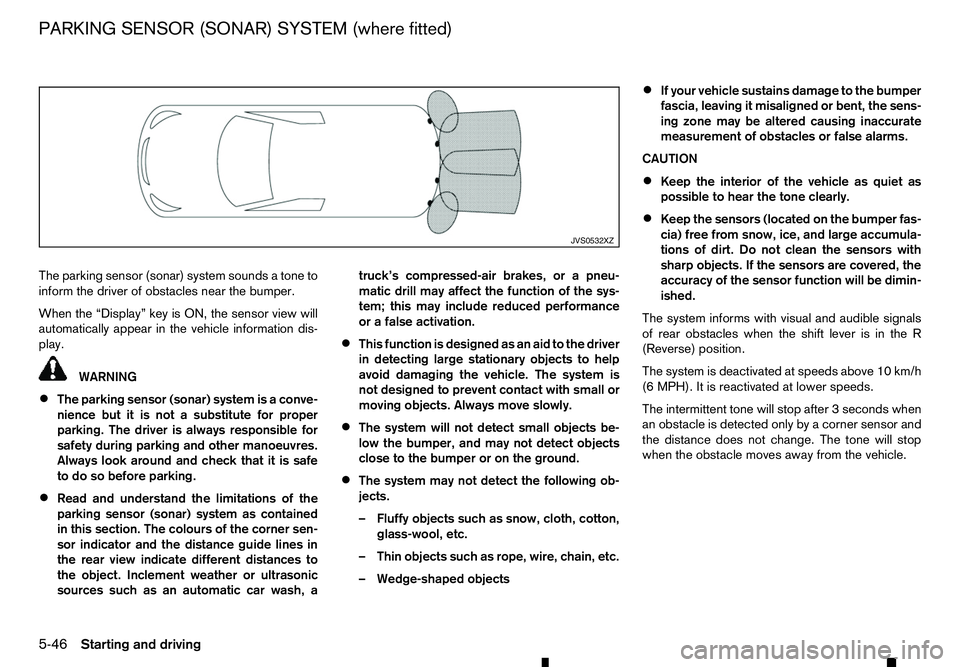
The parking sensor (sonar) system sounds
atone to
inform the driver of obstacles near the bumper.
When the “Display” key is ON, the sensor view will
automatically appear in the vehicle information dis-
play. WARNING
• The parking sensor (sonar) system is
aconve-
nience but it is not asubstitute for proper
parking. The driver is always responsible for
safety during parking and other manoeuvres.
Always look around and check that it is safe
to do so before parking.
• Read and understand the limitations of the
parking sensor (sonar) system as contained
in this section. The colours of the corner sen-
sor indicator and the distance guide lines in
the rear view indicate different distances to
the object. Inclement weather or ultrasonic
sources such as an automatic car wash, a truck’s compressed-air brakes, or
apneu-
matic drill may affect the function of the sys-
tem; this may include reduced performance
or afalse activation.
• This function is designed as an aid to the driver
in detecting large stationary objects to help
avoid damaging the vehicle. The system is
not designed to prevent contact with small or
moving objects. Always move slowly.
• The system will not detect small objects be-
low the bumper, and may not detect objects
close to the bumper or on the ground.
• The system may not detect the following ob-
jects.
–F
luffy objects such as snow, cloth, cotton,
glass-wool, etc.
–T hin objects such as rope, wire, chain, etc.
–W edge-shaped objects •
If your vehicle sustains damage to the bumper
fascia, leaving it misaligned or bent, the sens-
ing zone may be altered causing inaccurate
measurement of obstacles or false alarms.
CAUTION
• Keep the interior of the vehicle as quiet as
possible to hear the tone clearly.
• Keep the sensors (located on the bumper fas-
cia) free from snow, ice, and large accumula-
tions of dirt. Do not clean the sensors with
sharp objects. If the sensors are covered, the
accuracy of the sensor function will be dimin-
ished.
The system informs with visual and audible signals
of rear obstacles when the shift lever is in the R
(Reverse) position.
The system is deactivated at speeds above 10 km/h
(6 MPH). It is reactivated at lower speeds.
The intermittent tone will stop after 3seconds when
an obstacle is detected only by acorner sensor and
the distance does not change. The tone will stop
when the obstacle moves away from the vehicle. JVS0532XZ
PARKING SENSOR (SONAR) SYSTEM (where fitted)
5-46 Starting and driving
Page 250 of 340
Your new vehicle was designed to be used primarily
to carry passengers and luggage.
Towing atrailer will place additional loads on your
vehicle’s engine, drive train, steering, braking and
other systems. The towing of atrailer will exagger-
ate other conditions such as sway caused by cross-
winds, rough road surfaces or passing trucks.
Your driving style and speed must be adjusted ac-
cording to the circumstances. Before towing a
trailer, see an approved dealer or qualified work-
shop for an explanation about the proper use of tow-
ing equipment.
OPERATING PRECAUTIONS
• Avoid towing
atrailer during the running-in pe-
riod.
• Before driving, make sure that the lighting sys-
tem of the trailer works properly.
• Observe the legal maximum speeds for trailer
operation.
• Avoid abrupt starts, accelerations and stops.
• Avoid sharp turns and lane changes.
• Always drive your vehicle at
amoderate speed.
• Follow the trailer manufacturer’s instructions.
• Choose proper coupling devices (trailer hitch,
safety chain, roof carrier, etc.) for your vehicle
and trailer. These devices are available from an
approved dealer or qualified workshop where
you can also obtain more detailed information
about trailer towing. •
Never allow the total trailer load (trailer weight
plus its cargo weight) to exceed the maximum
set for the vehicle and the coupling device. See
an approved dealer or qualified workshop for
more information.
• The trailer must be loaded so that heavy goods
are placed over the axle. The maximum allowable
vertical load on the trailer hitch must not be ex-
ceeded.
• Have your vehicle serviced more often than at
the intervals specified in
aseparate maintenance
booklet.
• Trailer towing requires more fuel than under nor-
mal circumstances because of
aconsiderable
increase in traction power and resistance.
While towing atrailer, check the engine coolant
temperature indicator to prevent the vehicle from
overheating.
TYRE PRESSURE
When towing atrailer, inflate the vehicle tyres to the
maximum recommended COLD tyre pressure (for
full loading) indicated on the tyre placard.
Do not tow atrailer when the vehicle is installed with
at emporary spare tyre or acompact spare tyre.
SAFETY CHAINS
Always use asuitable chain between the vehicle
and trailer. The chain should be crossed and should
be attached to the hitch, not to the vehicle bumper
or axle. Be sure to leave enough slack in the chain
to permit turning corners. TRAILER BRAKES
Ensure that trailer brakes are installed as required
by local regulations. Also check that all other trailer
equipment conforms to local regulations.
Always block the wheels on both the vehicle and
trailer when parking. Apply the hand brake on the
trailer where fitted. Parking on
asteep slope is not
recommended.
If parking on asteep slope is unavoidable, place the
shift lever in the P(Park) position (Automatic trans-
mission model), or in an appropriate position
(Manual transmission model), and turn the front
wheels towards the kerb.
TRAILER DETECTION (where fitted)
When towing atrailer with agenuine RENAULT tow
bar electrical kit and the turn signal switch is used,
the electrical system of the vehicle will detect the
additional electrical load of the trailer lighting. As a
result, the direction indicator tone will be different.
TRAILER TOWING
5-48
Starting and driving
Page 251 of 340
When leaving your vehicle unoccupied:
• Always take the key with you
-even when leav-
ing the vehicle in your own garage.
• Close all windows completely and lock all doors.
• Always park your vehicle where it can be seen.
Park in
awell lit area during the night.
• If the security system is equipped, use it
-even
for ashort period.
• Never leave children or pets in the vehicle unat-
tended.
• Never leave valuables inside the vehicle. Always
take valuables with you.
• Never leave the vehicle documents in the ve-
hicle.
• Never leave articles on
aroof rail. Remove them
from the rack and keep and lock them inside the
vehicle.
• Never leave the spare key in the vehicle. WARNING
If the engine is not running or is turned off while
driving, the power assist for the steering will not
work. The steering will be much harder to oper-
ate.
The power assisted steering is designed to use a
hydraulic pump driven by the engine, to assist steer-
ing.
If the engine stops or the drive belt breaks, you will
still have control of the vehicle. However, greater
steering effort is needed, especially in sharp turns
and at low speeds. The brake system has two separate hydraulic cir-
cuits. If one circuit malfunctions, you will still have
braking ability at two wheels.
BRAKE PRECAUTIONS
Vacuum assisted brakes
The brake booster aids braking by using engine
vacuum. If the engine stops, you can stop the ve-
hicle by depressing the footbrake pedal. However,
greater foot pressure on the footbrake pedal will be
required to stop the vehicle. The stopping distance
will be longer.
If the engine is not running or is turned off while driv-
ing, the power assisted brakes will not function.
Braking will be harder. WARNING
Do not coast with the engine stopped.
Using brakes
Avoid resting your foot on the footbrake pedal while
driving. This will overheat the brakes, wear out the
brake linings/pads faster, and increase fuel con-
sumption.
To help reduce brake wear and to prevent the brakes
from overheating, reduce speed and downshift to a
lower gear before going down aslope or long grade.
Overheated brakes may reduce braking perfor-
mance and could result in loss of vehicle control.
VEHICLE SECURITY
POWER STEERING SYSTEM BRAKE SYSTEM
Starting and driving5-49
Page 252 of 340
While driving on
aslippery surface, be careful when
braking, accelerating or downshifting. Abrupt brak-
ing or acceleration could cause the wheels to skid
and result in an accident.
Wet brakes
When the vehicle is washed or driven through wa-
ter, the brakes may get wet. As aresult, your brak-
ing distance will be longer and the vehicle may pull
to one side during braking.
To dry the brakes, drive the vehicle at asafe speed
while lightly depressing the footbrake pedal to heat
up the brakes. Do this until the brakes return to nor-
mal. Avoid driving the vehicle at high speeds until
the brakes function correctly.
Parking brake running-in
Break in the parking brake shoes whenever the
stopping effect of the parking brake is weakened or
whenever the parking brake shoes and/or drums/
rotors are replaced, in order to assure the best brak-
ing performance.
This procedure is described in the vehicle service
manual and can be performed by an approved dealer
or qualified workshop.
ANTI-LOCK BRAKING SYSTEM (ABS) WARNING
The Anti-lock Braking System (ABS) is
asophis-
ticated device, but it cannot prevent accidents
resulting from careless or dangerous driving
techniques. It can help maintain vehicle control during braking on slippery surfaces. Remember
that stopping distances on slippery surfaces will
be longer than on normal surfaces even with ABS.
Stopping distances may also be longer on rough,
gravel or snow covered roads, or if you are using
tyre chains. Always maintain
asafe distance from
the vehicle in front of you. Ultimately, the driver
is responsible for safety.
Tyre type and condition may also affect braking
effectiveness.
• When replacing tyres, install the specified size
of tyres on all four wheels.
• When installing
aspare tyre, make sure that it
is the proper size and type as specified on the
tyre placard. (See “Vehicle identification” in
the “9. Technical information” section.)
• For detailed information, see “Tyres and
wheels” in the “9. Technical information” sec-
tion.
The Anti-lock Braking System (ABS) controls the
brakes so the wheels do not lock during hard brak-
ing or when braking on slippery surfaces. The sys-
tem detects the rotation speed at each wheel and
varies the brake fluid pressure to prevent each wheel
from locking and sliding. By preventing each wheel
from locking, the system helps the driver maintain
steering control and helps to minimise swerving and
spinning on slippery surfaces. Using system
Depress the brake pedal and hold it down. Depress
the brake pedal with firm steady pressure, but do
not pump the brakes. The ABS will operate to pre-
vent the wheels from locking up. Steer the vehicle to
avoid obstacles. WARNING
Do not pump the brake pedal. Doing so may re-
sult in increased stopping distances.
Self-test feature
The ABS includes electronic sensors, electric
pumps, hydraulic solenoids and acomputer. The
computer has abuilt-in diagnostic feature that tests
the system each time you start the engine and move
the vehicle at alow speed in forward or reverse.
When the self-test occurs, you may hear a“clunk”
noise and/or feel apulsation in the brake pedal. This
is normal and does not indicate amalfunction. If the
computer senses amalfunction, it switches the ABS
off and illuminates the ABS warning light on the
instrument panel. The brake system then operates
normally, but without anti-lock assistance. If the ABS
warning light illuminates during the self-test or while
driving, have the vehicle checked by an approved
dealer or qualified workshop.
Normal operation
The ABS operates at speeds above 5to10km/h (3
to 6M PH). The speed varies according to road con-
ditions.
5-50 Starting and driving
Page 253 of 340
When the ABS senses that one or more wheels are
close to locking up, the actuator rapidly applies and
releases hydraulic pressure. This action is similar to
pumping the brakes very quickly. You may feel a
pulsation in the brake pedal and hear anoise from
under the bonnet or feel avibration from the actua-
tor when it is operating. This is normal and indicates
that the ABS is operating properly. However, the
pulsation may indicate that road conditions are haz-
ardous and extra care is required while driving.
When the differential lock (where fitted) is engaged,
the ABS warning light illuminates. This indicates that
the anti-lock function is not fully operating. (See
“Rear differential locking system (where fitted)” ear-
lier in this section for the rear differential lock func-
tion.) WARNING
• Whatever the condition, drive with caution.
Accelerate and decelerate with great care. If
accelerating or decelerating too fast, the drive
wheels will lose even more traction.
• Allow more stopping distance in cold weather
driving. Braking should be started sooner than
on dry pavement.
• Keep at
agreater distance from the vehicle in
front of you on slippery roads.
• Wet ice (0°C, 32°F and freezing rain), very cold
snow and ice can be slick and very difficult to
drive on. The vehicle will have
alot less trac-
tion or grip under these conditions. Try to
avoid driving on wet ice until the road is salted
or sanded.
• Watch for slippery spots (glaring ice). These
may appear on an otherwise clear road in
shaded areas. If
apatch of ice is seen ahead,
brake before reaching it. Try not to brake while
actually on the ice, and avoid any sudden
steering manoeuvres.
• Do not use cruise control on slippery roads.
• Snow can trap dangerous exhaust gas under
your vehicle. Keep snow clear of the exhaust
pipe and from around your vehicle. BATTERY
If the battery is not fully charged during extremely
cold weather conditions, the battery fluid may freeze
and damage the battery. To maintain maximum effi-
ciency, the battery should be checked regularly. For
details, see “Battery” in the “8. Maintenance and
do-it-yourself” section of this manual.
ENGINE COOLANT
If the vehicle is to be left outside without anti-freeze,
drain the cooling system, including the engine block.
Refill before operating the vehicle. For details, see
“Engine cooling system” in the “8. Maintenance and
do-it-yourself” section of this manual.
TYRE EQUIPMENT
1. If you have snow tyres installed on the front/rear
wheels of your vehicle, they should be of the
same size, loading range, construction and type
(bias, bias-belted or radial) as the rear/front tyres.
2. If the vehicle is to be operated in severe winter conditions, snow tyres should be installed on all
four wheels.
3. For additional traction on icy roads, studded tyres may be used. However, some countries, prov-
inces and states prohibit their use. Check local,
state and provincial laws before installing stud-
ded tyres.
Skid and traction capabilities of studded snow
tyres, on wet or dry surfaces, may be poorer
than that of non-studded snow tyres.
COLD WEATHER DRIVING
Starting and driving5-51