belt RENAULT ALASKAN 2017 Owners Manual
[x] Cancel search | Manufacturer: RENAULT, Model Year: 2017, Model line: ALASKAN, Model: RENAULT ALASKAN 2017Pages: 340, PDF Size: 6.93 MB
Page 2 of 340
Foreword
Welcome
to the growing family of new RENAULT owners. This vehicle is delivered to you with confidence. It is produced using the latest techniques and strict qual-
ity control.
This handbook was prepared to help you understand the operation and maintenance of your vehicle so that you may enjoy many kilometres (miles) of drivin gpleasure.
Please read through this handbook before operating your vehicle.
As eparate Warranty Information &Maintenance Booklet explains in detail the warranty coverage that applies to your vehicle.
Your approved dealer knows your vehicle best. When you require any service or have any questions, your approved dealer will be glad to assist you with th eextensive
resources available for you.
IMPORTANT SAFETY INFORMATION REMINDERS!
Follow these important driving rules to help ensure asafe and complete trip for
you and your passengers!
• NEVER drive under the influence of alcohol or drugs.
• ALWAYS observe posted speed limits and never drive too fast for condi-
tions.
• ALWAYS use your seat belts and appropriate child restraint systems.
Preteen children should be seated in the rear seat.
• ALWAYS provide information about the proper use of vehicle safety fea-
tures to all occupants of the vehicle.
• ALWAYS review this Driver’s handbook for important safety information.
WHEN READING THE HANDBOOK
This handbook includes information for all options available on this model. There-
fore, you may find some information that does not apply to your vehicle.
Throughout this handbook, some illustrations may only show the layout for Left-
Hand Drive (LHD) models. For Right-Hand Drive (RHD) models, the illustrated
shape and location of some components may differ.
All information, specifications and illustrations in this handbook are those in effect at the time of printing. RENAULT reserves the right to change specifica-
tions or designs at any time without notice and without obligation. MODIFICATION OF YOUR VEHICLE
This vehicle cannot be modified without taking into consideration the RENAULT
“Bodybuilders Standards for Assembly, Equipment and Conversion” that has
been written for this purpose. All modifications done which do not follow the
instructions in that document could affect the vehicle functioning and its lifetime.
Furthermore, failure to comply with these Standards may arise in security prob-
lems and could even result in prosecution. Damages or failures in the vehicle as
ac
onsequence of modifications may not be covered under RENAULT warranty.
READ FIRST —THEN DRIVE SAFELY
Before driving your vehicle, read this Driver’s handbook carefully. This will en-
sure familiarity with controls and maintenance requirements, assisting you in the
safe operation of your vehicle.
Throughout this handbook the following symbols and words are used: WARNING
Indicates the presence of
ahazard that could cause death or serious per-
sonal injury. To avoid or reduce the risk, the procedures described must be
followed precisely.
CAUTION
Indicates the presence of ahazard that could cause minor or moderate per-
sonal injury, or damage to your vehicle. To avoid or reduce the risk, the pro-
cedures described must be followed carefully.
Page 5 of 340
ContentsIllustrated table of contents0
Safety
—seats, seat belts and supplemental restraint system1
Instruments and controls2
Pre-driving checks and adjustments3
Display screen, heater and air conditioner, and audio system4
Starting and driving5
In case of emergency6
Appearance and care7
Maintenance and do-it-yourself8
Technical information9
Index10
Page 7 of 340
0
Illustrated table of contents
Illustrated table of contents
Seats, seat belts and Supplemental Restraint
System (SRS).......................................................... 0-2
Exterior front ............................................................ 0-3
Exterior rear ............................................................. 0-4
Passenger compartment .......................................... 0-5
Cockpit ................................................................... 0-6 Left-Hand Drive (LHD) model.............................. 0-6 Right-Hand Drive (RHD) model ........................... 0-7
Instrument panel ...................................................... 0-8 Left-Hand Drive (LHD) model.............................. 0-8
Right-Hand Drive (RHD) model ........................... 0-9
Meters and gauges .................................................. 0-10
Engine compartment ................................................ 0-11 M9T 2.3DCI engine ............................................ 0-11
Page 8 of 340
1.
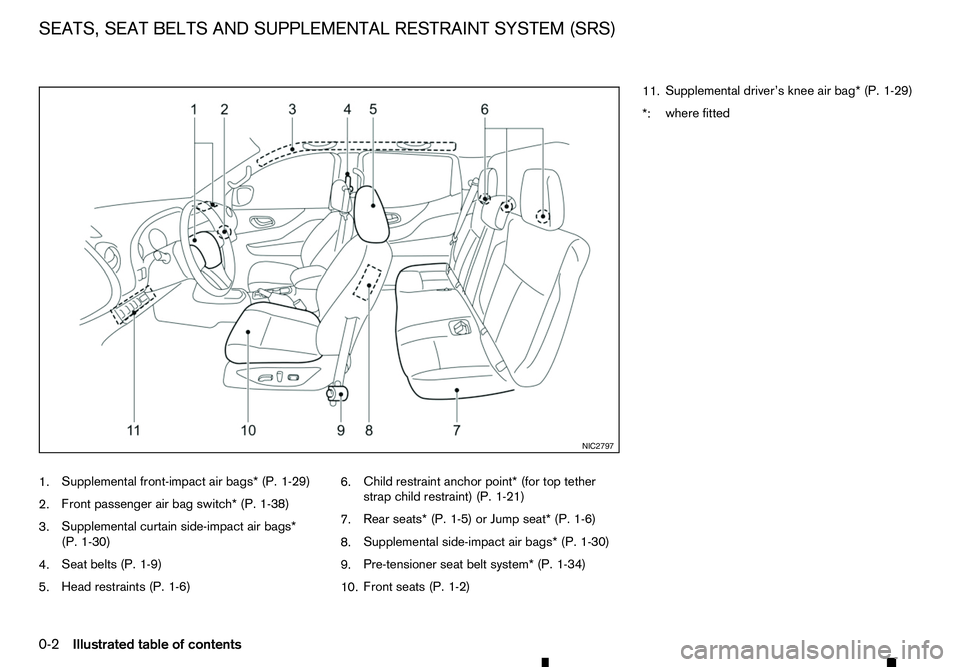
Supplemental front-impact air bags* (P. 1-29)
2. Front passenger air bag switch* (P. 1-38)
3. Supplemental curtain side-impact air bags*
(P. 1-30)
4. Seat belts (P. 1-9)
5. Head restraints (P. 1-6) 6.
Child restraint anchor point* (for top tether
strap child restraint) (P. 1-21)
7. Rear seats* (P. 1-5) or Jump seat* (P. 1-6)
8. Supplemental side-impact air bags* (P. 1-30)
9. Pre-tensioner seat belt system* (P. 1-34)
10. Front seats (P. 1-2) 11.
Supplemental driver’s knee air bag* (P. 1-29)
*: where fitted NIC2797
SEATS, SEAT BELTS AND SUPPLEMENTAL RESTRAINT SYSTEM (SRS)
0-2 Illustrated table of contents
Page 17 of 340
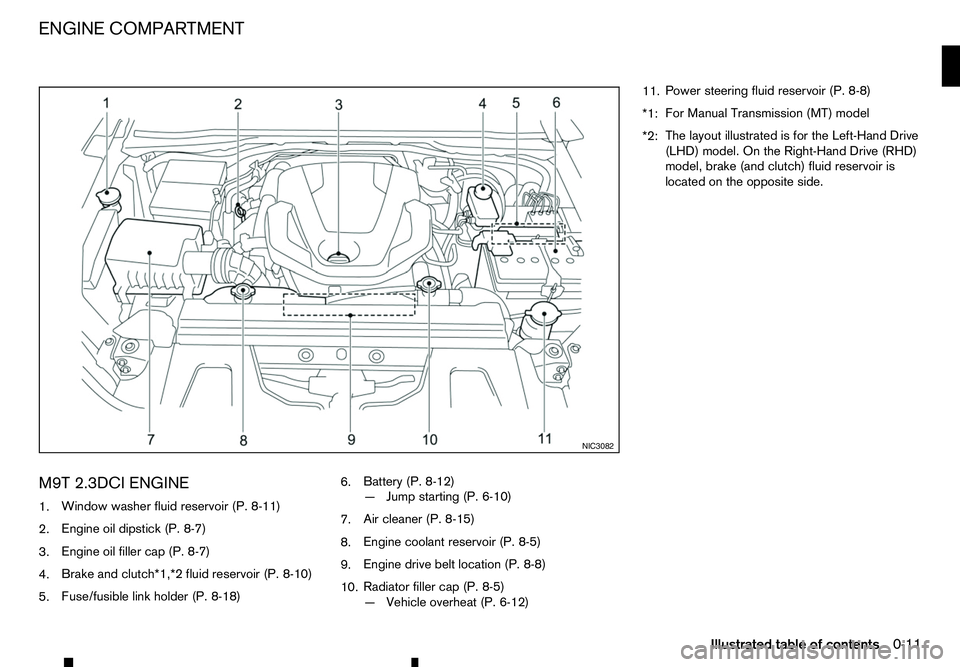
M9T 2.3DCI ENGINE
1. Window washer fluid reservoir (P. 8-11)
2. Engine oil dipstick (P. 8-7)
3. Engine oil filler cap (P. 8-7)
4. Brake and clutch*1,*2 fluid reservoir (P. 8-10)
5. Fuse/fusible link holder (P. 8-18) 6.
Battery (P. 8-12)
—J
ump starting (P. 6-10)
7. Air cleaner (P. 8-15)
8. Engine coolant reservoir (P. 8-5)
9. Engine drive belt location (P. 8-8)
10. Radiator filler cap (P. 8-5)
—V
ehicle overheat (P. 6-12) 11.
Power steering fluid reservoir (P. 8-8)
*1: For Manual Transmission (MT) model
*2: The layout illustrated is for the Left-Hand Drive
(LHD) model. On the Right-Hand Drive (RHD)
model, brake (and clutch) fluid reservoir is
located on the opposite side. NIC3082
ENGINE COMPARTMENT
Illustrated table of contents0-11
Page 19 of 340

1
Safety —seats, seat belts and supplemental
restraint system Safety
—seats, seat belts and supplemental
restraint system
Seats ....................................................................... 1-2 Front seats ......................................................... 1-2
Rear seats (Double Cab model) .......................... 1-5
Jump seats (where fitted for King Cab models) ... 1-6
Head restraints ........................................................ 1-6 Adjustable head restraint .................................... 1-7
Non-adjustable head restraint.............................. 1-7
Remove .............................................................. 1-7
Install.................................................................. 1-7
Adjust ................................................................. 1-8
Seat belts ................................................................ 1-9 Precautions on seat belt usage ........................... 1-9
Child safety ........................................................ 1-11
Pregnant women ................................................ 1-11
Injured persons................................................... 1-11
Centre mark on seat belts (where fitted) ............. 1-11
Three-point type seat belts .................................. 1-12
Two-point type seat belts (where fitted) ............... 1-13 Seat belt maintenance ........................................ 1-14
Child restraints ........................................................ 1-14
Precautions on child restraint usage.................... 1-14
Universal child restraints for front seat and rear
seats (for Europe) ............................................... 1-15
ISOFIX and i-Size child restraint system (for
second row seats) .............................................. 1-20
Child restraint anchorage (where fitted) .............. 1-21
Child restraint installation using ISOFIX .............. 1-22
Child restraint installation using three-point
type seat belt ...................................................... 1-24
Supplemental Restraint System (SRS) (where
fitted) ....................................................................... 1-29 Precautions on Supplemental Restraint
System (SRS)..................................................... 1-29
Supplemental air bag systems ............................ 1-36
Pre-tensioner seat belt system (where fitted) ....... 1-39
Repair and replacement procedure ..................... 1-40
Page 20 of 340
WARNING
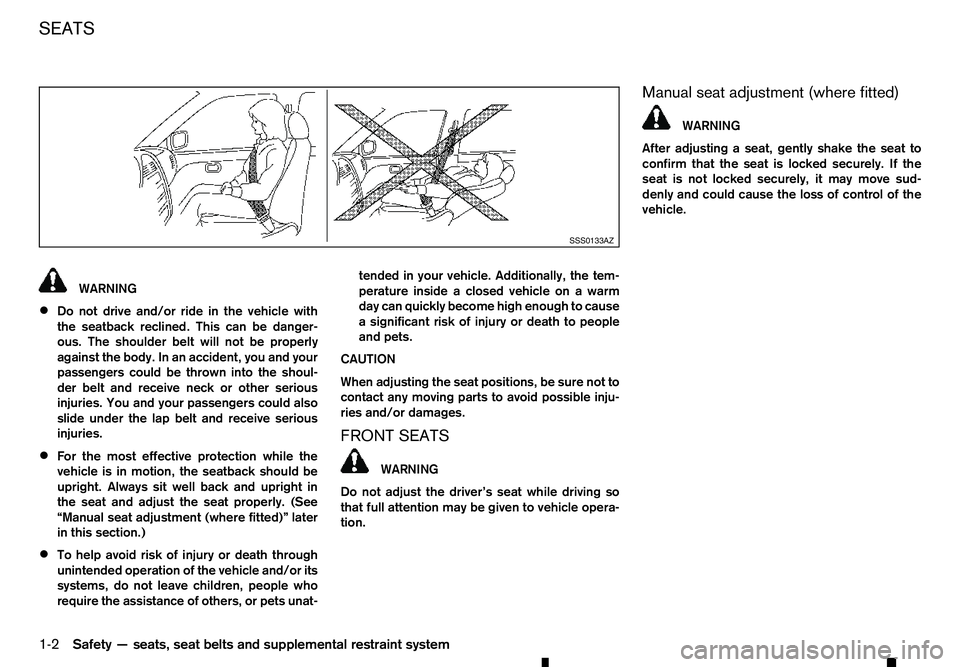
• Do not drive and/or ride in the vehicle with
the seatback reclined. This can be danger-
ous. The shoulder belt will not be properly
against the body. In an accident, you and your
passengers could be thrown into the shoul-
der belt and receive neck or other serious
injuries. You and your passengers could also
slide under the lap belt and receive serious
injuries.
• For the most effective protection while the
vehicle is in motion, the seatback should be
upright. Always sit well back and upright in
the seat and adjust the seat properly. (See
“Manual seat adjustment (where fitted)” later
in this section.)
• To help avoid risk of injury or death through
unintended operation of the vehicle and/or its
systems, do not leave children, people who
require the assistance of others, or pets unat- tended in your vehicle. Additionally, the tem-
perature inside
aclosed vehicle on awarm
day can quickly become high enough to cause
as ignificant risk of injury or death to people
and pets.
CAUTION
When adjusting the seat positions, be sure not to
contact any moving parts to avoid possible inju-
ries and/or damages.
FRONT SEATS WARNING
Do not adjust the driver’s seat while driving so
that full attention may be given to vehicle opera-
tion. Manual seat adjustment (where fitted) WARNING
After adjusting
aseat, gently shake the seat to
confirm that the seat is locked securely. If the
seat is not locked securely, it may move sud-
denly and could cause the loss of control of the
vehicle. SSS0133AZ
SEATS
1-2
Safety —seats, seat belts and supplemental restraint system
Page 21 of 340
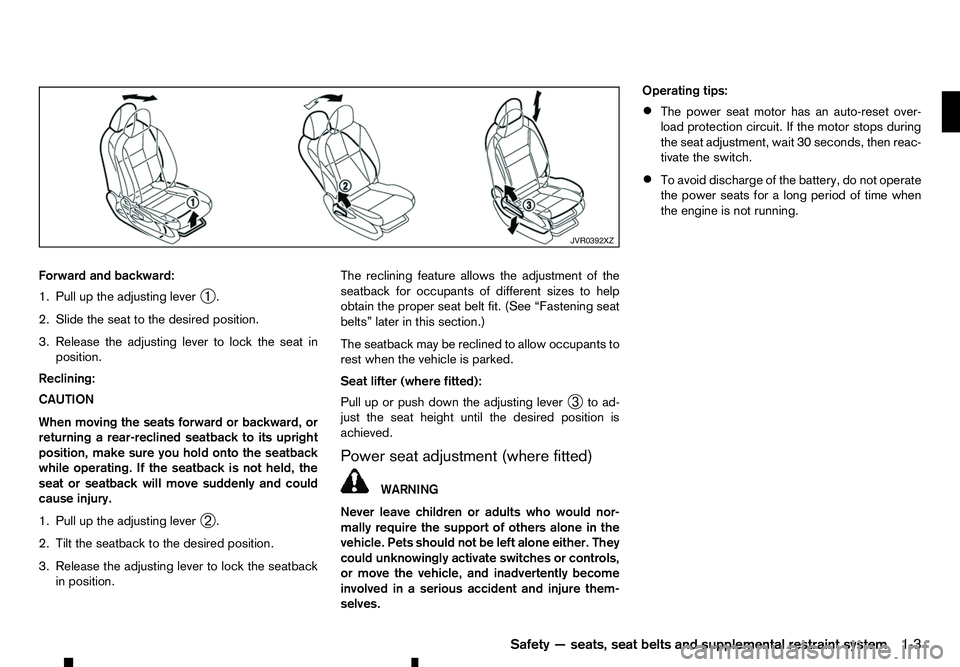
Forward and backward:
1. Pull up the adjusting lever ➀.
2. Slide the seat to the desired position.
3. Release the adjusting lever to lock the seat in position.
Reclining:
CAUTION
When moving the seats forward or backward, or
returning arear-reclined seatback to its upright
position, make sure you hold onto the seatback
while operating. If the seatback is not held, the
seat or seatback will move suddenly and could
cause injury.
1. Pull up the adjusting lever ➁.
2. Tilt the seatback to the desired position.
3. Release the adjusting lever to lock the seatback in position. The reclining feature allows the adjustment of the
seatback for occupants of different sizes to help
obtain the proper seat belt fit. (See “Fastening seat
belts” later in this section.)
The seatback may be reclined to allow occupants to
rest when the vehicle is parked.
Seat lifter (where fitted):
Pull up or push down the adjusting lever ➂to ad-
just the seat height until the desired position is
achieved.
Power seat adjustment (where fitted) WARNING
Never leave children or adults who would nor-
mally require the support of others alone in the
vehicle. Pets should not be left alone either. They
could unknowingly activate switches or controls,
or move the vehicle, and inadvertently become
involved in aserious accident and injure them-
selves. Operating tips:
• The power seat motor has an auto-reset over-
load protection circuit. If the motor stops during
the seat adjustment, wait 30 seconds, then reac-
tivate the switch.
• To avoid discharge of the battery, do not operate
the power seats for
along period of time when
the engine is not running. JVR0392XZ
Safety —seats, seat belts and supplemental restraint system
1-3
Page 22 of 340
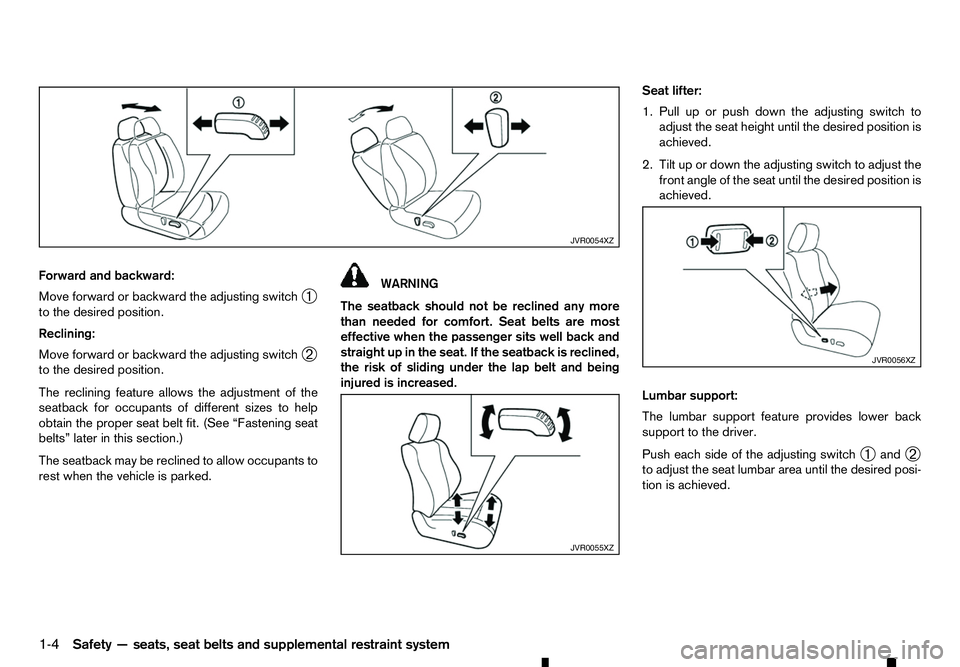
Forward and backward:
Move forward or backward the adjusting switch ➀
to the desired position.
Reclining:
Move forward or backward the adjusting switch ➁
to the desired position.
The reclining feature allows the adjustment of the
seatback for occupants of different sizes to help
obtain the proper seat belt fit. (See “Fastening seat
belts” later in this section.)
The seatback may be reclined to allow occupants to
rest when the vehicle is parked. WARNING
The seatback should not be reclined any more
than needed for comfort. Seat belts are most
effective when the passenger sits well back and
straight up in the seat. If the seatback is reclined,
the risk of sliding under the lap belt and being
injured is increased. Seat lifter:
1. Pull up or push down the adjusting switch to
adjust the seat height until the desired position is
achieved.
2. Tilt up or down the adjusting switch to adjust the front angle of the seat until the desired position is
achieved.
Lumbar support:
The lumbar support feature provides lower back
support to the driver.
Push each side of the adjusting switch ➀and
➁
to adjust the seat lumbar area until the desired posi-
tion is achieved. JVR0054XZ
JVR0055XZ JVR0056XZ
1-4 Safety —seats, seat belts and supplemental restraint system
Page 23 of 340
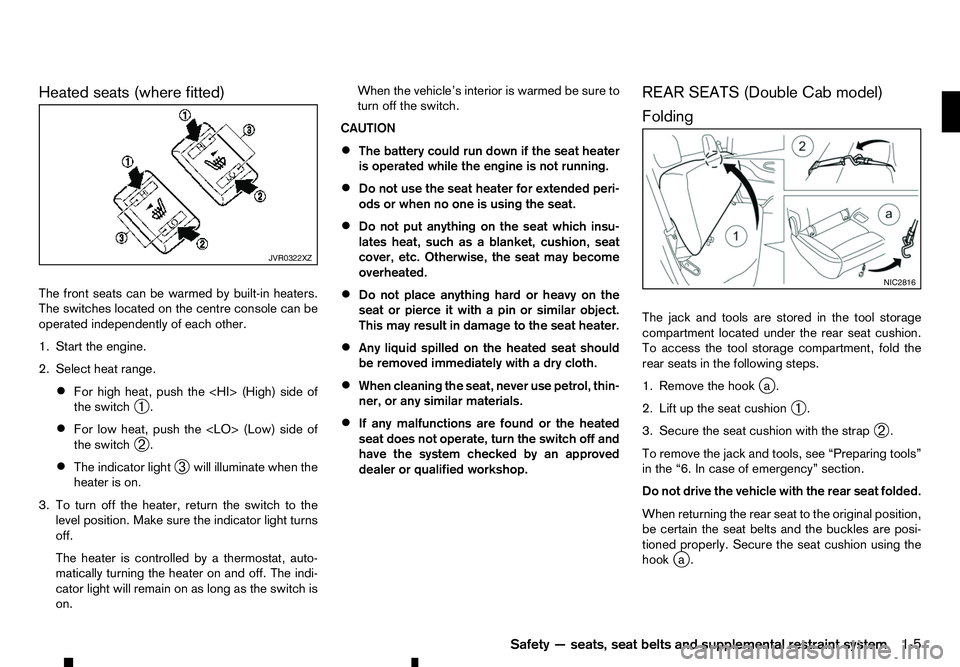
Heated seats (where fitted)
The front seats can be warmed by built-in heaters.
The switches located on the centre console can be
operated independently of each other.
1. Start the engine.
2. Select heat range. • For high heat, push the (High) side of
the switch
➀.
• For low heat, push the