ECU RENAULT ESPACE 2012 J81 / 4.G User Guide
[x] Cancel search | Manufacturer: RENAULT, Model Year: 2012, Model line: ESPACE, Model: RENAULT ESPACE 2012 J81 / 4.GPages: 267, PDF Size: 8.95 MB
Page 41 of 267

ENG_NU_932-3_X81ph3_Renault_1
r Is K O f d e a T H O r
ser IOUs I n JU rY: be")
JauneNoirNoir texte
1.35
ENG_UD24085_2
Sécurité enfants : installation du siège enfant (X81 - J81 - R\
enault)
ENG_NU_932-3_X81ph3_Renault_1
r Is K O f d e a T H O r
ser IOUs I n JU rY: before
fitting a rear-facing child
seat to this seat, check that
the air bag has been deactivated
(refer to the information on “Child
safety: deactivating/activating the
front passenger air bag” at the end
of the paragraph).
cHILd safeTY : fitting a child seat (2/4)
child seat attached using the belt
¬ Seat which allows a child seat
with “Universal” approval to be attached
by a seat belt.
− Seat which only allows a rear-
facing seat with “Universal” approval
to be attached with a seat belt.
Using a child safety system which is not approved for this vehicle will not
correctly protect the baby or child. They risk serious or even fatal injury.
³ Check the status of the air bag
before fitting a child seat or allowing a
passenger to use the seat.
child seat attached using the IsOfIX
mounting
üSeat which allows an ISOFIX child
seat to be fitted.
± The rear seats are fitted with
an anchorage point which allows a
forward-facing ISOFIX child seat with
universal approval to be fitted. The an-
chorage points are located at the back
of each rear seat.
The size of the ISOFIX child seat is in-
dicated by a letter:
– A, B and B1: for forward-facing seats
in group 1 (9 to 18 kg);
– C: rear-facing seats in group 1 (9 to
18 kg);
– D and E: shell seat or rear-facing
seats in group 0 or 0+ (less than
13 kg);
– F and G: cots in group 0 (less than
10 kg).
Page 42 of 267

ENG_NU_932-3_X81ph3_Renault_1
Jaune NoirNoir texte
cHILd safeTY : fitting a child seat (3/4)
Type of chil")
1.36
ENG_UD24085_2
Sécurité enfants : installation du siège enfant (X81 - J81 - R\
enault)
ENG_NU_932-3_X81ph3_Renault_1
Jaune NoirNoir texte
cHILd safeTY : fitting a child seat (3/4)
Type of child seat Weight of
the child seat size
ISOFIX (2) seats suitable for fitting a child seat
front passenger seat (1) (3) (4) rear seats, 1st row (4)rear seats,
2nd row (4)
carrycot fitted across the
vehicle
Group 0 < 10 kg
F, G XU – IL (6) U – IL (6)
shell seat/rear-facing seat
Group 0 and 0+ < 13 kg
D, E U (5) U - ILU - IL
rear-facing seat
Group 1 (8) 9 to 18 kg
CU (5) UU - IL
forward-facing seat
Group 1 9 to 18 kg
A, B, B1 XU - IUF - IL (7) U - IUF - IL (7)
Booster seat
Group 2 and 3 (9) 15 to 25 kg
a n d 2 2 t o
36 kg
X
U (7)U (7)
(1) rIsK Of deaTH Or serIOUs InJUr Y: before fitting a rear-facing child seat to this seat, check that the air bag
has been deactivated (refer to the information on “Child safety: deactivating/activating the front passenger air bag” at
the end of the paragraph).
The table below summarises the information already shown on the diagram on the previous page, to ensure the regula-
tions in force are respected.
Page 43 of 267

ENG_NU_932-3_X81ph3_Renault_1
X = Seat not suitable for fitting child seats.
U = S")
JauneNoirNoir texte
1.37
ENG_UD24085_2
Sécurité enfants : installation du siège enfant (X81 - J81 - R\
enault)
ENG_NU_932-3_X81ph3_Renault_1
X = Seat not suitable for fitting child seats.
U = Seat which allows a child seat with “Universal” approval to be installed using a seat belt; check that it can be fitted.
IUf/IL = On equipped vehicles, seat which allows an approved “Universal”/“semi-universal” or “vehicle specific” child seat to be
attached using the ISOFIX system; check that it can be fitted.
(2) The size of the child seat with the ISOFIX mounting is indicated by the
ü symbol followed by a letter (a, B, B1, c, d, e, f,
G).
(3) Only a rear-facing child seat may be installed in this seat.
(4) Raise the seat to the maximum and position it as far back as possible, t\
ilting the seatback slightly (approximately 25°).
(5) Only vehicles equipped with a seat with seat base height adjustment are \
authorised for fitting child seats.
(6)
A carrycot can be installed across the vehicle and will take up two seats. Position the child with his or her feet nearest the door.
(7) Forward-facing child seat; position the seatback of the child seat in contact with the seatback of the vehicle seat. Adjust the
height of the headrest or remove it if necessary; do not push the seat in front of the child more than halfway back on its runners
and do not recline the seatback more than 25°.
(8) To install a large rear-facing ISOFIX child seat (size C) in the 2nd row, fit the seats in the centred position or use the centre seat.
(9)
A child over 10 years of age, weighing more than 36 kg or taller than 1.36 m can be strapped directly into the seat like an adult.
cHILd safeTY : fitting a child seat (4/4)
Page 44 of 267
air bagdeactivating the front passenger air bags ........ (current page)
front passenger air bag deactivation ..................... (current page)
1.38
ENG_UD20343_1
Sécurité enfants : désactivation/activation airbag passager ava\
nt (X81 - J81 - Renault)
ENG_NU_932-3_X81ph3_Renault_1
Jaune NoirNoir texte
Deactivating/activating the front passenger air bag
deactivating the front
passenger air bags
(on equipped vehicles)
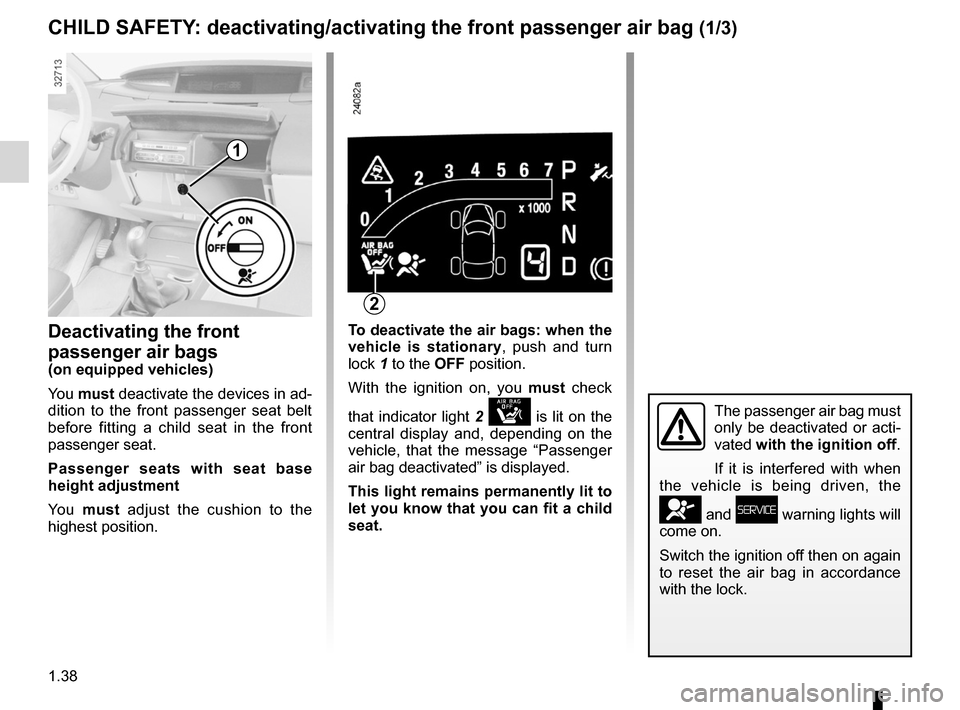
You must deactivate the devices in ad-
dition to the front passenger seat belt
before fitting a child seat in the front
passenger seat.
Passenger seats with seat base
height adjustment
You must adjust the cushion to the
highest position. To deactivate the air bags: when the
vehicle is stationary
, push and turn
lock 1 to the Off position.
With the ignition on, you must check
that indicator light 2
ã is lit on the
central display and, depending on the
vehicle, that the message “Passenger
air bag deactivated” is displayed.
This light remains permanently lit to
let you know that you can fit a child
seat.
cHILd safeTY : deactivating/activating the front passenger air bag (1/3)
1
2
The passenger air bag must
only be deactivated or acti-
vated with the ignition off.
If it is interfered with when
the vehicle is being driven, the
å and ú warning lights will
come on.
Switch the ignition off then on again
to reset the air bag in accordance
with the lock.
Page 45 of 267

Jaune NoirNoir texte
1.39
ENG_UD20343_1
Sécurité enfants : désactivation/activation airbag passager ava\
nt (X81 - J81 -")
air bagactivating the front passenger air bags ............ (current page)
Jaune NoirNoir texte
1.39
ENG_UD20343_1
Sécurité enfants : désactivation/activation airbag passager ava\
nt (X81 - J81 - Renault)
ENG_NU_932-3_X81ph3_Renault_1
cHILd safeTY : deactivating/activating the front passenger air bag (2/3)
3
a
danGer
Since operation of the front
passenger air bag is not
compatible with the position
of a rear-facing child seat, neVer
fit a rear-facing child seat on a front
passenger seat with an active front
air bag. The child may suffer very
serious injuries if the air bag is trig-
gered.
The markings on the dashboard and
labels A on each side of passenger sun
blind 3 (example: label shown above)
remind you of these instructions.
Page 46 of 267

ENG_NU_932-3_X81ph3_Renault_1
Operating faults
It is forbidden to fit a rear-facin")
1.40
ENG_UD20343_1
Sécurité enfants : désactivation/activation airbag passager ava\
nt (X81 - J81 - Renault)
ENG_NU_932-3_X81ph3_Renault_1
Operating faults
It is forbidden to fit a rear-facing child
seat to the front passenger seat if the
air bag activation/deactivation system
is faulty.
Allowing any other passenger to sit in
that seat is not recommended.
Contact your approved dealer as soon
as possible.
activating the front
passenger air bags
You should reactivate the air bag as
soon as you remove the child seat from
the front passenger seat to ensure the
protection of the front passenger in the
event of an impact.
To reactivate the air bags: when the
vehicle is stationary , push and turn
lock 1 to the On position.
With the ignition on, it is essential to
check that warning light 2,
ã, is off.
The front passenger seat belt additional
restraint systems are activated.
1
2
cHILd safeTY : deactivating/activating the front passenger air bag (3/3)
The passenger air bag must
only be deactivated or acti-
vated with the ignition off.
If it is interfered with when
the vehicle is being driven, the
å and ú warning lights will
come on.
Switch the ignition off then on again
to reset the air bag in accordance
with the lock.
danGer
Since operation of the front
passenger air bag is not
compatible with the position
of a rear-facing child seat, neVer
fit a rear-facing child seat on a front
passenger seat with an active front
air bag. The child may suffer very
serious injuries if the air bag is trig-
gered.
Page 73 of 267

lights:dipped beam headlights ................................... (current page)
lights: side lights ......................................................... (current page)
1.67
ENG_UD20353_1
Eclairage et signalisation extérieure (X81 - J81 - Renault)
ENG_NU_932-3_X81ph3_Renault_1
Lighting and exterior signals
eXTerIOr LIGHTInG and sIGnaLs (1/3)
kdipped beam
headlights
automatic operation
With the engine running, the dipped
beam headlights are switched on or off
automatically depending on the level of
ambient light, without the need to oper-
ate stalk 1 (position 0).
This function can be deactivated or re-
activated.
– To deactivate it, with the ignition
on and engine switched off , turn
stalk 1 twice consecutively from po -
sition 0 to side lights. This action is
confirmed by an audible signal.
– To activate it, with the ignition
switched on and engine running or
off, turn stalk 1 twice consecutively
from position 0 to side lights. This
action is confirmed by an audible
signal.
– To select the main beam headlights,
pull stalk 1 towards you. To return to
the dipped beam headlight position,
pull the stalk towards you again.
– The lights go out when the engine
is stopped, when the driver’s door is
opened or when the vehicle is locked
with the RENAULT card.
Manual operation
Turn the end of stalk 1 until the symbol
is opposite mark 3.
An indicator light lights up on the instru-
ment panel in all cases.
daytime running lights
The daytime running lights come on
when the engine is started if stalk 1 is
in position 0.
If the dipped beam headlights oper -
ate automatically, the daytime running
lights only come on if the side lights are
off
1
2
1
3
uside lights
Turn the end of stalk 1 until the
symbol is opposite mark 3.
The instrument panel lights up, the
brightness can be adjusted by using
control knob 2.
Page 153 of 267
sunroof.................................................. (up to the end of the DU)
3.31
ENG_UD20387_1
Toit ouvrant électrique (X81 - J81 - Renault)
ENG_NU_932-3_X81ph3_Renault_3
Electric sunroof
ELECTRIC SUNROOF
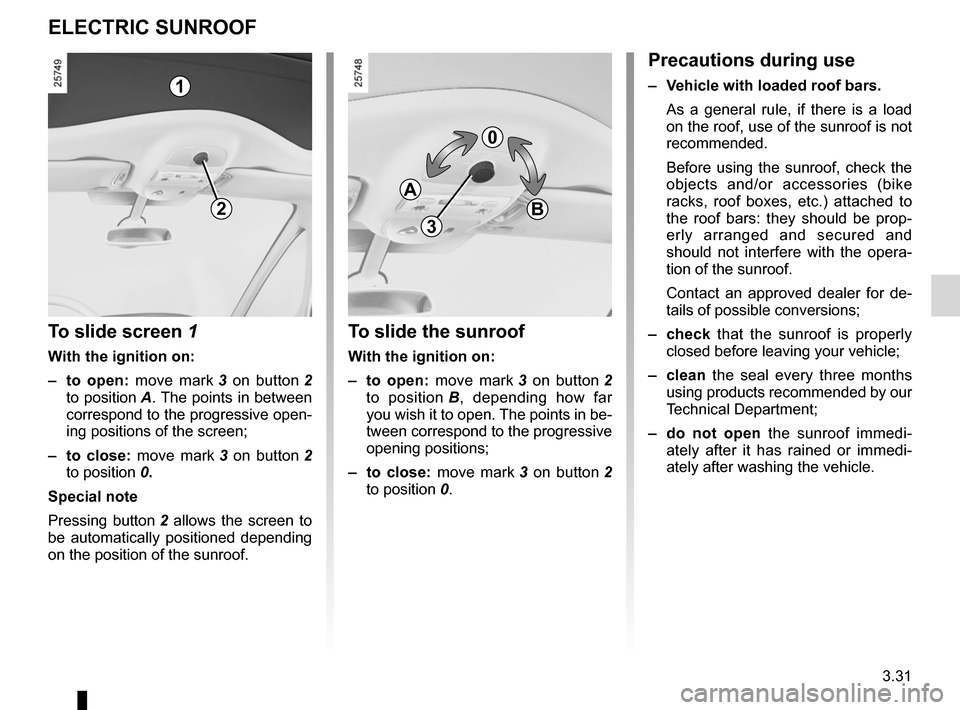
To slide screen 1
With the ignition on:
– to open: move mark 3 on button 2
to position A. The points in between
correspond to the progressive open-
ing positions of the screen;
– to close: move mark 3 on button 2
to position 0.
Special note
Pressing button 2 allows the screen to
be automatically positioned depending
on the position of the sunroof.
To slide the sunroof
With the ignition on:
– to open: move mark 3 on button 2
to position B , depending how far
you wish it to open. The points in be-
tween correspond to the progressive
opening positions;
– to close: move mark 3 on button 2
to position 0.
Precautions during use
– Vehicle with loaded roof bars.
As a general rule, if there is a load
on the roof, use of the sunroof is not
recommended.
Before using the sunroof, check the
objects and/or accessories (bike
racks, roof boxes, etc.) attached to
the roof bars: they should be prop -
erly arranged and secured and
should not interfere with the opera -
tion of the sunroof.
Contact an approved dealer for de -
tails of possible conversions;
– check that the sunroof is properly
closed before leaving your vehicle;
– clean the seal every three months
using products recommended by our
Technical Department;
– do not open the sunroof immedi -
ately after it has rained or immedi -
ately after washing the vehicle.1
2
3
A
0
B
Page 177 of 267

transporting objectsin the luggage compartment ............................ (current page)
towing rings .......................................... (up to the end of the DU)
3.55
ENG_UD21779_2
Transport d’objets dans le coffre (X81 - Renault)
ENG_NU_932-3_X81ph3_Renault_3
Always position the objects transported
so that the largest surface is against:
– The rear seatbacks for normal loads
(example A).
– The folded rear seats for heavier
loads (example B).
– The front seats, having removed the
rear seats, for the heaviest loads (ex-
ample C).
Transporting objects in the luggage compartment
TRANSPORTING OBJECTS IN THE LUGGAGE COMPARTMENT
Lashing points
Always position the heavi -
est items directly on the
floor. Use the anchorage
points located on the lug -
gage compartment floor to secure
items. The luggage should be
loaded in such a way that no items
will be thrown forward and strike the
occupants if the driver has to brake
suddenly. Fasten the rear seat belts,
even if the seats are not occupied.
B
C
A
Page 179 of 267

roof rackroof bars .......................................... (up to the end of the DU)
roof bars ............................................... (up to the end of the DU)
3.57
ENG_UD20403_1
Barres de toit (X81 - J81 - Renault)
ENG_NU_932-3_X81ph3_Renault_3
Roof bars
ROOF BARS
Storage position
To make the vehicle as aerodynamic
as possible, roof bars 1 must be stored
right at the rear of the vehicle.
Moving the bars
On each side, pull lever 2 inwards to re-
lease it (movement A).
Slide bar 1 to the required position. On
each side, push back lever 2 to secure
the bar (movement B). Check that it is
correctly locked.
Loading
The load should be evenly distributed
and must not exceed the maximum
permissible weight per bar indicated
on each bar (refer to the information on
“Weights” in Section 6).
Ensure that any objects and/or acces -
sories being transported are properly
secured. Straps can be fed through
recess 3.
Likewise, the two bars must be suffi -
ciently spaced to prevent the load from
rocking or falling off the bars.
1
2
A
B
3