ECU RENAULT ESPACE 2012 J81 / 4.G Owner's Manual
[x] Cancel search | Manufacturer: RENAULT, Model Year: 2012, Model line: ESPACE, Model: RENAULT ESPACE 2012 J81 / 4.GPages: 267, PDF Size: 8.95 MB
Page 180 of 267
3.58
ENG_UD20403_1
Barres de toit (X81 - J81 - Renault)
ENG_NU_932-3_X81ph3_Renault_3
ROOF BARS (continued)
Removing the bars
It may sometimes be necessary to
remove the roof bars. To do this:
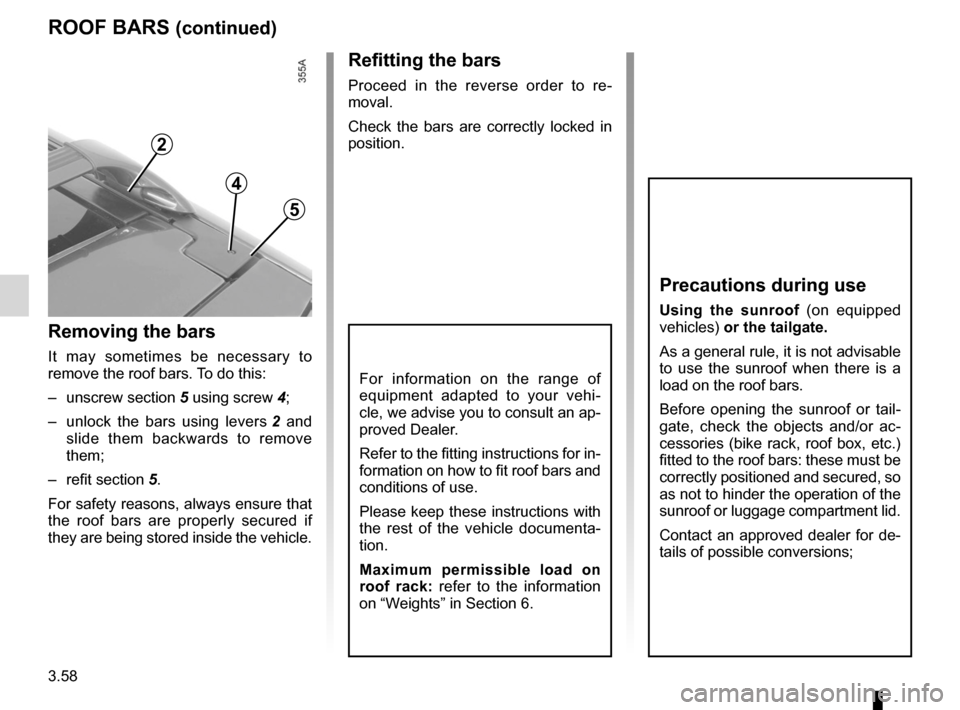
– unscrew section 5 using screw 4;
– unlock the bars using levers 2 and
slide them backwards to remove
them;
– refit section 5.
For safety reasons, always ensure that
the roof bars are properly secured if
they are being stored inside the vehicle.
Refitting the bars
Proceed in the reverse order to re -
moval.
Check the bars are correctly locked in
position.
Precautions during use
Using the sunroof (on equipped
vehicles) or the tailgate.
As a general rule, it is not advisable
to use the sunroof when there is a
load on the roof bars.
Before opening the sunroof or tail -
gate, check the objects and/or ac -
cessories (bike rack, roof box, etc.)
fitted to the roof bars: these must be
correctly positioned and secured, so
as not to hinder the operation of the
sunroof or luggage compartment lid.
Contact an approved dealer for de-
tails of possible conversions;
2
4
5
For information on the range of
equipment adapted to your vehi -
cle, we advise you to consult an ap-
proved Dealer.
Refer to the fitting instructions for in-
formation on how to fit roof bars and
conditions of use.
Please keep these instructions with
the rest of the vehicle documenta -
tion.
Maximum permissible load on
roof rack: refer to the information
on “Weights” in Section 6.
Page 189 of 267
engine oil capacity ................................................. (current page)
filter oil filter ............................................................. (current page)
oil change .............................................................. (current page)
JauneNoirNoir texte
4.7
ENG_UD25551_2
Niveau huile moteur : appoint/remplissage (X81 - J81 - Renault)
ENG_NU_932-3_X81ph3_Renault_4
oil change
Service intervals: please refer to your
vehicle’s maintenance document.
Average capacities for oil change oil
filter included.
(for information)
2.0 t engine : 5.40 litres
engine 2.0 dCi : 8.20 litres
engine oil grade
Refer to the Maintenance Service
Booklet for your vehicle.
enGIne oIL LeVeL: topping up/filling (2/2)
engine oil change: if you
are changing the oil when
the engine is hot, be careful
not to scald yourself if the
oil overflows.
Filling: take care when
topping up the oil that
no oil drips onto engine
components - risk of fire.
Remember to refit the cap securely
as there is a risk of fire if oil splashes
onto hot engine components.
Never run the engine in an
enclosed space as exhaust
gases are poisonous.
Consult your approved Dealer at
once if you notice an abnormal or
repeated drop in any of the fluid
levels.
The engine may be hot
when carrying out opera -
tions in close proximity. In
addition, the engine cooling
fan can come on at any moment.
Risk of injury.
Page 197 of 267
JauneNoirNoir texte
4.15
ENG_UD25392_1
Entretien de la carrosserie (X95 - J95 - R95 - Renault)
ENG_NU_932-3_X81ph3_Renault_4
– bird droppings , which cause a
chemical reaction with the paint that
rapidly discolours paintwork and
may even cause the paint to peel
off;
Wash the vehicle immediately to
remove these marks since it is im -
possible to remove them by polish -
ing;
– salt, particularly in the wheel arches
and underneath the body after driv -
ing in areas where the roads have
been gritted.
Using a roller type car wash
Return the windscreen wiper stalk to
the Park position (refer to the informa-
tion on the “Windscreen washer, wiper”
in Section 1). Check the mounting of
external accessories, additional lights
and mirrors, and ensure that the wiper
blades are secured with adhesive tape.
Remove the radio aerial mast if your
vehicle is fitted with this equipment.
Remember to remove the tape and refit
the antenna after washing.y ou should
Observe the vehicle stopping distances
when driving on gravelled surfaces to
prevent paint damage.
Repair, or have repaired quickly, areas
where the paint has been damaged, to
prevent corrosion spreading.
Remember to visit the body shop pe -
riodically in order to maintain your
anti-corrosion warranty. Refer to the
Maintenance Service Booklet.
Respect local regulations about wash -
ing vehicles (e.g. do not wash your ve-
hicle on a public highway).
Wash your car frequently, with the
engine off, with cleaning products rec-
ommended by the manufacturer (never
use abrasive products). Rinse thor -
oughly beforehand with a jet:
– spots of tree resin and industrial
grime;
– mud in the wheel arches and under -
neath the body which forms damp
patches;
BoDyWoRk MAIntenAnCe (2/2)
If it is necessary to clean mechani -
cal components, hinges, etc., spray
them with products approved by our
Technical Department to protect them
after they have been cleaned.
Cleaning the headlights
As the headlights are made of plastic
“glass”, use a soft cloth or cotton wool
to clean them. If this does not clean
them properly, moisten the cloth with
soapy water, then wipe clean with a soft
damp cloth or cotton wool.
Finally, carefully dry off with a soft dry
cloth.
Cleaning products containing alco -
hol must not be used.
We have selected special products
to care for your vehicle and you can
obtain these from the manufactur -
er’s accessory outlets.
Page 202 of 267
practical advice ..................................... (up to the end of the DU)
puncture ................................................ (up to the end of the DU)
emergency spare wheel ....................... (up to the end of the DU)
wheels (safety) ..................................... (up to the end of the DU)
5.2
ENG_UD24346_2
Roue de secours (X81 - J81 - Renault)
ENG_NU_932-3_X81ph3_Renault_5
Jaune NoirNoir texte
Puncture
Emergency spare wheel
Puncture/eMerGencY SPAre WHeeL (1/2)
In the event of a puncture,
depending on the vehicle,
you will have:
An emergency spare wheel or tyre in -
flation kit (refer to the information on the
following pages).
If you have an emergency spare wheel,
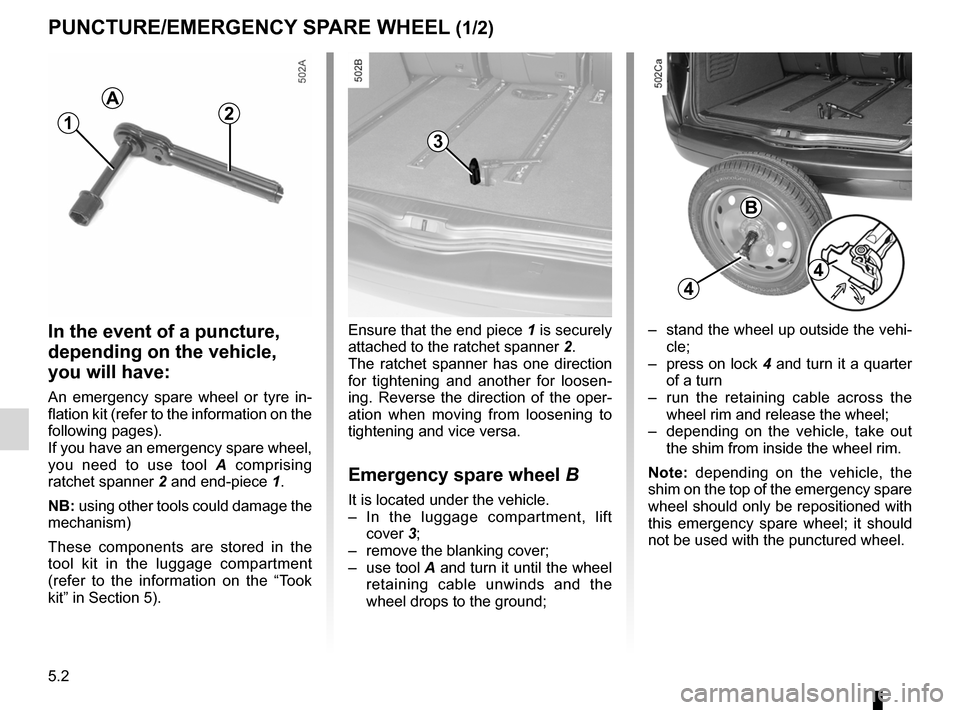
you need to use tool A comprising
ratchet spanner 2 and end-piece 1.
nB: using other tools could damage the
mechanism)
These components are stored in the
tool kit in the luggage compartment
(refer to the information on the “Took
kit” in Section 5). Ensure that the end piece 1 is securely
attached to the ratchet spanner
2.
The ratchet spanner has one direction
for tightening and another for loosen -
ing. Reverse the direction of the oper -
ation when moving from loosening to
tightening and vice versa.
emergency spare wheel B
It is located under the vehicle.
– In the luggage compartment, lift
cover 3;
– remove the blanking cover;
– use tool A and turn it until the wheel
retaining cable unwinds and the
wheel drops to the ground; –
stand the wheel up outside the vehi-
cle;
– press on lock 4 and turn it a quarter
of a turn
– run the retaining cable across the
wheel rim and release the wheel;
– depending on the vehicle, take out
the shim from inside the wheel rim.
n ote: depending on the vehicle, the
shim on the top of the emergency spare
wheel should only be repositioned with
this emergency spare wheel; it should
not be used with the punctured wheel.
12
3
B
4
A
4
Page 203 of 267
JauneNoirNoir texte
5.3
ENG_UD24346_2
Roue de secours (X81 - J81 - Renault)
ENG_NU_932-3_X81ph3_Renault_5
Puncture/eMerGencY SPAre WHeeL (2/2)
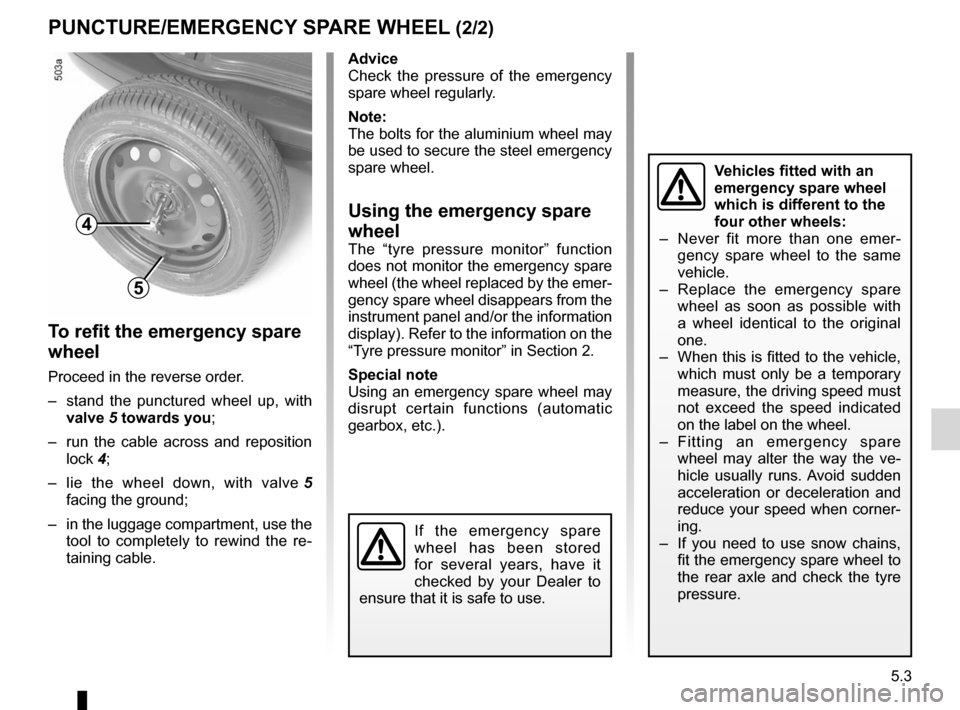
t o refit the emergency spare
wheel
Proceed in the reverse order.
– stand the punctured wheel up, with
valve 5 towards you;
– run the cable across and reposition
lock 4;
– lie the wheel down, with valve 5
facing the ground;
– in the luggage compartment, use the
tool to completely to rewind the re -
taining cable. Advice
Check the pressure of the emergency
spare wheel regularly.
note:
The bolts for the aluminium wheel may
be used to secure the steel emergency
spare wheel.
using the emergency spare
wheel
The “tyre pressure monitor” function
does not monitor the emergency spare
wheel (the wheel replaced by the emer-
gency spare wheel disappears from the
instrument panel and/or the information
display). Refer to the information on the
“Tyre pressure monitor” in Section 2.
Special note
Using an emergency spare wheel may
disrupt certain functions (automatic
gearbox, etc.).
If the emergency spare
wheel has been stored
for several years, have it
checked by your Dealer to
ensure that it is safe to use.
4
5
Vehicles fitted with an
emergency spare wheel
which is different to the
four other wheels:
– Never fit more than one emer -
gency spare wheel to the same
vehicle.
– Replace the emergency spare
wheel as soon as possible with
a wheel identical to the original
one.
– When this is fitted to the vehicle,
which must only be a temporary
measure, the driving speed must
not exceed the speed indicated
on the label on the wheel.
– Fitting an emergency spare
wheel may alter the way the ve -
hicle usually runs. Avoid sudden
acceleration or deceleration and
reduce your speed when corner-
ing.
– If you need to use snow chains,
fit the emergency spare wheel to
the rear axle and check the tyre
pressure.
Page 206 of 267
5.6
ENG_UD24347_2
Add J81 kit de gonflage (X81 - J81 - Renault)
ENG_NU_932-3_X81ph3_Renault_5
tYre InFLA tIOn KIt (continued)
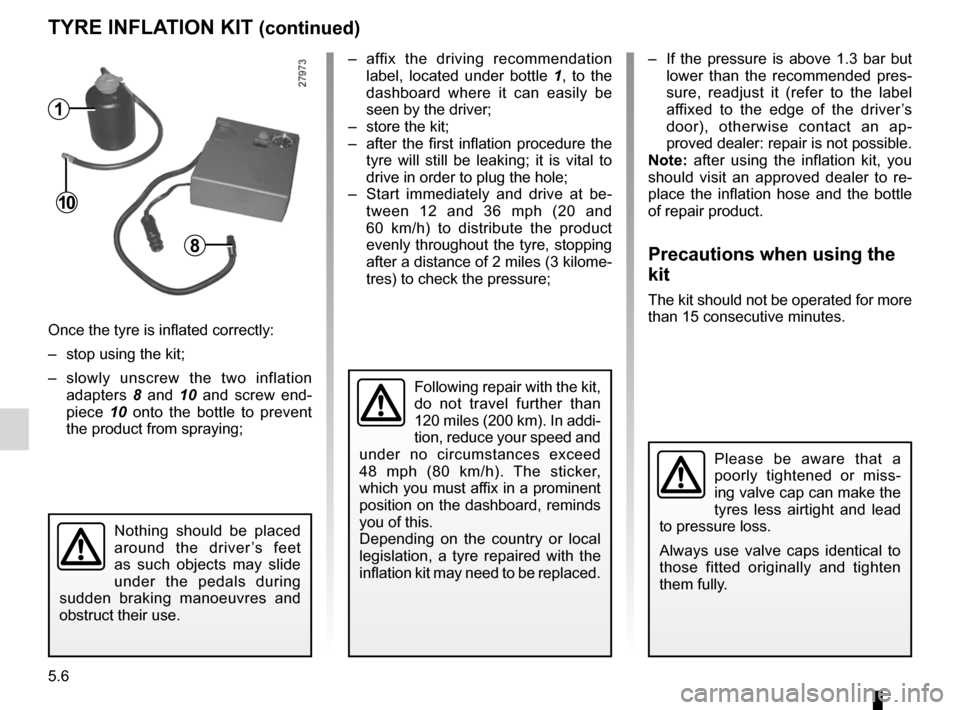
Once the tyre is inflated correctly:
– stop using the kit;
– slowly unscrew the two inflation
adapters 8 and 10 and screw end -
piece 10 onto the bottle to prevent
the product from spraying;
– affix the driving recommendation
label, located under bottle 1 , to the
dashboard where it can easily be
seen by the driver;
– store the kit;
– after the first inflation procedure the
tyre will still be leaking; it is vital to
drive in order to plug the hole;
– Start immediately and drive at be -
tween 12 and 36 mph (20 and
60 km/h) to distribute the product
evenly throughout the tyre, stopping
after a distance of 2 miles (3 kilome-
tres) to check the pressure; –
If the pressure is above 1.3 bar but
lower than the recommended pres -
sure, readjust it (refer to the label
affixed to the edge of the driver ’s
door), otherwise contact an ap -
proved dealer: repair is not possible.
n ote: after using the inflation kit, you
should visit an approved dealer to re -
place the inflation hose and the bottle
of repair product.
Precautions when using the
kit
The kit should not be operated for more
than 15 consecutive minutes.
Following repair with the kit,
do not travel further than
120 miles (200 km). In addi -
tion, reduce your speed and
under no circumstances exceed
48 mph (80 km/h). The sticker,
which you must affix in a prominent
position on the dashboard, reminds
you of this.
Depending on the country or local
legislation, a tyre repaired with the
inflation kit may need to be replaced.
Nothing should be placed
around the driver ’s feet
as such objects may slide
under the pedals during
sudden braking manoeuvres and
obstruct their use.
Please be aware that a
poorly tightened or miss -
ing valve cap can make the
tyres less airtight and lead
to pressure loss.
Always use valve caps identical to
those fitted originally and tighten
them fully.
1
8
10
Page 207 of 267
tool kit ................................................... (up to the end of the DU)
practical advice ..................................... (up to the end of the DU)
puncture ................................................ (up to the end of the DU)
jack ....................................................... (up to the end of the DU)
5.7
ENG_UD20692_3
Bloc outil (X81 - Renault)
ENG_NU_932-3_X81ph3_Renault_5
Tool kit (Jack - Wheelbrace)
t OOL KIt (1/2)
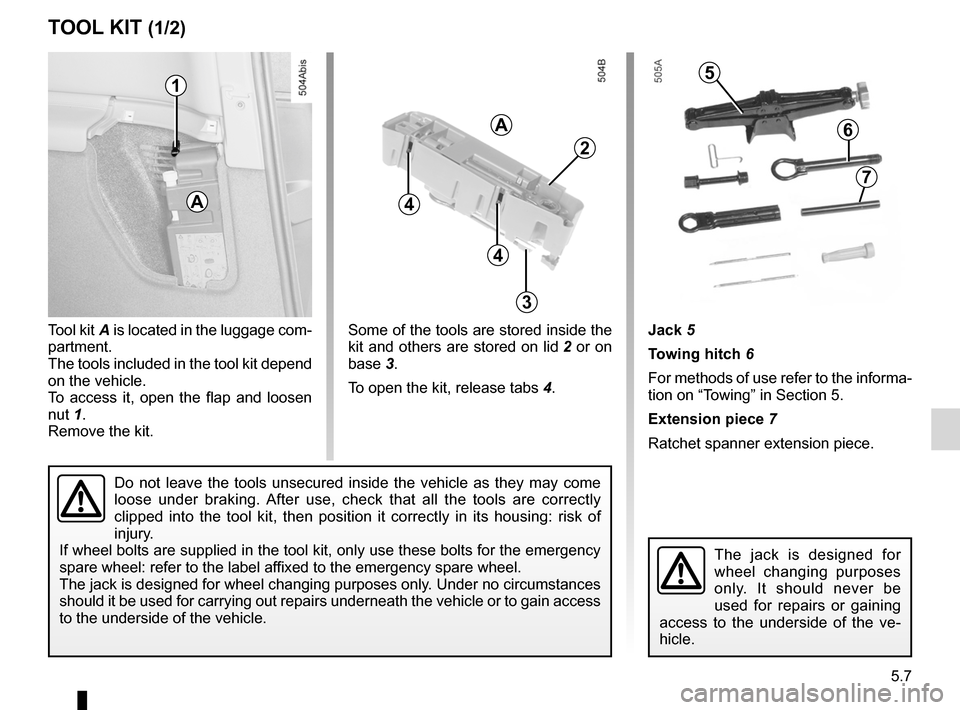
Tool kit A is located in the luggage com-
partment.
The tools included in the tool kit depend
on the vehicle.
To access it, open the flap and loosen
nut 1.
Remove the kit.Some of the tools are stored inside the
kit and others are stored on lid 2 or on
base 3.
To open the kit, release tabs 4.
1
A4
A
2
4
3
Jack 5
t owing hitch 6
For methods of use refer to the informa-
tion on “Towing” in Section 5.
extension piece 7
Ratchet spanner extension piece.
5
6
7
The jack is designed for
wheel changing purposes
only. It should never be
used for repairs or gaining
access to the underside of the ve -
hicle.
Do not leave the tools unsecured inside the vehicle as they may come
loose under braking. After use, check that all the tools are correctly
clipped into the tool kit, then position it correctly in its housing: risk of
injury.
If wheel bolts are supplied in the tool kit, only use these bolts for the emergency
spare wheel: refer to the label affixed to the emergency spare wheel.
The jack is designed for wheel changing purposes only. Under no circumstances
should it be used for carrying out repairs underneath the vehicle or to gain access
to the underside of the vehicle.
Page 208 of 267
hubcap tool ............................................................ (current page)
wheelbrace ............................................................ (current page)
tyres ....................................................................... (current page)
wheels (safety) ...................................................... (current page)
trims ....................................................................... (current page)
tyres ....................................................................... (current page)
5.8
ENG_UD20692_3
Bloc outil (X81 - Renault)
ENG_NU_932-3_X81ph3_Renault_5
Wheel trim - Wheel
t OOL KIt (2/2)/WHeeL trIM - WHeeL
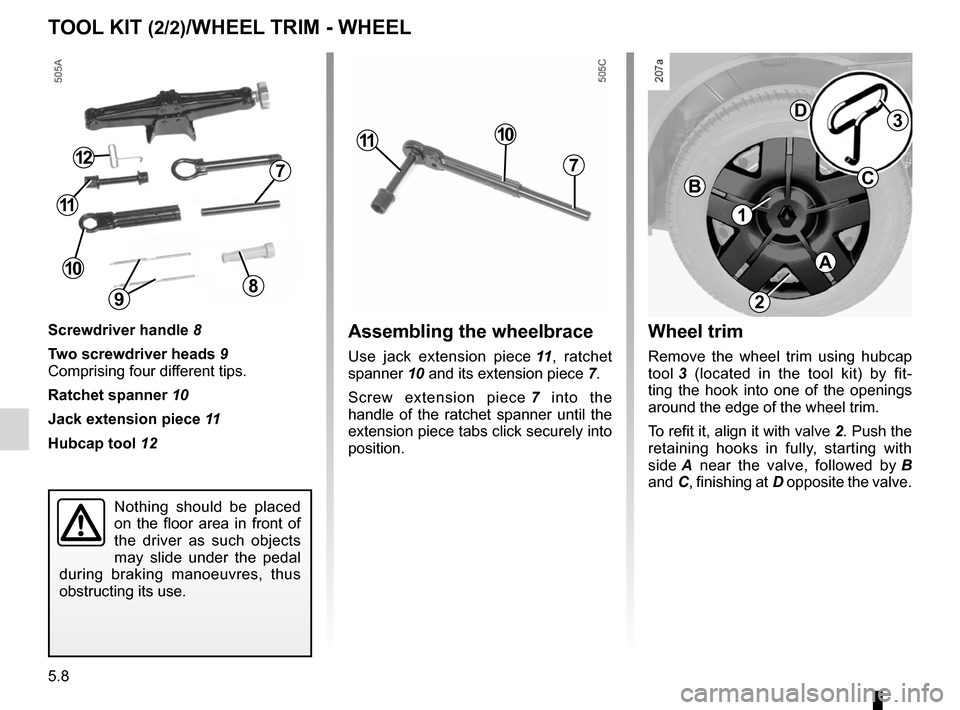
Screwdriver handle 8
two screwdriver heads 9
Comprising four different tips.
ratchet spanner 10
Jack extension piece 11
Hubcap tool 12Assembling the wheelbrace
Use jack extension piece 11 , ratchet
spanner 10 and its extension piece 7.
Screw extension piece 7 into the
handle of the ratchet spanner until the
extension piece tabs click securely into
position.
12
11
10
98
7
1110
7
Nothing should be placed
on the floor area in front of
the driver as such objects
may slide under the pedal
during braking manoeuvres, thus
obstructing its use.
Wheel trim
Remove the wheel trim using hubcap
tool 3 (located in the tool kit) by fit -
ting the hook into one of the openings
around the edge of the wheel trim.
To refit it, align it with valve 2. Push the
retaining hooks in fully, starting with
side A near the valve, followed by B
and C, finishing at D opposite the valve.
D3
c
A
2
B
1