tow RENAULT KANGOO 2012 X61 / 2.G Owner's Manual
[x] Cancel search | Manufacturer: RENAULT, Model Year: 2012, Model line: KANGOO, Model: RENAULT KANGOO 2012 X61 / 2.GPages: 237, PDF Size: 8.62 MB
Page 151 of 237
JauneNoirNoir texte
3.35
ENG_UD21477_3
Barres de toit (X61 - F61 - K61 - Renault)
ENG_NU_813-11_FK61_Renault_3
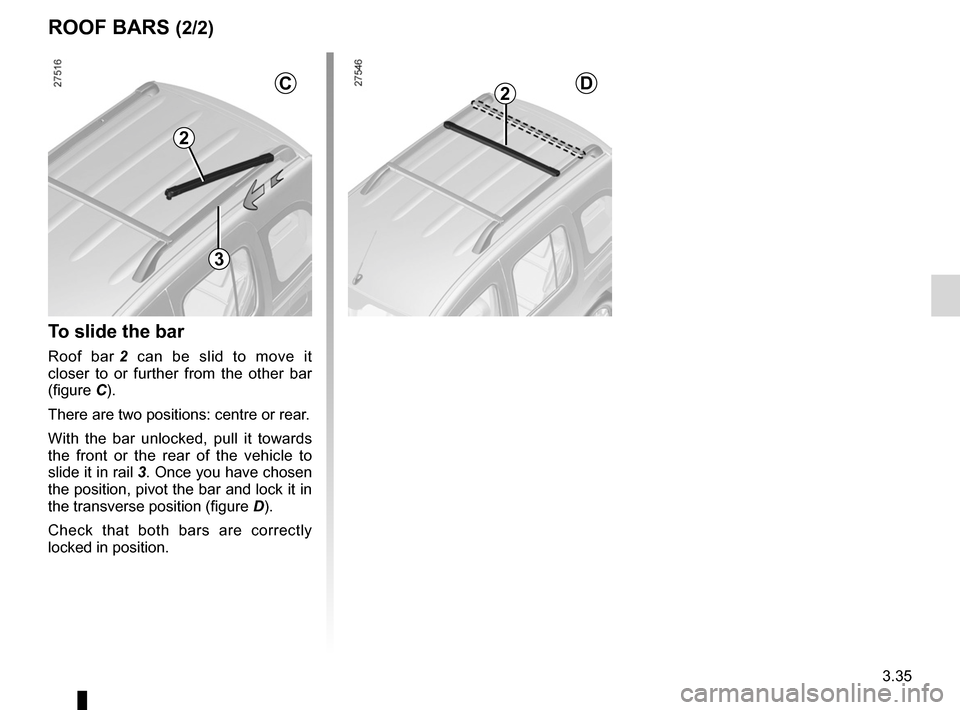
t o slide the bar
Roof bar 2 can be slid to move it
closer to or further from the other bar
(figure C).
There are two positions: centre or rear.
With the bar unlocked, pull it towards
the front or the rear of the vehicle to
slide it in rail 3. Once you have chosen
the position, pivot the bar and lock it in
the transverse position (figure D).
Check that both bars are correctly
locked in position.
2
2
DC
rOOF BArs (2/2)
3
Page 163 of 237
battery................................................... (up to the end of the DU)
4.11
ENG_UD26568_4
Batterie (X61 - F61 - K61 - Renault)
ENG_NU_813-11_FK61_Renault_4
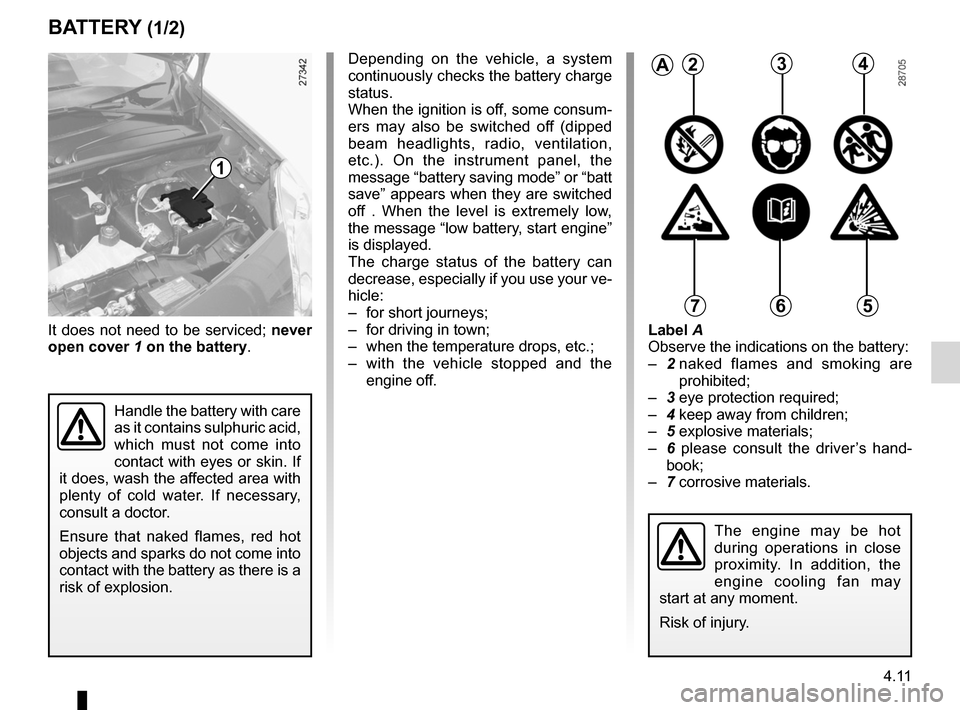
It does not need to be serviced; never
open cover 1 on the battery.
Battery
Handle the battery with care
as it contains sulphuric acid,
which must not come into
contact with eyes or skin. If
it does, wash the affected area with
plenty of cold water. If necessary,
consult a doctor.
Ensure that naked flames, red hot
objects and sparks do not come into
contact with the battery as there is a
risk of explosion.
BA tteR y (1/2)
Depending on the vehicle, a system
continuously checks the battery charge
status.
When the ignition is off, some consum-
ers may also be switched off (dipped
beam headlights, radio, ventilation,
etc.). On the instrument panel, the
message “battery saving mode” or “batt
save” appears when they are switched
off . When the level is extremely low,
the message “low battery, start engine”
is displayed.
The charge status of the battery can
decrease, especially if you use your ve-
hicle:
– for short journeys;
– for driving in town;
– when the temperature drops, etc.;
– with the vehicle stopped and the
engine off.
The engine may be hot
during operations in close
proximity. In addition, the
engine cooling fan may
start at any moment.
Risk of injury.
1
label A
Observe the indications on the battery:
– 2 naked flames and smoking are
prohibited;
– 3 eye protection required;
– 4 keep away from children;
– 5 explosive materials;
– 6 please consult the driver’s hand -
book;
– 7 corrosive materials.
A234
567
Page 165 of 237
tyre pressure.......................................................... (current page)
tyres ....................................................................... (current page)
tyre pressures ....................................... (up to the end of the DU)
4.13
ENG_UD29641_2
Pressions de gonflage des pneumatiques (en bar) (X61 - F61 - K61 - Re\
nault)ENG_NU_813-11_FK61_Renault_4
Tyre pressure
tyRe pReSSURe WHen cold
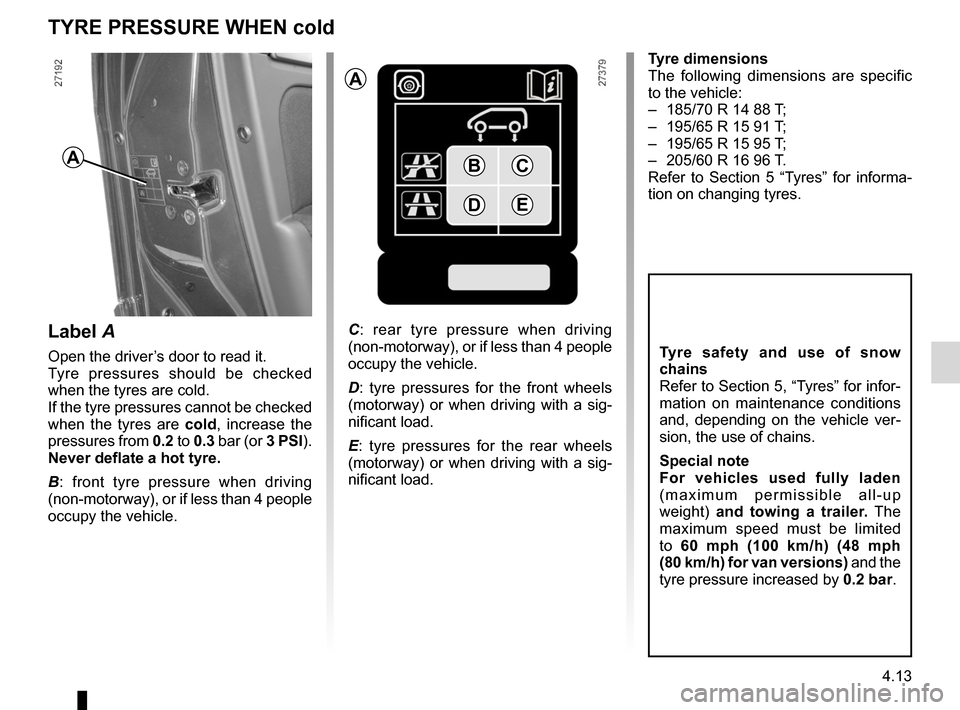
label A
Open the driver’s door to read it.
Tyre pressures should be checked
when the tyres are cold.
If the tyre pressures cannot be checked
when the tyres are cold, increase the
pressures from 0.2 to 0.3 bar (or 3 pSI).
never deflate a hot tyre.
B : front tyre pressure when driving
(non-motorway), or if less than 4 people
occupy the vehicle. C
: rear tyre pressure when driving
(non-motorway), or if less than 4 people
occupy the vehicle.
D : tyre pressures for the front wheels
(motorway) or when driving with a sig-
nificant load.
E : tyre pressures for the rear wheels
(motorway) or when driving with a sig-
nificant load.t yre safety and use of snow
chains
Refer to Section 5, “Tyres” for infor-
mation on maintenance conditions
and, depending on the vehicle ver -
sion, the use of chains.
Special note
For vehicles used fully laden
( m a x i m u m p e r m i s s i b l e a l l - u p
weight) and towing a trailer. The
maximum speed must be limited
to 60 mph (100 km/h) (48 mph
(80 km/h) for van versions) and the
tyre pressure increased by 0.2 bar.
C
De
BA
A
tyre dimensions
The following dimensions are specific
to the vehicle:
– 185/70 R 14 88 T;
– 195/65 R 15 91 T;
– 195/65 R 15 95 T;
– 205/60 R 16 96 T.
Refer to Section 5 “Tyres” for informa-
tion on changing tyres.
Page 171 of 237
5.1
ENG_UD29765_11
Sommaire 5 (X61 - F61 - K61 - Renault)
ENG_NU_813-11_FK61_Renault_5
Section 5: Practical advice
Puncture . . . . . . . . . . . . . . . . . . . . . . . . . . . . . . . . . . . . . . . . . . . . . . . . . . . . . . . . . . . . . . . . . . . . . . 5.2
Emergency spare wheel . . . . . . . . . . . . . . . . . . . . . . . . . . . . . . . . . . . . . . . . . . . . . . . . . . . . . . . . . . 5.2
Tyre inflation kit . . . . . . . . . . . . . . . . . . . . . . . . . . . . . . . . . . . . . . . . . . . . . . . . . . . . . . . . . . . . . . . . . 5.3
Tool kit . . . . . . . . . . . . . . . . . . . . . . . . . . . . . . . . . . . . . . . . . . . . . . . . . . . . . . . . . . . . . . . . . . . . . . . . 5.8
Wheels / Trim . . . . . . . . . . . . . . . . . . . . . . . . . . . . . . . . . . . . . . . . . . . . . . . . . . . . . . . . . . . . . . . . . . . 5.9
Changing a wheel . . . . . . . . . . . . . . . . . . . . . . . . . . . . . . . . . . . . . . . . . . . . . . . . . . . . . . . . . . . . . . . 5.10
Tyres . . . . . . . . . . . . . . . . . . . . . . . . . . . . . . . . . . . . . . . . . . . . . . . . . . . . . . . . . . . . . . . . . . . . . . . . . 5.12
Headlights: changing bulbs . . . . . . . . . . . . . . . . . . . . . . . . . . . . . . . . . . . . . . . . . . . . . . . . . . . . . . . . 5.15
Fog lights: changing bulbs . . . . . . . . . . . . . . . . . . . . . . . . . . . . . . . . . . . . . . . . . . . . . . . . . . . . . . . . . 5.17
Rear lights: changing bulbs . . . . . . . . . . . . . . . . . . . . . . . . . . . . . . . . . . . . . . . . . . . . . . . . . . . . . . . . 5.18
Indicator lights: changing bulbs . . . . . . . . . . . . . . . . . . . . . . . . . . . . . . . . . . . . . . . . . . . . . . . . . . . . . 5.21
Interior lights: changing bulbs . . . . . . . . . . . . . . . . . . . . . . . . . . . . . . . . . . . . . . . . . . . . . . . . . . . . . . 5.22
Battery: breakdowns . . . . . . . . . . . . . . . . . . . . . . . . . . . . . . . . . . . . . . . . . . . . . . . . . . . . . . . . . . . . . 5.24
Fuses . . . . . . . . . . . . . . . . . . . . . . . . . . . . . . . . . . . . . . . . . . . . . . . . . . . . . . . . . . . . . . . . . . . . . . . . . 5.26
Wiper blades . . . . . . . . . . . . . . . . . . . . . . . . . . . . . . . . . . . . . . . . . . . . . . . . . . . . . . . . . . . . . . . . . . . 5.28
Towing: breakdowns . . . . . . . . . . . . . . . . . . . . . . . . . . . . . . . . . . . . . . . . . . . . . . . . . . . . . . . . . . . . . 5.30
Fitted audio equipment . . . . . . . . . . . . . . . . . . . . . . . . . . . . . . . . . . . . . . . . . . . . . . . . . . . . . . . . . . . 5.32
Accessories . . . . . . . . . . . . . . . . . . . . . . . . . . . . . . . . . . . . . . . . . . . . . . . . . . . . . . . . . . . . . . . . . . . . 5.34
Radio frequency remote control unit: batteries . . . . . . . . . . . . . . . . . . . . . . . . . . . . . . . . . . . . . . . . . 5.35
Operating faults . . . . . . . . . . . . . . . . . . . . . . . . . . . . . . . . . . . . . . . . . . . . . . . . . . . . . . . . . . . . . . . . . 5.36
Page 178 of 237
tool kit .................................................................... (current page)
hubcap tool ............................................................ (current page)
wheelbrace ............................................................ (current page)
puncture ................................................................. (current page)
jack ........................................................................\
(current page)
towing hitch ............................................................ (current page)
wheelbrace ............................................................ (current page)
5.8
ENG_UD21490_4
Bloc outils (X61 - F61 - K61 - Renault)
ENG_NU_813-11_FK61_Renault_5
Tool kit
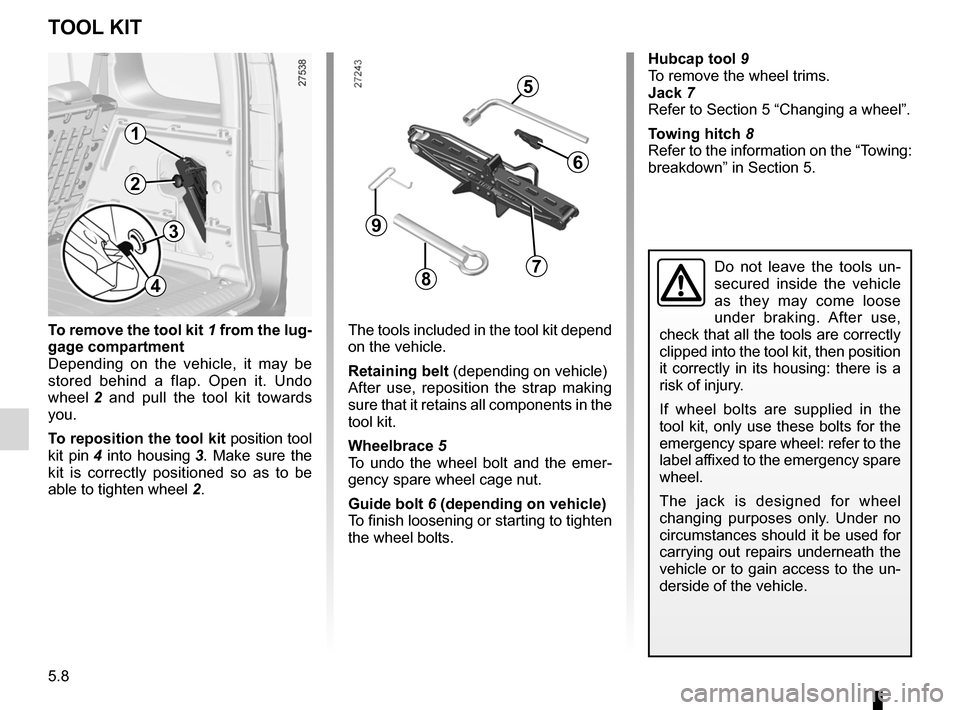
The tools included in the tool kit depend
on the vehicle.
retaining belt (depending on vehicle)
After use, reposition the strap making
sure that it retains all components in the
tool kit.
wheelbrace 5
To undo the wheel bolt and the emer -
gency spare wheel cage nut.
guide bolt 6 (depending on vehicle)
To finish loosening or starting to tighten
the wheel bolts.
t
o remove the tool kit 1 from the lug-
gage compartment
Depending on the vehicle, it may be
stored behind a flap. Open it. Undo
wheel 2 and pull the tool kit towards
you.
t o reposition the tool kit position tool
kit pin 4 into housing 3. Make sure the
kit is correctly positioned so as to be
able to tighten wheel 2.
tOOl KIt
5
6
9
1
3
2
87Do not leave the tools un -
secured inside the vehicle
as they may come loose
under braking. After use,
check that all the tools are correctly
clipped into the tool kit, then position
it correctly in its housing: there is a
risk of injury.
If wheel bolts are supplied in the
tool kit, only use these bolts for the
emergency spare wheel: refer to the
label affixed to the emergency spare
wheel.
The jack is designed for wheel
changing purposes only. Under no
circumstances should it be used for
carrying out repairs underneath the
vehicle or to gain access to the un-
derside of the vehicle.
4
hubcap tool 9
To remove the wheel trims.
Jack 7
Refer to Section 5 “Changing a wheel”.
t owing hitch 8
Refer to the information on the “Towing:
breakdown” in Section 5.
Page 186 of 237
indicators ............................................................... (current page)
indicators: direction indicators ........................................... (current page)
5.16
ENG_UD25826_4
Projecteurs : remplacement des lampes (X61 - F61 - K61 - Renault)
ENG_NU_813-11_FK61_Renault_5
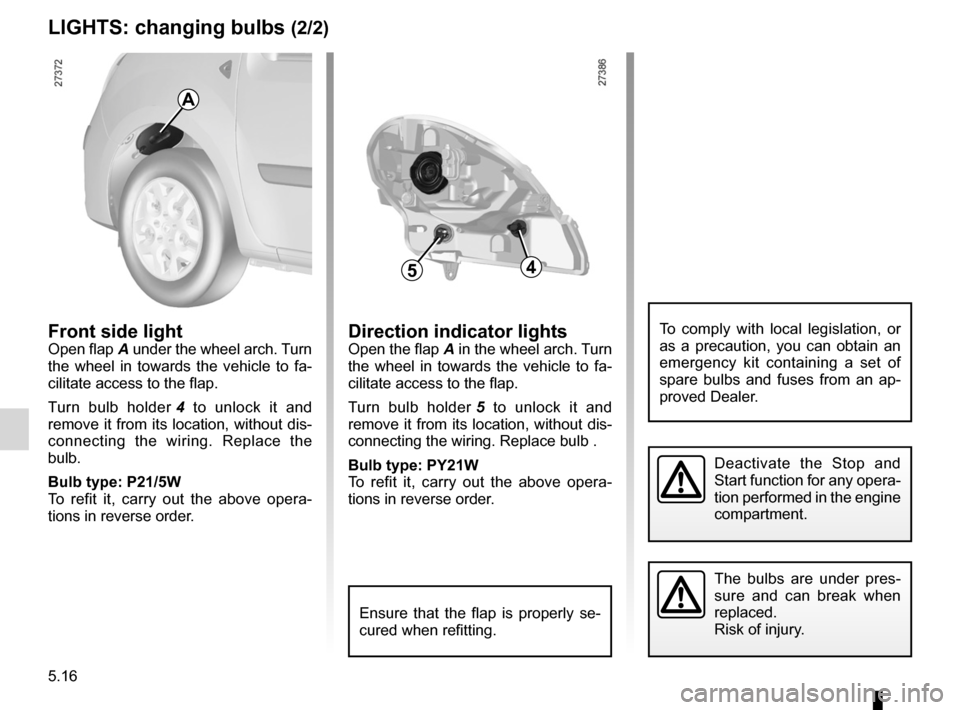
Front side lightOpen flap A under the wheel arch. Turn
the wheel in towards the vehicle to fa-
cilitate access to the flap.
Turn bulb holder 4 to unlock it and
remove it from its location, without dis-
connecting the wiring. Replace the
bulb.
Bulb type: P21/5w
To refit it, carry out the above opera -
tions in reverse order.Direction indicator lightsOpen the flap A in the wheel arch. Turn
the wheel in towards the vehicle to fa-
cilitate access to the flap.
Turn bulb holder 5 to unlock it and
remove it from its location, without dis-
connecting the wiring. Replace bulb .
Bulb type: Py21w
To refit it, carry out the above opera -
tions in reverse order.
The bulbs are under pres -
sure and can break when
replaced.
Risk of injury.
lIghts : changing bulbs (2/2)
45
a
Ensure that the flap is properly se -
cured when refitting.
Deactivate the Stop and
Start function for any opera -
tion performed in the engine
compartment.
To comply with local legislation, or
as a precaution, you can obtain an
emergency kit containing a set of
spare bulbs and fuses from an ap -
proved Dealer.
Page 188 of 237
rear lightschanging bulbs ................................ (up to the end of the DU)
lights: reversing lights ................................................. (current page)
lights: direction indicators ........................................... (current page)
lights: brake lights ...................................................... (current page)
bulbs changing ......................................... (up to the end of the DU)
brake lights changing bulbs ................................................. (current page)
bulbs changing ......................................... (up to the end of the DU)
5.18
ENG_UD6422_2
Feux arrière : remplacement des lampes (X61 - F61 - K61 - Renault)
ENG_NU_813-11_FK61_Renault_5
Jaune NoirNoir texte
Feux arrière : remplacement des lampes
The bulbs are under pres -
sure and can break when
replaced.
Risk of injury.
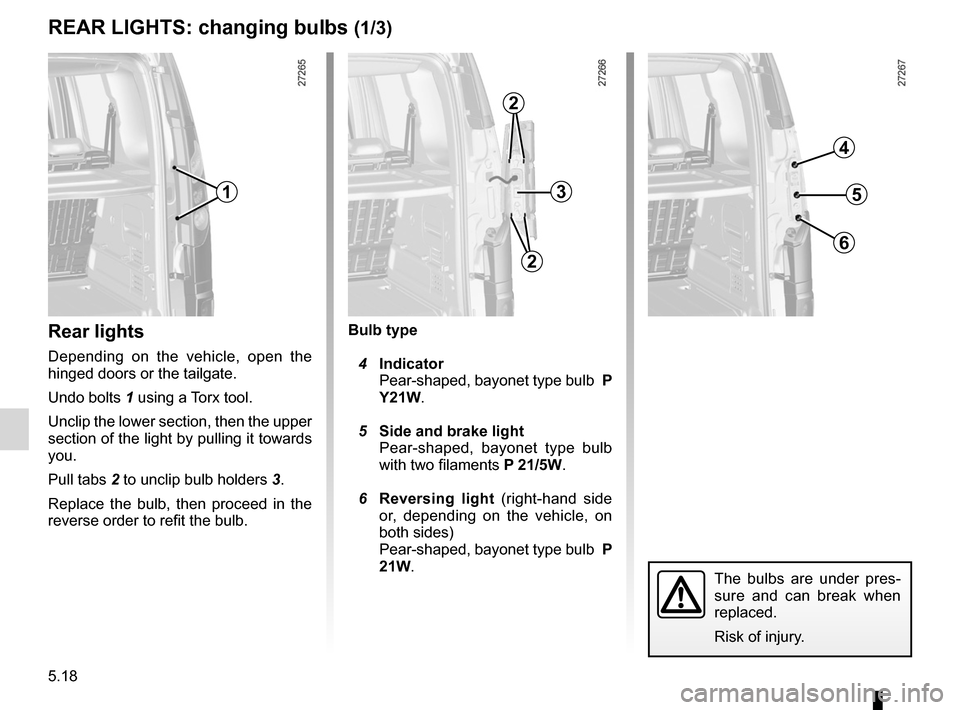
Bulb type
4 Indicator
Pear-shaped, bayonet type bulb P
y21w.
5 side and brake light
Pear-shaped, bayonet type bulb
with two filaments P 21/5w.
6 r eversing light (right-hand side
or, depending on the vehicle, on
both sides)
Pear-shaped, bayonet type bulb P
21w.rear lights
Depending on the vehicle, open the
hinged doors or the tailgate.
Undo bolts 1 using a Torx tool.
Unclip the lower section, then the upper
section of the light by pulling it towards
you.
Pull tabs 2 to unclip bulb holders 3.
Replace the bulb, then proceed in the
reverse order to refit the bulb.
rear lIghts: changing bulbs (1/3)
31
2
2
5
4
6
Page 200 of 237
towing hitch............................................................ (current page)
towing breakdown ....................................................... (current page)
5.30
ENG_UD9721_2
Remorquage : dépannage (X61 - F61 - K61 - Renault)
ENG_NU_813-11_FK61_Renault_5
Jaune NoirNoir texte
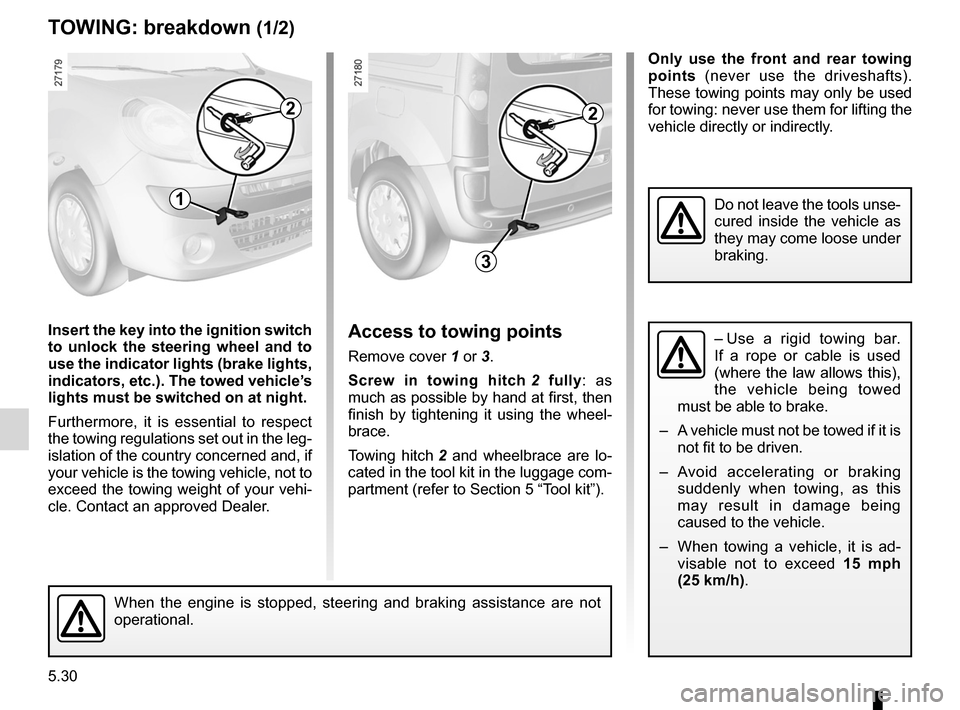
access to towing points
Remove cover 1 or 3.
s crew in towing hitch 2 fully : as
much as possible by hand at first, then
finish by tightening it using the wheel -
brace.
Towing hitch 2 and wheelbrace are lo -
cated in the tool kit in the luggage com-
partment (refer to Section 5 “Tool kit”).
Towing: breakdown
t OwIng: breakdown (1/2)
Insert the key into the ignition switch
to unlock the steering wheel and to
use the indicator lights (brake lights,
indicators, etc.). the towed vehicle’s
lights must be switched on at night.
Furthermore, it is essential to respect
the towing regulations set out in the leg-
islation of the country concerned and, if
your vehicle is the towing vehicle, not to
exceed the towing weight of your vehi-
cle. Contact an approved Dealer.
When the engine is stopped, steering and braking assistance are not
operational.
Only use the front and rear towing
points (never use the driveshafts).
These towing points may only be used
for towing: never use them for lifting the
vehicle directly or indirectly.
1
3
22
Do not leave the tools unse-
cured inside the vehicle as
they may come loose under
braking.
– Use a rigid towing bar.
If a rope or cable is used
(where the law allows this),
the vehicle being towed
must be able to brake.
– A vehicle must not be towed if it is
not fit to be driven.
– Avoid accelerating or braking
suddenly when towing, as this
may result in damage being
caused to the vehicle.
– When towing a vehicle, it is ad -
visable not to exceed 15 mph
(25 km/h).
Page 201 of 237

JauneNoirNoir texte
5.31
ENG_UD9721_2
Remorquage : dépannage (X61 - F61 - K61 - Renault)
ENG_NU_813-11_FK61_Renault_5
t OwIng: breakdown (2/2)
towing a vehicle with an
automatic gearbox
w ith the engine switched off: the
gearbox is no longer lubricated. It is
preferable to tow this type of vehicle on
a trailer or tow it with the front wheels
off the ground.
u nder exceptional circumstances ,
you may tow the vehicle with all four
wheels on the ground, only going
forward, with the gear lever in the
n eutral position, and for a distance
not exceeding 30 miles (50 km).
If the lever is stuck in P,
even though you are de -
pressing the brake pedal,
the lever can be released
manually.
To do this, unclip the cover at the
base of the lever.
Press simultaneously on mark 1
and on the unlocking button on the
lever.
1
Page 215 of 237
weights .................................................................. (current page)
towing .................................................................... (current page)
towing a caravan ................................................... (current page)
towing weights ...................................... (up to the end of the DU)
6.5
ENG_UD26105_4
Masses (X61 - F61 - K61 - Renault)
ENG_NU_813-11_FK61_Renault_6
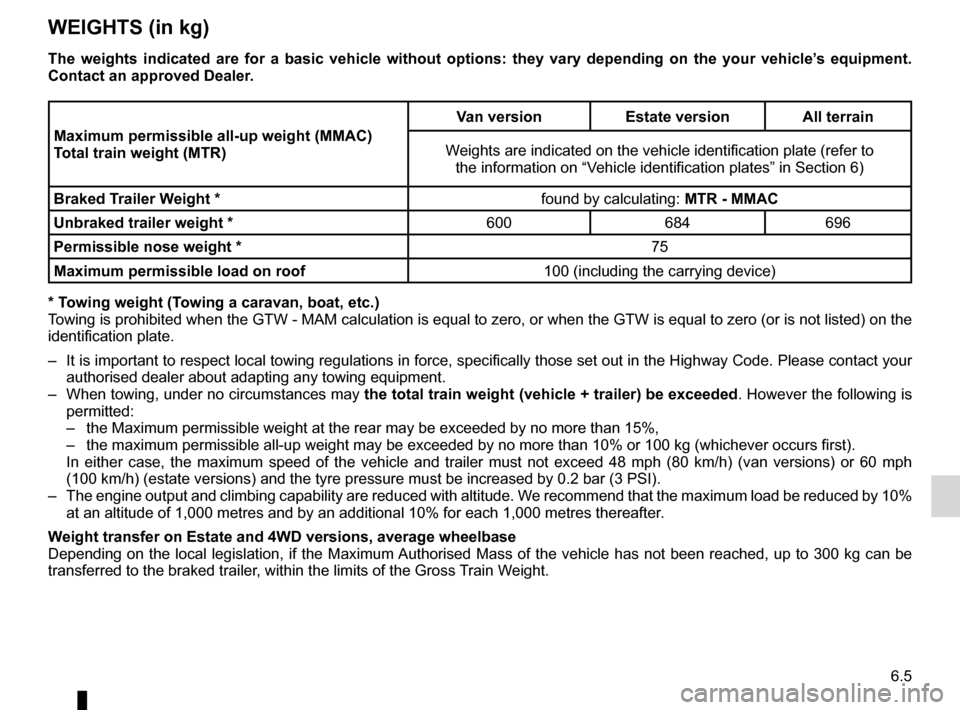
Weights (in kg)
t he weights indicated are for a basic vehicle without options: they vary depending on the your vehicle’s equipment.
contact an approved dealer.
Maximum permissible all-up weight (MMac)
t otal train weight (MtR) Van version
estate version all terrain
Weights are indicated on the vehicle identification plate (refer to the information on “Vehicle identification plates” in Section 6)
Braked t railer Weight * found by calculating: MtR - MMac
Unbraked trailer weight * 600684696
permissible nose weight * 75
Maximum permissible load on roof 100 (including the carrying device)
* t owing weight (t owing a caravan, boat, etc.)
Towing is prohibited when the GTW - MAM calculation is equal to zero, or when the GTW is equal to zero (or is not listed) on the
identification plate.
– It is important to respect local towing regulations in force, specifically those set out in the Highway Code. Please contact your
authorised dealer about adapting any towing equipment.
– When towing, under no circumstances may the total train weight (vehicle + trailer) be exceeded . However the following is
permitted:
– the Maximum permissible weight at the rear may be exceeded by no more than 15%,
– the maximum permissible all-up weight may be exceeded by no more than 10% or 100 kg (whichever occu\
rs first).
In either case, the maximum speed of the vehicle and trailer must not exceed 48 mph (80 km/h) (van versions) or 60 mph
(100 km/h) (estate versions) and the tyre pressure must be increased by 0.\
2 bar (3 PSI).
– The engine output and climbing capability are reduced with altitude. We recommend that the maximum load be reduced by 10%
at an altitude of 1,000 metres and by an additional 10% for each 1,000 m\
etres thereafter.
Weight transfer on estate and 4Wd versions, average wheelbase
Depending on the local legislation, if the Maximum Authorised Mass of the vehicle has not been reached, up to 300 kg can be
transferred to the braked trailer, within the limits of the Gross Train Weight.
Weights (in kg)