lights RENAULT KANGOO 2012 X61 / 2.G Owner's Guide
[x] Cancel search | Manufacturer: RENAULT, Model Year: 2012, Model line: KANGOO, Model: RENAULT KANGOO 2012 X61 / 2.GPages: 237, PDF Size: 8.62 MB
Page 96 of 237
special features of diesel versions........(up to the end of the DU)
2.10
ENG_UD29640_4
Particularités versions diesel (X61 - F61 - K61 - Renault)
ENG_NU_813-11_FK61_Renault_2
Special features of diesel versions
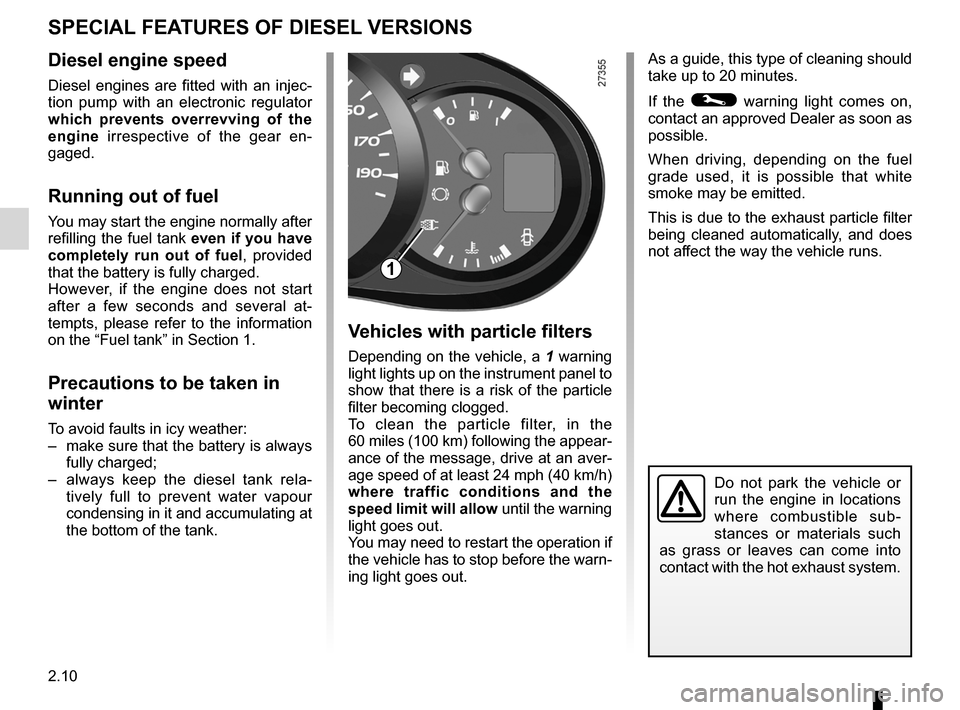
Vehicles with particle filters
Depending on the vehicle, a 1 warning
light lights up on the instrument panel to
show that there is a risk of the particle
filter becoming clogged.
To clean the particle filter, in the
60 miles (100 km) following the appear -
ance of the message, drive at an aver-
age speed of at least 24 mph (40 km/h)
where traffic conditions and the
speed limit will allow until the warning
light goes out.
You may need to restart the operation if
the vehicle has to stop before the warn-
ing light goes out.
Diesel engine speed
Diesel engines are fitted with an injec -
tion pump with an electronic regulator
which prevents overrevving of the
engine irrespective of the gear en -
gaged.
Running out of fuel
You may start the engine normally after
refilling the fuel tank even if you have
completely run out of fuel , provided
that the battery is fully charged.
However, if the engine does not start
after a few seconds and several at -
tempts, please refer to the information
on the “Fuel tank” in Section 1.
Precautions to be taken in
winter
To avoid faults in icy weather:
– make sure that the battery is always
fully charged;
– always keep the diesel tank rela -
tively full to prevent water vapour
condensing in it and accumulating at
the bottom of the tank.
SPECIAl fEATURES Of DIESEl VERSIONS
1
As a guide, this type of cleaning should
take up to 20 minutes.
If the
© warning light comes on,
contact an approved Dealer as soon as
possible.
When driving, depending on the fuel
grade used, it is possible that white
smoke may be emitted.
This is due to the exhaust particle filter
being cleaned automatically, and does
not affect the way the vehicle runs.
Do not park the vehicle or
run the engine in locations
where combustible sub -
stances or materials such
as grass or leaves can come into
contact with the hot exhaust system.
Page 98 of 237
2.12
ENG_UD21480_4
Conseils : antipollution, économies de carburant, conduite (X83 - X61 - Renault)
ENG_NU_813-11_FK61_Renault_2
Jaune NoirNoir texte
ADVICE: antipollution, fuel economy and driving (2/3)
– Do not overrev the engine in the in-
termediate gears.
Always use the highest gear possi -
ble without labouring the engine.
– Do not try to maintain the same
speed up a hill, accelerate no more
than you would on the level. Keep
your foot in the same position on the
accelerator pedal.
– Double declutching and accelerating
before switching off are unnecessary
in modern vehicles.
– Bad weather, flooded roads:
Do not drive through
floods if the water is
above the lower edge of
the wheel rims.
Exhaust gas monitoring
system
The exhaust gas monitoring system will
detect any operating faults in the vehi-
cle’s antipollution system.
If this system malfunctions, toxic sub -
stances may be released into the at -
mosphere or damage may occur.
ÄThis warning light on the in -
strument panel will indicate if
there are any faults in the system:
This lights up when the ignition is
switched on and goes out when the
engine is started.
– If it lights up continuously, consult an
approved Dealer as soon as possi -
ble;
– if it flashes, reduce the engine speed
until the light stops flashing. Contact
your approved dealer as soon as
possible.
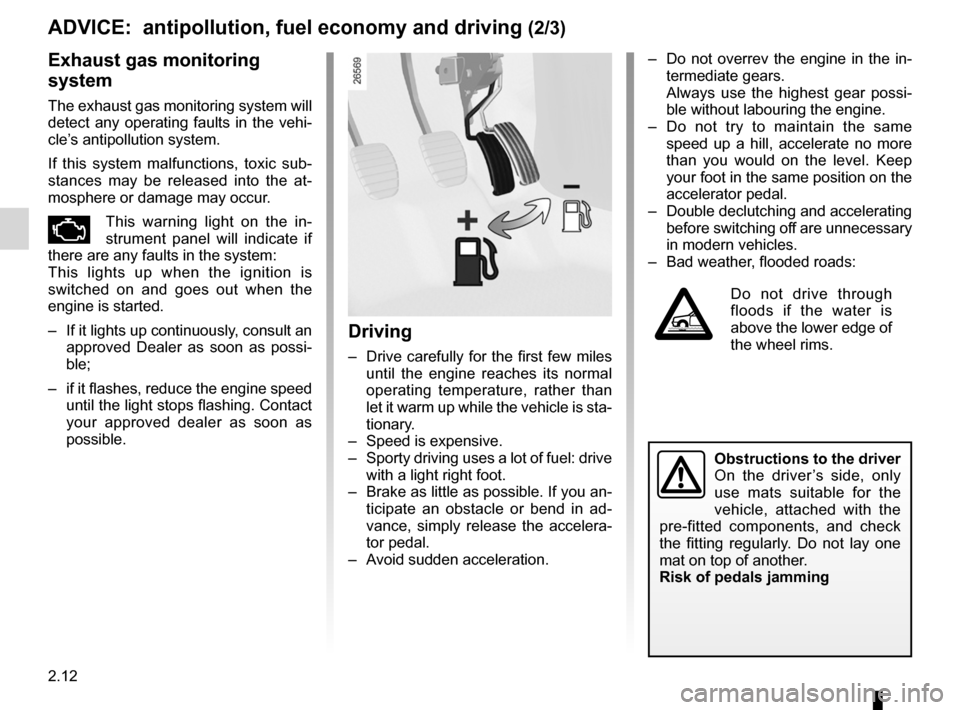
Driving
– Drive carefully for the first few miles
until the engine reaches its normal
operating temperature, rather than
let it warm up while the vehicle is sta-
tionary.
– Speed is expensive.
– Sporty driving uses a lot of fuel: drive
with a light right foot.
– Brake as little as possible. If you an-
ticipate an obstacle or bend in ad -
vance, simply release the accelera -
tor pedal.
– Avoid sudden acceleration.
Obstructions to the driver
On the driver ’s side, only
use mats suitable for the
vehicle, attached with the
pre-fitted components, and check
the fitting regularly. Do not lay one
mat on top of another.
Risk of pedals jamming
Page 99 of 237
JauneNoirNoir texte
2.13
ENG_UD21480_4
Conseils : antipollution, économies de carburant, conduite (X83 - X61 - Renault)
ENG_NU_813-11_FK61_Renault_2
ADVICE: antipollution, fuel economy and driving (3/3)
Advice on use
– Electricity is fuel; switch off all the
electrical components which are
not really needed. However (safety
first), keep your lights on when the
visibility is bad (“see and be seen”).
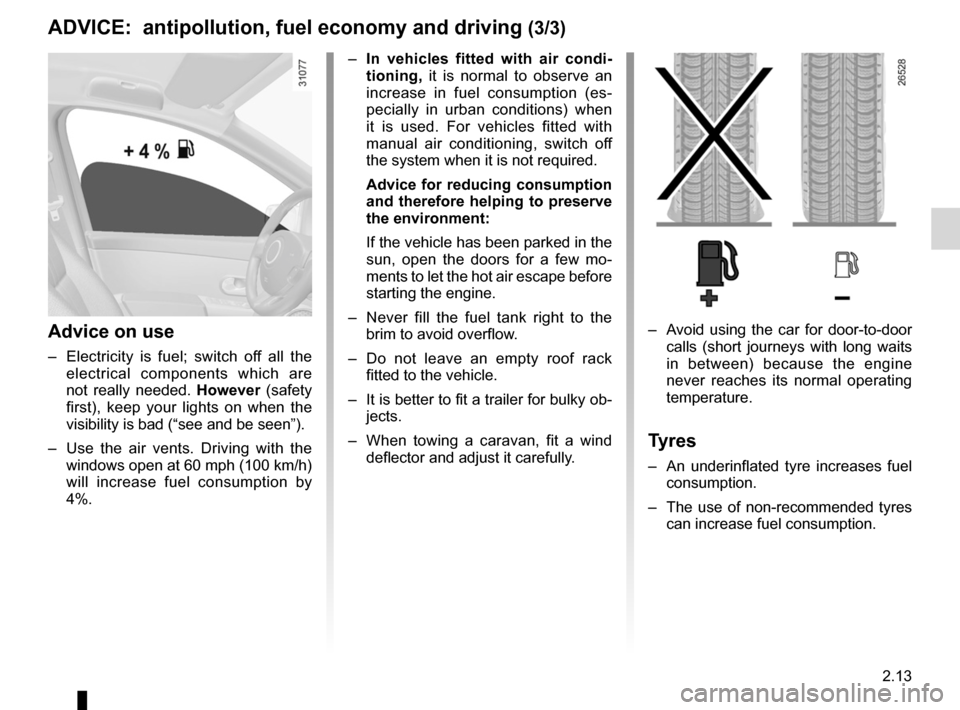
– Use the air vents. Driving with the
windows open at 60 mph (100 km/h)
will increase fuel consumption by
4%. –
Avoid using the car for door-to-door
calls (short journeys with long waits
in between) because the engine
never reaches its normal operating
temperature.
Tyres
– An underinflated tyre increases fuel
consumption.
– The use of non-recommended tyres
can increase fuel consumption.
–
In vehicles fitted with air condi -
tioning, it is normal to observe an
increase in fuel consumption (es -
pecially in urban conditions) when
it is used. For vehicles fitted with
manual air conditioning, switch off
the system when it is not required.
Advice for reducing consumption
and therefore helping to preserve
the environment:
If the vehicle has been parked in the
sun, open the doors for a few mo -
ments to let the hot air escape before
starting the engine.
– Never fill the fuel tank right to the
brim to avoid overflow.
– Do not leave an empty roof rack
fitted to the vehicle.
– It is better to fit a trailer for bulky ob-
jects.
– When towing a caravan, fit a wind
deflector and adjust it carefully.
Page 101 of 237
ASR (traction control) ........................... (up to the end of the DU)
ABS ...................................................... (up to the end of the DU)
traction control: ASR .............................(up to the end of the DU)
driving ................................................... (up to the end of the DU)
traction control: ASR .............................(up to the end of the DU)
anti-lock braking system: ABS ..............(up to the end of the DU)
ESP: Electronic Stability Program ........ (up to the end of the DU)
emergency brake assist ........................(up to the end of the DU)
emergency braking ............................... (up to the end of the DU)
Electronic Stability Program: ESP ........ (up to the end of the DU)
2.15
ENG_UD29758_3
Dispositifs de correction de conduite (X61 - F61 - K61 - Renault)
ENG_NU_813-11_FK61_Renault_2
AbS (anti-lock braking
system)
Under heavy braking, the ABS prevents
the wheels from locking, allowing the
stopping distance to be managed and
keeping control of the vehicle.
Under these circumstances, the vehi -
cle can be steered to avoid an obstacle
whilst braking. In addition, this system
can increase stopping distances, par -
ticularly on roads with low surface grip
(wet ground etc.).
You will feel a pulsation through the
brake pedal each time the system is
activated. The ABS does not in any way
improve the vehicle’s physical perform-
ance relating to the road surface and
roadholding. It is still essential to follow
the rules of good driving practice (such
as driving at a safe distance from the
vehicle in front, etc.).
Driver correction devices and aids
Operating faults:
– If the
x warning light on the in-
strument panel comes on while driv-
ing, braking is still operational ;
– If the
x and D warning
lights on the instrument panel come
on when driving, this indicates a
fault with the braking system.
In such cases, ABS, ESP and emer -
gency brake assist are also deactivated
and, depending on the vehicle, the
messages “CHECK ABS” and “CHECK
ESP” appear on the instrument panel.
Consult an approved dealer.
DRIVER CORRECTION DEVICES AND AIDS (1/3)
In an emergency, apply firm and
continuous pressure to the brake
pedal. There is no need to pump
it repeatedly. The ABS will modu -
late the force applied in the braking
system.
These functions are an ad-
ditional aid in the event of
critical driving conditions,
enabling the vehicle behav -
iour to be adapted to suit the driving
conditions.
However, the functions do not take
the place of the driver. They do
not increase the vehicle’s limits
and should not encourage you
to drive more quickly. Therefore,
they can under no circumstances
replace the vigilance or responsibil -
ity of the driver when manoeuvring
the vehicle (the driver must always
be ready for sudden incidents which
may occur when driving).
Yo u r b r a k i n g s y s t e m s
are partially operational.
However, it is dangerous
to brake suddenly and
it is essential to stop immediately,
as soon as traffic conditions allow.
Contact an approved dealer.
Depending on the vehicle, this is com-
posed of:
– t h e A bS ( a n t i - l o c k b r a k i n g
system);
– electronic stability control ESP
with understeer control and trac -
tion control ASR;
– emergency brake assist with, de -
pending on the vehicle, braking
anticipation.
Page 103 of 237
JauneNoirNoir texte
2.17
ENG_UD29758_3
Dispositifs de correction de conduite (X61 - F61 - K61 - Renault)
ENG_NU_813-11_FK61_Renault_2
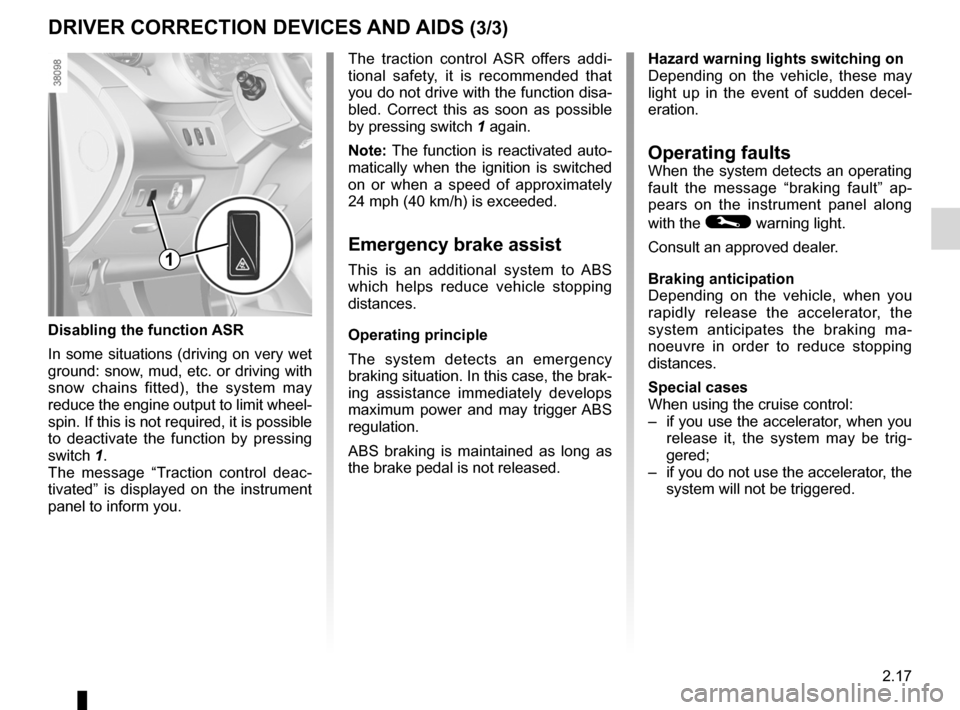
Disabling the function ASR
In some situations (driving on very wet
ground: snow, mud, etc. or driving with
snow chains fitted), the system may
reduce the engine output to limit wheel -
spin. If this is not required, it is possible
to deactivate the function by pressing
switch 1.
The message “Traction control deac -
tivated” is displayed on the instrument
panel to inform you. The traction control ASR offers addi
-
tional safety, it is recommended that
you do not drive with the function disa-
bled. Correct this as soon as possible
by pressing switch 1 again.
Note: The function is reactivated auto-
matically when the ignition is switched
on or when a speed of approximately
24 mph (40 km/h) is exceeded.
Emergency brake assist
This is an additional system to ABS
which helps reduce vehicle stopping
distances.
Operating principle
The system detects an emergency
braking situation. In this case, the brak-
ing assistance immediately develops
maximum power and may trigger ABS
regulation.
ABS braking is maintained as long as
the brake pedal is not released.
DRIVER CORRECTION DEVICES AND AIDS (3/3)
Hazard warning lights switching on
Depending on the vehicle, these may
light up in the event of sudden decel -
eration.
Operating faultsWhen the system detects an operating
fault the message “braking fault” ap -
pears on the instrument panel along
with the
© warning light.
Consult an approved dealer.
braking anticipation
Depending on the vehicle, when you
rapidly release the accelerator, the
system anticipates the braking ma -
noeuvre in order to reduce stopping
distances.
Special cases
When using the cruise control:
– if you use the accelerator, when you
release it, the system may be trig -
gered;
– if you do not use the accelerator, the
system will not be triggered.
1
Page 110 of 237
2.24
ENG_UD29760_3
Régulateur-limiteur de vitesses : fonction régulateur (X61 - F61 - K61 - X61 BUp - Renault)
ENG_NU_813-11_FK61_Renault_2
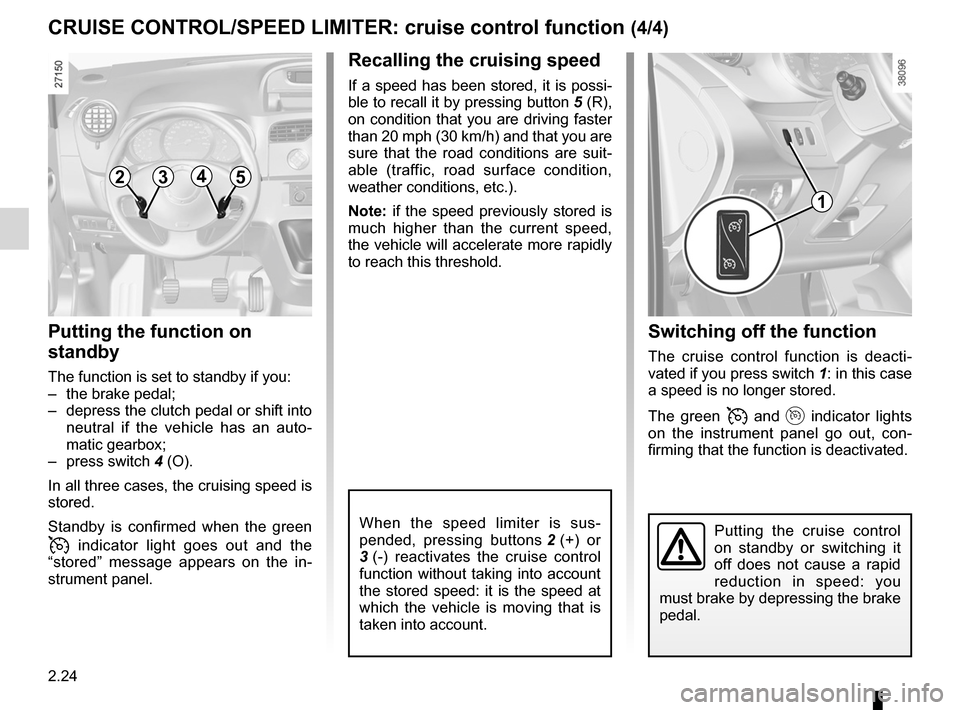
Switching off the function
The cruise control function is deacti -
vated if you press switch 1: in this case
a speed is no longer stored.
The green
and indicator lights
on the instrument panel go out, con -
firming that the function is deactivated.
Recalling the cruising speed
If a speed has been stored, it is possi-
ble to recall it by pressing button 5 (R),
on condition that you are driving faster
than 20 mph (30 km/h) and that you are
sure that the road conditions are suit -
able (traffic, road surface condition,
weather conditions, etc.).
Note: if the speed previously stored is
much higher than the current speed,
the vehicle will accelerate more rapidly
to reach this threshold.
When the speed limiter is sus -
pended, pressing buttons 2 (+) or
3 (-) reactivates the cruise control
function without taking into account
the stored speed: it is the speed at
which the vehicle is moving that is
taken into account.
Putting the function on
standby
The function is set to standby if you:
– the brake pedal;
– depress the clutch pedal or shift into
neutral if the vehicle has an auto -
matic gearbox;
– press switch 4 (O).
In all three cases, the cruising speed is
stored.
Standby is confirmed when the green
indicator light goes out and the
“stored” message appears on the in -
strument panel.
CRUISE CONTROl/SPEED lIMITER: cruise control function (4/4)
Putting the cruise control
on standby or switching it
off does not cause a rapid
reduction in speed: you
must brake by depressing the brake
pedal.
2453
1
Page 112 of 237

2.26
ENG_UD29761_3
Aide au parking (X61 - F61 - K61 - Renault)
ENG_NU_813-11_FK61_Renault_2
Prolonged deactivation of the
system
You can deactivate the system perma-
nently by pressing and holding switch 1.
The warning light built into the switch
remains lit constantly.
The deactivated system can be re -
activated by pressing and holding the
switch again.
Temporary deactivation of
the system
(depending on vehicle)
Press switch 1 to deactivate the system.
The indicator light built into the switch
lights up to remind you that the system
is deactivated.
Pressing the switch again will reacti -
vate the system and switch off the in -
dicator light.
The system is automatically reactivated
after the ignition is switched off and the
engine restarted.
PARkING DISTANCE CONTROl (2/2)
Operating faults
When the system detects an operating
fault there will be a 3-second continu -
ous beep as a warning. Consult an ap-
proved Dealer.
1
Page 130 of 237
3.14
ENG_UD10847_2
Air conditionné automatique (X61 - F61 - K61 - X61 BUp - Renault)
ENG_NU_813-11_FK61_Renault_3
Prolonged use of the air recirculation
mode may cause the windows to mist
up or lead to odours, as the air is not
renewed.
We therefore advise you to return to
normal mode (external air or automatic
recirculation) as soon as air recircula -
tion is no longer needed, by pressing
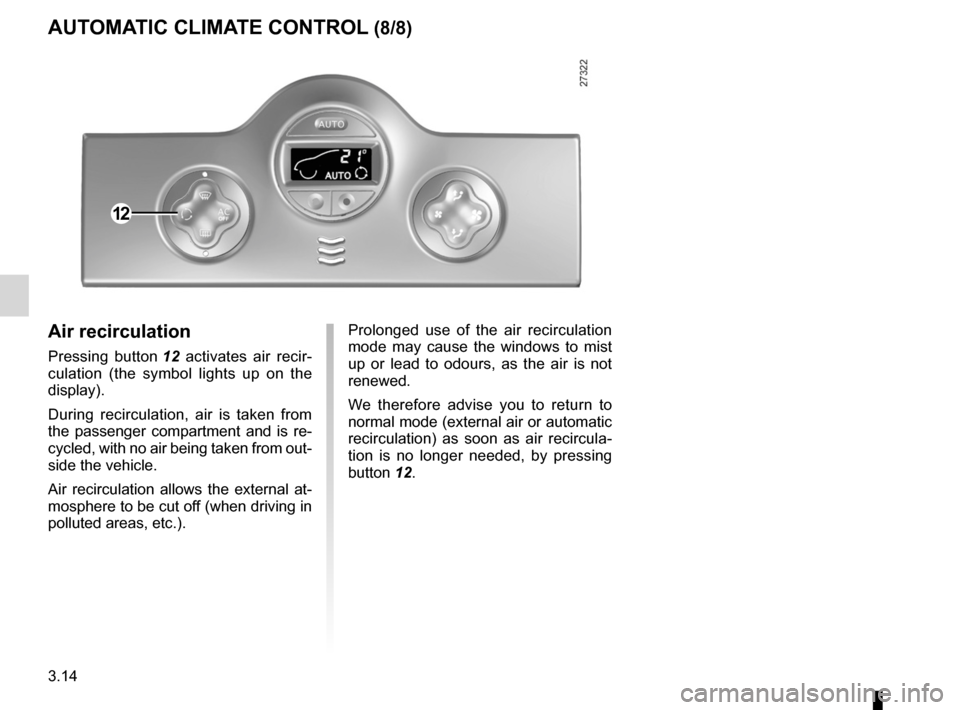
button 12.Air recirculation
Pressing button 12 activates air recir -
culation (the symbol lights up on the
display).
During recirculation, air is taken from
the passenger compartment and is re-
cycled, with no air being taken from out-
side the vehicle.
Air recirculation allows the external at-
mosphere to be cut off (when driving in
polluted areas, etc.).
AUt OMA tiC CLiMA te COntrOL (8/8)
12
Page 132 of 237
lighting:interior ............................................. (up to the end of the DU)
courtesy light ........................................ (up to the end of the DU)
map reading lights ................................ (up to the end of the DU)
3.16
ENG_UD17474_4
Eclairage intérieur (X61 - F61 - K61 - Renault)
ENG_NU_813-11_FK61_Renault_3
Jaune NoirNoir texte
Interior lighting
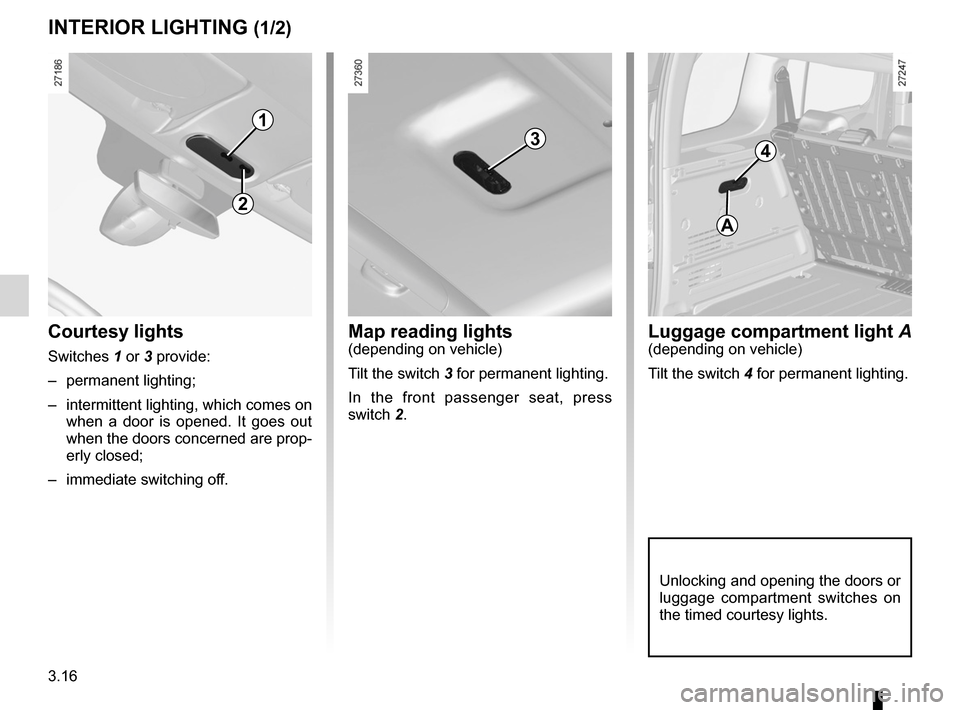
Map reading lights(depending on vehicle)
Tilt the switch 3 for permanent lighting.
In the front passenger seat, press
switch 2.Courtesy lights
Switches 1 or 3 provide:
– permanent lighting;
– intermittent lighting, which comes on
when a door is opened. It goes out
when the doors concerned are prop-
erly closed;
– immediate switching off.
interiOr LiGHtinG (1/2)
2
1
Luggage compartment light A(depending on vehicle)
Tilt the switch 4 for permanent lighting.
A
34
Unlocking and opening the doors or
luggage compartment switches on
the timed courtesy lights.
Page 147 of 237

towing equipmentfitting ................................................................ (current page)
JauneNoirNoir texte
3.31
ENG_UD29642_4
Transports d’objets dans le coffre (X61 - F61 - K61 - Renault)
ENG_NU_813-11_FK61_Renault_3
Towbar
trAnsPOrtinG OBjeCts in tHe BOOt (2/2)/t OWinG
Permissible nose weight, maxi -
mum permissible towing weight,
braked and unbraked: refer to
the information on “Weights” in
Section 6.
For fitting and conditions of use,
refer to the equipment’s fitting in -
structions.
Please keep these instructions with
the rest of the vehicle documenta -
tion.
If the towbar ball obscures the regis-
tration plate or the rear fog lights, it
should be removed when not in use.
In all cases, comply with local leg -
islation.
A = 776.5 mm.
A