light RENAULT KANGOO 2016 X61 / 2.G Service Manual
[x] Cancel search | Manufacturer: RENAULT, Model Year: 2016, Model line: KANGOO, Model: RENAULT KANGOO 2016 X61 / 2.GPages: 173, PDF Size: 3.8 MB
Page 100 of 173
bonnet................................................... (up to the end of the DU)
maintenance:mechanical ...................................... (up to the end of the DU)
4.2
ENG_UD7306_1
Capot moteur (X76 - Renault)
ENG_NU_854-2_X76LL_Renault_4
Bonnet
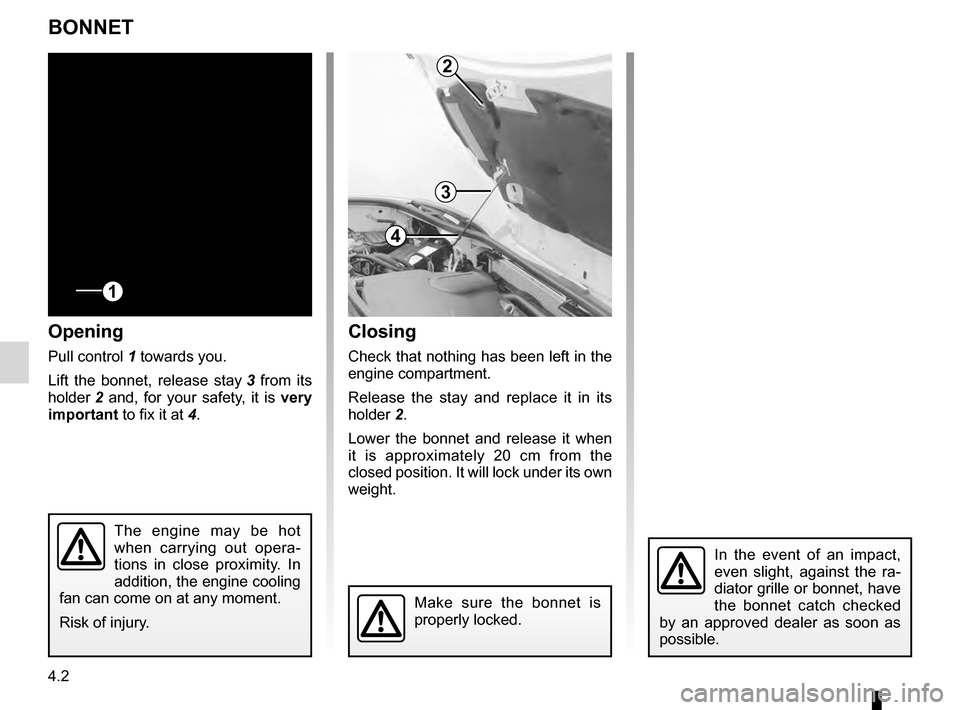
Closing
Check that nothing has been left in the
engine compartment.
Release the stay and replace it in its
holder
2.
Lower the bonnet and release it when
it is approximately 20 cm from the
closed position. It will lock under its own
weight.
Opening
Pull control 1 towards you.
L
ift the bonnet, release stay 3 from its
holder
2 and, for your safety, it is very
important to fix it at
4.
BOnnet
1
2
3
4
The engine may be hot
when carrying out opera-
tions in close proximity. In
addition, the engine cooling
fan can come on at any moment.
Risk of injury.
In the event of an impact,
even slight, against the ra-
diator grille or bonnet, have
the bonnet catch checked
by an approved dealer as soon as
possible.
Make sure the bonnet is
properly locked.
Page 101 of 173
maintenance:mechanical ...................................... (up to the end of the DU)
engine oil .............................................. (up to the end of the DU)
dipstick.................................................. (up to the end of the DU)
engine oil level ...................................... (up to the end of the DU) 4.3
ENG_UD13985_2
Niveau huile moteur (X76 - Renault)
ENG_NU_854-2_X76LL_Renault_4
Engine oil level
general information
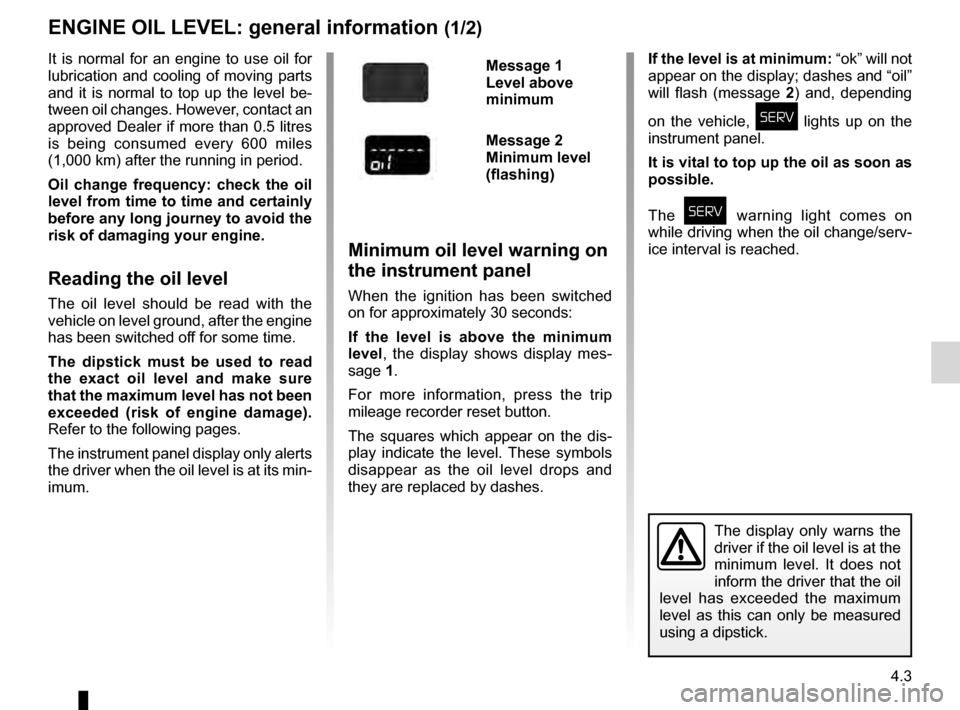
If the level is at minimum: “ok” will not
appear on the display; dashes and “oil”
will flash (message 2) and, depending
on the vehicle,
ø lights up on the
instrument panel.
It is vital to top up the oil as soon as
possible.
The
ø warning light comes on
while driving when the oil change/serv-
ice interval is reached.
Message 1
Level above
minimum
Message 2
Minimum level
(flashing)
Minimum oil level warning on
the instrument panel
When the ignition has been switched
on for approximately 30 seconds:
If the level is above the minimum
level , the display shows display mes-
sage
1.
For more information, press the trip
mileage recorder reset button.
The squares which appear on the dis-
play indicate the level. These symbols
disappear as the oil level drops and
they are replaced by dashes.
engIne OIL LeveL: general information (1/2)
The display only warns the
driver if the oil level is at the
minimum level. It does not
inform the driver that the oil
level has exceeded the maximum
level as this can only be measured
using a dipstick.
It is normal for an engine to use oil for
lubrication and cooling of moving parts
and it is normal to top up the level be-
tween oil changes. However, contact an
approved Dealer if more than 0.5 litres
is being consumed every 600 miles
(1,000 km) after the running in period.
Oil change frequency: check the oil
level from time to time and certainly
before any long journey to avoid the
risk of damaging your engine.
Reading the oil level
The oil level should be read with the
vehicle on level ground, after the engine
has been switched off for some time.
t h
e dipstick must be used to read
the exact oil level and make sure
that the maximum level has not been
exceeded (risk of engine damage).
Refer to the following pages.
The instrument panel display only alerts
the driver when the oil level is at its min-
imum.
Page 105 of 173
4.7
ENG_UD14325_2
Niveaux / Filtres (X76 - Renault)
ENG_NU_854-2_X76LL_Renault_4
Levels
The engine may be hot
during operations in close
proximity. In addition, the
engine cooling fan may
come on at any moment.
Risk of burns.
If you wish to check the disc and drum
wear yourself, you should obtain the
document explaining the checking pro-
cedure from our network or from the
manufacturer’s website.
t opping up
After any operation on the hydraulic cir-
cuit, a specialist must replace the fluid.
Only use fluids approved by the man-
ufacturer’s Technical Department (and
taken from a sealed container).
Replacement interval: refer to the
Maintenance Service Booklet for your
vehicle.
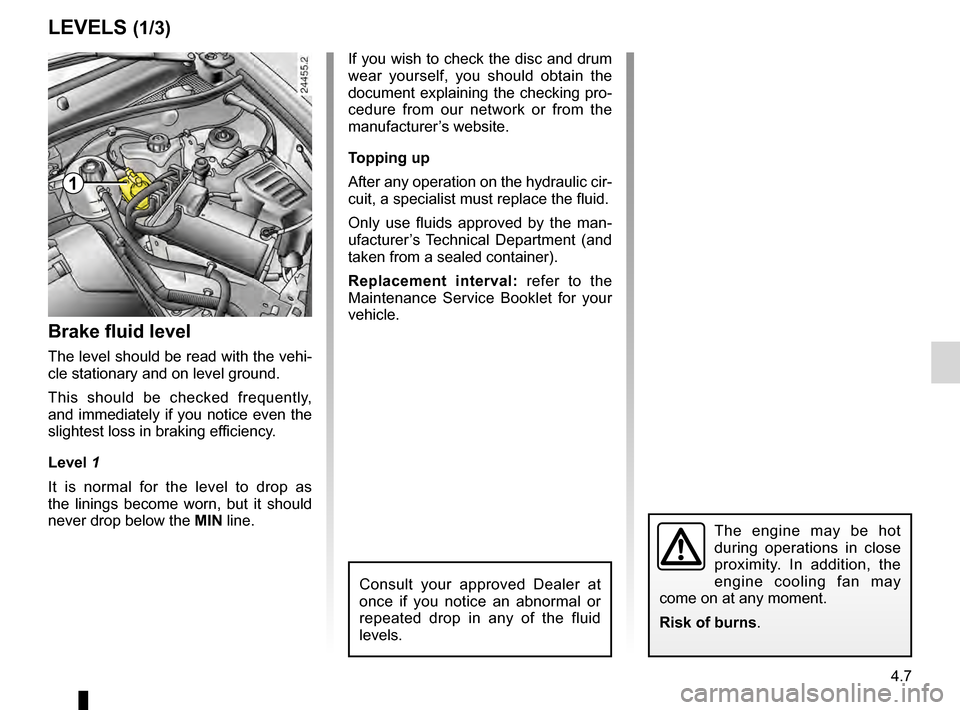
Brake fluid level
The level should be read with the vehi-
cle stationary and on level ground.
This should be checked frequently,
and immediately if you notice even the
slightest loss in braking efficiency.
Level
1
It is normal for the level to drop as
the linings become worn, but it should
never drop below the MI
n line.
LeveLS (1/3)
1
Consult your approved Dealer at
once if you notice an abnormal or
repeated drop in any of the fluid
levels.
Page 107 of 173
JauneNoirNoir texte
4.9
ENG_UD14325_2
Niveaux / Filtres (X76 - Renault)
ENG_NU_854-2_X76LL_Renault_4
LeveLS (3/3)/FIL teRS
Filters
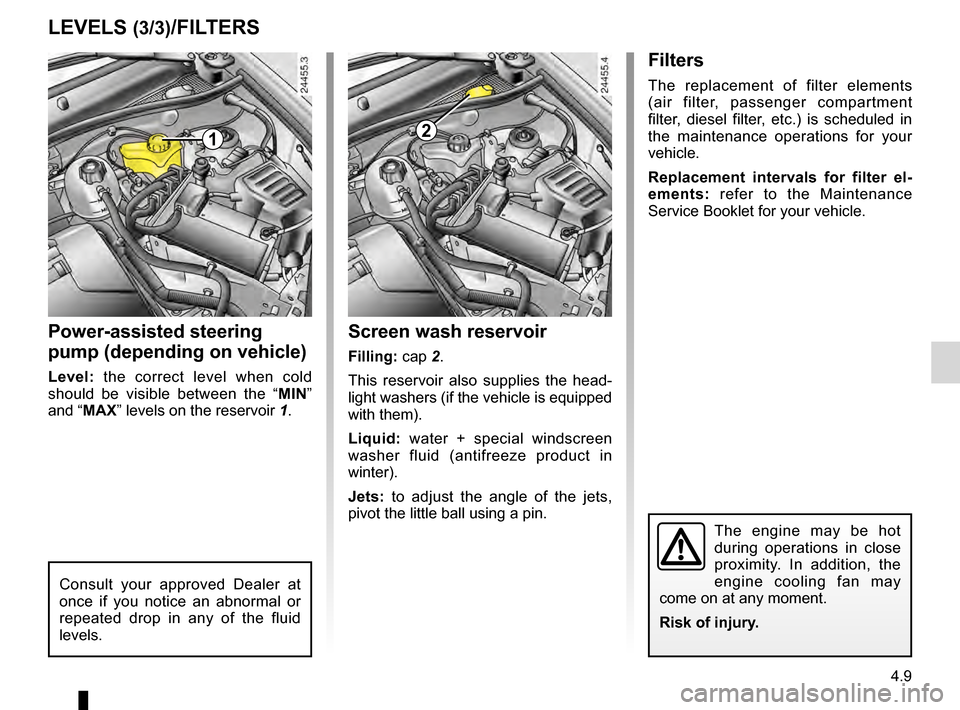
Power-assisted steering
pump (depending on vehicle)
Level: the correct level when cold
should be visible between the “ M In ”
and “MAX” levels on the reservoir 1.
1
Consult your approved Dealer at
once if you notice an abnormal or
repeated drop in any of the fluid
levels.
The engine may be hot
during operations in close
proximity. In addition, the
engine cooling fan may
come on at any moment.
Risk of injury.
2
Screen wash reservoir
Filling: cap 2.
This reservoir also supplies the head-
light washers (if the vehicle is equipped
with them).
Liquid: water + special windscreen
washer fluid (antifreeze product in
winter).
Jets: to adjust the angle of the jets,
pivot the little ball using a pin.
Filters
The replacement of filter elements
(air filter, passenger compartment
filter, diesel filter, etc.) is scheduled in
the maintenance operations for your
vehicle.
Replacement intervals for filter el-
ements: refer to the Maintenance
Service Booklet for your vehicle.
Page 109 of 173
maintenance:bodywork ........................................ (up to the end of the DU)
washing ................................................ (up to the end of the DU)
paintwork maintenance ................................... (up to the end of the DU)
anti-corrosion protection ........................................ (current page) 4.11
ENG_UD7309_1
Entretien de la carrosserie (X76 - Renault)
ENG_NU_854-2_X76LL_Renault_4
Bodywork maintenance
BOdywORk MAIntenAnCe (1/2)
– Use solvents not approved by our
Technical Department to remove
stains as this could damage the
paintwork.
–
Drive frequently in snow or muddy
conditions without washing the ve-
hicle, particularly under the wheel
arches and body.
y ou should not:
– Degrease or clean mechanical com-
ponents (eg. the engine compart-
ment), underneath the body, parts
with hinges (eg. inside the fuel flap)
and painted plastic external fittings
(eg. bumpers) using high-pressure
cleaning equipment or by spraying
on products not approved by our
Technical Department. If adequate
precautions are not taken, this could
give rise to corrosion or operational
faults.
–
Wash the vehicle in bright sunlight or
freezing temperatures.
–
Scrape off mud or dirt without pre -
wetting.
–
Allow dirt to accumulate.
– Allow rust to form following minor im -
pacts.
Protection against the effects
of corrosive agents
Although your vehicle has been treated
with very effective anti-corrosion prod-
ucts, it nevertheless remains subject to
the effects of:
–
corrosives in the atmosphere
– atmospheric pollution (urban and
industrial areas);
–
saline atmosphere (near the sea,
particularly in hot weather);
–
seasonal and damp climatic con -
ditions, (e.g.: road salt in winter,
water from road cleaners, etc.).
–
abrasives
Wind-borne dust and sand, mud,
road grit thrown up by other vehi-
cles, etc.
–
minor impacts
You should take a minimum number of
precautions in order to safeguard your
vehicle against such risks and not to
lose the benefit of your vehicle’s anti-
corrosion protection.
Page 110 of 173
4.12
ENG_UD7309_1
Entretien de la carrosserie (X76 - Renault)
ENG_NU_854-2_X76LL_Renault_4
BOdywORk MAIntenAnCe (2/2)
– Before going through a roller type
car wash, return the windscreen
wiper stalk to park position (refer to
the information on the “Windscreen
wash/wipe” in Section 1). Check the
mounting of external accessories,
additional lights, door mirrors, etc.,
and be sure to hold the wiper blades
and radio aerial in place with adhe-
sive tape.
Remove the radio aerial mast if your
vehicle is fitted with this equipment.
–
Spray mechanical components,
hinges, etc. with products approved
by our Technical Department to
protect them after they have been
cleaned.
We have selected special products
to care for your vehicle and you can
obtain these from the manufactur-
er’s accessory outlets.
– Observe the vehicle stopping dis-
tances when driving on gravelled
surfaces to prevent paint damage.
–
Repair, or have repaired quickly,
areas where the paint has been dam-
aged, to prevent corrosion spread-
ing.
–
Remember to visit the body shop
periodically if your vehicle has an
anti-corrosion warranty. Refer to the
Maintenance Service Booklet.
–
Respect local regulations about
washing vehicles (e.g. do not wash
your vehicle on a public highway).
y ou should
– Wash your car frequently, with the
engine off , with cleaning products
recommended by our Technical
Department (never use abrasive
products) and be sure to jet-rinse
off:
–
spots of tree resin and industrial
grime;
–
bird droppings, which cause
a chemical reaction with the
paint that rapidly discolours
paintwork and may even cause
the paint to peel off;
Wash the vehicle immediately to
remove these marks since it is im-
possible to remove them by pol-
ishing;
–
salt, particularly in the wheel
arches and underneath the body
after driving in areas where the
roads have been gritted;
–
mud in the wheel arches and un -
derneath the body which form
damp patches.
Page 111 of 173
maintenance:interior trim ...................................... (up to the end of the DU) 4.13
ENG_UD14593_2
Entretien des garnitures intérieures (X76 - Renault)
ENG_NU_854-2_X76LL_Renault_4
– Seat belts
These must be kept clean.
Use products selected by our
Technical Department (Approved
outlets) or warm, soapy water and a
sponge and wipe with a dry cloth.
d e
tergents or dyes must not be
used under any circumstances.
Interior trim maintenance
We have selected special products
to care for your vehicle and you can
obtain these from the manufactur-
er’s accessory outlets.
Whatever type of stain is on the trim,
use soapy water (if possible, warm wa-
ter) containing:
–
natural soap,
– washing up liquid (with one part
washing up liquid to 200 parts
water).
Rinse off with a soft, damp cloth.
Special features
–
g lass instrument panel (e.g.: in-
strument panel, clock, exterior tem-
perature display, radio display, etc.).
Use a soft cloth (or cotton wool).
If this does not clean it properly, use
a soft cloth (or cotton wool) slightly
moistened with soapy water and then
wipe clean with a soft damp cloth or
cotton wool.
Finally, carefully dry off with a soft
dry cloth.
Cleaning products containing al-
cohol must not be used under any
circumstances.
InteRIOR tRIM MAIntenAnCe
y ou should not:
You are strongly advised not to position
objects such as deodorants, scents, etc.
near air vents, as this could damage
your dashboard trim.
You are strongly recom-
mended not to use high-
pressure or spray cleaning
equipment inside the pas-
senger compartment: without care-
ful use, this equipment could impair
the correct functioning of the electri-
cal or electronic components in the
vehicle, or have other detrimental
effects.
Page 113 of 173

ENG_NU_854-2_X76LL_Renault_5
Section 5: Practical advice
Puncture . . . . . . . . . . . . . . . . . . . . . . . . . . . . . . . . . . . .\
. . . . . . .")
5.1
ENG_UD14022_2
Sommaire 5 (X76 - Renault)
ENG_NU_854-2_X76LL_Renault_5
Section 5: Practical advice
Puncture . . . . . . . . . . . . . . . . . . . . . . . . . . . . . . . . . . . .\
. . . . . . . . . . . . . . . . . . . . . . . . . . . . . . . . . . 5.2
Wheel trims . . . . . . . . . . . . . . . . . . . . . . . . . . . . . . . . . . . .\
. . . . . . . . . . . . . . . . . . . . . . . . . . . . . . . . 5.3
Changing a wheel . . . . . . . . . . . . . . . . . . . . . . . . . . . . . . . . . . . .\
. . . . . . . . . . . . . . . . . . . . . . . . . . . 5.4
Tyres . . . . . . . . . . . . . . . . . . . . . . . . . . . . . . . . . . . .\
. . . . . . . . . . . . . . . . . . . . . . . . . . . . . . . . . . . .\
. 5.5
Changing bulbs . . . . . . . . . . . . . . . . . . . . . . . . . . . . . . . . . . . .\
. . . . . . . . . . . . . . . . . . . . . . . . . . . . . 5.8
Front lights . . . . . . . . . . . . . . . . . . . . . . . . . . . . . . . . . . . . \
. . . . . . . . . . . . . . . . . . . . . . . . . . . 5.8
Fog lights . . . . . . . . . . . . . . . . . . . . . . . . . . . . . . . . . . . .\
. . . . . . . . . . . . . . . . . . . . . . . . . . . . 5.10
Rear lights: changing bulbs . . . . . . . . . . . . . . . . . . . . . . . . . . . . . . . . . . . . \
. . . . . . . . . . . . . . . . . . . . 5.1
1
Indicator lights . . . . . . . . . . . . . . . . . . . . . . . . . . . . . . . . . . . .\
. . . . . . . . . . . . . . . . . . . . . . . . 5.14
Interior lighting . . . . . . . . . . . . . . . . . . . . . . . . . . . . . . . . . . . .\
. . . . . . . . . . . . . . . . . . . . . . . . 5.15
Luggage compartment light . . . . . . . . . . . . . . . . . . . . . . . . . . . . . . . . . . . . \
. . . . . . . . . . . . . . . . . . . . 5.18
Battery: troubleshooting. . . . . . . . . . . . . . . . . . . . . . . . . . . . . . . . . . . . \
. . . . . . . . . . . . . . . . . . . . . . . 5.19
Fuses . . . . . . . . . . . . . . . . . . . . . . . . . . . . . . . . . . . . \
. . . . . . . . . . . . . . . . . . . . . . . . . . . . . . . . . . . . \
. 5.21
Wiper blades . . . . . . . . . . . . . . . . . . . . . . . . . . . . . . . . . . . .\
. . . . . . . . . . . . . . . . . . . . . . . . . . . . . . . 5.24
Towing: breakdown . . . . . . . . . . . . . . . . . . . . . . . . . . . . . . . . . . . .\
. . . . . . . . . . . . . . . . . . . . . . . . . . 5.26
Towing: towing equipment . . . . . . . . . . . . . . . . . . . . . . . . . . . . . . . . . . . . \
. . . . . . . . . . . . . . . . . . . . . 5.27
Fitting a radio . . . . . . . . . . . . . . . . . . . . . . . . . . . . . . . . . . . . \
. . . . . . . . . . . . . . . . . . . . . . . . . . . . . . . 5.28
Accessories . . . . . . . . . . . . . . . . . . . . . . . . . . . . . . . . . . . . \
. . . . . . . . . . . . . . . . . . . . . . . . . . . . . . . . 5.29
Fuel cut-off system in the event of a severe impact . . . . . . . . . . . . . . . . . . . . . . . . . . . . . . . . . . . .\
. 5.30
Radio frequency remote control: batteries. . . . . . . . . . . . . . . . . . . . . . . . . . . . . . . . . . . . \
. . . . . . . . . 5.31
Diesel filter . . . . . . . . . . . . . . . . . . . . . . . . . . . . . . . . . . . . \
. . . . . . . . . . . . . . . . . . . . . . . . . . . . . . . . . 5.32
Operating faults . . . . . . . . . . . . . . . . . . . . . . . . . . . . . . . . . . . . \
. . . . . . . . . . . . . . . . . . . . . . . . . . . . . 5.33
Page 116 of 173
changing a bulb .................................... (up to the end of the DU)
puncture................................................ (up to the end of the DU)
lifting the vehicle changing a wheel ............................ (up to the end of the DU)
5.4
ENG_UD7314_1
Changement de roue (X76 - Renault)
ENG_NU_854-2_X76LL_Renault_5
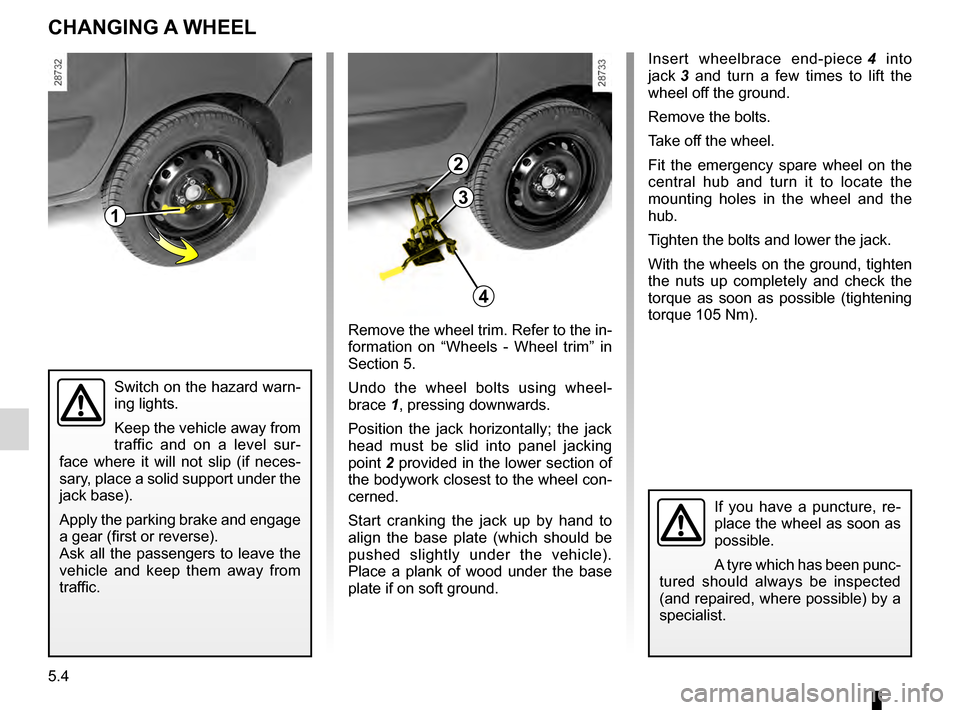
Insert wheelbrace end-piece 4 into
j
ack 3 and turn a few times to lift the
wheel off the ground.
Remove the bolts.
Take off the wheel.
Fit the emergency spare wheel on the
central hub and turn it to locate the
mounting holes in the wheel and the
hub.
Tighten the bolts and lower the jack.
With the wheels on the ground, tighten
the nuts up completely and check the
torque as soon as possible (tightening
torque 105 Nm).
Changing a wheel
If you have a puncture, re-
place the wheel as soon as
possible.
A tyre which has been punc-
tured should always be inspected
(and repaired, where possible) by a
specialist.
chAnging A WhEEl
1
2
4
3
Switch on the hazard warn-
ing lights.
Keep the vehicle away from
traffic and on a level sur-
face where it will not slip (if neces-
sary, place a solid support under the
jack base).
Apply the parking brake and engage
a gear (first or reverse).
Ask all the passengers to leave the
vehicle and keep them away from
traffic.
Remove the wheel trim. Refer to the in-
formation on “Wheels - Wheel trim” in
Section 5.
Undo the wheel bolts using wheel-
brace
1, pressing downwards.
Position the jack horizontally; the jack
head must be slid into panel jacking
point
2 provided in the lower section of
the bodywork closest to the wheel con-
cerned.
Start cranking the jack up by hand to
align the base plate (which should be
pushed slightly under the vehicle).
Place a plank of wood under the base
plate if on soft ground.
Page 120 of 173
bulbschanging ......................................... (up to the end of the DU)
changing a bulb .................................... (up to the end of the DU)
practical advice ..................................... (up to the end of the DU)
front lights changing bulbs ................................ (up to the end of the DU)
bulbs changing ......................................... (up to the end of the DU)
5.8
ENG_UD7316_1
Feux avant avec lampes halogènes : remplacement des lampes (X76 - Re\
nault)
ENG_NU_854-2_X76LL_Renault_5
Jaune NoirNoir texte
Changing bulbs
Front lights
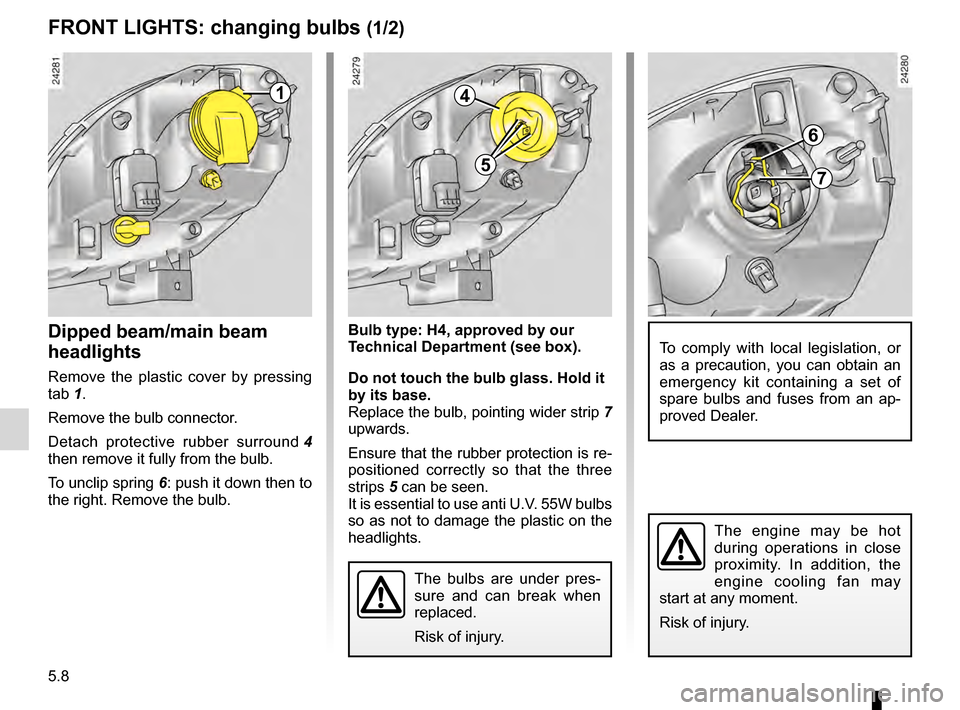
Bulb type: h4, approved by our
t echnical
Department (see box).
Do not touch the bulb glass. hold it
by
its base.
Replace the bulb, pointing wider strip 7
upwards.
Ensure that the rubber protection is re-
positioned correctly so that the three
strips
5 can be seen.
It is essential to use anti U.V. 55W bulbs
so as not to damage the plastic on the
headlights.
Dipped beam/main beam
headlights
Remove the plastic cover by pressing
tab
1.
Remove the bulb connector.
D
etach protective rubber surround 4
then remove it fully from the bulb.
T
o unclip spring 6: push it down then to
the right. Remove the bulb.
FrOnt lights : changing bulbs (1/2)
14
5
6
7
To comply with local legislation, or
as a precaution, you can obtain an
emergency kit containing a set of
spare bulbs and fuses from an ap-
proved Dealer.
The engine may be hot
during operations in close
proximity. In addition, the
engine cooling fan may
start at any moment.
Risk of injury.
The bulbs are under pres-
sure and can break when
replaced.
Risk of injury.