light RENAULT KANGOO 2016 X61 / 2.G Owner's Guide
[x] Cancel search | Manufacturer: RENAULT, Model Year: 2016, Model line: KANGOO, Model: RENAULT KANGOO 2016 X61 / 2.GPages: 173, PDF Size: 3.8 MB
Page 70 of 173

ENG_NU_854-2_X76LL_Renault_2
ADvIcE: antipollution, fuel economy and driving (3/3)
Advice on use
– Elec")
2.8
ENG_UD14000_2
Conseils antipollution, économies de carburant, conduite (X76 - Rena\
ult)
ENG_NU_854-2_X76LL_Renault_2
ADvIcE: antipollution, fuel economy and driving (3/3)
Advice on use
– Electricity is fuel; switch off all electri-
cal components which are not really
needed. h
owever (safety first), keep
your lights on when the visibility is
poor (“see and be seen”).
–
Use the air vents. Driving with the
windows open at 60 mph (100 km/h)
will increase fuel consumption by
4%. –
In vehicles fitted with air condi-
tioning , it is normal to observe an
increase in fuel consumption (es-
pecially in city conditions) when it is
used. For vehicles fitted with manual
air conditioning, switch off the system
when it is not required.
Some advice for reducing fuel
consumption and therefore helping
to protect the environment:
–
If the vehicle has been parked in the
sun, open the doors for a few mo-
ments to let the hot air escape before
starting the engine.
–
Never fill the fuel tank right to the
brim to avoid overflow.
–
Do not leave an empty roof rack
fitted to the vehicle.
–
It is better to fit a trailer for bulky ob -
jects.
–
When towing a caravan, fit an ap -
proved wind deflector and adjust it
carefully; –
Avoid using the vehicle for door -
to-door calls (short journeys with
long waits in between) because the
engine never reaches its normal op-
erating temperature.
t yres
– Inadequate pressures may increase
fuel consumption.
–
The use of non-recommended tyres
can increase fuel consumption.
Page 72 of 173
gear lever............................................................... (current page)
handbrake.............................................................. (current page)
power-assisted steering......................................... (current page)
2.10
ENG_UD13970_2
Levier vitesse / Frein main / Direction assistée (X76 - Renault)
ENG_NU_854-2_X76LL_Renault_2
Power-assisted steering
If you have power-assisted steering
fitted, do not leave the steering wheel
at full lock when the vehicle is parked
as this may damage the pump.1
Gear lever/Handbrake/Power-assisted steering
Gear lever
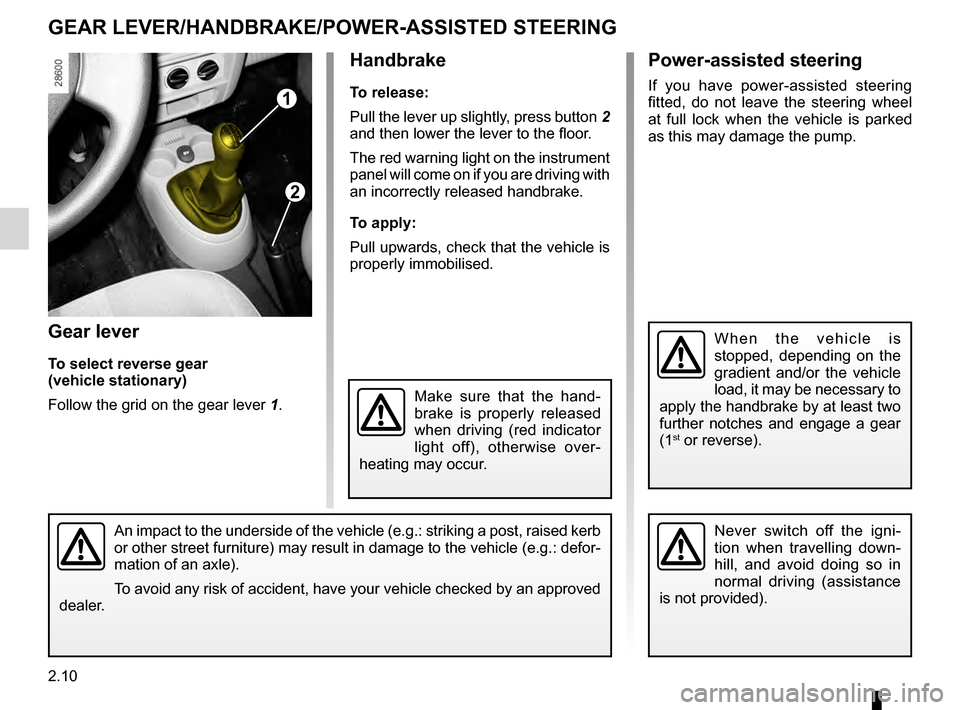
t o select reverse gear
(vehicle stationary)
Follow the grid on the gear lever
1.
GEAR lEvER/hANDBRAKE/PowER-ASSIStED StEERING
2
handbrake
t o release:
Pull the lever up slightly, press button 2
and then lower the lever to the floor.
The red warning light on the instrument
panel will come on if you are driving with
an incorrectly released handbrake.
t o apply:
Pull upwards, check that the vehicle is
properly immobilised.
Make sure that the hand-
brake is properly released
when driving (red indicator
light off), otherwise over-
heating may occur.
W h e n t h e v e h i c l e i s
stopped, depending on the
gradient and/or the vehicle
load, it may be necessary to
apply the handbrake by at least two
further notches and engage a gear
(1
st or reverse).
Never switch off the igni-
tion when travelling down-
hill, and avoid doing so in
normal driving (assistance
is not provided).An impact to the underside of the vehicle (e.g.: striking a post, raised kerb
or other street furniture) may result in damage to the vehicle (e.g.: defor-
mation of an axle).
To avoid any risk of accident, have your vehicle checked by an approved
dealer.
Page 73 of 173
ABS ...................................................... (up to the end of the DU)
anti-lock braking system: ABS .............. (up to the end of the DU) 2.11
ENG_UD7283_1
Système antiblocage des roues : ABS (X76 - Renault)
ENG_NU_854-2_X76LL_Renault_2
Anti-lock braking system
ANtI-locK BRAKING SyStEM: ABS
Depending on the vehicle, this is com-
posed of:
–
ABS (anti-lock braking system);
– emergency brake assist with, de -
pending on the vehicle, braking
anticipation;
These functions are an ad-
ditional aid in the event of
critical driving conditions,
enabling the vehicle behav-
iour to be adapted to suit the driving
conditions.
However, the functions do not take
the place of the driver. th
ey do
not increase the vehicle’s limits
and should not encourage you
to drive more quickly. Therefore,
they can under no circumstances
replace the vigilance or responsibil-
ity of the driver when manoeuvring
the vehicle (the driver must always
be ready for sudden incidents which
may occur when driving).
ABS (Anti-lock Braking
System)
Under heavy braking, the ABS prevents
the wheels from locking, allowing the
stopping distance to be managed and
keeping control of the vehicle.
Under these circumstances, the vehi-
cle can be steered to avoid an obstacle
whilst braking. In addition, this system
can increase stopping distances, par-
ticularly on roads with low surface grip
(wet ground etc.).
You will feel a pulsation through the
brake pedal each time the system is
activated. The ABS does not in any way
improve the vehicle’s physical perform-
ance relating to the road surface and
roadholding. It is still essential to follow
the rules of good driving practice (such
as driving at a safe distance from the
vehicle in front etc.).
In an emergency, apply firm and
continuous pressure to the brake
pedal. There is no need to pump
it repeatedly. The ABS will modu-
late the force applied in the braking
system.
operating faults:
– If the
x warning light on the in-
strument panel comes on while driv-
ing, braking is still operational ;
–
If the
x and D warning
lights on the instrument panel come
on when driving, this indicates a
fault with the braking system.
In such cases, the ABS and emergency
brake assist are also deactivated and,
depending on the vehicle, the mes-
sages “check ABS” and “check brak-
ing system” appear on the instrument
panel.
Consult an approved dealer.
Yo u r b r a k i n g s y s t e m s
are partially operational.
However, it is dangerous
to brake suddenly and
it is essential to stop immediately,
as soon as traffic conditions allow.
Contact an approved dealer.
Page 74 of 173
emergency brake assist........................ (up to the end of the DU)
emergency braking ............................... (up to the end of the DU)
2.12
ENG_UD7284_1
Assistance au freinage d urgence (X76 - Renault)
ENG_NU_854-2_X76LL_Renault_2
Emergency brake assist
EMERGENcy BRAKE ASSISt
Emergency brake assist
This is an additional system to ABS
which helps reduce vehicle stopping
distances.
o
perating principle
The system detects an emergency
braking situation. In this case, the brak-
ing assistance immediately develops
maximum power and may trigger ABS
regulation.
ABS braking is maintained as long as
the brake pedal is not released.
hazard warning lights
switching on
Depending on the vehicle, these may
light up in the event of sudden decel-
eration.
These functions are an ad-
ditional aid in the event of
critical driving conditions,
enabling the vehicle behav-
iour to be adapted to suit the driving
conditions.
However, the functions do not take
the place of the driver. th
ey do
not increase the vehicle’s limits
and should not encourage you
to drive more quickly. Therefore,
they can under no circumstances
replace the vigilance or responsibil-
ity of the driver when manoeuvring
the vehicle (the driver must always
be ready for sudden incidents which
may occur when driving).
Page 75 of 173

ENG_NU_854-2_X76LL_Renault_3
Section 3: Your comfort
Air vents. . . . . . . . . . . . . . . . . . . . . . . . . . . . . . . . . . . . \
. . . . . . . . . .")
3.1
ENG_UD14020_2
Sommaire 3 (X76 - Renault)
ENG_NU_854-2_X76LL_Renault_3
Section 3: Your comfort
Air vents. . . . . . . . . . . . . . . . . . . . . . . . . . . . . . . . . . . . \
. . . . . . . . . . . . . . . . . . . . . . . . . . . . . . . . . . . 3.2
Rear screen and windscreen de-icing and demisting . . . . . . . . . . . . . . . . . . . . . . . . . . . . . . . . . . . .\
3.4
Heating system/Ventilation . . . . . . . . . . . . . . . . . . . . . . . . . . . . . . . . . . . .\
. . . . . . . . . . . . . . . . . . . . 3.5
Air conditioning . . . . . . . . . . . . . . . . . . . . . . . . . . . . . . . . . . . .\
. . . . . . . . . . . . . . . . . . . . . . . . . . . . . 3.7
Interior lighting . . . . . . . . . . . . . . . . . . . . . . . . . . . . . . . . . . . . \
. . . . . . . . . . . . . . . . . . . . . . . . . . . . . . 3.12
Sun visor/Mirror/Windscreen . . . . . . . . . . . . . . . . . . . . . . . . . . . . . . . . . . . . \
. . . . . . . . . . . . . . . . . . . 3.13
Windows . . . . . . . . . . . . . . . . . . . . . . . . . . . . . . . . . . . .\
. . . . . . . . . . . . . . . . . . . . . . . . . . . . . . . . . . 3.14
Ashtrays/cigar lighter/accessories socket . . . . . . . . . . . . . . . . . . . . . . . . . . . . . . . . . . . .\
. . . . . . . . . 3.16
Rear bench seat . . . . . . . . . . . . . . . . . . . . . . . . . . . . . . . . . . . .\
. . . . . . . . . . . . . . . . . . . . . . . . . . . . 3.20
Transporting objects in the luggage compartment . . . . . . . . . . . . . . . . . . . . . . . . . . . . . . . . . . . .\
. . 3.22
Luggage compartment cover . . . . . . . . . . . . . . . . . . . . . . . . . . . . . . . . . . . . \
. . . . . . . . . . . . . . . . . . . 3.23
Luggage net. . . . . . . . . . . . . . . . . . . . . . . . . . . . . . . . . . . . \
. . . . . . . . . . . . . . . . . . . . . . . . . . . . . . . . 3.24
Page 78 of 173
rear screen de-icing/demisting ............. (up to the end of the DU)
windscreen de-icing/demisting ............. (up to the end of the DU)
3.4
ENG_UD7268_1
Dégivrage / Désembuage (X76 - Renault)
ENG_NU_854-2_X76LL_Renault_3
Rear screen and windscreen de-icing and demisting
Demisting the windscreen
and side windows
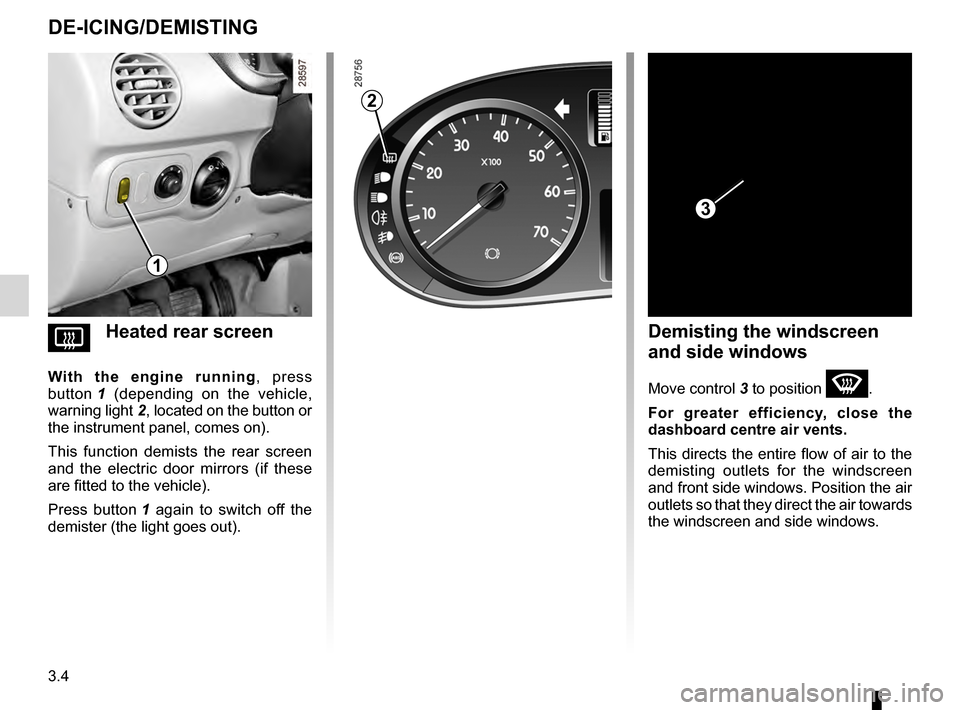
Move control 3 to position W.
For greater efficiency, close the
dashboard centre air vents.
This directs the entire flow of air to the
demisting outlets for the windscreen
and front side windows. Position the air
outlets so that they direct the air towards
the windscreen and side windows.
VHeated rear screen
With the engine running , press
b
utton 1 (depending on the vehicle,
warning
light 2, located on the button or
the instrument panel, comes on).
This function demists the rear screen
and the electric door mirrors (if these
are fitted to the vehicle).
P
ress button 1 again to switch off the
demister (the light goes out).
De-iCinG/DeMistinG
3
1
2
Page 80 of 173
3.6
ENG_UD14004_2
Chauffage - Ventilation (X76 - Renault)
ENG_NU_854-2_X76LL_Renault_3
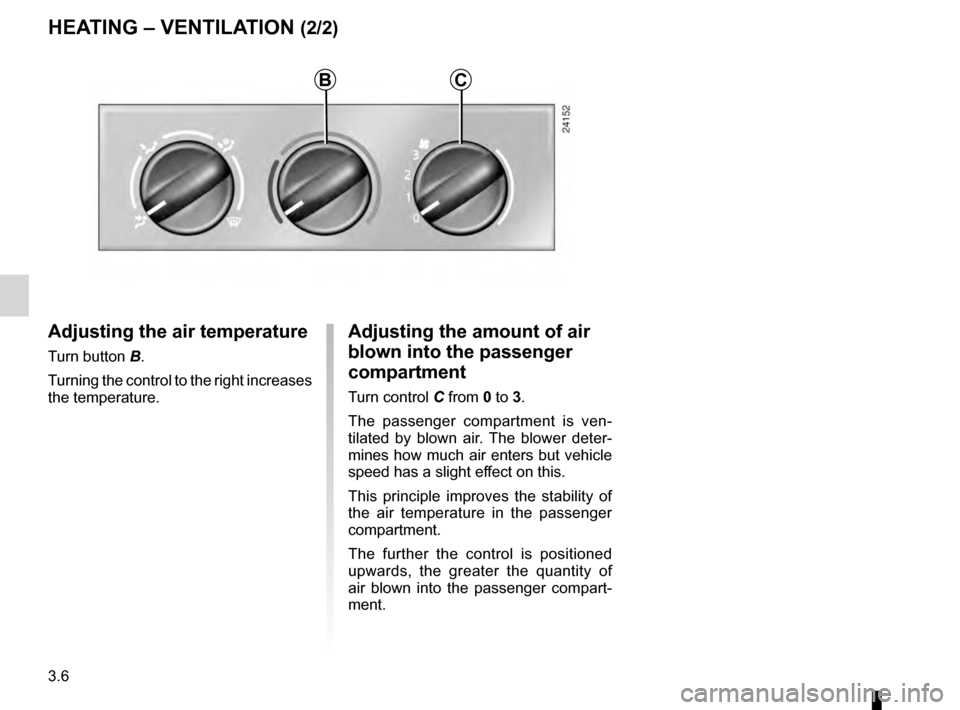
Adjusting the amount of air
blown into the passenger
compartment
Turn control C from 0 to 3.
The passenger compartment is ven-
tilated by blown air. The blower deter-
mines how much air enters but vehicle
speed has a slight effect on this.
This principle improves the stability of
the air temperature in the passenger
compartment.
The further the control is positioned
upwards, the greater the quantity of
air blown into the passenger compart-
ment.
Adjusting the air temperature
Turn button B.
Turning the control to the right increases
the temperature.
HeA tinG – ventiLA tiOn (2/2)
BC
Page 86 of 173
lighting:interior ............................................. (up to the end of the DU)
courtesy light ........................................ (up to the end of the DU)
map reading lights ................................ (up to the end of the DU)
3.12
ENG_UD7292_1
Eclairage intérieur (X76 - Renault)
ENG_NU_854-2_X76LL_Renault_3
Interior lighting
special features
Depending on the vehicle, remote un-
locking of the doors triggers timed light-
ing of the passenger compartment. If
one of the front or rear doors is opened,
the period for which the light is switched
on will start again.
Then the courtesy light and the luggage
compartment light dim and go out.
The lighting timer will cut out for vari-
ous reasons:
–
if a door has been open for 15 min -
utes;
–
if all the doors have been closed for
15 seconds:
–
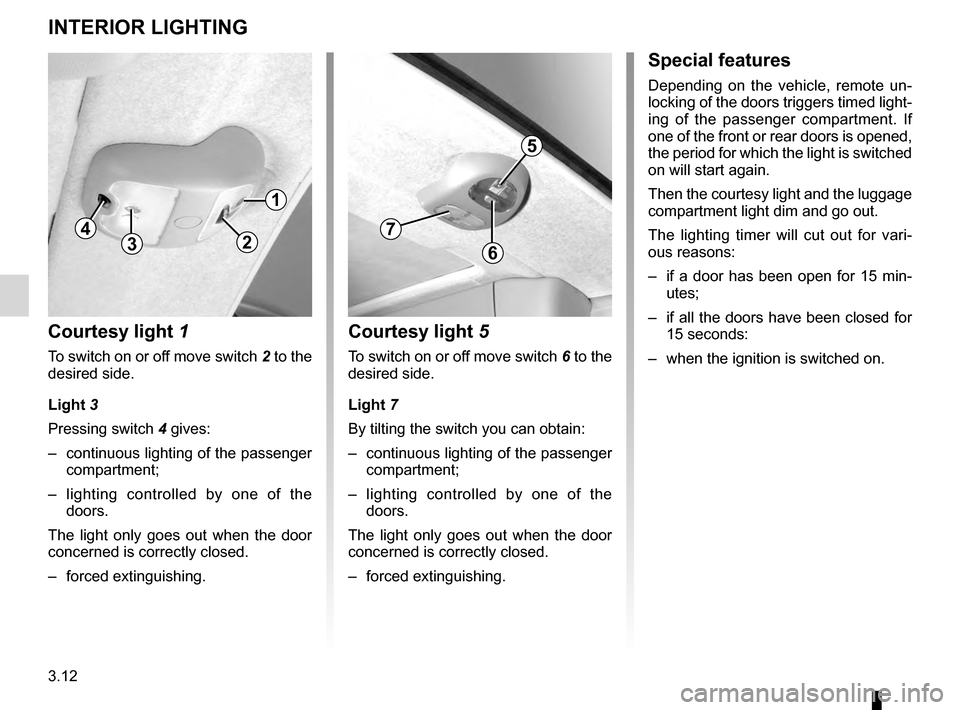
when the ignition is switched on.Courtesy light 5
To switch on or off move switch 6 to the
desired side.
Light
7
By tilting the switch you can obtain:
–
continuous lighting of the passenger
compartment;
–
lighting controlled by one of the
doors.
The light only goes out when the door
concerned is correctly closed.
–
forced extinguishing.
Courtesy light 1
To switch on or off move switch 2 to the
desired side.
Light
3
Pressing switch
4 gives:
–
continuous lighting of the passenger
compartment;
–
lighting controlled by one of the
doors.
The light only goes out when the door
concerned is correctly closed.
–
forced extinguishing.
interiOr LiGHtinG
432
1
5
6
7
Page 90 of 173
cigar lighter ........................................... (up to the end of the DU)
ashtrays ................................................ (up to the end of the DU)
3.16
ENG_UD14028_2
Cendriers - Allume-cigares (X76 - Renault)
ENG_NU_854-2_X76LL_Renault_3
Ashtrays/cigar lighter/accessories socket
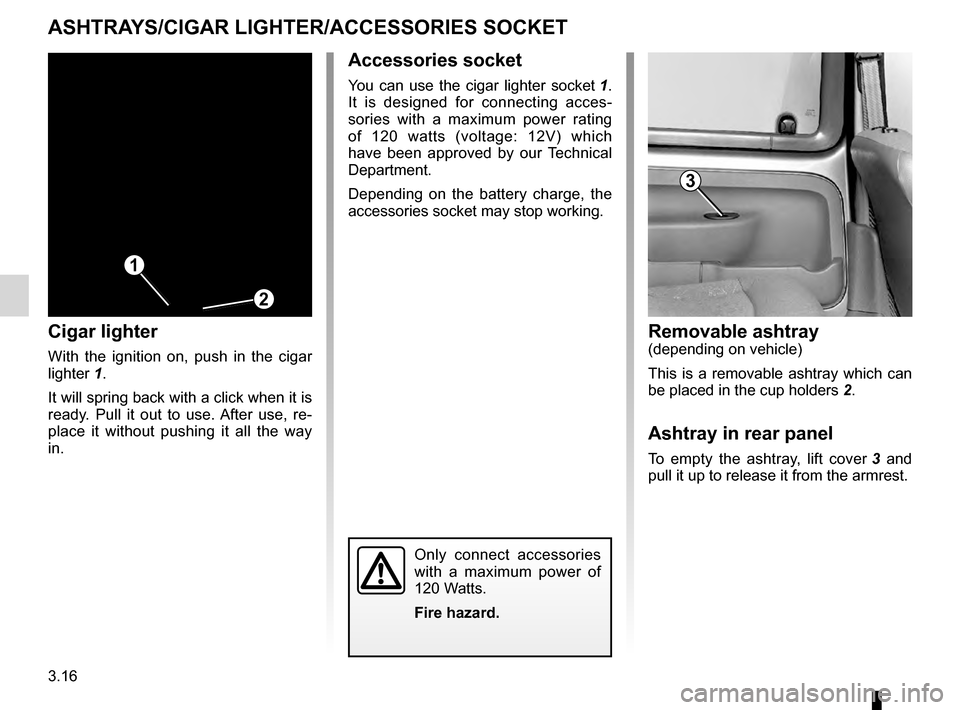
Cigar lighter
With the ignition on, push in the cigar
lighter
1.
It will spring back with a click when it is
ready. Pull it out to use. After use, re-
place it without pushing it all the way
in.
AsHtrA ys/CiGAr LiGHter/ACCessOries sOCket
2
1
3
removable ashtray(depending on vehicle)
This is a removable ashtray which can
be placed in the cup holders
2.
Ashtray in rear panel
To empty the ashtray, lift cover 3 and
pull it up to release it from the armrest.
Accessories socket
You can use the cigar lighter socket 1.
It is designed for connecting acces-
sories with a maximum power rating
of 120 watts (voltage: 12V) which
have been approved by our Technical
Department.
Depending on the battery charge, the
accessories socket may stop working.
Only connect accessories
with a maximum power of
120 Watts.
Fire hazard.
Page 94 of 173
rear bench seat..................................... (up to the end of the DU)
rear seatsfunctions ......................................... (up to the end of the DU)
3.20
ENG_UD7301_1
Banquette arrière : fonctionnalité (X76 - Renault)
ENG_NU_854-2_X76LL_Renault_3
Jaune NoirNoir texte
Rear bench seat
We would advise you to move the front
seats forward slightly to make it easier
to fold the seatback with the headrests
in position.
Make sure the headrests are in the cor-
rect position when the seat is returned
to its upright position.
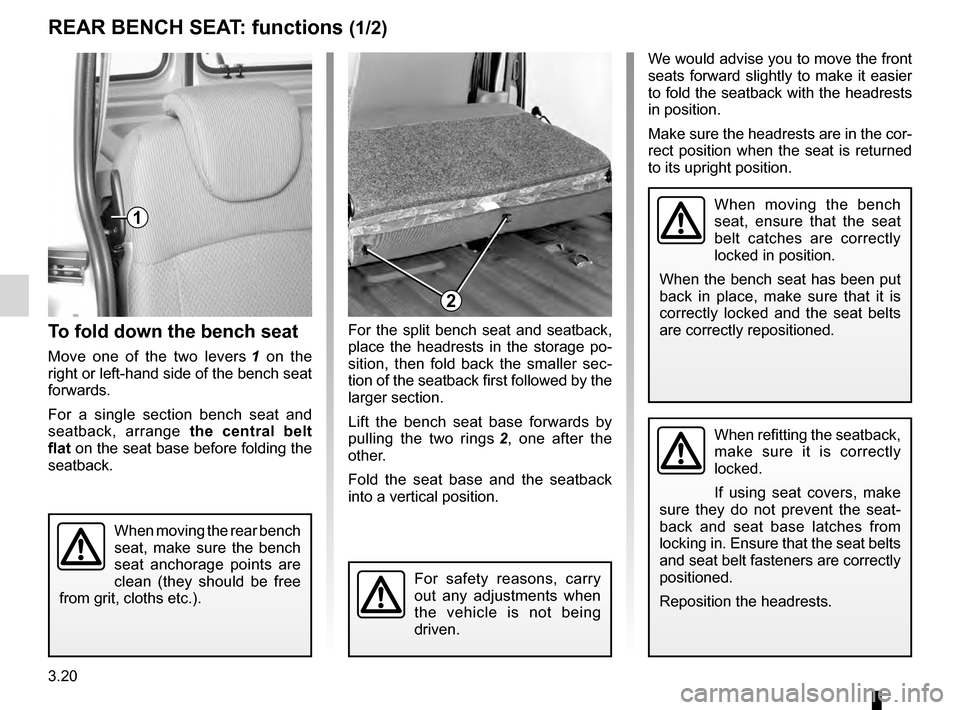
For the split bench seat and seatback,
place the headrests in the storage po-
sition, then fold back the smaller sec-
tion of the seatback first followed by the
larger section.
Lift the bench seat base forwards by
p
ulling the two rings 2 , one after the
other.
Fold the seat base and the seatback
into a vertical position.
t o fold down the bench seat
Move one of the two levers 1 on the
right or left-hand side of the bench seat
forwards.
For a single section bench seat and
seatback, arrange the central belt
flat on the seat base before folding the
seatback.
reAr BenCH seA t: functions (1/2)
1
2
For safety reasons, carry
out any adjustments when
the vehicle is not being
driven.
When moving the bench
seat, ensure that the seat
belt catches are correctly
locked in position.
When the bench seat has been put
back in place, make sure that it is
correctly locked and the seat belts
are correctly repositioned.
When moving the rear bench
seat, make sure the bench
seat anchorage points are
clean (they should be free
from grit, cloths etc.).
When refitting the seatback,
make sure it is correctly
locked.
If using seat covers, make
sure they do not prevent the seat-
back and seat base latches from
locking in. Ensure that the seat belts
and seat belt fasteners are correctly
positioned.
Reposition the headrests.