warning SAAB 9-3 2003 Owner's Manual
[x] Cancel search | Manufacturer: SAAB, Model Year: 2003, Model line: 9-3, Model: SAAB 9-3 2003Pages: 256, PDF Size: 21.66 MB
Page 31 of 256
31 Safety
Head protectionThe pillar trim and headlining are designed
to absorb energy, softening possible blows
to the head. After a crash, these items must
be changed in the seat positions that were
occupied. Never fit accessories to the pillar
trim or headlining as these could reduce the
effectiveness of the head protection and
inflatable curtain.
Side airbags
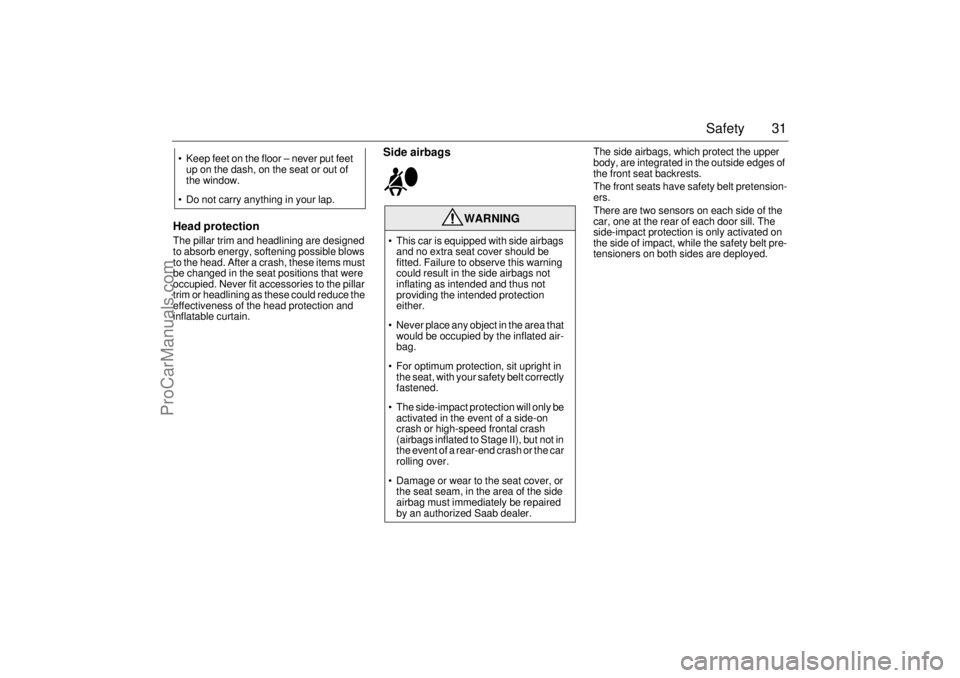
The side airbags, which protect the upper
body, are integrated in the outside edges of
the front seat backrests.
The front seats have safety belt pretension-
ers.
There are two sensors on each side of the
car, one at the rear of each door sill. The
side-impact protection is only activated on
the side of impact, while the safety belt pre-
tensioners on both sides are deployed. Keep feet on the floor – never put feet
up on the dash, on the seat or out of
the window.
Do not carry anything in your lap.
WARNING
This car is equipped with side airbags
and no extra seat cover should be
fitted. Failure to observe this warning
could result in the side airbags not
inflating as intended and thus not
providing the intended protection
either.
Never place any object in the area that
would be occupied by the inflated air-
bag.
For optimum protection, sit upright in
the seat, with your safety belt correctly
fastened.
The side-impact protection will only be
activated in the event of a side-on
crash or high-speed frontal crash
(airbags inflated to Stage II), but not in
the event of a rear-end crash or the car
rolling over.
Damage or wear to the seat cover, or
the seat seam, in the area of the side
airbag must immediately be repaired
by an authorized Saab dealer.
ProCarManuals.com
Page 32 of 256
32 Safety
Inflatable curtains
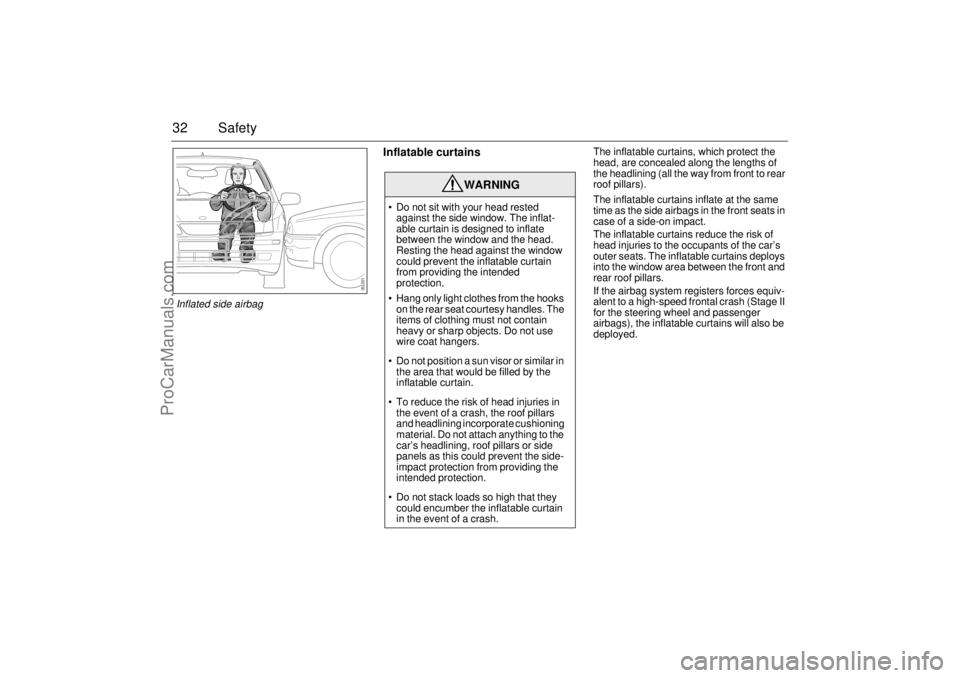
The inflatable curtains, which protect the
head, are concealed along the lengths of
the headlining (all the way from front to rear
roof pillars).
The inflatable curtains inflate at the same
time as the side airbags in the front seats in
case of a side-on impact.
The inflatable curtains reduce the risk of
head injuries to the occupants of the car’s
outer seats. The inflatable curtains deploys
into the window area between the front and
rear roof pillars.
If the airbag system registers forces equiv-
alent to a high-speed frontal crash (Stage II
for the steering wheel and passenger
airbags), the inflatable curtains will also be
deployed.
WARNING
Do not sit with your head rested
against the side window. The inflat-
able curtain is designed to inflate
between the window and the head.
Resting the head against the window
could prevent the inflatable curtain
from providing the intended
protection.
Hang only light clothes from the hooks
on the rear seat courtesy handles. The
items of clothing must not contain
heavy or sharp objects. Do not use
wire coat hangers.
Do not position a sun visor or similar in
the area that would be filled by the
inflatable curtain.
To reduce the risk of head injuries in
the event of a crash, the roof pillars
and headlining incorporate cushioning
material. Do not attach anything to the
car’s headlining, roof pillars or side
panels as this could prevent the side-
impact protection from providing the
intended protection.
Do not stack loads so high that they
could encumber the inflatable curtain
in the event of a crash.
Inflated side airbag
ProCarManuals.com
Page 34 of 256

34 SafetyAirbag warning lamp Crash sensing
Crash sensing and diagnostic modules
have been used in automobiles since air-
bags were first produced. The technical
information gained from these modules can
be useful to understanding the circum-
stances that led to the airbag deployment. In
addition, information from many field events
can be used in the aggregate to help manu-
facturers and others better understand real
world crashes. This, in turn, can lead to
improved automotive safety.
Your vehicle is equipped with two electronic
frontal sensors, which helps the sensing
system distinguish between a moderate
frontal impact and a more severe frontal
impact. Your vehicle is also equipped with a
crash sensing and diagnostic module,
which records information about the frontal
airbag system. The module records infor-
mation about the readiness of the system,
when the system commands airbag inflation
and driver’s safety belt usage at deployment
or in a near-deployment crash. The module
also records speed, engine rpm, brake and
throttle data etc.
Servicing the airbag systemThe airbag system must be inspected as
part of the normal service program but oth-
erwise may be regarded as maintenance-
free.
WARNING
If the airbag readiness light stays on
after you start your vehicle, it means
the airbag system may not be working
properly. See page 57.
The airbags in your vehicle may not
inflate in a crash, or they could even
inflate without a crash.
To help avoid injury to yourself or
others, have your vehicle serviced
right away if the airbag readiness light
stays on after you start your vehicle.
ProCarManuals.com
Page 35 of 256

35 Safety
Scrapping or working on airbag and
belt pretensionersFrequently asked questions on
function of the airbag
Do you still need to wear a safety belt if air-
bags are fitted?Yes, always! The airbag system compo-
nents merely supplement the car’s normal
safety system. Moreover, the front airbags
will only be actuated in a moderate to severe
frontal, or near-frontal crash, which means,
of course, that they provide no protection in
minor frontal crashes, major rear- or side-
crashes or if the car rolls over.
The safety belts help to reduce the sideway
movement of the body in a crash.
But they also ensure that, if a crash occurs
in which the airbags are inflated, the airbag
will make the optimum contact with the
occupant, i.e. square on from the front. If the
occupant meets the airbag in an offset posi-
tion, the protection afforded will be reduced.In addition, airbags provide no protection
against a secondary impact occurring in the
same incident. So there is no doubt about
the benefit of wearing safety belts at all
times.
Do not sit too close to the airbag: it needs
room to inflate.
The airbag inflates very quickly and power-
fully in order to protect an adult , before they
are thrown forward, in a serious frontal
crash.
How do I position the seat to leave room for
the airbag to inflate?Don’t have your seat too far forward.
Recline the seat back to increase the dis-
tance between you and the airbag. For short
drivers, special accessory pedal extensions
are available through your Saab dealer.
Airbags inflate extremely rapidly and with
great force – to be fast enough to protect an
adult in the seat.
WARNING
Under no circumstances should any
modifications be made that affect the
steering wheel or the airbag’s electri-
cal circuitry.
During any welding, both battery
cables must be disconnected and
covered.
Before quick drying paint in the vicinity
of the electronic control module, the
module’s grounding points and wiring
must be covered.
Airbags and safety belt pretensioners
must be deployed under controlled
conditions before the car is scrapped
or any of the system’s components are
removed. Airbags or belt pretension-
ers that have been deployed as a
result of a crash must be replaced by
new ones.
Airbag-system components must
never be transferred for use in another
vehicle.
All work involving the scrapping or
replacement of airbags or belt preten-
sioners must be carried out by autho-
rized personnel only.
ProCarManuals.com
Page 36 of 256

36 SafetyWhen do the airbags in the steering wheel
and passenger side of the dash board
inflate? The airbag will only be inflated under certain
predetermined conditions in a moderate to
severe frontal, or near-frontal crash,
depending on such factors as the force and
angle of the impact, the speed of the car on
impact, and the resistance to deformation of
the impacting object.
The airbag can only be activated once in the
same incident.
Do not attempt to drive the car after an
airbag has been inflated, even if it is possi-
ble.What won’t trigger the airbag? The airbag will not be activated in all frontal
crashes. For instance, if the car has hit
something relatively soft and yielding (e.g. a
snow drift or a hedge) or a solid object at a
low impact speed, the airbag will not neces-
sarily be triggered.
How loud is the inflation? The noise of the inflation is certainly loud,
but it is of an very short duration and will not
damage your hearing. For a short time after-
wards you could experience a buzzing
noise in your ears.
Most people who have experienced it
cannot remember the noise of the inflation
at all – all they remember is the noise of the
crash. Can you still use a child seat in the front if a
passenger airbag is installed? Definitely not!
Children 12 and under or shorter
than55 inches (140 cn) can be killed by the
airbag.
The back seat is the safest place for chil-
dren.
Never put a rear-facing child seat in the
front.
Sit as far back as possible from the air bag.
Always use seat belts and child restraints.
What should I do if the AIR-BAG warning
light comes on? If the warning light is on, it means that a fault
has been detected in the system. The
airbag cannot be relied on to operate as
intended and it might even be activated
erroneously. You should therefore take the
car to an authorized Saab dealer as soon as
possible.Are the dust and fumes given off when the
airbag operates at all harmful? Most people who have remained in a car
with little or no ventilation for several min-
utes complained only of minor irritation of
the throat and eyes. Avoid as much as pos-
sible getting dust on your skin as there is a
risk of skin irritation.
If you suffer from asthma, the incident may
bring on an attack, in which case you should
follow the normal procedure advised by
your doctor. It is advisable to consult a
doctor afterwards.
ProCarManuals.com
Page 38 of 256
38 SecurityDoorsOpen the door by lifting the door handle.
The following message appears on the
Saab Information Display (SID) if a door is
not closed (text displayed first when vehicle
speed exceeds 15 mph (25 km/h) and the
door has still not been closed):
Central lockingRemote controlThe remote control and ignition key are inte-
grated in one unit, and referred to in this
manual as the remote control.
The remote control contains a mechanical
key, referred to in this manual as the tradi-
tional key. This traditional key can be used
in an emergency to lock or unlock the
driver’s door from outside (see page 40).
This key does not fit the ignition switch.A key code number is supplied with your
car. This number needs to be quoted for
ordering a new traditional key (contained in
the remote control). Therefore, keep this
number in a safe place.
The remote control contains an electronic
code that is unique to your car. When the
remote control is inserted into the ignition
switch, this code is checked. If the code is
incorrect, the car will not start.
The car is supplied with two remote con-
trols. It is possible to have up to five remote
controls programmed for the car at any one
time. If one is lost, a replacement should be
obtained as soon as possible. Contact your
Saab dealer. When a new key is pro-
grammed into the car, the lost key will be
deprogrammed automatically.
Note:
If a new remote control has to be ordered
and programmed, at least one old one is
required for the locking system’s electronic
unit to recognize the new (ordered) remote
control.
Once the new remote control has been pro-
grammed, the old unit that is lost will not
work. Therefore you should carry two
remote controls separately, especially on
long journeys. Close doors.
WARNING
Leaving children or pets unattended in a
locked car is dangerous. It is also danger-
ous to leave children in a vehicle with the
ignition key. A child or others could be
badly injured or even killed.
ProCarManuals.com
Page 40 of 256
40 SecurityLocking/unlocking the carRemote locking and unlocking also control
the car alarm.
Remote locking
Press the button once: all doors and
the trunk lid locked.
The hazard warning lights will flash once to
confirm.
The car will be locked automatically
3 minutes after it is unlocked unless a door
or the trunk lid is opened.Remote unlocking
Pressing the button once: the driver´s
door and the fuel filler door is unlocked.
Press a second time to unlock the rest of the
doors and enable the trunk lid switch.
The hazard warning lights will flash twice to
confirm.
If a fault arises in the locking system, the
Saab Information Display (SID) will display:
Saab Information Display (SID), see page
64.
Intermittent malfunctioning
Equipment in the vicinity of the car that uses
the same frequency as the remote control
may cause interference to the remote con-
trol signal. In this case, retry from another
angle and aim at the receiver located by the
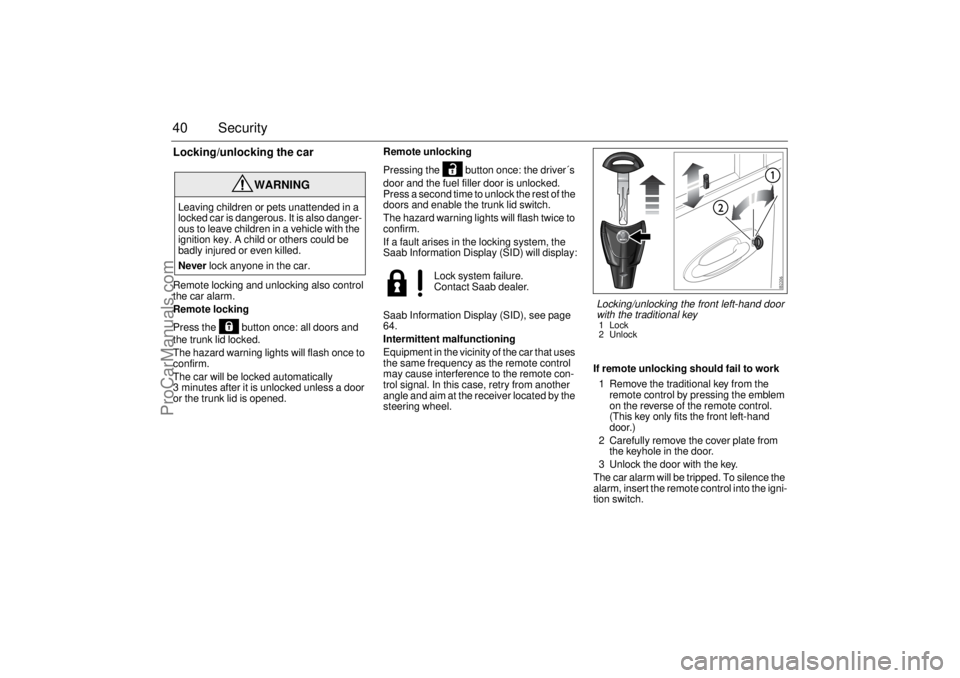
steering wheel.If remote unlocking should fail to work
1 Remove the traditional key from the
remote control by pressing the emblem
on the reverse of the remote control.
(This key only fits the front left-hand
door.)
2 Carefully remove the cover plate from
the keyhole in the door.
3 Unlock the door with the key.
The car alarm will be tripped. To silence the
alarm, insert the remote control into the igni-
tion switch.
WARNING
Leaving children or pets unattended in a
locked car is dangerous. It is also danger-
ous to leave children in a vehicle with the
ignition key. A child or others could be
badly injured or even killed.
Never lock anyone in the car.
Lock system failure.
Contact Saab dealer.
Locking/unlocking the front left-hand door
with the traditional key1 Lock
2 Unlock
ProCarManuals.com
Page 41 of 256
41 Security
Locking a car with dead batteryThe steering wheel lock requires sufficient
battery voltage to lock and unlock. If the bat-
tery voltage drops below a certain level
while the remote control is in the ignition
switch, you will not be able to remove the
remote control.
If you must leave the car, proceed as
follows:
1 Lock the car by pressing down the lock
buttons on the doors.
2 Lock the front left door from outside with
the traditional key (see page 40). The
car is now locked but the car alarm will
remain inactive.
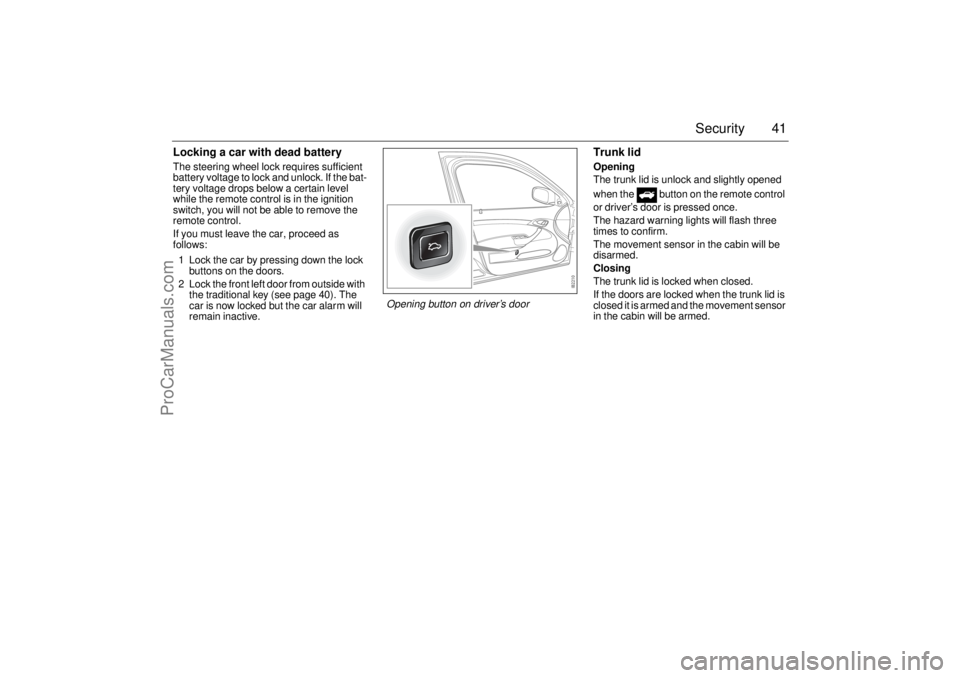
Trunk lidOpening
The trunk lid is unlock and slightly opened
when the button on the remote control
or driver’s door is pressed once.
The hazard warning lights will flash three
times to confirm.
The movement sensor in the cabin will be
disarmed.
Closing
The trunk lid is locked when closed.
If the doors are locked when the trunk lid is
closed it is armed and the movement sensor
in the cabin will be armed.
Opening button on driver’s door
ProCarManuals.com
Page 42 of 256
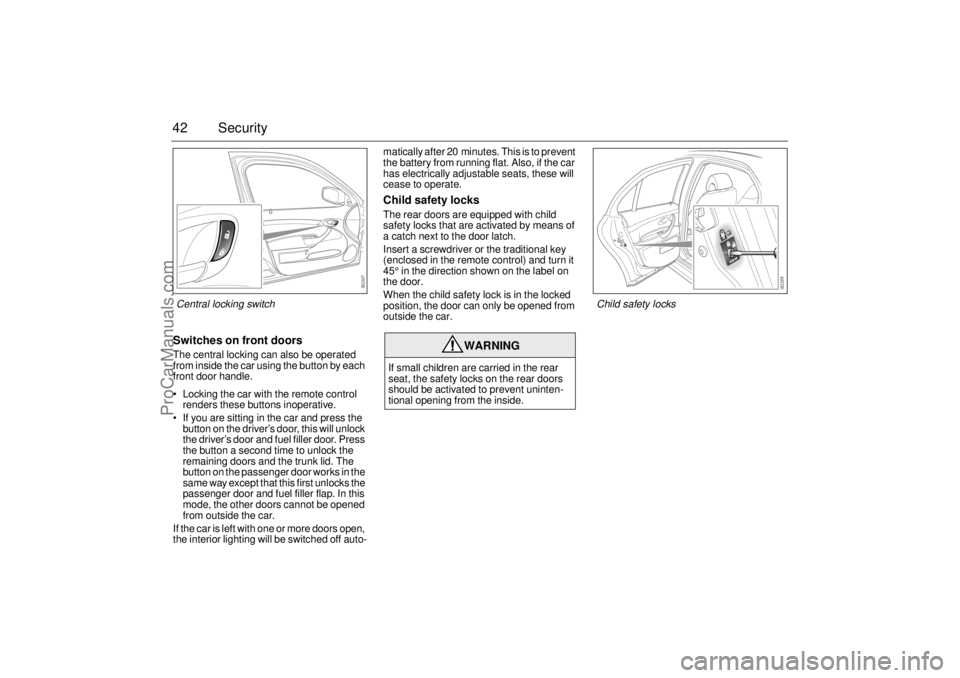
42 SecuritySwitches on front doorsThe central locking can also be operated
from inside the car using the button by each
front door handle.
Locking the car with the remote control
renders these buttons inoperative.
If you are sitting in the car and press the
button on the driver’s door, this will unlock
the driver’s door and fuel filler door. Press
the button a second time to unlock the
remaining doors and the trunk lid. The
button on the passenger door works in the
same way except that this first unlocks the
passenger door and fuel filler flap. In this
mode, the other doors cannot be opened
from outside the car.
If the car is left with one or more doors open,
the interior lighting will be switched off auto-matically after 20 minutes. This is to prevent
the battery from running flat. Also, if the car
has electrically adjustable seats, these will
cease to operate.
Child safety locksThe rear doors are equipped with child
safety locks that are activated by means of
a catch next to the door latch.
Insert a screwdriver or the traditional key
(enclosed in the remote control) and turn it
45° in the direction shown on the label on
the door.
When the child safety lock is in the locked
position, the door can only be opened from
outside the car.
WARNING
If small children are carried in the rear
seat, the safety locks on the rear doors
should be activated to prevent uninten-
tional opening from the inside.
Child safety locks
Central locking switch
ProCarManuals.com
Page 44 of 256
44 SecurityChanging the key battery
When the voltage of the remote control
battery drops below a certain level, the
Saab Information Display (SID) will display:
Change the battery as soon as possible to
avoid malfunctioning.
Battery type: Panasonic CR2032,
3V Lithium.
The battery should last for about 4 years of
normal use.
The battery type is marked on the inside of
the remote control. Avoid leaving finger-
prints on the faces of the battery.
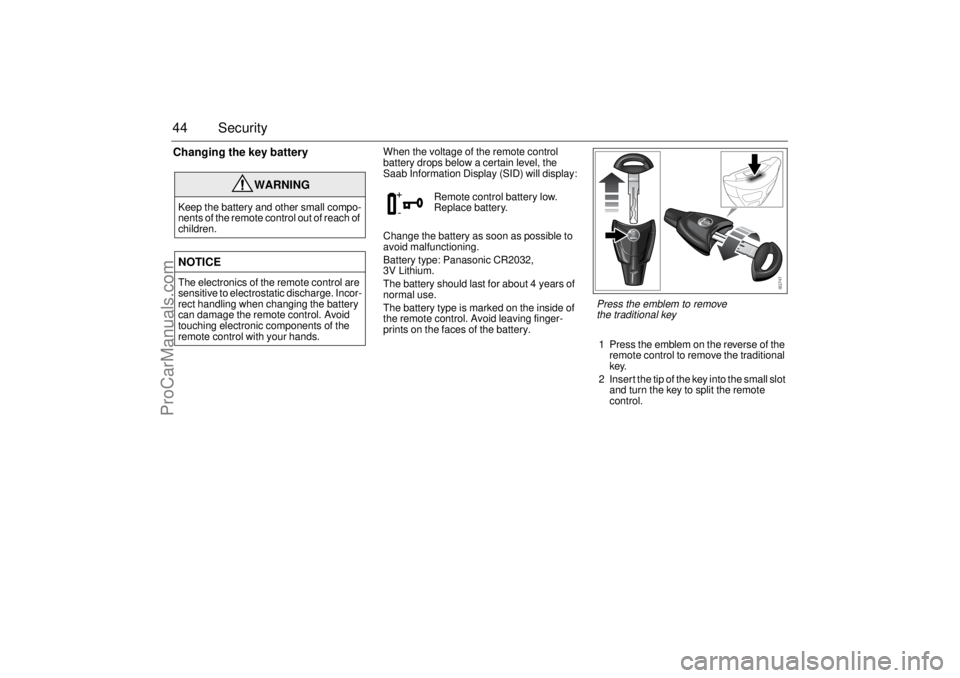
1 Press the emblem on the reverse of the
remote control to remove the traditional
key.
2 Insert the tip of the key into the small slot
and turn the key to split the remote
control.
WARNING
Keep the battery and other small compo-
nents of the remote control out of reach of
children.NOTICEThe electronics of the remote control are
sensitive to electrostatic discharge. Incor-
rect handling when changing the battery
can damage the remote control. Avoid
touching electronic components of the
remote control with your hands.
Remote control battery low.
Replace battery.
Press the emblem to remove
the traditional key
ProCarManuals.com