page 74 SAAB 9-3 2005 Owners Manual
[x] Cancel search | Manufacturer: SAAB, Model Year: 2005, Model line: 9-3, Model: SAAB 9-3 2005Pages: 292, PDF Size: 23 MB
Page 4 of 292
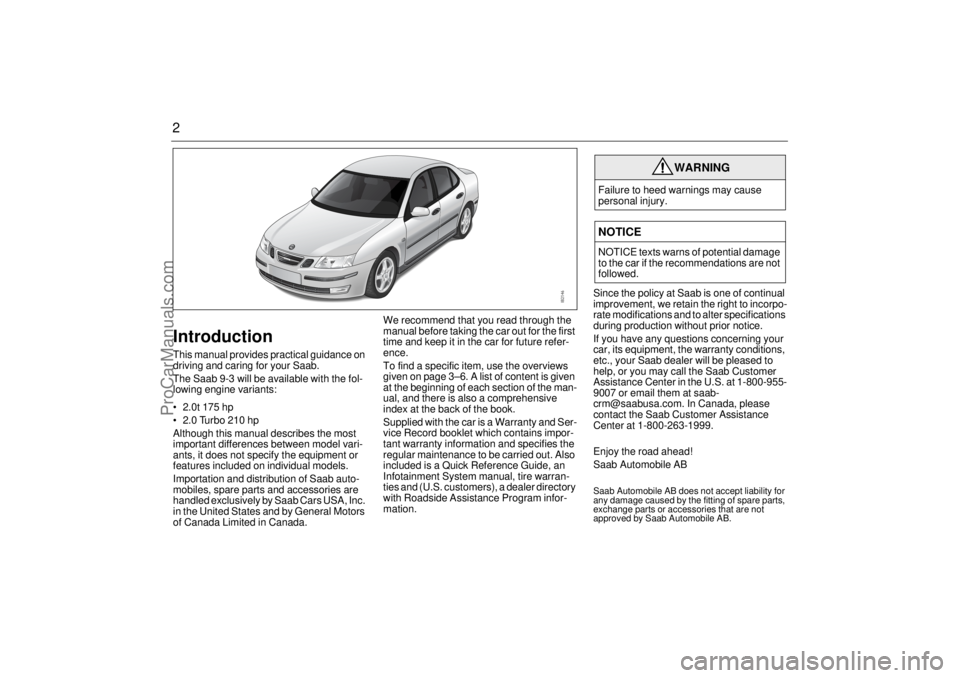
2IntroductionThis manual provides practical guidance on
driving and caring for your Saab.
The Saab 9-3 will be available with the fol-
lowing engine variants:
2.0t 175 hp
2.0 Turbo 210 hp
Although this manual describes the most
important differences between model vari-
ants, it does not specify the equipment or
features included on individual models.
Importation and distribution of Saab auto-
mobiles, spare parts and accessories are
handled exclusively by Saab Cars USA, Inc.
in the United States and by General Motors
of Canada Limited in Canada.We recommend that you read through the
manual before taking the car out for the first
time and keep it in the car for future refer-
ence.
To find a specific item, use the overviews
given on page 3–6. A list of content is given
at the beginning of each section of the man-
ual, and there is also a comprehensive
index at the back of the book.
Supplied with the car is a Warranty and Ser-
vice Record booklet which contains impor-
tant warranty information and specifies the
regular maintenance to be carried out. Also
included is a Quick Reference Guide, an
Infotainment System manual, tire warran-
ties and (U.S. customers), a dealer directory
with Roadside Assistance Program infor-
mation.Since the policy at Saab is one of continual
improvement, we retain the right to incorpo-
rate modifications and to alter specifications
during production without prior notice.
If you have any questions concerning your
car, its equipment, the warranty conditions,
etc., your Saab dealer will be pleased to
help, or you may call the Saab Customer
Assistance Center in the U.S. at 1-800-955-
9007 or email them at saab-
[email protected]. In Canada, please
contact the Saab Customer Assistance
Center at 1-800-263-1999.
Enjoy the road ahead!
Saab Automobile AB
Saab Automobile AB does not accept liability for
any damage caused by the fitting of spare parts,
exchange parts or accessories that are not
approved by Saab Automobile AB.
WARNING
Failure to heed warnings may cause
personal injury.NOTICENOTICE texts warns of potential damage
to the car if the recommendations are not
followed.
ProCarManuals.com
Page 12 of 292

10(This page has been left blank.)
ProCarManuals.com
Page 14 of 292
12 SafetySafety belts
Three-point inertia-reel safety belts are
provided for all seats.
The results of studies show that it is equally
important to wear safety belts in the rear
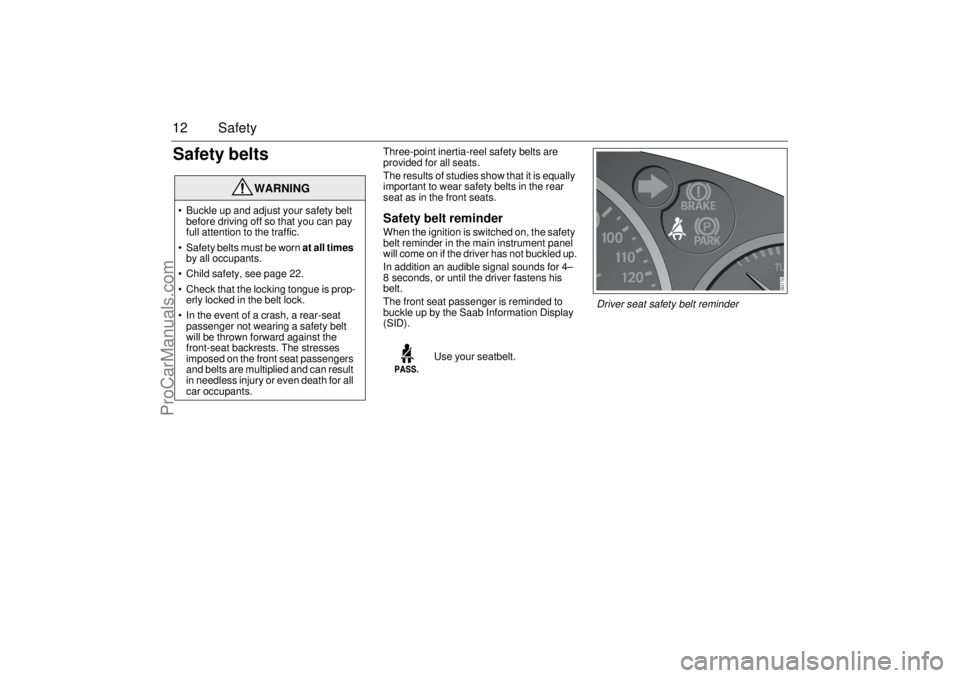
seat as in the front seats.Safety belt reminderWhen the ignition is switched on, the safety
belt reminder in the main instrument panel
will come on if the driver has not buckled up.
In addition an audible signal sounds for 4–
8 seconds, or until the driver fastens his
belt.
The front seat passenger is reminded to
buckle up by the Saab Information Display
(SID).
WARNING
Buckle up and adjust your safety belt
before driving off so that you can pay
full attention to the traffic.
Safety belts must be worn at all times
by all occupants.
Child safety, see page 22.
Check that the locking tongue is prop-
erly locked in the belt lock.
In the event of a crash, a rear-seat
passenger not wearing a safety belt
will be thrown forward against the
front-seat backrests. The stresses
imposed on the front seat passengers
and belts are multiplied and can result
in needless injury or even death for all
car occupants.
Use your seatbelt.
Driver seat safety belt reminder
ProCarManuals.com
Page 16 of 292
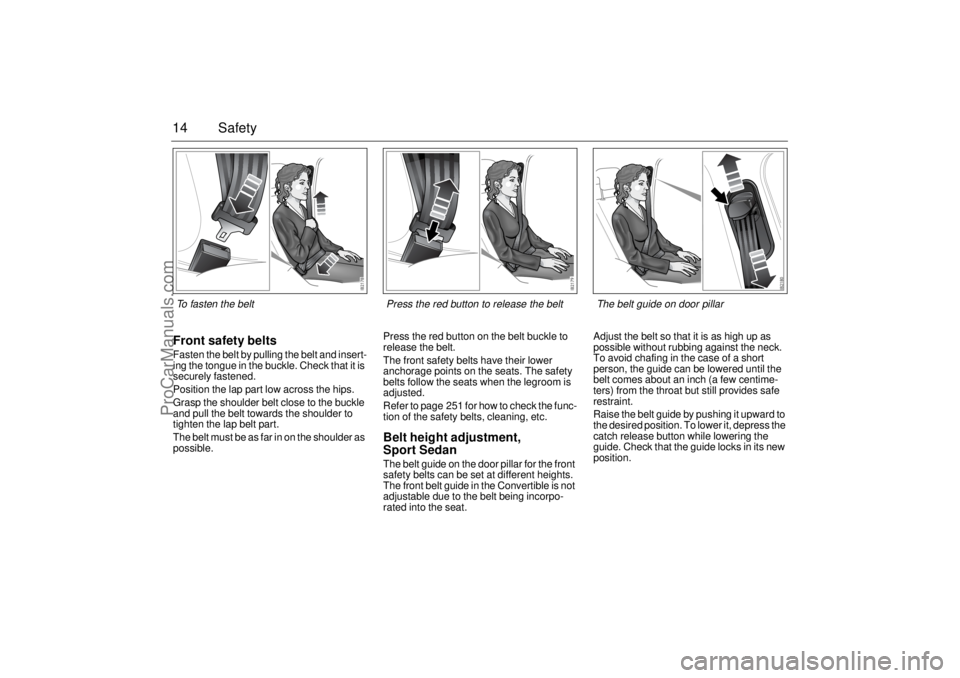
14 SafetyFront safety beltsFasten the belt by pulling the belt and insert-
ing the tongue in the buckle. Check that it is
securely fastened.
Position the lap part low across the hips.
Grasp the shoulder belt close to the buckle
and pull the belt towards the shoulder to
tighten the lap belt part.
The belt must be as far in on the shoulder as
possible.Press the red button on the belt buckle to
release the belt.
The front safety belts have their lower
anchorage points on the seats. The safety
belts follow the seats when the legroom is
adjusted.
Refer to page 251 for how to check the func-
tion of the safety belts, cleaning, etc.
Belt height adjustment,
Sport SedanThe belt guide on the door pillar for the front
safety belts can be set at different heights.
The front belt guide in the Convertible is not
adjustable due to the belt being incorpo-
rated into the seat.Adjust the belt so that it is as high up as
possible without rubbing against the neck.
To avoid chafing in the case of a short
person, the guide can be lowered until the
belt comes about an inch (a few centime-
ters) from the throat but still provides safe
restraint.
Raise the belt guide by pushing it upward to
the desired position. To lower it, depress the
catch release button while lowering the
guide. Check that the guide locks in its new
position.
To fasten the belt Press the red button to release the belt
The belt guide on door pillar
ProCarManuals.com
Page 18 of 292
16 SafetySafety belts, rear seatSafety belts rear seat, Convertible, see
page 69
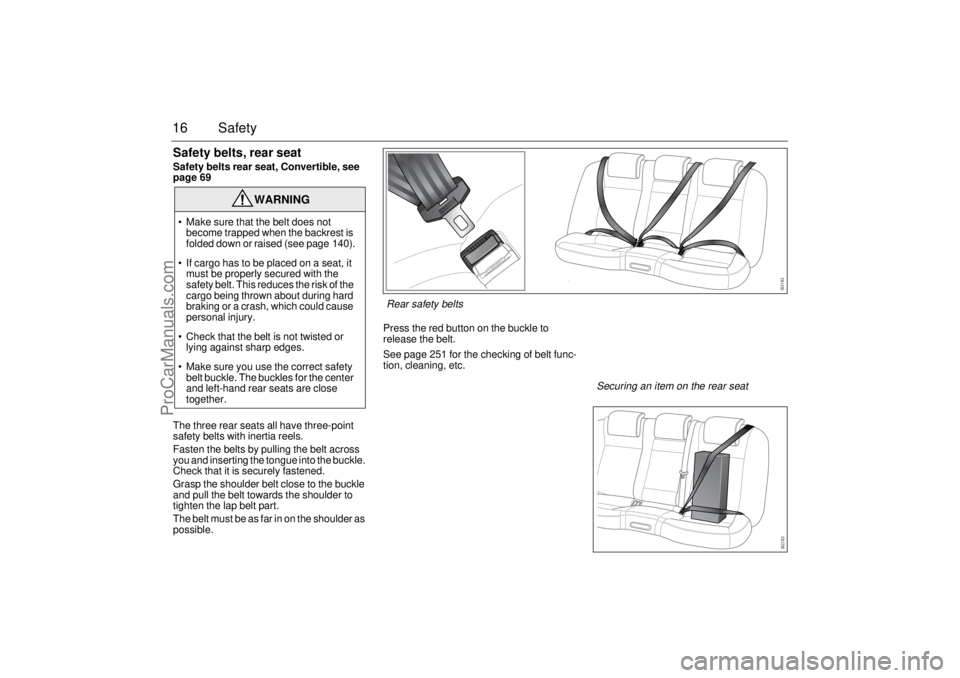
The three rear seats all have three-point
safety belts with inertia reels.
Fasten the belts by pulling the belt across
you and inserting the tongue into the buckle.
Check that it is securely fastened.
Grasp the shoulder belt close to the buckle
and pull the belt towards the shoulder to
tighten the lap belt part.
The belt must be as far in on the shoulder as
possible.Press the red button on the buckle to
release the belt.
See page 251 for the checking of belt func-
tion, cleaning, etc.
WARNING
Make sure that the belt does not
become trapped when the backrest is
folded down or raised (see page 140).
If cargo has to be placed on a seat, it
must be properly secured with the
safety belt. This reduces the risk of the
cargo being thrown about during hard
braking or a crash, which could cause
personal injury.
Check that the belt is not twisted or
lying against sharp edges.
Make sure you use the correct safety
belt buckle. The buckles for the center
and left-hand rear seats are close
together.
Rear safety belts
Securing an item on the rear seat
ProCarManuals.com
Page 19 of 292
17 Safety
SeatsManually adjusted front seats(if equipped)
The following front seat adjustments can be
made to achieve a comfortable driving
position:
Height
Sport Sedan - driver’s seat
Convertible - both seats
Legroom
Sport Sedan - both seats
Convertible - both seats
Backrest rake angle
Sport Sedan - both seats
Convertible - both seats
Lumbar support firmness
Sport Sedan - driver’s seat
Convertible - only electrically adjustable
front seats
Head restraint height
Sport Sedan - both seats
Convertible - both seatsWe recommend that adjustments to the
driver’s seat be performed in the following
order:
1Height
2 Legroom
3 Backrest rake angle
4 Head restraint height
Lastly, adjust the position of the steering
wheel (see page 122).
Electrically adjustable front seats
See page 19.
Electric heating, front seats (option)
See pages 107 and 116.
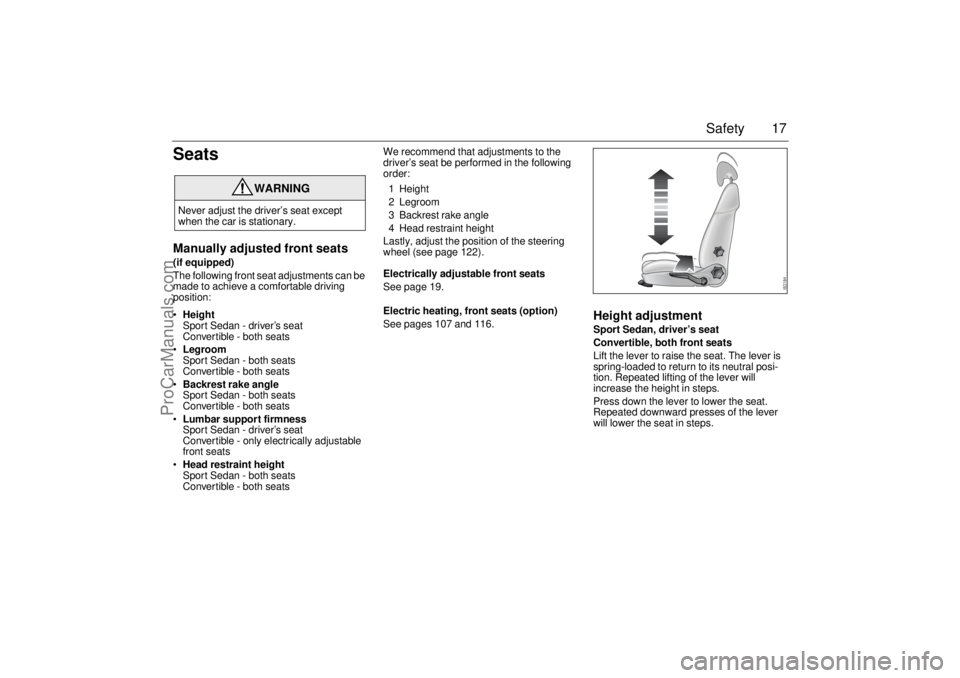
Height adjustmentSport Sedan, driver’s seat
Convertible, both front seats
Lift the lever to raise the seat. The lever is
spring-loaded to return to its neutral posi-
tion. Repeated lifting of the lever will
increase the height in steps.
Press down the lever to lower the seat.
Repeated downward presses of the lever
will lower the seat in steps.
WARNING
Never adjust the driver’s seat except
when the car is stationary.
ProCarManuals.com
Page 21 of 292
19 Safety
Electrically adjustable front
seats(option)
With the doors closed the seats can only be
adjusted when the ignition is ON.
However, there are two exceptions:
To facilitate getting into the car, both seats
can be adjusted when either of the front
doors is open.
The seats can be adjusted up to
2 minutes after both doors have been
closed (applicable only to cars without
window and sunroof pinch protection).
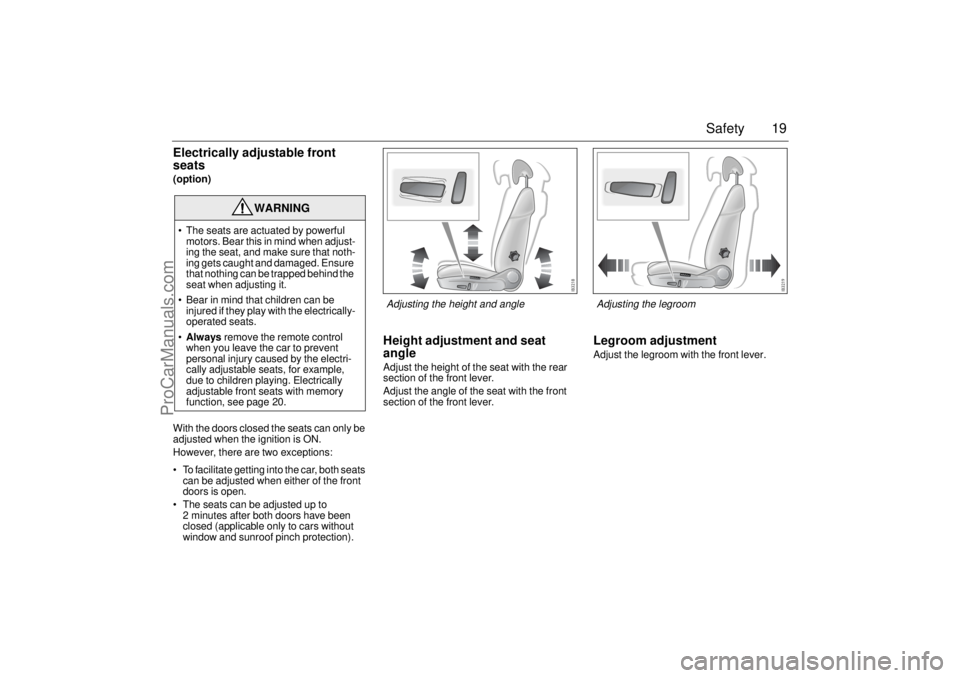
Height adjustment and seat
angleAdjust the height of the seat with the rear
section of the front lever.
Adjust the angle of the seat with the front
section of the front lever.
Legroom adjustmentAdjust the legroom with the front lever.
WARNING
The seats are actuated by powerful
motors. Bear this in mind when adjust-
ing the seat, and make sure that noth-
ing gets caught and damaged. Ensure
that nothing can be trapped behind the
seat when adjusting it.
Bear in mind that children can be
injured if they play with the electrically-
operated seats.
Always remove the remote control
when you leave the car to prevent
personal injury caused by the electri-
cally adjustable seats, for example,
due to children playing. Electrically
adjustable front seats with memory
function, see page 20.
Adjusting the height and angle Adjusting the legroom
ProCarManuals.com
Page 23 of 292
21 Safety
When the ignition is ON, all seat settings
can be adjusted. When the door is open and
before the remote control has been inserted
into the ignition switch, all seat settings can
be adjusted for up to 20 minutes.
The memory also includes the door mirror
settings.
Storing and restoring settings
1 Adjust the seat and the door mirrors.
The lumbar support is not included by
the memory function.
2 Press and hold the M-button and then
press one of the preselect buttons (1, 2
or 3). A chime will sound to confirm that
the settings have been saved.
To recall programmed settings, press and
hold the desired memory button until the
seat and door mirrors adopt their pro-
grammed positions. The memory function
also includes the door mirror settings.
To facilitate reversing, the passenger-side
door mirror can be angled down, refer to
page 134.
Head restraintsSport Sedan
Head restraint, Convertible, see page 68.
The front seats are equipped with Saab
Active Head Restraints (SAHRs). These are
designed to reduce the risk of neck injury if
the car is hit from behind.
The SAHR is a mechanical system, actu-
ated by body weight. The mechanism is built
into the top of the backrest, where it is con-
nected to the head restraint.
In the event of a rear-end crash, the body is
forced back against the backrest. This, in
turn, causes the mechanism to press the
head restraint forward and upward, thus lim-
iting the backward movement of the head.Therefore, the SAHR does not normally
need to be replaced or repaired after a rear-
end crash.
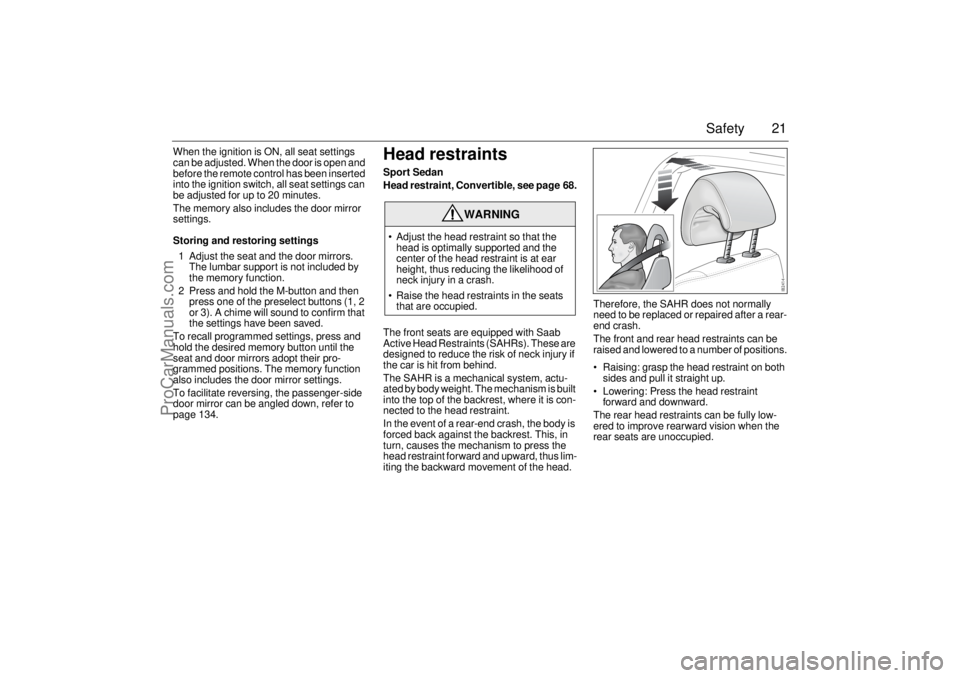
The front and rear head restraints can be
raised and lowered to a number of positions.
Raising: grasp the head restraint on both
sides and pull it straight up.
Lowering: Press the head restraint
forward and downward.
The rear head restraints can be fully low-
ered to improve rearward vision when the
rear seats are unoccupied.
WARNING
Adjust the head restraint so that the
head is optimally supported and the
center of the head restraint is at ear
height, thus reducing the likelihood of
neck injury in a crash.
Raise the head restraints in the seats
that are occupied.
ProCarManuals.com
Page 25 of 292

23 Safety
General information on child
safetyThe same attention must be given to child
safety in the car as is given to adults.
Children travel most safely when properly
restrained. However, the type of restraint
must be appropriate for the size of the child.
Always consult your Saab dealer before
fitting a child seat, child restraint or booster
cushion.
Make sure you are acquainted with the
legal requirements for seating children
in the car.
Make sure that it is possible to fit a child
restraint in accordance with the manufac-
turer’s child restraint instructions.
When fitting child restraints in cars you
must always read the instructions sup-
plied by the child restraint manufacturer.
Saab recommends the use of a rear-
facing child seat for as long as this is
possible - at a minimum for all children
under the age of 3 (approx. 15 kg). Use a
child seat approved for the weight of the
child.
Saab recommends the use of a booster seat
for children up to the age of 10.
LATCHLATCH (Lower Anchorages & Top tethers
for CHildren) is a US/Canadian safety stan-
dard for a uniform method of fitting child
restraints without using the standard safety
belts. Only certain child restraints are
equipped to utilize the LATCH system.
The LATCH system is installed in the car to
facilitate proper fitting of child restraints
designed for and equipped with LATCH
attachments. The LATCH system consists of top tether
and lower anchorages (also called ISOFIX).
In this vehicle, LATCH is installed at the two
outboard seating positions in the rear seat,
and there is a top tether on the rear center
position (not Convertible). The top tethers
are located on top of the parcel shelf
(Convertible: behind the head restraints),
see page 26. They are covered by a lid with
a child seat anchor symbol. The lower
anchorages are located where the seat
cushion and seat back come together.
There is a label above the inner lower
anchorage, see picture on next page. Label
consists of a symbol of a child restrained in
a seat inside a circle.
When fitting child restraints in cars you must
always read the instructions supplied by the
child restraint manufacturer.
If you have any questions regarding LATCH
please contact your Saab dealer.
ProCarManuals.com
Page 27 of 292
25 Safety
LATCH child seat installation
Before starting the installation, please read
through this instruction, and the child seat
installation instruction.
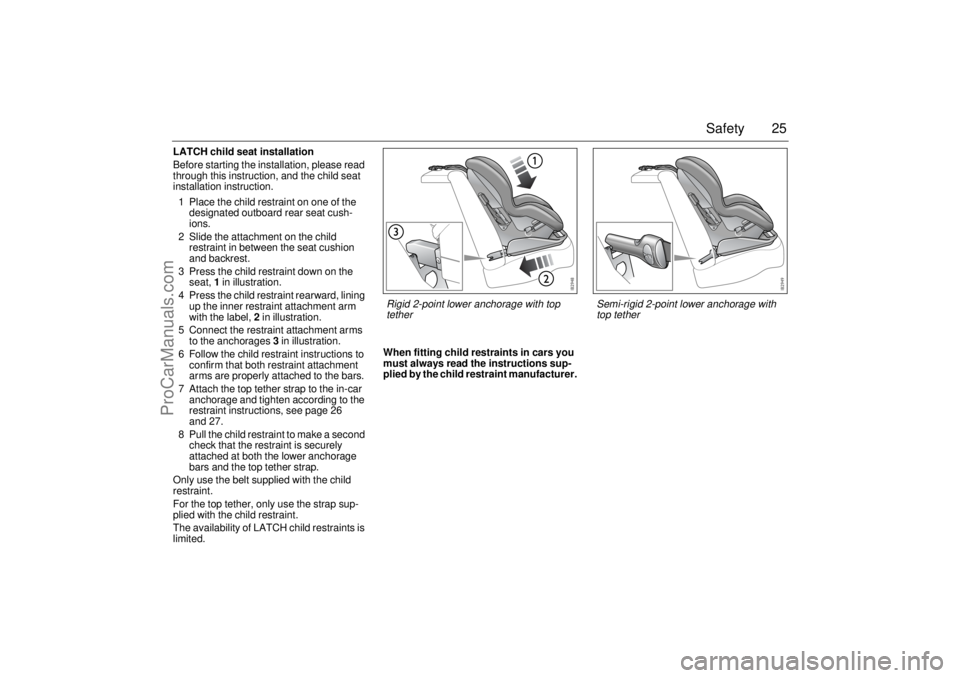
1 Place the child restraint on one of the
designated outboard rear seat cush-
ions.
2 Slide the attachment on the child
restraint in between the seat cushion
and backrest.
3 Press the child restraint down on the
seat, 1 in illustration.
4 Press the child restraint rearward, lining
up the inner restraint attachment arm
with the label, 2 in illustration.
5 Connect the restraint attachment arms
to the anchorages 3 in illustration.
6 Follow the child restraint instructions to
confirm that both restraint attachment
arms are properly attached to the bars.
7 Attach the top tether strap to the in-car
anchorage and tighten according to the
restraint instructions, see page 26
and 27.
8 Pull the child restraint to make a second
check that the restraint is securely
attached at both the lower anchorage
bars and the top tether strap.
Only use the belt supplied with the child
restraint.
For the top tether, only use the strap sup-
plied with the child restraint.
The availability of LATCH child restraints is
limited.When fitting child restraints in cars you
must always read the instructions sup-
plied by the child restraint manufacturer.
Rigid 2-point lower anchorage with top
tetherSemi-rigid 2-point lower anchorage with
top tether
ProCarManuals.com