set SAAB 9-3 2007 Owner's Guide
[x] Cancel search | Manufacturer: SAAB, Model Year: 2007, Model line: 9-3, Model: SAAB 9-3 2007Pages: 304, PDF Size: 26.16 MB
Page 127 of 304
127 Interior equipment
CompassThe compass is built into the rearview mir-
ror. The compass bearing is displayed in the
top right-hand corner of the mirror and is
updated every other second. The compass
displays the car’s direction of travel: N, NE,
E, etc.
Switch the compass display on and off by
pressing button 5 for 3 seconds, see illus-
tration on page 126.
Changing zones
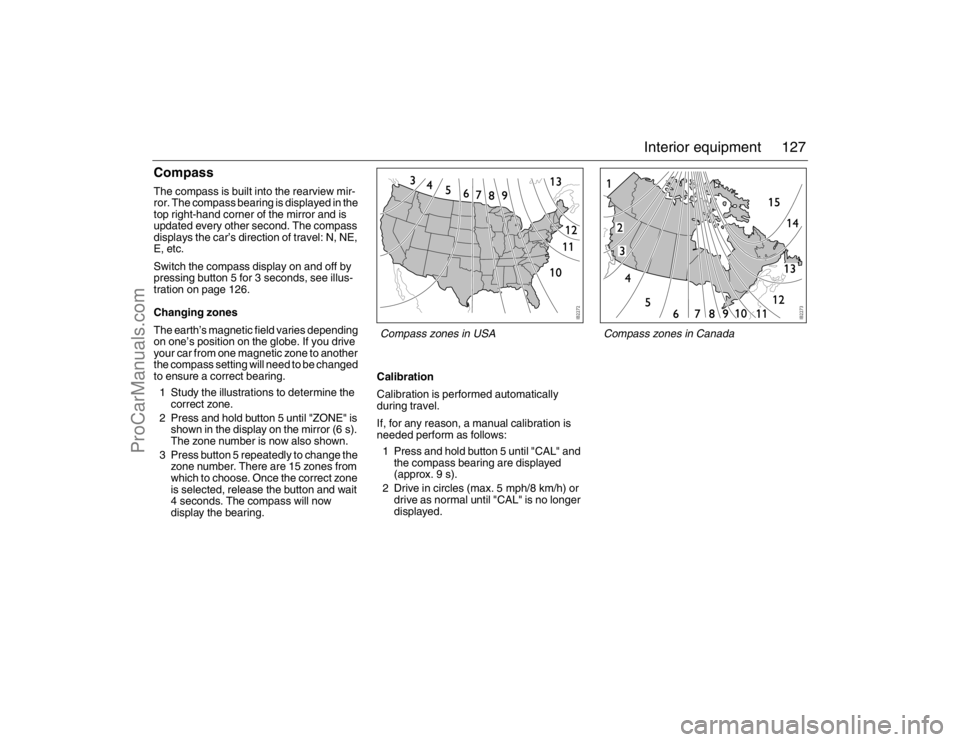
The earth’s magnetic field varies depending
on one’s position on the globe. If you drive
your car from one magnetic zone to another
the compass setting will need to be changed
to ensure a correct bearing.
1 Study the illustrations to determine the
correct zone.
2 Press and hold button 5 until "ZONE" is
shown in the display on the mirror (6 s).
The zone number is now also shown.
3 Press button 5 repeatedly to change the
zone number. There are 15 zones from
which to choose. Once the correct zone
is selected, release the button and wait
4 seconds. The compass will now
display the bearing.Calibration
Calibration is performed automatically
during travel.
If, for any reason, a manual calibration is
needed perform as follows:
1 Press and hold button 5 until "CAL" and
the compass bearing are displayed
(approx. 9 s).
2 Drive in circles (max. 5 mph/8 km/h) or
drive as normal until "CAL" is no longer
displayed.
Compass zones in USA
Compass zones in Canada
93_U S _M 07.book Page 127 W ednesday, April 12, 2006 9:30 AM
ProCarManuals.com
Page 148 of 304
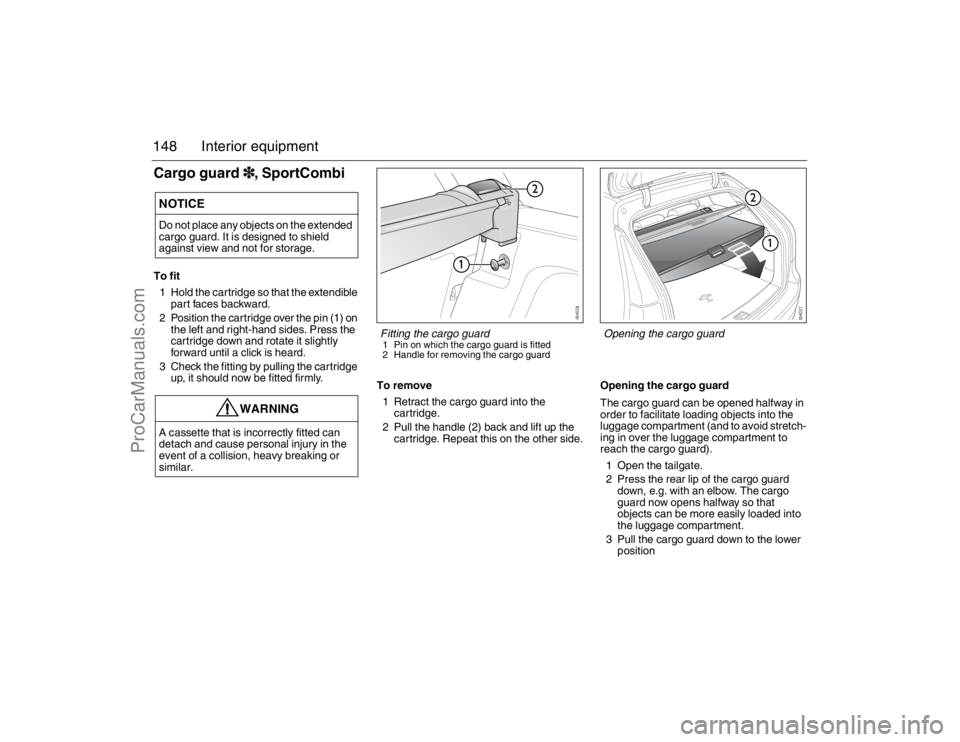
148 Interior equipmentCargo guard3, SportCombiTo fit
1 Hold the cartridge so that the extendible
part faces backward.
2 Position the cartridge over the pin (1) on
the left and right-hand sides. Press the
cartridge down and rotate it slightly
forward until a click is heard.
3 Check the fitting by pulling the cartridge
up, it should now be fitted firmly.
To remove
1 Retract the cargo guard into the
cartridge.
2 Pull the handle (2) back and lift up the
cartridge. Repeat this on the other side.Opening the cargo guard
The cargo guard can be opened halfway in
order to facilitate loading objects into the
luggage compartment (and to avoid stretch-
ing in over the luggage compartment to
reach the cargo guard).
1 Open the tailgate.
2 Press the rear lip of the cargo guard
down, e.g. with an elbow. The cargo
guard now opens halfway so that
objects can be more easily loaded into
the luggage compartment.
3 Pull the cargo guard down to the lower
positionNOTICEDo not place any objects on the extended
cargo guard. It is designed to shield
against view and not for storage.
WARNING
A cassette that is incorrectly fitted can
detach and cause personal injury in the
event of a collision, heavy breaking or
similar.
Fitting the cargo guard1 Pin on which the cargo guard is fitted
2 Handle for removing the cargo guard
Opening the cargo guard
93_U S _M 07.book Page 148 W ednesday, April 12, 2006 9:30 AM
ProCarManuals.com
Page 155 of 304
155 Starting and driving
Limp-homeThe engine management system has a
diagnostic feature that checks a number of
internal functions. If a fault is detected in the
throttle valve, the engine management
system will set the throttle system to the
limp-home mode. This means:
idling control will be poor (uneven idling
since regulated by ignition and fuel
supply)
engine performance will be reduced
the cruise control will not function
the capacity of the A/C compressor will be
limited.
If the diagnosis function detects a fault in the
engine management system, the light
"Engine malfunction (CHECK ENGINE)" in
the instrument panel will come on (see
page 83). Have the car checked at a work-
shop as soon as possible. We recommend
that you contact a Saab dealer.
Important considerations with
catalytic convertersThe catalytic converter is an emission con-
trol device incorporated in the car’s exhaust
system. It consists of a metal canister with a
honeycomb insert, the cells of which have
walls coated in a catalytic layer (precious
metal alloy).
To ensure that the catalytic converter con-
tinues to function properly, and also to avoid
damage to the converter and its associated
components, the following points must be
observed:
NOTICEIf "Engine malfunction (CHECK
ENGINE)" warning light starts to flash
(indicating that the engine is misfiring and
the catalytic converter can be damaged),
ease off the accelerator slightly. The light
should go out or start to shine constantly.
If the light continues to flash despite
easing off the accelerator, you may
continue to drive the car but at the mini-
mum throttle permitted by the current traf-
fic situation. Have the car checked as
soon as possible. We recommend that
you contact a Saab dealer.
NOTICEUse only unleaded gasoline. Leaded
gasoline is detrimental to the catalyst and
oxygen sensor and will seriously impair
the function of the catalytic converter.
93_U S _M 07.book Page 155 W ednesday, April 12, 2006 9:30 AM
ProCarManuals.com
Page 156 of 304
156 Starting and driving Have the car serviced regularly in accor-
dance with the service program.
Always be alert to any misfiring of the
engine (not running on all cylinders) and
any loss of power or performance. At the
first sign of a malfunction, reduce speed
and take the car to a workshop. We
recommend that you contact a Saab
dealer.
If the engine fails to start (in severe cold
or if the battery is flat), the car can be
bump started (manual transmission only)
or started using jump leads to a donor
battery. However, as soon as you have
started the engine, it is important that it
runs on all cylinders. If it is misfiring, allow
it to idle for up to 5 minutes to give it time
to settle and run smoothly. If, after this
time, the engine still fails to run properly,
switch off the engine to avoid serious
damage to the catalytic converter. We
recommend that you contact a Saab
dealer for advice. Never park the car on dry grass or other
combustible material. The catalytic
converter gets very hot and could there-
fore start a fire.
Never drive off if the engine is misfiring.
If you bump start the car when the engine
is already at normal working temperature,
the engine must start to run on all cylin-
ders. Abort bump starting if the engine
fails to start immediately.
Failure to strictly follow these instructions
can result in damage to the catalytic con-
verter and associated components, and
could represent a breach of the warranty
conditions.
NOTICEIf the car runs out of gas, air may be drawn
in with the fuel, which, in turn, can cause
the catalytic converter to be damaged by
overheating.
WARNING
If the engine is being run with the car on a
rolling road or dynamometer, to ensure
adequate cooling, air must be blown into
the engine compartment and under the
car at a rate equivalent to the ram-air
effect that would obtain at the corre-
sponding road speed.
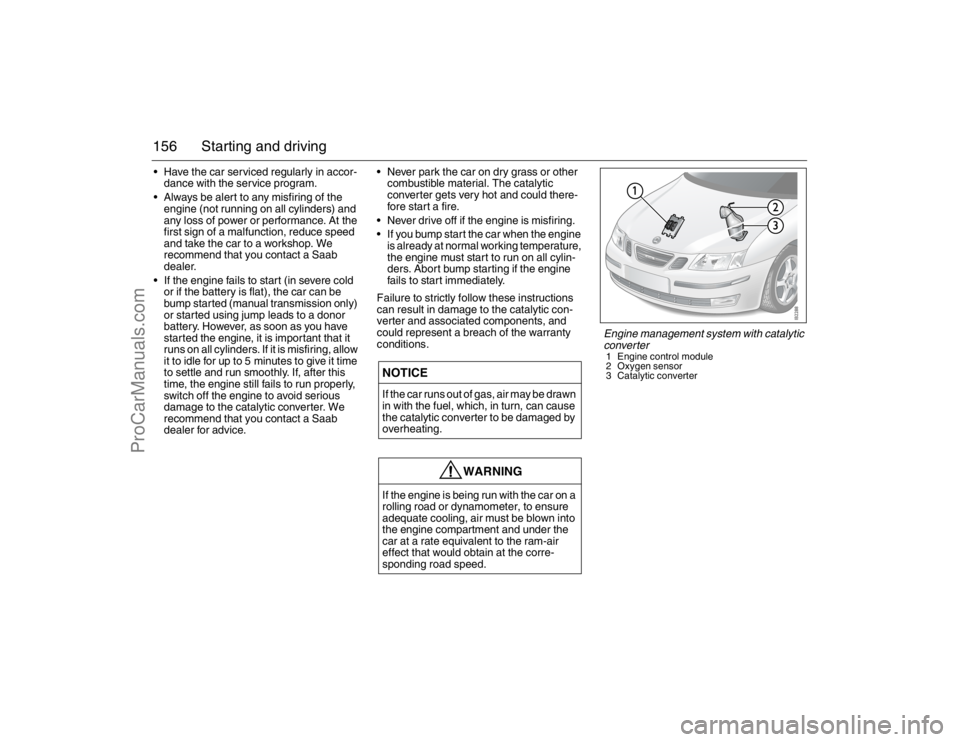
Engine management system with catalytic
converter1 Engine control module
2 Oxygen sensor
3 Catalytic converter
93_U S _M 07.book Page 156 W ednesday, April 12, 2006 9:30 AM
ProCarManuals.com
Page 169 of 304
169 Starting and driving
Cruise control(Cruise control system)
For safety reasons (brake system func-
tion), the brakes must be applied once
when the engine has started, before the
cruise control system can be activated.
The following message is shown on the SID:
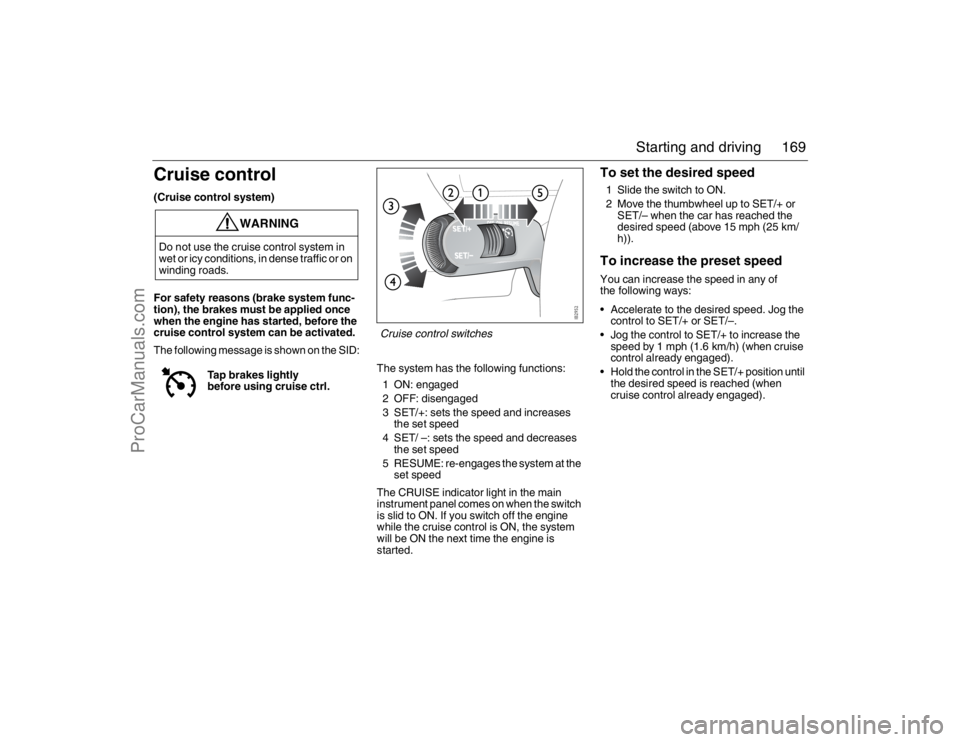
The system has the following functions:
1 ON: engaged
2 OFF: disengaged
3 SET/+: sets the speed and increases
the set speed
4 SET/ –: sets the speed and decreases
the set speed
5 RESUME: re-engages the system at the
set speed
The CRUISE indicator light in the main
instrument panel comes on when the switch
is slid to ON. If you switch off the engine
while the cruise control is ON, the system
will be ON the next time the engine is
started.
To set the desired speed1 Slide the switch to ON.
2 Move the thumbwheel up to SET/+ or
SET/– when the car has reached the
desired speed (above 15 mph (25 km/
h)).To increase the preset speedYou can increase the speed in any of
the following ways:
Accelerate to the desired speed. Jog the
control to SET/+ or SET/–.
Jog the control to SET/+ to increase the
speed by 1 mph (1.6 km/h) (when cruise
control already engaged).
Hold the control in the SET/+ position until
the desired speed is reached (when
cruise control already engaged).
WARNING
Do not use the cruise control system in
wet or icy conditions, in dense traffic or on
winding roads.
Tap brakes lightly
before using cruise ctrl.
Cruise control switches
93_U S _M 07.book Page 169 W ednesday, April 12, 2006 9:30 AM
ProCarManuals.com
Page 170 of 304
170 Starting and drivingTo reduce the preset speedYou can reduce speed in any of the follow-
ing ways:
Brake to the desired speed. Jog the
control to SET/+ or SET/–.
Jog the control to SET/– to reduce the
speed by 1 mph (1.6 km/h).
Hold the control in the SET/– position until
the desired speed is reached.Temporary increase in speedAccelerate, without shifting down (manual
transmission), to exceed the set speed such
as for overtaking. When you release the
accelerator, the car will return to the set
speed.To disengage the system
temporarilySlide the switch to the left towards OFF, but
only as far as to disengage the cruise con-
trol. Allow the switch to spring back.
To re-engage the systemSlide the switch to RESUME. The car will
return to the previously set speed. Vehicle
speed must exceed 15 mph (25 km/h).To disengage the systemThe system will be disengaged:
As soon as the brake or clutch pedal is
depressed (cars with manual transmis-
sion).
When the switch is slid towards OFF. See
also heading "To disengage the system
temporarily".
When the switch is slid to OFF.
When the TCS/ESP
® system is opera-
tive.
When position N is selected (cars with
automatic transmission).
BrakingIt is good practice to try your brakes period-
ically while driving. This is particularly
important when driving in heavy rain, on
roads with a lot of surface water, in snow or
in salty slush. In such conditions a slight
delay in the braking effect may be noticed.
To minimize this delay, dry the brakes by
applying them lightly now and again. This
should also be done after the car has been
washed, and in extremely damp weather.
To avoid the brakes becoming overheated,
such as when negotiating long descents
with a drop of several hundred yards (hun-
dred metres), select a low gear to utilize the
braking effect of the engine. If the car has
automatic transmission, select 1st or 2nd
gear.
You can help to prolong the life of the brakes
by thinking ahead and braking harder over
short periods, rather than braking more
moderately over long stretches.
93_U S _M 07.book Page 170 W ednesday, April 12, 2006 9:30 AM
ProCarManuals.com
Page 179 of 304
179 Starting and driving
Long-term parkingIf the car is not going to be used for some
time, e.g. three to four months, the following
steps are recommended:
Drain the washer fluid reservoir and
hoses.
Wash and wax the car. Clean the rubber
seals on the hood, trunk lid and doors,
and lubricate them with glycerol
(glycerine).
After washing the car, dry the brake discs
to avoid corrosion by taking the car out on
the road and applying the brakes a few
times.
Fill the fuel tank to prevent condensation
forming in it.
Top up the coolant and check the anti-
freeze before the onset of winter. Park the car in a dry, covered and well-
ventilated building. Leave the parking
brake OFF!
Convertible: If the car is stored, the soft
top should be closed.
If necessary, use wheel chocks and leave
the parking brake off.
Disconnect the negative (–) battery lead.
If frost is likely to occur during the storage
period, remove the battery and store it in
a frost-free place.
If it is not possible to stand the car on axle
stands, increase the tire pressure to
43 psi (3 bar).
Leave all the door windows open a crack
and cover the car with a non-plastic
tarpaulin – not one made of plastic which will
not breath.93_U S _M 07.book Page 179 W ednesday, April 12, 2006 9:30 AM
ProCarManuals.com
Page 182 of 304
182 Starting and drivingError messages
If the system malfunctions, the following
message will appear on the SID:
If the system is subject to interference, the
following message will be shown on the
SID:
If this message appears, clean the sensors.
The sensors are located in the black trim on
the rear bumper The system can be switched off using
Settings.
1 Select Settings using the steering
wheel controls, or .
2 Press and hold the SET button until
given audible confirmation.
3 Select Park Assistance.
4 Press the SET button.
5 Select ON or OFF.
6 Confirm the setting by pressing the SET
button.Explanation of ON and OFF.
Parking assistance
malfunction. Service.
Parking assistance
sensor interference.
Park Assistance
ONOFF
ON
Saab Parking Assistance is activated
automatically when reverse is
engaged. The system warns of objects
behind the car.
If a trailer is hitched up and correctly
connected to the trailer connector, the
system will be deactivated automati-
cally. You can also deactivate the sys-
tem temporarily with the CLR button if
reverse has been engaged and the
system is active.
OFF
Saab Parking Assistance deactivated.
93_U S _M 07.book Page 182 W ednesday, April 12, 2006 9:30 AM
ProCarManuals.com
Page 185 of 304
185 Starting and driving
Driving in cold weatherIn cold weather, special attention should be
paid to the following:
Before driving off, make sure that the
wiper blades have not frozen to the wind-
shield.
Remove any snow from the heating
system air intakes between the hood and
the windshield.
If necessary, inject oil into the locks to
prevent them from freezing. Use molyb-
denum-sulphide oil (MoS
2). If the locks
freeze, exercise care when unlocking the
car (manual unlocking) to avoid breaking
the key. Warm up the key or use a de-icer.
It is particularly important when the roads
are slippery that the brakes and tires are
in good condition.
For how to check the level of antifreeze in
the engine coolant, see page 209. Add gasoline anti-freeze when refueling
several times before the onset of winter.
This will prevent condensation water in
the fuel tank from freezing and causing
interruptions in the fuel supply. The likeli-
hood of condensation is lowest when the
fuel tank is full.
If the car is parked outside and the
temperature is below zero, gasoline anti-
freeze is of little use as it cannot remove
water that has already frozen. Park the
car in a warm place so that any ice that
may have built up melts, then add gaso-
line anti-freeze when refueling.
Condensation is caused by temperature
fluctuations, either in the outside temper-
ature alone or when the car is alternately
parked outdoors and in a garage.
Convertible: Avoid operating the soft top
at temperatures below 23°F (–5°C). The car is equipped with tires designed to
provide optimum grip on both wet and dry
roads, although this has been achieved at
the expense of somewhat reduced grip on
snow and ice. For regular driving on snow
and ice, we therefore recommend that
winter tires be fitted. However, winter tires
achieve this extra grip at the expense of
grip on bare road surfaces.
Winter tires, particularly studded tires, gen-
erally make driving safer on snow and ice.
Acquaint yourself with the legal provi-
sions governing the use of different
types of winter tires and snow chains.
Studded tires are not allowed in some
countries. If winter tires are fitted, the same
type must be fitted to all four wheels. Your
Saab dealer will be pleased to advise you on
the best tires for your car.
93_U S _M 07.book Page 185 W ednesday, April 12, 2006 9:30 AM
ProCarManuals.com
Page 194 of 304
194 Starting and drivingDriving with a loadThe handling characteristics are affected by
how the car is loaded.
Driving with the trunk lid
openIf you must drive with the trunk lid open,
close all windows and the moonroof (if
equipped) and set the cabin fan to its high-
est speed setting.
Driving in deep water
NOTICE Place the heaviest load as far forward
and as low as possible in the trunk.
Secure the load to the lashing eyes
(see page 139).
Heavy loads mean that the car’s
center of gravity is further back. As a
result, the car will sway more during
evasive steering.
Never exceed the permissible load of
the roof box, even if there is room for
more.
Ensure that the tire pressure is correct
– slight overinflation is preferable to
underinflation.
The braking distance of a loaded car is
always greater. Keep your distance
from the vehicle in front.
Do not exceed the car’s permissible
gross vehicle weight or axle load (see
page 280).
Roof loads can negatively affect tele-
communication.
For further information on tires see
page 241.
WARNING
Avoid driving with the trunk lid partly or
fully open, since exhaust fumes can be
drawn into the cabin.
NOTICEDo not drive in puddles or water deeper
than 7 in. (20 cm) and do not drive faster
than 3–4 mph. Water can otherwise be
sucked into the engine. The engine will be
seriously damaged if water enters the
intake system.
93_U S _M 07.book Page 194 W ednesday, April 12, 2006 9:30 AM
ProCarManuals.com