set SAAB 9-3 2007 Service Manual
[x] Cancel search | Manufacturer: SAAB, Model Year: 2007, Model line: 9-3, Model: SAAB 9-3 2007Pages: 304, PDF Size: 26.16 MB
Page 195 of 304
195 Starting and driving
Driving at nightBear in mind the following points, especially
when driving at night:
Nighttime driving requires your full
concentration
Do not rush. Count on your journey taking
slightly longer.
The number of drivers under the influence
of drugs is likely to be greater at night than
during the day.
Do not stare at the headlights of oncom-
ing vehicles.
Avoid driving at night if you have poor
eyesight. Night vision deteriorates with
age.
Keep your car’s headlights, windows and
mirrors clean. Also, if you wear glasses,
make sure they are clean.
Make sure you are well rested before
starting a long journey. Take a break
every other hour.
Only eat light meals. Heavy meals have a
tendency to induce tiredness.
Wild animals prefer to move at dusk and
dawn.
Check the headlight levelling setting (see
page 97).
Towing the car
Front towing eye
WARNING
Remember that the brake servo does
not operate when the engine is off.
Much greater pressure than normal
will therefore be required to operate
the brake pedal.
Nor does the steering servo operate
when the engine is off. The steering
will therefore be much heavier than
usual.
The towing vehicle should always be
heavier than the vehicle on tow.
Never allow passengers to ride in the
car when it is on tow.
Always seek professional help if the
car needs to be recovered.
The ignition switch must be in the ON
position if the car is moved with the
engine not running.
The steering wheel lock must be
disengaged before towing the car.
The steering wheel lock disengages
when the remote control is inserted
into the ignition switch, if the battery
has sufficient charge.
WARNING
Make sure that the towing eye is
screwed in tightly. It has a left-hand
thread!
The towing eye is only designed for
towing the car on roads. It must not
be used to pull the car out of a ditch,
for example.
Make sure that all bystanders keep a
suitable distance, in case the towing
eye or tow rope should snap. The
towing eye or tow rope could catapult
off and cause seriously injury.
Never drive with the towing eye fitted
to the front bumper. Return it to its
designated storage space.
93_U S _M 07.book Page 195 W ednesday, April 12, 2006 9:30 AM
ProCarManuals.com
Page 198 of 304
198 Starting and drivingJump starting
It is essential when a donor battery is to be
used to jump start the car that the jump
leads be connected correctly to prevent
arcing.
To jump start your vehicle:
1 Check the other vehicle. It must have a
12-volt battery with a negative ground
system.2 Get the vehicles close enough so the
jumper cables can reach, but be sure the
vehicles are not touching each other. If
a poor connection on the negative
jumper cable should exist, it is possible
for damage to be caused to electrical
systems/components of either vehicle
should inadvertent contact be made.
You would not be able to start your car
and bad grounding could damage the
electrical systems.
3 Turn off the ignition on both vehicles.
Turn off lights that are not needed, and
radios. This will avoid sparks and help
save both batteries and it could save
your radio.
WARNING
When working on the battery, highly
explosive gas can build up. A spark
could ignite this gas that collects
around the battery. Therefore, always
avoid sparks and open flames in the
vicinity of the battery.
The battery contains corrosive sulphu-
ric acid. Always wear a face mask or
goggles when working on the battery.
If battery acid gets into the eyes or
splashes onto skin or clothing, wash
the affected area liberally with water. If
acid gets into the eyes or a large quan-
tity makes contact with the skin, seek
medical help.
NOTICEIgnoring these steps could result in costly
damage to your vehicle that would not be
covered by your warranty.
Trying to start your car by pushing or pull-
ing it could damage your vehicle, even if
you have a manual transmission. If you
have an automatic transmission, your
vehicle cannot be started by pushing or
pulling it.
NOTICEIf the other system is not a 12-volt system
with a negative ground, both vehicles can
be damaged.
WARNING
You could be injured if the vehicles roll.
Set the parking brake firmly on each vehi-
cle. Put an automatic transmission in P
(Park) or a manual transmission in
Neutral.
93_U S _M 07.book Page 198 W ednesday, April 12, 2006 9:30 AM
ProCarManuals.com
Page 200 of 304
200 Starting and drivingUsing a battery charger3/starter
unitTo avoid damaging the car’s electrical
system and electronics, the following rules
must be followed when charging the battery
or jump starting the car.
If the charger or starter unit can be set to
different voltages (6V/12V/18V/24V), 12V
must be selected.
Follow the manufacturer’s instructions
supplied with the charger or starter unit.
No other apparatus that are grounded or
connected to the mains must be
connected to the car during charging or
jump starting.
The charger or starter unit must under no
conditions produce a voltage greater
than:
16V continuous
18V for 60 min.
If you are unsure about the charge rating of
the unit, disconnect the battery clamp from
the positive terminal before connecting the
unit to the battery.
For long tripsBefore starting off on a long journey, it is
advisable to have your car inspected by
your Saab dealer.
Obtain a few important items to take along
on your journey, such as spare bulbs, wiper
blades, fuses, a drive belt (poly-V-belt) and
the like.
You can check some points yourself before-
hand:
Check that no oil or fuel leaks out of the
engine or gearbox/transmission.
Check the coolant and power steering
fluid levels. Check also for leaks.
Inspect the drive belt (poly-V-belt) and
replace if it shows any signs of wear.
Check the battery charge.
Check the tires for tread pattern and air
pressure, including the compact spare
tire.
Take an extra remote control and keep it
separate.
Check the brakes.
Check all bulbs.
Check for the presence of the tool kit and
jack in the car.
93_U S _M 07.book Page 200 W ednesday, April 12, 2006 9:30 AM
ProCarManuals.com
Page 215 of 304
215 Car care
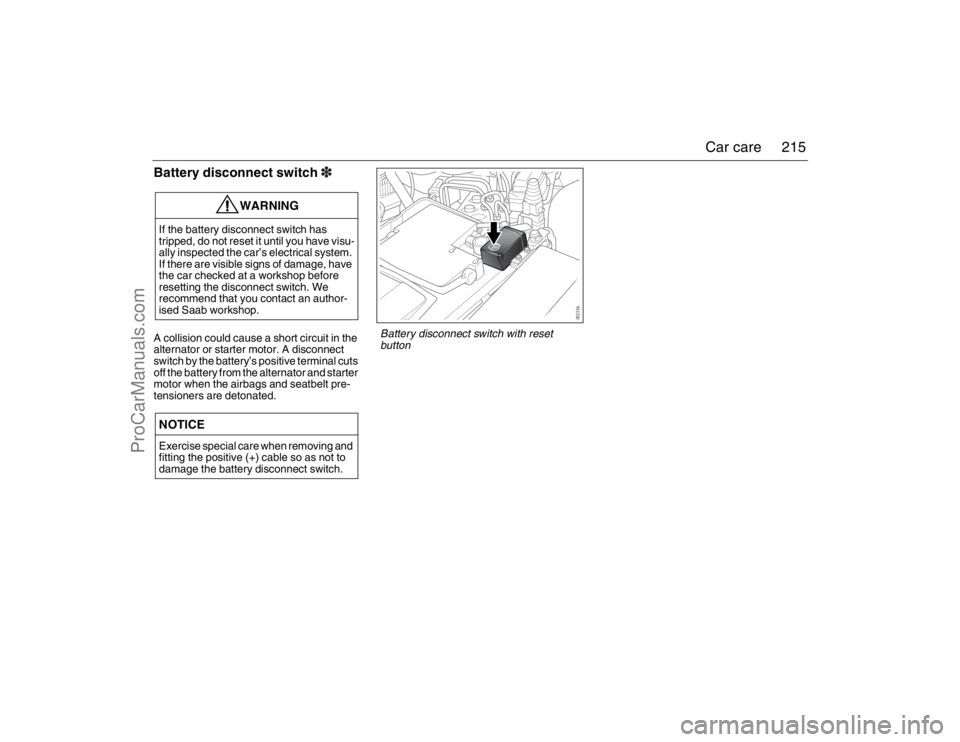
Battery disconnect switch3A collision could cause a short circuit in the
alternator or starter motor. A disconnect
switch by the battery’s positive terminal cuts
off the battery from the alternator and starter
motor when the airbags and seatbelt pre-
tensioners are detonated.
WARNING
If the battery disconnect switch has
tripped, do not reset it until you have visu-
ally inspected the car’s electrical system.
If there are visible signs of damage, have
the car checked at a workshop before
resetting the disconnect switch. We
recommend that you contact an author-
ised Saab workshop.NOTICEExercise special care when removing and
fitting the positive (+) cable so as not to
damage the battery disconnect switch.
Battery disconnect switch with reset
button
93_U S _M 07.book Page 215 W ednesday, April 12, 2006 9:30 AM
ProCarManuals.com
Page 242 of 304
242 Car careHigh speed operation
If you’ll be driving at high speeds, speeds of
100 mph (160 km/h) or higher, where it is
legal, set the cold inflation pressure to the
maximum inflation pressure shown on the
tire sidewall, or to 35 psi (244 kPa), which-
ever is lower. See the example below.
When you end this high-speed driving,
return to the cold inflation pressure shown
on the Tire and Loading Information label.
See on page 251.
Example:
You’ll find maximum load and inflation pres-
sure molded on the tire’s sidewall, in small
letters near the rim flange. It will read some-
thing like this: Maximum load 690 kg
(1521 lbs) 300 kPa (44 psi) Max. Press
For this example, you would set the inflation
pressure for high-speed driving at 35 psi
(244 kPa).When to checkCheck your tires once a month or more.
Don’t forget your compact spare tire. It
should be at 60 psi (420 kPa).
How to CheckUse a good quality pocket-type gage to
check tire pressure. You can’t tell if your
tires are properly inflated simply by looking
at them. Radial tires may look properly
inflated even when they’re underinflated.
Be sure to put the valve caps back on the
valve stems. They help prevent leaks by
keeping out dirt and moisture.Tire Inspection and RotationTires should be rotated every 10,000 miles
(16 000 km).
Any time you notice unusual wear, rotate
your tires as soon as possible and check
wheel alignment. Also check for damaged
tires or wheels. See “When It Is Time for
New Tires” on page 243 and “Wheel
Replacement” on page 247 for more infor-
mation.
The purpose of regular rotation is to achieve
more uniform wear for all tires on the vehi-
cle. The first rotation is the most important.
When rotating your tires, always use the
correct rotation pattern. Left front tire to left
rear. Left rear tire to right front. Right front to
right rear. Right rear to left front.
Don’t include the compact spare tire in your
tire rotation.
After the tires have been rotated, adjust the
front and rear inflation pressures as shown
on the Tire-Loading Information label. Make
WARNING
Driving at high speeds, 100 mph
(160 km/h) or higher, puts an additional
strain on tires.
Sustained high-speed driving causes
excessive heat build up and can cause
sudden tire failure. You could have a
crash and you or others could be killed.
Some high-speed rated tires require infla-
tion pressure adjustment for high speed
operation. When speed limits and road
conditions are such that a vehicle can be
driven at high speeds, make sure the tires
are rated for high speed operation, in
excellent condition, and set to the correct
cold tire inflation pressure for the vehicle
load.93_U S _M 07.book Page 242 W ednesday, April 12, 2006 9:30 AM
ProCarManuals.com
Page 245 of 304

245 Car care
Uniform Tire Quality GradingQuality grades can be found where applica-
ble on the tire sidewall between tread shoul-
der and maximum section width. For exam-
ple:
Treadwear 200 Traction AA
Temperature A
The following information relates to the
system developed by the United States
National Highway Traffic Safety Administra-
tion, which grades tires by treadwear, trac-
tion and temperature performance. (This
applies only to vehicles sold in the United
States.) The grades are molded on the side-
walls of most passenger car tires. The Uni-
form Tire Quality Grading system does not
apply to deep tread, winter-type snow tires,
space-saver or temporary use spare tires,
tires with nominal rim diameters of 10 to 12
inches (25 to 30 cm), or to some limited-pro-
duction tires.
While the tires available on General Motors
passenger cars and light trucks may vary
with respect to these grades, they must also
conform to federal safety requirements and
additional General Motors Tire Perfor-
mance Criteria (TPC) standards.
NOTICEWide wheels and tires with side walls that
are too low can:
be damaged in potholes, etc.
cause springs, shock absorbers and
wheel bearings and body mountings
to be overloaded.
affect the function of the Electronic
Stability Program (ESP
®).
The speed and load limits of the tires
must not be exceeded; see page 250.
Wheels larger than 17" must not be fitted
on the Saab 9-3 for reasons above. The
permissible offset is 1.61 inch (41 mm).
WARNING
Mixing tires could cause you to lose
control while driving. If you mix tires of
different sizes or types (radial and bias-
belted tires), the vehicle may not handle
properly, and you could have a crash.
Using tires of different sizes may also
cause damage to your vehicle. Be sure to
use the same size and type tires on all
wheels. It’s all right to drive with your
compact spare temporarily, it was devel-
oped for use on your vehicle. See
“Compact spare” on page 254.
WARNING
If you use bias-ply tires on your vehicle,
the wheel rim flanges could develop
cracks after many miles of driving. A tire
and/or wheel could fail suddenly, causing
a crash. Use only radial-ply tires with the
wheels on your vehicle.
93_U S _M 07.book Page 245 W ednesday, April 12, 2006 9:30 AM
ProCarManuals.com
Page 246 of 304
246 Car careTreadwear
The treadwear grade is a comparative
rating based on the wear rate of the tire
when tested under controlled conditions on
a specified government test course. For
example, a tire graded 150 would wear one
and a half (1.5) times as well on the govern-
ment course as a tire graded 100. The rela-
tive performance of tires depends upon the
actual conditions of their use, however, and
may depart significantly from the norm due
to variations in driving habits, service prac-
tices and differences in road characteristics
and climate.
Traction – AA, A, B, C
The traction grades, from highest to lowest,
are AA, A, B, and C. Those grades repre-
sent the tire’s ability to stop on wet pave-
ment as measured under controlled condi-
tions on specified government test surfaces
of asphalt and concrete. A tire marked C
may have poor traction performance. Warn-
ing: The traction grade assigned to this tire
is based on straight-ahead braking traction
tests, and does not include acceleration,
cornering, hydroplaning, or peak traction
characteristics.Temperature – A, B, C
The temperature grades are A (the highest),
B, and C, representing the tire’s resistance
to the generation of heat and its ability to dis-
sipate heat when tested under controlled
conditions on a specified indoor laboratory
test wheel. Sustained high temperature can
cause the material of the tire to degenerate
and reduce tire life, and excessive temper-
ature can lead to sudden tire failure. The
grade C corresponds to a level of perfor-
mance which all passenger car tires must
meet under the Federal Motor Vehicle
Safety Standard No. 109. Grades B and A
represent higher levels of performance on
the laboratory test wheel than the minimum
required by law.
Warning: The temperature grade for this tire
is established for a tire that is properly
inflated and not overloaded. Excessive
speed, underinflation, or excessive loading,
either separately or in combination, can
cause heat buildup and possible tire failure.
Wheel Alignment and Tire
BalanceThe wheels on your vehicle were aligned
and balanced carefully at the factory to give
you the longest tire life and best overall per-
formance.
Scheduled wheel alignment and wheel bal-
ancing are not needed. However, if you
notice unusual tire wear or your vehicle pull-
ing one way or the other, the alignment may
need to be reset. If you notice your vehicle
vibrating when driving on a smooth road,
your wheels may need to be rebalanced.
93_U S _M 07.book Page 246 W ednesday, April 12, 2006 9:30 AM
ProCarManuals.com
Page 247 of 304
247 Car care
Wheel ReplacementReplace any wheel that is bent, cracked or
badly rusted or corroded. If wheel nuts keep
coming loose, the wheel, wheel bolts and
wheel nuts should be replaced. If the wheel
leaks air, replace it (except some aluminum
wheels, which can sometimes be repaired).
See your dealer if any of these conditions
exist.
Your dealer will know the kind of wheel you
need.
Each new wheel should have the same
load-carrying capacity, diameter, width,
offset and be mounted the same way as the
one it replaces.
If you need to replace any of your wheels,
wheel bolts or wheel nuts, replace them only
with new Saab original equipment parts.
This way, you will be sure to have the right
wheel, wheel bolts and wheel nuts for your
vehicle.
Notice:
The wrong wheel can also cause
problems with bearing life, brake cool-
ing, speedometer or odometer calibra-
tion, headlamp aim, bumper height, vehi-
cle ground clearance and tire or tire
chain clearance to the body and chassis.
See “Changing a tire” on page 257.Used Replacement Wheels
WARNING
Using the wrong replacement wheels,
wheel bolts or wheel nuts on your vehicle
can be dangerous. It could affect the
braking and handling of your vehicle,
make your tires lose air and make you
lose control. You could have a collision in
which you or others could be injured.
Always use the correct wheel, wheel bolts
and wheel nuts for replacement.
WARNING
When fitting just one new pair of tires,
these should be fitted to the rear wheels,
as these are more critical to the direc-
tional stability of the car (e.g. on braking
or in a skid). The existing rear wheels
should therefore be moved to the front.
WARNING
Putting a used wheel on your vehicle is
dangerous. You can’t know how it’s been
used or how far it’s been driven. It could
fail suddenly and cause a crash. If you
have to replace a wheel, use a new GM
original equipment wheel.
93_U S _M 07.book Page 247 W ednesday, April 12, 2006 9:30 AM
ProCarManuals.com
Page 257 of 304
257 Car care
Changing a tire
WARNING
Lifting a vehicle and getting under it to do
maintenance or repairs is dangerous
without the appropriate safety equipment
and training. The jack provided with your
vehicle is designed only for changing a
flat tire. If it is used for anything else, you
or others could be badly injured or killed if
the vehicle slips off the jack. Use the jack
provided with your vehicle only for chang-
ing a flat tire.
Changing a tire can be dangerous. The
vehicle can slip off the jack and roll over
or fall on you or other people. You and
they could be badly injured or even killed.
Find a level place to change your tire. To
help prevent the vehicle from moving:
1 Set the parking brake firmly.
2 If you have an automatic transmis-
sion, put the shift lever in PARK (P).
For a manual transmission, leave the
car in gear (1st or REVERSE (R)).
3 Turn off the engine and do not restart
while the vehicle is raised.
4 Do not allow passengers to remain in
the vehicle.
To be even more certain the vehicle won't
move, you should put blocks at the front
and rear of the tire farthest away from the
one being changed. That would be the
tire, on the other side, at the opposite end
of the vehicle.
The car jack is designed solely for use
in changing a tire or fitting snow
chains. It must not be used to
support the car during repair work
or servicing.
Never crawl under a car that is
supported only by a jack. Always use
axle stands.
Raising your vehicle too high or with
the jack improperly positioned can
damage the vehicle and even make
the vehicle fall. To help avoid personal
injury and vehicle damage, be sure to
fit the jack lift head into the proper
location before raising the vehicle, and
raise the vehicle only far enough off
the ground so there is enough room for
the spare tire to fit (no more than
25 mm or 1 inch clearance between
the ground and the bottom of the tire).
Switch on the hazard warning lights if
the car is on a road.
The jack should be stored correctly
under the carpeting in the trunk. If it
lies loose in the car, it could thrown
forward and cause personal injury in
the event of a crash or if the car rolls
over.
Grit, salt and rust can clog the inner
threads of the wheel bolts if the car has
been driven for several years exclu-
sively with alloy wheels.
If steel wheels are being installed, the
bolt hole threads in the brake hubs
should be cleaned before the thinner
steel wheels are fitted. It may other-
wise not be possible to achieve the
correct clamping force, despite tight-
ening the wheel bolts to the correct
torque.
93_U S _M 07.book Page 257 W ednesday, April 12, 2006 9:30 AM
ProCarManuals.com
Page 264 of 304
264 Car care8 If spots are still visible, repeat the treat-
ment on these spots as before. Press
lightly with the brush to prevent damag-
ing the material. Do not use the brush
excessively. This can irreparably
damage the material. Do not repeat the
treatment more than twice.
9 When the soft top has fully dried, it must
be waterproofed immediately. Only use
the recommended waterproofing agent.
Follow the instructions on the packa-
ging.
10 To obtain even and optimum water-
proofing, the car must be closed for
24 hours after treatment. Do not touch
the material and do not place any
objects on it.
Waxing and polishingDo not wax a new car during the first three
or four months. In fact, there is no need to
polish the car before the paintwork has
started to dull through oxidation. Other than
in exceptional cases, do not use abrasive
polishes containing a cutting agent on a new
car. Always wash the car thoroughly before
waxing or polishing.Touching up the paintDamaged paintwork should be treated as
soon as it is discovered: the longer it is left,
the greater the risk of corrosion. The anti-
corrosion warranty does not cover corrosion
resulting from untreated defects.
Paintwork damage sustained in a crash is
usually extensive and can only be properly
restored by professionals.
However, you can repair small scratches
and stone chip damage yourself. The nec-
essary tools and materials, such as primer,
touch-up paint and brushes, are available
from a workshop. We recommend that you
contact a Saab dealer.
In the case of minor flaws in the paintwork,
where the metal has not been exposed and
an undamaged layer of paint remains,
touch-up paint can usually be applied
directly, after any dirt has been scraped
away using a pointed knife.If corrosion has already set in, such as the
result of stone-chip damage, use a pointed
knife to scrape off all surface rust. If possi-
ble, the damaged area should be taken
back to the bare metal. The metal should
then be primed with two thin coats of primer
applied by brush.
After the primer has dried, apply several thin
layers of topcoat until the surface of the
repaired area is flush with the surrounding
paintwork.
Stir both primer and touch-up paint thor-
oughly before use and allow each coat to
dry before applying the next.
Two-coat enamelAs the name implies, two-coat enamel is
applied in two operations. The first coat, the
base color, contains the pigment, metal
flakes and binder. The second coat consists
of a clear enamel, which provides the final
gloss for the paintwork and protects the
base from moisture and environmental con-
taminants.
Touch-up stone-chip damage as follows:
1 Thoroughly clean the damaged area.
2 Then apply the primer, base color and
finally, the clear enamel. To achieve the
best finish, apply two or three coats of
primer.
93_U S _M 07.book Page 264 W ednesday, April 12, 2006 9:30 AM
ProCarManuals.com