oil SAAB 9-3 2009 Owner's Manual
[x] Cancel search | Manufacturer: SAAB, Model Year: 2009, Model line: 9-3, Model: SAAB 9-3 2009Pages: 304, PDF Size: 44.31 MB
Page 210 of 304
210 Car careTransmission fluidManual transmission
Check and top up the oil in accordance with
the service program.
Automatic transmission
Check and top up the oil in accordance with
the service program.Coolant
There is an overpressu re in the cooling
system. Coolant temper atures can some-
times exceed 212° F (100° C).
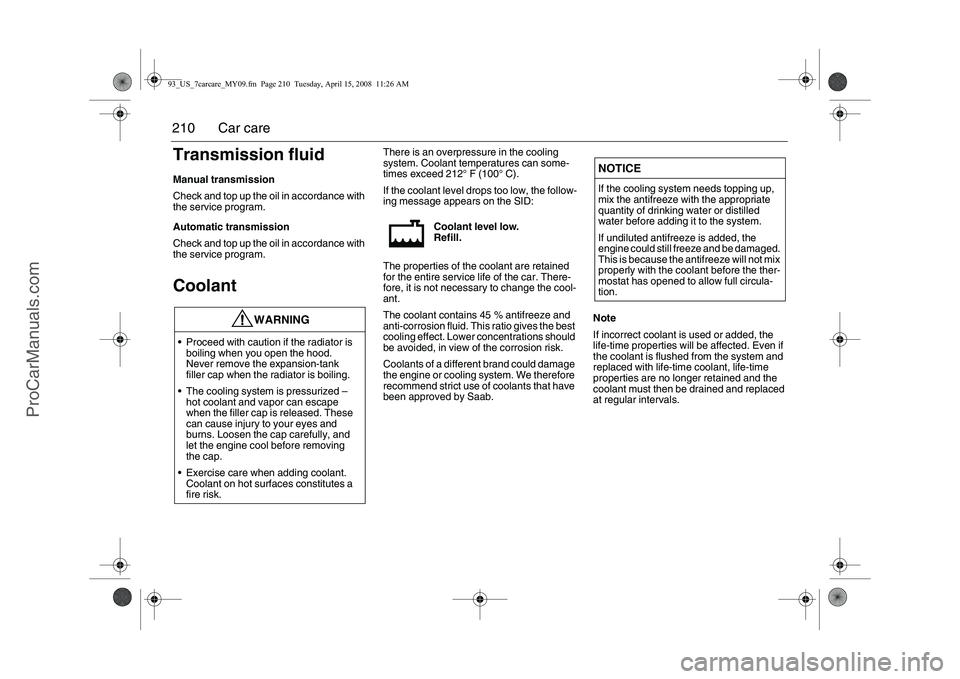
If the coolant level drops too low, the follow-
ing message appears on the SID:
The properties of the coolant are retained
for the entire service life of the car. There-
fore, it is not necessary to change the cool-
ant.
The coolant contains 45 % antifreeze and
anti-corrosion fluid. This ratio gives the best
cooling effect. Lower concentrations should
be avoided, in view of the corrosion risk.
Coolants of a different brand could damage
the engine or cooling system. We therefore
recommend strict use of coolants that have
been approved by Saab. Note
If incorrect coolant is used or added, the
life-time properties will be affected. Even if
the coolant is flushed from the system and
replaced with life-time coolant, life-time
properties are no longer retained and the
coolant must then be drained and replaced
at regular intervals.
WARNING
Proceed with caution if the radiator is
boiling when you open the hood.
Never remove the expansion-tank
filler cap when the radiator is boiling.
The cooling system is pressurized – hot coolant and vapor can escape
when the filler cap is released. These
can cause injury to your eyes and
burns. Loosen the cap carefully, and
let the engine cool before removing
the cap.
Exercise care when adding coolant. Coolant on hot surfaces constitutes a
fire risk.
Coolant level low.
Refill.
NOTICEIf the cooling system needs topping up,
mix the antifreeze with the appropriate
quantity of drinking water or distilled
water before adding it to the system.
If undiluted antifreeze is added, the
engine could still freeze and be damaged.
This is because the antifreeze will not mix
properly with the coolant before the ther-
mostat has opened to allow full circula-
tion.
93_US_7carcare_MY09.fm Page 210 Tuesday, April 15, 2008 11:26 AM
ProCarManuals.com
Page 213 of 304
213
Car care
Brake pads should only be changed at a
workshop. We recommend that you con-
tact a Saab dealer.
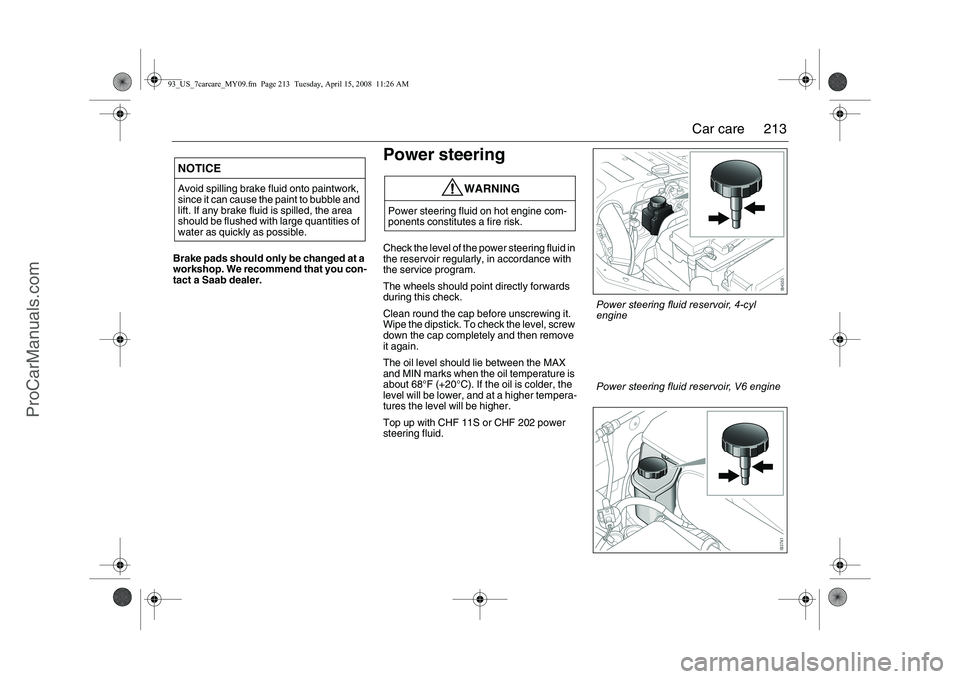
Power steeringCheck the level of the power steering fluid in
the reservoir regularly, in accordance with
the service program.
The wheels should point directly forwards
during this check.
Clean round the cap before unscrewing it.
Wipe the dipstick. To check the level, screw
down the cap completely and then remove
it again.
The oil level should lie between the MAX
and MIN marks when the oil temperature is
about 68°F (+20°C). If the oil is colder, the
level will be lower, and at a higher tempera-
tures the level will be higher.
Top up with CHF 11S or CHF 202 power
steering fluid.
NOTICEAvoid spilling brake fluid onto paintwork,
since it can cause the paint to bubble and
lift. If any brake fluid is spilled, the area
should be flushed with large quantities of
water as quickly as possible.
WARNING
Power steering fluid on hot engine com-
ponents constitutes a fire risk.
Power steering fluid reservoir, 4-cyl
enginePower steering fluid reservoir, V6 engine
93_US_7carcare_MY09.fm Page 213 Tuesday, April 15, 2008 11:26 AM
ProCarManuals.com
Page 250 of 304
250 Car care
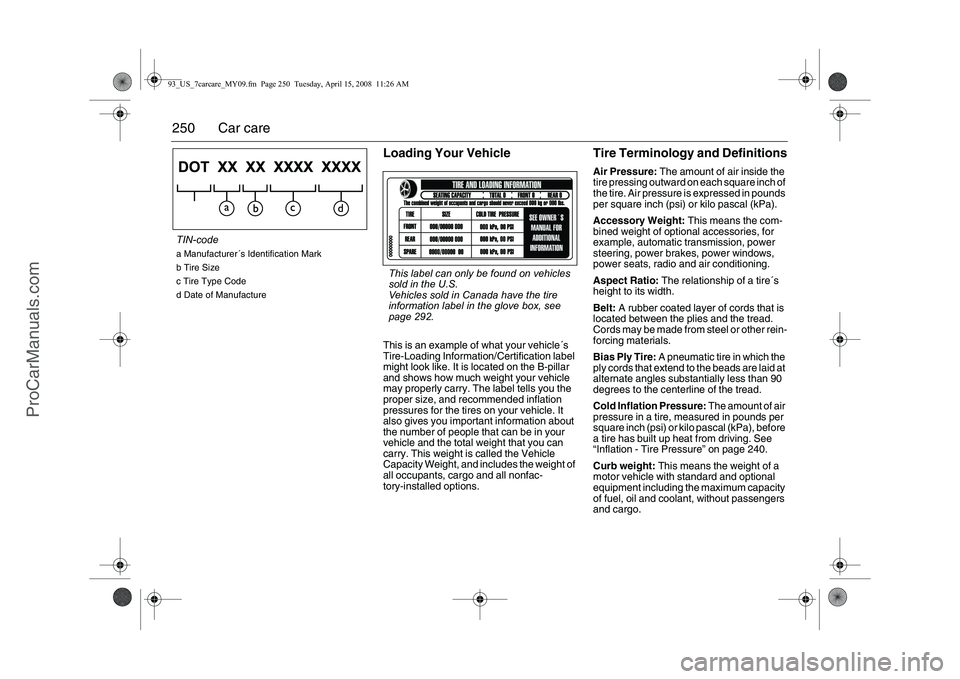
Loading Your VehicleThis is an example of what your vehicle´s
Tire-Loading Information/Certification label
might look like. It is located on the B-pillar
and shows how much weight your vehicle
may properly carry. The label tells you the
proper size, and recommended inflation
pressures for the tires on your vehicle. It
also gives you important information about
the number of people that can be in your
vehicle and the total weight that you can
carry. This weight is called the Vehicle
Capacity Weight, and includes the weight of
all occupants, cargo and all nonfac-
tory-installed options.
Tire Terminology and DefinitionsAir Pressure: The amount of air inside the
tire pressing outward on each square inch of
the tire. Air pressure is expressed in pounds
per square inch (psi) or kilo pascal (kPa).
Accessory Weight: This means the com-
bined weight of optional accessories, for
example, automatic transmission, power
steering, power brakes, power windows,
power seats, radio and air conditioning.
Aspect Ratio: The relationship of a tire´s
height to its width.
Belt: A rubber coated layer of cords that is
located between the plies and the tread.
Cords may be made from steel or other rein-
forcing materials.
Bias Ply Tire: A pneumatic tire in which the
ply cords that extend to the beads are laid at
alternate angles substantially less than 90
degrees to the centerline of the tread.
Cold Inflation Pressure: The amount of air
pressure in a tire, measured in pounds per
square inch (psi) or ki lo pascal (kPa), before
a tire has built up heat from driving. See
“Inflation - Tire Pressure” on page 240.
Curb weight: This means the weight of a
motor vehicle with standard and optional
equipment including the maximum capacity
of fuel, oil and coolant, without passengers
and cargo.
This label can only be found on vehicles
sold in the U.S.
Vehicles sold in Canada have the tire
information label in the glove box, see
page 292.
TIN-codea Manufacturer´s Identification Mark
b Tire Size
c Tire Type Code
d Date of Manufacture93_US_7carcare_MY09.fm
Page 250 Tuesday, April 15, 2008 11:26 AM
ProCarManuals.com
Page 266 of 304
266 Car careSafety beltsCheck the function of the safety belts regu-
larly as follows:
Hold the diagonal strap and pull it sharply. The safety belt should lock and it should
not be possible to withdraw it further.
Check the anchorage points in the floor.
They must not have suffered rust damage.
If a belt is worn or has any fraying edges, it
should be replaced.
Safety belts must not co me into contact with
substances such as polishes, oil or chemi-
cals. If the belts get dirty, wash them with
warm water and a detergent or have them
replaced.
Upholstery and trimTo remove fluff and hairs from the seats,
door armrests and headlining, use a
vacuum cleaner, a moist lint-free cloth, or a
clothes brush. Remove spots and dirt using
a cloth moistened with lukewarm soapy
water.
When using a stain remover, always work
from the outside toward s the center to avoid
leaving a ring. If a soiled ring or spot should
remain, it can usually be removed using
lukewarm soapy water or water alone.
Spots left by liquids, such as soft drinks or
thin oil, must be removed at once with an
absorbent material, such as kitchen towel-
ling. Then clean with a stain remover.
White spirit is recommended for removing
grease and oil stains. A medium stiff brush
may also be used.
Cleaning and caring for leather
upholsteryThe principal reason for treating leather
upholstery is to maintain its elegant appear-
ance and to provide it with a protective film.
Discolor at ion caused by dust and wear
mainly affects the lighter shades, although
this is not detrimental to the leather, indeed,
the patina resulting from use is often consid-
ered desirable in leather. But if the leather is
allowed to become too grubby, it can start to
look shabby. Vacuum the leather regularly
with a soft brush attachment to remove
loose dirt and dust.
The leather upholstery should be cleaned
and reconditioned twice a year in conjunc-
tion with spring and autumn inspections. In
very warm, dry climates the leather may
need more regular reconditioning. Use con-
ventional leather care products. Follow the
instructions on the packaging.
Do not use harsh polishing agents, cleaning
agents, sprays, coarse soap or hot water.
Semi-Anilin is a leather that is colored
throughout which only has a thin protective
finish and is accordingly more sensitive than
a surface colored l eather and therefore
need more care to keep the protection and
ageing properties.
WARNING
If the car is involved in a crash, the safety
belts, belt pretensioners and other asso-
ciated components must be inspected.
We recommend that you contact a Saab
dealer.
Never make any alterations or repairs to
the safety belts your self. We recommend
that you contact a Saab dealer.93_US_7carcare_MY09.fm Page 266 Tuesday, April 15, 2008 11:26 AM
ProCarManuals.com
Page 268 of 304
268 Car careThe underside of the car also needs wash-
ing regularly, and this should be done extra
thoroughly at the end of winter. Clean the
underside of the car by hand if the car is
usually washed in an automatic car wash
without special facilities for underbody
cleaning.
Never wash or leave the car to dry in the
sun, but wipe it dry with a chamois leather
immediately after washing to avoid smears
and streaks.
Clean the inside of window glass using a
proprietary window cleaner. This is particu-
larly important when the car is new, as
upholstery and trim have a tendency to
sweat a little at first.
Keep the glass well polished, as this helps
to prevent misting.
Clean the outside of the windows with Saab
washer fluid. This is especially important if
the car has been washed in an automatic
car wash, as sometimes a wax treatment is
used that can contaminate the windshield
and impair the performance of the wipers.
Saab offers a full co mplement of car care
products. See your dealer or visit us at our
website. Convertible
If a pressure washer is used be heedful of
the following recommendations:
On the lower part of the car (not higher than the door handles): max pressure
of 100 bar and not closer than 8 in.
(20 cm).
On the upper part of the car: tax pres- sure of 100 bar and not closer than
32 in. (80 cm).
Do not use any drying chemicals or water- proofing agents.
Avoid automatic car washes.
WARNING
Read and follow the instructions on the packaging of the recommended
cleaning agents and waterproofing
agents. We recommend that you con-
tact an authorized Saab dealer
regarding recommended cleaning
agents and waterproofing agents.
Never treat the soft top with hot wax or similar.
Never use petrochemical based sol-
vents for cleaning. Only use water with
a recommended cleaning agent. Pet-
rochemical based solvents can cause
irreparable damage to the soft top.
Never use a pressure washer to clean the soft top. Only use normal house-
hold water pressure.NOTICE Only operate the soft top when it is clean and dry.
Do not lower the so ft top when it is
damp. This can cause folds and pres-
sure marks. If the soft top is heavily
soiled, the dirt may cause irreparable
visible chafe marks.
Only use water, recommended clean- ing agents and a microfibre cloth if the
soft top is already damaged, other-
wise the damage can become worse.
At creases, seams and window edges the cleaning motion should be away
from the crease, seam or window
edge in to the soft top.
93_US_7carcare_MY09.fm Page 268 Tuesday, April 15, 2008 11:26 AM
ProCarManuals.com
Page 269 of 304
269
Car care
When the soft top is only slightly soiled,
follow the directions on the cleaning agent
packaging. No brushing is necessary.
Check the soft top for water penetration
from time to time by spraying a small
amount of water on it. If water does not form
droplets but disappear into the material, it is
recommended to wash normally and then
waterproof.
If the soft top is heavily soiled and normal
recommended cleaning does not produce a
noticeable improvement, carry out the fol-
lowing.
The following cleaning method must be only
used if the soft top is heavily soiled and must
not be carried out more than twice a year.
1 Stop normal cleaning.
2 Rinse off the thick dirt thoroughly with water.
3 Spray the newly rinsed soft top with the recommended cleaning agent and allow
it to work in for 15-20 minutes. 4 Move the washing brush backwards and
forwards, not diagonally, from side to
side or in circles. Use a soft brush, like a
clothes brush or a micro fibre cloth so
that the cleaning agent foams. Never
use a wire brush.
5 Then rinse the soft top with warm water and brush using a soft brush in the direc-
tion of the vehicle until all foam has
disappeared. Brush carefully to prevent
damaging the material.
6 Dry the soft top using a clean chamois leather or a cloth that does not leave lint
on the soft top.
7 Allow the soft top to dry fully. Touch with a hand after a while, if the material feels
damp, allow it to dry for longer. 8 If spots are still visible, repeat the treat-
ment on these spots as before. Press
lightly with the brush to prevent damag-
ing the material. Do not use the brush
excessively. This can irreparably
damage the material. Do not repeat the
treatment more than twice.
9 When the soft top has fully dried, it must be waterproofed immediately. Only use
the recommended waterproofing agent.
Follow the instructions on the packag-
ing.
10 To obtain even and optimum waterproof- ing, the car must be closed for 24 hours
after treatment. Do not touch the mate-
rial and do not place any objects on it.
WARNING
Water hotter than 37 °C can burn the skin,
cause skin irritation and/or cause injuries.
Use suitable protection.
93_US_7carcare_MY09.fm Page 269 Tuesday, April 15, 2008 11:26 AM
ProCarManuals.com
Page 271 of 304
271
Car care
Anti-corrosion
treatmentThe entire car undergoes a series of
anti-corrosion processes during production.
These include electr ophoretic priming,
PVC-based coating to protect against stone
chip damage and corrosion, and treatment
of body cavities and members with thin,
penetrating rust-proofing oil.
In addition, most body panels, such as the
hood, doors and floor pan are galvanized.
The anti-corrosion treatment on some parts
of the car is constantly exposed to wear and
prone to damage. This applies particularly
to the underside of the car and inside the
wheel arches, where grit, road salt and the
like that are thrown up can give rise to cor-
rosion where the underseal has worn away.
The extent of this obv iously depends on the
conditions in which the car is used.
Accordingly, make it a habit to hose the
underside of the car often and to inspect the
condition of the underseal. The anti-corro-
sion warranty does not relieve the car owner
of the need to carry out normal maintenance
to the rust-proofing and to make good any
damage. Use a hose to clean the underside of the car
thoroughly. After it has dried, use a brush or
spray to apply a viscous anti-corrosion
agent to any worn or damaged areas, to
prevent the onset of corrosion.
Even after the anti-corrosion warranty has
expired, it makes good sense to continue to
maintain the
rust-proofing.
Seams in the body, especially those in the
doors and trunk lid, are particularly vulnera-
ble to corrosion from the outside, caused by
grit and salt thrown up from the road, and to
corrosion from the inside, largely as a result
of condensation. Keep the seams clean and
at the first sign of any rust, apply a thin, pen-
etrating, anti-corrosion oil. Your Saab
dealer will be pleased to give you further
advice.
What causes rust?Steel body panels of automobiles are sub-
ject to rusting whenever air and moisture
manage to penetrate the protective finish.
Body panels may rust through if the process
is unchecked. Rusting can occur wherever
water is trapped or where the car’s panels
are continuously damp.
Damage to paint and undercoating by
stones, gravel and minor crashes immedi-
ately exposes metal to air and moisture.
Road salts used for de-icing will collect on
the bottom of the car and promote rusting.
Areas of the country with high humidity have
a greater potential for rust problems, espe-
cially where salt is used on roads or there is
moist sea air. Industrial pollution (fallout)
may also damage paint and promote rust-
ing.Preventive maintenanceThe following procedures are necessary to
help protect against rusting. Refer also to
the terms and conditions of the Performa-
tion Limited Warranty described in the war-
ranty booklet. 1 Wash the car freque ntly, and wax at
least twice a year. Under adverse
conditions, where there is a rapid
buildup of dirt, sand or road salt, wash
your car at least once a week. After
extreme exposure to salted snow or
slush, evidenced by a white film on the
car, wash the car immediately. Frequent
93_US_7carcare_MY09.fm Page 271 Tuesday, April 15, 2008 11:26 AM
ProCarManuals.com
Page 273 of 304
273
Car care
Air conditioning (A/C)
TroubleshootingIf a fault occurs in the A/C system, there are
a number of checks you can perform your-
self. If the fault persists, however, have the
system checked at a workshop. We recom-
mend that you contact a Saab dealer.
Note
When the A/C system is running, the intake
air is dehumidified. The resultant condensa-
tion that forms on the evaporator is drained
off under the car. When the car is parked,
this may result in a small puddle forming on
the ground. The warmer the air and the
higher the relative humidity, the more con-
densation will be produced.Inadequate cooling1 Check that the condenser (in front of the radiator) has not become clogged with
dirt and insects.
2 Make sure that the compressor drive belt does not slip (see page 215).
3 Check the fuses for the ventilation fans and compressor (see page 235).
Maintenance The compressor drive belt should be inspected under the regular service
program.
Clean away dirt and insects from the condenser and radiator to prevent clog-
ging. When washing the car, use the hose
to spray the radiator and condenser
(located in front of the radiator) from both
sides (both from the front of the car and
from inside the engine bay). Do not use a
pressure washer.
Caution: Do not hose down the radia-
tor and condenser while the engine is
hot.
Other than in extremely cold weather, do not
screen the radiator, e.g. with netting, as this
will greatly diminish its cooling capacity.
Applicable to the manual climate control system - During cold mo nths the air condi-
tioning should be switched on once or
twice a month and run for 5–10 minutes
during highway driving once the engine is
warm.
This action saves the gaskets in the
compressor from being spoiled. The
WARNING
All repairs and adjustments to the A/C system must be carried out at a Saab
dealer authorized for this kind of work.
The A/C system is pressurized. Do not break any connections or undo A/C
system components.
Escaping gas can cause eye injury or other personal injury.NOTICE The A/C system is designed for use with R134a refrigerant.
Refrigerant handling requires special equipment and special procedures for
charging and draining the system.
Never mix R 134a with other refriger- ants.
NOTICEDo not use a pressure washer when
cleaning the condenser or radiator due to
the risk of damage.
93_US_7carcare_MY09.fm Page 273 Tuesday, April 15, 2008 11:26 AM
ProCarManuals.com
Page 279 of 304
279 Customer Assistance and Information
Engine oil and filter changesChanging the engine oil and filter is required
at every service point. Use only a Saab
approved long-life oil filter and engine oils
meeting the classifications stated in the
Warranty and Service Record Booklet. The
use of extra additives in the oil is not neces-
sary and is not recommended, and may be
harmful to turbochargers.
More frequent oil changes are recom-
mended if your vehicle is operated under
any of the following conditions:
Most trips are less than 5–10 miles (8–
16 km). This is particularly important
when outside temperatures are below
freezing.
Most trips include extensive idling
(frequent stop-and-go traffic).
Most trips are through dusty areas (such
as construction zones).
If the vehicle is used for delivery service,
police, taxi or other commercial applica-
tions.
If your driving habits match this description,
have the engine oil and filter changed in-
between normal services. These conditions
cause the engine oil to break down faster.
The Warranties and Service Record Book-
let has provisions to record extra oil
changes.
Service record retentionIt is the owner’s responsibility to retain ser-
vice records. If possible, you should keep
copies of all shop work orders for all service
and repairs, whenever performed. As indi-
cated in the new car and emission control
system warranties, it is important to docu-
ment that all necessary maintenance has
been done.
HOW THE SERVICE RECORD IS ORGA-
NIZED
The service record is comprised of a series
of coupons on which to record services as
they are performed. There are additional
coupons for documenting extra engine oil
and filter changes, extra automatic trans-
mission fluid services necessary for severe
service conditions, and brake fluid changes.
HOW TO USE THE SERVICE RECORD
COUPONS
When the car is brought to a Saab dealer for
scheduled maintenance, present the War-
ranties & Service Record Booklet to the ser-
vice manager. When the technician has
completed the service, the technician will
sign the maintenance record. The person
responsible for quality assurance at the
dealership will also sign and stamp the
record with the dealer identification stamp.
Service costsDealer pricing practices and labor for ser-
vice work vary. Saab’s recommended ser-
vice times for each service point do not
include the labor required to replace wear
items, such as wiper blades, brake pads or
tires. Nor is labor to perform other service or
repairs found to be necessary as a result of
the inspections included in these times.
Additional labor and parts will be charged
for such work when necessary, except as
covered under an applicable Saab warranty
or any optional extended service contract.
Transmission fluid changes or suspension
alignment, when necessary, are also addi-
tional.
Dealer charges for general shop material,
regulated hazardous waste removal, recy-
cling expenses or other operation costs may
also be applied to service and repair
invoices and are apt to vary by dealer and
location.
93_US_MY09.book Page 279 Tuesday, April 15, 2008 10:30 AM
ProCarManuals.com
Page 283 of 304
283 Technical data
General data __________ 284
Engine _______________ 286
Engine oil _____________ 286
Fuel__________________ 287
Engines ______________ 287
Electrical system_______ 287
Brake system__________ 287
Wheels and tires _______ 288
Plates and labels _______ 292
Technical data
3Asterisk means: equipment not fitted in all cars
(can depend on model variant, engine variant,
market specification, options or accessories).93_US_MY09.book Page 283 Tuesday, April 15, 2008 10:30 AM
ProCarManuals.com