power steering fluid SAAB 9-5 2002 Owners Manual
[x] Cancel search | Manufacturer: SAAB, Model Year: 2002, Model line: 9-5, Model: SAAB 9-5 2002Pages: 272, PDF Size: 16.26 MB
Page 6 of 272
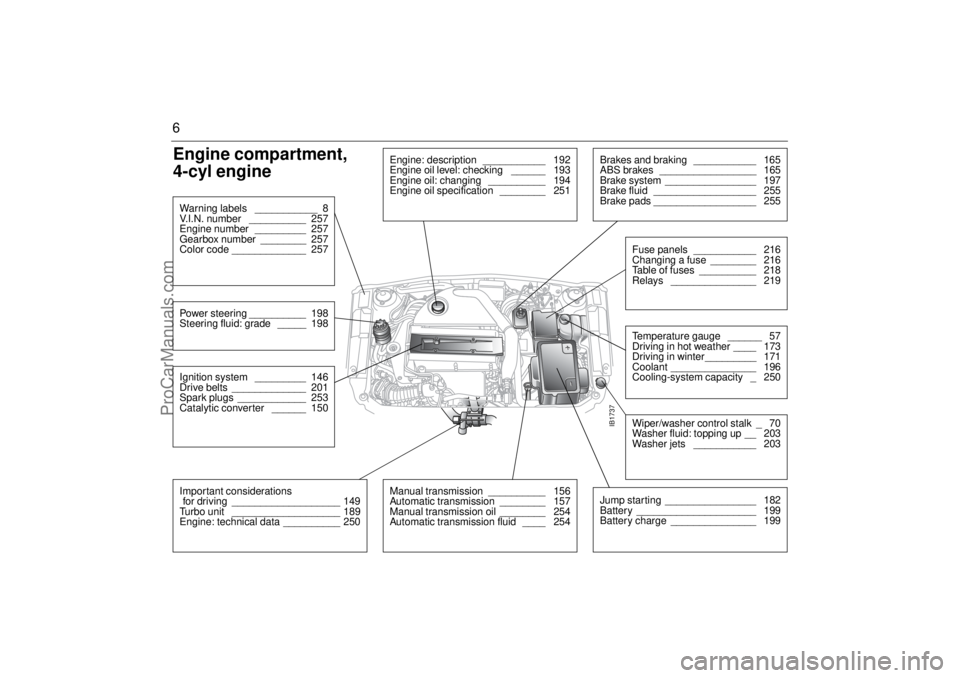
6Engine compartment,
4-cyl engine
IB1737
Engine: description ___________ 192
Engine oil level: checking ______ 193
Engine oil: changing __________ 194
Engine oil specification ________ 251
Brakes and braking ___________ 165
ABS brakes _________________ 165
Brake system ________________ 197
Brake fluid __________________ 255
Brake pads __________________ 255
Fuse panels ___________ 216
Changing a fuse ________ 216
Table of fuses __________ 218
Relays _______________ 219Temperature gauge ______ 57
Driving in hot weather ____ 173
Driving in winter_________ 171
Coolant _______________ 196
Cooling-system capacity _ 250
Power steering __________ 198
Steering fluid: grade _____ 198
Wiper/washer control stalk _ 70
Washer fluid: topping up __ 203
Washer jets ___________ 203
Jump starting ________________ 182
Battery _____________________ 199
Battery charge _______________ 199
Manual transmission __________ 156
Automatic transmission ________ 157
Manual transmission oil ________ 254
Automatic transmission fluid ____ 254
Important considerations
for driving ___________________ 149
Turbo unit ___________________ 189
Engine: technical data __________ 250Ignition system _________ 146
Drive belts _____________ 201
Spark plugs ____________ 253
Catalytic converter ______ 150Warning labels ___________ 8
V.I.N. number __________ 257
Engine number _________ 257
Gearbox number ________ 257
Color code _____________ 257
ProCarManuals.com
Page 7 of 272
7
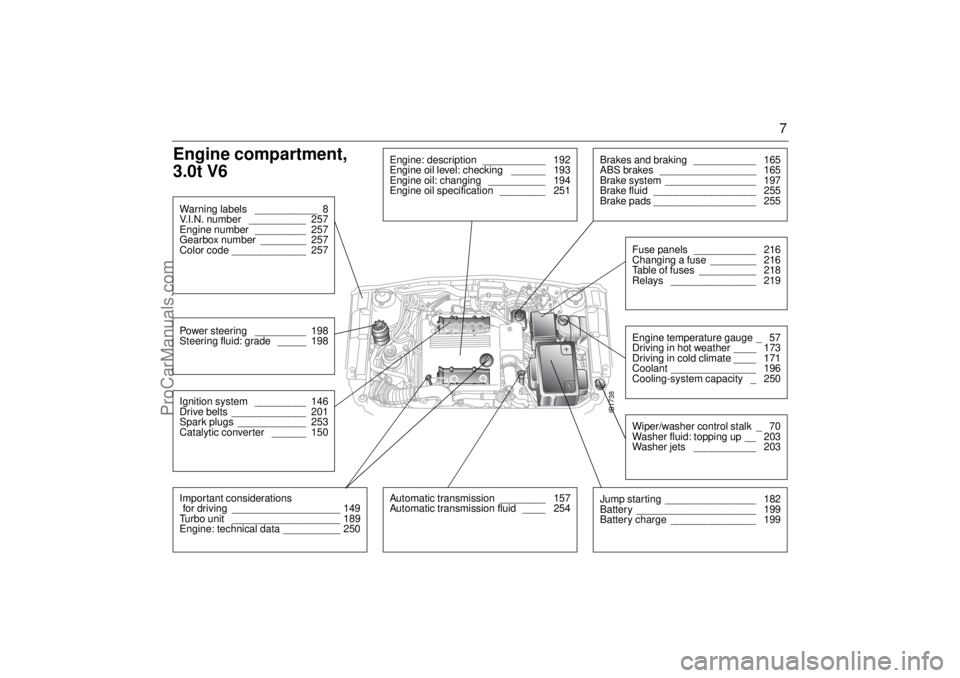
Engine compartment,
3.0t V6
IB1738
Warning labels ___________ 8
V.I.N. number __________ 257
Engine number _________ 257
Gearbox number ________ 257
Color code _____________ 257Ignition system _________ 146
Drive belts _____________ 201
Spark plugs ____________ 253
Catalytic converter ______ 150Important considerations
for driving ___________________ 149
Turbo unit ___________________ 189
Engine: technical data __________ 250
Automatic transmission ________ 157
Automatic transmission fluid ____ 254
Brakes and braking ___________ 165
ABS brakes _________________ 165
Brake system ________________ 197
Brake fluid __________________ 255
Brake pads __________________ 255Jump starting ________________ 182
Battery _____________________ 199
Battery charge _______________ 199
Fuse panels ___________ 216
Changing a fuse ________ 216
Table of fuses __________ 218
Relays _______________ 219Engine temperature gauge _ 57
Driving in hot weather ____ 173
Driving in cold climate ____ 171
Coolant _______________ 196
Cooling-system capacity _ 250
Power steering _________ 198
Steering fluid: grade _____ 198
Wiper/washer control stalk _ 70
Washer fluid: topping up __ 203
Washer jets ___________ 203
Engine: description ___________ 192
Engine oil level: checking ______ 193
Engine oil: changing __________ 194
Engine oil specification ________ 251
ProCarManuals.com
Page 51 of 272

51 Instruments and controls
Warning, charging
This light will come on together with if
the battery is discharging. If it comes on
while you are driving, stop the car as soon
as possible and switch off the engine.
Check the alternator drive belt (see page
201). If the belt has broken, the engine may
overheat (cooling system will not function
properly), the battery will not be charged,
the A/C compressor will not run and power
assistance for the steering will be lost.
Brake warning light
This light will come on together with if
there is insufficient brake fluid in the reser-
voir (see pages 197 / 197).
If the ABS warning light is on at the same
time, the ABS system may be inoperative
because of a fault (see ”Anti-lock brake
warning”, page 52).
Parking brake warning
light
This light will show when the parking brake
is on (see page 185).
If the car is driven with the parking brake still
on, will also come on and a chime will
sound.
The parking brake is mechanical and oper-
ates on the rear wheels.
WARNING
Never drive the car when these warning
lights are on. Danger of brake failure!
Have the brake system checked by an
authorized Saab dealer.
WARNING
Always apply the parking brake when
parking, see page 185.
Always apply the parking brake before
removing the ignition key.
Do not apply the parking brake while
the car is moving.
ProCarManuals.com
Page 187 of 272
187 Car care and technical information
Car care and
technical
information
772
Hood release handle ....... 188
Engine compartment,
4-cyl. engine ................... 189
Engine compartment,
6-cyl. (3.0t V6)................. 190
Emission control systems 191
Engine............................... 192
Engine oil ......................... 193
Transmission fluid........... 195
Coolant ............................. 196
Brake and clutch fluid ..... 197
Power steering fluid ........ 198
Air filter ............................. 198 Battery .............................. 199
Drive belts ........................ 201
Wipers and washers ....... 202
Changing bulbs ............... 204
Fuses ................................ 216
Wheels .............................. 222
Compact spare wheel ..... 226
Flat spotting..................... 230
Air conditioning (ACC) ... 231
Safety belts ...................... 232
Upholstery and trim ........ 232
Textile carpeting.............. 232
Washing the car .............. 233 Waxing and polishing ...... 233
Engine compartment ....... 233
Touching up the paint ..... 234
Anti-corrosion treatment . 235
For long trips .................... 237
Recovery and/or recycling
of automotive materials. 237
Headlight aiming .............. 239
ProCarManuals.com
Page 189 of 272
189 Car care and technical information
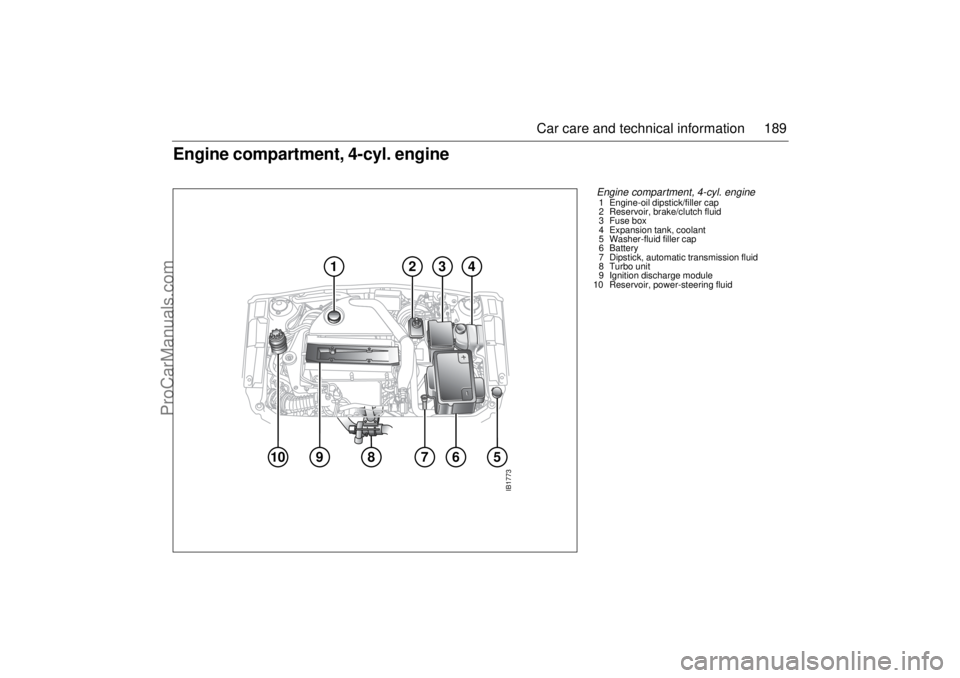
Engine compartment, 4-cyl. engine
10
9
6
7
8
1
2
4
3
5
IB1773
Engine compartment, 4-cyl. engine 1 Engine-oil dipstick/filler cap
2 Reservoir, brake/clutch fluid
3 Fuse box
4 Expansion tank, coolant
5 Washer-fluid filler cap
6Battery
7 Dipstick, automatic transmission fluid
8 Turbo unit
9 Ignition discharge module
10 Reservoir, power-steering fluid
ProCarManuals.com
Page 190 of 272
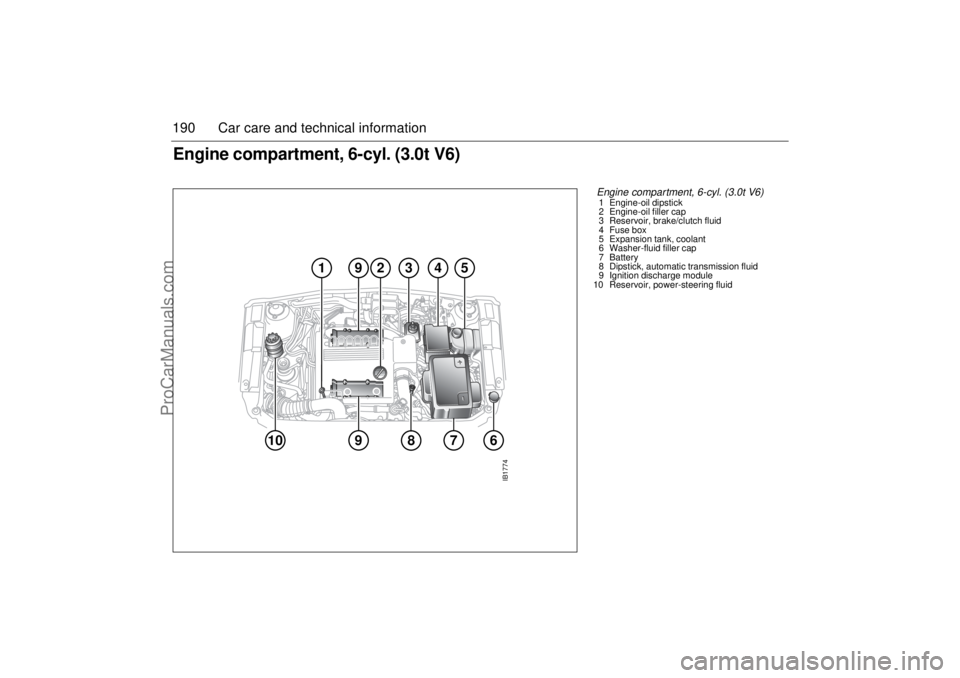
190 Car care and technical informationEngine compartment, 6-cyl. (3.0t V6)
99
2
1
4
57
6
10
83
IB1774
Engine compartment, 6-cyl. (3.0t V6) 1 Engine-oil dipstick
2 Engine-oil filler cap
3 Reservoir, brake/clutch fluid
4 Fuse box
5 Expansion tank, coolant
6 Washer-fluid filler cap
7Battery
8 Dipstick, automatic transmission fluid
9 Ignition discharge module
10 Reservoir, power-steering fluid
ProCarManuals.com
Page 198 of 272

198 Car care and technical informationPower steering fluidCheck the level of the power steering fluid in
the reservoir regularly, in accordance with
the service program.
The wheels should point forward during the
check.
Clean around the cap before it is
unscrewed. Clean the dipstick. Screw in the
cap completely again before checking the
level.
The oil should lie between the MAX and MIN
marks when the oil temperature is about
70°F (+20°C). If the oil is colder the level can
be lower, and in higher temperatures the
level can be higher, both of which are
acceptable.
Top up with ”Power Steering Fluid
CHF 11S” (part number 8996860).
Air filter
WARNING
Do not fill the power steering fluid to
above the MAX mark. Too much fluid can
result in leakage.
Power steering fluid on hot engine com-
ponents constitutes a fire risk.
WARNING
For Service and Repair, parts equivalent
to those used by Saab should be used.
Be aware that some non standard
replacement parts may put you in an
unsafe condition, even if they might fit.
IB501
Power steering fluid reservoir
ProCarManuals.com
Page 237 of 272

237 Car care and technical information
4Inspect the undercoating and touch
up if necessary.
Pay particular atten-
tion to the fenders and wheel housings,
which are exposed to abrasion by flying
gravel, etc. If the composition has worn
or flaked off, the steel must be thor-
oughly cleaned and dried before a fresh
coat is applied. The cleaning is best
done with a scraper and a steel wire
brush, followed by washing with solvent.
Apply the new coating thinly, as other-
wise it may run off or fall off when dry.
For long tripsBefore setting off on a long journey, it is
advisable to have your car checked over by
your Saab dealer.
Obtain a few important items to take along
on your journey such as spare bulbs, wiper
blades, fuses, a Poly-V-belt and the like.
You can check some points yourself before-
hand:
Make sure that the engine is in good con-
dition.
Check that no oil or gasoline leaks out of
the engine or gearbox/transmission.
Check the coolant and power steering
fluid levels. Check also for leaks.
Inspect the Poly-V-belt and replace it if it
shows any signs of hard wear.
Check the battery charge.
Check the tires for tread pattern and air
pressure, including the compact spare
wheel.
Check the brakes.
Check all bulbs.
Check for the presence of the tool kit and
the jack in the car.
Recovery and/or
recycling of automotive
materialsA typical car consists of metals (65–75%),
plastics (10–14%), rubber (5%) and small
quantities of glass, wood, paper and tex-
tiles.
Some of these materials can be recycled,
while others can be recovered in chemical
processes for reuse in new products or as a
source of energy.
While the Saab 9-5 was still at the draw-
ing-board stage, Saab engineers were
giving serious consideration to how the
maximum quantity of materials could be
reclaimed from the car on its eventual
scrapping. To facilitate sorting, plastic parts,
for instance, have been marked to identify
the precise nature of the plastic.
Approximately 90% of the materials in the
car can be recycled or recovered, where
facilities exist.
Before the car is scrapped, all the oils and
other fluids that could pollute the environ-
ment should be recovered from the car. It
may be of interest in this context to learn that
the refrigerant used in the Saab 9-5’s ACC
systems (R134a) contains neither CFCs nor
any other chlorine compounds.
ProCarManuals.com
Page 255 of 272

255 Specifications
Suspension
SteeringBrake systemSpring type, front and rear ___________ Coil springs
Maximum deflection of springs:
Front __________________________ 7.09 in (180 mm)
Rear ___________________________ 7.87 in (200 mm)
Dampers, front and rear _____________ Gas-filled dampers
Steering _________________________ Power-assisted
steering of
rack-and-pinion
type; telescopic
steering-column
shaft with universal
joints
Number of turns, lock to lock __________ 2,9
Power-steering fluid ________________ Power-steering
fluid CHF 11S Footbrake (ABS) ____________________ Hydraulic disc
brakes with vacuum
servo unit. Diago-
nally split circuits;
ventilated discs on
front wheels. EBD
function, see page
165.
Handbrake ________________________ Acts on rear wheels
Brake fluid _________________________ DOT 4
Brake-fluid capacity _________________ 0.925 qts (900 ml)
Disc diameter:
Front ___________________________ 11.34 in (288 mm)
Front, certain variants *) _____________ 12.05 in (306 mm)
Rear ___________________________ 11.26 in (286 mm)
Rear, certain variants *) _____________ 11.81 in (300 mm)
*) 15” wheel must not be used on these
variants.
Total friction area of brake pads:
Front ___________________________ 36.3 in
2 (234 cm
2)
Rear ___________________________ 15.5 in
2 (100 cm
2)
ProCarManuals.com
Page 263 of 272

263 Index
Light switches
___________________ 65
Luggage-compartment lighting
______ 69
MMain instrument panel
_____________ 50
Main/dipped beam
_______________ 65
Maintenance schedule ___________ 244
Manual gearbox, technical data
____ 254
Maxi fuses
_____________________ 217
Milometer ______________________ 56
Motoring abroad
________________ 237
NNight Panel
_____________________ 63
OOil capacity, engine
______________ 250
Oil change, engine ______________ 194
Oil specification
_________________ 250
OnStar
________________________ 105
Outdoor temperature
______________ 59
Owner assistance
_______________ 245
PPaintwork, touching-in
____________ 234
Parking Assistance
______________ 184
Parking lights
___________________ 65
Plates and labels ________________ 257
Poly-V-belt
____________________ 201Power steering
_________________198
Power-steering fluid
_____________198
Pressure gauge
__________________58
Programming I, ACC
______________78
Programming II, ACC _____________79
Programming the ACC ____________78
QQuestions on function of airbag
_____35
Quick guide, Audio System
_________85
RRadio
__________________________88
Rain sensor
_____________________70
Rear fog light ____________________66
Rear seat, 9-5 Sedan, folding
______132
Rear seat, 9-5 Wagon, folding _____135
Rear-seat head restraints
__________18
Rear-view mirror, antidazzle _______124
Rearview mirrors
________________123
Reclamation
___________________237
Recommendations for cars with
automatic transmission,
towing a caravan or trailer
________174
Refuelling
_____________________152
Relay panel ____________________219
Remote control __________________38
Remote-control battery, changing
____40
Remove the key
________________146
Reporting safety defects
__________246Reprogramming of systems
______ 259
Reservoir, power-steering fluid ____ 198
Rev counter
____________________ 56
Reversing lights
_________________ 68
Roof load
_____________________ 176
Running-in ____________________ 170
SSID
__________________________ 59
SRS (airbag)
___________________ 29
SRS, supplementary restraint system
29
Saab 9-5 Audio System
___________ 83
Saab Information Display (SID)
_____ 59
Saab Parking Assistance
________ 184
Safety belts
____________________ 12
Safety belts, care of
_____________ 232
Safety-belt pretensioners
_________ 13
Safety-belt reminder
_____________ 12
Seats
________________________ 118
Securing a load
_________________ 41
Selector lever indication,
automatic transmission
__________ 59
Service costs
__________________ 245
Service information
_____________ 246
Service intervals
_______________ 244
Service record retention
_________ 245
Settings, seats
_________________ 118
Side airbags
___________________ 32
Signalling, horn ________________ 122
Sliding floor, 9-5 Wagon
_________ 140
Snow chains
__________________ 171
ProCarManuals.com