service SAAB 9-5 2004 Owner's Manual
[x] Cancel search | Manufacturer: SAAB, Model Year: 2004, Model line: 9-5, Model: SAAB 9-5 2004Pages: 288, PDF Size: 16.91 MB
Page 150 of 288

150 Starting and drivingIt is possible for air to enter the lubricating
system in conjunction with an oil or oil-filter
change, or if the car has been stored for
some time. This air can cause the hydraulic
cam followers to emit a ticking noise, which
can persist for up to 15 minutes after start-
ing. Although this is quite normal and does
not indicate any malfunction, it is advisable
not to exceed 3,000 rpm before the noise
has disappeared.
The hydraulic cam lifters are completely
service free; the valve clearance is set up at
the factory and will not need any subse-
quent adjustment.
Starting the engineAvoid racing the engine or putting a heavy
load on it before it has warmed up. Drive
away as soon as the oil warning light has
been extinguished to enable the engine to
attain its normal temperature as quickly as
possible.
The engine has an automatic choke and
should be started as follows:
Cars with manual transmission
To start the engine the clutch pedal must
be fully depressed.
1 Depress the clutch pedal fully but do not
touch the accelerator.
2 Start the engine. Let the ignition key
spring back as soon as the engine has
started and is running smoothly – at very
low temperatures, you may need to run
the starter for up to 25 seconds. Wait
20–30 seconds before running the
starter again, to give the battery time to
recover.
Note:
On cars with manual transmission, if the
starter fails to engage when the ignition key
is turned to the start position, make sure the
clutch pedal is full depressed. Misposi-
tioned floor mats or other obstructions
under the clutch pedal may affect starting.
Let the engine idle for about 10 seconds. Do
not open the throttle wide for at least 2–
3 minutes after starting. Cars with automatic transmission
1 The selector lever must be in the P or N
position.
2 Keep your foot on the brake pedal.
3 Start the engine. Let the ignition key
spring back as soon as the engine has
started and is running smoothly – at very
low temperatures, you may need to run
the starter for up to 25 seconds. Wait
20–30 seconds before running the
starter again, to give the battery time to
recover.
Let the engine idle for about 10 seconds. Do
not open the throttle wide for at least
2–3 minutes after starting.
Useful tips on cold climate starting If the engine has failed to start after several
attempts in very cold weather, press and
hold the accelerator down to the floor and
run the starter for 5–10 seconds. This will
prevent the engine being flooded (exces-
sively rich fuel-air mixture).
Now start the engine in the normal way – do
not touch the accelerator.
If the engine stalls immediately after starting
(e.g. if the clutch was released too quickly),
do not touch the accelerator when restarting
the engine. The tail pipe of the exhaust system
can become very hot during driving.
Bear this in mind when loading and
unloading the car.
Do not rest or sleep in the car when
parked with the engine running. There
is a risk of depressing the accelerator
which could lead to engine damage.
ProCarManuals.com
Page 152 of 288

152 Starting and driving
One of the advantages of the system is
that it enables the engine to be run
safely on lower-grade fuel, although not
lower than AON 87.
The maximum boost pressure is
adjusted automatically to the knocking
or pinging tendency of the engine.
Occasional, short-lived knocking when
the engine is under a heavy load is per-
fectly normal; the extent will depend on
the grade of fuel in the tank.
Isolated instances of knocking are
more likely to occur with low-octane
fuel. This controlled form of knocking,
followed by a reduction in the boost
pressure, is a sign that the wastegate is
functioning and is perfectly safe for the
engine.
Important considerations with cata-
lytic convertersThe catalytic converter is an emission-con-
trol device incorporated in the car’s exhaust
system. It consists of a metal canister with a
honeycomb insert, the cells of which have
walls coated in a catalytic layer (mixture of
precious metals).
To ensure that the catalytic converter con-
tinues to function properly, and also to avoid
damage to the converter and its associated
components, the following points must be
observed:
Have the car serviced regularly in accor-
dance with the service program. The fuel
and ignition systems are particularly
important in this context.
Always be alert to any misfiring of the
engine (not running on all cylinders) and
any loss of power or performance. At the
first sign of a malfunction, reduce speed
and take the car to an authorized Saab
dealer as soon as possible.
If the engine fails to start (in very cold
weather or if the battery is flat), the car can
be push started (manual gearbox only) or
started using jumper cables to a donor
NOTICE If the engine sounds strange there is a
fault in the system. Have the car
checked without delay by an autho-
rized Saab dealer.
The use of fuel with too low an octane
rating can cause serious engine dam-
age.
WARNING
If the engine is being run with the car on a
rolling road or dynamometer, longer than
for a standard state emission inspection,
to ensure adequate cooling, air must be
blown into the engine compartment and
under the car at a rate equivalent to the
ram-air effect that would be obtained at
the corresponding road speed.
NOTICEUse only unleaded gasoline. Leaded gas-
oline is detrimental to the catalyst and
oxygen sensor and will seriously impair
the function of the catalytic converter.
ProCarManuals.com
Page 155 of 288

155 Starting and driving
Opening the fuel filler door in an emergency,
see page 146.
Recommended fuel:The engine in your Saab 9-5 is designed to
operate on unleaded gasoline that has an
octane rating of 87 or higher. Octane rating
is determined according to the formula:
where MON is the Motor Octane Number,
and RON is the Research Octane Number.
The average of these two values is the
octane rating of the gasoline as it appears
on the pump at a retail gas station. This
value is sometimes referred to as the
"Anti-Knock Index" (AKI) or the "Average
Octane Number" (AON).
To avoid deposit formation on the fuel injec-
tors which can cause poor driveability, use
only quality gasolines that contain deter-
gents and corrosion inhibitors. Because
gasolines sold at retail gas stations vary in
their composition and quality, you should
switch to a different brand if you begin expe-
riencing driveability and/or hard starting
problems shortly after refueling your car. In
recent years, a variety of fuel additives and
alcohols or oxygenates have been blended
with gasoline. These types of gasolines may
be found in all parts of the United States and
Canada, but particularly in geographic
areas and cities that have high carbon mon-
oxide levels. Saab approves the use of such
"reformulated" gasolines in its products,
which help in reducing pollution from all
motor vehicles, provided that the following blending percentages are met by such
fuels:
Up to 10 % ethanol by volume, with corro-
sion inhibitors.
Up to 15 % MTBE by volume (methyl ter-
tiary butyl ether).
Up to 5 % methanol by volume, with an
equal amount of a suitable co-solvent and
added corrosion inhibitors.
Other, less common, fuel additives used by
some gasoline dealers are also acceptable,
provided that the resultant gasoline is not
more than 2.7 % oxygen by weight.
Some Canadian and U.S. gasolines contain
an octane enhancing additive called meth-
lycyclopentadienyl manganese tricarbonyl
(MMT). If such fuel is used, your emission
control system performance may deterio-
rate and the malfunction indicator lamp on
your instrument panel may turn on. If this
occurs, return to your authorized Saab
dealer for service.
However, these blended gasolines are reg-
ulated and should never exceed these rec-
ommended blend percentages and service
station operators should know if their gaso-
lines contain detergents and oxygenates,
and have been reformulated to reduce vehi-
cle emissions. Nevertheless, if you begin to
notice a problem with the way your car starts
or runs shortly after it has been refueled, try
a different brand of gasoline.
NOTICE Fill to maximum filling capacity
Stop filling after the first time that the
nozzle trips to shut off the flow of fuel.
Filling capacity can differ between
different fuel stations and outside
temperature. Fuel tank volume when
nozzle trips to shut off, may vary by
0.5 gal. (2 liters).
Do not fill fuel all the way up the filler
pipe. The gasoline must be allowed
room for expansion especially during
hot weather.
MON + RON
2
ProCarManuals.com
Page 156 of 288
156 Starting and driving
Fuel (Gasoline Engine)Use regular unleaded gasoline rated at 87
octane or higher. Use of gasoline with an
octane rating lower than 87 can result in
severe engine damage. Damage caused by
incorrect fuel being used is not covered
under the terms of the New Car Warranty
and will be the responsibility of the owner. It
is recommended that the gasoline meet
specifications which were developed by the
American Automobile Manufacturers Asso-
ciation (AAMA) and endorsed by the Cana-
dian Motor Vehicle Manufacturers Associa-
tion for better vehicle performance and
engine protection. Gasolines meeting the
AAMA specification could provide improved
driveability and emission control system
performance compared to other gasolines.
Be sure the posted octane is at least 87. If
the octane is less than 87, you may get a
heavy knocking noise when you drive. If it’s
bad enough, it can damage your engine. If
you’re using fuel rated at 87 octane or
higher and you hear heavy knocking, your
engine needs service. But don’t worry if you
hear a little pinging noise when you’re accel-
erating or driving up a hill. That’s normal,
and you don’t have to buy a higher octane
fuel to get rid of pinging. It’s the heavy, con-
stant knock that means you have a problem.
NOTICEHigher concentrations of methanol than
listed above, or the use of methanol-
blended gasoline without suitable
co-solvents and corrosion inhibitors,
can damage your car’s fuel system,
leading to the need for repairs which are
not covered by Saab’s product warranty.
NOTICEThe engine control module (ECM) mon-
itoring the engine parameters also
stores fault codes.
Under certain circumstances, this may
cause constant illumination of the
”Engine malfunction (CHECK
ENGINE)” lamp , thus indicating a
fault that must be checked by your Saab
dealer, see page 57.
NOTE: always observe the following two
measures:
Make sure that the fuel filler cap is
screwed on correctly before the
engine is started. Screw on the fuel
filler cap until you hear 3 distinct
clicks.
Avoid driving with the fuel low level
indicator illuminated. The symbol
illuminates when less than approxi-
mately 2 gallons (8 litres) of fuel
remains in the tank.
In Canada, look for the
”Auto Makers’ Choice” label
on the fuel pump.
ProCarManuals.com
Page 157 of 288

157 Starting and driving
If your vehicle is certified to meet California
Emission Standards (indicated on the
underhood emission control label), it is
designed to operate on fuels that meet Cali-
fornia specifications. If such fuels are not
available in states adopting California emis-
sions standards, your vehicle will operate
satisfactorily on fuels meeting federal spec-
ifications, but emission control system per-
formance may be affected. The ”Engine
malfunction (CHECK ENGINE)” indicator
on your main instrument panel may turn on
and/or your vehicle may fail a smog-check
test. See ”Engine malfunction (CHECK
ENGINE)” indicator on page 57. If this
occurs, return to your authorized Saab
dealer for diagnosis to determine the cause
of failure. In the event it is determined that
the cause of the condition is the type of fuels
used, repairs may not be covered by your
warranty. Some gasolines that are not reformulated
for low emissions may contain an
octane-enhancing additive called methylcy-
clopentadienyl manganese tricarbonyl
(MMT); ask your service station operator
whether or not the fuel contains MMT. Saab
Automobile AB does not recommend the
use of such gasolines. If fuels containing
MMT are used, spark plug life may be
reduced and your emission control system
performance may be affected. The malfunc-
tion indicator lamp on your instrument panel
may turn on. If this occurs, return to your
authorized Saab dealer for service.
Engine Break-In PeriodPistons, bores and bearings need time to
obtain uniform, wear-resistant surfaces.
If a new engine is driven too hard, this grad-
ual process of bedding-in will not be possi-
ble and the life of the engine will be short-
ened.
During the first 1,200 miles (2,000 km), do
not exceed 5,000 rpm.
In addition, refrain from driving the car at full
throttle, other than for brief instances,
during the first 1,800 miles (3,000 km). Wearing in new brake padsNew brake pads take time to bed in, about
90 miles (150 km) if the car is driven largely
under stop-and-go conditions or about
300 miles (500 km) of highway driving.
To extend the useful life of the pads, avoid
hard braking as much as possible during
this period.
ProCarManuals.com
Page 162 of 288
162 Starting and driving
Overheated transmission fluid If the automatic-transmission fluid should
overheat, the following message will appear
on the SID:
”Gearbox too hot. Make a safe stop.”. In this
event, stop the car in a suitable place,
switch off the engine and open the hood.
Wait for several minutes then turn on the
ignition to check that the message has gone
out. When driving subsequent to the trans-
mission fluid overheating, select a gear in
which the engine speed is about 3,000 rpm.
Overheating of the automatic-transmission
fluid can occur when the car is towing a
heavy load, such as a camping trailer in hilly
country. High ambient temperatures can
also increase the temperature of the trans-
mission fluid or the oil cooler may be faulty.
Contact an authorized Saab dealer (see
also page 178).
Driving on hilly roads with a heavy
loadThe transmission fluid can overheat when
the gearbox is strained, for example, when
driving with a trailer on hilly roads. To avoid
the transmission fluid overheating, always
drive in Normal mode. The adaptive gear
change patterns are then active.
High air temperatures or a faulty oil cooler
can also cause the transmission fluid to
overheat. Overheating reduces the service
life of the fluid. Contact an authorized Saab
dealer (see also page 178). Towing Towing of cars with automatic transmission,
see page 188.
NOTICEIf the control module has actuated the
Limp-home function for the automatic
transmission, the car will remain in 5th
gear when D is selected, making it very
sluggish.
Select position L to prevent unnecessary
wear on the transmission. The transmis-
sion then starts in 2nd gear. Once the car
is moving you can select position D.
When the indicator light is on, the car
must not be driven with a caravan or
trailer attached.
WARNING
Remember to use engine-braking (selec-
tor position D or L) to spare the brakes
when you are driving on a long or steep
downhill slope.
Brake failure can result from overheated
brakes!
ProCarManuals.com
Page 175 of 288
175 Starting and driving
a major impact on fuel consumption after
the engine has started from cold. Thus, if the
car is mainly used for short journeys of
3–5 miles (5–8 km), the fuel consumption
will be 60–80 % higher than normal.Driving technique To obtain the best running economy, not
only regarding fuel consumption but gen-
eral wear also, regular service is required.
High speed, unnecessary acceleration,
heavy braking and much low gear work all
gives rise to higher fuel consumption.
Frequent gear changing in traffic, starting
in cold weather, the use of studded tires
and roof racks, and towing a trailer all
increase fuel consumption.
Do not run the engine when the car is sta-
tionary.
If idling, it will take much longer before the
engine becomes hot. Engine wear is
greatest during this warming-up phase.
Therefore drive away as soon as possible
after the engine is started and avoid high
revving. Driving in a low gear results in higher fuel
consumption than in a high gear because
of the higher engine speed for a given
road speed. Always change up to a higher
gear as soon as traffic conditions allow
and use the highest gear as much as pos-
sible.
Check the air pressure in the tires once a
month. Incorrect pressures increase tire
wear. It is better to have slightly higher
pressure than lower.
Check fuel consumption regularly.
Increased consumption can indicate that
something is wrong and that the car
needs to be checked by an authorized
Saab dealer.
Practical trials on the roads have demon-
strated that substantial savings in fuel con-
sumption can be made if the above advice
is heeded.
Road conditions Wet roads increase fuel consumption, as do
unpaved roads and driving in hilly country
(the amount of fuel saved driving downhill is
less than the additional amount required to
climb the hill).
WARNING
Never switch the engine off while driving
as the effect of the brakes and power
steering will be greatly reduced.
ProCarManuals.com
Page 193 of 288
193 Starting and driving
9 Attach the cable at least 18 inches
(45 cm) away from the discharged bat-
tery, but not near engine parts that
move. To avoid an arc which could deto-
nate the hydrogen gas around the bat-
tery, the final connection must be at least
18” from the battery.
10 Start the vehicle with the good battery
and run the engine for a while.
11 Try to start the vehicle with the dis-
charged battery. If it does not start after
a few tries, it probably needs service.
12 Remove the cables in reverse order to
prevent electrical shorting. Take care
that they do not touch each other or any
other metal.
Charging the battery/Jump startingTo avoid damaging the car’s electrical
system and electronics, the following rules
must be followed when charging the battery
or jump starting the car.
If the charger or starter unit can be set to
different voltages (6V/12V/18V/24V), 12V
must be selected.
Follow the manufacturer’s instructions
supplied with the charger or starter unit.
No other apparatus that are grounded or
connected to the mains must be
connected to the car during charging or
jump starting.
The charger or starter unit must under no
conditions produce a voltage greater
than:
16V continuous
18V for 60 min.
If you are unsure about the charge rating
of the unit, disconnect the battery clamp
from the positive terminal before connect-
ing the unit to the battery.
WARNING
Do not let the other end touch anything
until the next step. The other end of the
negative cable does not go to the dead
battery. It goes to a major metal part with
a good ground on the engine of the vehi-
cle with the discharged battery.
ProCarManuals.com
Page 202 of 288
202 Car care and technical informationEngine familiesSaab cars imported into the United States
and Canada meet all applicable emission
control standards. The engine family and
appropriate tune-up specifications are iden-
tified on a label affixed to the left front inner
fender.
These engine families meet applicable EPA
Federal Standards, California State Stan-
dards and Canadian Federal Standards and
are equipped with the following systems:
• Sequential multiport fuel injection sys-
tem.
Three way catalytic converter.
Crankcase emissions control system.
Evaporative emission control system.
On-Board diagnostic (OBD II) system.
Emission control
systemsThe systems for controlling emissions to the
atmosphere require regular checking and
adjustment at the intervals specified in the
service program.
In addition to meeting the exhaust emission
regulations and thereby helping to keep the
environment clean, a correctly tuned engine
will also give maximum fuel economy.Saab Trionic engine management
systemThe Saab Trionic engine management
system is a unique Saab development that
combines sequential multiport fuel injection,
electronic distributorless ignition and turbo-
charger boost pressure control into one sys-
tem.The Trionic engine control module (ECM)
monitors many different engine parameters
such as:
Intake manifold pressure.
Intake air temperature.
Crankshaft position.
Engine coolant temperature.
Throttle position and
The oxygen content of the exhaust gases.
The ECM receives information regarding
engine knocking from a sophisticated feed-
back function in the ignition discharge unit.
By processing all of this information, the Tri-
onic system can control fuel injector open-
ing duration, ignition timing and turbo-
charger boost pressure to provide excellent
engine performance while maintaining low
emissions and fuel consumption.
WARNING
Engine exhaust, some of its constituents,
and certain vehicle components contain
or emit chemicals known to the State of
CA to cause cancer and birth defects and
reproductive harm. In addition, certain
fluids contained in vehicles and certain
products of component wear contain or
emit chemicals known to the State of Cali-
fornia to cause cancer and birth defects or
other reproductive harm.
NOTICEThe Trionic engine management systems
continuously monitors the operation of
these systems and have on-board diag-
nostic capabilities (OBD II).
If the ”Engine malfunction (CHECK
ENGINE)” lamp in the main instru-
ment illuminates, this indicates that the
Trionic ECM has detected a problem. The
car will continue to operate, but perfor-
mance may be diminished. You should
have your car checked by a Saab dealer
as soon as possible.
ProCarManuals.com
Page 205 of 288
205 Car care and technical information
The engine oil must be changed in accor-
dance with the service program, see page
264.
Oil volume and grade, see page 273.
Oil changing should be carried out on a
warm engine.
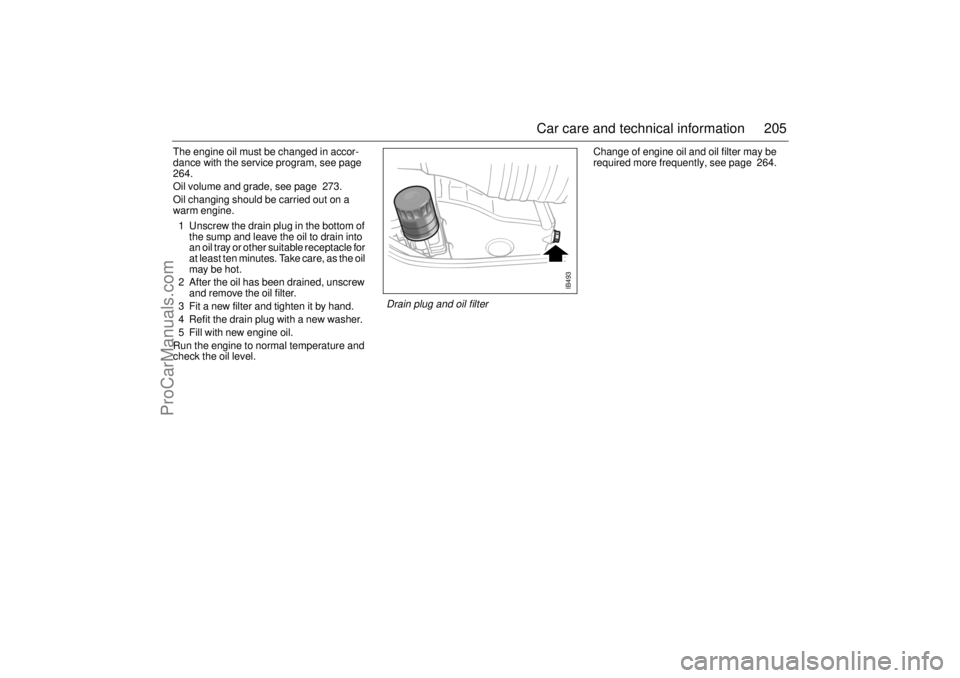
1 Unscrew the drain plug in the bottom of
the sump and leave the oil to drain into
an oil tray or other suitable receptacle for
at least ten minutes. Take care, as the oil
may be hot.
2 After the oil has been drained, unscrew
and remove the oil filter.
3 Fit a new filter and tighten it by hand.
4 Refit the drain plug with a new washer.
5 Fill with new engine oil.
Run the engine to normal temperature and
check the oil level. Change of engine oil and oil filter may be
required more frequently, see page 264.
IB493
Drain plug and oil filter
ProCarManuals.com