service SAAB 9-5 2004 Owner's Guide
[x] Cancel search | Manufacturer: SAAB, Model Year: 2004, Model line: 9-5, Model: SAAB 9-5 2004Pages: 288, PDF Size: 16.91 MB
Page 206 of 288
206 Car care and technical informationTransmission fluidManual transmission Check and top up the fluid in accordance
with the service program.
If original fluid cannot be obtained for top-
ping up (see page 276), automatic trans-
mission fluid Dexron III (synthetic oil) can be
used. If so, the car should be taken to an
authorized Saab dealer immediately to
have the reason for low fluid level corrected
and original fluid installed.Automatic transmission Check the fluid level as follows:
1 Stand the car on level ground and apply
the parking brake. The automatic trans-
mission fluid must be at normal running
temperature, approximately 175°F
(80°C). This can be achieved by driving
the car for about 30 min on the open
road.
2 With the engine idling, move the selector
lever to D and wait for at least
15 seconds. Next, move the selector
lever to R and wait for 15 seconds again.
Finally, move the selector lever to P. Let
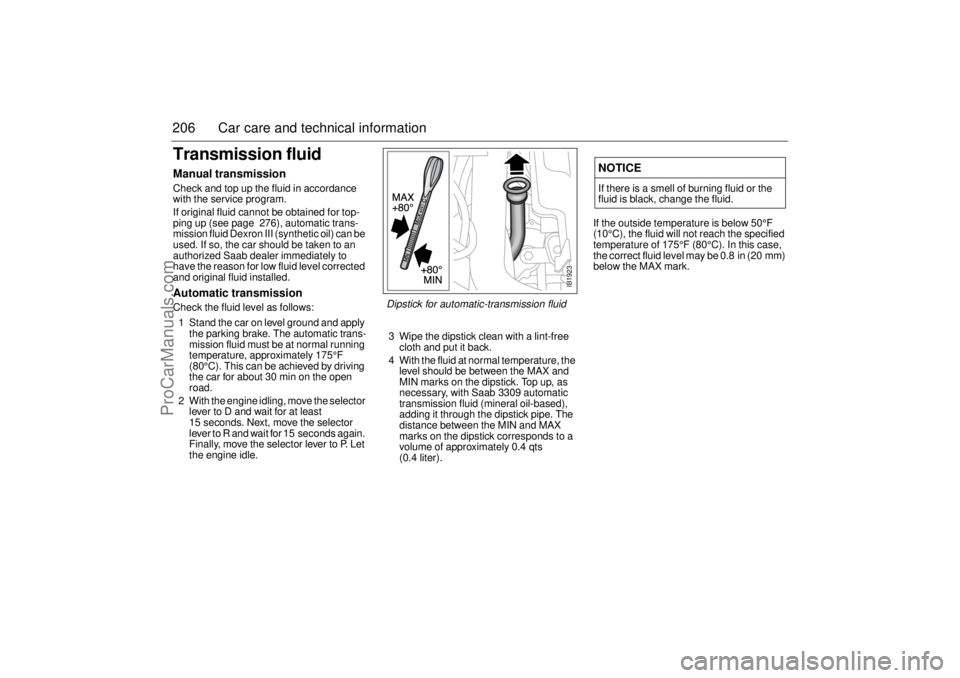
the engine idle.3 Wipe the dipstick clean with a lint-free
cloth and put it back.
4 With the fluid at normal temperature, the
level should be between the MAX and
MIN marks on the dipstick. Top up, as
necessary, with Saab 3309 automatic
transmission fluid (mineral oil-based),
adding it through the dipstick pipe. The
distance between the MIN and MAX
marks on the dipstick corresponds to a
volume of approximately 0.4 qts
(0.4 liter).
If the outside temperature is below 50°F
(10°C), the fluid will not reach the specified
temperature of 175°F (80°C). In this case,
the correct fluid level may be 0.8 in (20 mm)
below the MAX mark.NOTICEIf there is a smell of burning fluid or the
fluid is black, change the fluid.
IB1923
Dipstick for automatic-transmission fluid
ProCarManuals.com
Page 207 of 288
207 Car care and technical information
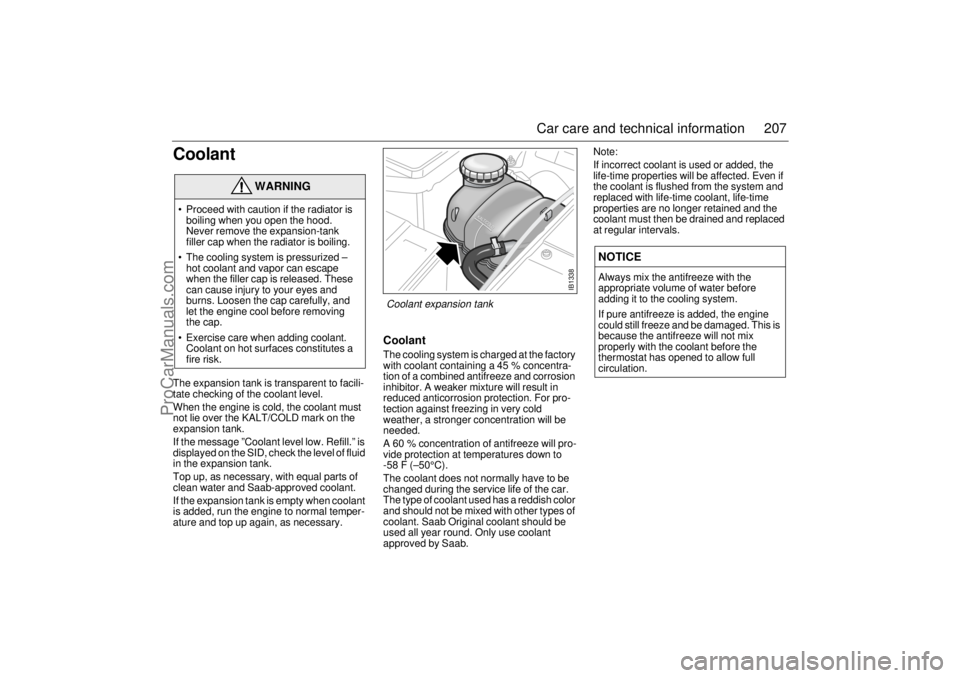
Coolant The expansion tank is transparent to facili-
tate checking of the coolant level.
When the engine is cold, the coolant must
not lie over the KALT/COLD mark on the
expansion tank.
If the message ”Coolant level low. Refill.” is
displayed on the SID, check the level of fluid
in the expansion tank.
Top up, as necessary, with equal parts of
clean water and Saab-approved coolant.
If the expansion tank is empty when coolant
is added, run the engine to normal temper-
ature and top up again, as necessary.
Coolant The cooling system is charged at the factory
with coolant containing a 45 % concentra-
tion of a combined antifreeze and corrosion
inhibitor. A weaker mixture will result in
reduced anticorrosion protection. For pro-
tection against freezing in very cold
weather, a stronger concentration will be
needed.
A 60 % concentration of antifreeze will pro-
vide protection at temperatures down to
-58 F (–50°C).
The coolant does not normally have to be
changed during the service life of the car.
The type of coolant used has a reddish color
and should not be mixed with other types of
coolant. Saab Original coolant should be
used all year round. Only use coolant
approved by Saab. Note:
If incorrect coolant is used or added, the
life-time properties will be affected. Even if
the coolant is flushed from the system and
replaced with life-time coolant, life-time
properties are no longer retained and the
coolant must then be drained and replaced
at regular intervals.
WARNING
Proceed with caution if the radiator is
boiling when you open the hood.
Never remove the expansion-tank
filler cap when the radiator is boiling.
The cooling system is pressurized –
hot coolant and vapor can escape
when the filler cap is released. These
can cause injury to your eyes and
burns. Loosen the cap carefully, and
let the engine cool before removing
the cap.
Exercise care when adding coolant.
Coolant on hot surfaces constitutes a
fire risk.
NOTICEAlways mix the antifreeze with the
appropriate volume of water before
adding it to the cooling system.
If pure antifreeze is added, the engine
could still freeze and be damaged. This is
because the antifreeze will not mix
properly with the coolant before the
thermostat has opened to allow full
circulation.
IB1338
Coolant expansion tank
ProCarManuals.com
Page 208 of 288
208 Car care and technical informationBrake and clutch fluid Checking the fluid level The combined brake and clutch-fluid reser-
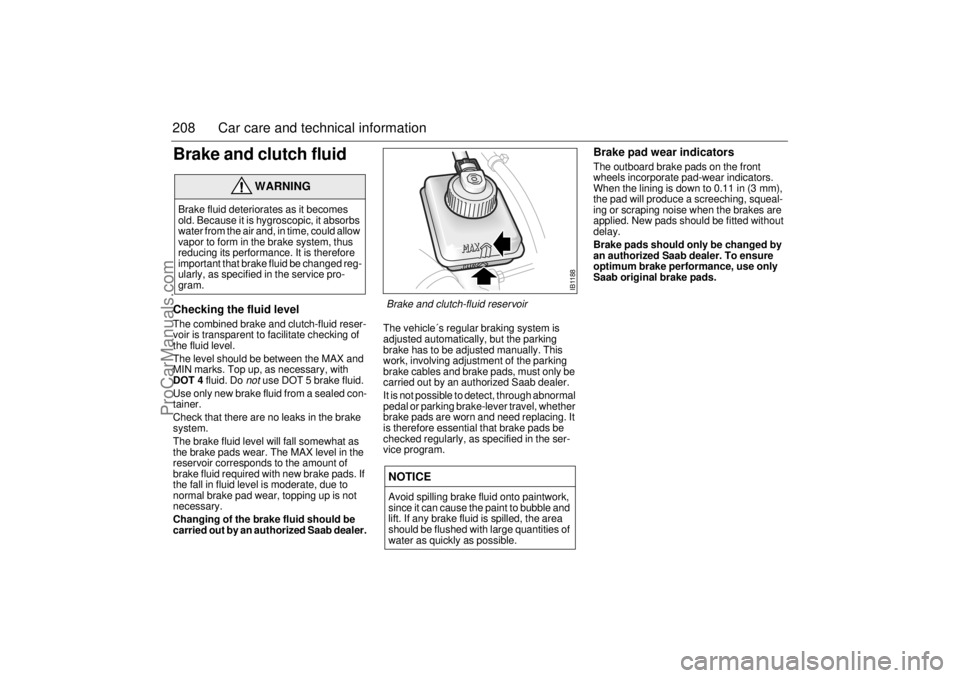
voir is transparent to facilitate checking of
the fluid level.
The level should be between the MAX and
MIN marks. Top up, as necessary, with
DOT 4 fluid. Do
not
use DOT 5 brake fluid.
Use only new brake fluid from a sealed con-
tainer.
Check that there are no leaks in the brake
system.
The brake fluid level will fall somewhat as
the brake pads wear. The MAX level in the
reservoir corresponds to the amount of
brake fluid required with new brake pads. If
the fall in fluid level is moderate, due to
normal brake pad wear, topping up is not
necessary.
Changing of the brake fluid should be
carried out by an authorized Saab dealer.The vehicle´s regular braking system is
adjusted automatically, but the parking
brake has to be adjusted manually. This
work, involving adjustment of the parking
brake cables and brake pads, must only be
carried out by an authorized Saab dealer.
It is not possible to detect, through abnormal
pedal or parking brake-lever travel, whether
brake pads are worn and need replacing. It
is therefore essential that brake pads be
checked regularly, as specified in the ser-
vice program.
Brake pad wear indicators The outboard brake pads on the front
wheels incorporate pad-wear indicators.
When the lining is down to 0.11 in (3 mm),
the pad will produce a screeching, squeal-
ing or scraping noise when the brakes are
applied. New pads should be fitted without
delay.
Brake pads should only be changed by
an authorized Saab dealer. To ensure
optimum brake performance, use only
Saab original brake pads.
WARNING
Brake fluid deteriorates as it becomes
old. Because it is hygroscopic, it absorbs
water from the air and, in time, could allow
vapor to form in the brake system, thus
reducing its performance. It is therefore
important that brake fluid be changed reg-
ularly, as specified in the service pro-
gram.
NOTICEAvoid spilling brake fluid onto paintwork,
since it can cause the paint to bubble and
lift. If any brake fluid is spilled, the area
should be flushed with large quantities of
water as quickly as possible.
IB1188
Brake and clutch-fluid reservoir
ProCarManuals.com
Page 209 of 288
209 Car care and technical information
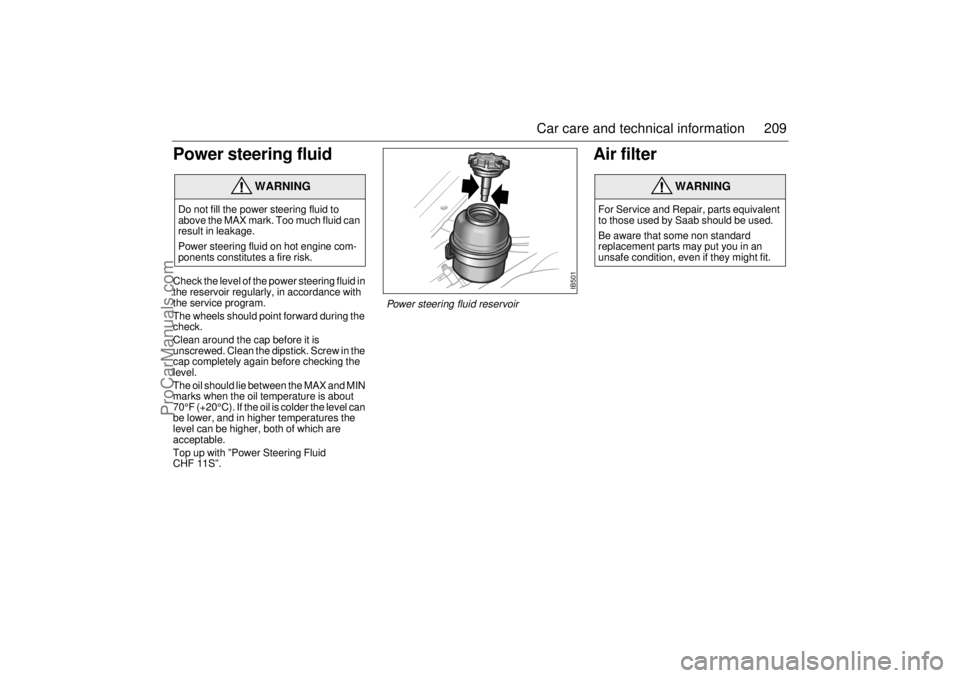
Power steering fluidCheck the level of the power steering fluid in
the reservoir regularly, in accordance with
the service program.
The wheels should point forward during the
check.
Clean around the cap before it is
unscrewed. Clean the dipstick. Screw in the
cap completely again before checking the
level.
The oil should lie between the MAX and MIN
marks when the oil temperature is about
70°F (+20°C). If the oil is colder the level can
be lower, and in higher temperatures the
level can be higher, both of which are
acceptable.
Top up with ”Power Steering Fluid
CHF 11S”.
Air filter
WARNING
Do not fill the power steering fluid to
above the MAX mark. Too much fluid can
result in leakage.
Power steering fluid on hot engine com-
ponents constitutes a fire risk.
WARNING
For Service and Repair, parts equivalent
to those used by Saab should be used.
Be aware that some non standard
replacement parts may put you in an
unsafe condition, even if they might fit.
IB501
Power steering fluid reservoir
ProCarManuals.com
Page 215 of 288
215 Car care and technical information
Changing bulbsCheck that the new bulb is working when finished.
Use only "Long Life" bulbs.
Headlight aiming, see page 259.
Xenon headlight (certain variants)Xenon headlights produce roughly twice as much light as halogen
bulbs and have a significantly longer service life.
The lamp units consist of a gas discharge lamp containing xenon.
When the lights are switched on a very high voltage activates the
xenon gas. The lamps soon reach full intensity.
Cars with xenon headlights have automatic levelling. The levelling
system comprises two sensors on the front axle, one on the rear axle
and a control unit under the headlight housing. Headlight alignment
is regulated automatically to prevent dazzling oncoming traffic.
Alignment is also adjusted during braking.
WARNING
Before changing a bulb in the engine bay, switch off the engine to
avoid danger of fingers and hands being injured by moving parts.
The radiator fan can start up even when the engine is switched off.
Xenon headlights are high voltage and must therefore be
changed at an authorized Saab workshop. Work involving
high-voltage components is potentially lethal.NOTICE Since the headlight lenses are made of plastic, rinse dried-on
dirt with water and allow it time to soften up before cleaning
the lenses. Avoid rubbing the lenses when dry and never use
solvents.
Use de-icer spray instead of scraping the ice off.
NOTICE Do not fit bulbs with a higher rating than 55 W, since the head-
light reflector and the wiring of the car are not designed for a
higher wattage.
Switch off the ignition before changing a bulb, to avoid possi-
ble short-circuiting.
Do not touch the glass of the bulbs with your fingers. The oil
on your skin can shorten the life of the bulb.
ProCarManuals.com
Page 233 of 288
233 Car care and technical information
Tires Your new vehicle comes with high-quality
tires made by a leading tire manufacturer. If
you ever have questions about your tire
warranty and where to obtain service, see
your Saab Warranty and Service Record
Booklet for details.
Inflation - Tire PressureThe Tire-Loading Information label, which is
on the inside of the trunk lid, shows the cor-
rect inflation pressures for your tires when
they’re cold. “Cold” means your vehicle has
been sitting for at least three hours or driven
no more than 1 mile (1.6 km).Notice:
Don’t let anyone tell you that
underinflation or overinflation is all
right. It’s not. If your tires don’t have
enough air (underinflation), you can get
the following:
Too much flexing
Too much heat
Tire overloading
Bad wear
Bad handling
Bad fuel economy
If your tires have too much air (overinfla-
tion), you can get the following:
Unusual wear
Bad handling
Rough ride
Needless damage from road hazardsAdjust the tire pressure to match the current
load and speed of the car (see page 279).
The stated tire pressures apply to cold tires,
i.e. tires that are the same temperature as
the outside air temperature. Tire pressure
increases as the tires become warm (e.g.
during highway driving) by approximately
0.3 bar (4 psi). When the temperature of the
tires changes by 50°F (10°C), the tire pres-
sure will change 0.1 bar (2 psi).
Never reduce the pressure of a hot tire. If the
tires are hot when you check them, only
increase the pressure, if necessary.
WARNING
Poor maintained and improperly used
tires are dangerous.
Overloading your tires can cause
overheating as a result of too much
friction. You could have an air-out and
a serious accident. See “Loading Your
Vehicle” on page 242.
Underinflated tires pose the same
danger as overloaded tires. The
resulting accident could cause serious
injury. Check all tires frequently to
maintain the recommended pressure.
Tire pressure should be checked
when your tires are cold.
Overinflated tires are more likely to be
cut, punctured or broken by a sudden
impact – such as when you hit a pot-
hole. Keep tires at the recommended
pressure.
Worn, old tires can cause accidents. If
your tread is badly worn, or if your tires
have been damaged, replace them.
ProCarManuals.com
Page 235 of 288
235 Car care and technical information
When It Is Time for New TiresOne way to tell when it’s time for new tires is
to check the treadwear indicators, which will
appear when your tires have only 1/16 inch
(1.6 mm) or less of tread remaining.
You need a new tire if any of the following
statements are true:
You can see the indicators at three or
more places around the tire.
You can see cord or fabric showing
through the tire’s rubber.
The tread or sidewall is cracked, cut or
snagged deep enough to show cord or
fabric.
The tire has a bump, bulge or split.
The tire has a puncture, cut or other
damage that can’t be repaired well
because of the size or location of the dam-
age.
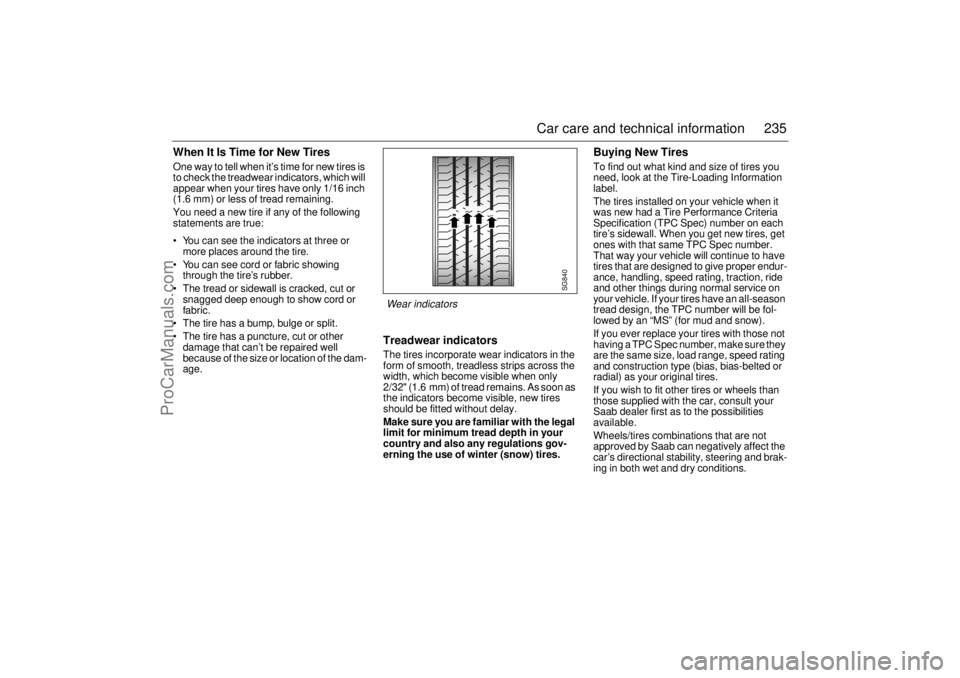
Treadwear indicatorsThe tires incorporate wear indicators in the
form of smooth, treadless strips across the
width, which become visible when only
2/32" (1.6 mm) of tread remains. As soon as
the indicators become visible, new tires
should be fitted without delay.
Make sure you are familiar with the legal
limit for minimum tread depth in your
country and also any regulations gov-
erning the use of winter (snow) tires.
Buying New TiresTo find out what kind and size of tires you
need, look at the Tire-Loading Information
label.
The tires installed on your vehicle when it
was new had a Tire Performance Criteria
Specification (TPC Spec) number on each
tire’s sidewall. When you get new tires, get
ones with that same TPC Spec number.
That way your vehicle will continue to have
tires that are designed to give proper endur-
ance, handling, speed rating, traction, ride
and other things during normal service on
your vehicle. If your tires have an all-season
tread design, the TPC number will be fol-
lowed by an “MS” (for mud and snow).
If you ever replace your tires with those not
having a TPC Spec number, make sure they
are the same size, load range, speed rating
and construction type (bias, bias-belted or
radial) as your original tires.
If you wish to fit other tires or wheels than
those supplied with the car, consult your
Saab dealer first as to the possibilities
available.
Wheels/tires combinations that are not
approved by Saab can negatively affect the
car’s directional stability, steering and brak-
ing in both wet and dry conditions.
SG840
Wear indicators
ProCarManuals.com
Page 237 of 288

237 Car care and technical information
Uniform Tire Quality GradingQuality grades can be found where applica-
ble on the tire sidewall between tread shoul-
der and maximum section width. For exam-
ple:
Treadwear 200 Traction AA Temperature
A
The following information relates to the
system developed by the United States
National Highway Traffic Safety Administra-
tion, which grades tires by treadwear, trac-
tion and temperature performance. (This
applies only to vehicles sold in the United
States.) The grades are molded on the side-
walls of most passenger car tires. The Uni-
form Tire Quality Grading system does not
apply to deep tread, winter-type snow tires,
space-saver or temporary use spare tires,
tires with nominal rim diameters of 10 to 12
inches (25 to 30 cm), or to some limited-pro-
duction tires.
While the tires available on General Motors
passenger cars and light trucks may vary
with respect to these grades, they must also
conform to federal safety requirements and
additional General Motors Tire Perfor-
mance Criteria (TPC) standards.Treadwear
The treadwear grade is a comparative
rating based on the wear rate of the tire
when tested under controlled conditions on
a specified government test course. For
example, a tire graded 150 would wear one
and a half (1.5) times as well on the govern-
ment course as a tire graded 100. The rela-
tive performance of tires depends upon the
actual conditions of their use, however, and
may depart significantly from the norm due
to variations in driving habits, service prac-
tices and differences in road characteristics
and climate.
Traction – AA, A, B, C
The traction grades, from highest to lowest,
are AA, A, B, and C. Those grades repre-
sent the tire’s ability to stop on wet pave-
ment as measured under controlled condi-
tions on specified government test surfaces
of asphalt and concrete. A tire marked C
may have poor traction performance. Warn-
ing: The traction grade assigned to this tire
is based on straight-ahead braking traction
tests, and does not include acceleration,
cornering, hydroplaning, or peak traction
characteristics.Temperature – A, B, C
The temperature grades are A (the highest),
B, and C, representing the tire’s resistance
to the generation of heat and its ability to dis-
sipate heat when tested under controlled
conditions on a specified indoor laboratory
test wheel. Sustained high temperature can
cause the material of the tire to degenerate
and reduce tire life, and excessive temper-
ature can lead to sudden tire failure. The
grade C corresponds to a level of perfor-
mance which all passenger car tires must
meet under the Federal Motor Vehicle
Safety Standard No. 109. Grades B and A
represent higher levels of performance on
the laboratory test wheel than the minimum
required by law.
Warning: The temperature grade for this tire
is established for a tire that is properly
inflated and not overloaded. Excessive
speed, underinflation, or excessive loading,
either separately or in combination, can
cause heat buildup and possible tire failure.
ProCarManuals.com
Page 240 of 288

240 Car care and technical informationTire Sidewall LabelingUseful information about a tire is molded
into it´s sidewall.
Tire size: The tire size ia a combination of
letters and numbers used to define a partic-
ular tire´s width, height, aspect ratio, con-
struction type and service description.
Department of Transportation (DOT):
The Department of Transportation (DOT)
code indicates that the tire is in compliance
with the U.S. Department of Transportation
Motor Vehicle Safety standards.
Tire Identification Number (TIN): The let-
ters and numbers following DOT code are
the Tire Identification Number (TIN). The
TIN shows the manufacturer and plant
code, tire size, and date the tire was manu-
factured. The TIN is molded onto both sides
of the tire.
Tire Ply Material: The type of cord and
number of plies in the sidewall and under
the tread.Uniform Tire Quality Grading (UTQG):
Tire manufacturers are required to grade
tires based on performance factors: tread-
wear, traction and temperature resistance.
For more information see “Uniform Tire
Quality Grading” on page 237.
Maximum Cold Inflation Load Limit: Max-
imum load that can be carried and the max-
imum pressure needed to support that load.
For information on recommended tire pres-
sure see “Lowest recommended tire pres-
sure, cold tires” on page 279and “Loading
Your Vehicle” on page 242.
Tire SizeThe following illustration shows an example
of a typical passenger car tire size.
Passenger (P-Metric) Tire: The United
States version of a metric tire sizing system.
The letter “P” as the first character in the tire
size means a passenger vehicle tire engi-
neered to standards set by the U.S Tire and
Rim Association.
Tire Width: The three-digit number indi-
cates the tire section width in millimeters
from sidewall to sidewall.P215/55 R 16 93 H
|| |||||
ab c d e f g
a Passenger (P-Metric) Tire
bTire Width
c Aspect Ratio
d Belt Rating
e Rim diameter
f Load range
g Speed rating
ProCarManuals.com
Page 252 of 288
252 Car care and technical informationAir conditioning
(ACC)
Fault diagnosis If a fault occurs in the A/C system, there are
a number of checks you can perform your-
self. If the fault persists, however, have the
system checked by an authorized Saab
dealer.Important!
When the A/C system is running, the intake
air is dehumidified, and the resultant con-
densation is drained off through two outlets
underneath the floor of the car in the vicinity
of the front doors. It is therefore perfectly
normal for water to be seen dripping from
these outlets when the car is parked. The
warmer the ambient air and the higher the
humidity, the greater will be the amount of
condensation formed.
Inadequate cooling: a Check that the condenser (forward of
the radiator) has not become clogged
with dirt and insects.
b Make sure that the drive belt for the com-
pressor is not slipping.
c Check the fuses for the ventilation fans
and compressor.
Maintenance • The drive belt for the compressor should
be inspected under the regular service
program.
Clean dirt and insects away from the con-
denser and radiator to prevent clogging.
When washing the car, use the hose to
spray the radiator and condenser (located
forward of the radiator) from both sides
(both from the front of the car and from
inside the engine bay). Do not use a pres-
sure washer.Caution: Do not use the hose when the
engine is hot.Other than in extremely cold weather, do not
screen the radiator, e.g. with netting, as this
will greatly diminish its cooling capacity.Note:
The A/C system will only operate
when the outdoor temperature is above the
freezing point (0°C, 32°F).
WARNING
All repairs and adjustments on the A/C
system must be carried out by a Saab
dealer authorized for this kind of work.
The A/C system is pressurized. Do not
break any connections or undo A/C
system components.
Escaping refrigerant gas can cause
visual impairment or other injury.NOTICE The A/C system is designed for use
with R134a refrigerant.
Refrigerant handling requires special
equipment and special procedures for
charging and draining the system.
Never mix R134a and R12 refriger-
ants.
ProCarManuals.com