warning SATURN ASTRA 2008 Owner's Manual
[x] Cancel search | Manufacturer: SATURN, Model Year: 2008, Model line: ASTRA, Model: SATURN ASTRA 2008Pages: 304, PDF Size: 1.92 MB
Page 163 of 304
A warning chime will sound and
a brake warning light located on the
instrument panel cluster will come
on, if the parking brake is set,
the ignition is on and the vehicle
speed is greater than 5 mph
(8 km/h).
Notice:Driving with the parking
brake on can overheat the
brake system and cause
premature wear or damage
to brake system parts. Make sure
that the parking brake is fully
released and the brake warning
light is off before driving.Shifting Into Park
{CAUTION
It can be dangerous to get out
of your vehicle if the shift lever
is not fully in PARK (P) with the
parking brake rmly set. Your
vehicle can roll. If you have left
the engine running, the vehicle
can move suddenly. You or
others could be injured. To be
sure your vehicle will not move,
even when you are on fairly level
ground, use the steps that
follow.1. Hold the brake pedal down
with your right foot and set
the parking brake. SeeParking
Brake on page 8-10for more
information.
2. Move the shift lever into
PARK (P) by holding in the button
on the shift lever and pushing the
shift lever all the way toward the
front of the vehicle.
3. Turn the ignition key to
LOCK/OFF.
4. Remove the key and take it
with you. If you can leave
your vehicle with the ignition
key in your hand, your vehicle
is in PARK (P).
Driving and Operating 8-11
ProCarManuals.com
Page 169 of 304

Medical research shows that alcohol
in a person’s system can make crash
injuries worse, especially injuries
to the brain, spinal cord, or heart.
This means that when anyone who
has been drinking — driver or
passenger — is in a crash, that
person’s chance of being killed or
permanently disabled is higher than
if the person had not been drinking.
Control of a Vehicle
The following three systems help
to control your vehicle while
driving — brakes, steering, and
accelerator. At times, as when
driving on snow or ice, it is easy to
ask more of those control systems
than the tires and road can provide.
Meaning, you can lose control of
your vehicle.
Adding non-dealer/non-retailer
accessories can affect your vehicle’s
performance. SeeAccessories
and Modifications on page 9-3.
Braking
SeeBrake System Warning Light on
page 4-17.
Braking action involves perception
time and reaction time. First, you
have to decide to push on the brake
pedal. That is perception time. Then
you have to bring up your foot and
do it. That is reaction time.
Average reaction time is about
three-fourths of a second. But that
is only an average. It might be
less with one driver and as long
as two or three seconds or
more with another. Age, physical
condition, alertness, coordination,
and eyesight all play a part.
So do alcohol, drugs, and
frustration. But even in three-fourths
of a second, a vehicle moving at
60 mph (100 km/h) travels 66 feet
(20 m). That could be a lot of
distance in an emergency, so
keeping enough space between
your vehicle and others is important.And, of course, actual stopping
distances vary greatly with the
surface of the road, whether it is
pavement or gravel; the condition of
the road, whether it is wet, dry, or icy;
tire tread; the condition of the brakes;
the weight of the vehicle; and the
amount of brake force applied.
Avoid needless heavy
braking. Some people drive in
spurts — heavy acceleration
followed by heavy braking — rather
than keeping pace with traffic. This
is a mistake. The brakes might not
have time to cool between hard
stops. The brakes will wear out much
faster if you do a lot of heavy braking.
If you keep pace with the traffic and
allow realistic following distances,
you will eliminate a lot of
unnecessary braking. That means
better braking and longer brake life.
Driving and Operating 8-17
ProCarManuals.com
Page 170 of 304
If your vehicle’s engine ever stops
while you are driving, brake normally
but do not pump the brakes. If you
do, the pedal could get harder to
push down. If the engine stops, you
will still have some power brake
assist. But you will use it when you
brake. Once the power assist is used
up, it can take longer to stop and the
brake pedal will be harder to push.
Adding non-dealer/non-retailer
accessories can affect your vehicle’s
performance. SeeAccessories
and Modifications on page 9-3.Antilock Brake
System (ABS)
Your vehicle has the Antilock
Brake System (ABS), an advanced
electronic braking system that
will help prevent a braking skid.
When you start the engine and
begin to drive away, ABS will check
itself. You might hear a momentary
motor or clicking noise while this
test is going on, and you might even
notice that the brake pedal moves a
little. This is normal.
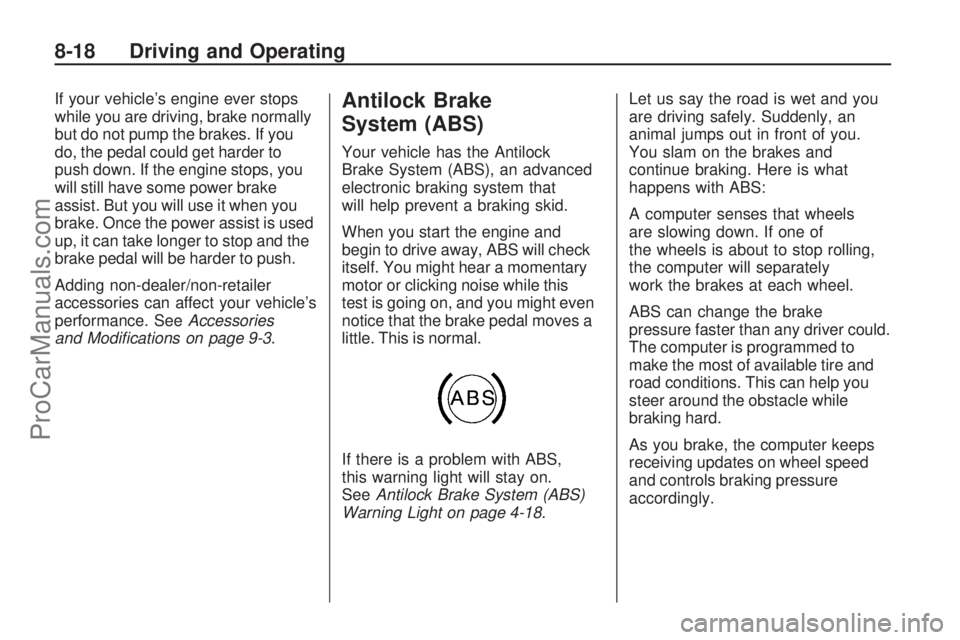
If there is a problem with ABS,
this warning light will stay on.
SeeAntilock Brake System (ABS)
Warning Light on page 4-18.Let us say the road is wet and you
are driving safely. Suddenly, an
animal jumps out in front of you.
You slam on the brakes and
continue braking. Here is what
happens with ABS:
A computer senses that wheels
are slowing down. If one of
the wheels is about to stop rolling,
the computer will separately
work the brakes at each wheel.
ABS can change the brake
pressure faster than any driver could.
The computer is programmed to
make the most of available tire and
road conditions. This can help you
steer around the obstacle while
braking hard.
As you brake, the computer keeps
receiving updates on wheel speed
and controls braking pressure
accordingly.
8-18 Driving and Operating
ProCarManuals.com
Page 176 of 304

If your vehicle starts to slide, ease
your foot off the accelerator pedal
and quickly steer the way you want
the vehicle to go. If you start steering
quickly enough, your vehicle may
straighten out. Always be ready for a
second skid if it occurs.
Of course, traction is reduced when
water, snow, ice, gravel, or other
material is on the road. For safety,
you want to slow down and
adjust your driving to these
conditions. It is important to slow
down on slippery surfaces because
stopping distance is longer and
vehicle control more limited.
While driving on a surface with
reduced traction, try your best to
avoid sudden steering, acceleration,
or braking, including reducing
vehicle speed by shifting to a lower
gear. Any sudden changes could
cause the tires to slide. You
might not realize the surface isslippery until your vehicle is
skidding. Learn to recognize warning
clues — such as enough water,
ice, or packed snow on the road to
make a mirrored surface — and
slow down when you have any
doubt.
Remember: Any Antilock Brake
System (ABS) helps avoid only the
braking skid.
Driving at Night
Night driving is more dangerous
than day driving because some
drivers are likely to be impaired — by
alcohol or drugs, with night vision
problems, or by fatigue.
Night driving tips include:
Drive defensively.
Do not drink and drive.
Reduce headlamp glare by
adjusting the inside rearview
mirror.
Slow down and keep more space
between you and other vehicles
because headlamps can only
light up so much road ahead.
Watch for animals.
When tired, pull off the road.
Do not wear sunglasses.
Avoid staring directly into
approaching headlamps.
Keep the windshield and all glass
on your vehicle clean — inside
and out.
Keep your eyes moving,
especially during turns or curves.
No one can see as well at night as
in the daytime. But, as we get
older, these differences increase.
A 50-year-old driver might need
at least twice as much light to see
the same thing at night as a
20-year-old.
8-24 Driving and Operating
ProCarManuals.com
Page 177 of 304
Driving in Rain and on
Wet Roads
Rain and wet roads can reduce
vehicle traction and affect your
ability to stop and accelerate.
Always drive slower in these types
of driving conditions and avoid
driving through large puddles and
deep-standing or owing water.
{CAUTION
Wet brakes can cause crashes.
They might not work as well in
a quick stop and could cause
pulling to one side. You could
lose control of the vehicle.
After driving through a large
puddle of water or a car/vehicle
wash, lightly apply the brake
pedal until the brakes work
normally.
(Continued)
CAUTION (Continued)
Flowing or rushing water
creates strong forces. Driving
through owing water could
cause your vehicle to be
carried away. If this happens,
you and other vehicle
occupants could drown. Do not
ignore police warnings and be
very cautious about trying to
drive through owing water.
Hydroplaning
Hydroplaning is dangerous. Water
can build up under your vehicle’s
tires so they actually ride on the
water. This can happen if the road is
wet enough and you are going fast
enough. When your vehicle is
hydroplaning, it has little or no
contact with the road.There is no hard and fast rule about
hydroplaning. The best advice is
to slow down when the road is wet.
Other Rainy Weather Tips
Besides slowing down, other wet
weather driving tips include:
Allow extra following distance.
Pass with caution.
Keep windshield wiping
equipment in good shape.
Keep the windshield washer uid
reservoir lled.
Have good tires with proper tread
depth. SeeTires on page 9-38.
Turn off cruise control, if
equipped.
Driving and Operating 8-25
ProCarManuals.com
Page 179 of 304

{CAUTION
Coasting downhill in N (Neutral)
or with the ignition off is
dangerous. The brakes will
have to do all the work of
slowing down and they could
get so hot that they would not
work well. You would then have
poor braking or even none
going down a hill. You could
crash. Always have the engine
running and the vehicle in gear
when going downhill.
Stay in your own lane. Do not
swing wide or cut across the
center of the road. Drive at
speeds that let you stay in your
own lane.
Top of hills: Be alert — something
could be in your lane (stalled car,
accident).
Pay attention to special road
signs (falling rocks area, winding
roads, long grades, passing or
no-passing zones) and take
appropriate action.
Winter Driving
Here are some tips for winter
driving:
Have your vehicle in good shape
for winter.
You might want to put winter
emergency supplies in your
vehicle.
Include an ice scraper, a small
brush or broom, a supply of
windshield washer uid, a rag, some
winter outer clothing, a small shovel,
a ashlight, a red cloth, and reective
warning triangles. And, if you will be
driving under severe conditions,
include a small bag of sand, a pieceof old carpet, or a couple of burlap
bags to help provide traction. Be sure
you properly secure these items in
your vehicle.
Also seeTires on page 9-38.
Driving on Snow or Ice
Most of the time, those places
where the tires meet the road
probably have good traction.
However, if there is snow or ice
between the tires and the road, you
can have a very slippery situation.
You have a lot less traction, or grip,
and need to be very careful.
What is the worst time for this? Wet
ice. Very cold snow or ice can be
slick and hard to drive on. But wet ice
can be even more trouble because it
can offer the least traction of all.
Driving and Operating 8-27
ProCarManuals.com
Page 180 of 304

You can get wet ice when it is about
freezing, 32°F (0°C), and freezing
rain begins to fall. Try to avoid driving
on wet ice until salt and sand crews
can get there.
Whatever the condition — smooth
ice, packed, blowing, or loose
snow — drive with caution.
Accelerate gently. Try not to
break the fragile traction. If you
accelerate too fast, the drive wheels
will spin and polish the surface
under the tires even more.
The Antilock Brake System (ABS)
improves your vehicle’s stability
when you make a hard stop
on a slippery road. Even though you
have ABS, begin stopping soonerthan you would on dry pavement.
SeeAntilock Brake System
(ABS) on page 8-18.
Allow greater following distance
on any slippery road.
Watch for slippery spots. The
road might be ne until you hit
a spot that is covered with ice.
On an otherwise clear road, ice
patches can appear in shaded
areas where the sun cannot
reach, such as around clumps of
trees, behind buildings, or under
bridges. Sometimes the surface
of a curve or an overpass can
remain icy when the surrounding
roads are clear. If you see a patch
of ice ahead of you, brake before
you are on it. Try not to brake
while you are actually on the ice,
and avoid sudden steering
maneuvers.
If You Are Caught in a Blizzard
If you are stopped by heavy
snow, you could be in a serious
situation. You should probably
stay with your vehicle unless you
know for sure that you are near
help and you can hike through the
snow. Here are some things to do
to summon help and keep yourself
and your passengers safe:
Turn on the hazard warning
ashers.
Tie a red cloth to your vehicle to
alert police that you have been
stopped by the snow.
Put on extra clothing or wrap a
blanket around you. If you do not
have blankets or extra clothing,
make body insulators from
newspapers, burlap bags, rags,
oor mats — anything you can
wrap around yourself or tuck
under your clothing to keep warm.
You can run the engine to keep
warm, but be careful.
8-28 Driving and Operating
ProCarManuals.com
Page 191 of 304
Vehicle Service
and Care
Service
Service...............................9-2
Accessories and
Modications.....................9-3
California Proposition 65
Warning............................9-3
California Perchlorate
Materials Requirements.....9-3
Doing Your Own
Service Work....................9-4
Adding Equipment to the
Outside of the Vehicle......9-4
Owner Checks
Owner Checks....................9-5
Hood Release.....................9-5
Engine Compartment
Overview...........................9-6
Engine Oil..........................9-7
Engine Oil Life System.......9-9
Engine Air Cleaner/Filter. . . .9-11
Automatic Transmission
Fluid................................9-12
Manual Transmission
Fluid................................9-12
Hydraulic Clutch................9-12
Engine Coolant.................9-12
Pressure Cap....................9-15
Engine Overheating...........9-15
Cooling System.................9-16
Power Steering Fluid.........9-20
Windshield Washer Fluid. . . .9-20
Windshield Wiper Blade
Replacement...................9-21
Brakes..............................9-22
Battery..............................9-25
Headlamp Aiming
Headlamp Aiming..............9-26
Bulb Replacement
Bulb Replacement.............9-28
Halogen Bulbs..................9-28
Front Turn Signal Lamps. . .9-28
Taillamps
(Five-Door Hatchback).....9-29
Taillamps
(Three-Door Hatchback). . .9-30
License Plate Lamp..........9-32
Replacement Bulbs...........9-33
Electrical System
Add-On Electrical
Equipment.......................9-33
Headlamp Wiring..............9-33
Windshield Wiper Fuses. . . .9-34
Power Windows and
Other Power Options.......9-34
Fuses...............................9-34
Engine Compartment
Fuse Block......................9-34
Rear Compartment
Fuse Block......................9-36
Tires
Tires.................................9-38
Winter Tires......................9-39
Tire Sidewall Labeling.......9-40
Tire Terminology and
Denitions.......................9-43
Ination - Tire Pressure. . . .9-46
High-Speed Operation.......9-47
Tire Pressure Monitor
System............................9-48
Tire Pressure Monitor
Operation........................9-50
Tire Inspection and
Rotation..........................9-51
When It Is Time for
New Tires.......................9-53
Vehicle Service and Care 9-1
ProCarManuals.com
Page 193 of 304
Accessories and
Modications
When non-dealer/non-retailer
accessories are added to your
vehicle they can affect your vehicle’s
performance and safety, including
such things as, airbags, braking,
stability, ride and handling,
emissions systems, aerodynamics,
durability, and electronic systems like
antilock brakes, traction control and
stability control. Some of these
accessories could even cause
malfunction or damage not covered
by warranty.
GM Accessories are designed to
complement and function with other
systems on your vehicle. Your GM
dealer/retailer can accessorize
your vehicle using genuine GM
Accessories. When you go to your
GM dealer/retailer and ask forGM Accessories, you will know that
GM-trained and supported service
technicians will perform the work
using genuine GM Accessories.
Also, seeAdding Equipment to
Your Airbag-Equipped Vehicle on
page 1-35.
California Proposition 65
Warning
Most motor vehicles, including this
one, contain and/or emit chemicals
known to the State of California
to cause cancer and birth defects or
other reproductive harm. Engine
exhaust, many parts and systems
(including some inside the vehicle),
many uids, and some component
wear by-products contain and/or
emit these chemicals.
California Perchlorate
Materials Requirements
Certain types of automotive
applications, such as airbag
initiators, seat belt pretensioners,
and lithium batteries contained
in remote keyless entry transmitters,
may contain perchlorate materials.
Special handling may be necessary.
For additional information, see
www.dtsc.ca.gov/hazardouswaste/
perchlorate.
Vehicle Service and Care 9-3
ProCarManuals.com
Page 200 of 304
How to Reset the Engine Oil
Life System
The Engine Oil Life System
calculates when to change the
engine oil and lter based on vehicle
use. Whenever the oil is changed,
reset the system so it can calculate
when the next oil change is
required. If a situation occurs where
you change the oil prior to the
letters InSP appearing in the
odometer display, reset the system.
After changing the engine oil,
reset the system:
1. Turn the ignition key to
LOCK/OFF.
2. Press the instrument panel
cluster stem until the odometer
is displayed.3. Press and hold the cluster
stem until the letters InSP
are displayed.
4. Hold the cluster stem down and
turn the ignition key to ON/RUN.
5. The letters InSP in the instrument
panel cluster display will ash.
6. Keep the cluster stem down for
at least 20 seconds and then
release the stem.
If the letters InSP and the remaining
mileage for the next oil change
appear in the instrument panel
cluster display, the system is
properly reset.
What to Do with Used Oil
Used engine oil contains certain
elements that can be unhealthy for
your skin and could even cause
cancer. Do not let used oil stay on
your skin for very long. Clean your
skin and nails with soap and water,
or a good hand cleaner. Wash or
properly dispose of clothing or rags
containing used engine oil. See the
manufacturer’s warnings about the
use and disposal of oil products.
Used oil can be a threat to the
environment. If you change your own
oil, be sure to drain all the oil from the
lter before disposal. Never dispose
of oil by putting it in the trash, pouring
it on the ground, into sewers, or into
streams or bodies of water. Recycle
it by taking it to a place that collects
used oil.
9-10 Vehicle Service and Care
ProCarManuals.com