maintenance Seat Alhambra 2006 Owner's Manual
[x] Cancel search | Manufacturer: SEAT, Model Year: 2006, Model line: Alhambra, Model: Seat Alhambra 2006Pages: 299, PDF Size: 6.33 MB
Page 257 of 299
If and when255
Safety FirstOperating instructionsTips and MaintenanceTe c h n i c a l D a t a
•If, due to a breakdown, the gearbox does not have lubricant, the vehicle
should be towed with the drive wheels suspended.
•If it is necessary to tow a vehicle with an automatic gearbox for more than
50 km, it should be towed by qualified personnel and with the drive wheels
suspended.
Lifting the vehicle
Vehicle lifting points
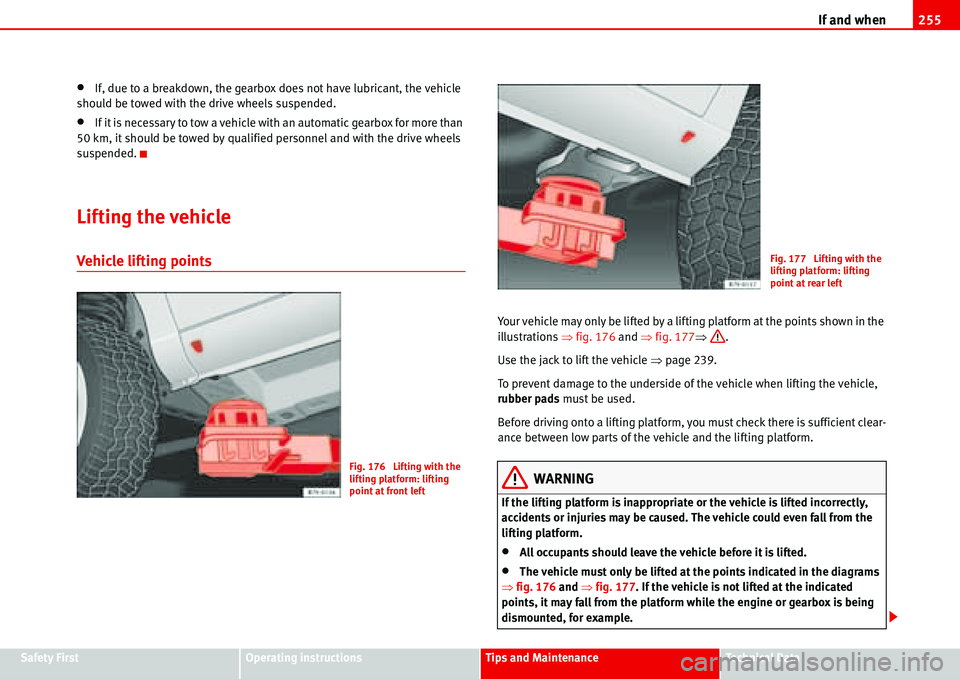
Your vehicle may only be lifted by a lifting platform at the points shown in the
illustrations Ÿfig. 176 and Ÿfig. 177Ÿ.
Use the jack to lift the vehicle Ÿpage 239.
To prevent damage to the underside of the vehicle when lifting the vehicle,
rubber pads must be used.
Before driving onto a lifting platform, you must check there is sufficient clear-
ance between low parts of the vehicle and the lifting platform.
WARNING
If the lifting platform is inappropriate or the vehicle is lifted incorrectly,
accidents or injuries may be caused. The vehicle could even fall from the
lifting platform.
•All occupants should leave the vehicle before it is lifted.
•The vehicle must only be lifted at the points indicated in the diagrams
Ÿfig. 176 and Ÿfig. 177. If the vehicle is not lifted at the indicated
points, it may fall from the platform while the engine or gearbox is being
dismounted, for example.
Fig. 176 Lifting with the
lifting platform: lifting
point at front left
Fig. 177 Lifting with the
lifting platform: lifting
point at rear left
Page 259 of 299
General notes on the technical data257
Safety FirstOperating instructionsTips and MaintenanceTe c h n i c a l D a t a
Te c h n i c a l D a t a
General notes on the technical data
What you should be aware of
General notes
All data in the official vehicle documents take precedence over this data.
All data in these documents are valid for the basic model as offered in Spain.
The vehicle data card included in the inspection and maintenance schedule
in the vehicles registration documents show which engine is installed in the
vehicle.The figures may be different if additional equipment is fitted, for different
models, for special vehicles and for other countries.
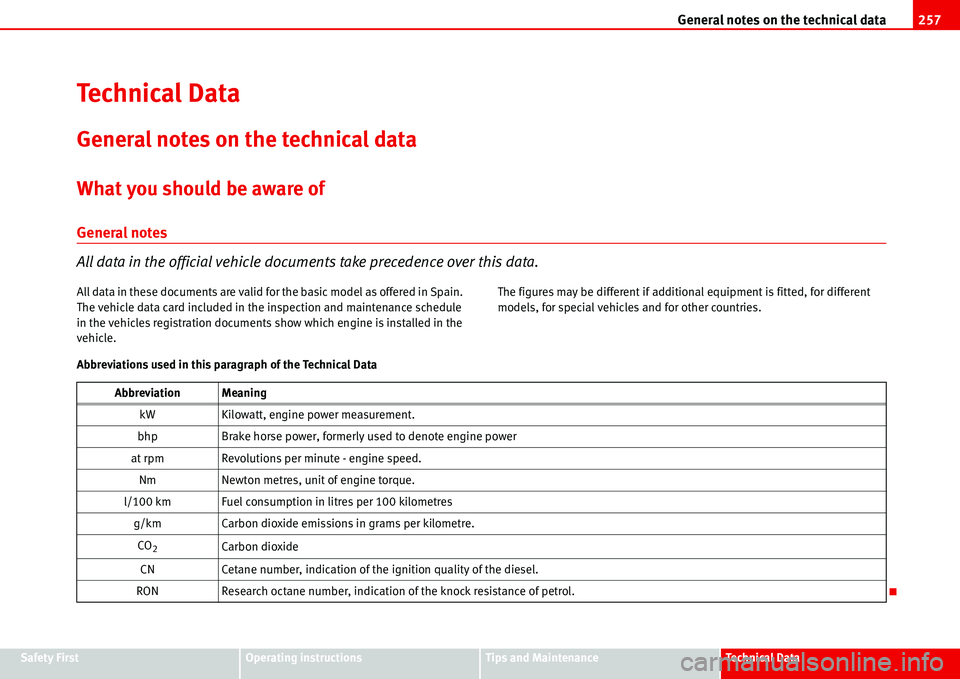
Abbreviations used in this paragraph of the Technical Data
Abbreviation Meaning
kW Kilowatt, engine power measurement.
bhp Brake horse power, formerly used to denote engine power
at rpm Revolutions per minute - engine speed.
Nm Newton metres, unit of engine torque.
l/100 km Fuel consumption in litres per 100 kilometres
g/km Carbon dioxide emissions in grams per kilometre.
CO
2Carbon dioxide
CN Cetane number, indication of the ignition quality of the diesel.
RON Research octane number, indication of the knock resistance of petrol.
Page 260 of 299
General notes on the technical data 258
Vehicle identification data
Vehicle identification number
The vehicle identification number (chassis number) can be read from outside
the vehicle through a viewer in the windscreen. This is located on the left-
hand side of the vehicle in the lower area of the windscreen. It is also located
on the right hand side of the engine compartment.
Type plate
The type plate is located on the left rib inside the engine compartment.
Vehicle data
The data sticker is placed on the inside of the spare wheel recess in the
luggage compartment.
The following information can be found in the vehicle information:
•Vehicle identification number (chassis number)
•Vehicle type / engine power / gearbox type
•Engine and gearbox code / paint number / interior equipment
•Optional extras / PR numbers
This data also appears in the inspection and maintenance plan.
Page 261 of 299
General notes on the technical data259
Safety FirstOperating instructionsTips and MaintenanceTe c h n i c a l D a t a
How are the figures measured?
Fuel consumption
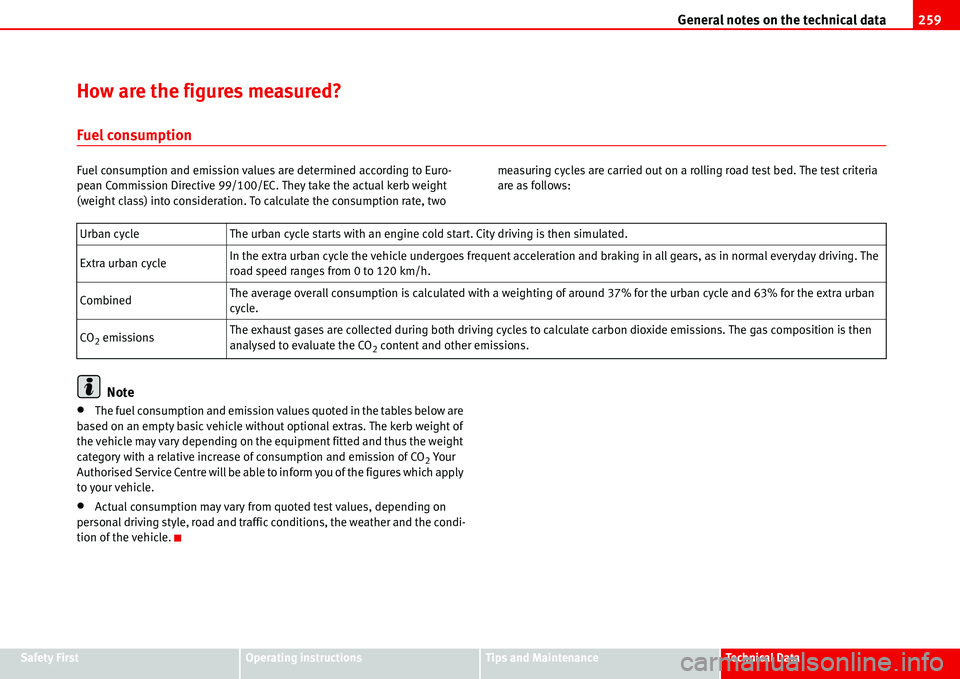
Fuel consumption and emission values are determined according to Euro-
pean Commission Directive 99/100/EC. They take the actual kerb weight
(weight class) into consideration. To calculate the consumption rate, two measuring cycles are carried out on a rolling road test bed. The test criteria
are as follows:
Note
•The fuel consumption and emission values quoted in the tables below are
based on an empty basic vehicle without optional extras. The kerb weight of
the vehicle may vary depending on the equipment fitted and thus the weight
category with a relative increase of consumption and emission of CO
2 Your
Authorised Service Centre will be able to inform you of the figures which apply
to your vehicle.
•Actual consumption may vary from quoted test values, depending on
personal driving style, road and traffic conditions, the weather and the condi-
tion of the vehicle.Urban cycle The urban cycle starts with an engine cold start. City driving is then simulated.
Extra urban cycleIn the extra urban cycle the vehicle undergoes frequent acceleration and braking in all gears, as in normal everyday driving. The
road speed ranges from 0 to 120 km/h.
CombinedThe average overall consumption is calculated with a weighting of around 37% for the urban cycle and 63% for the extra urban
cycle.
CO
2 emissionsThe exhaust gases are collected during both driving cycles to calculate carbon dioxide emissions. The gas composition is then
analysed to evaluate the CO2 content and other emissions.
Page 263 of 299
General notes on the technical data261
Safety FirstOperating instructionsTips and MaintenanceTe c h n i c a l D a t a Snow chains
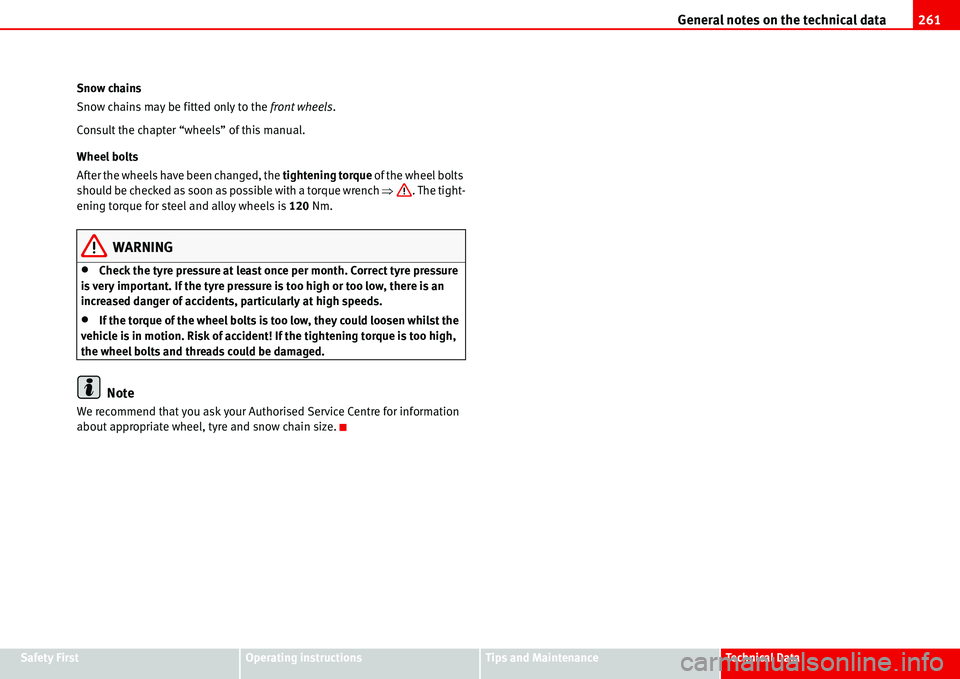
Snow chains may be fitted only to the front wheels.
Consult the chapter “wheels” of this manual.
Wheel bolts
After the wheels have been changed, the tightening torque of the wheel bolts
should be checked as soon as possible with a torque wrench Ÿ. The tight-
ening torque for steel and alloy wheels is 120 Nm.
WARNING
•Check the tyre pressure at least once per month. Correct tyre pressure
is very important. If the tyre pressure is too high or too low, there is an
increased danger of accidents, particularly at high speeds.
•If the torque of the wheel bolts is too low, they could loosen whilst the
vehicle is in motion. Risk of accident! If the tightening torque is too high,
the wheel bolts and threads could be damaged.
Note
We recommend that you ask your Authorised Service Centre for information
about appropriate wheel, tyre and snow chain size.
Page 265 of 299
Technical Data263
Safety FirstOperating instructionsTips and MaintenanceTe c h n i c a l D a t a
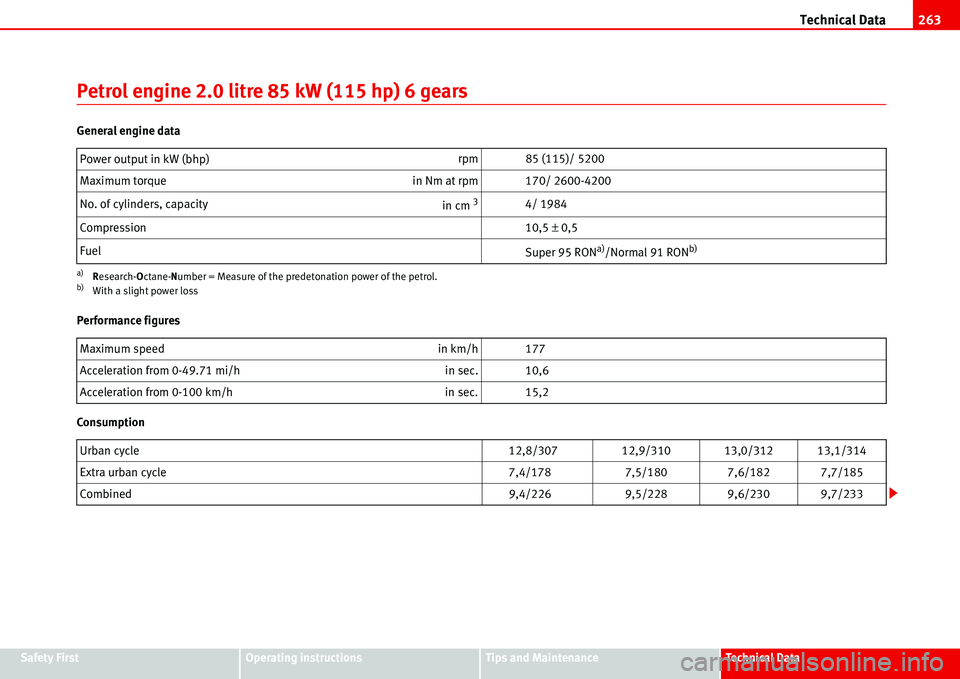
Petrol engine 2.0 litre 85 kW (115 hp) 6 gears
General engine data
Performance figures
ConsumptionPower output in kW (bhp)rpm 85 (115)/ 5200
Maximum torquein Nm at rpm 170/ 2600-4200
No. of cylinders, capacity
in cm
34/ 1984
Compression 10,5 ± 0,5
Fuel
Super 95 RON
a)/Normal 91 RONb)
a)Research-Octane-Number = Measure of the predetonation power of the petrol.b)With a slight power loss
Maximum speedin km/h 177
Acceleration from 0-49.71 mi/h in sec. 10,6
Acceleration from 0-100 km/hin sec. 15,2
Urban cycle12,8/307 12,9/310 13,0/312 13,1/314
Extra urban cycle7,4/178 7,5/180 7,6/182 7,7/185
Combined9,4/226 9,5/228 9,6/230 9,7/233
Page 267 of 299
Technical Data265
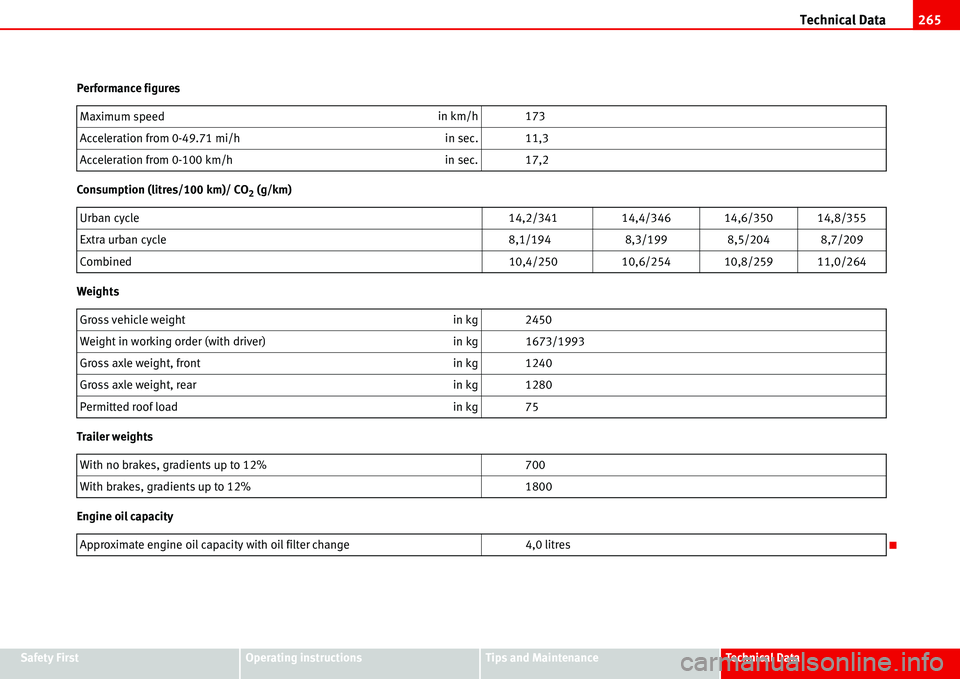
Safety FirstOperating instructionsTips and MaintenanceTe c h n i c a l D a t a Performance figures
Consumption (litres/100 km)/ CO
2 (g/km)
Weights
Trailer weights
Engine oil capacityMaximum speedin km/h 173
Acceleration from 0-49.71 mi/h in sec. 11,3
Acceleration from 0-100 km/hin sec. 17,2
Urban cycle14,2/341 14,4/346 14,6/350 14,8/355
Extra urban cycle8,1/194 8,3/199 8,5/204 8,7/209
Combined10,4/250 10,6/254 10,8/259 11,0/264
Gross vehicle weightin kg 2450
Weight in working order (with driver)in kg 1673/1993
Gross axle weight, frontin kg 1240
Gross axle weight, rearin kg 1280
Permitted roof loadin kg 75
With no brakes, gradients up to 12%700
With brakes, gradients up to 12%1800
Approximate engine oil capacity with oil filter change4,0 litres
Page 269 of 299
Technical Data267
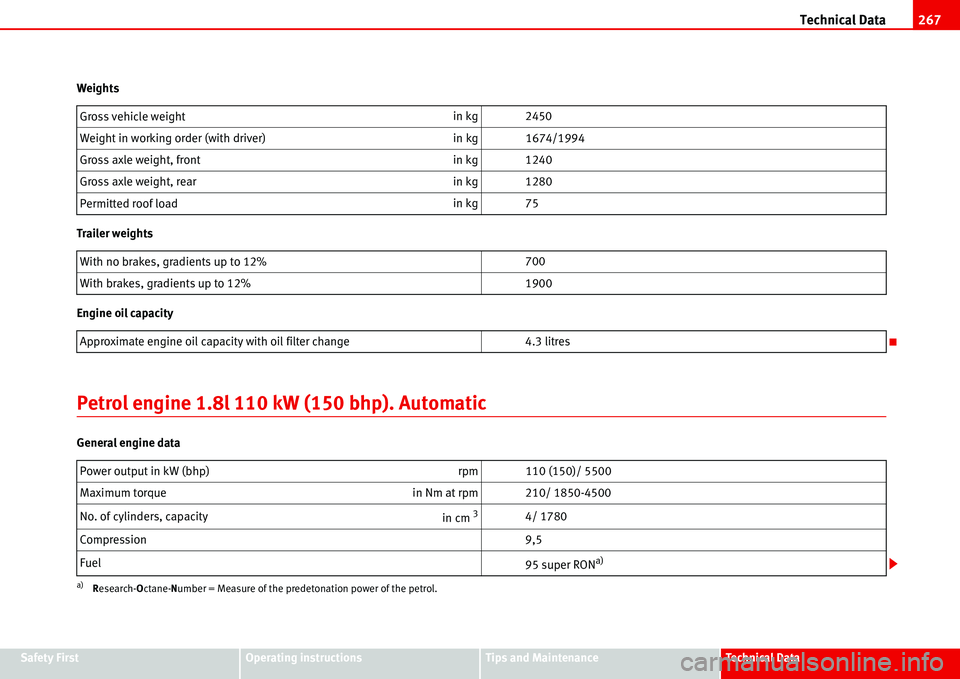
Safety FirstOperating instructionsTips and MaintenanceTe c h n i c a l D a t a Weights
Trailer weights
Engine oil capacity
Petrol engine 1.8l 110 kW (150 bhp). Automatic
General engine dataGross vehicle weightin kg 2450
Weight in working order (with driver)in kg 1674/1994
Gross axle weight, frontin kg 1240
Gross axle weight, rearin kg 1280
Permitted roof loadin kg 75
With no brakes, gradients up to 12%700
With brakes, gradients up to 12%1900
Approximate engine oil capacity with oil filter change 4.3 litres
Power output in kW (bhp)rpm 110 (150)/ 5500
Maximum torquein Nm at rpm 210/ 1850-4500
No. of cylinders, capacity
in cm
34/ 1780
Compression 9,5
Fuel
95 super RON
a)
a)Research-Octane-Number = Measure of the predetonation power of the petrol.
Page 271 of 299
Technical Data269
Safety FirstOperating instructionsTips and MaintenanceTe c h n i c a l D a t a
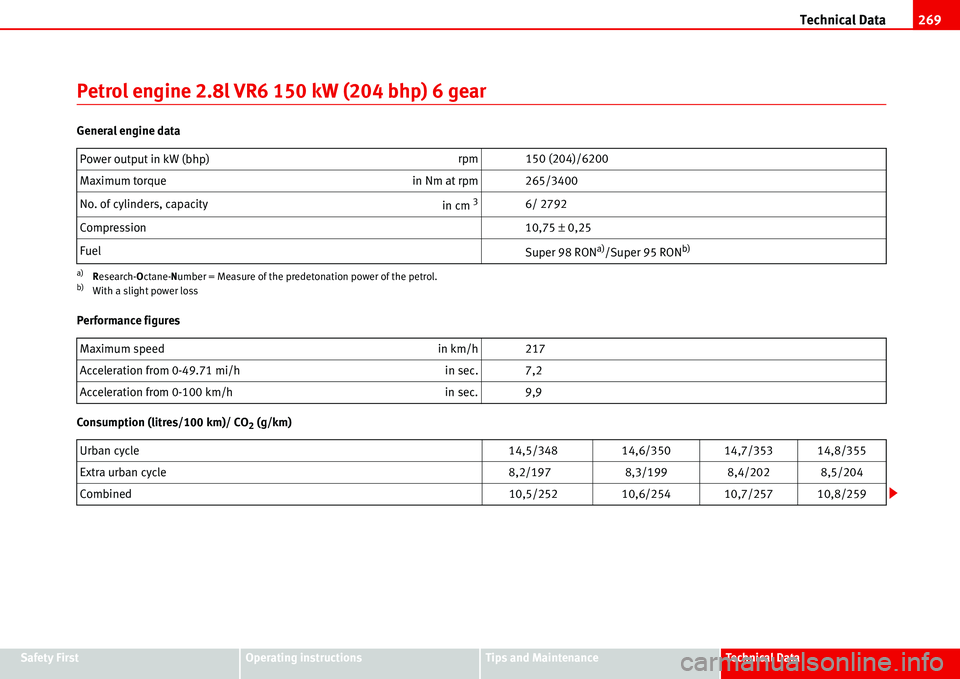
Petrol engine 2.8l VR6 150 kW (204 bhp) 6 gear
General engine data
Performance figures
Consumption (litres/100 km)/ CO
2 (g/km) Power output in kW (bhp)rpm 150 (204)/6200
Maximum torquein Nm at rpm 265/3400
No. of cylinders, capacity
in cm
36/ 2792
Compression 10,75 ± 0,25
Fuel
Super 98 RON
a)/Super 95 RONb)
a)Research-Octane-Number = Measure of the predetonation power of the petrol.b)With a slight power loss
Maximum speedin km/h 217
Acceleration from 0-49.71 mi/h in sec. 7,2
Acceleration from 0-100 km/hin sec. 9,9
Urban cycle14,5/348 14,6/350 14,7/353 14,8/355
Extra urban cycle8,2/197 8,3/199 8,4/202 8,5/204
Combined10,5/252 10,6/254 10,7/257 10,8/259
Page 273 of 299
Technical Data271
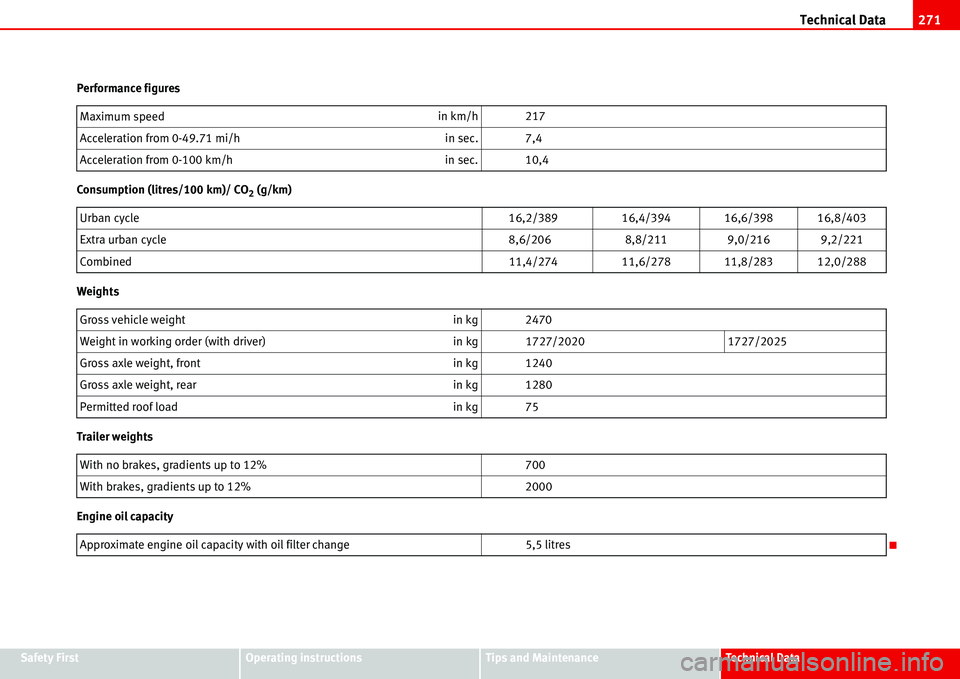
Safety FirstOperating instructionsTips and MaintenanceTe c h n i c a l D a t a Performance figures
Consumption (litres/100 km)/ CO
2 (g/km)
Weights
Trailer weights
Engine oil capacityMaximum speedin km/h 217
Acceleration from 0-49.71 mi/h in sec. 7,4
Acceleration from 0-100 km/hin sec. 10,4
Urban cycle16,2/389 16,4/394 16,6/398 16,8/403
Extra urban cycle8,6/206 8,8/211 9,0/216 9,2/221
Combined11,4/274 11,6/278 11,8/283 12,0/288
Gross vehicle weightin kg 2470
Weight in working order (with driver)in kg 1727/2020 1727/2025
Gross axle weight, frontin kg 1240
Gross axle weight, rearin kg 1280
Permitted roof loadin kg 75
With no brakes, gradients up to 12%700
With brakes, gradients up to 12%2000
Approximate engine oil capacity with oil filter change5,5 litres