ECU Seat Alhambra 2006 Owner's Guide
[x] Cancel search | Manufacturer: SEAT, Model Year: 2006, Model line: Alhambra, Model: Seat Alhambra 2006Pages: 299, PDF Size: 6.33 MB
Page 125 of 299
Seats and stowage123
Safety FirstOperating instructionsTips and MaintenanceTe c h n i c a l D a t a
Removing or adjusting head restraints
The head restraints can be adjusted by moving them up and
down.
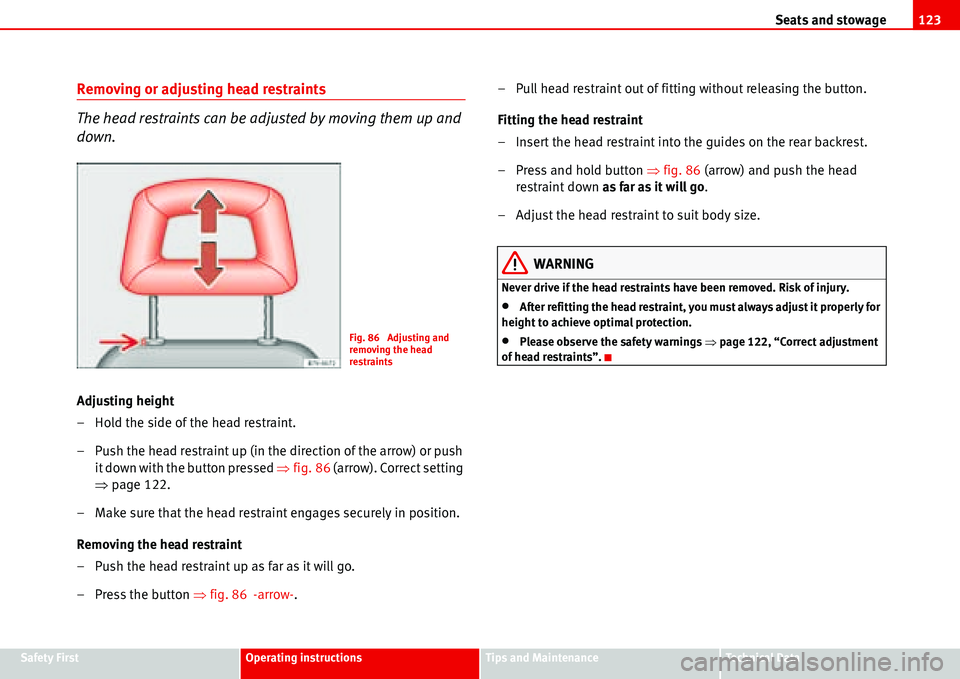
Adjusting height
– Hold the side of the head restraint.
– Push the head restraint up (in the direction of the arrow) or push
it down with the button pressed Ÿfig. 86 (arrow). Correct setting
Ÿpage 122.
– Make sure that the head restraint engages securely in position.
Removing the head restraint
– Push the head restraint up as far as it will go.
– Press the button Ÿfig. 86 -arrow-.– Pull head restraint out of fitting without releasing the button.
Fitting the head restraint
– Insert the head restraint into the guides on the rear backrest.
– Press and hold button Ÿfig. 86 (arrow) and push the head
restraint down as far as it will go.
– Adjust the head restraint to suit body size.
WARNING
Never drive if the head restraints have been removed. Risk of injury.
•After refitting the head restraint, you must always adjust it properly for
height to achieve optimal protection.
•Please observe the safety warnings Ÿpage 122, “Correct adjustment
of head restraints”.Fig. 86 Adjusting and
removing the head
restraints
Page 127 of 299
Seats and stowage125
Safety FirstOperating instructionsTips and MaintenanceTe c h n i c a l D a t a
•To reduce the risk of injury to the driver and front passenger during
sudden braking manoeuvres or an accident, never drive with the backrest
tilted far back. Risk of injury. The maximum protection of the seat belt can
be achieved only when the backrests are in an upright position and the
driver and front passenger have properly adjusted their seat belts. The
further the backrests are tilted to the rear, the greater the risk of injury due
to improper positioning of the belt web!
•Exercise caution when adjusting the seat height or forwards/back-
wards position. Injuries can be caused if the backrest is tilted without due
care and attention.
•Never turn the driver or front passenger seat while the vehicle is in
motion. While adjusting your seat, you will assume an incorrect sitting
position. Risk of injury. Only turn the driver or passenger seats when the
vehicle is stationary.
•When the vehicle is in motion, the rotating front seats must be securely
engaged and facing the direction of travel. These front seats may be used
only when the vehicle is stationary.
Caution
The driver seat and front passenger seat must not be occupied while they are
being turned. If the seat is occupied when it is turned, it could be damaged.
Seat heating A
The seat cushions and backrests of the front seats can be
heated electrically.
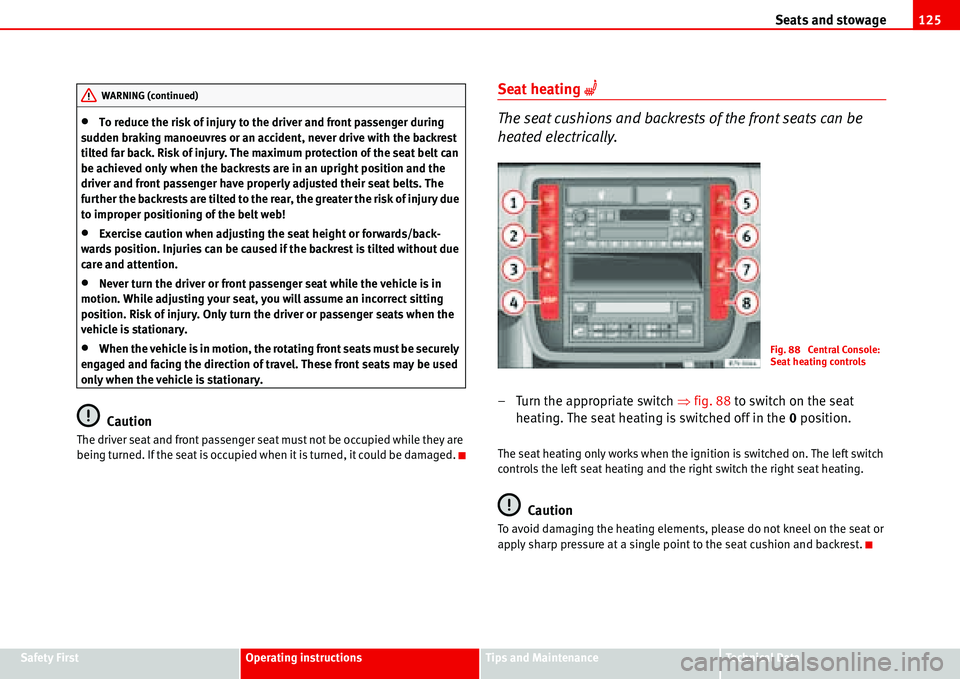
– Turn the appropriate switch Ÿfig. 88 to switch on the seat
heating. The seat heating is switched off in the 0 position.
The seat heating only works when the ignition is switched on. The left switch
controls the left seat heating and the right switch the right seat heating.
Caution
To avoid damaging the heating elements, please do not kneel on the seat or
apply sharp pressure at a single point to the seat cushion and backrest.
WARNING (continued)
Fig. 88 Central Console:
Seat heating controls
Page 129 of 299
Seats and stowage127
Safety FirstOperating instructionsTips and MaintenanceTe c h n i c a l D a t a Second row, right seat
27).
Third row, right seat27).
Notes on the installation of the seats
•Seats and are of the same construction and thus interchangeable.
•Seats and are of the same construction and thus interchangeable.
•Seat can be installed in positions .
•The seat can be installed in positions , , and .
Moving seats
– Make sure that the vehicle is not on a steep slope.
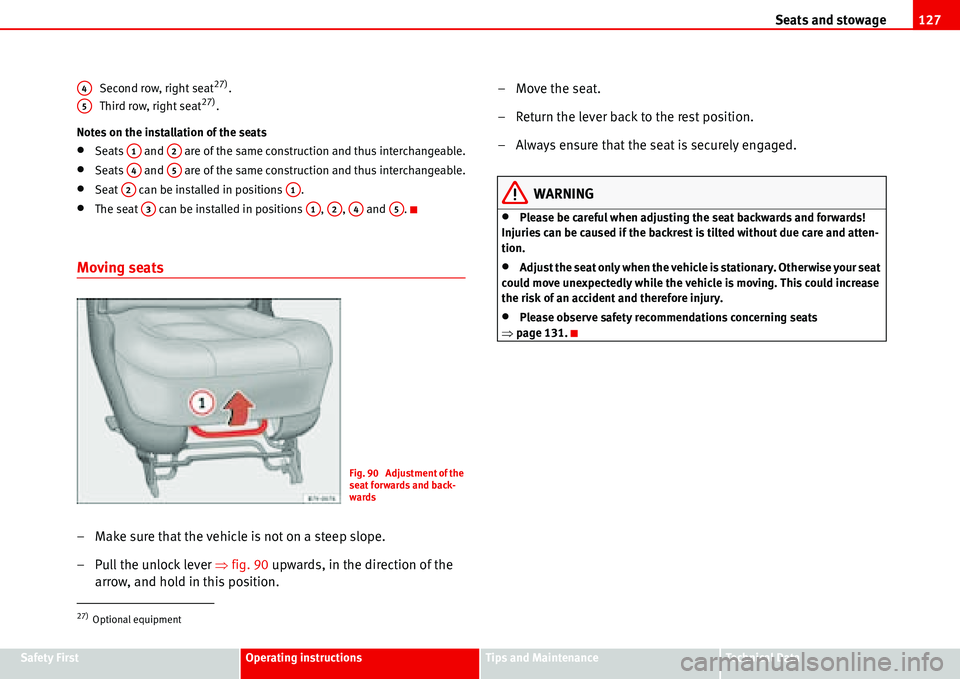
– Pull the unlock lever Ÿfig. 90 upwards, in the direction of the
arrow, and hold in this position.–Move the seat.
– Return the lever back to the rest position.
– Always ensure that the seat is securely engaged.
WARNING
•Please be careful when adjusting the seat backwards and forwards!
Injuries can be caused if the backrest is tilted without due care and atten-
tion.
•Adjust the seat only when the vehicle is stationary. Otherwise your seat
could move unexpectedly while the vehicle is moving. This could increase
the risk of an accident and therefore injury.
•Please observe safety recommendations concerning seats
Ÿpage 131.
27)Optional equipment
A4
A5
A1A2
A4A5
A2A1
A3A1A2A4A5
Fig. 90 Adjustment of the
seat forwards and back-
wards
Page 133 of 299
Seats and stowage131
Safety FirstOperating instructionsTips and MaintenanceTe c h n i c a l D a t a
Adjusting the armrest
– Turn the thumb wheel underneath the armrests to adjust the
angle of the armrests to your requirement.
Removable armrest
29)
– Take hold of the armrest at the rear and press the button
Ÿpage 130, fig. 95 in the direction of the arrow.
– With the button pressed, pull the armrest off to the side out of the
holder.
– When installing, please ensure that the armrest engages
securely in the holder.
The removable armrests for the second row of seats can be found in a trans-
port bag Ÿpage 130, fig. 96.
The bag hangs from a head restraint of a seat in the last row of seats or, in
vehicles with 4 integrated child seats
29), on the centre seat of the second row
of seats.
WARNING
•The transport bag should always be secured properly when travelling in
the vehicle as it could otherwise be a safety risk in an accident or braking
manoeuvre. We recommend that you keep the bag at home.
•The bag, if you do decide to keep it in the vehicle, may not be secured
to the head restraint of an integrated child seat. The backrest could be
forced forward in an accident or braking manoeuvre due to the weight of the
bag.
Safety instructions for seats
WARNING
•Occupants may travel on the seats in the passenger compartment only
if the following conditions are fulfilled at the same time:
−The seats must always be fitted in the appropriate floor anchors and
must be securely engaged.
−The backrest of all seats must be in the upright position and securely
engaged in this position.
−The seat occupants must have access to the seat belts. The seat
belts must be fitted correctly.
−All the occupants of the vehicle must be correctly seated while
driving.
•A seat which has been removed can cause injury if it is transported in
the vehicle. Each seat must always be fitted in the floor anchors and must
be securely engaged. The backrest must be in an upright position. If a
bench seat is not properly secured, it could become a life-threatening
hazard for all vehicle occupants.
•Make sure that the bases of seats are not soiled or damaged when
removed from the vehicle.
•All adjustment to the seats, including fitting and removal, may be
carried out only when the vehicle is stationary.
29)Optional equipment
Page 134 of 299
Seats and stowage 132
Some seat settings for the Alhambra
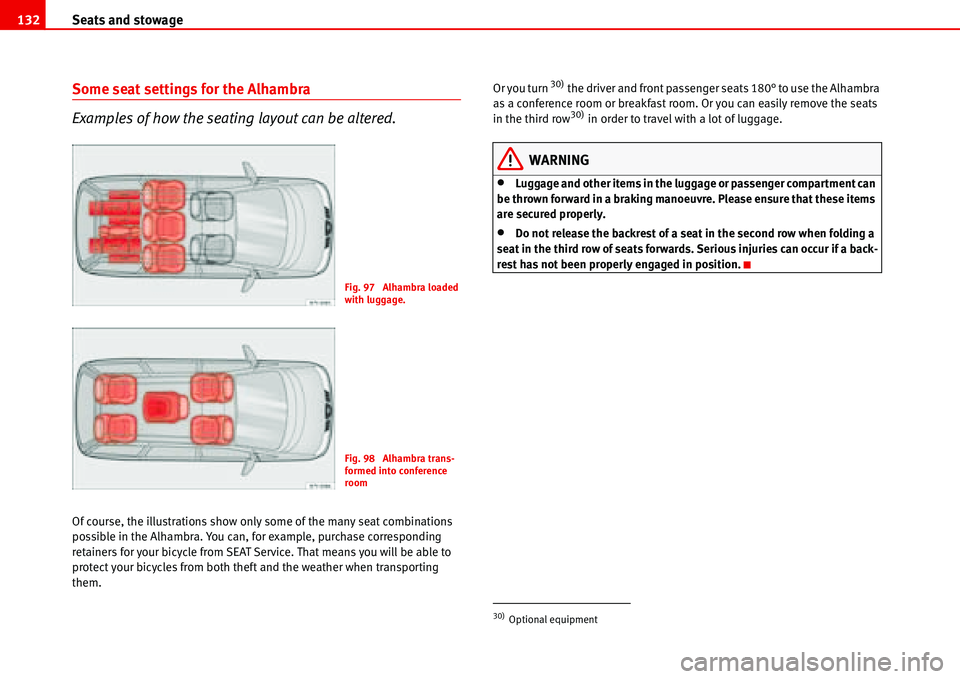
Examples of how the seating layout can be altered.
Of course, the illustrations show only some of the many seat combinations
possible in the Alhambra. You can, for example, purchase corresponding
retainers for your bicycle from SEAT Service. That means you will be able to
protect your bicycles from both theft and the weather when transporting
them.Or you turn
30) the driver and front passenger seats 180° to use the Alhambra
as a conference room or breakfast room. Or you can easily remove the seats
in the third row
30) in order to travel with a lot of luggage.
WARNING
•Luggage and other items in the luggage or passenger compartment can
be thrown forward in a braking manoeuvre. Please ensure that these items
are secured properly.
•Do not release the backrest of a seat in the second row when folding a
seat in the third row of seats forwards. Serious injuries can occur if a back-
rest has not been properly engaged in position.
Fig. 97 Alhambra loaded
with luggage.
Fig. 98 Alhambra trans-
formed into conference
room
30)Optional equipment
Page 140 of 299
Seats and stowage 138
WARNING
The folding tables may not be folded down whilst the vehicle is in motion
and anyone is seated on the second row of seats. There is a risk on injury
during a sudden braking manoeuvre! The table must therefore be closed
and properly secured whilst the vehicle is in motion.
Clothes hangers
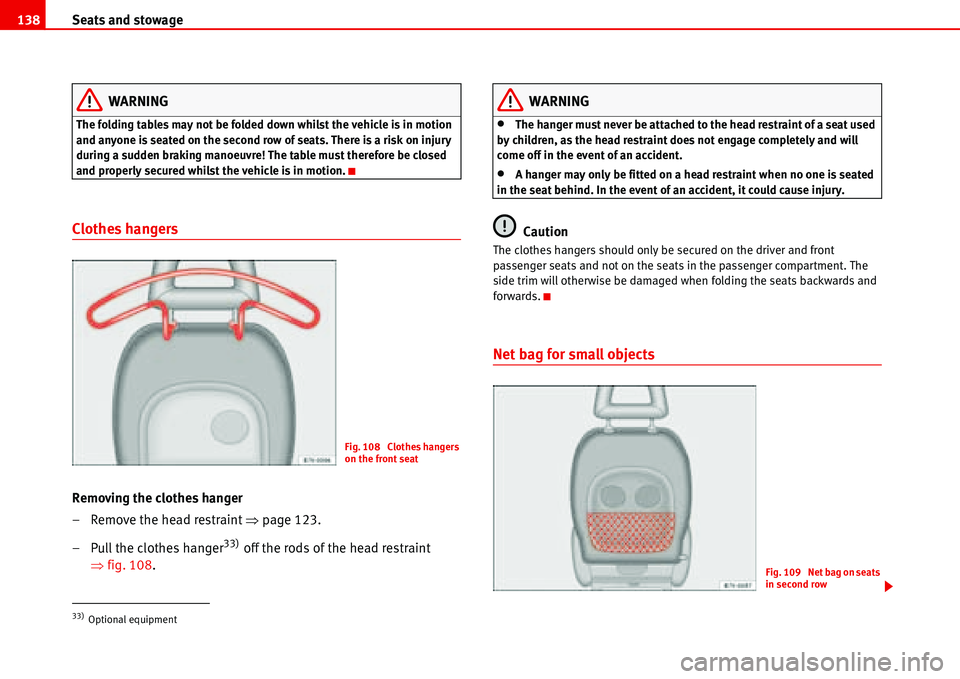
Removing the clothes hanger
– Remove the head restraint Ÿpage 123.
– Pull the clothes hanger
33) off the rods of the head restraint
Ÿfig. 108.
WARNING
•The hanger must never be attached to the head restraint of a seat used
by children, as the head restraint does not engage completely and will
come off in the event of an accident.
•A hanger may only be fitted on a head restraint when no one is seated
in the seat behind. In the event of an accident, it could cause injury.
Caution
The clothes hangers should only be secured on the driver and front
passenger seats and not on the seats in the passenger compartment. The
side trim will otherwise be damaged when folding the seats backwards and
forwards.
Net bag for small objects
33)Optional equipment
Fig. 108 Clothes hangers
on the front seat
Fig. 109 Net bag on seats
in second row
Page 144 of 299
Seats and stowage 142
Hazard warning triangles and first aid kit
Warning triangle
The hazard warning triangle may be fitted in the bracket behind the right trim
of the luggage compartment.
Note
The warning triangle is not part of the vehicle's standard equipment.
First-aid kit
In the bracket located behind the right hand trim in the luggage compartment
there is space for a standard first aid kit and the hazard warning triangle.
For reasons of space, in vehicles fitted with a removable tow bar
35) the
bracket only holds a smaller first aid kit and the hazard warning triangle.
Note
•In some vehicles the first aid kit bracket is behind the left hand trim in the
luggage compartment.
•The first aid kit is not issued as a standard feature with the vehicle.
•The first aid kit must comply with legal requirements.
•Observe the expiry date of the contents of the first aid kit. You should
purchase a new first-aid kit as soon as possible after the shelf-life date of the
first-aid kit has expired.
•Before buying accessories and replacement parts, refer to the note “
Accessories, modifications and renewal of parts”.
Luggage compartment
Loading the luggage compartment
All luggage and other loose objects must be safely secured in
the luggage compartment.
Please observe the following points to ensure the vehicle handles
well at all times:
– If necessary, remove the seats to increase the load area.
– Distribute the load as evenly as possible in the luggage compart-
ment.
– Place and stow heavy objects directly on the floor of the vehicle.
If possible they should be positioned above or in front of the rear
axle.
– Drive particularly carefully if you are transporting heavy objects
Ÿpage 144.
– Use suitable straps to secure heavy objects to the fitted fastening
rings Ÿpage 143.
– If objects protrude over the end of the vehicle, you must draw the
attention of other road users to this. Observe legal requirements
when doing so.
When driving with the tailgate open, please observe the instructions on
Ÿpage 98.
35)Optional equipment
Page 145 of 299
Seats and stowage143
Safety FirstOperating instructionsTips and MaintenanceTe c h n i c a l D a t a
WARNING
Loose luggage and other objects in the luggage compartment can cause
serious injuries.
•Always stow objects in the luggage compartment and secure them on
the fastening rings.
•Use suitable specialist straps to secure heavy objects.
•During sudden manoeuvres or accidents, loose objects can be thrown
forward, injuring vehicle occupants. This increased risk of injury will be
further increased if a loose object is struck by an inflating airbag. If this
happens, objects can be transformed into “missiles”. Risk of fatal injury.
•Remember that transporting heavy objects modifies the driving condi-
tions as the centre of gravity has been altered. There is a risk of accident.
Therefore, it is essential to adjust your speed and driving style accordingly,
to avoid accidents.
•Never exceed the allowed axle loads or allowed maximum weight. If the
allowed axle load or the allowed total weight is exceeded, the driving char-
acteristics of the vehicle may change, leading to accidents, injuries and
damage to the vehicle.
•Never leave the vehicle unattended, especially when the tailgate is
open. Children could climb into the luggage compartment closing the door
behind them; they will remain trapped without help and there is a mortal
risk.
•Never allow children to play in or around the vehicle. Close and lock
both the tailgate and all the doors when you leave the vehicle. Before you
lock the vehicle, make sure that there are no adults or children in the
vehicle.
•Never transport passengers in the luggage compartment. Every
passenger must be properly belted in .
Caution
•Avoid overloading small areas by placing heavy objects on the vehicle
floor.
•The wires of the heating element in the rear window and the window aerial
in the rear side windows could be damaged if objects on the luggage
compartment cover rub against them.
•If you have removed the seats from the passenger compartment, you
should place a large, robust covering over the floor anchors to prevent
damage.
Note
•Air circulation in the vehicle helps reduce fogging of the windows. Used
air escapes through ventilation slits in the side trim of the luggage compart-
ment. Ensure that the ventilation slits are never covered.
•Straps for securing the load to the fastening rings are commercially
available.
Fastening rings
There are fastening rings in the luggage compartment which
can be used to secure luggage and other objects.
– Always use suitable undamaged belts for fastening the luggage
or any other object tot he anchorage rings Ÿ in “Loading the
luggage compartment” on page 142.
The retainers for the detachable seat belts for the third row of seats and the
floor anchors for the seats can be used as fastening rings for items of
luggage.
Page 146 of 299
Seats and stowage 144
During a collision or an accident, even small and light objects can build up so
much energy that they can cause very severe injuries. The amount of “kinetic
energy” depends on the speed of the vehicle and the weight of the object.
The most significant factor, however, is the speed of the vehicle.
For example: an object weighing 4.5 kg is lying unsecured in the vehicle.
During a frontal collision at a speed of 50 km/h, this object generates a force
corresponding to 20 times its weight. That means that the effective weight of
the object increases to about 90 kg. You can imagine the severity of the inju-
ries which might be sustained if this “projectile” strikes an occupant as it flies
through the passenger compartment. This increased risk of injury will be
further increased if a loose object is struck by an inflating airbag.
WARNING
If pieces of baggage or other objects are secured to the fastening rings with
inappropriate or damaged retaining cords, injuries could result in the event
of braking manoeuvres or accidents.
•To prevent pieces of luggage or other objects from flying forward,
always use appropriate retaining cords which are secured to the fastening
rings.
•Never secure a child seat on the fastening rings.
Loading heavy objects
Special care is required when loading heavy objects and
when driving a vehicle which contains heavy objects.
Observe the following points to prevent damage and accidents:
– If necessary, remove the seats to increase the load area.–Before loading the vehicle place a sturdy mat or similar cover
flush on floor of the vehicle.
– Where necessary, do not cover protruding parts of the vehicle
floor.
– Protect the seat anchor points from damage.
– Avoid overloading small areas - spread the load.
– Use suitable straps to secure the objects to retaining rings.
– Drive particularly carefully and think ahead.
– If possible, avoid sudden braking and driving manoeuvres.
WARNING
For safety reasons, you should read and observe all information on loading
the vehicle Ÿpage 144.
Caution
•If you have removed the seats from the passenger compartment, you
should place a large, robust covering over the seat rails to prevent damage.
•Avoid overloading small areas - spread the load.
Safety notes on loading the vehicle
WARNING
Loose luggage and other objects in the luggage compartment can cause
serious injuries.
Page 147 of 299
Seats and stowage145
Safety FirstOperating instructionsTips and MaintenanceTe c h n i c a l D a t a
•Always stow objects safely in the vehicle and secure them on the
fastening rings if necessary.
•Use suitable specialist straps to secure heavy objects.
•Loose objects in the vehicle can move suddenly. As the centre of gravity
moves, safety is impaired and the vehicle becomes difficult to handle.
•During sudden manoeuvres or accidents, loose objects can be thrown
forward, injuring vehicle occupants. This increased risk of injury will be
further increased if a loose object is struck by an inflating airbag. If this
happens, objects can be transformed into “missiles”. Risk of fatal injury.
•Remember that transporting heavy objects modifies the driving condi-
tions as the centre of gravity has been altered. There is a risk of accident.
Therefore, it is essential to adjust your speed and driving style accordingly,
to avoid accidents.
•Never exceed the allowed axle loads or allowed maximum weight. If the
allowed axle load or the allowed total weight is exceeded, the driving char-
acteristics of the vehicle may change, leading to accidents, injuries and
damage to the vehicle.
•Never leave the vehicle unattended, especially when the tailgate is
open. Children could climb into the interior of the vehicle closing the door
behind them; they will remain trapped without help and there is a mortal
risk.
•Never allow children to play in or around the vehicle. Close and lock all
windows, the tailgate and all doors when you leave the vehicle.
•Never transport passengers in the luggage compartment. Every
passenger must be properly belted in.
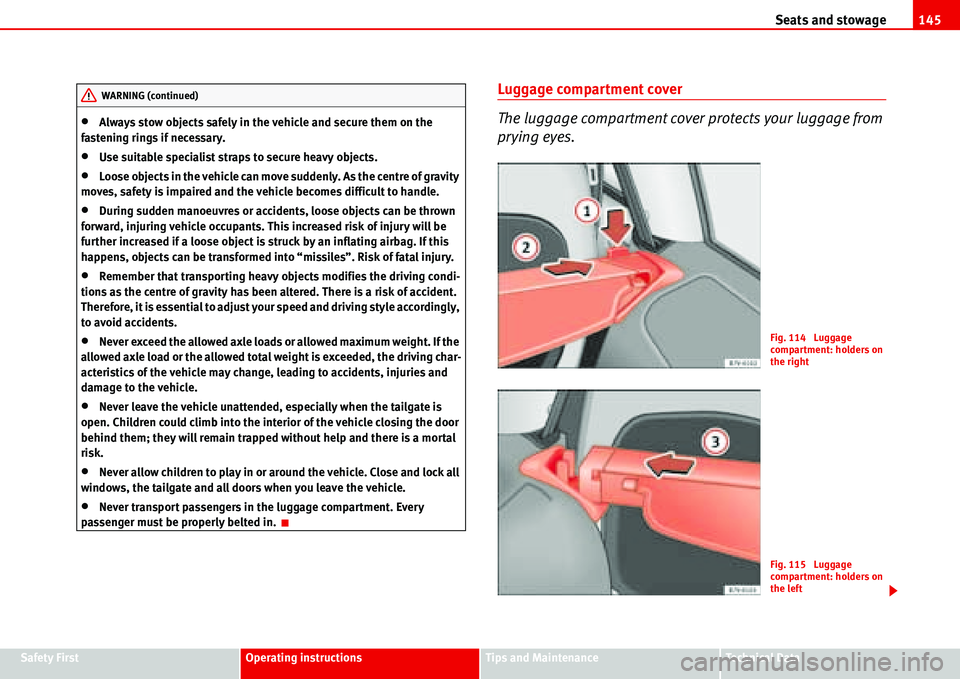
Luggage compartment cover
The luggage compartment cover protects your luggage from
prying eyes.WARNING (continued)
Fig. 114 Luggage
compartment: holders on
the right
Fig. 115 Luggage
compartment: holders on
the left