ECU Seat Alhambra 2006 Owner's Guide
[x] Cancel search | Manufacturer: SEAT, Model Year: 2006, Model line: Alhambra, Model: Seat Alhambra 2006Pages: 299, PDF Size: 6.33 MB
Page 149 of 299
Seats and stowage147
Safety FirstOperating instructionsTips and MaintenanceTe c h n i c a l D a t a
WARNING
Always fit the net partition carefully, observing the instructions. Risk of
injury.
•Heavy, pointed or sharp items which are not stowed securely can cause
injury in the event of sudden braking manoeuvres or accidents, even if the
net bag is correctly assembled.
•For reasons of safety, vehicle occupants must not travel behind a fitted
safety net.
Roof carrier
Safety notes on using the roof carrier
The roof carrier system must always be installed exactly
according to the instructions provided.
•Your vehicle has special roof rails on the right and left for fitting the
mounts. Therefore, standard roof carriers cannot be used.
•The mounts are the basis of a complete roof carrier system. Special
fixtures must then be added in order to safely transport luggage, bicycles,
skis, surf boards or boats on the roof. All these system components are avail-
able from SEAT Service. We recommend you use genuine SEAT roof carrier
systems. If you wish to use a different roof carrier, make sure that it can be
fitted securely to your vehicle and that it cannot damage your vehicle.
•We recommend that you keep the assembly instructions provided by the
roof carrier manufacturer in your vehicle wallet.
•Only the fitted retainers may be used to secure the carrier feet on vehicles
without a roof railing. These retainers are located underneath the plastic rain
channel between the markings.
•In vehicles with roof edging36), the basic supports can be fitted on the
edge making sure to adapt the distance between the supports to the objects
to be carried. On vehicles with a sliding/tilting roof
36), however, the front
carrier may not be fitted near the rear edge of the sliding/tilting roof when the
roof is open.
When should the roof carrier be removed?
•When it is not needed (to save fuel, reduce wind noise and avoid theft).
•Before cleaning in an automatic car wash.
WARNING
•If you do not use mounts approved by SEAT or fail to fit them according
to instructions, the load or the roof carrier itself may fall off the vehicle roof
and onto the street. Risk of accident or injury.
•The risk of an accident is increased by transporting heavy or bulky
loads on the roof, which affects the car's handling by shifting the centre of
gravity and increasing susceptibility to cross winds. Both circumstances
increase the risk of accident. Therefore you must adapt your driving style
and speed to the prevailing conditions - avoid sudden braking or driving
manoeuvres when there is a load on the roof carrier.
•The roof carrier system must always be installed exactly according to
the instructions provided.
Caution
•Check all bolted connections and fastenings for the roof carrier system
before every trip. If necessary, tighten bolted connections and check the
system at regular, appropriate intervals, e.g. at each stop during a long trip.
•The height of your vehicle is changed by the installation of the roof carrier
and the load secured on it. Bear this in mind when driving through garage
doors or low underpasses – there is danger of damage to the vehicle.
36)Optional equipment
Page 150 of 299
Seats and stowage 148
•Damage to the vehicle caused by incorrect installation of mounts or roof
carrier systems not approved by the factory are excluded from the vehicle
warranty.
Securing the load
Loads transported on the roof carrier must be securely
attached. The car's handling is affected when transporting
loads.
The maximum permissible roof load for your vehicle is 75 kg. The load limit
applies to the combined weight of the carrier system and the load itself.
Distribute the load evenly. However, if you are using a roof carrier with a lower
weight rating, you will not be able to carry the maximum roof load. Do not
exceed the maximum weight limit for the roof carrier which is listed in the
fitting instructions.
WARNING
•If damaged, fine or inadequate securing straps are used to fasten
objects carried on the roof, they could break in the event of sharp braking.
This could cause an accident and serious injury.
•Always use appropriate securing straps to secure objects on the roof
carrier against sliding or flying off. This could cause an accident. The load
must be correctly secured.
•Always respect the maximum authorised weight for the roof, the
maximum authorised weight on the axles and the total maximum author-
ised weight of the vehicle. Otherwise there is danger of causing an acci-
dent.
•The risk of an accident is increased by transporting heavy or bulky
loads on the roof, which affects the car's handling by shifting the centre of
gravity and increasing susceptibility to cross winds. Both circumstances increase the risk of accident. Therefore you must adapt your driving style
and speed to the prevailing conditions - avoid sudden braking or driving
manoeuvres when there is a load on the roof carrier.
Caution
Please take extra care not to let the tailgate or rear window strike the roof load
when open – there is a risk of damage to the vehicle.
For the sake of the environment
The roof carrier is often left on the roof for convenience even if it is not being
used. However, increased air resistance means that the vehicle uses more
fuel. For this reason you should always take off the roof carrier when it is not
in use.
Cooling and heating box*
Notes on usage
The cooling and heating box may only be installed in the posi-
tion of rear left seat in the third row.
Power can be supplied by any of the 12 Volt sockets in the vehicle. It
consumes approximately 33 watts and has a capacity of approximately
32 litres.
The battery will discharge if the cooling and heating box is used for a long
period while the engine is switched off.
WARNING (continued)
Page 152 of 299
Seats and stowage 150
Switching on the heating function
– Insert the cable plug in the cooling and heating box so that the
red marking on the plug is pointing to the notch.
– Insert the connector cable plug into one of the vehicle's 12 volt
sockets.
– Keep the lid of the cooling and heating box closed.
Switching the cooling and heating box off fully
– Disconnect the power supply to the 12 Volt socket.
The internal temperature of the cooling and heating box is dependent on the
temperature in the vehicle. In cooling mode, the internal temperature can be
max. 20 degrees below the temperature in the vehicle. In heating mode it can
be max. 35 degrees above the temperature in the vehicle Ÿ in “Safety
notes on using the cooling and heating box” on page 150.
If you switch directly from cooling to heating (or vice versa) it will take a rela-
tively long time for the interior to reach the desired temperature.
Faults
If the cooling and heating box does not work, proceed as follows:
•Check whether there is power and whether the plug is securely in the
socket.
•Make sure the power cable is not damaged.
•Check the fuse for the power supply to the 12 Volt socket.
•Run the engine to recharge the battery.
If these steps do not help, contact a qualified dealership.
Safety notes on using the cooling and heating box
WARNING
•For reasons of safety, the cooling and heating box lid must always be
closed and latched when the vehicle is in motion. The cooling and heating
box must always be firmly secured in the correct floor anchors.
•If the temperature in the vehicle is too low, the temperature in the box
may fall below +2 degrees and the contents may freeze. Bottles and other
containers could burst. Risk of injury.
•For reasons of safety, the cooling and heating box lid must not be used
as a table or shelf when the vehicle is in motion.
•Always close the lid of the cooling and heating box before the vehicle
moves off. If the flap is open, it could drop down when the vehicle moves
off. Risk of injury.
Page 191 of 299
Driving and the environment189
Safety FirstOperating instructionsTips and MaintenanceTe c h n i c a l D a t a Gross combination weight
The gross combination weight is the actual weight of the laden vehicle plus
the actual weight of the laden trailer . If the maximum permissible trailer
weight is to be utilized, the weight of the vehicle may have to be reduced.
Distributing the load
Distribute loads in the trailer so that heavy objects are as near to the axle as
possible. Loads carried in the trailer must be secured to prevent them
moving.
Tyre pressure
Set tyre pressure to the maximum permitted pressure shown on the sticker on
the inside of the tank flap. Set the tyre pressure of the trailer tyres in accord-
ance with the trailer manufacturer's recommendations.
Exterior mirrors
Check whether you can see enough of the road behind the trailer with the
standard mirrors. If this is not the case you should have additional mirrors
fitted. Both exterior mirrors should be mounted on hinged extension
brackets. Adjust the mirrors to give sufficient vision to the rear.
Headlight adjustment
If towing a trailer the dipped light may dazzle other drivers. Use the headlight
range control to lower the cone of light. If you do not have headlight range
control, have the headlights adjusted by a qualified dealership.
WARNING
•Never transport people in a trailer. This could result in fatal accidents.
•To avoid dazzling other drivers, adjust the dipped beam according to
the load. If not, an accident may occur.
•If using 225/45 R 17 94 W tyres for 7J x 17 wheels it is not permitted to
tow a trailer.
Note
•Towing a trailer places additional demands on the vehicle. We recom-
mend additional services between the normal inspection intervals if the
vehicle is used frequently for towing a trailer.
•Find out whether special regulations apply to towing a trailer in your
country.
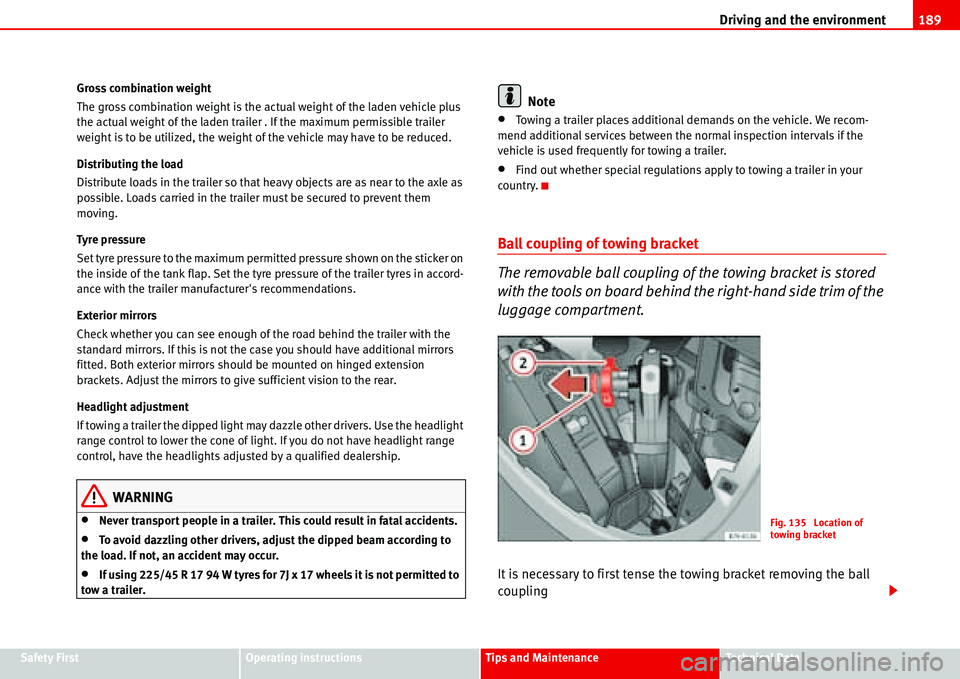
Ball coupling of towing bracket
The removable ball coupling of the towing bracket is stored
with the tools on board behind the right-hand side trim of the
luggage compartment.
It is necessary to first tense the towing bracket removing the ball
coupling
Fig. 135 Location of
towing bracket
Page 192 of 299
Driving and the environment 190
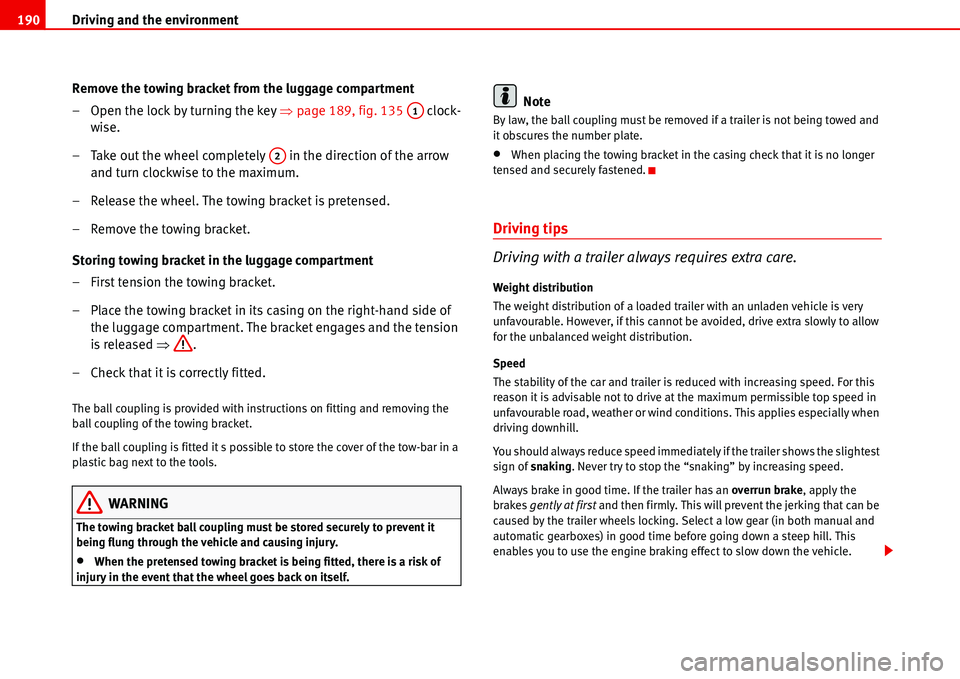
Remove the towing bracket from the luggage compartment
– Open the lock by turning the key Ÿpage 189, fig. 135 clock-
wise.
– Take out the wheel completely in the direction of the arrow
and turn clockwise to the maximum.
– Release the wheel. The towing bracket is pretensed.
– Remove the towing bracket.
Storing towing bracket in the luggage compartment
– First tension the towing bracket.
– Place the towing bracket in its casing on the right-hand side of
the luggage compartment. The bracket engages and the tension
is released Ÿ.
– Check that it is correctly fitted.
The ball coupling is provided with instructions on fitting and removing the
ball coupling of the towing bracket.
If the ball coupling is fitted it s possible to store the cover of the tow-bar in a
plastic bag next to the tools.
WARNING
The towing bracket ball coupling must be stored securely to prevent it
being flung through the vehicle and causing injury.
•When the pretensed towing bracket is being fitted, there is a risk of
injury in the event that the wheel goes back on itself.
Note
By law, the ball coupling must be removed if a trailer is not being towed and
it obscures the number plate.
•When placing the towing bracket in the casing check that it is no longer
tensed and securely fastened .
Driving tips
Driving with a trailer always requires extra care.
Weight distribution
The weight distribution of a loaded trailer with an unladen vehicle is very
unfavourable. However, if this cannot be avoided, drive extra slowly to allow
for the unbalanced weight distribution.
Speed
The stability of the car and trailer is reduced with increasing speed. For this
reason it is advisable not to drive at the maximum permissible top speed in
unfavourable road, weather or wind conditions. This applies especially when
driving downhill.
You should always reduce speed immediately if the trailer shows the slightest
sign of snaking. Never try to stop the “snaking” by increasing speed.
Always brake in good time. If the trailer has an overrun brake, apply the
brakes gently at first and then firmly. This will prevent the jerking that can be
caused by the trailer wheels locking. Select a low gear (in both manual and
automatic gearboxes) in good time before going down a steep hill. This
enables you to use the engine braking effect to slow down the vehicle.
A1
A2
Page 207 of 299
Accessories, parts replacement and modifications205
Safety FirstOperating instructionsTips and MaintenanceTe c h n i c a l D a t a If a towing bracket is to be retro-fitted to the car, it must be done according to
the instructions of the towing bracket manufacturer.
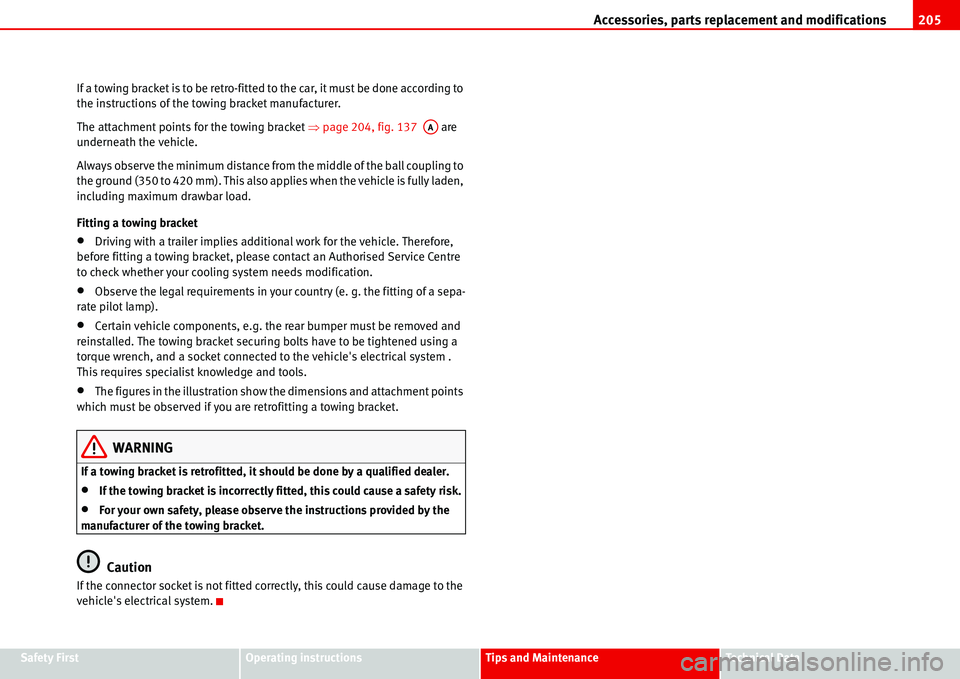
The attachment points for the towing bracket Ÿpage 204, fig. 137 are
underneath the vehicle.
Always observe the minimum distance from the middle of the ball coupling to
the ground (350 to 420 mm). This also applies when the vehicle is fully laden,
including maximum drawbar load.
Fitting a towing bracket
•Driving with a trailer implies additional work for the vehicle. Therefore,
before fitting a towing bracket, please contact an Authorised Service Centre
to check whether your cooling system needs modification.
•Observe the legal requirements in your country (e. g. the fitting of a sepa-
rate pilot lamp).
•Certain vehicle components, e.g. the rear bumper must be removed and
reinstalled. The towing bracket securing bolts have to be tightened using a
torque wrench, and a socket connected to the vehicle's electrical system .
This requires specialist knowledge and tools.
•The figures in the illustration show the dimensions and attachment points
which must be observed if you are retrofitting a towing bracket.
WARNING
If a towing bracket is retrofitted, it should be done by a qualified dealer.
•If the towing bracket is incorrectly fitted, this could cause a safety risk.
•For your own safety, please observe the instructions provided by the
manufacturer of the towing bracket.
Caution
If the connector socket is not fitted correctly, this could cause damage to the
vehicle's electrical system.
AA
Page 212 of 299
Checking and refilling levels 210
WARNING
All work on the engine or in the engine compartment, e.g. checking and
refilling fluids, involves the danger of injury and scalding as well as the risk
of accident or fire.
•Never open the bonnet if you see steam, smoke or coolant escaping
from the engine compartment. Otherwise, there is a risk of sustaining
burns. Wait until no more steam or coolant is emitted, then allow the
engine to cool before carefully opening the bonnet.
•Switch off the engine and remove the key from the ignition.
•Apply the handbrake and move the gear stick to neutral or selector
lever to position P.
•Keep children away from the vehicle.
•Never touch hot engine parts. There is a risk of burns.
•Never spill liquids on a hot engine or on a hot exhaust gas system. This
is a fire hazard.
•Avoid causing short-circuits in the electrical system, particularly at the
points where the jump leads are attached Ÿpage 250. The battery could
explode.
•Never touch the radiator fan. It is temperature controlled and could
start automatically, even when the engine has been switched off and the
key removed from the ignition!
•Do not unscrew the cap on the expansion tank when the engine is hot.
If the coolant is hot, the cooling system will be pressurised!
•Protect face, hands and arms by covering the cap with a large, thick
cloth to protect against escaping coolant and steam.
•Always make sure you have not left any objects, such as cleaning cloths
and tools, in the engine compartment.
•If you have to work underneath the vehicle, you must use suitable
stands additionally to support the vehicle, there is a risk of accident!. A
hydraulic jack is insufficient for securing the vehicle and there is a risk of
injury.
•If any work has to be performed when the engine is started or with the
engine running, there is an additional, potentially fatal, safety risk from the
rotating parts, such as the drive belts, alternator, radiator fan, etc., and
from the high-voltage ignition system. You should also observe the
following points:
−Never touch the electrical wiring of the ignition system.
−Ensure that jewellery, loose clothing and long hair do not get
trapped in rotating engine parts. Danger of death. Before starting any
work remove jewellery, tie back and cover hair, and wear tight-fitting
clothes.
−Always think carefully about pressing the accelerator if a gear is
engaged in either an automatic or manual gearbox. The vehicle could
move, even if the handbrake is applied. Danger of death.
•If work has to be carried out on the fuel system or on electrical compo-
nents, you must observe the following safety notes in addition to the above
warnings:
−Always disconnect the battery. The vehicle must be unlocked when
this is done, otherwise the alarm will be triggered.
−Do not smoke.
−Never work near naked flames.
−Always have a fire extinguisher on hand.
Caution
When changing or topping up service fluids, make absolutely certain that you
fill the fluids into the correct reservoirs. Failure to observe this point will result
in serious malfunctions and engine damage!
WARNING (continued)
Page 214 of 299
Checking and refilling levels 212
•Never open the bonnet if you see steam, smoke or coolant escaping
from the engine compartment.
•Wait until no more steam, smoke or coolant is emitted from the bonnet,
then carefully open the bonnet.
•Make sure that the support rod is inserted securely and properly in the
holder in the open bonnet.
•When working in the engine compartment, always observe the safety
warnings Ÿpage 209
Closing the bonnet
Closing the bonnet
1. To close the bonnet, pull it down to overcome the gas strut pres-
sure.
2. Make sure that the bonnet catches onto its clasp. Do not press
down Ÿ
If the bonnet does not close properly, open it again and close it properly.
WARNING
If the bonnet is not closed properly, it could open while you are driving and
completely obscure your view of the road. Risk of accident.
•After closing the bonnet, always check that it is properly secured. The
bonnet must be flush with the surrounding body panels.
•If you notice that the bonnet latch is not secured when the vehicle is
moving, stop the vehicle immediately and close the bonnet properly. Risk
of accident.
Engine oil
Engine oil specifications
The engine oil used must conform with exact specifications.
Specifications
The engine comes with a special, high quality, multi grade oil that can be
used in all seasons of the year except for those regions affected by extreme
cold.
As the use of good quality oil is necessary for the correct operation and long
service life of the engine, when it becomes necessary to replenish or change
the oil, always use an oil that complies to the VW standards.
If it is not possible to find oil conforming to the VW standards then oil
conforming to the ACEA or API standards with an appropriate viscosity at
atmospheric temperature should be used instead. The use of this type of oil
may have some repercussions on the performance of the engine for example,
long starting time, increased consumption and a higher emission level.
If a top up is required then different oils may be mixed as long as they all
conform to the VW standards.
The specifications (VW standards) set out in the following page should
appear on the container of the service oil; the container will display together
the different standards for petrol and diesel engines, the oil can be used for
both types of engines.
WARNING (continued)
Page 231 of 299
Checking and refilling levels229
Safety FirstOperating instructionsTips and MaintenanceTe c h n i c a l D a t a heads must be used. This ensures that wheels are fitted securely and that the
brake system functions correctly.
In certain circumstances, you may not use wheel bolts from a different car -
even if it is the same model Ÿpage 202.
WARNING
If the wheel bolts are not tightened correctly, the wheel could become
loose while driving. Risk of accident.
•The wheel bolts must be clean and turn easily. Never apply grease or oil
to them.
•Use only wheel bolts which belong to the wheel.
•If the prescribed torque of the wheel bolts is too low, they could loosen
whilst the vehicle is in motion. Risk of accident! If the tightening torque is
too high, the wheel bolts and threads could be damaged.
Caution
The prescribed torque for wheel bolts for steel and alloy wheels is 120 Nm.
Winter tyres
Winter tyres will improve the vehicles handling on snow and
ice.
In winter conditions winter tyres will considerably improve the vehicles
handling. The design of summer tyres (width, rubber compound, tread
pattern) gives less grip on ice and snow.
Winter tyres must be inflated to a pressure 0.2 bar higher than the pressures
specified for summer tyres (see sticker on tank flap).
Winter tyres must be fitted on all four wheels.Information on permitted winter tyre sizes can be found in the vehicle's regis-
tration documents. Use only radial winter tyres. All tyre sizes listed in the
vehicle documentation also apply to winter tyres.
Winter tyres lose their effectiveness when the tread is worn down to a depth
of 4 mm.
The speed rating code Ÿpage 227, “New tyres and wheels” determines the
following speed limits Ÿ:
Q max. 99.42 mi/h
S max. 111.85 mi/h
T max. 118.06 mi/h
H max. 210 km/h
In some countries, vehicles that can exceed the speed rating of the fitted tyre
must have an appropriate sticker in the driver's field of view. These stickers
are available from your Authorised Service Centre. The legal requirements of
each country must be followed.
Do not have winter tyres fitted for unnecessarily long periods. Vehicles with
summer tyres handle better when the roads are free of snow and ice.
If you have a flat tyre, please refer to the notes on the spare wheel
Ÿpage 227, “New tyres and wheels”.
WARNING
The maximum speed for the winter tyres must not be exceeded. Otherwise,
this could lead to tyre damage and thus, an accident risk.
For the sake of the environment
Fit your summer tyres in good time. They are quieter, do not wear so quickly
and reduce fuel consumption.
Page 233 of 299
If and when231
Safety FirstOperating instructionsTips and MaintenanceTe c h n i c a l D a t a
If and when
Vehicle onboard tools*, spare wheel*,
puncture repair kit* and towing bracket
Location
The vehicle tools, the spare wheel and the removable towing
bracket ball coupling are stored in the luggage compartment.
Vehicle tool kit and removable ball coupling
The vehicle tool kit and removable towing bracket ball coupling are stored on
the right of the luggage compartment, behind a cover.
Spare wheel
The spare wheel is stored underneath the vehicle Ÿpage 232.
Caution
Make sure that the spare wheel / removed wheel and the tools are stored
safely in the luggage compartment.
Vehicle onboard tools*
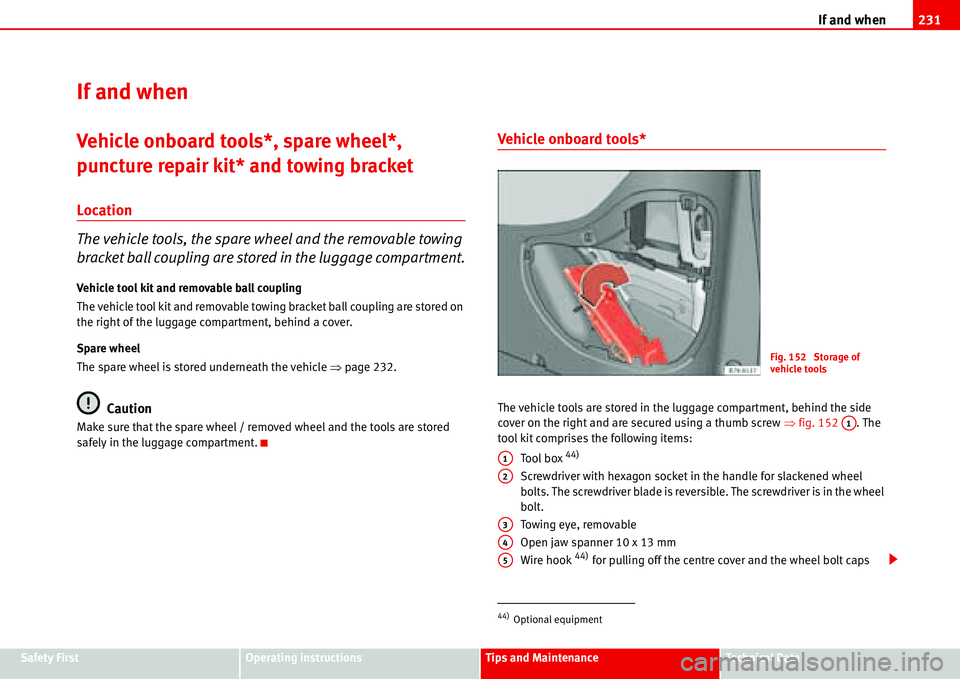
The vehicle tools are stored in the luggage compartment, behind the side
cover on the right and are secured using a thumb screwŸfig. 152 . The
tool kit comprises the following items:
To ol b ox
44)
Screwdriver with hexagon socket in the handle for slackened wheel
bolts. The screwdriver blade is reversible. The screwdriver is in the wheel
bolt.
Towing eye, removable
Open jaw spanner 10 x 13 mm
Wire hook
44) for pulling off the centre cover and the wheel bolt caps
44)Optional equipment
Fig. 152 Storage of
vehicle tools
A1
A1
A2
A3
A4
A5