maintenance Seat Alhambra 2006 Owner's Guide
[x] Cancel search | Manufacturer: SEAT, Model Year: 2006, Model line: Alhambra, Model: Seat Alhambra 2006Pages: 299, PDF Size: 6.33 MB
Page 43 of 299
Airbag system41
Safety FirstOperating instructionsTips and MaintenanceTe c h n i c a l D a t a
Curtain airbags
Description of curtain airbags
The airbag system is not a substitute for the seat belts.
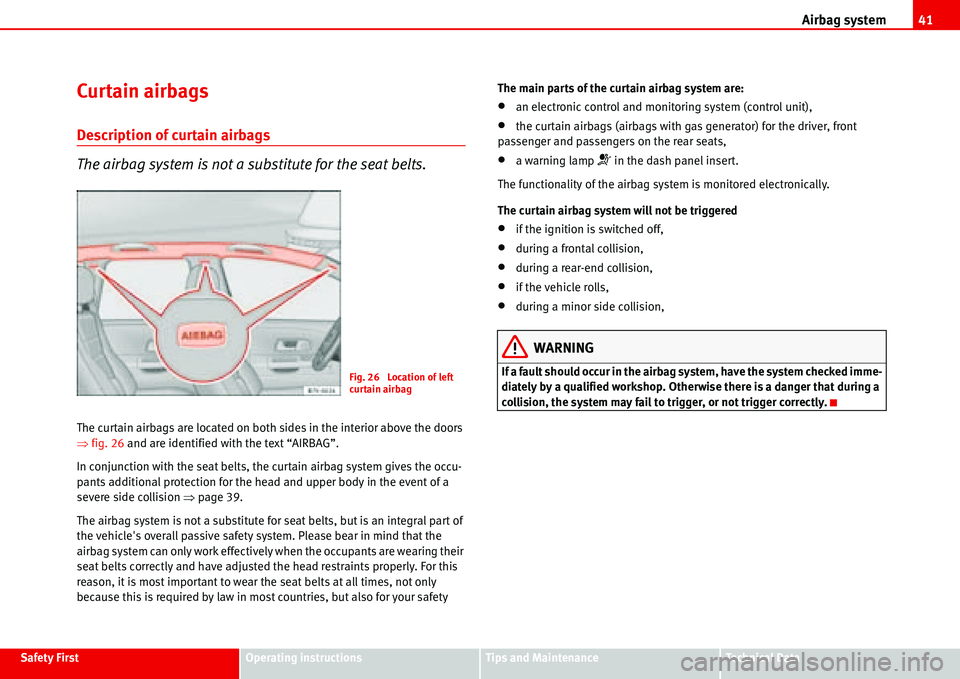
The curtain airbags are located on both sides in the interior above the doors
Ÿfig. 26 and are identified with the text “AIRBAG”.
In conjunction with the seat belts, the curtain airbag system gives the occu-
pants additional protection for the head and upper body in the event of a
severe side collision Ÿpage 39.
The airbag system is not a substitute for seat belts, but is an integral part of
the vehicle's overall passive safety system. Please bear in mind that the
airbag system can only work effectively when the occupants are wearing their
seat belts correctly and have adjusted the head restraints properly. For this
reason, it is most important to wear the seat belts at all times, not only
because this is required by law in most countries, but also for your safetyThe main parts of the curtain airbag system are:
•an electronic control and monitoring system (control unit),
•the curtain airbags (airbags with gas generator) for the driver, front
passenger and passengers on the rear seats,
• a warning lamp T in the dash panel insert.
The functionality of the airbag system is monitored electronically.
The curtain airbag system will not be triggered
•if the ignition is switched off,
•during a frontal collision,
•during a rear-end collision,
•if the vehicle rolls,
•during a minor side collision,
WARNING
If a fault should occur in the airbag system, have the system checked imme-
diately by a qualified workshop. Otherwise there is a danger that during a
collision, the system may fail to trigger, or not trigger correctly.Fig. 26 Location of left
curtain airbag
Page 45 of 299
Airbag system43
Safety FirstOperating instructionsTips and MaintenanceTe c h n i c a l D a t a
•Do not attempt to modify components of the airbag system in any way.
•The side and head airbags are managed through sensors located in the
interior of the front doors. To ensure the correct functioning of the side and
head airbags neither the doors nor the door panels should be modified in
any way (e.g. fitting loudspeakers). If the front door is damaged in any way,
this may affect the correct working of the system. All work carried out on
the front door must be made in a qualified workshop.
Deactivating airbags*
Disabling front passenger front and side airbags
The passenger airbags must be disconnected when a rear
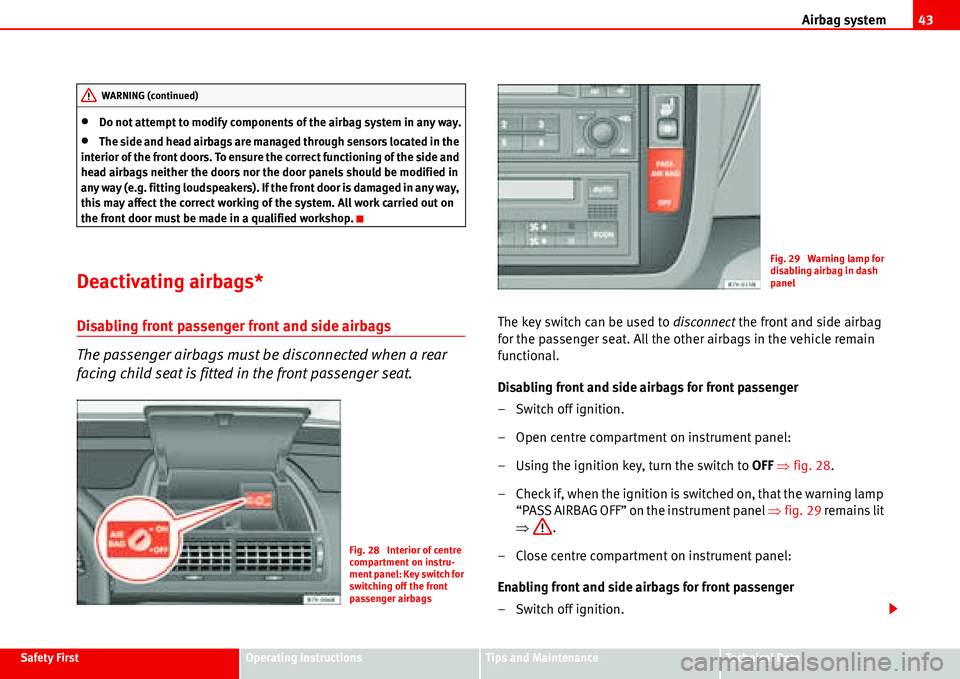
facing child seat is fitted in the front passenger seat.The key switch can be used to disconnect the front and side airbag
for the passenger seat. All the other airbags in the vehicle remain
functional.
Disabling front and side airbags for front passenger
– Switch off ignition.
– Open centre compartment on instrument panel:
– Using the ignition key, turn the switch to OFF Ÿfig. 28.
– Check if, when the ignition is switched on, that the warning lamp
“PASS AIRBAG OFF” on the instrument panel Ÿfig. 29 remains lit
Ÿ.
– Close centre compartment on instrument panel:
Enabling front and side airbags for front passenger
– Switch off ignition.
WARNING (continued)
Fig. 28 Interior of centre
compartment on instru-
ment panel: Key switch for
switching off the front
passenger airbags
Fig. 29 Warning lamp for
disabling airbag in dash
panel
Page 47 of 299
Child safety45
Safety FirstOperating instructionsTips and MaintenanceTe c h n i c a l D a t a
Child safety
Brief introduction
Introduction
Statistics show that children are generally safer on the rear
seat than on the front passenger seat.
We recommend that children under 12 years of age be transported on the rear
seats. Children travelling on the rear seat must use a child restraint system or
the seat belts provided, depending on their age, height and weight. For
safety reasons, the child restraint system should be installed in the centre of
the rear seat or behind the front passenger's seat.
The physical principles involved and the forces acting in a collision apply to
children just as much as adults Ÿpage 19. But unlike adults, children do not
have fully developed muscle and bone structures. This means that children
are subject to a greater risk of injury.
To reduce this risk, children must always use special child restraint systems
when travelling in the vehicle.
We recommend the use of child safety products from the SEAT Genuine Acces-
sories Program including systems for all ages made by “Peke”
2).
These systems have been especially designed and approved, complying with
the ECE-R44. regulation.
Follow the manufacturer's instructions and observe any statutory require-
ments when installing and using child seats. Always read and observe
Ÿpage 45.We recommend that you include the manufacturer's directions for child seat
use in the vehicle wallet and always keep them in the vehicle.
Safety notes on using child seats
Proper use of child seats substantially reduces the risk of
injury in an accident!
As the driver, you are responsible for any children you transport in
your vehicle.
– Protect your children by properly using appropriate child seats.
– Always ensure that the belt webbing is properly positioned
according to the instructions provided by the manufacturer of the
child seat.
– When travelling, do not allow children to distract you from traffic.
– Take breaks regularly during long trips. Take a break at least
every two hours.
We recommend that you include the manufacturer's directions for child seat
use in the vehicle wallet and always keep them in the vehicle.
WARNING
•Never fit a child seat in the passenger seat, where the child faces back-
wards to the direction of travel and the frontal airbag has not been deacti-
vated. This is highly dangerous for the child. If it is necessary, in excep-
2)Not for all countries
Page 49 of 299
Child safety47
Safety FirstOperating instructionsTips and MaintenanceTe c h n i c a l D a t a
Child seats
Categorisation of child seats into groups
Use only child seats that are officially approved and suitable
for the child.
Child seats are covered by the European standard ECE R 44 (issued by the
Economic Commission of Europe).
The child seats are grouped into 5 categories:
Group 0: to 10 kg
Group 0+: to 13 kg
Group 1: 9to18kg
Group 2: 15 to 25 kg
Group 3: from 22 to 36 kg
Child seats that have been tested and approved under the ECE R 44 standard
bear the test mark on the seat (the letter E in a circle with the test number
below it).
Group 0 and 0+ child seats
A suitable child seat and a correctly adjusted seat belt can
help to protect your child.
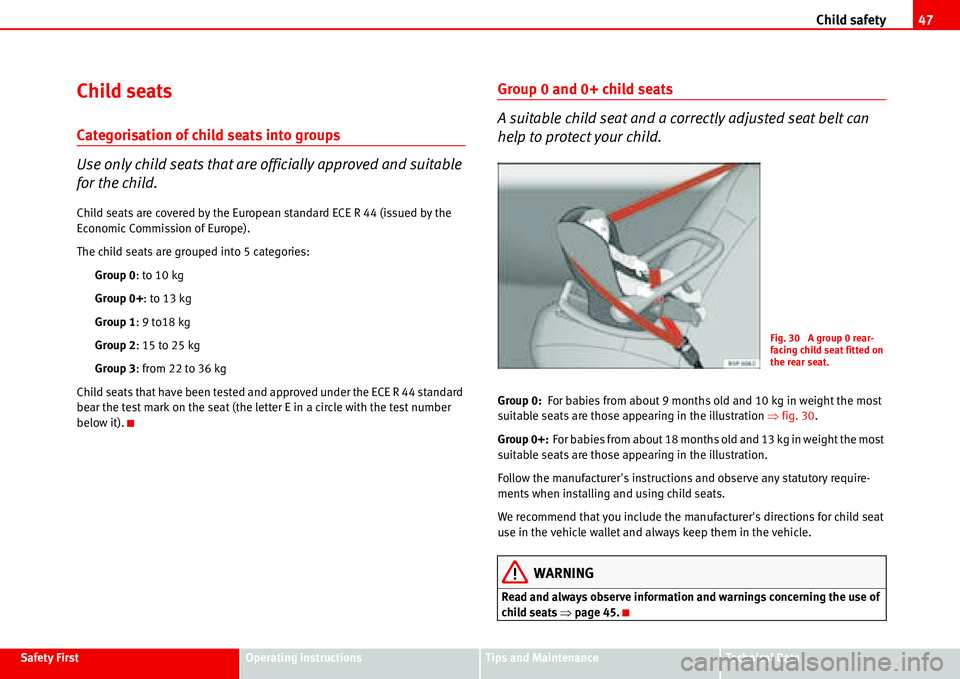
Group 0: For babies from about 9 months old and 10 kg in weight the most
suitable seats are those appearing in the illustration Ÿ fig. 30.
Group 0+: For babies from about 18 months old and 13 kg in weight the most
suitable seats are those appearing in the illustration.
Follow the manufacturer's instructions and observe any statutory require-
ments when installing and using child seats.
We recommend that you include the manufacturer's directions for child seat
use in the vehicle wallet and always keep them in the vehicle.
WARNING
Read and always observe information and warnings concerning the use of
child seats Ÿpage 45.
Fig. 30 A group 0 rear-
facing child seat fitted on
the rear seat.
Page 51 of 299
Child safety49
Safety FirstOperating instructionsTips and MaintenanceTe c h n i c a l D a t a
WARNING
•The shoulder part of the seat belt must lie approximately on the centre
of the shoulder, never across the neck or the arm. The seat belt must lie
close to the torso. The lap belt part must lie across the pelvis, not across
the stomach, and always fit closely. Pull the belt tight if necessary to take
up any slack Ÿpage 22, “Seat belts”.
•Read and always observe information and warnings concerning the use
of child seats Ÿpage 45.
Installation of child seats in vehicle seats
General notes
The correct fitting of child seats in the different seats is described below.
Child restraint systems that have been checked according to ECE-R 44 are
suitable for installation on the front passenger seat or on the rear seats.
Note
The passenger seat and the rear seats comply with directive 77/541 EEC for
the installation of child restraint systems .
Front passenger seat
Only the use of an officially approved child seat corre-
sponding to the weight and height of the child is permitted.
Universal seats for children in groups 0, 0+, 1, 2, or 3 (Ÿpage 52) Ÿ can
be fitted in the passenger seat.
To fit a child seat, position the seat in the upright position and move the
passenger seat as far back as possible. The seat must be in the highest posi-
tion
3) on vehicles with a height-adjustableŸ front passenger seat.
WARNING
•Never fit a child seat in the passenger seat, where the child faces back-
wards to the direction of travel and the frontal airbag has not been deacti-
vated. This is highly dangerous for the child. If it is necessary in excep-
tional cases to transport a child on the front passenger seat, you must
always disable the front and side passenger airbags Ÿpage 43
•Children must travel in a child seat appropriate to their weight and
height.
•The vehicle seat must always be fitted in the direction of travel when
securing child restraint systems in weight class 0 or 0+.
•Read and always observe information and warnings concerning the use
of child seats Ÿ in “Safety notes on using child seats” on page 45.
•Please always read and follow the information and warnings provided
by the child seat manufacturer.
3)Optional equipment
Page 53 of 299
Child safety51
Safety FirstOperating instructionsTips and MaintenanceTe c h n i c a l D a t a
ISOFIX child seat mounting system
ISOFIX child seats can be mounted in the second and third
row seats quickly, safely and easily.When removing or fitting the child seat, please be sure to follow the
manufacturer's instructions.
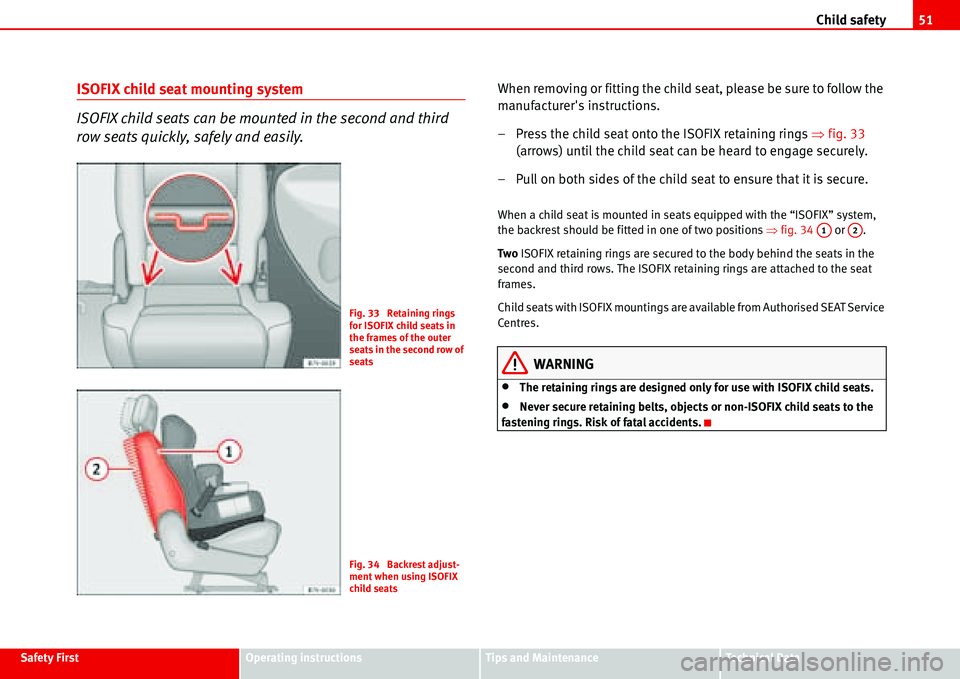
– Press the child seat onto the ISOFIX retaining rings Ÿfig. 33
(arrows) until the child seat can be heard to engage securely.
– Pull on both sides of the child seat to ensure that it is secure.
When a child seat is mounted in seats equipped with the “ISOFIX” system,
the backrest should be fitted in one of two positions Ÿfig. 34 or .
Two ISOFIX retaining rings are secured to the body behind the seats in the
second and third rows. The ISOFIX retaining rings are attached to the seat
frames.
Child seats with ISOFIX mountings are available from Authorised SEAT Service
Centres.
WARNING
•The retaining rings are designed only for use with ISOFIX child seats.
•Never secure retaining belts, objects or non-ISOFIX child seats to the
fastening rings. Risk of fatal accidents.
Fig. 33 Retaining rings
for ISOFIX child seats in
the frames of the outer
seats in the second row of
seats
Fig. 34 Backrest adjust-
ment when using ISOFIX
child seats
A1A2
Page 55 of 299
Child safety53
Safety FirstOperating instructionsTips and MaintenanceTe c h n i c a l D a t a
– Pull the loop in the direction of the arrow and push the seat
cushion down until it engages.
Fitting the slumber roll
– Remove the head restraint.
– Fit the head restraint onto the slumber roll
– Reinsert the head restraint and push down until it can be heard
to engage.
Removing the slumber roll
– Remove the head restraint.
– Pull the slumber roll off the head restraint.
– Reinsert the head restraint and push down until it can be heard
to engage.
For safety reasons, we recommend that the child seat for children in Group 1
is installed facing against the direction of travel.
Adjusting the belt routing for larger children in Group1
A correctly adjusted seat belt helps to protect your child!
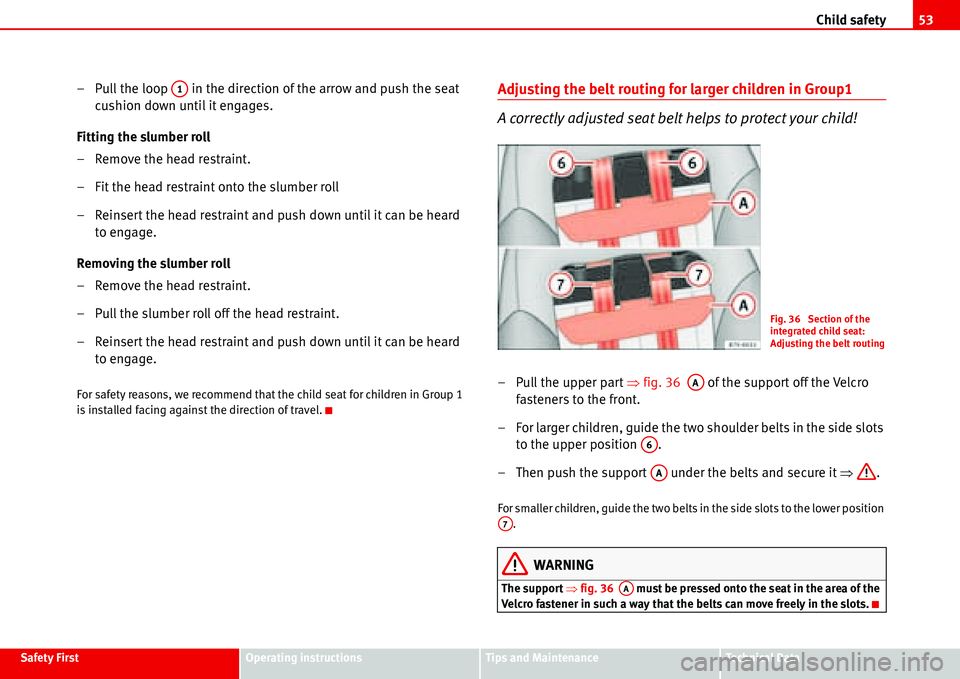
– Pull the upper part Ÿfig. 36 of the support off the Velcro
fasteners to the front.
– For larger children, guide the two shoulder belts in the side slots
to the upper position .
– Then push the support under the belts and secure it Ÿ.
For smaller children, guide the two belts in the side slots to the lower position
.
WARNING
The support Ÿfig. 36 must be pressed onto the seat in the area of the
Velcro fastener in such a way that the belts can move freely in the slots.
A1
Fig. 36 Section of the
integrated child seat:
Adjusting the belt routing
AA
A6
AA
A7
AA
Page 57 of 299
Child safety55
Safety FirstOperating instructionsTips and MaintenanceTe c h n i c a l D a t a
Releasing the harness belt for children in Group 1
A correctly adjusted seat belt helps to protect your child!
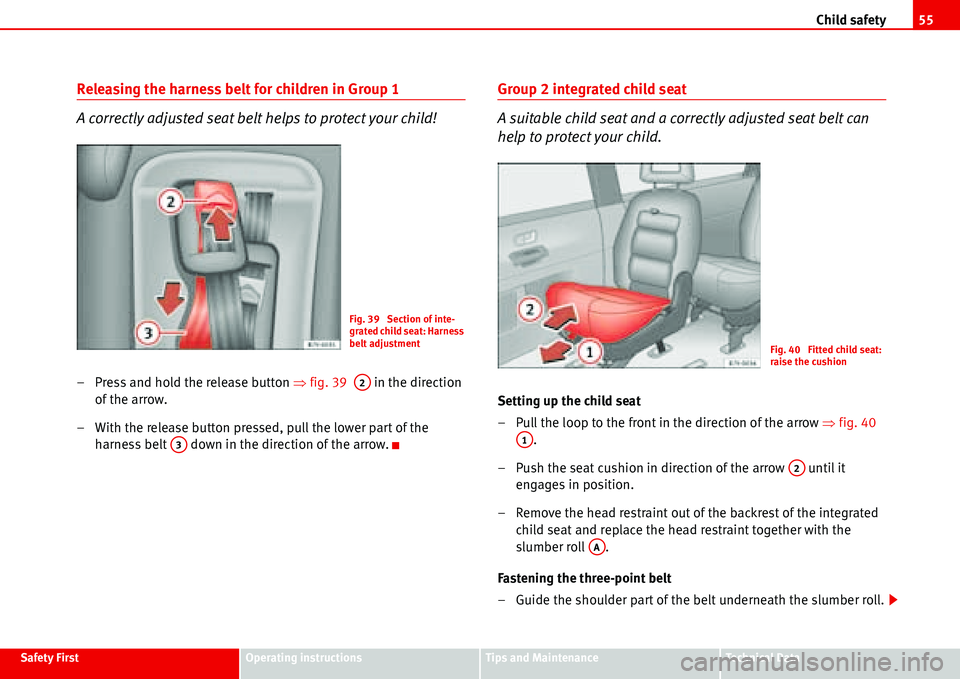
– Press and hold the release button Ÿfig. 39 in the direction
of the arrow.
– With the release button pressed, pull the lower part of the
harness belt down in the direction of the arrow.
Group 2 integrated child seat
A suitable child seat and a correctly adjusted seat belt can
help to protect your child.
Setting up the child seat
– Pull the loop to the front in the direction of the arrow Ÿfig. 40
.
– Push the seat cushion in direction of the arrow until it
engages in position.
– Remove the head restraint out of the backrest of the integrated
child seat and replace the head restraint together with the
slumber roll .
Fastening the three-point belt
– Guide the shoulder part of the belt underneath the slumber roll.
Fig. 39 Section of inte-
grated child seat: Harness
belt adjustment
A2
A3
Fig. 40 Fitted child seat:
raise the cushion
A1
A2
AA
Page 59 of 299
Child safety57
Safety FirstOperating instructionsTips and MaintenanceTe c h n i c a l D a t a
– Push the seat cushion in direction of the arrow until it
engages in position.
Fastening the three-point belt
– To fasten the three-point belt, take hold of the tongue and pull it
slowly across the chest and lap.
– Push the tongue of the belt into the lock for that seat so that it
engages audibly (pull to check!)
– Adjust the three-point belt to suit body size Ÿ.
Restoring the normal seat
– Pull the loop in the direction of the arrow and push the seat
cushion down until it engages.
Use the following measures to guarantee the proper routing of the shoulder
belt:
•Seatbelt height setting
•Adjustment of the seat forwards and backwards
•Backrest angle adjustment
WARNING
•For safety reasons, the seat for children in Group 3 may only be fitted in
the direction of travel and in one of the outer positions (not on the centre
seat).
•The risk of injury is increased if the belt is not correctly routed .
•The shoulder part of the belt should be positioned roughly over the
centre of the shoulder, never across the neck, and fit closely against the
upper part of the body.
•The lap belt part must lie across the pelvis, not across the stomach, and
always fit closely. Tighten the lap belt as necessary.
Cleaning the child seat
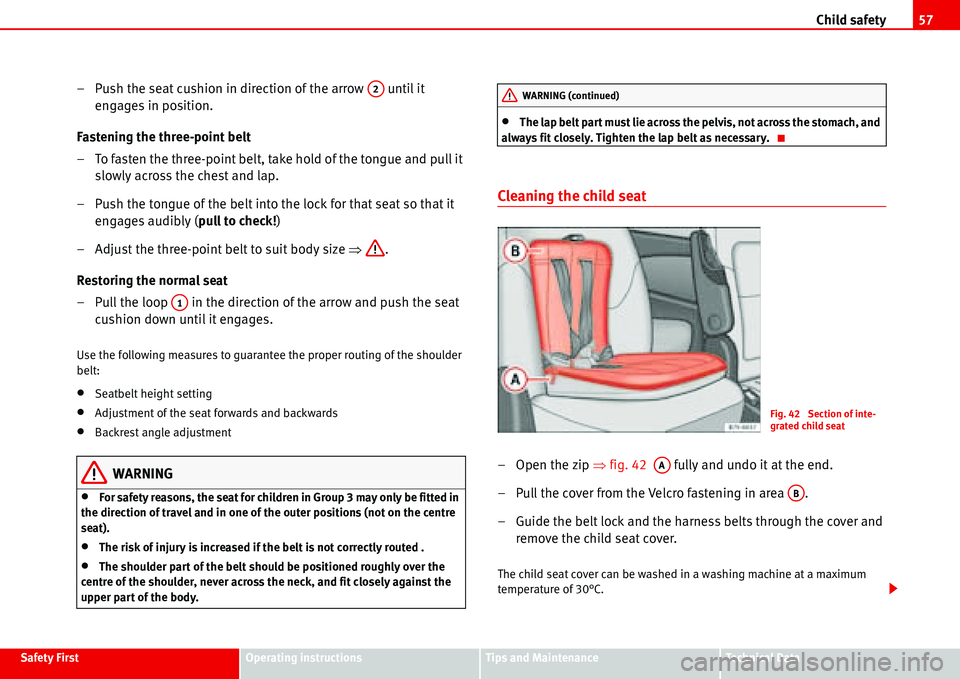
– Open the zip Ÿfig. 42 fully and undo it at the end.
– Pull the cover from the Velcro fastening in area .
– Guide the belt lock and the harness belts through the cover and
remove the child seat cover.
The child seat cover can be washed in a washing machine at a maximum
temperature of 30°C.
A2
A1
WARNING (continued)
Fig. 42 Section of inte-
grated child seat
AA
AB
Page 61 of 299

59
Safety FirstOperating instructionsTips and MaintenanceTe c h n i c a l D a t a