remove seats Seat Alhambra 2006 Owner's Guide
[x] Cancel search | Manufacturer: SEAT, Model Year: 2006, Model line: Alhambra, Model: Seat Alhambra 2006Pages: 299, PDF Size: 6.33 MB
Page 146 of 299
Seats and stowage 144
During a collision or an accident, even small and light objects can build up so
much energy that they can cause very severe injuries. The amount of “kinetic
energy” depends on the speed of the vehicle and the weight of the object.
The most significant factor, however, is the speed of the vehicle.
For example: an object weighing 4.5 kg is lying unsecured in the vehicle.
During a frontal collision at a speed of 50 km/h, this object generates a force
corresponding to 20 times its weight. That means that the effective weight of
the object increases to about 90 kg. You can imagine the severity of the inju-
ries which might be sustained if this “projectile” strikes an occupant as it flies
through the passenger compartment. This increased risk of injury will be
further increased if a loose object is struck by an inflating airbag.
WARNING
If pieces of baggage or other objects are secured to the fastening rings with
inappropriate or damaged retaining cords, injuries could result in the event
of braking manoeuvres or accidents.
•To prevent pieces of luggage or other objects from flying forward,
always use appropriate retaining cords which are secured to the fastening
rings.
•Never secure a child seat on the fastening rings.
Loading heavy objects
Special care is required when loading heavy objects and
when driving a vehicle which contains heavy objects.
Observe the following points to prevent damage and accidents:
– If necessary, remove the seats to increase the load area.–Before loading the vehicle place a sturdy mat or similar cover
flush on floor of the vehicle.
– Where necessary, do not cover protruding parts of the vehicle
floor.
– Protect the seat anchor points from damage.
– Avoid overloading small areas - spread the load.
– Use suitable straps to secure the objects to retaining rings.
– Drive particularly carefully and think ahead.
– If possible, avoid sudden braking and driving manoeuvres.
WARNING
For safety reasons, you should read and observe all information on loading
the vehicle Ÿpage 144.
Caution
•If you have removed the seats from the passenger compartment, you
should place a large, robust covering over the seat rails to prevent damage.
•Avoid overloading small areas - spread the load.
Safety notes on loading the vehicle
WARNING
Loose luggage and other objects in the luggage compartment can cause
serious injuries.
Page 148 of 299
Seats and stowage 146
Opening the luggage compartment cover
– After fitting the luggage compartment cover, pull the handle on
the cover back and hook in the cover on the side.
Removing the luggage compartment cover
– Press the unlock button (with the luggage compartment cover
rolled up) Ÿpage 145, fig. 114 in the direction of the arrow
and remove the cover from the right holder upwards.
– Remove the cover from the left holder in the direction of the arrow
and remove from the vehicle.
Fitting the luggage compartment cover
– Push the luggage compartment cover to the stop in the direction
of the arrow Ÿpage 145, fig. 115 into the left-hand holder.
– Press the cover down into the right-hand holder until it engages
in position.
Light items of clothing or other objects on the luggage compartment cover
can restrict visibility through the rear window.
WARNING
•Never leave hard, heavy or sharp objects on the shelf (unrolled) or in the
pockets of clothing on the luggage compartment cover. Animals must
never be allowed onto the luggage compartment cover. During a sudden
braking or driving manoeuvre or an accident, these objects and animals
endanger all vehicle occupants. Risk of injury.
Caution
The wires of the heating element in the rear window and the window aerial in
the rear side windows could be damaged if objects on the luggage compart-
ment cover rub against them.
Net bag
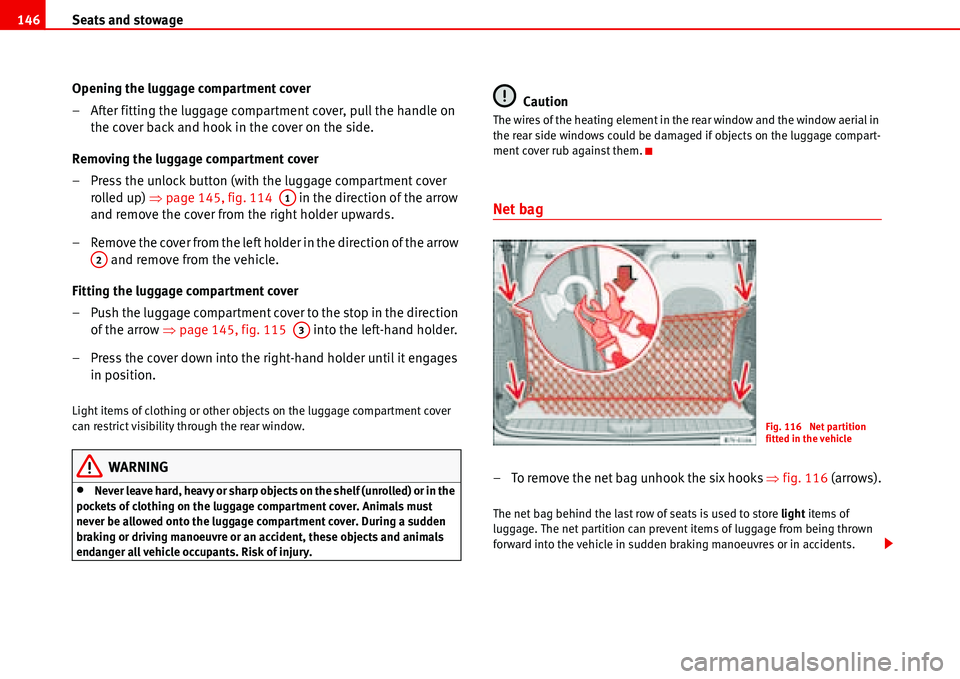
– To remove the net bag unhook the six hooks Ÿfig. 116 (arrows).
The net bag behind the last row of seats is used to store light items of
luggage. The net partition can prevent items of luggage from being thrown
forward into the vehicle in sudden braking manoeuvres or in accidents.
A1
A2
A3
Fig. 116 Net partition
fitted in the vehicle
Page 149 of 299
Seats and stowage147
Safety FirstOperating instructionsTips and MaintenanceTe c h n i c a l D a t a
WARNING
Always fit the net partition carefully, observing the instructions. Risk of
injury.
•Heavy, pointed or sharp items which are not stowed securely can cause
injury in the event of sudden braking manoeuvres or accidents, even if the
net bag is correctly assembled.
•For reasons of safety, vehicle occupants must not travel behind a fitted
safety net.
Roof carrier
Safety notes on using the roof carrier
The roof carrier system must always be installed exactly
according to the instructions provided.
•Your vehicle has special roof rails on the right and left for fitting the
mounts. Therefore, standard roof carriers cannot be used.
•The mounts are the basis of a complete roof carrier system. Special
fixtures must then be added in order to safely transport luggage, bicycles,
skis, surf boards or boats on the roof. All these system components are avail-
able from SEAT Service. We recommend you use genuine SEAT roof carrier
systems. If you wish to use a different roof carrier, make sure that it can be
fitted securely to your vehicle and that it cannot damage your vehicle.
•We recommend that you keep the assembly instructions provided by the
roof carrier manufacturer in your vehicle wallet.
•Only the fitted retainers may be used to secure the carrier feet on vehicles
without a roof railing. These retainers are located underneath the plastic rain
channel between the markings.
•In vehicles with roof edging36), the basic supports can be fitted on the
edge making sure to adapt the distance between the supports to the objects
to be carried. On vehicles with a sliding/tilting roof
36), however, the front
carrier may not be fitted near the rear edge of the sliding/tilting roof when the
roof is open.
When should the roof carrier be removed?
•When it is not needed (to save fuel, reduce wind noise and avoid theft).
•Before cleaning in an automatic car wash.
WARNING
•If you do not use mounts approved by SEAT or fail to fit them according
to instructions, the load or the roof carrier itself may fall off the vehicle roof
and onto the street. Risk of accident or injury.
•The risk of an accident is increased by transporting heavy or bulky
loads on the roof, which affects the car's handling by shifting the centre of
gravity and increasing susceptibility to cross winds. Both circumstances
increase the risk of accident. Therefore you must adapt your driving style
and speed to the prevailing conditions - avoid sudden braking or driving
manoeuvres when there is a load on the roof carrier.
•The roof carrier system must always be installed exactly according to
the instructions provided.
Caution
•Check all bolted connections and fastenings for the roof carrier system
before every trip. If necessary, tighten bolted connections and check the
system at regular, appropriate intervals, e.g. at each stop during a long trip.
•The height of your vehicle is changed by the installation of the roof carrier
and the load secured on it. Bear this in mind when driving through garage
doors or low underpasses – there is danger of damage to the vehicle.
36)Optional equipment