load capacity Seat Alhambra 2009 Owner's Manual
[x] Cancel search | Manufacturer: SEAT, Model Year: 2009, Model line: Alhambra, Model: Seat Alhambra 2009Pages: 285, PDF Size: 7.62 MB
Page 152 of 285
Seats and stowage
150•
Damage to the vehicle caused by incorrect installation of mounts or roof
carrier systems not approved by the factory are excluded from the vehicle
warranty.
Securing the load
Loads transported on the roof carrier must be securely
attached. The car's handling is affected when transporting
loads.The maximum permissible roof load for your vehicle is 75 kg. The load limit
applies to the combined weight of the carrier system and the load itself.
Distribute the load evenly. However, if you are using a roof carrier with a lower
weight rating, you will not be able to carry the maximum roof load. Do not
exceed the maximum weight limit for the roof carrier which is listed in the
fitting instructions.
WARNING
•
If damaged, fine or inadequate securing straps are used to fasten
objects carried on the roof, they could break in the event of sharp braking.
This could cause an accident and serious injury.
•
Always use appropriate securing straps to secure objects on the roof
carrier against sliding or flying off.,This could cause an accident. The load
must be correctly secured.
•
Always respect the maximum authorised weight for the roof, the
maximum authorised weight on the axles and the total maximum author-
ised weight of the vehicle. Otherwise there is danger of causing an acci-
dent.
•
The risk of an accident is increased by transporting heavy or bulky
loads on the roof, which affects the car's handling by shifting the centre of
gravity and increasing susceptibility to cross winds. Both circumstances increase the risk of accident. Therefore you must adapt your driving style
and speed to the prevailing conditions - avoid sudden braking or driving
manoeuvres when there is a load on the roof carrier.
Caution
Please take extra care not to let the tailgate or rear window strike the roof load
when open – there is a risk of damage to the vehicle.
For the sake of the environment
The roof carrier is often left on the roof for convenience even if it is not being
used. However, increased air resistance means that the vehicle uses more
fuel. For this reason you should always take off the roof carrier when it is not
in use.Cooling and heating box*Notes on usage
The cooling and heating box may on
ly be installed in the posi-
tion of rear left seat in the third row.Power can be supplied by any of the 12 Volt sockets in the vehicle. It
consumes approximately 33 watts and has a capacity of approximately 32
litres.
The battery will discharge if the cooling and heating box is used for a long
period while the engine is switched off.
WARNING (continued)
alhambra_aleman.book Seite 150 Montag, 23. M‰ rz 2009 1:12 13
Page 258 of 285
If and when
256Your vehicle may only be lifted by a lifting platform at the points shown in the
illustrations ⇒page 255, fig. 175 and ⇒page 255, fig. 176 ⇒ .
Using the jack to lift the vehicle ⇒page 241.
To prevent damage to the underside of the vehicle when lifting the vehicle,
rubber pads must be used.
Before driving onto a lifting platform, you must check there is sufficient clear-
ance between low parts of the vehicle and the lifting platform.
WARNING
If the lifting platform is inappropriate or the vehicle is lifted incorrectly,
accidents or injuries may be caused. The vehicle could even fall from the
lifting platform.•
All occupants should leave the vehicle before it is lifted.
•
The vehicle must only be lifted at the points indicated in the diagrams
⇒ page 255, fig. 175 and ⇒page 255, fig. 176 . If the vehicle is not lifted
at the indicated points, it may fall from the platform while the engine or
gearbox is being dismounted, for example.
•
Never start the engine when the vehicle is raised. Risk of accident. The
vehicle may fall from the platform due to the engine vibrations.
•
When work is being carried out underneath the vehicle, it must be
secured using suitable frames. If not, an accident may occur.
•
To lift the vehicle, only two-pillar or two-post lifting platforms with
sufficiently long arms and load-bearing capacity should be used.
•
Lifting platforms with fluid filled cushions may not be used for lifting
the vehicle.Caution
•
The vehicle should never be lifted at the engine oil sump, the gearbox, or
the front or rear axle. This could cause serious damage to the vehicle.
•
Before driving onto a lifting platform, you must check there is sufficient
clearance between low parts of the vehicle and the lifting platform.
alhambra_aleman.book Seite 256 Montag, 23. M‰ rz 2009 1:12 13
Page 262 of 285
General notes on the technical data
260WeightsKerb weight refers to the basic model with a fuel tank filled to 90% capacity
and without optional extras. The figure quoted includes 75 kg to allow for the
weight of the driver.
For special versions and optional equipment fittings or for the addition of
accessories, the weight of the vehicle will increase ⇒.
WARNING
•
Please note that the centre of gravity may shift when transporting
heavy objects; this may affect the vehicle's handling and lead to an acci-
dent. Always adjust your speed and driving style to suit road conditions
and requirements.
•
Never exceed the gross axle weight rating or the gross vehicle weight
rating. If the allowed axle load or the allowed total weight is exceeded, the
driving characteristics of the vehicle may change, leading to accidents,
injuries and damage to the vehicle.
To w i n g a t r a i l e rTra iler weig htsTrailer weigh ts
The trailer weights and drawbar loads approved are selected in intensive
trials according to precisely defined criteria. The approved trailer weights are
valid for vehicles in the EU for maximum speeds of 80 km/h (in certain
circumstances up to 100 km/h). The figures may be different in other coun-
tries. All data in the official vehicle documents take precedence over these
data ⇒ . Drawbar load
The
maximum permitted weight exerted by the trailer drawbar on the ball joint
of the towing bracket must not exceed 85 kg.
In the interest of road safety, we recommend that you always tow
approaching the maximum drawbar load. The response of the trailer on the
road will be poor if the drawbar load is too small.
If the maximum permissible drawbar load cannot be met (e.g. with small,
empty and light-weight single axle trailers or tandem axle trailers with an axle
base of less than 1 metre), at least 4% of the actual trailer weight is a legal
stipulation for a drawbar load.
WARNING
•
For safety reasons, you should not drive at speeds above 80 km/h when
towing a trailer. This also applies to countries where higher speeds are
permitted.
•
Never exceed the maximum trailer weights or the draw bar loading. If
the permissible axle load or the permissible total weight is exceeded, the
driving characteristics of the vehicle may change, leading to accidents,
injuries and damage to the vehicle.
WheelsTyre pressure, snow chains, wheel boltsTyre pressu res
The sticker with the tyre pressure values can be found on the inside of the
tank flap. The tyre pressure values given there are for cold tyres. The slightly
raised pressures of warm tyres must not be reduced ⇒.
alhambra_aleman.book Seite 260 Montag, 23. M‰ rz 2009 1:12 13
Page 266 of 285
Technical Data
264Weights
Trailer weigh ts
Engine oil capacityDiesel engine 1.9l TDI 85 kW (115 bhp) 6 gears four-wheel driveGeneral engine data Gross vehicle weight
in kg 2450
Weight in working order (with driver) in kg 1674
Gross axle weight, front in kg 1240
Gross axle weight, rear in kg 1280
Permitted roof load in kg 75
With no brakes, gradients up to 12% 700
With brakes, gradients up to 12% 1900
Approximate engine oil capacity with oil filter change 4.3 litres
Power output in kW (bhp) rpm 85 (115)/ 4000
Maximum torque in Nm at rpm 310/1900
No. of cylinders, capacity in cm
3
4/1896
Compression 18
Fuel Petrol min. 51 CN
a) or Biodiesel 7 % in accordance with DIN 51628
a)Cetane- Number (cetane index) = Measure of the combustion power of the diesel.
alhambra_aleman.book Seite 264 Montag, 23. M‰ rz 2009 1:12 13
Page 267 of 285
Technical Data265
Safety First
Operating instructions
Tips and Maintenance
Te c h n i c a l D a t a
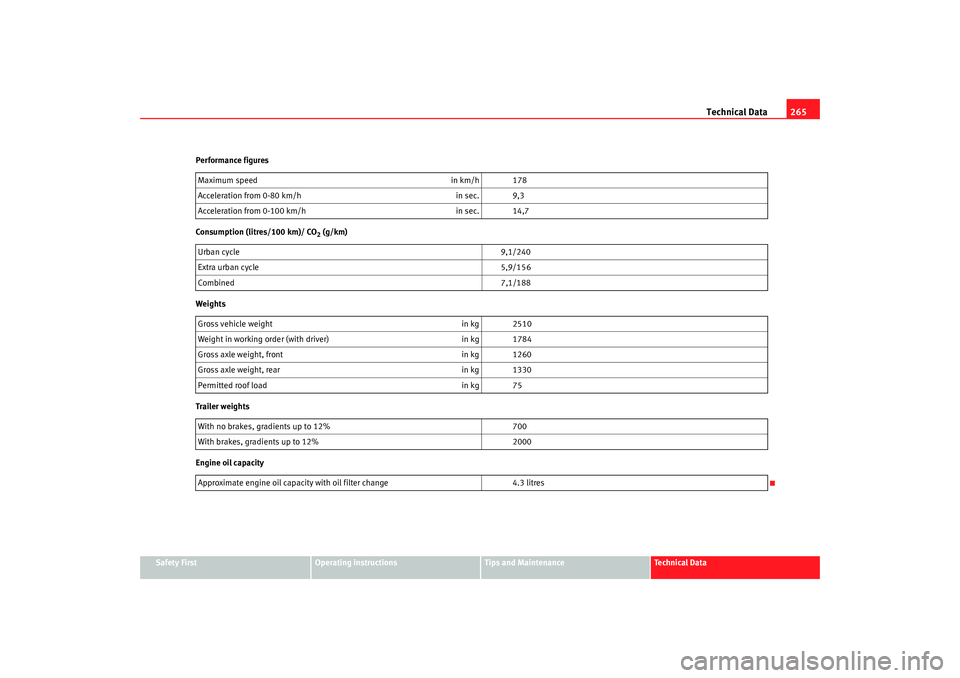
Performance figures
Consumption (litres/100 km)/ CO
2 (g/km)
Weights
Trailer weights
Engine oil capacity Maximum speed
in km/h 178
Acceleration from 0-80 km/h in sec. 9,3
Acceleration from 0-100 km/h in sec. 14,7
Urban cycle 9,1/240
Extra urban cycle 5,9/156
Combined 7,1/188
Gross vehicle weight in kg 2510
Weight in working order (with driver) in kg 1784
Gross axle weight, front in kg 1260
Gross axle weight, rear in kg 1330
Permitted roof load in kg 75
With no brakes, gradients up to 12% 700
With brakes, gradients up to 12% 2000
Approximate engine oil capacity with oil filter change 4.3 litres
alhambra_aleman.book Seite 265 Montag, 23. M‰rz 2009 1:12 13
Page 269 of 285
Technical Data267
Safety First
Operating instructions
Tips and Maintenance
Te c h n i c a l D a t a
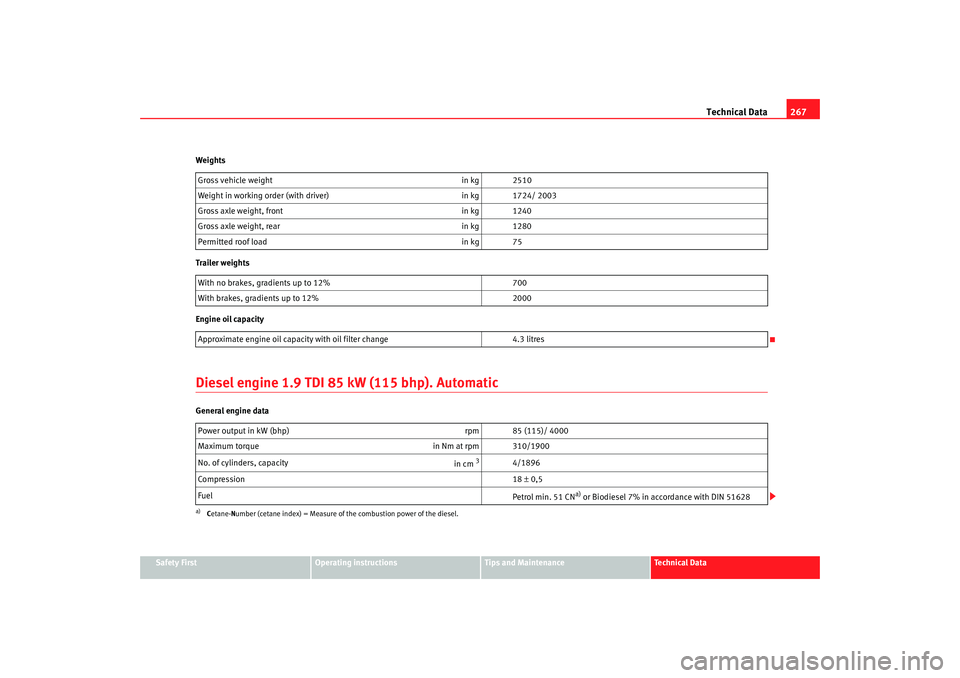
Weights
Trailer weights
Engine oil capacity
Diesel engine 1.9 TDI 85 kW (115 bhp). AutomaticGeneral engine data
Gross vehicle weight
in kg 2510
Weight in working order (with driver) in kg 1724/ 2003
Gross axle weight, front in kg 1240
Gross axle weight, rear in kg 1280
Permitted roof load in kg 75
With no brakes, gradients up to 12% 700
With brakes, gradients up to 12% 2000
Approximate engine oil capacity with oil filter change 4.3 litres
Power output in kW (bhp) rpm 85 (115)/ 4000
Maximum torque in Nm at rpm 310/1900
No. of cylinders, capacity in cm
3
4/1896
Compression 18 ± 0,5
Fuel Petrol min. 51 CN
a) or Biodiesel 7% in accordance with DIN 51628
a)Cetane- Number (cetane index) = Measure of the combustion power of the diesel.
alhambra_aleman.book Seite 267 Montag, 23. M‰ rz 2009 1:12 13
Page 270 of 285
Technical Data
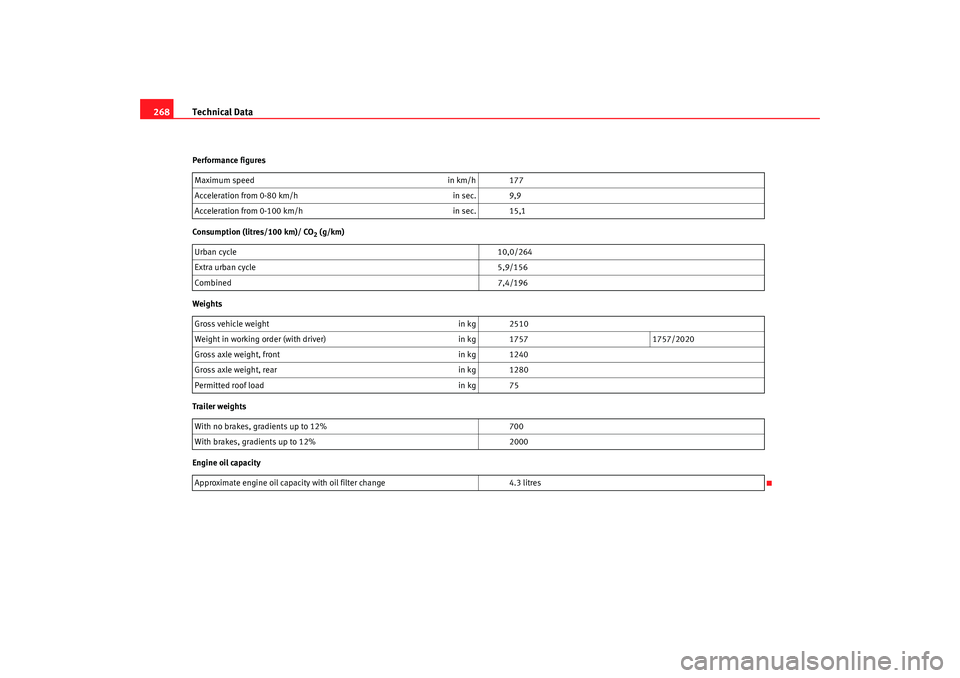
268Performance figures
Consumption (litres/100 km)/ CO
2 (g/km)
Weights
Trailer weigh ts
Engine oil capacity Maximum speed
in km/h 177
Acceleration from 0-80 km/h in sec. 9,9
Acceleration from 0-100 km/h in sec. 15,1
Urban cycle 10,0/264
Extra urban cycle 5,9/156
Combined 7,4/196
Gross vehicle weight in kg 2510
Weight in working order (with driver) in kg 17571757/2020
Gross axle weight, front in kg 1240
Gross axle weight, rear in kg 1280
Permitted roof load in kg 75
With no brakes, gradients up to 12% 700
With brakes, gradients up to 12% 2000
Approximate engine oil capacity with oil filter change 4.3 litres
alhambra_aleman.book Seite 268 Montag, 23. M‰rz 2009 1:12 13
Page 272 of 285
Technical Data
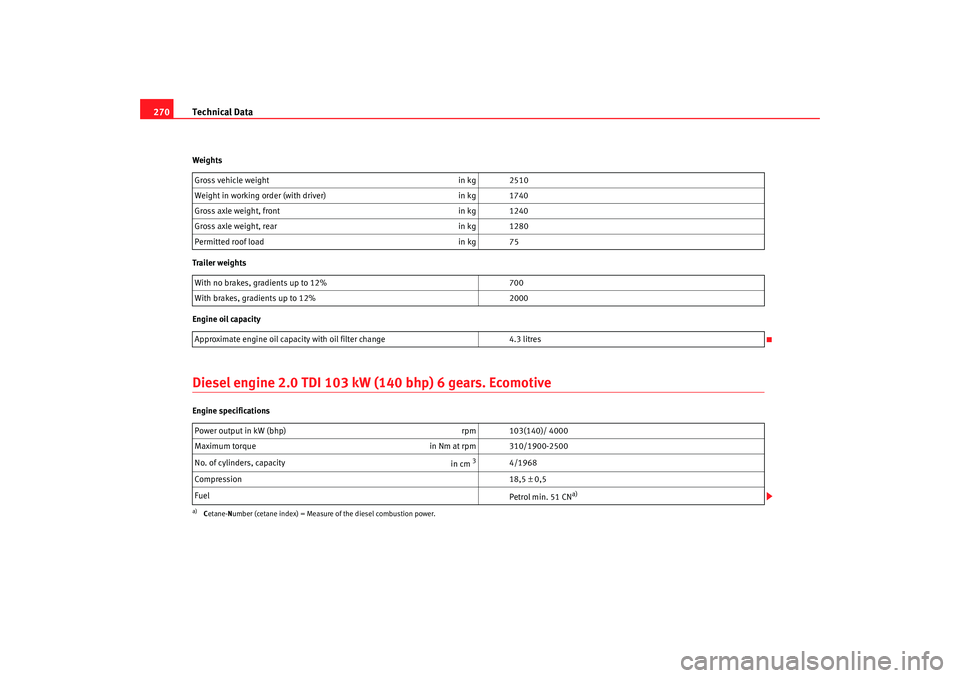
270Weights
Trailer weigh ts
Engine oil capacityDiesel engine 2.0 TDI 103 kW (140 bhp) 6 gears. EcomotiveEngine specifications Gross vehicle weight
in kg 2510
Weight in working order (with driver) in kg 1740
Gross axle weight, front in kg 1240
Gross axle weight, rear in kg 1280
Permitted roof load in kg 75
With no brakes, gradients up to 12% 700
With brakes, gradients up to 12% 2000
Approximate engine oil capacity with oil filter change 4.3 litres
Power output in kW (bhp) rpm 103(140)/ 4000
Maximum torque in Nm at rpm 310/1900-2500
No. of cylinders, capacity in cm
3
4/1968
Compression 18,5 ± 0,5
Fuel Petrol min. 51 CN
a)
a)Cetane- Number (cetane index) = Measure of the diesel combustion power.
alhambra_aleman.book Seite 270 Montag, 23. M‰ rz 2009 1:12 13
Page 273 of 285
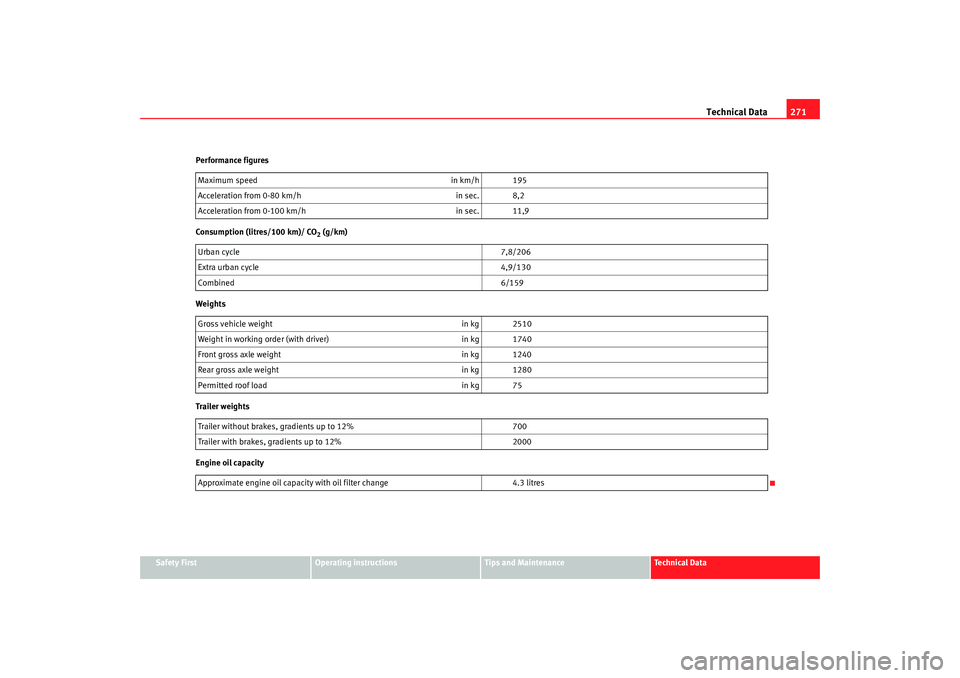
Technical Data271
Safety First
Operating instructions
Tips and Maintenance
Te c h n i c a l D a t a
Performance figures
Consumption (litres/100 km)/ CO
2 (g/km)
Weights
Trailer weights
Engine oil capacity Maximum speed
in km/h 195
Acceleration from 0-80 km/h in sec. 8,2
Acceleration from 0-100 km/h in sec. 11,9
Urban cycle 7,8/206
Extra urban cycle 4,9/130
Combined 6/159
Gross vehicle weight in kg 2510
Weight in working order (with driver) in kg 1740
Front gross axle weight in kg 1240
Rear gross axle weight in kg 1280
Permitted roof load in kg 75
Trailer without brakes, gradients up to 12% 700
Trailer with brakes, gradients up to 12% 2000
Approximate engine oil capacity with oil filter change 4.3 litres
alhambra_aleman.book Seite 271 Montag, 23. M‰rz 2009 1:12 13