engine Seat Alhambra 2011 Owner's Manual
[x] Cancel search | Manufacturer: SEAT, Model Year: 2011, Model line: Alhambra, Model: Seat Alhambra 2011Pages: 385, PDF Size: 7.92 MB
Page 293 of 385
291
Checking and refilling levels WARNING (Continued)
● Battery acid is very corrosive and caustic. It can burn skin and cause
b lindne
ss. When handling the battery, protect yourself from splashes of
acids, above all your hands, arms and face.
● Never tilt the vehicle battery. Battery acid could spill out of the open-
ings
to release gases and cause corrosion damage.
● Never open the vehicle battery.
● If battery acid splashes on you, immediately rinse your eyes and skin
abund
antly with water for several minutes. Then seek medical care imme-
diately.
● If acid is swallowed by mistake, consult a doctor immediately.
Charging, replacing and connecting or disconnecting the
batt er
y Charging the battery
The v
ehic
le battery should be charged by a specialist workshop only, as bat-
teries using special technology have been installed and they must be charg-
ed in a controlled environment ⇒ . SEAT recommends visiting a Technical
Serv ic
e.
Replacing a vehicle battery
The battery has been developed to suit the conditions of its location and
has special safety features. If the battery must be replaced, consult a quali-
fied SEAT workshop for information on electromagnetic compatibility, the
size and maintenance, performance and safety requirements of the new bat-
tery in your vehicle before you purchase one. SEAT recommends you have
the battery replaced by a qualified SEAT workshop.
Use only maintenance-free genuine batteries conforming to TL 825 06 and
VW 7 50 73 Standards. These standards must be dated April 2008 or later. Start-Stop systems (
⇒ page 196) ar
e equipped with a special battery. There-
fore, it must only be replaced with a battery of the same specifications.
Disconnecting the vehicle's battery
If you must disconnect the battery from the electrical system, please note
the following:
● Switch off the ignition and all electrical equipment.
● The vehicle must be unlocked before disconnecting the battery, other-
wise the al
arm will be triggered.
● First disconnect the negative cable and then the positive ⇒ .
Connectin g the
vehicle's battery
● Before reconnecting the battery, switch off the engine, the ignition and
electric dev
ices.
● First reconnect the positive cable and then the negative ⇒ .
Differ ent
control lamps may light up after connecting the battery and switch-
ing the ignition on. They will be turned off after a short trip at a speed of
between 15 - 20 km/h (10 - 12 mph). If the warning indicators remain lit,
please visit a specialised workshop to have the vehicle checked.
If the battery has been disconnected for a long time, it is possible that the
next service date is not displayed or calculated correctly ⇒ page 57. Respect
the maximum service intervals permitted ⇒ Booklet Maintenance Pro-
gramme.
Automatic consumer disconnection
The intelligent vehicle electrical system automatically implements a range
of measures to prevent the battery from discharging when high demands
are made on it: Safety First Operating instructions Practical tips Technical Data
Page 294 of 385
292
Checking and refilling levels
● the idling s peed i s increased so that the alternator provides more elec-
tricity.
● where necessary, the power of the most powerful consumers is reduced
or even comp
letely disconnected.
● On starting the engine, the power supply from the 12-volt sockets and
the cigar
ette lighter may be interrupted for a short time.
The on-board management program cannot always prevent the battery from
running flat. For example, if the ignition is left on for a long period with the
engine off or if the side lights or parking lights are left on while the vehicle
is stationary.
Why does the battery run flat?
● When stationary for a long time without starting the engine, particularly
if the ignition is
switched on.
● Use of electrical consumers with the engine switched off.
● If the auxiliary heater is running ⇒ page 163.WARNING
Incorrectly securing the battery or using the wrong battery can cause
short -c
ircuits, fire and serious injuries.
● Always use only maintenance free batteries that do not run flat alone
and whose proper
ties, specifications and size correspond to the stand-
ard battery. The specifications are indicated on the battery case. WARNING
A highly explosive mixture of gases is released when the battery is under
ch ar
ge.
● The batteries should be charged in a well-ventilated room only.
● Never charge a frozen or recently thawed battery. A flat battery can
freeze at
temperatures around 0°C (+32°F). WARNING (Continued)
● Always replace a battery which has frozen.
● B
att
ery cables not correctly connected may cause a short circuit. Re-
connect fir
st the positive cable and then the negative cable. CAUTION
● Never disconnect the battery if the ignition is switched on or if the en-
gine i s
running. This could damage the electrical system or electronic com-
ponents.
● Never plug accessories supply current, such as solar panels or a battery
char
ger, to the 12-volt sockets or the cigarette lighter. This could damage
the vehicle's electrical system. For the sake of the environment
● Dispose of the battery in an environment-friendly manner. Batteries con-
t ain t
oxic substances such as sulphuric acid and lead.
● Battery acid can contaminate the environment. Collect any spilt service
fluids and al
low a dispose of them correctly.
Page 302 of 385

300
Wheels and tyres
Driving style : driving r ound bends fast or sudden acceleration or braking
speed up the wear of tyres. When the driving style is normal, if the tyres
wear too quickly, have the running gear settings checked at a Technical
Service.
Wheel run-out: The wheels on new vehicles are balanced. However, certain
circumstances may lead to imbalance (run-out), which is detected as vibra-
tions in the steering wheel. Run-out leads to wear of the steering and sus-
pension. In the event of run out, the wheels should be balanced again.
When a new wheel is fitted, it should be balanced again.
Running gear settings : an incorrectly positioned running gear increases the
wear of tyres and affects your safety while driving. If tyres wear too quickly,
have the wheel alignment checked at a specialist workshop. WARNING
If you notice unusual vibration or the car pulls to one side while driving,
this m
ay indicate that one of the tyres is damaged.
● Reduce speed immediately and stop, while observing the highway
code.
● Check
the wheels and tyres for damage.
● Never carry on driving on worn tyres or wheels. Request qualified as-
sis
tance immediately.
● If there is no visible exterior damage, drive slowly and carefully to the
neare
st qualified workshop and have the vehicle checked.
Winter tyres* In winter conditions winter tyres will considerably improve the vehicles han-
dling.
The de
sign of summer tyres (width, rubber compound, tread pattern)
gives less grip on ice and snow. Winter tyres also improve the vehicle brak-
ing performance, reducing the braking distance in winter weather. SEAT rec- ommend that winter tyres be fitted to the vehicle at temperatures below
+7°C (+45°F).
The perf
ormance of winter tyres is much reduced if the tyre tread is worn be-
low 4 mm (1/16 inch). The age of the tyre is another factor affecting per-
formance, regardless of the depth of the tyre tread.
Please observe the following when using winter tyres:
● Observe legal requirements in each country.
● Winter tyres must be fitted on all four wheels.
● Only use winter tyres in wintery weather conditions.
● Only use winter tyres of the size authorised for the vehicle.
● Only use radial winter tyres of the same type, size (rolling circumference)
and trea
d pattern.
● Adjust speeds to within the limits indicated (code letter on tyre) ⇒ .
Speed limit
A c ode l
etter indicating the speed limit is stamped on all winter tyres
⇒ page 303.
In some vehicles, it is possible to set a speed warning in the MFA (multifunc-
tion indicator) menu on the instrument panel ⇒ page 62.
If you use V-rated tyres the speed limits and tyre pressure will be deter-
mined by engine size. Please ask your SEAT qualified workshop for further
information on the maximum permitted speed and the required pressures
for the tyres.
All-wheel drive*
Thanks to its all-wheel drive, your car will have plenty of traction in winter
conditions, even with the standard tyres. Nevertheless, SEAT still recom-
mend that winter tyres or all-season tyres should be fitted on all four wheels
when winter road conditions are expected, mainly because this will give a
better braking response.
Page 308 of 385
306
Wheels and tyres WARNING (Continued)
● Only use suitable tools that are not damaged when changing a wheel.
● A
lw
ays stop the engine, turn on the electronic parking brake and
plac
e the gear selector lever in position P, for an automatic gearbox, or
engage a gear for a manual gearbox to reduce the risk of the vehicle mov-
ing accidentally.
● Have the tightening torque of the wheel bolts checked as soon as
poss
ible with a reliable torque wrench.
Preparations for changing a wheel Check list
Bef
or
e changing a wheel, complete the following operations in the order
given ⇒ :
Park the
vehicle on an even and solid surface.
Connect the electronic parking brake ⇒ page 183.
Automatic gearbox: Move selector lever to position P ⇒ page 174.
Stop the engine and remove the key from the ignition ⇒ page 170.
Manual gearbox: Select a gear ⇒ page 174.
Have all vehicle occupants get out of the vehicle and wait in a safe
place (for example, behind the safety barrier).
Block the opposite wheel with wedges or a similar object.
When towing a trailer: unhook the trailer from the towing vehicle and
park it correctly.
If the luggage compartment is full: take the baggage out of the vehicle. Take the vehicle tool kit out of the luggage compartment.
Remove the wheel trims ⇒ page 304.
1.
2.
3.
4.
5.
6.
7.
8.
9.
10.
11. WARNING
Failure to follow the checklist prepared for your own safety could lead to
acc ident
s and severe injuries.
● Always complete the operations given in the checklist and observe
the genera
l rules of safety.
Page 312 of 385
310
Wheels and tyres
Check list
For y
our own safety and that of other passengers, the following points
should be observed in the order given ⇒ :
Select a s
uitable flat and firm surface for raising the vehicle.
Switch off the engine, engage a gear (manual gearbox) or place the se-
lector lever in position P ⇒ page 174 and turn on the electronic parking
brake ⇒ page 183.
When towing a trailer: unhook the trailer from the towing vehicle and
park it correctly.
Loosen the wheel bolts on the wheel to be changed ⇒ page 307.
Look below the vehicle for the jacking point ⇒ fig. 183 closest to the
tyre which has to be changed.
Raise the jack with the handle until it can be inserted below the jacking
point.
Ensure that the foot of the jack is firmly on the ground and that it is
placed immediately below the lifting point on the vehicle ⇒ fig. 184.
Straighten the jack and continue raising it using the handle until the
claw holds the vertical reinforcement beneath the vehicle ⇒ fig. 184.
Raise the vehicle until the wheel is clear of the ground. WARNING
If the vehicle is not correctly raised, it could fall off the jack causing seri-
ous injur
y. Please observe the following rules to minimise the risk of in-
jury:
● You should only use a jack approved by SEAT for your vehicle. Other
jack
s, even those approved for other SEAT models, might slip out of
place.
● The ground should be firm and flat. If the ground is sloped or soft
then the vehic
le could slip and fall off the jack. If necessary, support the
jack on a wide solid base. 1.
2.
3.
4.
5.
6.
7.
8.
9. WARNING (Continued)
● If the ground is slippery (for example, on tiles), place a non-slip sur-
f ac
e (for example a floor mat) beneath the jack to avoid slipping.
● Only fit the jack at the prescribed jacking points. The claw of the jack
should grip the r
einforcement nerve on the underbody ⇒ fig. 184.
● You should never have any limbs beneath a raised vehicle which is
only s
upported by a jack.
● If you have to work underneath the vehicle, you must use suitable
stand
s additionally to support the vehicle, there is a risk of accident!.
● Never raise the vehicle if it is tilting to one side or the engine is run-
ning.
● Never s
tart the engine when the vehicle is raised. The vehicle may
come loose fr
om the jack due to the engine vibrations. WARNING
Failure to follow the checklist prepared for your own safety could lead to
acc ident
s and severe injuries.
● Always complete the operations given in the checklist and observe
the genera
l rules of safety.
Page 315 of 385
313
If and when
Move the selector lever to its intermediate position or to P ⇒ page 174.
St op the engine and remove the key from the ignition ⇒ page 170.
Have all occupants leave the vehicle and move to safety, for example
behind a guard rail.
When leaving the vehicle, take all keys with you.
Place an emergency warning triangle to indicate the position of your ve-
hicle to other road users.
Allow the engine to cool and check if a specialist is required.
Examples of when to use the hazard warning lights:
● If the vehicles ahead suddenly slow down or reach the end of a traffic
jam, to w
arn the vehicles behind.
● In case of an emergency.
● If the vehicle breaks down.
● When being towed.
Alwa
ys comply with the applicable laws regarding the use of hazard warn-
ing lights.
If the hazard warning lights are not working, you must use an alternative
method of drawing attention to your vehicle. This method must comply with
traffic legislation. WARNING
Failure to follow the checklist prepared for your own safety could lead to
acc ident
s and severe injuries.
● Always complete the operations given in the checklist and observe
the genera
l rules of safety. 4.
5.
6.
7.
8.
9.
WARNING
The components of the exhaust system reach very high temperatures.
This c
ould cause a fire and considerable damage.
● Always park your vehicle so that no part of the exhaust system can
come in cont
act with flammable materials (such as dried grass or fuel). Note
● The vehicle battery will discharge and run down if the hazard warning
lights r
emain on for too much time (even with the ignition turned off).
● For some vehicles, the brake lights will blink when braking suddenly at
speeds
of approximately 80 km/h to warn vehicles behind. If braking con-
tinues, then the hazard warning lights will automatically be turned on at the
speed of less than approximately 10 km an hour. The brake lights remain lit.
Upon accelerating, the hazard warning lights will be automatically turned
off. Safety First Operating instructions Practical tips Technical Data
Page 321 of 385
319
If and when
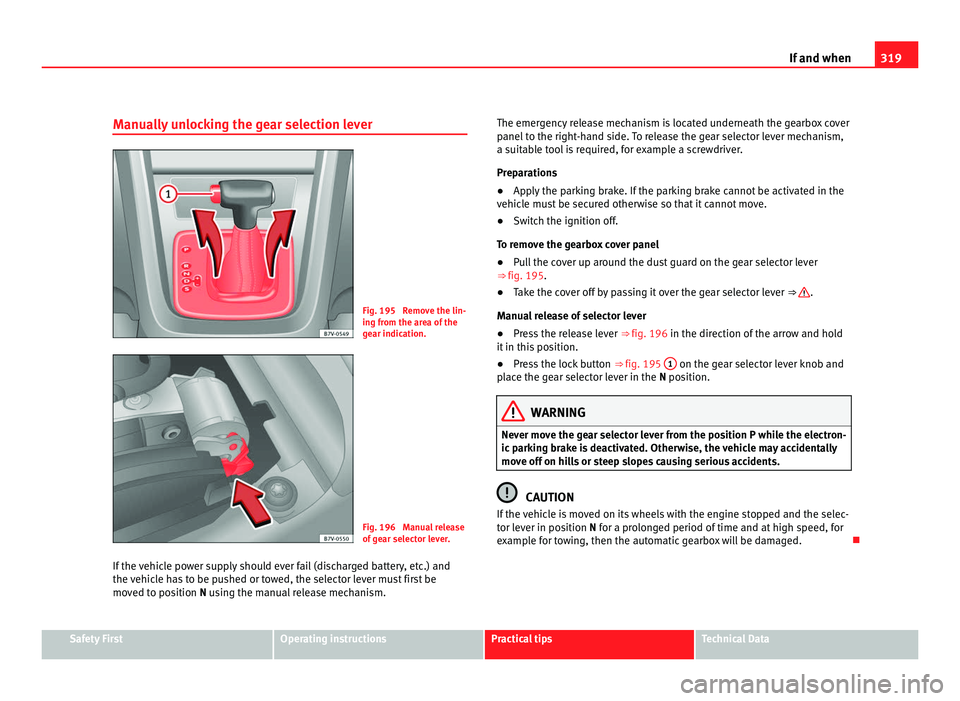
Manually unlocking the gear selection lever Fig. 195 Remove the lin-
ing fr
om the ar
ea of the
gear indication. Fig. 196 Manual release
of g
e
ar selector lever.
If the vehicle power supply should ever fail (discharged battery, etc.) and
the vehic
le has to be pushed or towed, the selector lever must first be
moved to position N using the manual release mechanism. The emergency release mechanism is located underneath the gearbox cover
panel t
o the right-hand side. To release the gear selector lever mechanism,
a suitable tool is required, for example a screwdriver.
Preparations
● Apply the parking brake. If the parking brake cannot be activated in the
vehicl
e must be secured otherwise so that it cannot move.
● Switch the ignition off.
To remo
ve the gearbox cover panel
● Pull the cover up around the dust guard on the gear selector lever
⇒ fig. 195.
● Take the cover off by passing it over the gear selector lever ⇒ .
Manua l
release of selector lever
● Press the release lever ⇒ fig. 196 in the direction of the arr
ow and hold
it in this position.
● Press the lock button ⇒ fig. 195 1 on the gear selector lever knob and
pl ac
e the gear selector lever in the N position. WARNING
Never move the gear selector lever from the position P while the electron-
ic p ark
ing brake is deactivated. Otherwise, the vehicle may accidentally
move off on hills or steep slopes causing serious accidents. CAUTION
If the vehicle is moved on its wheels with the engine stopped and the selec-
tor l ev
er in position N for a prolonged period of time and at high speed, for
example for towing, then the automatic gearbox will be damaged. Safety First Operating instructions Practical tips Technical Data
Page 322 of 385
320
If and when
Tools*
Introduction When securing the vehicle in case of a breakdown, please note the legal re-
quirements
f
or each country.
Additional information and warnings:
● Working in the engine compartment ⇒ page 275
● Ch
ange wheel ⇒ pag
e 305
● In case of emergency ⇒ pag
e 312WARNING
Loose objects in the passenger compartment can be violently fired
through the c omp
artment in case of a sudden manoeuvre or braking and
especially in accidents causing serious injury.
● Make sure that the vehicle tools are stored safely in the luggage com-
partment
. WARNING
Unsuitable or damaged on-board tools can cause injury or accidents.
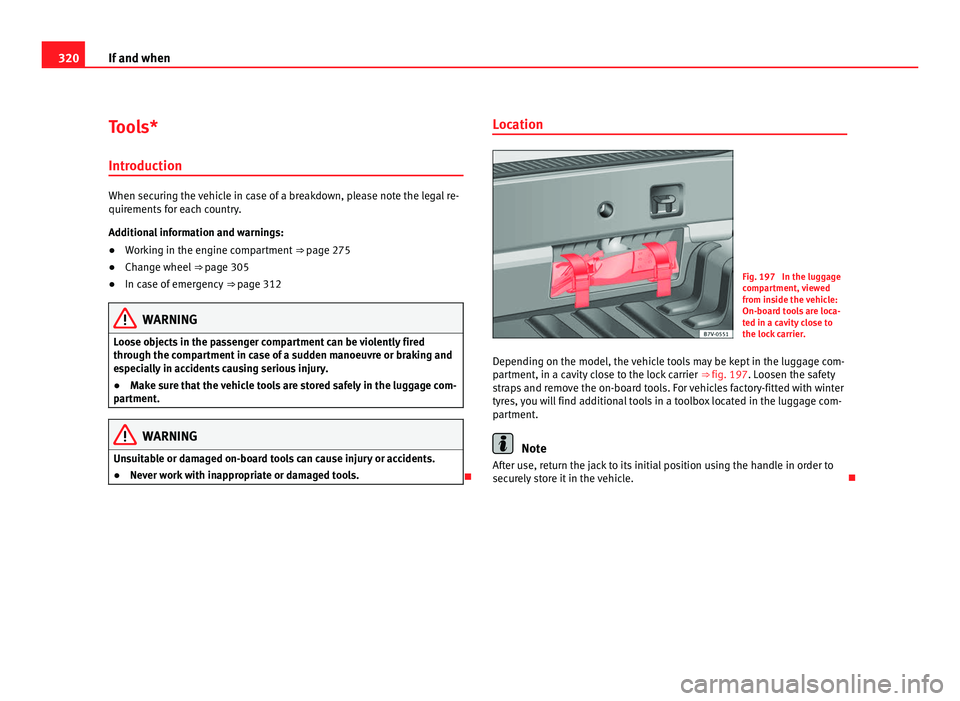
● Never work with inappropriate or damaged tools. Location Fig. 197 In the luggage
comp
ar
tment, viewed
from inside the vehicle:
On-board tools are loca-
ted in a cavity close to
the lock carrier.
Depending on the model, the vehicle tools may be kept in the luggage com-
partment, in a c
avity close to the lock carrier ⇒ fig. 197. Loosen the safety
straps and remove the on-board tools. For vehicles factory-fitted with winter
tyres, you will find additional tools in a toolbox located in the luggage com-
partment. Note
After use, return the jack to its initial position using the handle in order to
secur ely
store it in the vehicle.
Page 324 of 385
322
If and when
Fuses
Introduction Due to the constant update of vehicles, fuse assignments depending on
equipment and the u
se of
the same fuse for various electrical components,
at the time of printing this manual it is not possible to provide an up-to-date
summary of the electrical components fuse positions. For detailed informa-
tion about the fuse positions, please consult a Technical Service.
In general, a fuse can be assigned to various electrical components. Like-
wise, an electrical component can be protected by several fuses.
Only replace fuses when the cause of the problem has been solved. If a
newly inserted fuse blows after a short time, you must have the electrical
system checked by a qualified dealership as soon as possible.
Additional information and warnings:
● Working in the engine compartment ⇒ page 275WARNING
The high voltages in the electrical system can give serious electrical
shock s, c
ausing burns and even death!
● Never touch the electrical wiring of the ignition system.
● Take care not to cause short circuits in the electrical system. WARNING
Using unsuitable fuses, repairing fuses or bridging a current circuit with-
out f u
ses can cause a fire and serious injury.
● Never use a fuse with a higher value. Only replace fuses with a fuse of
the same amperag
e (same colour and markings) and size.
● Never repair a fuse.
● Never replace a fuse by a metal strip, staple or similar. CAUTION
● To avoid damage to the vehicles electric system, before replacing a fuse
t urn off
the ignition, the lights and all electrical elements and remove the
keys from the ignition.
● If you replace a fuse with higher-rating fuse, you could cause damage to
another part
of the electrical system.
● Protect the fuse boxes when open to avoid the entry of dust or humidity.
Dirt and humidity
inside fuse boxes can cause damage to the electrical sys-
tem. Note
● One single consumer could have more than one fuse.
● Sev er
al consumers could run over one single fuse.
Page 325 of 385
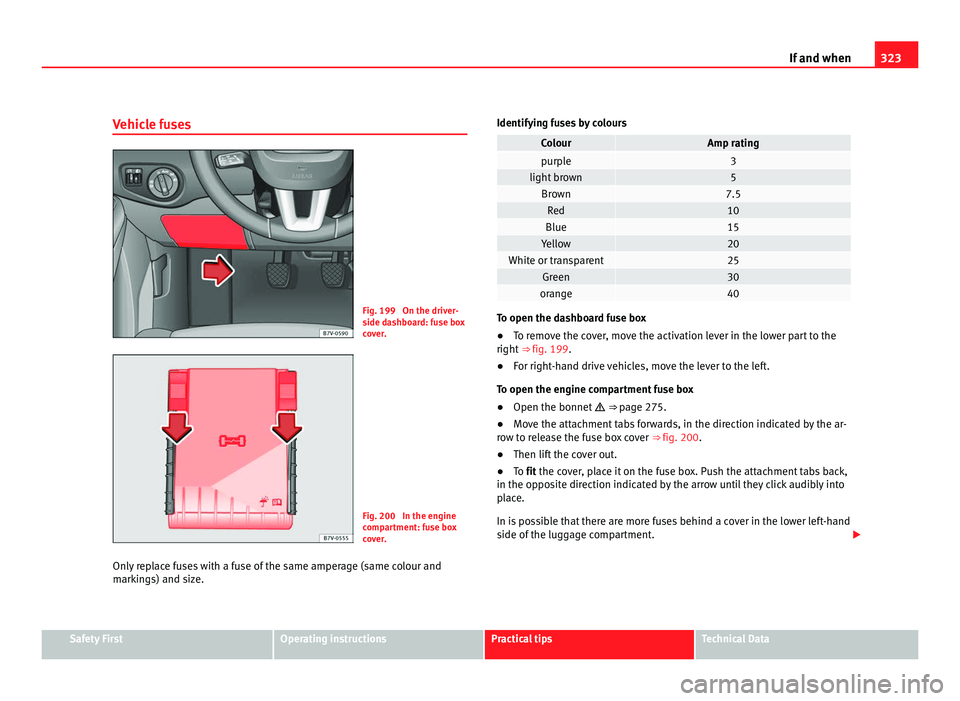
323
If and when
Vehicle fuses Fig. 199 On the driver-
side d
a
shboard: fuse box
cover. Fig. 200 In the engine
comp
ar
tment: fuse box
cover.
Only replace fuses with a fuse of the same amperage (same colour and
markin
gs) and size. Identifying fuses by colours Colour Amp rating
purple 3
light brown 5
Brown 7.5
Red 10
Blue 15
Yellow 20
White or transparent 25
Green 30
orange 40
To open the dashboard fuse box
●
To remove the cover, move the activation lever in the lower part to the
right ⇒ fig. 199 .
● F
or right-hand drive vehicles, move the lever to the left.
To open the engine c
ompartment fuse box
● Open the bonnet ⇒ pag
e 275.
● Move the attachment tabs forwards, in the direction indicated by the ar-
row t
o release the fuse box cover ⇒ fig. 200.
● Then lift the cover out.
● To fit the cover, place it on the fuse box. Push the attachment tabs back,
in the oppo
site direction indicated by the arrow until they click audibly into
place.
In is possible that there are more fuses behind a cover in the lower left-hand
side of the luggage compartment. Safety First Operating instructions Practical tips Technical Data