load capacity Seat Alhambra 2011 Owner's Manual
[x] Cancel search | Manufacturer: SEAT, Model Year: 2011, Model line: Alhambra, Model: Seat Alhambra 2011Pages: 385, PDF Size: 7.92 MB
Page 15 of 385
13
Safe driving
Also valid for the front passenger:
● Move the front passenger seat back as far as possible for optimum pro-
tection shou l
d the airbag deploy.
Transporting objects Introduction Always transport heavy loads in the trunk and place the seat backs in a ver-
tical
po
sition. Always use the anchors provided with suitable rope to secure
heavy objects. Never overload the vehicle. Both the carrying capacity as well
as the distribution of the load in the vehicle have effects on the driving be-
haviour and braking ability ⇒ .
Addition a
l information and warnings:
● Tailgate ⇒ page 84
● T
o lower the passenger seat back ⇒ page 117
● Light
⇒ page 95
● Lug
gage compartment ⇒ page 125
● R
oof carrier ⇒ page 138
● T
owing mode ⇒ page 233
● Wheel
s and tyres ⇒ page 293 WARNING
Unsecured or incorrectly secured objects can cause serious injury in case
of a s ud
den manoeuvring or breaking or in case of an accident. This is es-
pecially true when objects are struck by a detonating airbag and fired
through the vehicle interior. To reduce the risks, please note the follow-
ing:
● Secure all objects in the vehicle. Always keep equipment and heavy
obj
ects in the luggage compartment.
● Always secure objects with suitable rope or slings so that they cannot
enter the are
as around the frontal or side airbags in case of sudden brak-
ing or an accident.
● Always ensure that objects inside the vehicle cannot move into the
area of
the bags while driving.
● While driving, always keep object compartments closed.
● Remove all objects from the passenger seat when this is followed
down. When the se
at back is folded down, it presses on small and light
objects and these are detected by the weight sensor on the seat; this
sends false information to the airbag control unit.
● While the backrest of the front passenger's seat is folded, the frontal
airbag mus
t remain disconnected and the PASSENGER AIRBAG OFF light
on.
● Objects secured in the vehicle should never be placed in such a way
as t
o make passengers sit in an incorrect position.
● If secured objects occupy a seat then this should not be occupied or
used by
anybody. Safety First Operating instructions Practical tips Technical Data
Page 127 of 385
125
Seats and storage compartments WARNING
Travelling with the head restraints removed or improperly adjusted in-
cr e
ases the risk of severe or fatal injuries in the event of accidents and
sudden braking or manoeuvres.
● Always fit and adjust the head restraint properly whenever a person
is oc
cupying a seat.
● Refit any removed head restraints immediately so that passengers
are properly
protected. CAUTION
On removing and fitting the head restraint, make sure the head restraint
does not
hit the interior roof of the vehicle or the backrest of the front seat.
This could damage the interior roof and other parts of the vehicle.
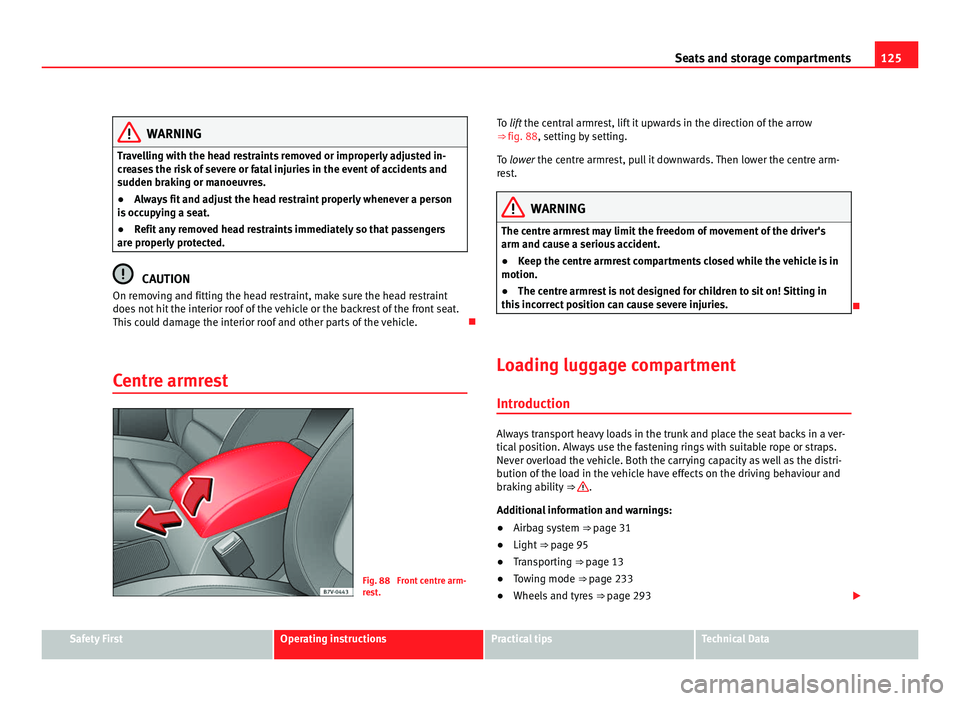
Centre armrest Fig. 88 Front centre arm-
re
s
t. To lift the central armrest, lift it upwards in the direction of the arrow
⇒ fig. 88
, setting by setting.
To lower the centre armrest, pull it downwards. Then lower the centre arm-
rest. WARNING
The centre armrest may limit the freedom of movement of the driver's
arm and cau se a seriou
s accident.
● Keep the centre armrest compartments closed while the vehicle is in
motion.
● The centre armrest is not designed for children to sit on! Sitting in
this inc
orrect position can cause severe injuries.
Loading luggage compartment Introduction Always transport heavy loads in the trunk and place the seat backs in a ver-
tical
po
sition. Always use the fastening rings with suitable rope or straps.
Never overload the vehicle. Both the carrying capacity as well as the distri-
bution of the load in the vehicle have effects on the driving behaviour and
braking ability ⇒ .
Addition a
l information and warnings:
● Airbag system ⇒ page 31
● Light
⇒ page 95
● Tr
ansporting ⇒ page 13
● T
owing mode ⇒ page 233
● Wheel
s and tyres ⇒ page 293 Safety First Operating instructions Practical tips Technical Data
Page 142 of 385
140
Seats and storage compartments
The position holes are located on the inner side of the rail ⇒ fig. 101.WARNING
If the base supports and the roof carrier system are incorrectly fitted or
used in an u n
suitable manner, the entire system could break free causing
accident and injury.
● Always take the manufacturer assembly instructions into account.
● Only use base supports and roof carrier systems that are not dam-
aged and are c
orrectly fitted.
● The base support should only be fitted to the points indicated in the
diagram
⇒ fig. 101.
● Secure the base supports and roof carrier system correctly.
● Check the screw fittings and attachments before driving and after a
short di
stance. During each long journey, check the attachments during
every break.
● Always fit the roof carrier system correctly for wheels, skis and surf-
board
s.
● Never change or repair the basic supports or roof carrier system. Note
Read and take into account the instructions included with the roof carrier
sys t
em fitted and keep them in the vehicle.
Loading the roof carrier system Loads can only be correctly secured when the roof carrier system is correctly
fitted
⇒ .
Max imum authori
sed roof load
The maximum authorised roof load is 100 kg (about 220 lbs). The roof load
includes the roof carrier system and the load being transported ⇒ .Always check the roof carrier system weight and the weight of the load to be
tran
s
ported and, if necessary, weigh them. Never exceed the maximum au-
thorised roof load.
If you are using a roof carrier with a lower weight rating, you cannot trans-
port the maximum roof load. Do not exceed the maximum weight limit for
the roof carrier given in the fitting instructions.
Distributing a load
Uniformly distribute loads and secure them correctly ⇒ .
Check att
achments
After fitting the base supports and the roof carrier system, always check the
attachments after a short trip or at regular intervals. WARNING
Exceeding the maximum authorised roof load can result in accidents
and/or v ehic
le damage.
● Always respect the maximum authorised weight for the roof, the max-
imum authorised weight
on the axles and the total maximum authorised
weight of the vehicle.
● Never exceed the capacity of the roof carrier system even if this is
les
s than the maximum authorised roof load.
● Secure heavy objects towards the front and distribute the load even-
ly. WARNING
Loose and incorrectly secured loads can fall from the roof carrier system
cau s
ing accidents and injury.
● Always use suitable ropes and straps in good condition.
● Always secure loads correctly.
Page 190 of 385
188
Driving
If the brake servo does not operate or the vehicle must be towed, then the
brak e ped
al will have to be pressed with more force given that the braking
distance will be increased when the brake servo does not operate ⇒ .
WARNING
New brake pads do not brake to full efficiency.
● For the first 320 km (200 miles), new brake pads have not yet reached
their max imum br
aking capacity, and need to be run in first. For this, to
compensate for reduced braking efficiency the brake pedal will have to
be pressed with more force.
● To avoid losing control of the vehicle and causing serious accidents,
alwa
ys take great care when driving with new brake pads.
● When running in new brake pads, always respect the safety distances
between y
ou and other vehicles and do not cause situations requiring ex-
treme braking performance. WARNING
When brakes overheat, braking is less efficient and braking distances in-
cr e
ase.
● When driving on slopes, brakes can be overloaded and overheat
quickly
.
● Reduce speed, move down a gear or select a shorter range of gears
before lon
g steep slopes. This allows you to use the engine braking ef-
fect and to reduce the strain on the brake system.
● Non-standard or damaged front spoilers could restrict the airflow to
the brake
s and cause them to overheat. WARNING
Wet, frozen or salt-covered brakes take time to brake and this increases
brak in
g distances.
● Test the brakes carefully.
● Dry the brakes, free them of ice and salt by braking gently several
times, when we
ather, road and traffic conditions permit. WARNING
Driving without the brake servo may significantly increase the braking
dist
ance and result in a severe accident.
● Never allow the vehicle to move forwards when the engine is switched
off.
● If the br
ake servo does not operate or the vehicle must be towed,
then the brake ped
al will have to be pressed with more force given that
the braking distance will be increased when the brake servo does not op-
erate. CAUTION
● Never make the brakes slip by pressing the pedal gently, if it is not really
nec e
ssary to brake. Continuously pressing on the brake pedal will heat the
brakes. This could significantly reduce braking power, increase braking dis-
tance or even result in the total failure of the brake system.
● Reduce speed, move down a gear or select a shorter range of gears be-
fore lon
g steep slopes. This allows you to use the engine braking effect and
to reduce the strain on the brake system. Otherwise, the brakes may over-
heat and fail. Only use the brakes to reduce speed or to stop.
Page 239 of 385
237
Trailer towing
For the sake of road safety, SEAT recommends using the maximum allowed
dra wb
ar load. The handling of the combined vehicle and trailer will be poor
if the drawbar load is too low.
The drawbar load increases the weight on the rear axle, reducing the vehicle
carrying capacity.
Gross combination weight
This figure refers to the combined weight of the loaded vehicle and loaded
trailer.
Loading the trailer
The combined vehicle and trailer must be balanced. Use the maximum
drawbar load authorised and do not overload the front or the rear of the
trailer:
● Distribute loads in the trailer so that heavy objects are as near to the
axle a
s possible or even above it.
● Correctly secure the trailer load.
Tyr
e pressure
Inflate the trailer tyres according to the manufacturer's instructions.
Inflate the towing vehicles tyres to the maximum ⇒ page 293.WARNING
Exceeding the maximum authorised axle load, drawbar load or the gross
comb in
ation weight of the towing vehicle and trailer could cause a seri-
ous accident with severe consequences.
● Never exceed the specifications.
● With the actual load on the front and rear axles, the maximum axle
load shou
ld never be exceeded. The weight on the front and rear should
never exceed the gross vehicle weight. WARNING
If the load moves, the stability and safety of the vehicle and trailer com-
bin ation w
ill be seriously affected and this could result in a serious acci-
dent.
● Always correctly load the trailer.
● Always secure loads correctly with suitable and undamaged attach-
ment rope or s
traps.
Driving with a trailer Adjusting the headlights
When to
w
ing a trailer, the front of the vehicle may rise and so the dipped
beam headlights may blind other drivers. Use the headlight range control to
lower the cone of light. If you do not have headlight range control, have the
headlights adjusted by a qualified dealership. Vehicles with high-intensity
discharge lamps adapt automatically and do not require adjustment.
Details of driving with a trailer
● If the trailer has an overru
n brake, apply the brakes gently at first and
then, firmly. This will prevent the jerking that can be caused by the trailer
wheels locking.
● As of the combined vehicle and trailer mass, braking distances will be
great
er.
● Select a low gear before driving down a steep hill to use the engine
brakin
g effect to slow down the vehicle. Otherwise, the braking system
could overheat and fail. Safety First Operating instructions Practical tips Technical Data
Page 265 of 385
263
Accessories, parts replacement and modifications
The vehicle should not be lifted using lifting platforms with lift pads con-
tainin g fluid.
When r
aising a vehicle using a platform or jack, a series of precautionary
measures are required. Never raise the vehicle with a lifting platform or jack
unless you have received training in how to do so and know how to lift the
vehicle safely.
Notes on raising the vehicle with a jack ⇒ page 309. WARNING
The improper use of the lifting platform or the jack when raising the vehi-
cl e m
ay result in accidents or serious injury.
● Before raising the vehicle, please observe the manufacturer's instruc-
tions f
or the platform or jack, and the legal requirements, where applica-
ble.
● There should not be anyone inside the vehicle when it is being raised
or once it i
s in the air.
● Only use the jacking points indicated in the figures ⇒ fig. 160
and
⇒ fig. 161 when raising the vehicle. If the vehicle is not lifted at the indi-
cated points, it may fall from the platform while the engine or gearbox is
being dismounted, for example.
● The jacking points should be centrally aligned and firmly positioned
on the platf
orm support plates.
● Never start the engine when the vehicle is raised! The vehicle may fall
from the pl
atform due to the engine vibrations.
● If it is necessary to work underneath the vehicle while it is raised, you
should c
heck that the supporting stands have an adequate load capacity.
● Never climb onto the lifting platform.
● Always make sure that the weight of the vehicle does not exceed the
lifting p
latform load capacity. CAUTION
● Never raise the vehicle at the engine oil sump, the gearbox or the rear or
fr ont
axles.
● Always use an intermediat
e rubber support to prevent damage to the
vehicle underbody. Check that the arms of the lifting platform are able to
move with obstruction.
● The arms should not come into contact with the side running boards or
other parts
of the vehicle. Safety First Operating instructions Practical tips Technical Data
Page 295 of 385
293
Wheels and tyres
Wheels and tyres
Wheels
Introduction The SEAT Alhambra is equipped as standard with anti-puncture technology
tyr
e
s (Conti-Seal). In the event of a puncture or air leak of up to 5 mm, the
tyre seals the hole with a protective layer inside the tread.
SEAT recommend that all work on tyres and wheels is carried out by a Tech-
nical Service. They have the necessary special tools and replacement parts,
trained personnel and facilities for disposing of the old tyres. SEAT recom-
mends visiting a Technical Service.
Additional information and warnings:
● Transporting ⇒ page 13
● T
owing mode ⇒ page 233
● Br
aking, stopping and parking ⇒ page 183
● P
ark assist system ⇒ page 202
● T
yre control systems ⇒ page 221
● C
aring for and cleaning the vehicle exterior ⇒ page 242
● Wheel
trims ⇒ page 304
● Ch
ange wheel ⇒ page 305
● Not
es for the user ⇒ page 255 WARNING
The vehicle cannot be totally controlled or braked if the tyres (new or
used) ar e w
orn or damaged.
● Incorrect use of wheels and tyres could make driving more dangerous
and res
ult in serious accidents and damage.
● All four wheels must be fitted with radial tyres of the same type, size
(rol
ling circumference) and the same tread pattern.
● New tyres do not give maximum grip and will not have reached their
maximum br
aking capacity to start with, and therefore need running in.
To prevent accidents and major damage, extreme caution should be tak-
en for the first 600 km (370 miles).
● Check tyre pressures regularly and ensure they are maintained at the
pres
sures indicated. If the tyre pressure is too low, the tyres could over-
heat, resulting in tread detachment or even burst tyres.
● Never drive on damaged (punctured, cut, cracked or dented) or worn
tyre
s. Driving on damaged or worn tyres could result in burst tyres, seri-
ous accidents or damage. Worn or damaged tyres must be replaced im-
mediately.
● Never exceed the maximum permitted speed or loads specified for the
type of ty
re fitted on your vehicle.
● The efficiency of driver and brake assist systems also depends on the
grip of the tyr
es.
● If you notice unusual vibration or if the vehicle pulls to one side when
driving, s
top the car immediately and check the tyres and wheels for
damage.
● To minimise the risk of losing control of the vehicle or causing a seri-
ous ac
cident, never undo the bolted joints of beadlock wheels. Safety First Operating instructions Practical tips Technical Data
Page 298 of 385
296
Wheels and tyres
Wheel rims The design of wheel bolts is matched to the rims. If different rims are fitted,
the corr
ect
wheel bolts with the right length and correctly shaped bolt
heads must be used. This ensures that wheels are fitted securely and that
the brake system functions correctly ⇒ page 305.
For technical reasons, it is not generally possible to use the wheels from
other vehicles. In some cases, this may also be true for the same model of
wheel.
The tyres and rims approved by SEAT are specially matched to the character-
istics of the vehicle and are critical to good road holding and safe handling.
Wheel bolts
Wheel bolts must be tightened to the correct torque ⇒ page 305.
Beadlock wheel rims
Beadlock wheel rims have various components. These are joined together
by special bolts using a special procedure. This ensures good performance,
a better seal, improved safety and wheel run out. Therefore, worn rims
should always be replaced and must only be repaired in a Technical Service.
SEAT recommends visiting a Technical Service ⇒ .
Wheel rims w
ith bolted trims
Wheel rims may be fitted with interchangeable trim parts which are attach-
ed to the rim using self-locking bolts. Worn trims should only be replaced at
a Technical Service. SEAT recommends visiting a Technical Service ⇒ .
WARNING
The use of worn or damaged wheel rims could make driving more danger-
ous and r
esult in serious accidents and damage.
● Only wheel rims which have been approved for use with your vehicle
should be u
sed.
● Inspect wheel rims regularly for damage and replace as required. WARNING
If the bolted joints of wheel rims with bolted ring trims are not correctly
tightened or loo sened, thi
s could result in serious accident.
● Never loosen the bolted joints of wheel rims with bolted ring trims.
● Any work relating to wheel rims with bolted rims should be carried
out at qua
lified workshop. SEAT recommends visiting a Technical Service.
Replacement of new tyres and wheel rims New tyres
●
When tyres are new, drive with extreme caution for the first 500 km
(310 mil e
s), as all tyres need to be run-in. Tyres which have not been run-in
do not have such good grip ⇒ or braking capacity
⇒ .
● All four wheels must be fitted with radial tyres of the same type, size
(ro l
ling circumference) and the same tread pattern.
● The tread depth of new tyres may vary, according to the type and make
of tyr
e and the tread pattern.
Replacing tyres
● Where possible, always replace both wheels on an axle (both wheels on
the front ax
le or both wheels on the rear axle) ⇒ .
● Old tyres should only be replaced by SEAT approved tyres for the vehicle
in ques tion, and in ac
cordance with the maximum permitted size, diameter,
load and speed capacity.
● Never use tyres which are larger than SEAT approved tyres. If the tyres
are too b
ig, they may knock or rub against the chassis or other components,
resulting in damage.
Page 303 of 385

301
Wheels and tyres
Please observe all instructions and warnings when using snow c hains
⇒ page 301. WARNING
Although winter tyres help to make driving safer in the winter, you
shoul d not
take unnecessary risks.
● Adjust your speed and driving style to visibility, road, traffic and
weather c
onditions.
● Never exceed the maximum permitted speed or loads specified for the
type of w
inter tyre fitted on your vehicle. For the sake of the environment
When winter is over, change back to summer tyres. In temperatures above
+7°C (+45°F), per f
ormance will be improved if summer tyres are used. Fuel
consumption, wear and noises while driving will all be reduced. Note
● If the vehicle is fitted with a tyre control system, this should be “reprog-
r ammed” whenev
er a tyre is changed ⇒ page 223.
● Please ask at SEAT qualified workshops for information about the per-
mitted siz
es for winter tyres.
Snow chains When using snow chains, applicable local legislation and maximum permit-
ted s
peed limits
must be observed.
In winter weather, snow chains not only help to improve grip but also im-
prove the braking capacity. Snow chains must only be mounted
on the front wheel
s, even on all-wheel
drive vehicles, and only with the tyre and rim combinations listed below: Tyre size Wheel rim
205/60 R16 6 1/2 J x 16 ET 33
SEAT recommends you ask a SEAT qualified workshop for further informa-
tion on wheel, tyr
e and c
hain sizes.
Wherever possible use fine-link chains measuring less than 15 mm (37/64
inch) including the lock.
Remove wheel hub covers and trim rings before fitting snow chains ⇒ .
The wheel bo lts
should be covered with caps for safety reasons. These are
available from qualified workshops. WARNING
The use of unsuitable or incorrectly fitted chains could lead to serious ac-
cident s
and damage.
● Always the appropriate snow chains.
● Observe the fitting instructions provided by the snow chain manufac-
turer
.
● Never exceed the maximum permitted speeds when driving with snow
chain
s. CAUTION
● You must remove the snow chains to drive on roads which are free of
s no
w. Otherwise they will impair handling, damage the tyres and wear out
very quickly.
● Wheel rims may be damaged or scratched if the chains come into direct
contact
with them. SEAT recommends the use of covered snow chains. Safety First Operating instructions Practical tips Technical Data
Page 305 of 385

303
Wheels and tyres Tyre code (example) Meaning
DOT BT RA TY5 1709 Tyre identification number (TIN
a)
, ma y be only on
interior wall of wheel) and date of manufacture: DOT The tyre complies with the legal require-
ments of
the US
Department of Trans-
port, responsible for tyre safety regula-
tions. BT Place of manufacture code.
RA Information about manufacturer and tyre
siz
e. TY5 Manufacturer's tyre specifications.
1709 Date of manufacture: Week 17 of 2009.
TWI This identifies the position of the Tread Wear In-
dicat
or
⇒ page 298. MAX LOAD 615 KG
(1356 LBS) US load rating, indicating maximum permitted
loa
d per ty
re. MAX INFLATION 350 KPA
(51 PSI) US limit, indicating maximum permitted tyre
pre
s
sure. SIDEWALL 1 PLY RAYON Information about tyre wall components:
1 la
y
er of rayon (artificial silk). TREAD 4 PLIES
1 RAY
ON + 2
STEEL +
1 NYLON Information about tread components:
In the ex
amp
le, there are 4 layers below the
tread: 1 layer of rayon (artificial silk), 2 layers of
steel reinforcement and 1 layer of nylon. Information for the end consumer concerning the comparative values of
the es
t
ablished base tyres (standardised test procedures) :TREADWEAR 280 Relative service life of the tyre, with respect to
spec
ific
US standard test. TRACTION AA Braking capacity of tyre on wet surface (AA, A, B
or C). Tyre code (example) Meaning
TEMPERATURE A Tyre temperature resistance at higher test
speed
s
(A, B or C). If there are different letters, they are specific codes of the tyre manufac-
tur
er or s
pecific national codes. a)
The letters TIN refer to the tyre serial number.
Ty r
es with directional tread pattern
Tyres with directional tread pattern have been designed to operate best
when rotating in only one direction. An arrow on the tyre sidewall indicates
the direction of rotation on tyres with directional tread. Always observe the
direction of rotation indicated when mounting the wheel. This guarantees
optimum grip and helps to avoid aquaplaning, excessive noise and wear.
Tyre load rating
The load rating code indicates the maximum load in kilogrammes each
wheel can carry (load capacity).
615 kg (1356 pounds)
650 kg (1433 pounds)
690 kg (1521 pounds)
730 kg (1609 pounds)
775 kg (1709 pounds)
Speed rating
The speed rating indicates the maximum speed permitted for the tyres.
max. 150 km/h (93 mph)
max. 160 km/h (99 mph)
max. 170 km/h (106 mph)
max. 180 km/h (112 mph)
max. 190 km/h (118 mph)
max. 200 km/h (124 mph)
91
93
95
97
99
P
Q
R
S
T
U
Safety First Operating instructions Practical tips Technical Data