ABS Seat Alhambra 2011 User Guide
[x] Cancel search | Manufacturer: SEAT, Model Year: 2011, Model line: Alhambra, Model: Seat Alhambra 2011Pages: 385, PDF Size: 7.92 MB
Page 192 of 385
190
Driving
wheels are prevented from digging into loose surfaces. All-terrain ABS only
inter v
enes when driving in a straight line. When the front wheels are turned,
the normal ABS is activated.
Braking assist system (BAS)
The brake assist system may reduce the required braking distance. The
brake assist system boosts the braking force if you press the brake pedal
quickly in an emergency. As a result, the braking pressure increases rapidly,
the braking force is multiplied and the braking distance is reduced. This en-
ables the ABS to be activated more quickly and efficiently.
¡Do not lift your foot off the brake pedal! When the brake pedal is released
or when the brake force is reduced, braking assist automatically turns off
the brake servo.
Traction control when accelerating ASR (TCS)
In the event of wheelspin, the ASR (TCS) reduces the engine torque to match
the amount of grip available. The ASR (TCS) makes some situations easier,
for example, when starting, accelerating or going uphill, even in unfavoura-
ble road conditions.
The ASR (TCS) can be switched on or off manually ⇒ page 191.
Electronic differential lock system (EDS)
EDS is available when driving in straight lines under normal conditions.
When the EDL detects wheelspin, it brakes the spinning wheel and directs
the power to the other drive wheels. To prevent the disc brake of the braked
wheel from overheating, the EDL cuts out automatically if subjected to ex-
cessive loads. The EDL will switch on again automatically when the brake
has cooled down. WARNING
Driving at high speed on icy, slippery wet ground can result in loss of ve-
hicl e c
ontrol and serious injury to the driver and passengers.
● Adjust your speed and driving style to visibility, road, traffic and
weather c
onditions. Even though the braking assist systems ABS, BAS,
EDS, ASR (TCS) and ESC (ESP) provide more security, do not take unnec-
essary risks while driving.
● Braking assist systems can not overcome the laws of physics. Even
with ESC
(ESP) and other systems, slippery and wet roads will always be
dangerous.
● Driving to quickly on wet ground can result in the wheels losing con-
tact w
ith the ground in an effect known as aquaplaning. Without adher-
ence, it is impossible to brake, steer or control the vehicle.
● Braking assist systems cannot avoid accidents if, for example, the
driver does
not respect safety distances or drives to quickly in difficult
conditions.
● Even though braking assist systems are extremely effective and help
contro
l the vehicle in difficult situations, remember that the vehicle sta-
bility depends on tyre grip.
● When accelerating on a slippery surface, for example on ice and
snow
, press the accelerator carefully. The wheels can still slip even with
braking assist systems resulting in loss of vehicle control. WARNING
The effectiveness of the ESC (ESP) can be considerably reduced if other
component s
and systems affecting driving dynamics are not maintained
or are not functioning correctly. This includes, among others, brakes,
tyres and other systems already mentioned.
● Remember that changing and fitting other components to the vehicle
can affect
operation of the ABS, BAS, ASL EDL and ESC (ESP).
Page 193 of 385
191
Driving WARNING (Continued)
● Changes to the vehicle suspension or using unapproved wheel/tyre
c omb
inations can affect operation of the ABS, BAS, ASL EDL and ESC
(ESP) and their effectiveness.
● Likewise, the effectiveness of ESC (ESP) depends on the use of suita-
ble ty
res ⇒ page 293. Note
● To ensure that the ESC (ESP) and ASR (TCS) work properly, all four
wheel s
must be fitted with identical tyres. Any differences in the rolling radi-
us of the tyres can cause the system to reduce engine power when this is
not desired.
● If a malfunction should occur in the ABS, the ESC (ESP), ASR (TCS) and
EDS w
ill also be affected.
● Noises may be heard while any of the above systems are operating.
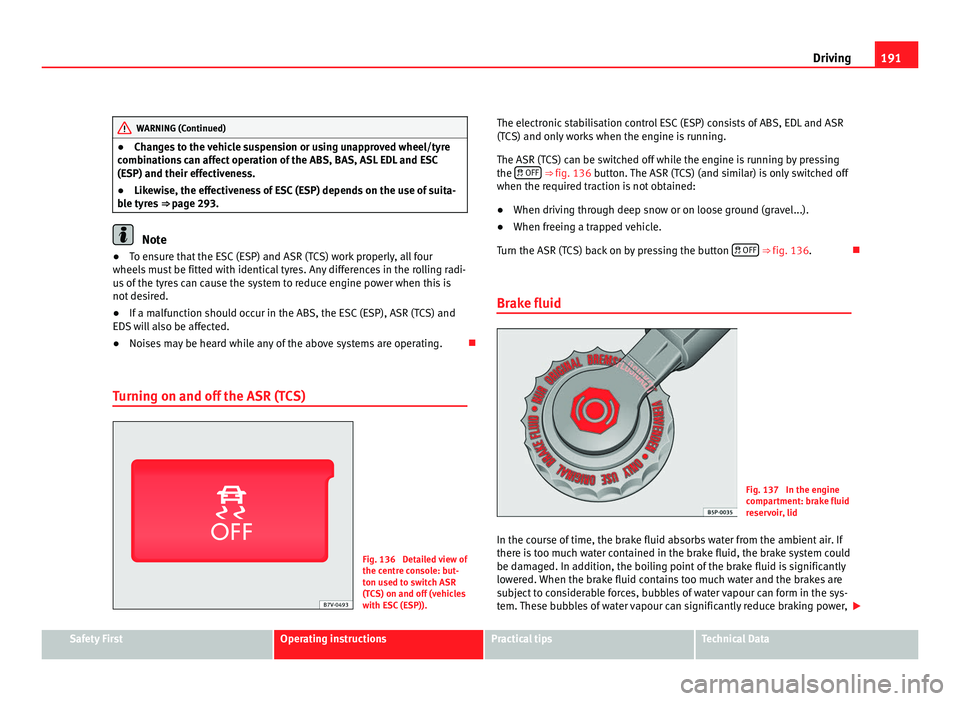
Turning on and off the ASR (TCS) Fig. 136 Detailed view of
the centr
e c
onsole: but-
ton used to switch ASR
(TCS) on and off (vehicles
with ESC (ESP)). The electronic stabilisation control ESC (ESP) consists of ABS, EDL and ASR
(TCS) and on
ly works when the engine is running.
The ASR (TCS) can be switched off while the engine is running by pressing
the OFF ⇒ fig. 136 butt
on.
The ASR (TCS) (and similar) is only switched off
when the required traction is not obtained:
● When driving through deep snow or on loose ground (gravel...).
● When freeing a trapped vehicle.
Turn the ASR (TC
S) back on by pressing the button OFF ⇒ fig. 136.
Brake fluid Fig. 137 In the engine
comp
ar
tment: brake fluid
reservoir, lid
In the course of time, the brake fluid absorbs water from the ambient air. If
there is
too much water contained in the brake fluid, the brake system could
be damaged. In addition, the boiling point of the brake fluid is significantly
lowered. When the brake fluid contains too much water and the brakes are
subject to considerable forces, bubbles of water vapour can form in the sys-
tem. These bubbles of water vapour can significantly reduce braking power, Safety First Operating instructions Practical tips Technical Data
Page 223 of 385
221
Driving
Tyre monitoring systems Introduction The tyre monitor indicator monitors the tyre pressure of each wheel during
drivin
g u
sing the ABS sensors. The ABS sensors monitor the tyre tread pe-
rimeter and vibrations of each tire. The tyre monitor indicator warns the driv-
er if it detects a considerable drop in tyre pressure of one or several tyres
while driving. Loss of tyre pressure will be indicated by the indicator as
well as a sound and sometimes a text message on the screen of the instru-
ment panel. When you open the driver's door, you will find a label indicat-
ing the tyre pressure recommended by the manufacturer for the maximum
vehicle load for each tyre approved for the vehicle in question. By pressing
the adjustment button on the tyre monitoring indicator, you may change the
reference pressure for the tyres so that the tyre pressure to be monitored co-
incides with actual tyre pressure ⇒ page 223.
Suitable use of the adjustment button ⇒ page 223.
Additional information and warnings:
● Transporting ⇒ pag
e 13
● Braking, stopping and parking ⇒ pag
e 183
● Caring for and cleaning the vehicle exterior ⇒ pag
e 242
● Wheels and tyres ⇒ pag
e 293
● Accessories, parts replacement, repairs and modifications ⇒ pag
e 257 WARNING
Unsuitable handling of the wheels and tyres may lead to sudden tyre
pre s
sure losses, to tread separation or even to a blow-out.
● Check tyre pressures regularly and ensure they are maintained at the
pres
sures indicated. If the tyre pressure is too low, the tyres could over-
heat, resulting in tread detachment or even burst tyres.
● Tyre pressure should be that indicated on the label when the tyres are
col
d at all times ⇒ page 297.
● Regularly check the cold inflation pressure of the tyres. If necessary,
chan
ge the tyre pressure of the vehicle tyres while they are cold.
● Regularly check your tyres for damage and wear.
● Never exceed the maximum permitted speed or loads specified for the
type of ty
re fitted on your vehicle. WARNING
Incorrect use of the tyre monitoring indicator button could result in the
indicat or giv
ing erroneous messages or prevented from indicating the
danger caused by a defective tyre ⇒ page 223. CAUTION
● The tyre valves may be damaged if the cap is not in place. Check that the
c ap
s are identical to the standard caps and have been correctly tightened.
Do not use metal caps ⇒ page 223.
● Do not damage the valves when changing the tyres ⇒ page 223. For the sake of the environment
Under-inflated tyres lead to increased fuel consumption and tyre wear. Safety First Operating instructions Practical tips Technical Data
Page 224 of 385
222
Driving Note
● Do not only rely on the tyre monitoring system. Regularly check your
ty r
es to ensure that the tyre pressure is correct and that the tyres are not
damaged due to puncture, cuts, tears and impacts/dents. Remove objects
from the tyres only when the tyres have not been pierced by these.
● The tyre monitoring system is set to the tyre pressure recommended by
the manufact
urer and indicated on the label ⇒ fig. 176.
Elements of the tyre monitoring indicator Tyre monitoring indicator with button.
See ⇒ page 223.
Warning lamp on the in
strument panel.
S
ET button on the centre console.
Monitoring the tread of all tyres using ABS sensors (indirect measure-
ment).
Adjustable medium and full-load tyre pressures.
Button to update the system when the tyre pressure is changed. Control lamp Lights
up or
fla she
s Possible cause ⇒ Solution
The tyre pressure of a wheel
ha
s
dropped considerably in
relation to the pressure set by
the driver ⇒ page 223.
Stop the vehicle! Reduc
e your
speed immediately! Stop the ve-
hicle safely as soon as possible.
Avoid sudden manoeuvres and
braking!
Check all tyres and pressures.
Replace any damaged tyres. System malfunction. Consult a specialist workshop if
the tyr
e pr
essure is correct and
the lamp remains lit after
switching the ignition off and
back on again. Have the system
checked there. Several warning and control lamps should light up for a few seconds when
the ignition is
sw
itched. This signals that the lamp is working properly. They
will switch off after a few seconds. WARNING
When the tyres are inflated at different pressures or at a pressure that is
too lo w then a ty
re may the damaged resulting in a loss of control of the
vehicle and a serious or mortal accident.
● If the indicator lights, st
op immediately and check the tyres.
● If the tyres are inflated at different pressures or if a tyre pressure is
too low
, this will increase tyre wear, negatively affecting vehicle stability
and increasing braking distances.
Page 225 of 385
223
Driving WARNING (Continued)
● If tyres are inflated at different pressures or a tyre pressure is too low,
a ty r
e may be damaged and burst resulting in a loss of control of the ve-
hicle.
● The driver is responsible for ensuring that all of the vehicle tyres are
correctly
inflated to the right pressure. The recommended tyre pressure
is indicated on the label ⇒ fig. 176.
● The tyre monitoring system can only operate correctly if all of the
tyre
s are inflated to the correct pressure when cold.
● Driving with tyres at the wrong pressure can cause damage to them
and res
ult in an accident. Ensure that the tyre pressures of all the tyres
correspond to the vehicle load.
● Before starting a journey, always inflated tyres to the correct pres-
sure.
● If
tyre pressure is too low then the tyre is subject to greater forces
and it ma
y be heated to such an extent that the tread can rupture and the
tyre will burst.
● With an overloaded vehicle at high speed, the tyres can overheat and
burs
t resulting in a loss of vehicle control.
● Tyre pressures which are too high or too low reduce the useful life of
the tyre, aff
ecting the vehicle's performance.
● If a tyre has not been punctured then it does not have to be changed
immediately; driv
e to the nearest specialist workshop at a moderate
speed and have the tyre checked and inflated to the correct pressure. WARNING
If the warning lamps and messages are ignored, the vehicle may stall in
traffic, or m a
y cause accidents and severe injuries.
● Never ignore the warning lamps or text messages.
● Stop the vehicle safely as soon as possible. CAUTION
Failure to heed the warning lamps and text messages when they appear
ma y
result in faults in the vehicle.
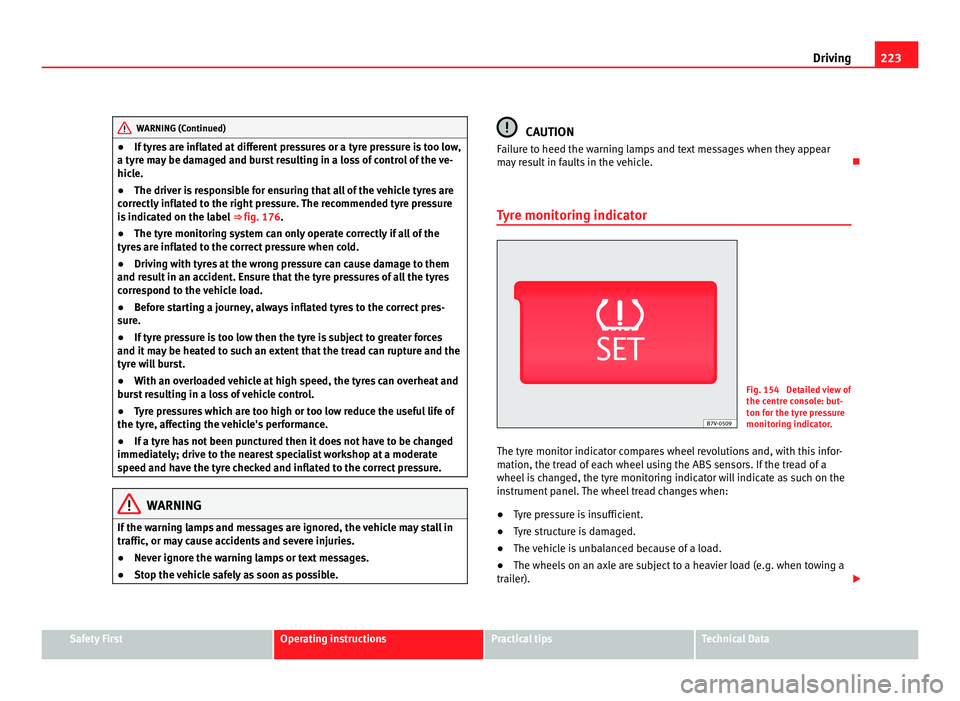
Tyre monitoring indicator Fig. 154 Detailed view of
the centr
e c
onsole: but-
ton for the tyre pressure
monitoring indicator.
The tyre monitor indicator compares wheel revolutions and, with this infor-
mation, the tr e
ad of each wheel using the ABS sensors. If the tread of a
wheel is changed, the tyre monitoring indicator will indicate as such on the
instrument panel. The wheel tread changes when:
● Tyre pressure is insufficient.
● Tyre structure is damaged.
● The vehicle is unbalanced because of a load.
● The wheels on an axle are subject to a heavier load (e.g. when towing a
trail
er). Safety First Operating instructions Practical tips Technical Data
Page 236 of 385
234
Trailer towing CAUTION
● If the rear lights of the trailer are not correctly connected, the vehicle
el ectr
onics may be damaged.
● If the trailer absorbs excessive electric current, the vehicle electronics
may
be damaged.
● Never connect the trailer's electric system to the electrical connections
of the re
ar lights or any other power sources. Only use suitable connections
for providing electric current to the trailer. Note
● Towing a trailer places additional demands on the vehicle. At SEAT, we
r ec
ommend additional services between the normal inspection intervals if
the vehicle is used frequently for towing a trailer.
● In some countries, an additional fire extinguisher is required if the trailer
weight i
s more than 2500 kg
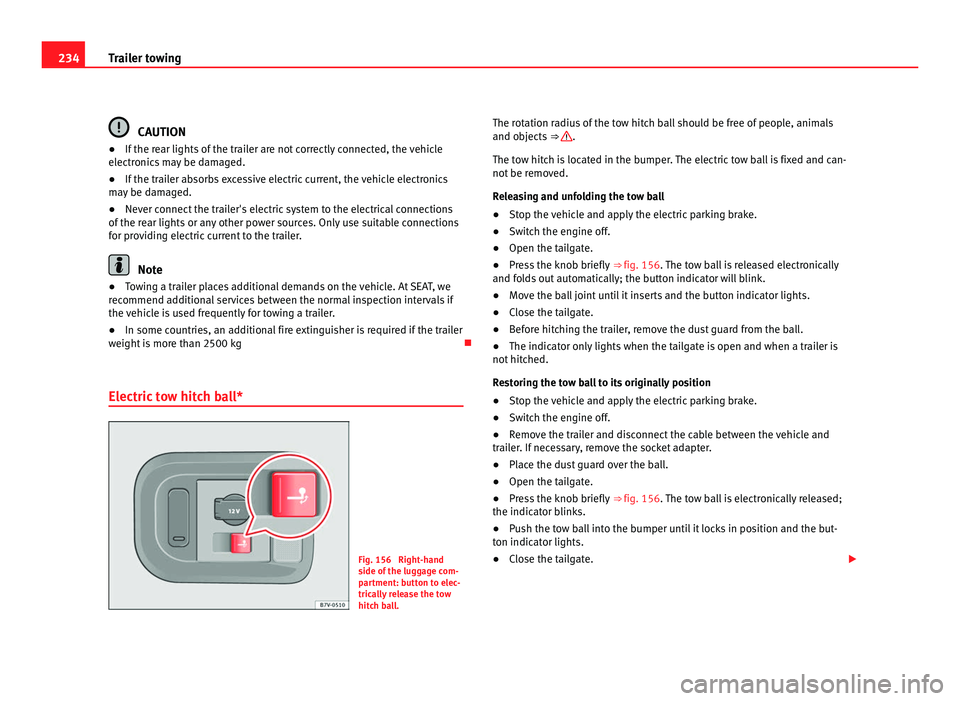
Electric tow hitch ball* Fig. 156 Right-hand
side of
the lug
gage com-
partment: button to elec-
trically release the tow
hitch ball. The rotation radius of the tow hitch ball should be free of people, animals
and obj
ects ⇒ .
The to w hit
ch is located in the bumper. The electric tow ball is fixed and can-
not be removed.
Releasing and unfolding the tow ball
● Stop the vehicle and apply the electric parking brake.
● Switch the engine off.
● Open the tailgate.
● Press the knob briefly ⇒ fig. 156. The to
w ball is released electronically
and folds out automatically; the button indicator will blink.
● Move the ball joint until it inserts and the button indicator lights.
● Close the tailgate.
● Before hitching the trailer, remove the dust guard from the ball.
● The indicator only lights when the tailgate is open and when a trailer is
not hitc
hed.
Restoring the tow ball to its originally position
● Stop the vehicle and apply the electric parking brake.
● Switch the engine off.
● Remove the trailer and disconnect the cable between the vehicle and
trail
er. If necessary, remove the socket adapter.
● Place the dust guard over the ball.
● Open the tailgate.
● Press the knob briefly ⇒ fig. 156. The to
w ball is electronically released;
the indicator blinks.
● Push the tow ball into the bumper until it locks in position and the but-
ton indicat
or lights.
● Close the tailgate.
Page 240 of 385
238
Trailer towing
●The vehicle centre of gravity and handling change because of the trailer
lo a
d and because of the increased combined mass of the vehicle and trail-
er.
● If the towing vehicle is empty and the trailer loaded then the load distri-
bution is
incorrect. If you must travel in these conditions, drive carefully and
reduce your speed accordingly.
Hill starts with a trailer
Depending on the hill and the gross combined weight, it is possible that the
combined vehicle and trailer move backwards slightly when starting.
For a hill start with a trailer, proceed as follows:
● Press and hold the brake pedal.
● Press the button once to turn off the electric parking brake
⇒ p ag
e 183.
● Press and hold the button to hold the vehicle and trailer combination
us in
g the parking brake.
● With a manual gearbox: press the clutch pedal to the floor.
● Engage first gear or the gear range D ⇒ page 174, Ch
anging gear.
● Release the brake pedal.
● Move off slowly. To do this, gently release the clutch pedal (for manual
gearbo
x).
● Release the button only when the engine provides sufficient power
to mo v
e the vehicle and trailer combination. WARNING
Jerking the trailer in an unsuitable manner could cause loss of vehicle
contr o
l with the subsequent serious consequences.
● Driving with a trailer and transporting heavy or a large objects will
chan
ge the vehicle handling and braking distances. WARNING (Continued)
● Antic ipate traffic and be extremely cautious. Brake early.
● Adju
s
t your speed and driving style to visibility, road, traffic and
weather c
onditions. Reduce your speed, especially on steep hills.
● Accelerate gently and carefully. Avoid brusque manoeuvres and sud-
den brakin
g.
● Always take the following precautions seriously. Reduce your speed
immediately
if you observe the trailer rocking from side to side.
● Never try to stop the “snaking” by increasing speed.
● Always take the speed limits for vehicles with and without trailers in
each c
ountry into account.
Stabilising the vehicle and trailer combination Stabilisation of the vehicle and trailer combination is an extension of the
electr
onic
stability control ESC (ESP) and helps, with the assistance of the
trajectory control, to reduce trailer “snaking”.
Stabilisation of the vehicle and trailer combination is active when the ESC
(ESP) indicator on the dashboard remains lit for about two seconds more
than the ABS indicator.
Requirements for stabilising the vehicle/trailer combination
● An original tow hitch is fitted by the manufacturer or a compatible model
is r
etrofitted.
● The ESC (ESP) is on. The warning indicator in the control panel is not
lit
.
● The trailer is connected to the vehicle using the socket.
● The vehicle is driven faster than 60 km/h.
● The maximum drawbar load is used.
Page 253 of 385
251
Vehicle maintenance and cleaning CAUTION
Failure to observe the instructions in the check list for caring for your up-
hol s
tery could result in damage or discolouration of the upholstery and cov-
ers.
● Always follow the check list and perform the necessary operations. Note
SEAT recommends you take the vehicle to a Technical Service to treat any
stain
s on the upholstery caused by the discolouration of clothing.
Cleaning upholstery, textile covers and Alcantara ®
mat eri
alNormal cleaning
●
Before applying cleaning products, please read the instructions for han-
dling and the w arnin
gs shown on the container.
● The upholstery, textile covers, Alcantara ®
materi
al and mats should be
regularly vacuumed (with vacuum brush).
● We recommend that you use a soft sponge or lint-free, micro-fibre cloth
for normal
cleaning ⇒ .
● Clean Alcantara ®
sur f
aces with a damp lint-free cotton, wool or micro-
fibre cloth used for normal cleaning ⇒ .
General s
uperficial dirt on upholstery and textile covers can be cleaned with
a normal foam cleaning product.
If the upholstery and the material trims are very dirty, we recommend you
have them cleaned by a specialist cleaning form.
Cleaning stains
It may be necessary to clean the whole surface and not only the stain itself.
Especially if the surface has been dirtied through normal use. Otherwise, the stained area may become lighter than the rest of the surface after treat-
ment. Type of stain Cleaning the vehicle
Water-based stains
,
e.g. c off
ee or fruit
juice.
Use a sponge and wipe with a solution of water
and w oo
l wash.
Dry the area gently with a soft dry cloth. Persistent stains
,
e.g. c hoc
olate or
make-up.
Apply cleaning paste a)
dir ectly to the stain and
treat.
Next, rinse with clean water using a sponge or
damp cloth to remove the cleaning product deposits.
Carefully dry the area with an absorbent dry cloth. Grease-based
st
ain
s, e.g. oil or lip-
stick.
Apply a neutral soap or cleaning paste a)
and tr e at
the stain.
Apply absorbent material to loose colorants or par-
ticles of grease.
Then rinse the area with clean water. Take care not
to soak the upholstery. a)
Bile soap can be used as a cleaning paste. CAUTION
● Brushes should only be used to clean the mats and floor mat! Other sur-
f ac
es may be damaged if a brush is used.
● Do not use steam cleaning equipment, as the dirt becomes more incrus-
ted in the mat
erial when steam is applied.
● Alcantara ®
uphols
teries should never be soaked.
● Do not use leather cleaning products, solvents, wax polish, shoe cream,
spot r
emovers or similar products on Alcantara ®
.
● Never use brushes for cleaning damp material as they could damage the
surf
ace.
● Do not use steam cleaning equipment, as the dirt becomes more incrus-
ted in the mat
erial when steam is applied. Safety First Operating instructions Practical tips Technical Data
Page 254 of 385
252
Vehicle maintenance and cleaning
Cleaning and care of real leather upholstery In the event of query regarding the care or cleaning of the leather in your
vehic
l
e, please ask a Technical Service or specialised workshop.
Cleaning and care
Untreated Nappa is delicate as it is not covered with a layer of colour.
● Use a suitable impregnating cream with ultra-violet protection at regular
interv
als and after cleaning. This cream will nourish and moisturise the
leather, keep it supple and able to breathe. It will also form a protective
film.
● Clean the leather every two to three months and remove fresh dirt as
neces
sary.
● Leather should be treated every six months with a suitable leather care
product ⇒
.
● When using care and cleaning products, only apply the minimum re-
quired quantitie s.
● R
emove stains from fresh ball-pen and other inks, lipstick, shoe cream
and simil
ar stains as soon as possible.
● Caring for coloured leather. A special coloured cream will renew the col-
our of the le
ather when required and will eliminate differences in colour.
● Then wipe off with a soft, dry cloth.
Cle
aning the vehicle
SEAT recommends the use of a damp cotton or wool cloth for general clean-
ing.
Do not let the water soak through the leather or soak into the seams. Type of stain Cleaning the vehicle
More stubborn dirt
Apply a mild soap and water solution a)
u s
ing a
cloth. (Squeeze out the cloth well before applica-
tion).
Carefully dry the area with an absorbent dry cloth. Water-based stains
,
e.g. c off
ee, tea, fruit
juice, blood, etc.
Remove fresh stains with an absorbent cloth.
U se a s
uitable cleaning product to treat dried-in
stains ⇒ .
Grease-based
st
ain
s, e.g. oil or lip-
stick, etc.
Remove fresh stains with an absorbent cloth.
U se a s
uitable cleaning product if the stain has not
yet penetrated the surface ⇒ .
Tr e
at dry stains with a grease-removal spray ⇒ .
Dry
difficult stains ,
e. g. ink, f
elt-tip pen,
nail varnish, pig-
ment dispersions or
shoe polish.
Carefully dry the area with an absorbent dry cloth.
C l
ean using a special stain remover suitable for
use on leather. a)
Mild soap and water solution: two table spoons of neutral soap per litre of water. CAUTION
● On no acc ou
nt use solvents, wax polish, shoe cream, spot removers or
similar materials.
● In the event of spilt liquids, dry immediately with an absorbent cloth to
prevent
the liquid penetrating through the leather. CAUTION
If the car is left standing in the sun for long periods, the leather should be
prot ect
ed against direct sunlight to prevent it from fading. Note
However, slight colour variations will arise in normal use.
Page 266 of 385
264
Checking and refilling levels
Checking and refilling levels
Filling the tank
Introduction The fuel tank flap is on the rear right of the vehicle.
Addition
a
l information and warnings:
● Fuel ⇒ page 267
● Selectiv
e Catalytic Reduction (AdBlue) ⇒ page 271
● W
orking in the engine compartment ⇒ page 275WARNING
Refuelling or handling fuel carelessly can cause an explosion or fire re-
su ltin
g in serious burns and injuries.
● Always make sure that you correctly close the fuel cap to avoid evap-
oration and fuel
spillage.
● Fuels are highly explosive and inflammable substances that can
cause seriou
s burns and injuries.
● Fuel could leak out or be spilt if the engine is not switched off or if the
fill
er fuel nozzle is not fully inserted into the tank filler neck when refuel-
ling. This could lead to a fire, explosion and severe injuries.
● When refuelling, turn off the engine, the auxiliary heating
(⇒ page 163) and t
urn off the ignition for safety reasons.
● Always turn off mobile telephones, radio apparatus and other radio
wave emittin
g equipment before refuelling. Electromagnetic waves could
cause sparks and lead to a fire. WARNING (Continued)
● Nev er enter the vehicle while refuelling. If it is absolutely necessary
t o ent
er the vehicle, close the door and touch a metal surface before
touching the filler nozzle again. This will prevent the generation of static
electricity. Sparks could cause a fire when refuelling.
● Never handle fuel close to open flames, sparks or objects with slow
combu
stion (e.g. cigarettes).
● Avoid static electricity and electro-magnetic radiation when refuel-
ling.
● Ob
serve the safety regulations of the service station.
● Never spill fuel on the vehicle or in the luggage compartment. WARNING
For safety reasons, SEAT does not recommend carrying a spare fuel canis-
ter in the v
ehicle. Fuel could be spilled and catch fire, above all in case of
an accident and this applies to a full container as well as empty contain-
ers. This could lead to explosions, fires and injuries.
● Observe the following if you exceptionally have to carry fuel in a can-
ist
er:
– Never place a fuel container to fill it inside the vehicle or on the ve-
hicle, f
or example, in the luggage compartment or on the tailgate.
Filling in these circumstances could create an electrostatic charge
and spark that could ignite fuel fumes.
– Always place the canister on the ground to fill it.
– Insert the fuel nozzle into the mouth of the canister as far as possi-
ble.