ECU Seat Alhambra 2011 User Guide
[x] Cancel search | Manufacturer: SEAT, Model Year: 2011, Model line: Alhambra, Model: Seat Alhambra 2011Pages: 385, PDF Size: 7.92 MB
Page 42 of 385
40
Child safety WARNING (Continued)
secured when using a child seat with a base or foot then the compart-
ment c
o
ver could rupture in an accident and the child will be ejected and
suffer serious injury.
● Please read and observe the child seat manufacturer's handling in-
structions. WARNING
An empty or loose child seat could fly uncontrollably around the vehicle
interior and c au
se injuries in the event of an accident or sudden braking.
● When not in use while the vehicle is in motion, always safely secure it
or stor
e it in the luggage compartment. Note
Replace the child seat after an accident, as it may have invisible damage.
General information on transporting children in the vehicle Legal regulations and provisions will always take priority over the descrip-
tions
of
this instruction manual. There are different regulations and provi-
sions for the use of child seats and their mountings ( ⇒ table on page 41).
In some countries, for example, the use of child seats on certain seats in the
vehicle may be forbidden.
The physical principles and the forces acting on the vehicle in the event of a
collision or other type of accidents also apply to children ⇒ page 21. Howev-
er, unlike adults and youngsters, children do not have fully developed mus-
cle and bone structures. In the event of an accident, children are subject to
a greater risk than adults of sustaining severe injuries.
Given that children's bodies are not yet fully developed, child restraint sys-
tems must be used that are especially adapted to their height, weight and constitution. There are laws in force in many countries that determine the
use of ap
proved seat systems for transporting babies and children.
Only used authorised, approved child seats that are suitable for the vehicle.
Always consult with a SEAT qualified workshop or a specialist workshop
should you have any doubts.
Checklist
To transport children in the vehicle ⇒ :
● Observe the legal requirements specific to each country.
● For safety reasons, SEAT recommends that children under 12 years of
age ar e tr
ansported on the rear seats.
● Only if you have no alternative should a child travel on the front passen-
ger seat
⇒ page 42. The safest place in the vehicle is on the rear seat be-
hind the front passenger seat.
● Child must always use a child restraint system when travelling in the ve-
hicle.
The child restraint system must be suitable for the height, weight and
constitution of the child.
● Only one child may occupy a child seat.
● Follow the user instructions from the child seat manufacturer and always
keep them in the v
ehicle.
● If the child seat is secured using the seat belt, guide the seat belt
through or arou
nd the child seat according to the instructions of the child
seat manufacturer.
● Make sure the belt webbing is correctly positioned and that the child is
sitting pr
operly.
● The child seat should be installed on the rear seat behind the front pas-
senger se
at so that the child can exit the car on the kerb side.
● Do not leave toys or other loose objects on the child seat or on the seat
while the
vehicle is in motion.
Page 43 of 385
41
Child safety
Specific child seat regulations for each country (selection) Regulation Further information
ECE-R 44
a) Technical Service or qualified work-
shop
a)
ECE-R: Economic Commi ssion for Europe Regulation.
Categorisation of child seats according to ECE-R 44 Weight cate-
gory Weight of the
chil
d Installation of the child seat
Group 0 children up to 10
kg Rear-facing. On rear seats, optionally
usin
g the ISOFIX system. Group 0+ children up to 13
kg Group 1 9 to 18 kg Forward-facing. On rear seats, optional-
ly us
ing the ISOFIX system. Group 2 15 to 25 kg Forward-facing. On the outer rear seats
or in the centr e se
at of the second row
of seats and on all seats in the third row. Optionally with ISOFIX system. Group 3 22 to 36 kg Forward-facing.
Not all children fit in the seat of their weight group. Nor do all seats adapt to
the v
ehic
le. Therefore, always check whether the child fits properly in the
child seat and whether the seat can be installed safely in the vehicle.
The rear seats are suitable for child seats with the ISOFIX system specially
designed for this type of vehicle in accordance with regulation ECE-R 44.
Child seats approved under the ECE-R 44 regulation are fitted with the corre-
sponding approval symbol. The sign is an upper-case E in a circle with the
identification number below it. WARNING
Not following the checklist prepared for your own safety could lead to ac-
cident s
and severe injuries.
● Always follow the check list and perform the necessary operations. WARNING
In general, the rear seat is always the safest place for correctly belted in
chil
dren in the event of an accident.
● A suitable child seat that is correctly installed and used on one of the
rear se
ats offer the most protection possible for babies and small chil-
dren in most accidents. Note
Other accessories may be required to fit the child retention system with a
ba se or f
oot security and safely. Contact a specialist or qualified workshop. Safety First Operating instructions Practical tips Technical Data
Page 44 of 385
42
Child safety
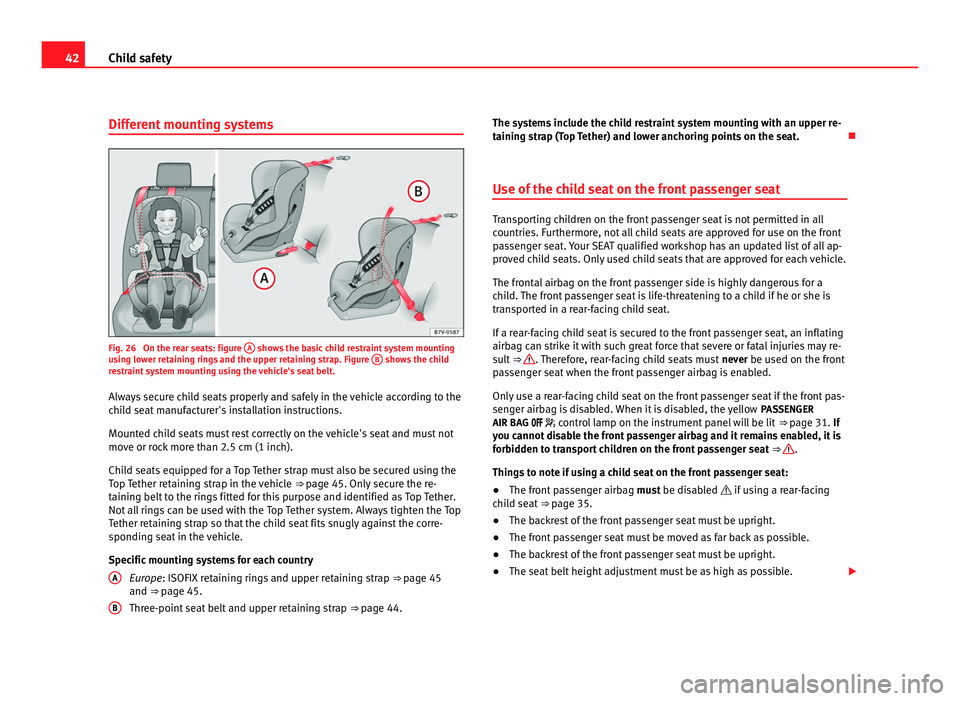
Different mounting systems Fig. 26 On the rear seats: figure
A shows the basic child restraint system mounting
us in
g lower retaining rings and the upper retaining strap. Figure B shows the child
re s
traint system mounting using the vehicle's seat belt.
Always secure child seats properly and safely in the vehicle according to the
child seat manufacturer's installation instructions.
Mounted child seats must rest correctly on the vehicle's seat and must not
move or rock more than 2.5 cm (1 inch).
Child seats equipped for a Top Tether strap must also be secured using the
Top Tether retaining strap in the vehicle ⇒ page 45. Only secure the re-
taining belt to the rings fitted for this purpose and identified as Top Tether.
Not all rings can be used with the Top Tether system. Always tighten the Top
Tether retaining strap so that the child seat fits snugly against the corre-
sponding seat in the vehicle.
Specific mounting systems for each country
Europe: ISOFIX retaining rings and upper retaining strap ⇒ page 45
and ⇒ page 45.
Three-point seat belt and upper retaining strap ⇒ page 44.
A B The systems include the child restraint system mounting with an upper re-
tainin
g s
trap (Top Tether) and lower anchoring points on the seat.
Use of the child seat on the front passenger seat Transporting children on the front passenger seat is not permitted in all
cou
ntrie
s. Furthermore, not all child seats are approved for use on the front
passenger seat. Your SEAT qualified workshop has an updated list of all ap-
proved child seats. Only used child seats that are approved for each vehicle.
The frontal airbag on the front passenger side is highly dangerous for a
child. The front passenger seat is life-threatening to a child if he or she is
transported in a rear-facing child seat.
If a rear-facing child seat is secured to the front passenger seat, an inflating
airbag can strike it with such great force that severe or fatal injuries may re-
sult ⇒ . Therefore, rear-facing child seats must
never be u
sed on the front
passenger seat when the front passenger airbag is enabled.
Only use a rear-facing child seat on the front passenger seat if the front pas-
senger airbag is disabled. When it is disabled, the yellow PASSENGER
AIR BAG control lamp on the instrument panel will be lit ⇒ page 31. If
you cannot disable the front passenger airbag and it remains enabled, it is
forbidden to transport children on the front passenger seat ⇒ .
Thing s
to note if using a child seat on the front passenger seat:
● The front passenger airbag must
be disabled if using a rear-facing
child seat ⇒ page 35.
● The backrest of the front passenger seat must be upright.
● The front passenger seat must be moved as far back as possible.
● The backrest of the front passenger seat must be upright.
● The seat belt height adjustment must be as high as possible.
Page 45 of 385
43
Child safety
Suitable child seats
The chi l
d seat must be authorised by the manufacturer especially for use on
a front passenger seat with a frontal or side airbag.
If the front passenger seat is equipped with retaining rings, the child seat
can be secured using the approved retaining system provided it is approved
for this type of vehicle in accordance with current regulations in the country
in question.
Universal seats for children in groups 0, 0+, 1, 2 or 3 according to the ECE-
R 44 regulation. WARNING
If a child seat is mounted on the front passenger seat, the risk of the
chi l
d sustaining severe or fatal injuries in the event of an accident increa-
ses. Rear-facing child seats must never be mounted on the front passen-
ger seat when the front passenger airbag is enabled. This is life-threaten-
ing to the child should the frontal airbag deploy, as the child seat would
be struck by the inflated airbag and thrown against the backrest. WARNING
If, in exceptional circumstances, a child must be transported in a rear-fac-
ing c hi
ld seat on the front passenger seat, strictly observe the following:
● Always disable the front passenger airbag and leave it disabled.
● The child seat must be approved by the manufacturer for use on a
front p
assenger seat with frontal and side airbag.
● Follow the installation instructions of the child seat manufacturer and
obser
ve the warnings.
● Move the front passenger seat as far back as possible and adjust it to
its highe
st position to keep as far away as possible from the frontal air-
bag. WARNING (Continued)
● Move the backrest to the upright position.
● The se
at
belt height adjustment must be as high as possible.
● Children must always be protected with an approved child restraint
syst
em suited to their height and weight.
Use of the child seat on the rear seat If a child seat is mounted on the rear seat, adapt the position of the front
pa
s
senger seat so that the child has enough space. Therefore, adapt the
front passenger seat to the size of the child seat and the height of the child.
Ensure the passenger is in the correct position ⇒ page 10.
Move the second and third row of seats fully back and lock them. Place the
seat backs in a vertical position and fold the armrests down.
ISOFIX child seats approved for rear seats
The rear seats are suitable for child seats with the ISOFIX system specially
designed for this type of vehicle in accordance with regulation ECE-R 44.
ISOFIX child seats are divided into “specific categories for the vehicle”,
“limited” or “semi-universal”.
Child seat manufacturers supply a list of vehicles with each ISOFIX seat,
which includes the models for which the ISOFIX child seat in question is ap-
proved. If the vehicle is included in the manufacturer's list and the ISOFIX
child seat belongs to a seat category included in the list, then it can be
used in your vehicle. If necessary, contact the child seat manufacturer for an
updated list of vehicles. Safety First Operating instructions Practical tips Technical Data
Page 46 of 385
44
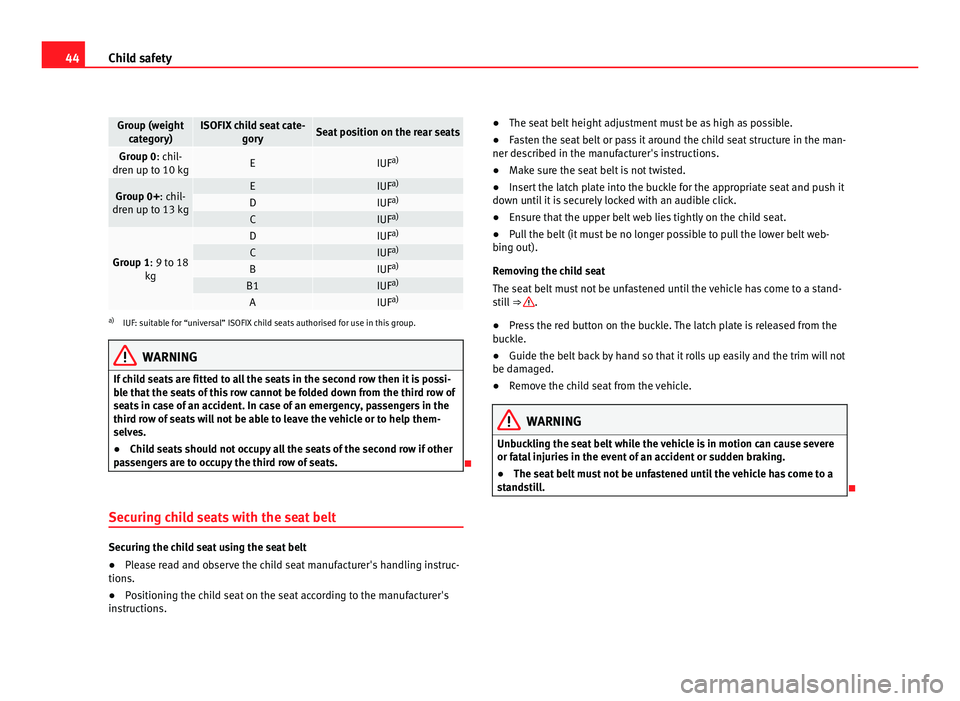
Child safety Group (weight
cat e
gory) ISOFIX child seat cate-
gory Seat position on the rear seats
Group 0: chil-
dr en up t
o 10 kg E IUF
a) Group 0+: chil-
dr en up t
o 13 kg E IUF
a) D IUF
a) C IUF
a) Group 1: 9 to 18
kg D IUF
a) C IUF
a) B IUF
a) B1 IUF
a) A IUF
a) a)
IUF: suitable for “universal” ISOFIX child seats authorised for use in this group. WARNING
If child seats are fitted to all the seats in the second row then it is possi-
bl e th
at the seats of this row cannot be folded down from the third row of
seats in case of an accident. In case of an emergency, passengers in the
third row of seats will not be able to leave the vehicle or to help them-
selves.
● Child seats should not occupy all the seats of the second row if other
pas
sengers are to occupy the third row of seats.
Securing child seats with the seat belt Securing the child seat using the seat belt
●
Please read and observe the child seat manufacturer's handling instruc-
tions.
● Po
sitioning the child seat on the seat according to the manufacturer's
instruction
s. ●
The seat belt height adjustment must be as high as possible.
● Fa
sten the seat belt or pass it around the child seat structure in the man-
ner desc
ribed in the manufacturer's instructions.
● Make sure the seat belt is not twisted.
● Insert the latch plate into the buckle for the appropriate seat and push it
down unti
l it is securely locked with an audible click.
● Ensure that the upper belt web lies tightly on the child seat.
● Pull the belt (it must be no longer possible to pull the lower belt web-
bing out).
R
emoving the child seat
The seat belt must not be unfastened until the vehicle has come to a stand-
still ⇒ .
● Press the red button on the buckle. The latch plate is released from the
buc k
le.
● Guide the belt back by hand so that it rolls up easily and the trim will not
be damag
ed.
● Remove the child seat from the vehicle. WARNING
Unbuckling the seat belt while the vehicle is in motion can cause severe
or fat a
l injuries in the event of an accident or sudden braking.
● The seat belt must not be unfastened until the vehicle has come to a
stand
still.
Page 47 of 385
45
Child safety
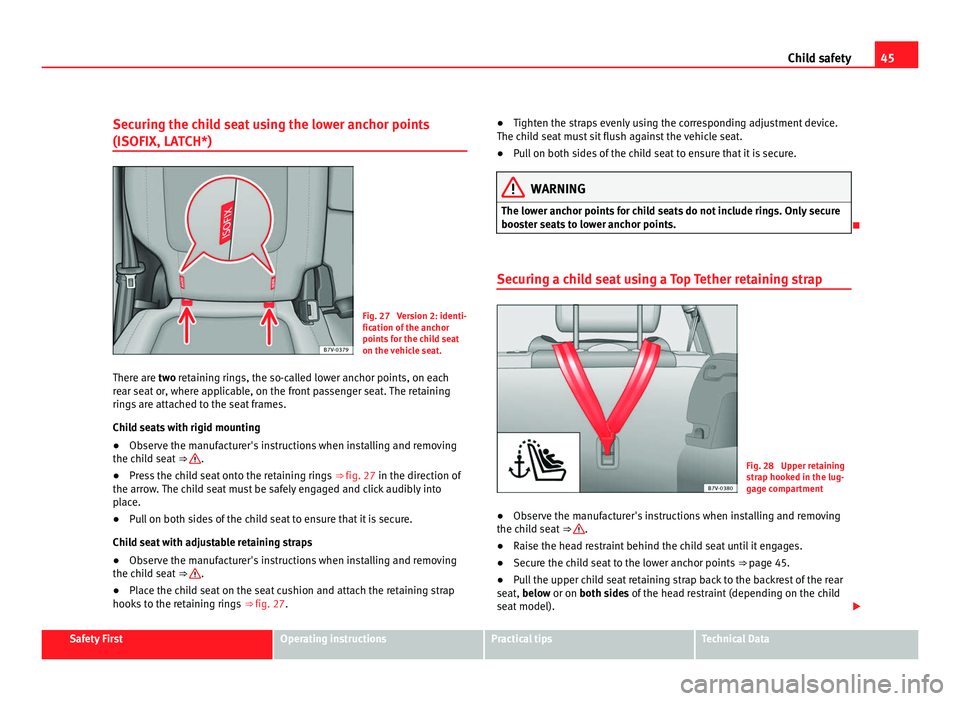
Securing the child seat using the lower anchor points
(ISOFIX, LAT CH*) Fig. 27 Version 2: identi-
fication of
the anc
hor
points for the child seat
on the vehicle seat.
There are two r
etaining rings, the so-called lower anchor points, on each
rear seat or, where applicable, on the front passenger seat. The retaining
rings are attached to the seat frames.
Child seats with rigid mounting
● Observe the manufacturer's instructions when installing and removing
the chil
d seat ⇒ .
● Press the child seat onto the retaining rings ⇒ fig. 27 in the direction of
the arr o
w. The child seat must be safely engaged and click audibly into
place.
● Pull on both sides of the child seat to ensure that it is secure.
Child se
at with adjustable retaining straps
● Observe the manufacturer's instructions when installing and removing
the chil
d seat ⇒ .
● Place the child seat on the seat cushion and attach the retaining strap
hooks t
o the retaining rings ⇒ fig. 27. ●
Tighten the straps evenly using the corresponding adjustment device.
The chi
ld seat must sit flush against the vehicle seat.
● Pull on both sides of the child seat to ensure that it is secure. WARNING
The lower anchor points for child seats do not include rings. Only secure
boos t
er seats to lower anchor points.
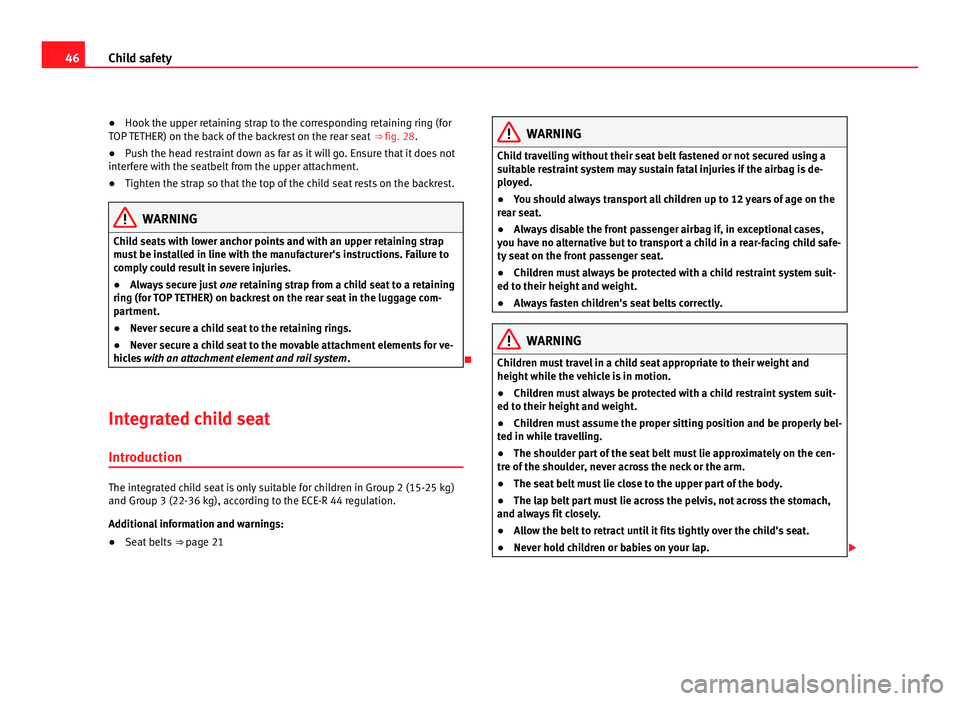
Securing a child seat using a Top Tether retaining strap Fig. 28 Upper retaining
str
ap hook
ed in the lug-
gage compartment
● Observe the manufacturer's instructions when installing and removing
the chil
d seat ⇒ .
● Raise the head restraint behind the child seat until it engages.
● Secure the child seat to the lower anchor points ⇒ page 45.
● P
ull the upper child seat retaining strap back to the backrest of the rear
seat, belo
w or on both sides of the head restraint (depending on the child
seat model). Safety First Operating instructions Practical tips Technical Data
Page 48 of 385
46
Child safety
● Hook the upper retaining strap to the corresponding retaining ring (for
T OP
TETHER) on the back of the backrest on the rear seat ⇒ fig. 28.
● Push the head restraint down as far as it will go. Ensure that it does not
interf
ere with the seatbelt from the upper attachment.
● Tighten the strap so that the top of the child seat rests on the backrest. WARNING
Child seats with lower anchor points and with an upper retaining strap
mus t
be installed in line with the manufacturer's instructions. Failure to
comply could result in severe injuries.
● Always secure just one r
etaining strap from a child seat to a retaining
ring (for TOP TETHER) on backrest on the rear seat in the luggage com-
partment.
● Never secure a child seat to the retaining rings.
● Never secure a child seat to the movable attachment elements for ve-
hicle
s with an attachment element and rail system .
Integrated child seat Introduction The integrated child seat is only suitable for children in Group 2 (15-25 kg)
and Group 3 (22-36 k
g), ac
cording to the ECE-R 44 regulation.
Additional information and warnings:
● Seat belts ⇒ pag
e 21 WARNING
Child travelling without their seat belt fastened or not secured using a
suit ab
le restraint system may sustain fatal injuries if the airbag is de-
ployed.
● You should always transport all children up to 12 years of age on the
rear se
at.
● Always disable the front passenger airbag if, in exceptional cases,
you hav
e no alternative but to transport a child in a rear-facing child safe-
ty seat on the front passenger seat.
● Children must always be protected with a child restraint system suit-
ed to their height and w
eight.
● Always fasten children's seat belts correctly. WARNING
Children must travel in a child seat appropriate to their weight and
height whi l
e the vehicle is in motion.
● Children must always be protected with a child restraint system suit-
ed to their height and w
eight.
● Children must assume the proper sitting position and be properly bel-
ted in whil
e travelling.
● The shoulder part of the seat belt must lie approximately on the cen-
tre of the shou
lder, never across the neck or the arm.
● The seat belt must lie close to the upper part of the body.
● The lap belt part must lie across the pelvis, not across the stomach,
and alwa
ys fit closely.
● Allow the belt to retract until it fits tightly over the child's seat.
● Never hold children or babies on your lap.
Page 52 of 385
50
Child safety
Seat belt guide handle
● Secure the seat belt guide handle to the side head restraint on the win-
dow s ide.
The guide handle is secured by a button.
● Open the upper button on the seat belt guide handle and pass the belt
webb
ing below the side head restraint and through the guide handle.
● Close the button again.
Adjustin
g the belt routing
● Guide the automatic three-point seat belt below the side head restraint.
● Pull the latch plate and slowly place the belt webbing across the child's
ches
t and lap.
● Insert the latch plate into the buckle for the appropriate seat and push it
down unti
l it is securely locked with an audible click.
● Pull the belt to ensure that the latch plate is securely engaged in the
buck
le. WARNING
The seat belt only offers maximum protection from severe or fatal injuries
when it i s
correctly positioned.
● Children must assume the proper sitting position and be properly bel-
ted in whil
e travelling.
● The shoulder belt must be positioned against the middle of the
shoulder
.
● The seat belt must lie flat and fit comfortably.
● Allow the belt to retract until it fits tightly over the child's seat.
● The lap part of the seat belt must lie across the pelvis, never across
the stom
ach.
● Only one child may occupy a child seat. Removing the seat belt
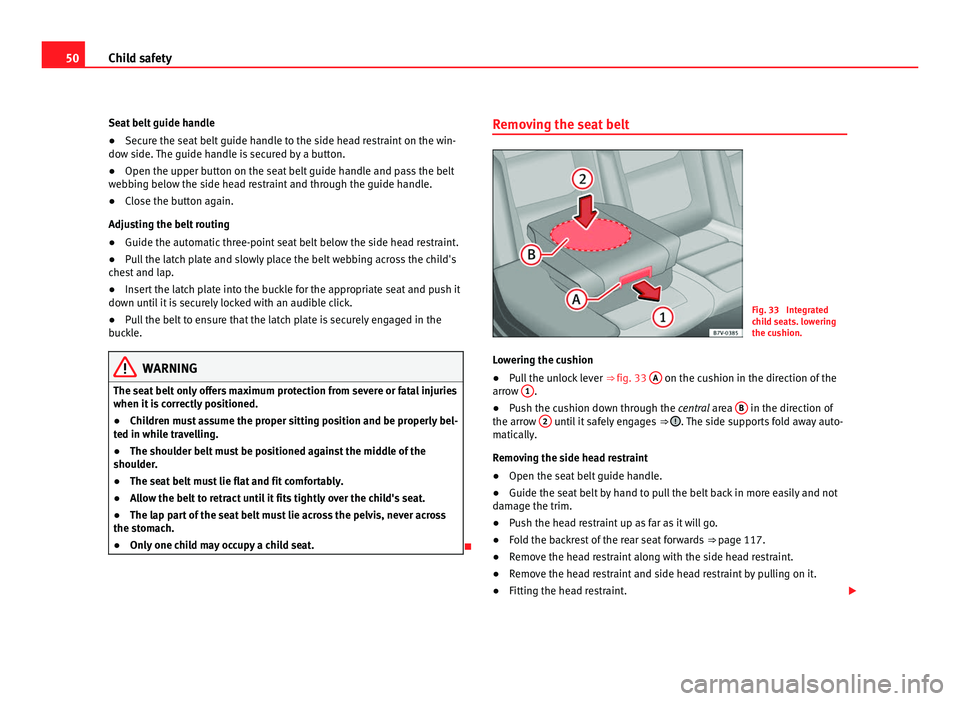
Fig. 33 Integrated
chi
l
d seats. lowering
the cushion.
Lowering the cushion
● Pull the unlock lever ⇒ fig. 33 A on the cushion in the direction of the
arro w 1 .
● Push the cushion down through the cen tr
al area B in the direction of
the arro w 2 until it safely engages
⇒ . The side supports fold away auto-
matic al
ly.
Removing the side head restraint
● Open the seat belt guide handle.
● Guide the seat belt by hand to pull the belt back in more easily and not
damag
e the trim.
● Push the head restraint up as far as it will go.
● Fold the backrest of the rear seat forwards ⇒ page 117.
● R
emove the head restraint along with the side head restraint.
● Remove the head restraint and side head restraint by pulling on it.
● Fitting the head restraint.
Page 79 of 385
77
Unlocking and locking
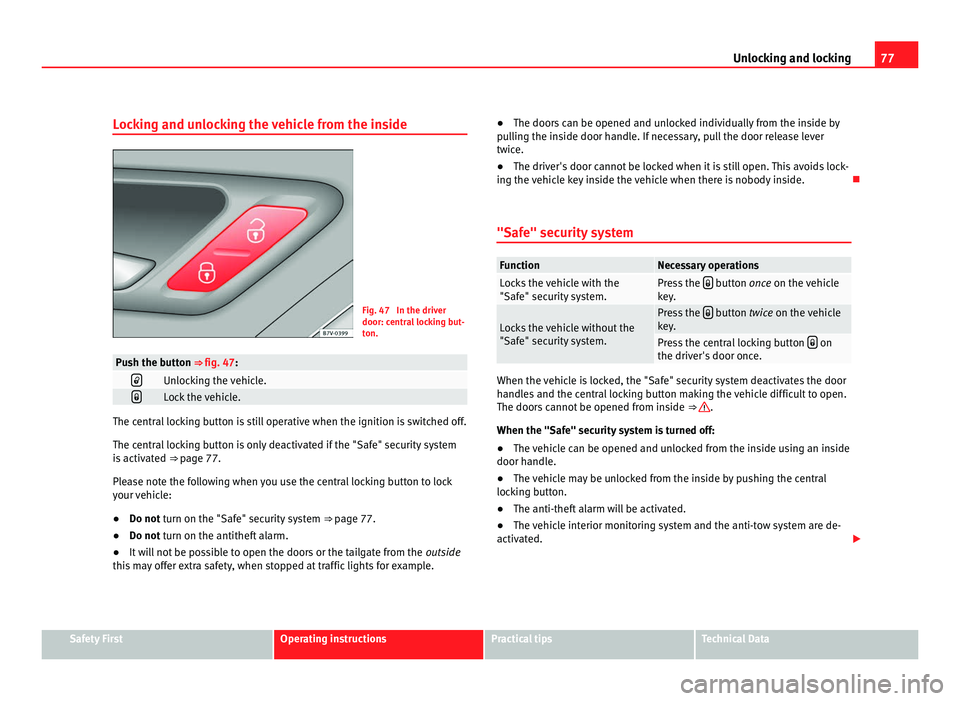
Locking and unlocking the vehicle from the inside Fig. 47 In the driver
door: centr
a
l locking but-
ton. Push the button ⇒ fig. 47:
Unlocking the vehicle.
Lock the vehicle.
The central locking button is still operative when the ignition is switched off.
The centr
al
locking button is only deactivated if the "Safe" security system
is activated ⇒ page 77.
Please note the following when you use the central locking button to lock
your vehicle:
● Do not turn on the "Safe" security system ⇒ pag
e 77.
● Do not turn on the antitheft alarm.
● It w
ill not be possible to open the doors or the tailgate from the outside
this
may offer extra safety, when stopped at traffic lights for example. ●
The doors c
an be opened and unlocked individually from the inside by
pulling the inside door handle. If necessary, pull the door release lever
twice.
● The driver's door cannot be locked when it is still open. This avoids lock-
ing the v
ehicle key inside the vehicle when there is nobody inside.
"Safe" security system Function Necessary operations
Locks the vehicle with the
"Safe" sec
urity
system. Press the
button once on the vehicle
k ey
. Locks the vehicle without the
"Safe" sec
urity
system. Press the
button twice on the vehicle
k ey
. Press the central locking button
on
the driver's door onc
e. When the vehicle is locked, the "Safe" security system deactivates the door
handl
e
s and the central locking button making the vehicle difficult to open.
The doors cannot be opened from inside ⇒ .
When the "Safe" sec urity
system is turned off:
● The vehicle can be opened and unlocked from the inside using an inside
door handle.
● The
vehicle may be unlocked from the inside by pushing the central
lockin
g button.
● The anti-theft alarm will be activated.
● The vehicle interior monitoring system and the anti-tow system are de-
activated. Safety First Operating instructions Practical tips Technical Data
Page 80 of 385
78
Unlocking and locking
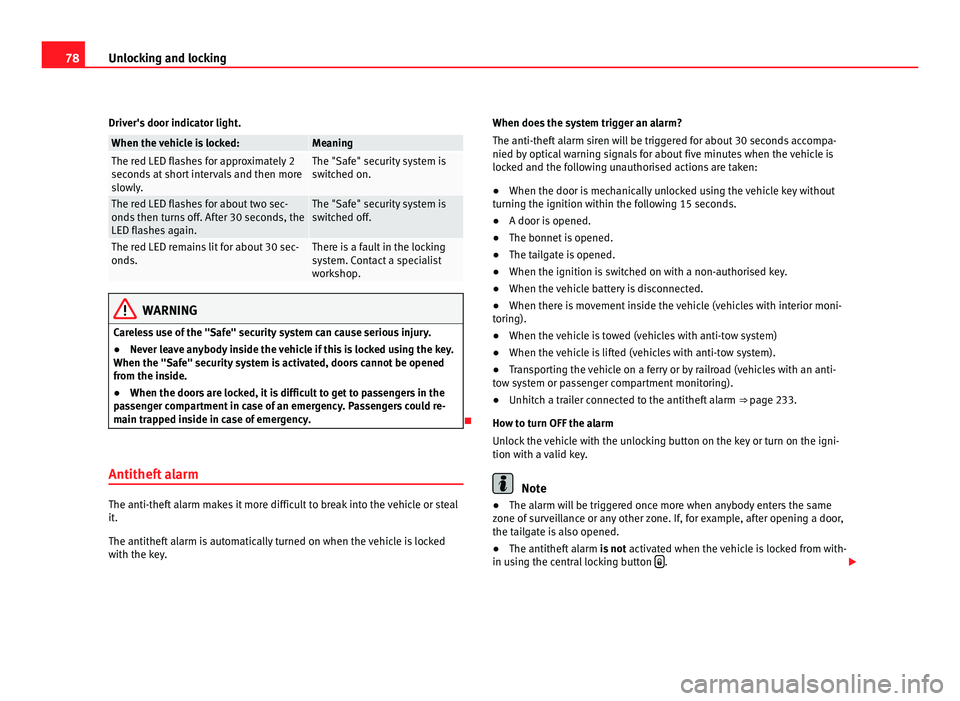
Driver's door indicator light. When the vehicle is locked: Meaning
The red LED flashes for approximately 2
second
s
at short intervals and then more
slowly. The "Safe" security system is
swit
c
hed on. The red LED flashes for about two sec-
onds
then t
urns off. After 30 seconds, the
LED flashes again. The "Safe" security system is
swit
c
hed off. The red LED remains lit for about 30 sec-
onds. There is a fault in the locking
sys
t
em. Contact a specialist
workshop. WARNING
Careless use of the "Safe" security system can cause serious injury.
● Never leave anybody inside the vehicle if this is locked using the key.
When the "Safe" sec urity
system is activated, doors cannot be opened
from the inside.
● When the doors are locked, it is difficult to get to passengers in the
pas
senger compartment in case of an emergency. Passengers could re-
main trapped inside in case of emergency.
Antitheft alarm The anti-theft alarm makes it more difficult to break into the vehicle or steal
it.
The antithef
t
alarm is automatically turned on when the vehicle is locked
with the key. When does the system trigger an alarm?
The anti-theft al
arm siren will be triggered for about 30 seconds accompa-
nied by optical warning signals for about five minutes when the vehicle is
locked and the following unauthorised actions are taken:
● When the door is mechanically unlocked using the vehicle key without
turning the ignition w
ithin the following 15 seconds.
● A door is opened.
● The bonnet is opened.
● The tailgate is opened.
● When the ignition is switched on with a non-authorised key.
● When the vehicle battery is disconnected.
● When there is movement inside the vehicle (vehicles with interior moni-
toring).
● When the
vehicle is towed (vehicles with anti-tow system)
● When the vehicle is lifted (vehicles with anti-tow system).
● Transporting the vehicle on a ferry or by railroad (vehicles with an anti-
tow sy
stem or passenger compartment monitoring).
● Unhitch a trailer connected to the antitheft alarm ⇒ pag
e 233.
How to turn OFF the alarm
Unlock the vehicle with the unlocking button on the key or turn on the igni-
tion with a valid key. Note
● The alarm will be triggered once more when anybody enters the same
z one of
surveillance or any other zone. If, for example, after opening a door,
the tailgate is also opened.
● The antitheft alarm is not activ
ated when the vehicle is locked from with-
in using the central locking button .