ECU Seat Alhambra 2011 Owner's Guide
[x] Cancel search | Manufacturer: SEAT, Model Year: 2011, Model line: Alhambra, Model: Seat Alhambra 2011Pages: 385, PDF Size: 7.92 MB
Page 139 of 385
137
Seats and storage compartments WARNING
Baggage net supports that are not secured correctly can be released from
the guide in ca se of
the sudden braking or accident. As a result, objects
may be fired through the passenger compartment causing serious injury
or death.
● Always ensure that the baggage net supports are correctly inserted
into the rai
ls; the red mark should not be visible.
● Never secure a child seat to the baggage net supports. CAUTION
● The baggage net supports placed on the rail system can be damaged
when f o
lding down seats from the third row or putting them back into posi-
tion and these can also damage the seats themselves. Before folding down
or repositioning the seats, remove the baggage net supports from the rail
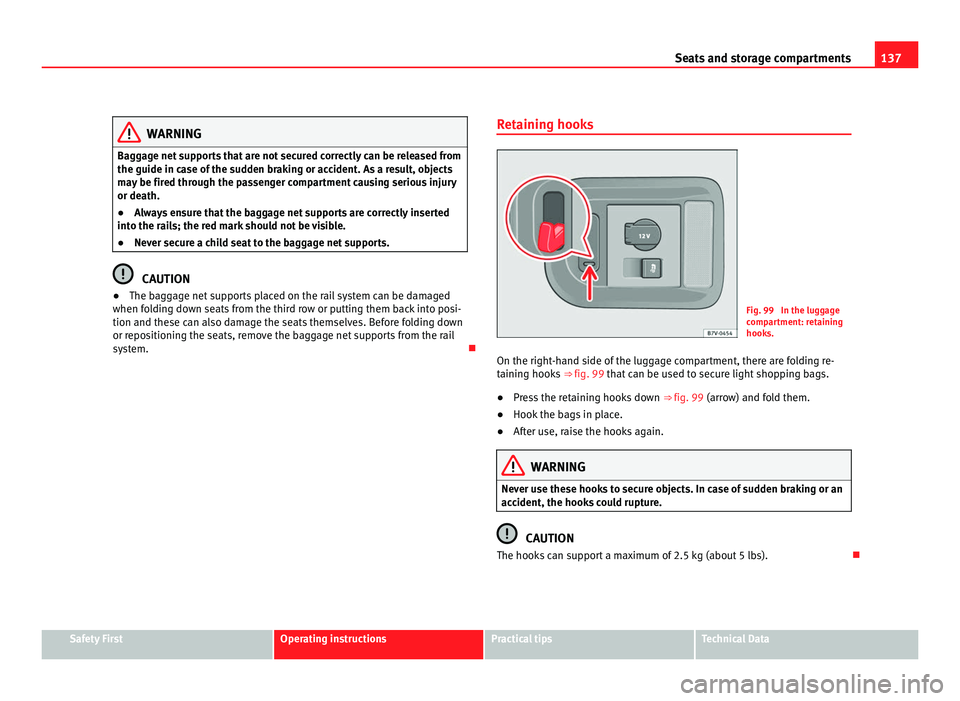
system. Retaining hooks Fig. 99 In the luggage
comp
ar
tment: retaining
hooks.
On the right-hand side of the luggage compartment, there are folding re-
taining hook
s ⇒ fig. 99 that can be used to secure light shopping bags.
● Press the retaining hooks down ⇒ fig. 99 (arrow) and f
old them.
● Hook the bags in place.
● After use, raise the hooks again. WARNING
Never use these hooks to secure objects. In case of sudden braking or an
acc ident, the hook
s could rupture. CAUTION
The hooks can support a maximum of 2.5 kg (about 5 lbs). Safety First Operating instructions Practical tips Technical Data
Page 140 of 385
138
Seats and storage compartments
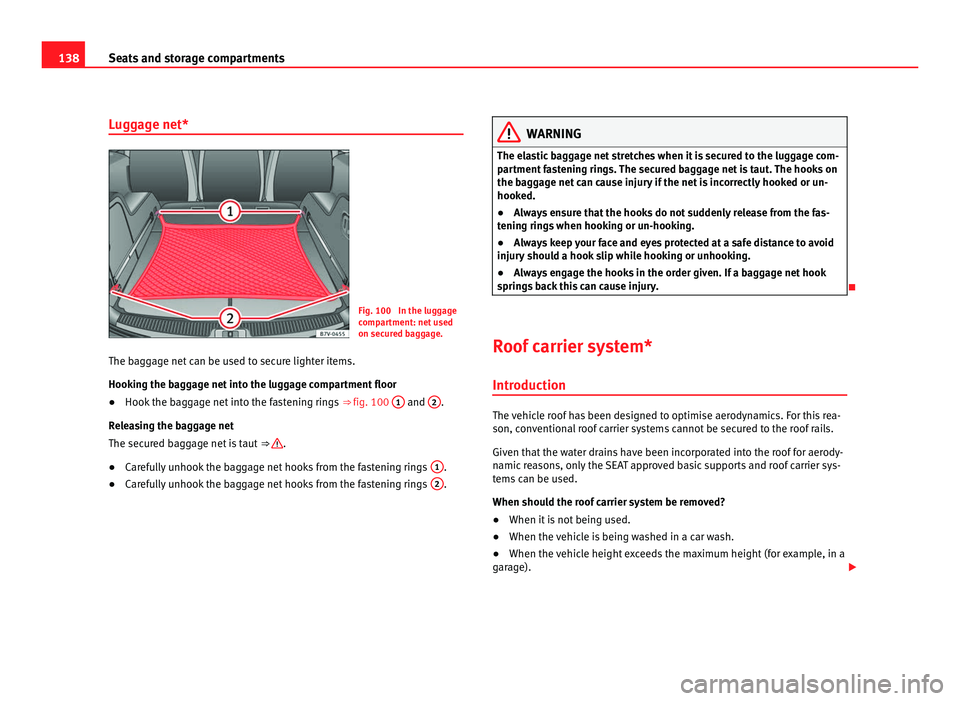
Luggage net* Fig. 100 In the luggage
comp
ar
tment: net used
on secured baggage.
The baggage net can be used to secure lighter items.
Hooking the b
aggage net into the luggage compartment floor
● Hook the baggage net into the fastening rings ⇒ fig. 100 1 and
2 .
Rel e
asing the baggage net
The secured baggage net is taut ⇒ .
● Carefully unhook the baggage net hooks from the fastening rings 1 .
● Carefully unhook the baggage net hooks from the fastening rings 2 . WARNING
The elastic baggage net stretches when it is secured to the luggage com-
par tment
fastening rings. The secured baggage net is taut. The hooks on
the baggage net can cause injury if the net is incorrectly hooked or un-
hooked.
● Always ensure that the hooks do not suddenly release from the fas-
tening rin
gs when hooking or un-hooking.
● Always keep your face and eyes protected at a safe distance to avoid
injury shou
ld a hook slip while hooking or unhooking.
● Always engage the hooks in the order given. If a baggage net hook
spring
s back this can cause injury.
Roof carrier system* Introduction The vehicle roof has been designed to optimise aerodynamics. For this rea-
son, con
v
entional roof carrier systems cannot be secured to the roof rails.
Given that the water drains have been incorporated into the roof for aerody-
namic reasons, only the SEAT approved basic supports and roof carrier sys-
tems can be used.
When should the roof carrier system be removed?
● When it is not being used.
● When the vehicle is being washed in a car wash.
● When the vehicle height exceeds the maximum height (for example, in a
garag
e).
Page 141 of 385
139
Seats and storage compartments
Additional information and warnings:
● Light ⇒ page 95
● Tr
ansporting ⇒ page 13
● E
cological driving ⇒ page 225
● Wheel
s and tyres ⇒ page 293
● A
ccessories, parts replacement, repairs and modifications ⇒ page 257WARNING
The risk of an accident is increased by transporting heavy or bulky loads
on the roof , whic
h affects the car's handling by shifting the centre of
gravity and increasing susceptibility to cross winds.
● Always secure loads correctly with suitable and undamaged attach-
ment rope or s
traps.
● Large, heavy, wide and flat loads negatively affect the vehicle aerody-
namics, c
entre of gravity and handling.
● Avoid brusque manoeuvres and sudden braking.
● Adjust your speed and driving style to visibility, road, traffic and
weather c
onditions. CAUTION
● Always remove the roof carrier system from the roof before entering a car
w a
sh.
● The height of your vehicle is changed by the installation of the roof carri-
er and the load sec
ured on it. Compare the vehicle height with the passage
height, for example in underground car parks or entering garage doors.
● The roof antenna, the range of the panoramic sliding roof and the tail-
gate shou
ld not be affected by the roof carrier system and the load being
transported.
● Take extra care not to let the tailgate strike the roof load when opening. For the sake of the environment
The vehicle uses more fuel when the roof carrier system is fitted.
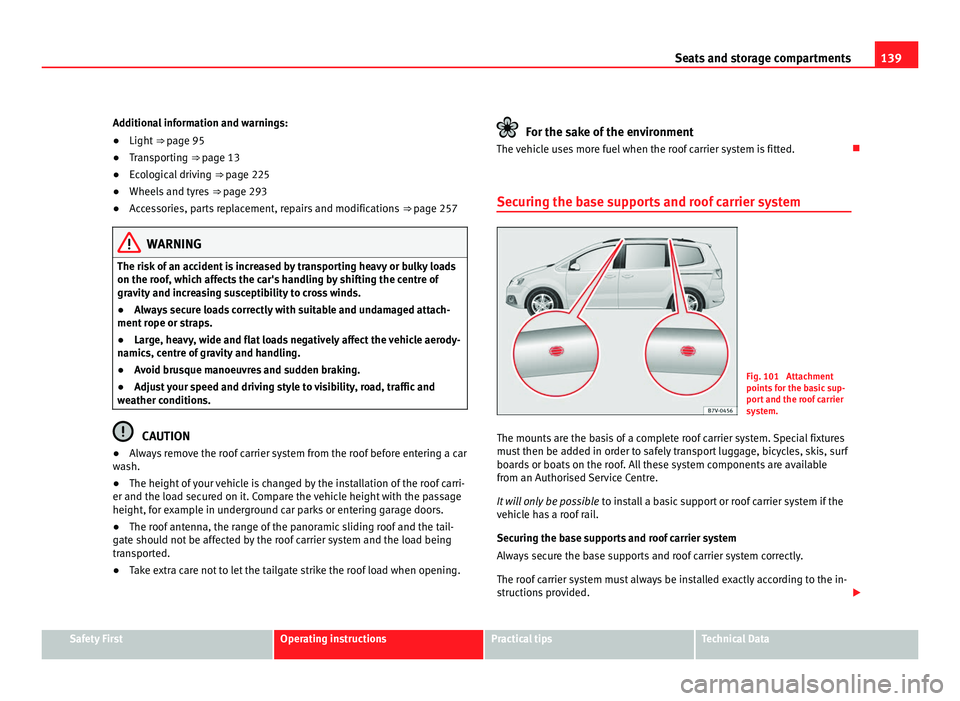
Securing the base supports and roof carrier system Fig. 101 Attachment
points
f
or the basic sup-
port and the roof carrier
system.
The mounts are the basis of a complete roof carrier system. Special fixtures
mus t
then be added in order to safely transport luggage, bicycles, skis, surf
boards or boats on the roof. All these system components are available
from an Authorised Service Centre.
It will only be possible to install a basic support or roof carrier system if the
vehicle has a roof rail.
Securing the base supports and roof carrier system
Always secure the base supports and roof carrier system correctly.
The roof carrier system must always be installed exactly according to the in-
structions provided. Safety First Operating instructions Practical tips Technical Data
Page 142 of 385
140
Seats and storage compartments
The position holes are located on the inner side of the rail ⇒ fig. 101.WARNING
If the base supports and the roof carrier system are incorrectly fitted or
used in an u n
suitable manner, the entire system could break free causing
accident and injury.
● Always take the manufacturer assembly instructions into account.
● Only use base supports and roof carrier systems that are not dam-
aged and are c
orrectly fitted.
● The base support should only be fitted to the points indicated in the
diagram
⇒ fig. 101.
● Secure the base supports and roof carrier system correctly.
● Check the screw fittings and attachments before driving and after a
short di
stance. During each long journey, check the attachments during
every break.
● Always fit the roof carrier system correctly for wheels, skis and surf-
board
s.
● Never change or repair the basic supports or roof carrier system. Note
Read and take into account the instructions included with the roof carrier
sys t
em fitted and keep them in the vehicle.
Loading the roof carrier system Loads can only be correctly secured when the roof carrier system is correctly
fitted
⇒ .
Max imum authori
sed roof load
The maximum authorised roof load is 100 kg (about 220 lbs). The roof load
includes the roof carrier system and the load being transported ⇒ .Always check the roof carrier system weight and the weight of the load to be
tran
s
ported and, if necessary, weigh them. Never exceed the maximum au-
thorised roof load.
If you are using a roof carrier with a lower weight rating, you cannot trans-
port the maximum roof load. Do not exceed the maximum weight limit for
the roof carrier given in the fitting instructions.
Distributing a load
Uniformly distribute loads and secure them correctly ⇒ .
Check att
achments
After fitting the base supports and the roof carrier system, always check the
attachments after a short trip or at regular intervals. WARNING
Exceeding the maximum authorised roof load can result in accidents
and/or v ehic
le damage.
● Always respect the maximum authorised weight for the roof, the max-
imum authorised weight
on the axles and the total maximum authorised
weight of the vehicle.
● Never exceed the capacity of the roof carrier system even if this is
les
s than the maximum authorised roof load.
● Secure heavy objects towards the front and distribute the load even-
ly. WARNING
Loose and incorrectly secured loads can fall from the roof carrier system
cau s
ing accidents and injury.
● Always use suitable ropes and straps in good condition.
● Always secure loads correctly.
Page 143 of 385
141
Seats and storage compartments
Storage compartments
Introduction Storage compartments must only be used to store light or small objects.
The front
c
entral armrest compartment houses the factory-fitted AUX-IN or
multimedia (MEDIA-IN) connection sockets.
The factory-fitted CD changer is located in the left-hand storage compart-
ment of the luggage compartment.
Additional information and warnings:
● Child seats (accessories) ⇒ page 39
● L
uggage compartment ⇒ page 125
● C
are and cleaning of the vehicle interior ⇒ page 249
● ⇒
Bookl et Radio or ⇒ Booklet navigation system WARNING
In the event of sudden braking movements or turns, loose objects may be
thro wn ar
ound the vehicle interior. This could cause serious injuries to
passengers and cause the driver to lose control of the vehicle.
● Do not transport animals or place hard, heavy or sharp objects inside
the vehic
le in: open storage compartments, instrument panel, storage
tray, items of clothing or bags.
● While driving, always keep object compartments closed. WARNING
Objects falling into the driver's footwell could prevent use of the pedals.
This c
ould lead the driver to lose control of the vehicle, increasing the
risk of a serious accident.
● Make sure the pedals can be used at all times, with no objects rolling
underneath them.
● The floor m
at should always be secured to the floor.
● Never place other mats or rugs on top of the original mat supplied by
the factor
y.
● Make sure that no objects can fall into the driver's footwell while the
vehicl
e is in motion. CAUTION
● Objects on the shelf could chafe against the wires of the heating ele-
ment in the r
ear window and cause damage.
● Do not keep heat-sensitive objects, food or medicines inside the vehi-
cle. He
at and cold could damage them or render them useless.
● Light-transparent objects placed inside the vehicle, such as lenses,
magnify
ing glasses or transparent suction caps on the windows, could con-
centrate the sun's rays and cause damage to the vehicle. Note
The ventilating slits between the heated rear window and the shelf must not
be co v
ered so that used air can escape from the vehicle. Safety First Operating instructions Practical tips Technical Data
Page 147 of 385
145
Seats and storage compartments
Pull the lever to open ⇒ fig. 107.
Pr ess the cover upwards to close.
Vehicle wallet compartment
The glove compartment is designed to store the vehicle wallet.
The vehicle wallet should always be kept in the glove compartment. To store
the wallet, insert it sideways into the glove compartment.
Cooling the glove compartment
There is an air vent ⇒ fig. 108 A on the rear panel so that cooled air from
the clim at
e control system (this must be connected) is fed into the glove
compartment. Turn the air vent to open and close it. WARNING
The risk of serious injuries in the event of an accident during a sudden
brak in
g manoeuvre or turn is increased if the glove compartment is left
open.
● Keep the glove compartment closed while the vehicle is in motion. CAUTION
For structural reasons, some model versions will have gaps behind the
glov e c
ompartment into which small objects may fall. This could lead to
strange noises and damage to the vehicle. You should therefore not keep
very small objects in the glove compartment. Storage compartments in the rear floor area*
Fig. 109 Storage com-
par
tment
s in the floor
area of the second row of
seats.
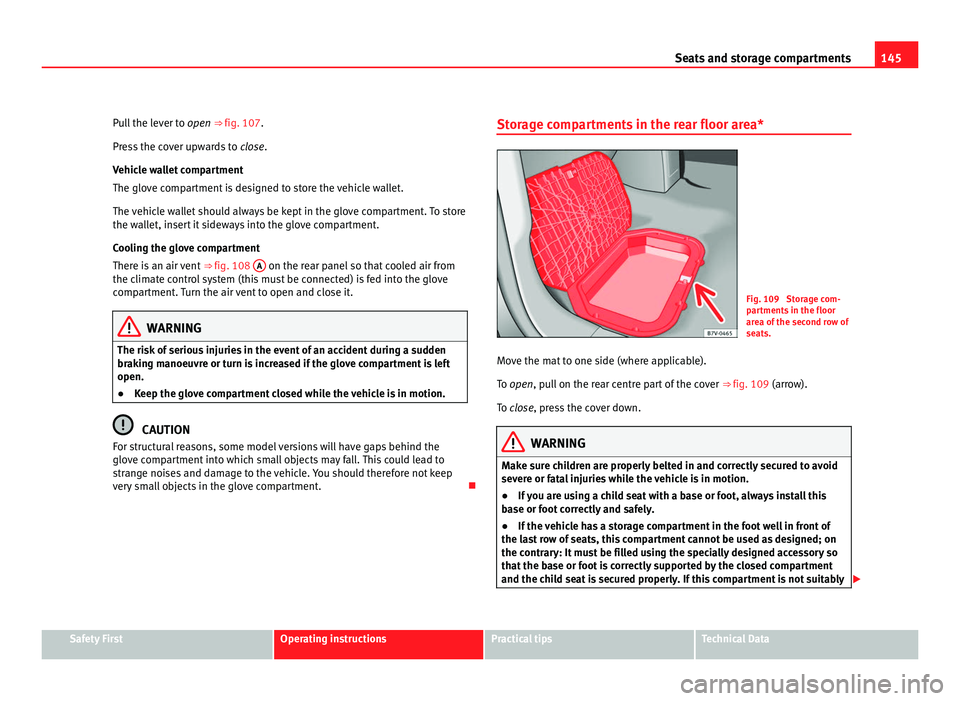
Move the mat to one side (where applicable).
To open
, pull on the rear centre part of the cover ⇒ fig. 109 (arrow).
To close, press the cover down. WARNING
Make sure children are properly belted in and correctly secured to avoid
sever e or f
atal injuries while the vehicle is in motion.
● If you are using a child seat with a base or foot, always install this
base or f
oot correctly and safely.
● If the vehicle has a storage compartment in the foot well in front of
the las
t row of seats, this compartment cannot be used as designed; on
the contrary: It must be filled using the specially designed accessory so
that the base or foot is correctly supported by the closed compartment
and the child seat is secured properly. If this compartment is not suitably Safety First Operating instructions Practical tips Technical Data
Page 148 of 385
146
Seats and storage compartments WARNING (Continued)
secured when using a child seat with a base or foot then the compart-
ment c
o
ver could rupture in an accident and the child will be ejected and
suffer serious injury.
● Please read and observe the child seat manufacturer's handling in-
structions.
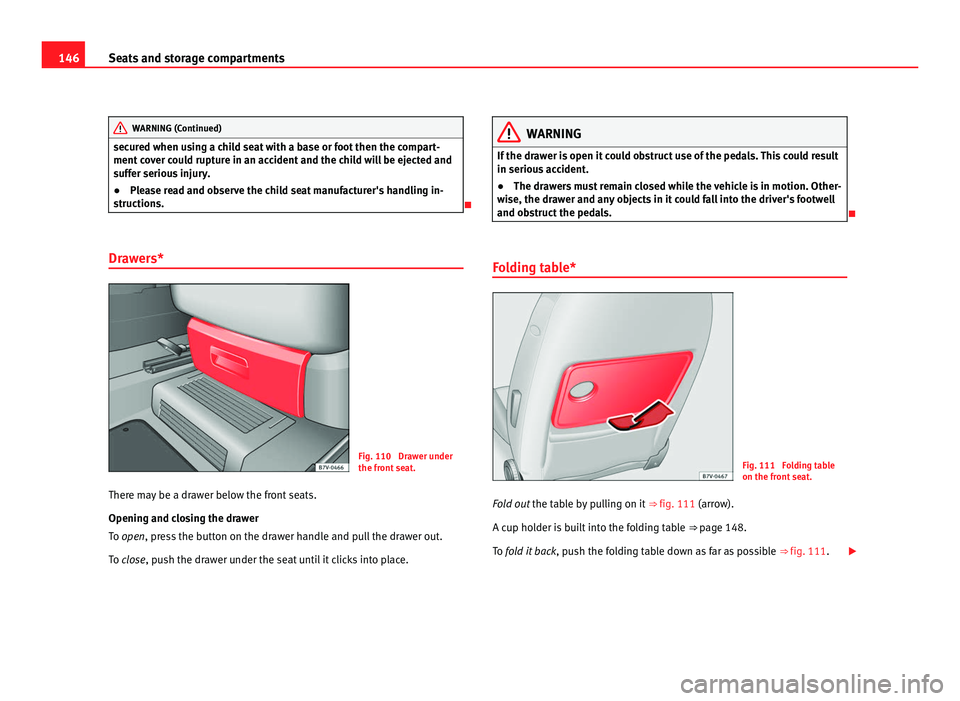
Drawers* Fig. 110 Drawer under
the front
se
at.
There may be a drawer below the front seats.
Opening and clo
sing the drawer
To open, press the button on the drawer handle and pull the drawer out.
To close, push the drawer under the seat until it clicks into place. WARNING
If the drawer is open it could obstruct use of the pedals. This could result
in serious ac
cident.
● The drawers must remain closed while the vehicle is in motion. Other-
wise, the dr
awer and any objects in it could fall into the driver's footwell
and obstruct the pedals.
Folding table* Fig. 111 Folding table
on the front
se
at.
Fold out the tabl
e by pulling on it ⇒ fig. 111 (arrow).
A cup holder is built into the folding table ⇒ page 148.
To fold it back , push the folding table down as far as possible ⇒ fig. 111.
Page 178 of 385
176
Driving
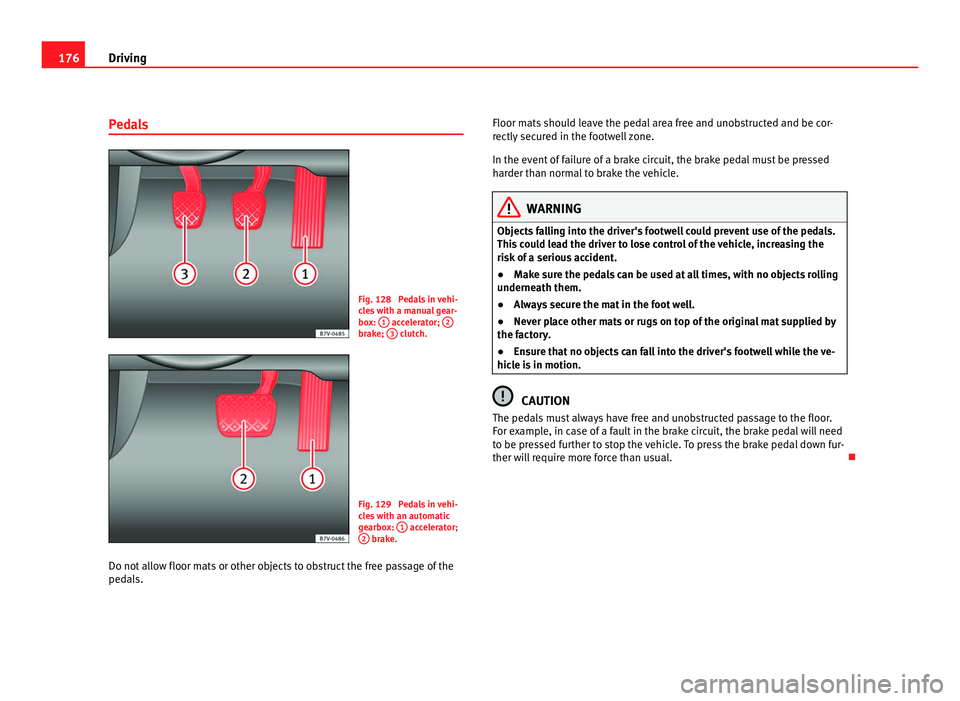
Pedals Fig. 128 Pedals in vehi-
cl
e
s with a manual gear-
box: 1 accelerator;
2 brake;
3 clutch.
Fig. 129 Pedals in vehi-
cl
e
s with an automatic
gearbox: 1 accelerator;
2 brake.
Do not allow floor mats or other objects to obstruct the free passage of the
pedal s. Floor m
ats should leave the pedal area free and unobstructed and be cor-
rectly sec
ured in the footwell zone.
In the event of failure of a brake circuit, the brake pedal must be pressed
harder than normal to brake the vehicle. WARNING
Objects falling into the driver's footwell could prevent use of the pedals.
This c
ould lead the driver to lose control of the vehicle, increasing the
risk of a serious accident.
● Make sure the pedals can be used at all times, with no objects rolling
underneath them.
● A
lways secure the mat in the foot well.
● Never place other mats or rugs on top of the original mat supplied by
the factor
y.
● Ensure that no objects can fall into the driver's footwell while the ve-
hicle i
s in motion. CAUTION
The pedals must always have free and unobstructed passage to the floor.
For e x
ample, in case of a fault in the brake circuit, the brake pedal will need
to be pressed further to stop the vehicle. To press the brake pedal down fur-
ther will require more force than usual.
Page 192 of 385
190
Driving
wheels are prevented from digging into loose surfaces. All-terrain ABS only
inter v
enes when driving in a straight line. When the front wheels are turned,
the normal ABS is activated.
Braking assist system (BAS)
The brake assist system may reduce the required braking distance. The
brake assist system boosts the braking force if you press the brake pedal
quickly in an emergency. As a result, the braking pressure increases rapidly,
the braking force is multiplied and the braking distance is reduced. This en-
ables the ABS to be activated more quickly and efficiently.
¡Do not lift your foot off the brake pedal! When the brake pedal is released
or when the brake force is reduced, braking assist automatically turns off
the brake servo.
Traction control when accelerating ASR (TCS)
In the event of wheelspin, the ASR (TCS) reduces the engine torque to match
the amount of grip available. The ASR (TCS) makes some situations easier,
for example, when starting, accelerating or going uphill, even in unfavoura-
ble road conditions.
The ASR (TCS) can be switched on or off manually ⇒ page 191.
Electronic differential lock system (EDS)
EDS is available when driving in straight lines under normal conditions.
When the EDL detects wheelspin, it brakes the spinning wheel and directs
the power to the other drive wheels. To prevent the disc brake of the braked
wheel from overheating, the EDL cuts out automatically if subjected to ex-
cessive loads. The EDL will switch on again automatically when the brake
has cooled down. WARNING
Driving at high speed on icy, slippery wet ground can result in loss of ve-
hicl e c
ontrol and serious injury to the driver and passengers.
● Adjust your speed and driving style to visibility, road, traffic and
weather c
onditions. Even though the braking assist systems ABS, BAS,
EDS, ASR (TCS) and ESC (ESP) provide more security, do not take unnec-
essary risks while driving.
● Braking assist systems can not overcome the laws of physics. Even
with ESC
(ESP) and other systems, slippery and wet roads will always be
dangerous.
● Driving to quickly on wet ground can result in the wheels losing con-
tact w
ith the ground in an effect known as aquaplaning. Without adher-
ence, it is impossible to brake, steer or control the vehicle.
● Braking assist systems cannot avoid accidents if, for example, the
driver does
not respect safety distances or drives to quickly in difficult
conditions.
● Even though braking assist systems are extremely effective and help
contro
l the vehicle in difficult situations, remember that the vehicle sta-
bility depends on tyre grip.
● When accelerating on a slippery surface, for example on ice and
snow
, press the accelerator carefully. The wheels can still slip even with
braking assist systems resulting in loss of vehicle control. WARNING
The effectiveness of the ESC (ESP) can be considerably reduced if other
component s
and systems affecting driving dynamics are not maintained
or are not functioning correctly. This includes, among others, brakes,
tyres and other systems already mentioned.
● Remember that changing and fitting other components to the vehicle
can affect
operation of the ABS, BAS, ASL EDL and ESC (ESP).
Page 233 of 385
231
Trailer towing
Trailer towing Introduction Always be aware of the legal requirements for each country to drive with a
trai
l
er and to use a trailer bracket.
Your car is intended mainly for transporting passengers however, it can also
be used to tow a trailer provided that it is fitted with the necessary equip-
ment. The additional load has an effect on the useful life, fuel consumption
and the vehicle performance and, in some cases, reduce the service inter-
vals.
Driving with a trailer requires more force from the vehicle and, thus, more
concentration from the driver.
For wintertime temperatures, fit winter tyres to the vehicle and the trailer.
Drawbar load
The maximum permitted Drawbar load exerted by the trailer drawbar on the
ball joint of the tow hitch must not exceed 100 kg (approximately 220 lbs).
Vehicles with the Start-Stop function
With a SEAT factory fitted or retrofitted trailer bracket, the Start-Stop func-
tion is automatically deactivated when a trailer is connected. For trailer
brackets not installed by SEAT, the Start-Stop function must be deactivated
manually using a button located on the dashboard before driving with a
trailer and it must remain off for the entire journey ⇒ .
Addition a
l information and warnings:
● Anti-theft alarm system ⇒ page 74
● Light
⇒ page 95
● Ec
ological driving ⇒ page 225
● St
arter assist systems (Start-Stop function) ⇒ page 194●
Wheel
s and tyres
⇒ p
age 293
● Accessories, parts replacement, repairs and modifications ⇒ page 257 WARNING
Never transport people in a trailer: this will endanger in their life and is
again s
t the law. WARNING
The incorrect use of the tow hitch can cause accidents and injury.
● Only use a tow hitch in good condition and correctly installed.
● Never change or repair a tow hitch.
● To reduce the risk of injury in case of a reversing collision, injury to
pedestri
ans and cyclists when parking, always keep the ball joint in
when a trailer is not being used.
● Never fit a trailer tow hitch “that distributes the load” or “balances
the load”.
Your vehicle has not been designed for this type of tow hitch.
The tow hitch may fail and the trailer will separate from the vehicle. WARNING
Driving with a trailer and transporting heavy or large objects can affect
vehic l
e handling and even cause an accident.
● Always secure loads correctly with suitable and undamaged attach-
ment rope or s
traps.
● Adjust your speed and driving style to visibility, road, traffic and
weather c
onditions. Safety First Operating instructions Practical tips Technical Data