ECU Seat Alhambra 2011 Workshop Manual
[x] Cancel search | Manufacturer: SEAT, Model Year: 2011, Model line: Alhambra, Model: Seat Alhambra 2011Pages: 385, PDF Size: 7.92 MB
Page 294 of 385
292
Checking and refilling levels
● the idling s peed i s increased so that the alternator provides more elec-
tricity.
● where necessary, the power of the most powerful consumers is reduced
or even comp
letely disconnected.
● On starting the engine, the power supply from the 12-volt sockets and
the cigar
ette lighter may be interrupted for a short time.
The on-board management program cannot always prevent the battery from
running flat. For example, if the ignition is left on for a long period with the
engine off or if the side lights or parking lights are left on while the vehicle
is stationary.
Why does the battery run flat?
● When stationary for a long time without starting the engine, particularly
if the ignition is
switched on.
● Use of electrical consumers with the engine switched off.
● If the auxiliary heater is running ⇒ page 163.WARNING
Incorrectly securing the battery or using the wrong battery can cause
short -c
ircuits, fire and serious injuries.
● Always use only maintenance free batteries that do not run flat alone
and whose proper
ties, specifications and size correspond to the stand-
ard battery. The specifications are indicated on the battery case. WARNING
A highly explosive mixture of gases is released when the battery is under
ch ar
ge.
● The batteries should be charged in a well-ventilated room only.
● Never charge a frozen or recently thawed battery. A flat battery can
freeze at
temperatures around 0°C (+32°F). WARNING (Continued)
● Always replace a battery which has frozen.
● B
att
ery cables not correctly connected may cause a short circuit. Re-
connect fir
st the positive cable and then the negative cable. CAUTION
● Never disconnect the battery if the ignition is switched on or if the en-
gine i s
running. This could damage the electrical system or electronic com-
ponents.
● Never plug accessories supply current, such as solar panels or a battery
char
ger, to the 12-volt sockets or the cigarette lighter. This could damage
the vehicle's electrical system. For the sake of the environment
● Dispose of the battery in an environment-friendly manner. Batteries con-
t ain t
oxic substances such as sulphuric acid and lead.
● Battery acid can contaminate the environment. Collect any spilt service
fluids and al
low a dispose of them correctly.
Page 298 of 385
296
Wheels and tyres
Wheel rims The design of wheel bolts is matched to the rims. If different rims are fitted,
the corr
ect
wheel bolts with the right length and correctly shaped bolt
heads must be used. This ensures that wheels are fitted securely and that
the brake system functions correctly ⇒ page 305.
For technical reasons, it is not generally possible to use the wheels from
other vehicles. In some cases, this may also be true for the same model of
wheel.
The tyres and rims approved by SEAT are specially matched to the character-
istics of the vehicle and are critical to good road holding and safe handling.
Wheel bolts
Wheel bolts must be tightened to the correct torque ⇒ page 305.
Beadlock wheel rims
Beadlock wheel rims have various components. These are joined together
by special bolts using a special procedure. This ensures good performance,
a better seal, improved safety and wheel run out. Therefore, worn rims
should always be replaced and must only be repaired in a Technical Service.
SEAT recommends visiting a Technical Service ⇒ .
Wheel rims w
ith bolted trims
Wheel rims may be fitted with interchangeable trim parts which are attach-
ed to the rim using self-locking bolts. Worn trims should only be replaced at
a Technical Service. SEAT recommends visiting a Technical Service ⇒ .
WARNING
The use of worn or damaged wheel rims could make driving more danger-
ous and r
esult in serious accidents and damage.
● Only wheel rims which have been approved for use with your vehicle
should be u
sed.
● Inspect wheel rims regularly for damage and replace as required. WARNING
If the bolted joints of wheel rims with bolted ring trims are not correctly
tightened or loo sened, thi
s could result in serious accident.
● Never loosen the bolted joints of wheel rims with bolted ring trims.
● Any work relating to wheel rims with bolted rims should be carried
out at qua
lified workshop. SEAT recommends visiting a Technical Service.
Replacement of new tyres and wheel rims New tyres
●
When tyres are new, drive with extreme caution for the first 500 km
(310 mil e
s), as all tyres need to be run-in. Tyres which have not been run-in
do not have such good grip ⇒ or braking capacity
⇒ .
● All four wheels must be fitted with radial tyres of the same type, size
(ro l
ling circumference) and the same tread pattern.
● The tread depth of new tyres may vary, according to the type and make
of tyr
e and the tread pattern.
Replacing tyres
● Where possible, always replace both wheels on an axle (both wheels on
the front ax
le or both wheels on the rear axle) ⇒ .
● Old tyres should only be replaced by SEAT approved tyres for the vehicle
in ques tion, and in ac
cordance with the maximum permitted size, diameter,
load and speed capacity.
● Never use tyres which are larger than SEAT approved tyres. If the tyres
are too b
ig, they may knock or rub against the chassis or other components,
resulting in damage.
Page 309 of 385
307
Wheels and tyres
Wheel bolts Fig. 181 Changing the
wheel: Sl
ac
ken the wheel
bolts. Fig. 182 Changing the
wheel: T
y
re valve 1 and
pos ition of
anti-theft
wheel locking bolt 2 or
3 .
Only use the tool supplied with the vehicle to loosen the wheel bolts.
Loo sen the wheel
bolts only about one turn before raising the vehicle with
the jack. If the wheel bolt is very tight, you may be able to loosen it by pushing down
on the end of the wheel br
ace carefully with your foot. Hold on to the car for
support and take care not to slip.
Loosening wheel bolts
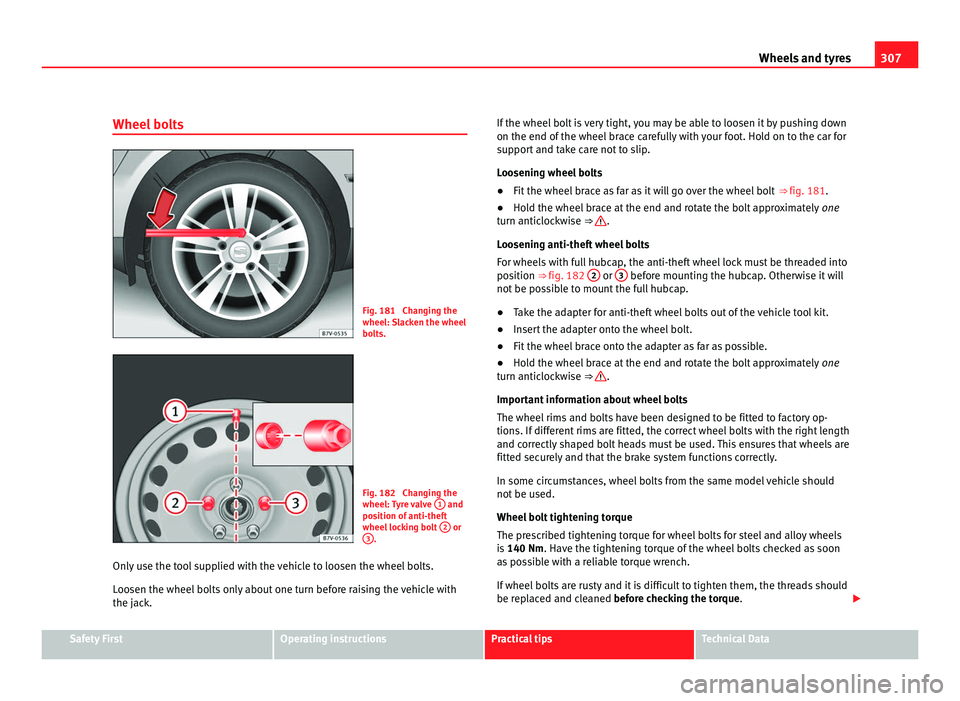
● Fit the wheel brace as far as it will go over the wheel bolt ⇒ fig. 181.
● Hold the wheel brace at the end and rotate the bolt approximately one
turn antic
lockwise ⇒ .
Loo senin
g anti-theft wheel bolts
For wheels with full hubcap, the anti-theft wheel lock must be threaded into
position ⇒ fig. 182 2 or
3 before mounting the hubcap. Otherwise it will
not be po s
sible to mount the full hubcap.
● Take the adapter for anti-theft wheel bolts out of the vehicle tool kit.
● Insert the adapter onto the wheel bolt.
● Fit the wheel brace onto the adapter as far as possible.
● Hold the wheel brace at the end and rotate the bolt approximately one
turn antic
lockwise ⇒ .
Import ant
information about wheel bolts
The wheel rims and bolts have been designed to be fitted to factory op-
tions. If different rims are fitted, the correct wheel bolts with the right length
and correctly shaped bolt heads must be used. This ensures that wheels are
fitted securely and that the brake system functions correctly.
In some circumstances, wheel bolts from the same model vehicle should
not be used.
Wheel bolt tightening torque
The prescribed tightening torque for wheel bolts for steel and alloy wheels
is 140 Nm. Have the tightening torque of the wheel bolts checked as soon
as possible with a reliable torque wrench.
If wheel bolts are rusty and it is difficult to tighten them, the threads should
be replaced and cleaned before checking the torque. Safety First Operating instructions Practical tips Technical Data
Page 314 of 385
312
If and when
If and when
In case of emergency
Introduction Additional information and warnings:
●
Braking, stopping and parking ⇒ pag e 183
● Emer
gency locking and unlocking ⇒ page 314
● V
ehicle tools ⇒ page 320 WARNING
A faulty vehicle in traffic represents a risk of accident for the driver and
for other r o
ad users.
● Stop the vehicle safely as soon as possible. Park the vehicle a safe
dist
ance from surrounding traffic to lock all the doors in case of an emer-
gency. Turn on the hazard warning lights to warn other road users.
● Never leave children or disabled people alone in the vehicle if the
doors ar
e to be locked. In case of an emergency, passengers will be trap-
ped inside the vehicle. Individuals locked in the vehicle can be exposed
to very high or very low temperatures. Protecting yourself and securing the vehicle Fig. 186 In the centre of
the ins
trument
panel:
Switch for hazard warn-
ing lights.
Always fulfil legal requirements for securing a broken down vehicle. In a
number of cou
ntries it is now obligatory, for example, to turn on the hazard
warning lights and use a reflective safety vest ⇒ page 314.
When being towed with the hazard warning lights on, a change in direction
or traffic lane can be indicated as usual using the turn indicator lever. The
hazard lights will be interrupted temporarily.
Checklist
For your own safety and that of other passengers, the following points
should be observed in the order given ⇒ :
Park the
vehicle a safe distance from traffic and on suitable ground
⇒ .
Turn on the h az
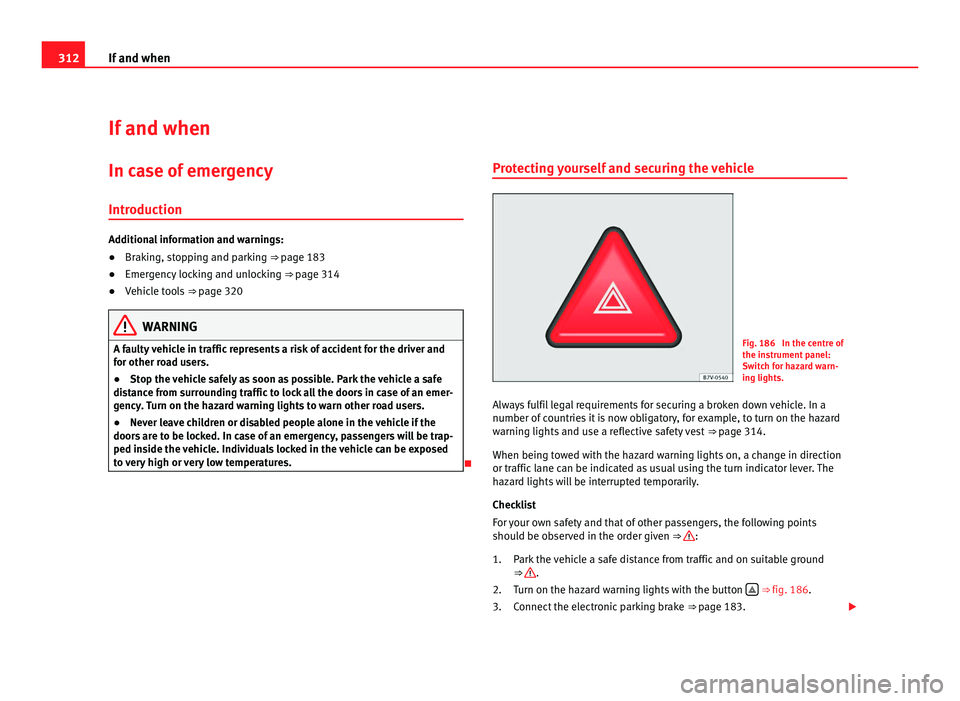
ard warning lights with the button ⇒
fig. 186 .
C
onnect the electronic parking brake ⇒ page 183.
1.
2.
3.
Page 316 of 385
314
If and when
First aid kit, warning triangle, reflective vests and fire
extingui
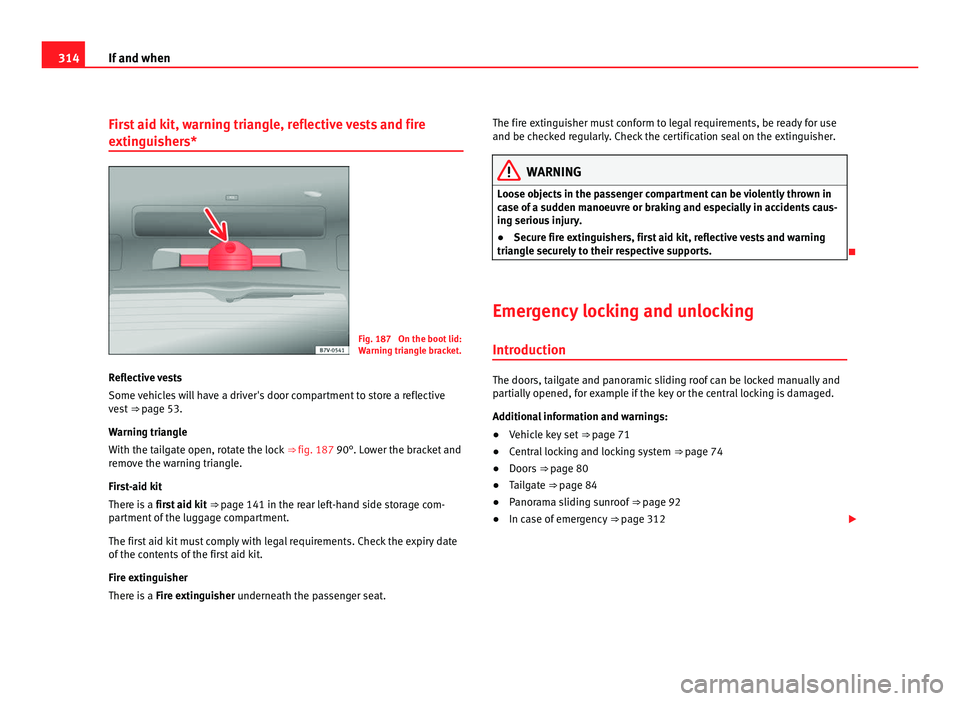
shers* Fig. 187 On the boot lid:
Warnin
g tri
angle bracket.
Reflective vests
Some vehic
les will have a driver's door compartment to store a reflective
vest ⇒ page 53.
Warning triangle
With the tailgate open, rotate the lock ⇒ fig. 187 90°. Lower the bracket and
remove the warning triangle.
First-aid kit
There is a first aid kit ⇒ page 141 in the rear left-hand side storage com-
partment of the luggage compartment.
The first aid kit must comply with legal requirements. Check the expiry date
of the contents of the first aid kit.
Fire extinguisher
There is a Fire extinguisher underneath the passenger seat. The fire extinguisher must conform to legal requirements, be ready for use
and be check
ed regularly. Check the certification seal on the extinguisher. WARNING
Loose objects in the passenger compartment can be violently thrown in
ca se of
a sudden manoeuvre or braking and especially in accidents caus-
ing serious injury.
● Secure fire extinguishers, first aid kit, reflective vests and warning
triangl
e securely to their respective supports.
Emergency locking and unlocking Introduction The doors, tailgate and panoramic sliding roof can be locked manually and
par
ti
ally opened, for example if the key or the central locking is damaged.
Additional information and warnings:
● Vehicle key set ⇒ pag
e 71
● Central locking and locking system ⇒ pag
e 74
● Doors ⇒ page 80
● T
ailgate ⇒ pag
e 84
● Panorama sliding sunroof ⇒ pag
e 92
● In case of emergency ⇒ pag
e 312
Page 321 of 385
319
If and when
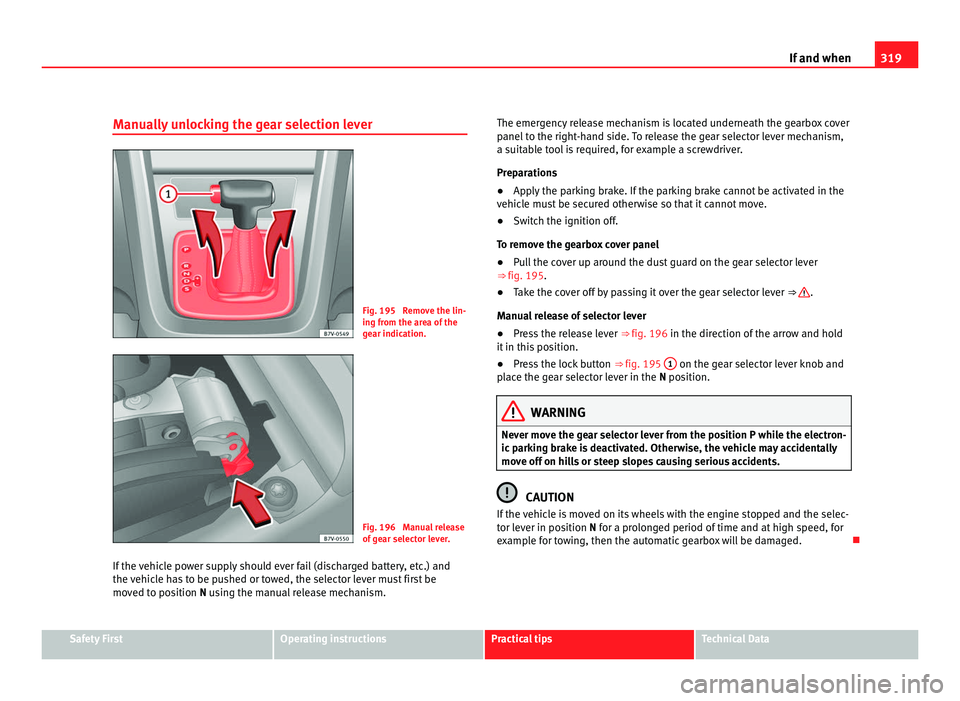
Manually unlocking the gear selection lever Fig. 195 Remove the lin-
ing fr
om the ar
ea of the
gear indication. Fig. 196 Manual release
of g
e
ar selector lever.
If the vehicle power supply should ever fail (discharged battery, etc.) and
the vehic
le has to be pushed or towed, the selector lever must first be
moved to position N using the manual release mechanism. The emergency release mechanism is located underneath the gearbox cover
panel t
o the right-hand side. To release the gear selector lever mechanism,
a suitable tool is required, for example a screwdriver.
Preparations
● Apply the parking brake. If the parking brake cannot be activated in the
vehicl
e must be secured otherwise so that it cannot move.
● Switch the ignition off.
To remo
ve the gearbox cover panel
● Pull the cover up around the dust guard on the gear selector lever
⇒ fig. 195.
● Take the cover off by passing it over the gear selector lever ⇒ .
Manua l
release of selector lever
● Press the release lever ⇒ fig. 196 in the direction of the arr
ow and hold
it in this position.
● Press the lock button ⇒ fig. 195 1 on the gear selector lever knob and
pl ac
e the gear selector lever in the N position. WARNING
Never move the gear selector lever from the position P while the electron-
ic p ark
ing brake is deactivated. Otherwise, the vehicle may accidentally
move off on hills or steep slopes causing serious accidents. CAUTION
If the vehicle is moved on its wheels with the engine stopped and the selec-
tor l ev
er in position N for a prolonged period of time and at high speed, for
example for towing, then the automatic gearbox will be damaged. Safety First Operating instructions Practical tips Technical Data
Page 322 of 385
320
If and when
Tools*
Introduction When securing the vehicle in case of a breakdown, please note the legal re-
quirements
f
or each country.
Additional information and warnings:
● Working in the engine compartment ⇒ page 275
● Ch
ange wheel ⇒ pag
e 305
● In case of emergency ⇒ pag
e 312WARNING
Loose objects in the passenger compartment can be violently fired
through the c omp
artment in case of a sudden manoeuvre or braking and
especially in accidents causing serious injury.
● Make sure that the vehicle tools are stored safely in the luggage com-
partment
. WARNING
Unsuitable or damaged on-board tools can cause injury or accidents.
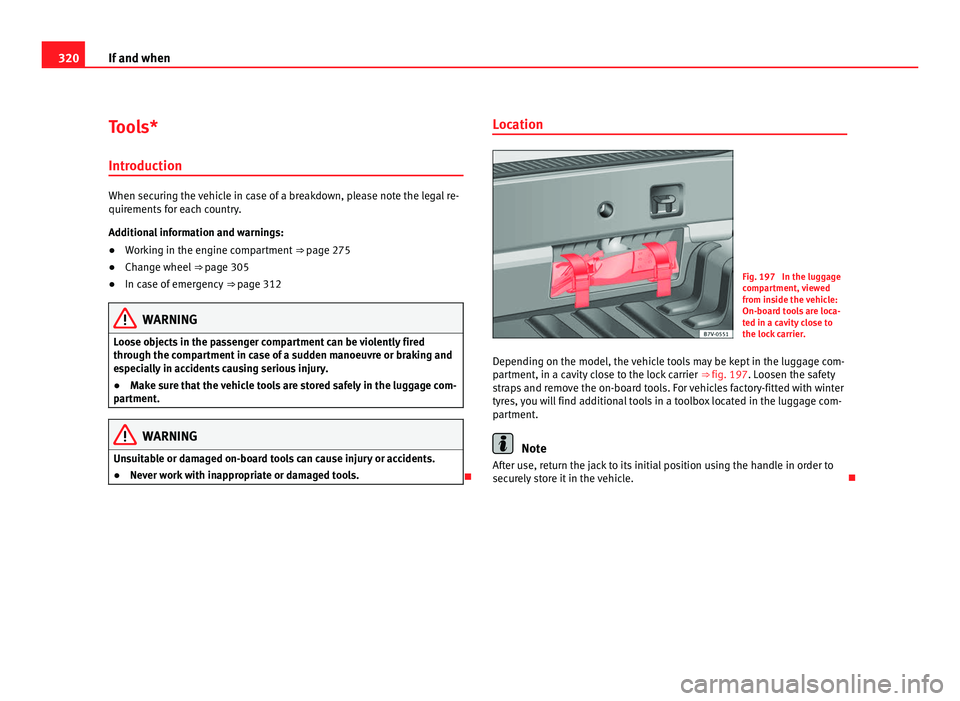
● Never work with inappropriate or damaged tools. Location Fig. 197 In the luggage
comp
ar
tment, viewed
from inside the vehicle:
On-board tools are loca-
ted in a cavity close to
the lock carrier.
Depending on the model, the vehicle tools may be kept in the luggage com-
partment, in a c
avity close to the lock carrier ⇒ fig. 197. Loosen the safety
straps and remove the on-board tools. For vehicles factory-fitted with winter
tyres, you will find additional tools in a toolbox located in the luggage com-
partment. Note
After use, return the jack to its initial position using the handle in order to
secur ely
store it in the vehicle.
Page 335 of 385
333
If and when
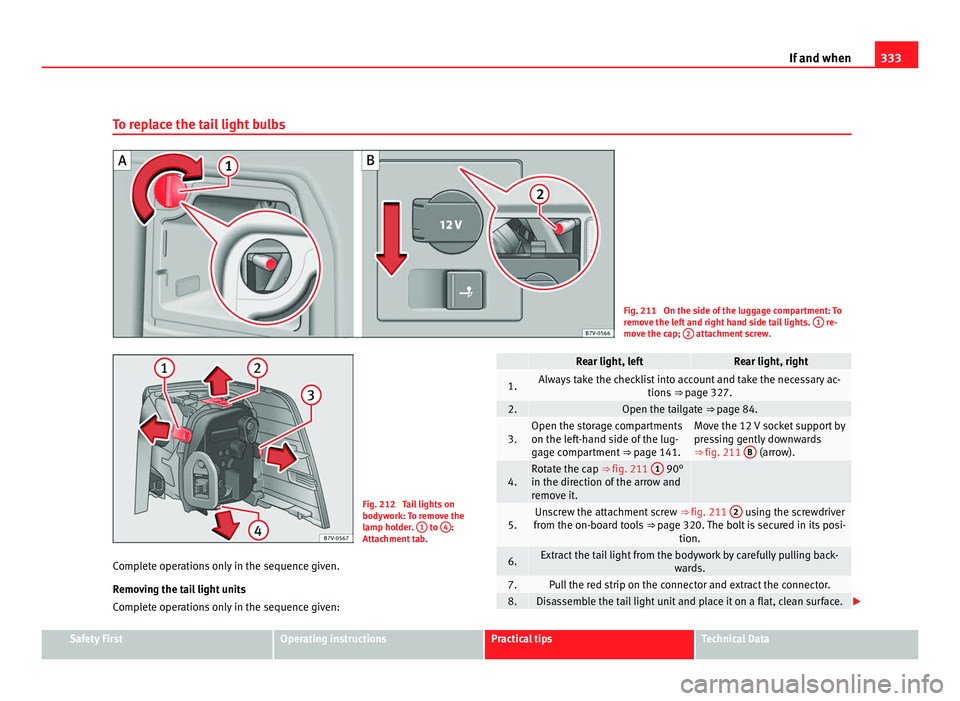
To replace the tail light bulbs Fig. 211 On the side of the luggage compartment: To
remo
v
e the left and right hand side tail lights. 1 re-
mov e the c
ap; 2 attachment screw.
Fig. 212 Tail lights on
bodywork:
T
o remove the
lamp holder. 1 to
4 :
Attac hment
tab.
Complete operations only in the sequence given.
Remov
ing the tail light units
Complete operations only in the sequence given: Rear light, left Rear light, right
1. Always take the checklist into account and take the necessary ac-
tions ⇒
page 327. 2. Open the tailgate ⇒ pag
e 84. 3. Open the storage compartments
on the lef
t
-hand side of the lug-
gage compartment ⇒ page 141. Move the 12 V socket support by
pre
s
sing gently downwards
⇒ fig. 211 B (arrow).
4. Rotate the cap ⇒ fig. 211
1 90°
in the direction of the arr
ow and
remove it.
5. Unscrew the attachment screw
⇒ fig. 211 2 using the screwdriver
from the on-bo ar
d tools ⇒ page 320. The bolt is secured in its posi-
tion. 6. Extract the tail light from the bodywork by carefully pulling back-
ward
s. 7. Pull the red strip on the connector and extract the connector.
8. Disassemble the tail light unit and place it on a flat, clean surface.
Safety First Operating instructions Practical tips Technical Data
Page 336 of 385
334
If and when
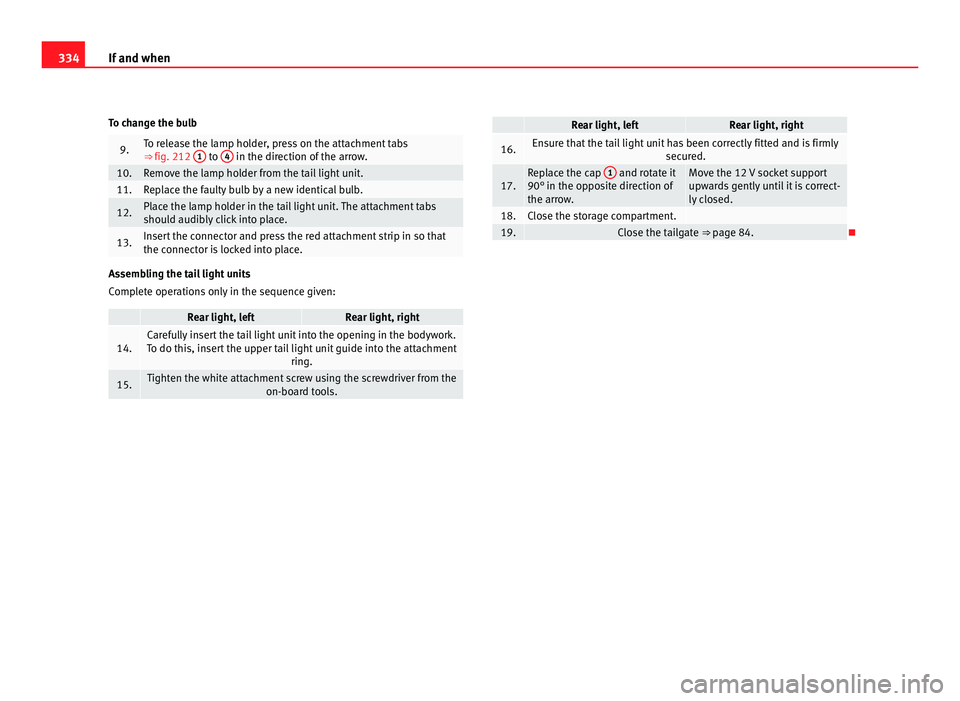
To change the bulb 9. To release the lamp holder, press on the attachment tabs
⇒ fig. 212
1 to
4 in the direction of the arrow.
10. Remove the lamp holder from the tail light unit.
11. Replace the faulty bulb by a new identical bulb.
12. Place the lamp holder in the tail light unit. The attachment tabs
shoul
d audib
ly click into place. 13. Insert the connector and press the red attachment strip in so that
the connect
or i
s locked into place.Assembling the tail light units
Comp
l
ete operations only in the sequence given: Rear light, left Rear light, right
14. Carefully insert the tail light unit into the opening in the bodywork.
To do thi s, in
sert the upper tail light unit guide into the attachment ring.15. Tighten the white attachment screw using the screwdriver from the
on-board t
ools. Rear light, left Rear light, right
16. Ensure that the tail light unit has been correctly fitted and is firmly
secured. 17. Replace the cap
1 and rotate it
90° in the oppo s
ite direction of
the arrow. Move the 12 V socket support
upw
ar
ds gently until it is correct-
ly closed. 18. Close the storage compartment.
19. Close the tailgate ⇒
pag
e 84.
Page 343 of 385
341
If and when
Instructions for tow starting In general, the vehicle should not be started by towing. Jump-starting is
much mor
e pr
eferable ⇒ page 337.
For technical reasons, the following vehicles can not be tow started:
● Vehicles with an automatic gearbox.
● Vehicles with an electronic parking brake, given that it is possible that
the brake w
ill not be disengaged.
● If the vehicle battery is flat, it is possible that the engine control units do
not operat
e correctly.
However, if your vehicle must absolutely be tow-started (manual gearbox):
● Engage the 2nd or 3rd gear.
● Keep the clutch pressed down.
● Switch on the ignition and the hazard warning lights.
● Release the clutch when both vehicles are moving.
● As soon as the engine starts, press the clutch and move the gear lever
into neutral
. This helps to prevent a collision with the towing vehicle. CAUTION
When tow-starting, fuel could enter the catalytic converter and damage it.
Towing instructions Tow-rope or tow-bar
When to
w
ing, the tow bar is the safest and vehicle friendly way. You should
only use a tow-rope if you do not have a tow-bar. A tow-rope should be slightly elastic to avoid damage to both vehicles. It is
advi
sable to use a tow-rope made of synthetic fibre or similarly elastic mate-
rial.
Only secure the tow rope or tow bar to the tow ring or specially designed
fitting.
Vehicles with a factory fitted towing device , can only be used for towing
with a tow-bar, specially designed to fit on a tow hitch ball ⇒ page 233.
Towing vehicles with an automatic gearbox
Note the following for a towed vehicle:
● Make sure the gear selector lever is in the N position.
● Do not
drive faster than 50 km/h (30 mph) when towing a vehicle.
● Do not tow further than 50 km (30 miles).
● If a breakdown truck is used, the vehicle must be towed with the front
wheels r
aised. Note the following instructions for towing four wheel drive
vehicles.
Instructions for towing four-wheel-drive vehicles
Four wheel drive vehicles can be towed using a toolbar or tow rope. If the
vehicle is towed with the front or rear axle raised, the engine must be turned
off to avoid transmission damage.
For vehicles with a double clutched DSG ®
(direct shift gearbox) the instruc-
tions for towing vehicles with an automatic gearbox apply ⇒ page 341.
Situations in which the vehicle should not be towed
In the following cases, the vehicle should not be towed but transported on a
trailer or special vehicle:
● If the vehicle gearbox does not contain lubricant due to a fault.
● If the vehicle battery is flat and, as a result, the electronic steering lock
and electronic
parking brake cannot be disengaged if applied.
● If the vehicle to be towed has an automatic gearbox and the distance to
be cov
ered is greater than 50 km (30 miles). Safety First Operating instructions Practical tips Technical Data