bonnet Seat Alhambra 2011 User Guide
[x] Cancel search | Manufacturer: SEAT, Model Year: 2011, Model line: Alhambra, Model: Seat Alhambra 2011Pages: 385, PDF Size: 7.92 MB
Page 257 of 385
255
Vehicle maintenance and cleaning
Notes for the user Labels and p
latesSome parts in the engine compartment come from the factory with certifi-
cat
e
s of safety, labels or plates containing important information regarding
the operation of the vehicle, for example, on the petrol cap, on the passeng-
er's sun visor, on the driver's door strut, or on the floor of the luggage com-
partment.
● Never remove these certificates of safety, labels or plates, and ensure
they are k
ept in good condition and are legible.
● If a vehicle part, bearing a certificate of safety, label or plate, is re-
plac
ed, the qualified workshop should attach the information back in the
same place.
Certificate of safety
A certificate of safety on the door strut states that all the safety standards
and regulations established by the national traffic authorities responsible
for road safety were met at the time of manufacture. It may also give the
month and year of manufacture, together with the chassis number.
Warning of high voltage label*
There is a label close to the bonnet lock which warns of high voltage in the
vehicle electrical installation. The vehicle ignition system complies with sev-
eral standards, including the Canadian standard, ICES-002.
Using your vehicle in other countries and continents The vehicle is manufactured at the factory for use in a particular country in
acc
or
dance with the national legislation in force at the time of manufacture. If the vehicle is sold in another country or used in another country for an ex-
tended period of time, the ap
plicable legislation of that country should be
observed.
It may be necessary to fit or remove certain pieces of equipment or to deac-
tivate certain functions. Service work may also be affected. This is particu-
larly true if the vehicle is used in a different climate for an extended period
of time.
As there are different types of frequency bands around the world, you may
find that the radio or navigation system supplied at the factory does not
work in another country. CAUTION
● SEAT does not accept liability for any damage to the vehicle due to the
u se of
a lower quality fuel, an inadequate service or the non-availability of
genuine spare parts.
● SEAT does not accept liability if the vehicle does not comply in part or in
ful
l with the legal requirements of other countries or continents.
Radio reception and the aerial The aerial of radio and navigation systems fitted at the factory may be
mount
ed in diff
erent parts of the vehicle:
● On the inside of the rear window, next to the rear window heating,
● on the inside of the rear side windows,
● on the inside of the windscreen,
● on the roof of the car.
Aerials
mounted on the inside of a window can be recognised by the fine
wires. Safety First Operating instructions Practical tips Technical Data
Page 263 of 385
261
Accessories, parts replacement and modifications
In vehicles equipped with an emergency call function via the mobile phone
or other app li
ances connected in the vehicle, it is possible to send the vehi-
cle position. If the control unit records an accident with airbag activation,
the system may automatically send a signal. This will depend on the net-
work operator. Normally, transmission is only possible in areas with good
coverage.
Event Data Recorder
The vehicle is not fitted with an event data recorder.
An event data recorder temporarily stores the vehicle information. There-
fore, in the event of accident, it is possible to obtain detailed information
about how the accident occurred. For example, in vehicles with airbag sys-
tems, data relating to speed of impact, seat belt status, seat positions and
airbag activation times may be stored. The volume of data depends on the
manufacturer.
Event data recorders can only be mounted with authorisation from the vehi-
cle owner and, in some countries, they are governed by local legislation.
Reprogramming control units
On the whole, all the data required for the component management is stor-
ed in the control units. The programming of certain convenience functions,
such as the convenience indicators, individual door opening and instruc-
tions on the display can be modified using special equipment at the work-
shop. If this is the case, the information and descriptions given in the in-
structions manual will not match the original functions. Therefore, SEAT rec-
ommends that any modifications are recorded in the section “Other work-
shop notes” in the Maintenance Programme.
The Technical Service must have a record of any modification to the pro-
gramming.
Reading the vehicle fault memory
There is a diagnostics connector in the vehicle interior for reading the vehi-
cle fault memory. The fault memory documents errors and deviations from
the theoretical values of the electronic control units. The diagnostics connector is in the driver's side footwell area, next to the
lever f
or opening the bonnet, below a cover.
The fault memory should only be read and reset by a Technical Service.
Using a mobile telephone in a vehicle without connection
to an ext
erior aerial Mobile telephones transmit and receive radio waves, both when in use and
when on st
and-b
y. Scientific studies state that radio waves exceeding cer-
tain values may be harmful to the human body. International committees
and authorities have established limits and directives in order to ensure
electromagnetic radiation from mobile phones remains within certain limits
that do not endanger human health. However, there is no available conclu-
sive scientific evidence that cordless phones are completely safe.
Therefore, some experts recommend that use of mobile phone be kept to a
minimum until the results of current research are published.
When a mobile phone not connected to an exterior aerial is used inside the
vehicle, the electromagnetic radiation may be greater than if the mobile
phone were connected to a built-in aerial or to another exterior aerial.
If the vehicle is fitted with a suitable hands-free device, it will comply with
the legislation in many countries which only permits the use of mobile
phones inside vehicles using a hands-free device.
The hands-free system mounted at the factory has been designed for use
with conventional mobile phones and phones with Bluetooth technology.
Mobile phones should be placed on a suitable phone cradle. In addition,
the cradle should always be correctly fitted into the base plate. This ensures
that the mobile phone is securely fastened to the instrument panel and con-
nected to the exterior aerial of the vehicle.
If the mobile phone is connected to an aerial incorporated into the vehicle
or an exterior aerial connected to the vehicle, this will help to reduce the Safety First Operating instructions Practical tips Technical Data
Page 277 of 385
275
Checking and refilling levels
Working in the engine compartment Introduction Before working in the engine compartment, make sure that the vehicle is
park
ed on horiz
ontal and firm ground.
The engine compartment of the vehicle is a hazardous area. Never work on
the engine or in the engine compartment if you are not familiar with the op-
erations to be carried out, the applicable safety standards and especially if
you do not have the instruments, liquids and tools necessary ⇒ ! Have
the work c
arried out by a Technical Service if you are uncertain. Negligent
work can cause serious injury.
Additional information and warnings:
● Windscreen wash system ⇒ page 105
● St
art and stop the engine ⇒ page 170
● Br
ake fluid ⇒ page 183
● V
ehicle battery ⇒ page 288
● Chec
ks when filling up ⇒ page 264
● En
gine oil ⇒ page 279
● En
gine coolant ⇒ page 283
● A
ccessories, parts replacement, repairs and modifications ⇒ page 257 WARNING
If the vehicle moves unexpectedly, this could cause serious injury.
● Never work underneath the vehicle if it is not secured against moving.
If y
ou must work underneath the vehicle with the wheels in contact with
the ground then it should be parked on flat ground, the wheels should be
prevented from moving and the key must be removed from the ignition.
● If you have to work underneath the vehicle, you must use suitable
stand
s additionally to support the vehicle, there is a risk of accident!.
The jack is not intended for this kind of work and its failure could lead to
severe injuries. WARNING
The engine compartment is a dangerous area capable of causing serious
injury .
● F
or all type of work, always take the utmost precautions, work care-
ful
ly and note the general safety standards in force. Never take personal
risks.
● Never work on the engine or in the engine compartment if you are not
famili
ar with the necessary operations. If you are not sure about proce-
dures then visit a Technical Service to carry out the necessary work. In-
correct work can cause serious injuries.
● Never open the bonnet if you see steam or coolant escaping from the
engine comp
artment. Hot vapours and coolant can cause serious burns.
Always wait until you cannot see or hear the sound of steam or coolant
coming from the engine compartment.
● Always allow the engine to cool down before opening the bonnet.
● Contact with hot elements of the engine and the exhaust system can
cause b
urns. Safety First Operating instructions Practical tips Technical Data
Page 278 of 385
276
Checking and refilling levels WARNING (Continued)
● Onc e the engine has cooled, follow the instructions below before
openin g the bonnet:
– T
urn on the electronic parking brake and place the gear selector
lever in P or the g
ear stick in neutral.
– Remove the key from the ignition.
– Keep children away from the engine compartment and never leave
them uns
upervised.
● When the engine is warm or hot, the cooling system is pressurised!
Do not un
screw the cap on the expansion tank when the engine is hot.
Otherwise, coolant may spray out under pressure causing burns and seri-
ous injury.
–Carefully and slowly unscrew the cap anticlockwise, gently press-
ing down on it
.
– Always protect your face, hands and arms from hot coolant and
ste
am using a large, thick cloth.
● When refilling liquids, avoid spilling them on parts of the engine and
the exhau
st system. Spilled liquids could cause a fire. WARNING
The high voltages of the electrical system can give electric shocks as well
as c
ausing burns and serious injury and possibly even death!
● Never cause short circuits in the electrical system. The battery could
explode.
● T
o minimise the risk of electric shock and serious consequences
while the en
gine is running or starting the engine, note the following:
– Never touch the electrical wiring of the ignition system.
– Never touch electric cables or the gas discharge lamps. WARNING
In the engine compartment, there are rotating parts that could cause se-
rious injur
y.
● Never place your hands on or near the radiator fan. Touching the rotor
bla
des could seriously harm you. The ventilator works according to the
engine temperature and could start suddenly even when the ignition is
turned off and the key is removed.
● If any work has to be performed when the engine is started or with
the engine runnin
g, there is an additional, potentially fatal, safety risk
from the rotating parts, such as the drive belts, alternator, radiator fan
etc as well as from the high-voltage ignition system. Always work with
the utmost caution.
–Always make sure that no parts of your body, jewellery, ties, loose
clothing and lon
g hair can be trapped by the rotating parts of the en-
gine. Before any work, remove ties and jewellery ( necklaces, etc), tie
longhair back and tie all items of loose clothing to your body to make
sure that they cannot be trapped by engine components.
– Take extreme caution when operating the accelerator and remain
attentive.
The vehicle could move, even with the electronic parking
brake activated.
● Always make sure you have not left any objects, such as cloths or
tool
s, in the engine compartment. If any object is left in the engine com-
partment, this could cause malfunctions, engine faults and even a fire. WARNING
Refill liquids and certain materials can catch fire easily in the engine
comp ar
tment, causing a fire and serious injury!
● Never smoke.
● Never work close to places exposed to flames or sparks.
Page 280 of 385
278
Checking and refilling levels
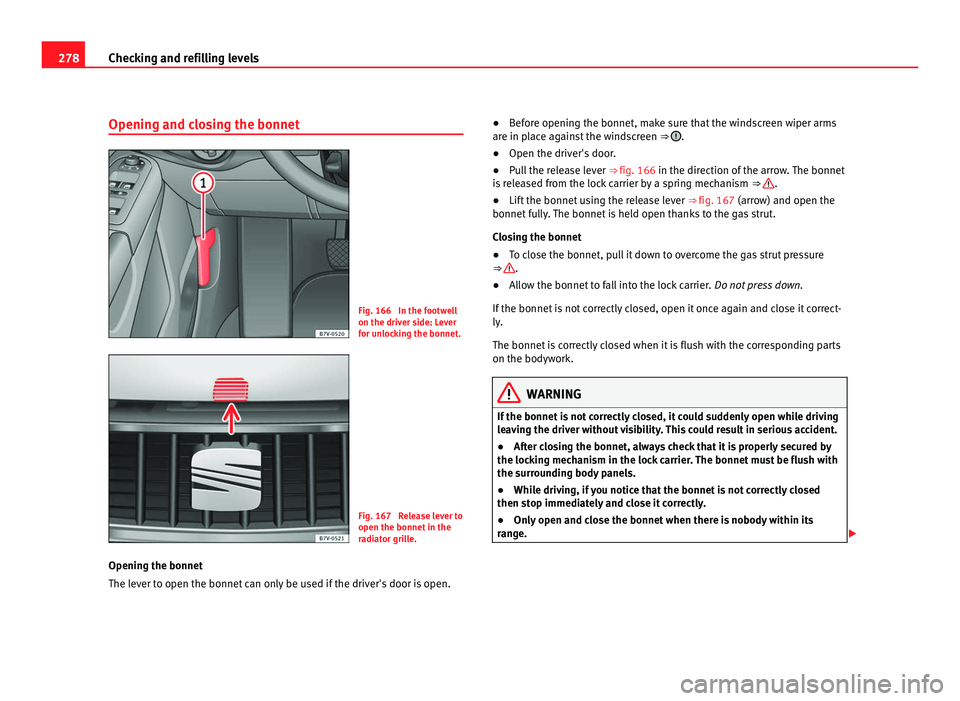
Opening and closing the bonnet Fig. 166 In the footwell
on the driver s
ide: L
ever
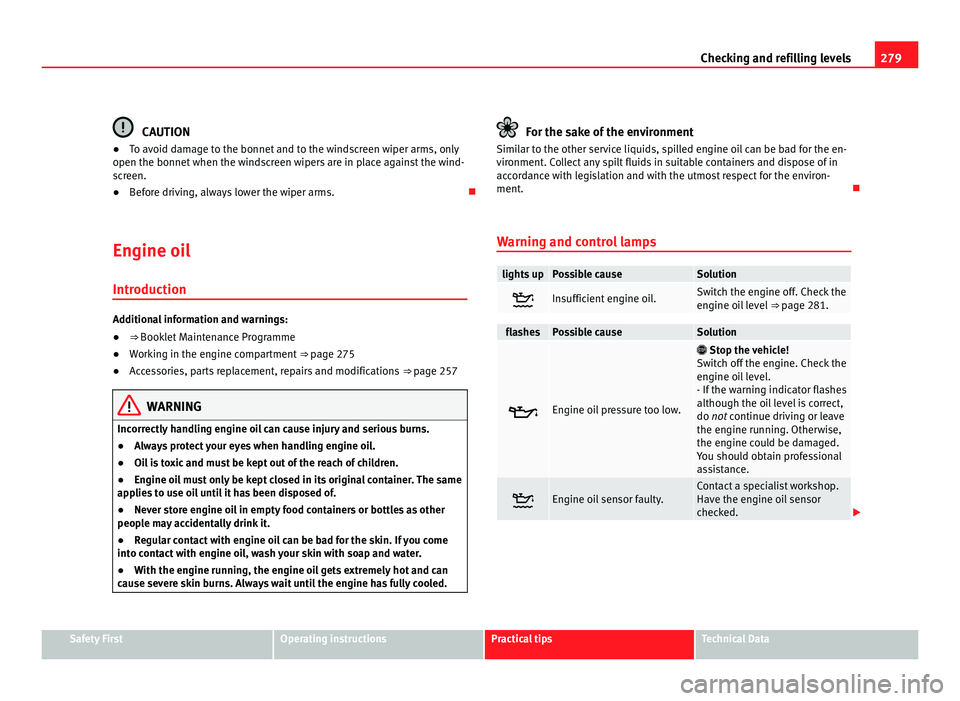
for unlocking the bonnet. Fig. 167 Release lever to
open the bonnet in the
r a
diator grille.
Opening the bonnet
The lever t
o open the bonnet can only be used if the driver's door is open. ●
Before opening the bonnet, make sure that the windscreen wiper arms
are in p
lace against the windscreen ⇒ .
● Open the driver's door.
● Pull the release lever ⇒ fig. 166 in the direction of the arr
ow. The bonnet
is released from the lock carrier by a spring mechanism ⇒ .
● Lift the bonnet using the release lever ⇒ fig. 167 (arrow) and open the
bonnet
fully. The bonnet is held open thanks to the gas strut.
Closing the bonnet
● To close the bonnet, pull it down to overcome the gas strut pressure
⇒ .
● Allow the bonnet to fall into the lock carrier. Do not pre
ss down.
If the bonnet is not correctly closed, open it once again and close it correct-
ly.
The bonnet is correctly closed when it is flush with the corresponding parts
on the bodywork. WARNING
If the bonnet is not correctly closed, it could suddenly open while driving
le av
ing the driver without visibility. This could result in serious accident.
● After closing the bonnet, always check that it is properly secured by
the lockin
g mechanism in the lock carrier. The bonnet must be flush with
the surrounding body panels.
● While driving, if you notice that the bonnet is not correctly closed
then stop immedi
ately and close it correctly.
● Only open and close the bonnet when there is nobody within its
rang
e.
Page 281 of 385
279
Checking and refilling levels CAUTION
● To avoid damage to the bonnet and to the windscreen wiper arms, only
open the bonnet when the w
indscreen wipers are in place against the wind-
screen.
● Before driving, always lower the wiper arms.
Engine oil Introduction Additional information and warnings:
●
⇒ Book l
et Maintenance Programme
● W
orking in the engine compartment ⇒ page 275
● A
ccessories, parts replacement, repairs and modifications ⇒ page 257WARNING
Incorrectly handling engine oil can cause injury and serious burns.
● Always protect your eyes when handling engine oil.
● Oil is toxic and must be kept out of the reach of children.
● Engine oil must only be kept closed in its original container. The same
app lie
s to use oil until it has been disposed of.
● Never store engine oil in empty food containers or bottles as other
people m
ay accidentally drink it.
● Regular contact with engine oil can be bad for the skin. If you come
into cont
act with engine oil, wash your skin with soap and water.
● With the engine running, the engine oil gets extremely hot and can
cause sev
ere skin burns. Always wait until the engine has fully cooled. For the sake of the environment
Similar to the other service liquids, spilled engine oil can be bad for the en-
vir onment
. Collect any spilt fluids in suitable containers and dispose of in
accordance with legislation and with the utmost respect for the environ-
ment.
Warning and control lamps lights up Possible cause Solution
Insufficient engine oil. Switch the engine off. Check the
engine oi
l
level ⇒ page 281. flashes Possible cause Solution
Engine oil pressure too low.
Stop the vehicle!
Sw it
ch off the engine. Check the
engine oil level.
- If the warning indicator flashes
although the oil level is correct,
do not continue driving or leave
the engine running. Otherwise,
the engine could be damaged.
You should obtain professional
assistance. Engine oil sensor faulty. Contact a specialist workshop.
Have the en
gine oi
l sensor
checked. Safety First Operating instructions Practical tips Technical Data
Page 283 of 385
281
Checking and refilling levels
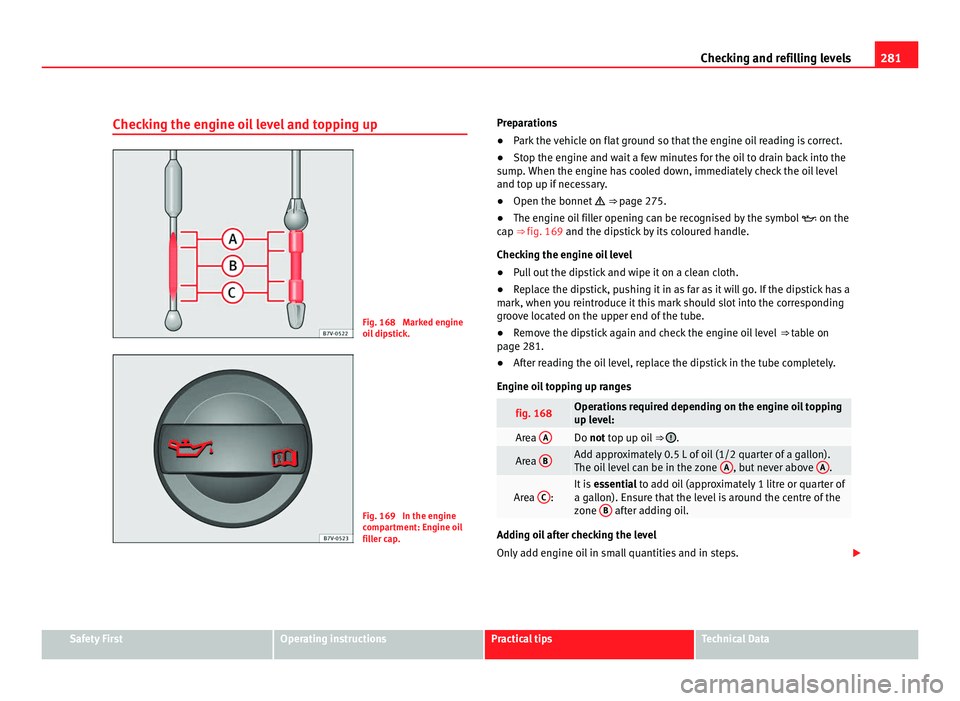
Checking the engine oil level and topping up Fig. 168 Marked engine
oil
dip
stick. Fig. 169 In the engine
comp
ar
tment: Engine oil
filler cap. Preparations
●
Park the vehicle on flat ground so that the engine oil reading is correct.
● Stop the engine and wait a few minutes for the oil to drain back into the
sump.
When the engine has cooled down, immediately check the oil level
and top up if necessary.
● Open the bonnet ⇒ p
age 275.
● The engine oil filler opening can be recognised by the symbol on the
cap ⇒
fig. 169 and the dipstick by its coloured handle.
Checking the engine oil level
● Pull out the dipstick and wipe it on a clean cloth.
● Replace the dipstick, pushing it in as far as it will go. If the dipstick has a
mark, when y
ou reintroduce it this mark should slot into the corresponding
groove located on the upper end of the tube.
● Remove the dipstick again and check the engine oil level ⇒ tabl
e on
page 281.
● After reading the oil level, replace the dipstick in the tube completely.
Engine oil
topping up ranges fig. 168 Operations required depending on the engine oil topping
up lev
el: Area
A Do not top up oil
⇒ .
Area
B Add approximately 0.5 L of oil (1/2 quarter of a gallon).
The oil
l
evel can be in the zone A , but never above
A .
Area
C : It is
essential to add oil (approximately 1 litre or quarter of
a g al
lon). Ensure that the level is around the centre of the
zone B after adding oil.
Adding oil after checking the level
Only
a
dd engine oil in small quantities and in steps. Safety First Operating instructions Practical tips Technical Data
Page 288 of 385
286
Checking and refilling levels
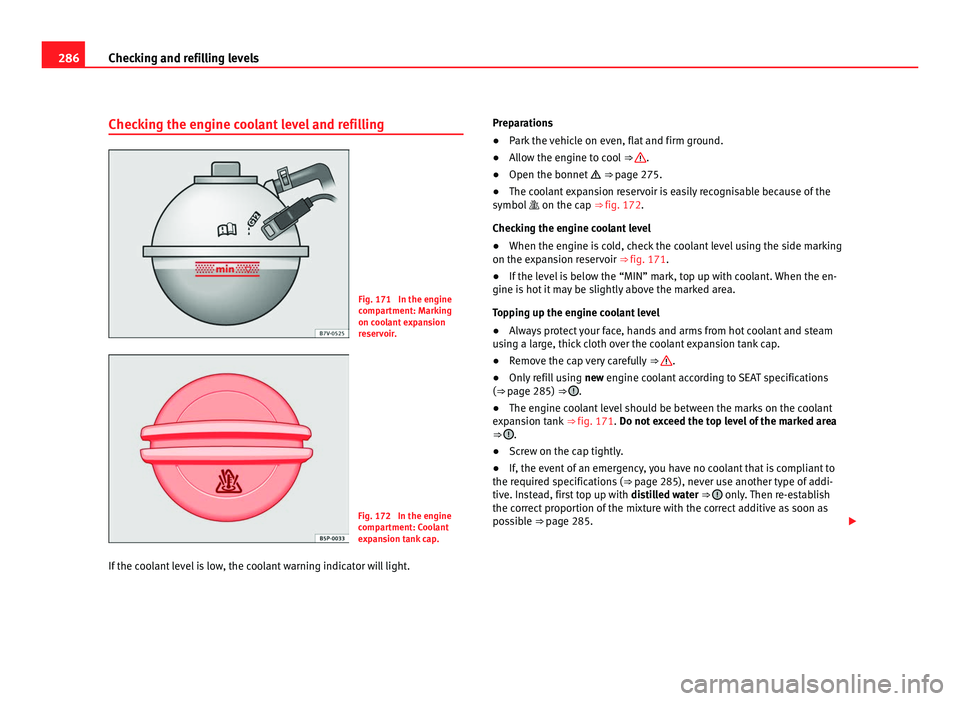
Checking the engine coolant level and refilling Fig. 171 In the engine
comp
ar
tment: Marking
on coolant expansion
reservoir. Fig. 172 In the engine
comp
ar
tment: Coolant
expansion tank cap.
If the coolant level is low, the coolant warning indicator will light. Preparations
●
Park the vehicle on even, flat and firm ground.
● Allow the engine to cool ⇒ .
● Open the bonnet ⇒ p
age 275.
● The coolant expansion reservoir is easily recognisable because of the
symbol
on the cap ⇒ fig. 172.
Checking the engine coolant level
● When the engine is cold, check the coolant level using the side marking
on the expan
sion reservoir ⇒ fig. 171.
● If the level is below the “MIN” mark, top up with coolant. When the en-
gine is hot
it may be slightly above the marked area.
Topping up the engine coolant level
● Always protect your face, hands and arms from hot coolant and steam
usin
g a large, thick cloth over the coolant expansion tank cap.
● Remove the cap very carefully ⇒ .
● Only refill using new engine coo
lant according to SEAT specifications
(⇒ page 285) ⇒ .
● The engine coolant level should be between the marks on the coolant
exp an
sion tank ⇒ fig. 171. Do not exceed the top level of the marked area
⇒ .
● Screw on the cap tightly.
● If, the event of an emergency, you have no coolant that is compliant to
the requir ed s
pecifications ( ⇒ page 285), never use another type of addi-
tive. Instead, first top up with distilled water ⇒ only. Then re-establish
the corr ect
proportion of the mixture with the correct additive as soon as
possible ⇒ page 285.
Page 289 of 385
287
Checking and refilling levels WARNING
Hot vapours and coolant can cause serious burns.
● Never open the coolant expansion tank if steam or coolant is coming
from the en gine c
ompartment. Wait until you cannot see or hear any
steam or coolant escaping.
● Always wait until the engine has completely cooled before very care-
ful
ly opening the expansion tank cap. Contact with hot elements of the
engine can cause skin burns.
● Once the engine has cooled, follow the instructions below before
opening the bonnet:
–Turn on the el
ectronic parking brake and place the gear selector
lever in P or the g
ear stick in neutral.
– Remove the key from the ignition.
– Keep children away from the engine compartment and never leave
them uns
upervised.
● When the engine is warm or hot, the cooling system is pressurised!
Do not un
screw the cap on the expansion tank when the engine is hot.
Otherwise, coolant may spray out under pressure causing burns and seri-
ous injury.
–Carefully and slowly unscrew the cap anticlockwise, gently press-
ing down on it
.
– Always protect your face, hands and arms from hot coolant and
ste
am using a large, thick cloth.
● When refilling liquids, avoid spilling them on parts of the engine and
the exhau
st system. Spilled liquids could cause a fire. Under specific cir-
cumstances, the ethylene glycol can catch fire. CAUTION
● Top up with distilled water only. Any other type of water may lead to con-
s ider
able rusting in the engine due to its chemical components. This could
consequently damage the engine. If you have not used distilled water but
another type of water to top up the coolant, a specialist workshop must im-
mediately replace all of the fluid in the engine cooling system.
● Only top up coolant to the top level of the marked area ⇒ fig. 171. Other-
wi
se the excess coolant will be forced out of the cooling system when the
engine is hot, causing damage.
● If a lot of liquid coolant has been lost, wait for the engine to cool do
wn
completely before adding coolant. Extensive coolant loss is an indication of
leaks in the engine cooling system. Have the engine cooling system inspec-
ted immediately by a Technical Service. Otherwise you may damage the en-
gine.
● When refilling or changing service liquids, ensure that you put the liq-
uids int
o the right tank. Making a mistake when refilling could cause seri-
ous malfunctions and damage the engine! Safety First Operating instructions Practical tips Technical Data
Page 292 of 385
290
Checking and refilling levels
Checking the electrolyte level of the vehicle battery Fig. 173 In the engine
comp
ar
tment: Remove
the cover from the vehi-
cle's battery. Fig. 174 In the engine
comp
ar
tment: Unfold the
vehicle's battery hose.
The battery's electrolyte level should be checked regularly in high-mileage
vehicl
es, in hot countries and in older batteries. Other batteries do not re-
quire maintenance. Start-Stop systems (
⇒ page 196) ar
e equipped with a special battery label-
led “AGM”. For technical reasons, it is not possible to check the electrolyte
level of these batteries
Preparations
● Prepare the vehicle for work in the engine compartment ⇒ page 275
● Open the bonnet
⇒ p
age 275.
Opening the battery cover
The battery covers are different depending on the engine size of the vehicle:
● In the case of a cover: pres
s the tab ⇒ fig. 173 A in the direction of the
arro w and p
ull the cover upwards.
● In the case of a hose: fol
d the cover to one side to remove ⇒ fig. 174.
Checking the battery electrolyte level
● Make sure there is sufficient lighting to clearly recognise the colours.
Never use open fl
ames or sparklers as a light source.
● Depending on the level of acid, the Magic eye on the top of the battery
wil
l change colour. Colour indicator Necessary operations
light yellow
or col
-
ourless The electrolyte level of the vehicle's battery is too low.
Have the b
att
ery checked and, where applicable, re-
placed by a specialist workshop. Black indication The electrolyte level of the vehicle's battery is correct.
WARNING
Working with the vehicle battery involves a risk of corrosion, explosions
and electric shoc
k.
● Always wear protective gloves and eye protection.