open bonnet Seat Alhambra 2011 User Guide
[x] Cancel search | Manufacturer: SEAT, Model Year: 2011, Model line: Alhambra, Model: Seat Alhambra 2011Pages: 385, PDF Size: 7.92 MB
Page 281 of 385
279
Checking and refilling levels CAUTION
● To avoid damage to the bonnet and to the windscreen wiper arms, only
open the bonnet when the w
indscreen wipers are in place against the wind-
screen.
● Before driving, always lower the wiper arms.
Engine oil Introduction Additional information and warnings:
●
⇒ Book l
et Maintenance Programme
● W
orking in the engine compartment ⇒ page 275
● A
ccessories, parts replacement, repairs and modifications ⇒ page 257WARNING
Incorrectly handling engine oil can cause injury and serious burns.
● Always protect your eyes when handling engine oil.
● Oil is toxic and must be kept out of the reach of children.
● Engine oil must only be kept closed in its original container. The same
app lie
s to use oil until it has been disposed of.
● Never store engine oil in empty food containers or bottles as other
people m
ay accidentally drink it.
● Regular contact with engine oil can be bad for the skin. If you come
into cont
act with engine oil, wash your skin with soap and water.
● With the engine running, the engine oil gets extremely hot and can
cause sev
ere skin burns. Always wait until the engine has fully cooled. For the sake of the environment
Similar to the other service liquids, spilled engine oil can be bad for the en-
vir onment
. Collect any spilt fluids in suitable containers and dispose of in
accordance with legislation and with the utmost respect for the environ-
ment.
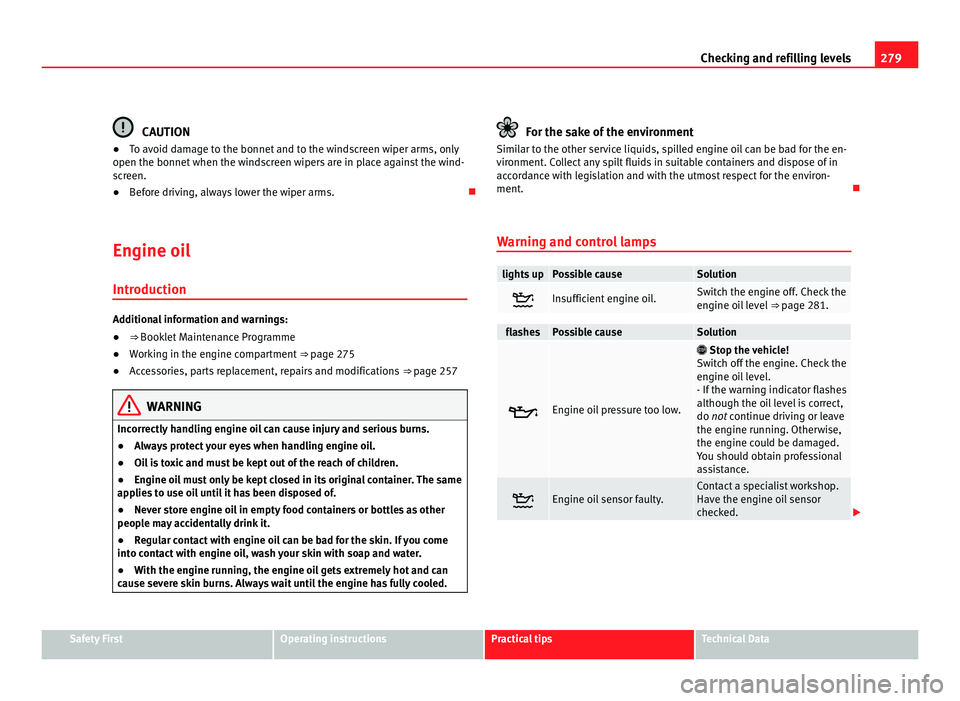
Warning and control lamps lights up Possible cause Solution
Insufficient engine oil. Switch the engine off. Check the
engine oi
l
level ⇒ page 281. flashes Possible cause Solution
Engine oil pressure too low.
Stop the vehicle!
Sw it
ch off the engine. Check the
engine oil level.
- If the warning indicator flashes
although the oil level is correct,
do not continue driving or leave
the engine running. Otherwise,
the engine could be damaged.
You should obtain professional
assistance. Engine oil sensor faulty. Contact a specialist workshop.
Have the en
gine oi
l sensor
checked. Safety First Operating instructions Practical tips Technical Data
Page 283 of 385
281
Checking and refilling levels
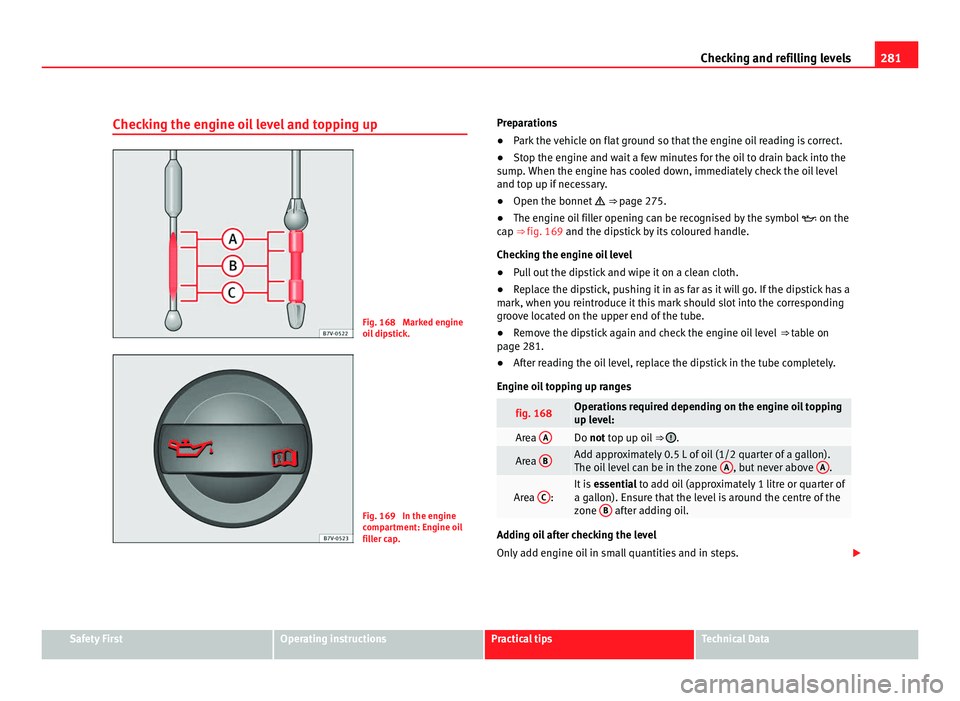
Checking the engine oil level and topping up Fig. 168 Marked engine
oil
dip
stick. Fig. 169 In the engine
comp
ar
tment: Engine oil
filler cap. Preparations
●
Park the vehicle on flat ground so that the engine oil reading is correct.
● Stop the engine and wait a few minutes for the oil to drain back into the
sump.
When the engine has cooled down, immediately check the oil level
and top up if necessary.
● Open the bonnet ⇒ p
age 275.
● The engine oil filler opening can be recognised by the symbol on the
cap ⇒
fig. 169 and the dipstick by its coloured handle.
Checking the engine oil level
● Pull out the dipstick and wipe it on a clean cloth.
● Replace the dipstick, pushing it in as far as it will go. If the dipstick has a
mark, when y
ou reintroduce it this mark should slot into the corresponding
groove located on the upper end of the tube.
● Remove the dipstick again and check the engine oil level ⇒ tabl
e on
page 281.
● After reading the oil level, replace the dipstick in the tube completely.
Engine oil
topping up ranges fig. 168 Operations required depending on the engine oil topping
up lev
el: Area
A Do not top up oil
⇒ .
Area
B Add approximately 0.5 L of oil (1/2 quarter of a gallon).
The oil
l
evel can be in the zone A , but never above
A .
Area
C : It is
essential to add oil (approximately 1 litre or quarter of
a g al
lon). Ensure that the level is around the centre of the
zone B after adding oil.
Adding oil after checking the level
Only
a
dd engine oil in small quantities and in steps. Safety First Operating instructions Practical tips Technical Data
Page 288 of 385
286
Checking and refilling levels
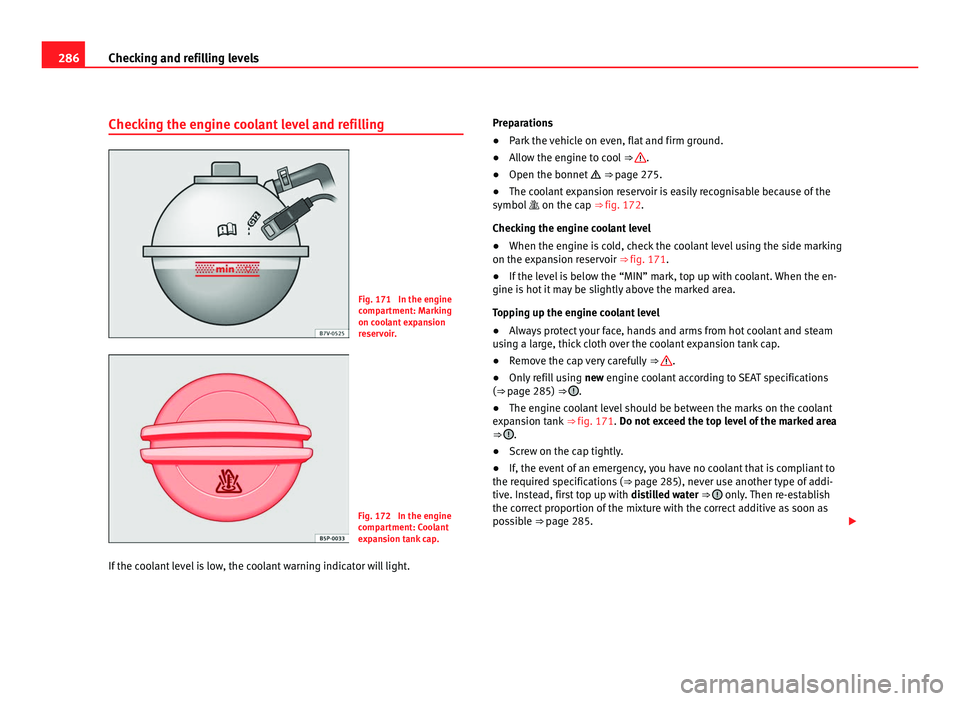
Checking the engine coolant level and refilling Fig. 171 In the engine
comp
ar
tment: Marking
on coolant expansion
reservoir. Fig. 172 In the engine
comp
ar
tment: Coolant
expansion tank cap.
If the coolant level is low, the coolant warning indicator will light. Preparations
●
Park the vehicle on even, flat and firm ground.
● Allow the engine to cool ⇒ .
● Open the bonnet ⇒ p
age 275.
● The coolant expansion reservoir is easily recognisable because of the
symbol
on the cap ⇒ fig. 172.
Checking the engine coolant level
● When the engine is cold, check the coolant level using the side marking
on the expan
sion reservoir ⇒ fig. 171.
● If the level is below the “MIN” mark, top up with coolant. When the en-
gine is hot
it may be slightly above the marked area.
Topping up the engine coolant level
● Always protect your face, hands and arms from hot coolant and steam
usin
g a large, thick cloth over the coolant expansion tank cap.
● Remove the cap very carefully ⇒ .
● Only refill using new engine coo
lant according to SEAT specifications
(⇒ page 285) ⇒ .
● The engine coolant level should be between the marks on the coolant
exp an
sion tank ⇒ fig. 171. Do not exceed the top level of the marked area
⇒ .
● Screw on the cap tightly.
● If, the event of an emergency, you have no coolant that is compliant to
the requir ed s
pecifications ( ⇒ page 285), never use another type of addi-
tive. Instead, first top up with distilled water ⇒ only. Then re-establish
the corr ect
proportion of the mixture with the correct additive as soon as
possible ⇒ page 285.
Page 289 of 385
287
Checking and refilling levels WARNING
Hot vapours and coolant can cause serious burns.
● Never open the coolant expansion tank if steam or coolant is coming
from the en gine c
ompartment. Wait until you cannot see or hear any
steam or coolant escaping.
● Always wait until the engine has completely cooled before very care-
ful
ly opening the expansion tank cap. Contact with hot elements of the
engine can cause skin burns.
● Once the engine has cooled, follow the instructions below before
opening the bonnet:
–Turn on the el
ectronic parking brake and place the gear selector
lever in P or the g
ear stick in neutral.
– Remove the key from the ignition.
– Keep children away from the engine compartment and never leave
them uns
upervised.
● When the engine is warm or hot, the cooling system is pressurised!
Do not un
screw the cap on the expansion tank when the engine is hot.
Otherwise, coolant may spray out under pressure causing burns and seri-
ous injury.
–Carefully and slowly unscrew the cap anticlockwise, gently press-
ing down on it
.
– Always protect your face, hands and arms from hot coolant and
ste
am using a large, thick cloth.
● When refilling liquids, avoid spilling them on parts of the engine and
the exhau
st system. Spilled liquids could cause a fire. Under specific cir-
cumstances, the ethylene glycol can catch fire. CAUTION
● Top up with distilled water only. Any other type of water may lead to con-
s ider
able rusting in the engine due to its chemical components. This could
consequently damage the engine. If you have not used distilled water but
another type of water to top up the coolant, a specialist workshop must im-
mediately replace all of the fluid in the engine cooling system.
● Only top up coolant to the top level of the marked area ⇒ fig. 171. Other-
wi
se the excess coolant will be forced out of the cooling system when the
engine is hot, causing damage.
● If a lot of liquid coolant has been lost, wait for the engine to cool do
wn
completely before adding coolant. Extensive coolant loss is an indication of
leaks in the engine cooling system. Have the engine cooling system inspec-
ted immediately by a Technical Service. Otherwise you may damage the en-
gine.
● When refilling or changing service liquids, ensure that you put the liq-
uids int
o the right tank. Making a mistake when refilling could cause seri-
ous malfunctions and damage the engine! Safety First Operating instructions Practical tips Technical Data
Page 292 of 385
290
Checking and refilling levels
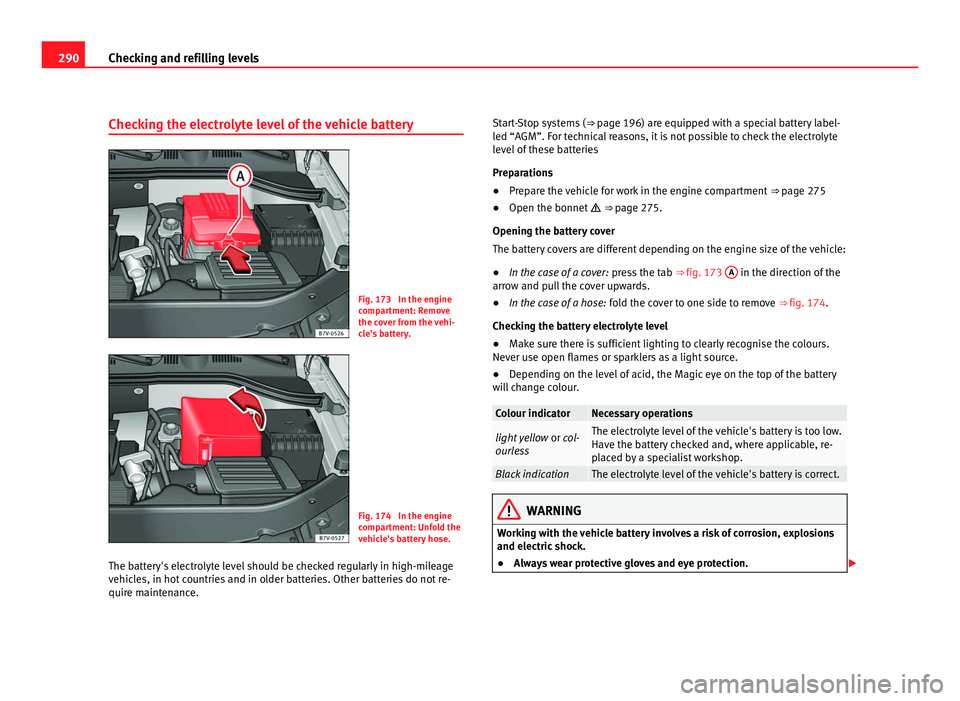
Checking the electrolyte level of the vehicle battery Fig. 173 In the engine
comp
ar
tment: Remove
the cover from the vehi-
cle's battery. Fig. 174 In the engine
comp
ar
tment: Unfold the
vehicle's battery hose.
The battery's electrolyte level should be checked regularly in high-mileage
vehicl
es, in hot countries and in older batteries. Other batteries do not re-
quire maintenance. Start-Stop systems (
⇒ page 196) ar
e equipped with a special battery label-
led “AGM”. For technical reasons, it is not possible to check the electrolyte
level of these batteries
Preparations
● Prepare the vehicle for work in the engine compartment ⇒ page 275
● Open the bonnet
⇒ p
age 275.
Opening the battery cover
The battery covers are different depending on the engine size of the vehicle:
● In the case of a cover: pres
s the tab ⇒ fig. 173 A in the direction of the
arro w and p
ull the cover upwards.
● In the case of a hose: fol
d the cover to one side to remove ⇒ fig. 174.
Checking the battery electrolyte level
● Make sure there is sufficient lighting to clearly recognise the colours.
Never use open fl
ames or sparklers as a light source.
● Depending on the level of acid, the Magic eye on the top of the battery
wil
l change colour. Colour indicator Necessary operations
light yellow
or col
-
ourless The electrolyte level of the vehicle's battery is too low.
Have the b
att
ery checked and, where applicable, re-
placed by a specialist workshop. Black indication The electrolyte level of the vehicle's battery is correct.
WARNING
Working with the vehicle battery involves a risk of corrosion, explosions
and electric shoc
k.
● Always wear protective gloves and eye protection.
Page 325 of 385
323
If and when
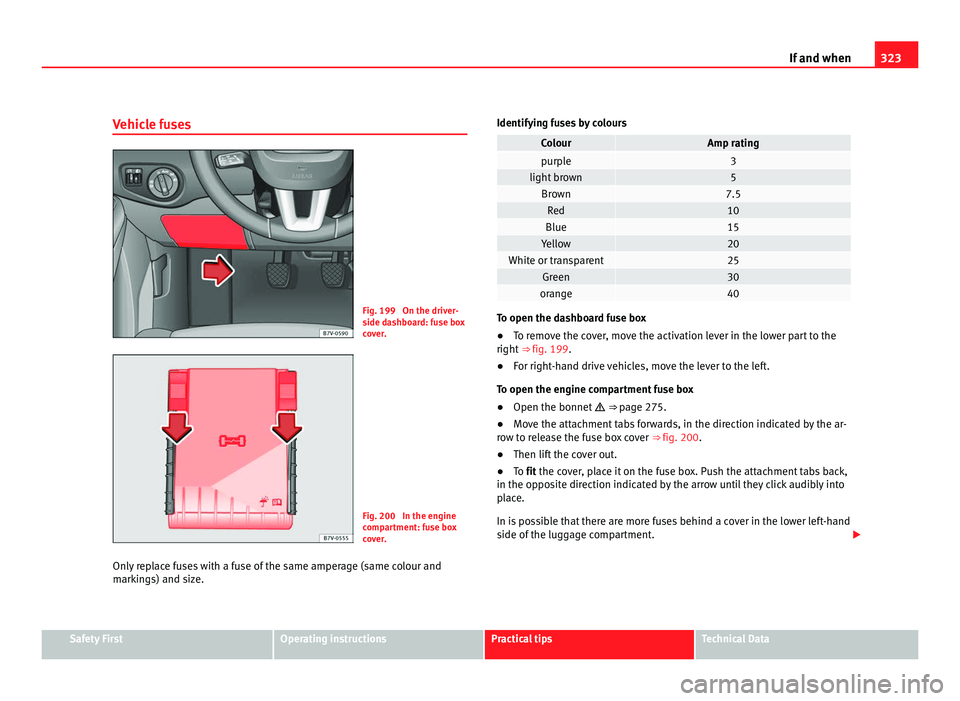
Vehicle fuses Fig. 199 On the driver-
side d
a
shboard: fuse box
cover. Fig. 200 In the engine
comp
ar
tment: fuse box
cover.
Only replace fuses with a fuse of the same amperage (same colour and
markin
gs) and size. Identifying fuses by colours Colour Amp rating
purple 3
light brown 5
Brown 7.5
Red 10
Blue 15
Yellow 20
White or transparent 25
Green 30
orange 40
To open the dashboard fuse box
●
To remove the cover, move the activation lever in the lower part to the
right ⇒ fig. 199 .
● F
or right-hand drive vehicles, move the lever to the left.
To open the engine c
ompartment fuse box
● Open the bonnet ⇒ pag
e 275.
● Move the attachment tabs forwards, in the direction indicated by the ar-
row t
o release the fuse box cover ⇒ fig. 200.
● Then lift the cover out.
● To fit the cover, place it on the fuse box. Push the attachment tabs back,
in the oppo
site direction indicated by the arrow until they click audibly into
place.
In is possible that there are more fuses behind a cover in the lower left-hand
side of the luggage compartment. Safety First Operating instructions Practical tips Technical Data
Page 330 of 385
328
If and when WARNING
Failure to follow the checklist prepared for your own safety could lead to
acc ident
s and severe injuries.
● Always complete the operations given in the checklist and observe
the genera
l rules of safety. CAUTION
Always remove and fit headlights carefully to avoid damage to the paint-
work and other
vehicle parts.
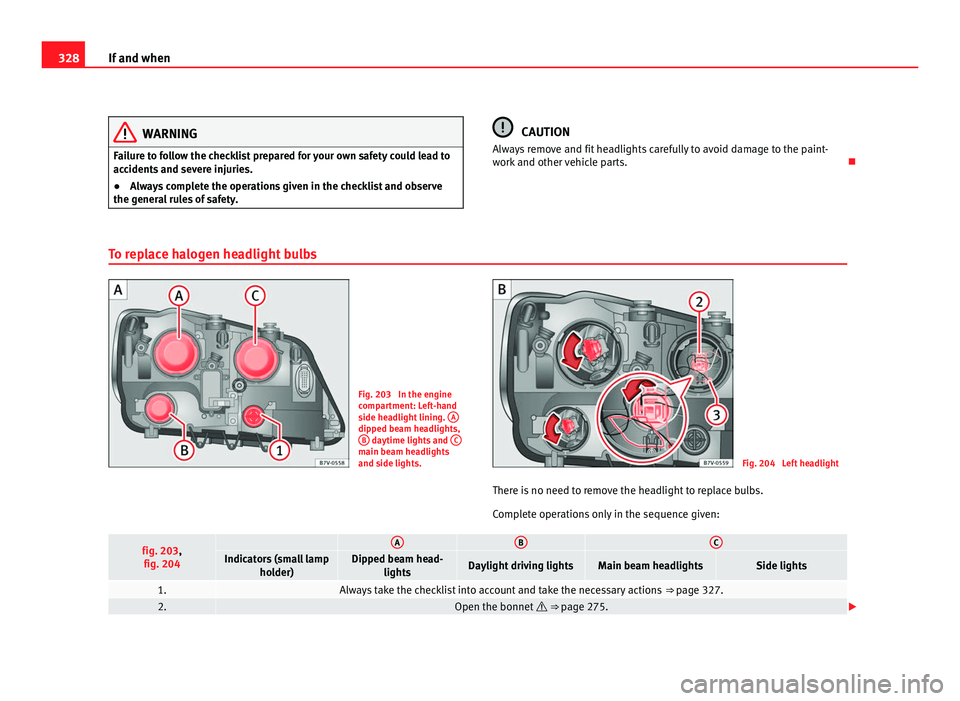
To replace halogen headlight bulbs Fig. 203 In the engine
comp
ar
tment: Left-hand
side headlight lining. A dipped beam headlights,
B daytime lights and
C main beam headlights
and side light
s. Fig. 204 Left headlight
There is no need to remove the headlight to replace bulbs.
Comp l
ete operations only in the sequence given: fig. 203,
fig. 204 A B C
Indicators (small lamp
holder) Dipped beam head-
lights Daylight driving lights Main beam headlights Side lights
1. Always take the checklist into account and take the necessary actions
⇒ pag
e 327.2. Open the bonnet
⇒ page 275.
Page 332 of 385
330
If and when
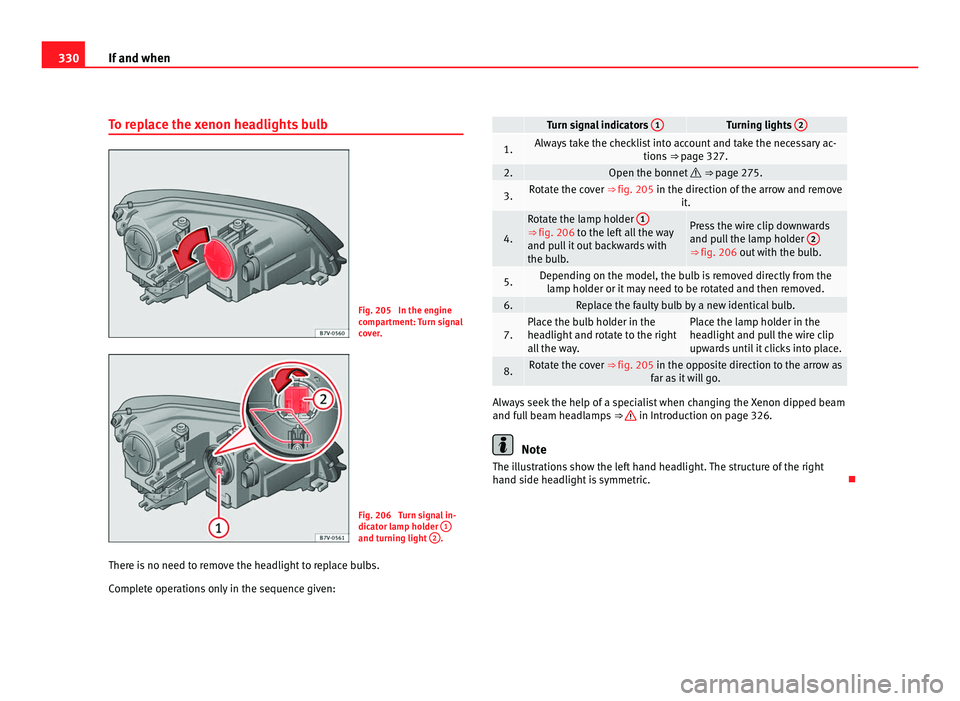
To replace the xenon headlights bulb Fig. 205 In the engine
comp
ar
tment: Turn signal
cover. Fig. 206 Turn signal in-
dicat
or l
amp holder 1 and turning light
2 .
There is no need to remove the headlight to replace bulbs.
Comp l
ete operations only in the sequence given: Turn signal indicators
1 Turning lights
2 1. Always take the checklist into account and take the necessary ac-
tions ⇒
page 327. 2. Open the bonnet
⇒ page 275. 3. Rotate the cover ⇒
fig. 205 in the dir
ection of the arrow and remove
it. 4. Rotate the lamp holder
1 ⇒ fig. 206 to the left all the way
and p
u
ll it out backwards with
the bulb. Press the wire clip downwards
and pu
l
l the lamp holder 2 ⇒ fig. 206 out w
ith the b
ulb. 5. Depending on the model, the bulb is removed directly from the
lamp ho l
der or it may need to be rotated and then removed. 6. Replace the faulty bulb by a new identical bulb.
7. Place the bulb holder in the
hea
dlight
and rotate to the right
all the way. Place the lamp holder in the
hea
dlight
and pull the wire clip
upwards until it clicks into place. 8. Rotate the cover ⇒
fig. 205 in the op
posite direction to the arrow as
far as it will go. Always seek the help of a specialist when changing the Xenon dipped beam
and fu
l
l beam headlamps ⇒ in Introduction on page 326.
Note
The illustrations show the left hand headlight. The structure of the right
hand s ide he
adlight is symmetric.
Page 347 of 385
345
General notes on the technical data
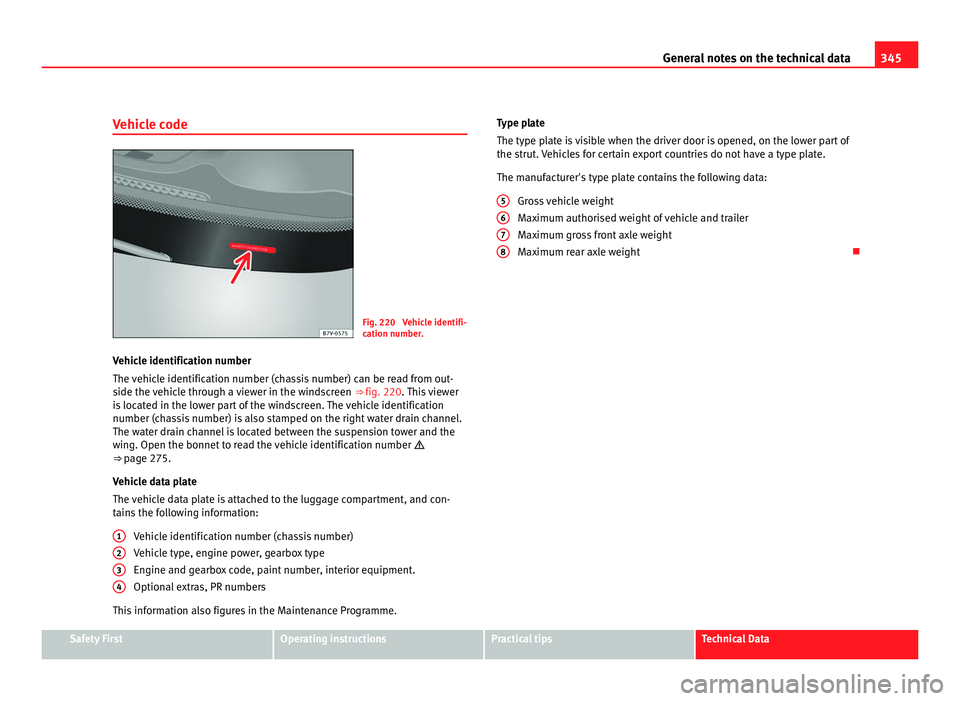
Vehicle code Fig. 220 Vehicle identifi-
cation number
.
V
ehicle identification number
The vehic
le identification number (chassis number) can be read from out-
side the vehicle through a viewer in the windscreen ⇒ fig. 220. This viewer
is located in the lower part of the windscreen. The vehicle identification
number (chassis number) is also stamped on the right water drain channel.
The water drain channel is located between the suspension tower and the
wing. Open the bonnet to read the vehicle identification number
⇒ page 275.
Vehicle data plate
The vehicle data plate is attached to the luggage compartment, and con-
tains the following information:
Vehicle identification number (chassis number)
Vehicle type, engine power, gearbox type
Engine and gearbox code, paint number, interior equipment.
Optional extras, PR numbers
This information also figures in the Maintenance Programme. 1 2
3
4 Type plate
The type pl
at
e is visible when the driver door is opened, on the lower part of
the strut. Vehicles for certain export countries do not have a type plate.
The manufacturer's type plate contains the following data:
Gross vehicle weight
Maximum authorised weight of vehicle and trailer
Maximum gross front axle weight
Maximum rear axle weight 5
6
7
8
Safety First Operating instructions Practical tips Technical Data
Page 368 of 385
ASR
See "Brak in
g assist systems" . . . . . . . . . . 191
See "Braking assist" . . . . . . . . . . . . . . . . . 190
Turning on and off . . . . . . . . . . . . . . . . . . . 191
Assistance systems . . . . . . . . . . . . . . . . . . . . . 212 Cruise control . . . . . . . . . . . . . . . . . . . . . . . 212
Electronic differential lock system (EDS) . 190
Assisted braking systems . . . . . . . . . . . . . . . . 189
Assist systems Anti-lock brake system (ABS) . . . . . . . . . . 189
Auto Hold . . . . . . . . . . . . . . . . . . . . . . . . . . 194
Braking assist . . . . . . . . . . . . . . . . . . . . . . . 190
Electronic stability programme ESC (ESP) 189
Lane Assist . . . . . . . . . . . . . . . . . . . . . . . . . 215
Lane Assist system . . . . . . . . . . . . . . . . . . . 215
Optical parking system . . . . . . . . . . . . . . . 200
Park assist . . . . . . . . . . . . . . . . . . . . . . . . . 199
Park Assist . . . . . . . . . . . . . . . . . . . . . . . . . 202
Park Assist system . . . . . . . . . . . . . . . . . . . 202
Parking sensor system . . . . . . . . . . . . . . . . 199
Rear Assist . . . . . . . . . . . . . . . . . . . . . . . . . 207
Rear assist system . . . . . . . . . . . . . . . . . . . 207
Sign Assist . . . . . . . . . . . . . . . . . . . . . . . . . 218
Start-Stop . . . . . . . . . . . . . . . . . . . . . . . . . . 196
Start assist . . . . . . . . . . . . . . . . . . . . . . . . . 194
Traction control system ASR (TCS) . . . . . . . 191
Traction control when accelerating ASR(TCS) . . . . . . . . . . . . . . . . . . . . . . . . . . . . . 190
Tyre monitoring indicator . . . . . . . . . . . . . . 223
Auto Hold . . . . . . . . . . . . . . . . . . . . . . . . . . . . . 194
Automatic belt retainer . . . . . . . . . . . . . . . . . . . 26 Automatic car wash . . . . . . . . . . . . . . . . . . . . . 243
Switc hing Auto Hold off . . . . . . . . . . . . . . . 195
Switching the start assist off . . . . . . . . . . . 195
Automatic consumer disconnection . . . . . . . . 291
Automatic dipped beam control . . . . . . . . . . . . 99
Automatic gearbox . . . . . . . . . . . . . . . . . . . . . . 174 Changing gear . . . . . . . . . . . . . . . . . . . . . . 178
Driving . . . . . . . . . . . . . . . . . . . . . . . . . . . . . 180
DSG automatic gearbox . . . . . . . . . . . . . . . 180
Ignition key lock . . . . . . . . . . . . . . . . . . . . . 172
Kickdown system . . . . . . . . . . . . . . . . . . . . 180
Launch-Control programme . . . . . . . . . . . . 180
Malfunction . . . . . . . . . . . . . . . . . . . . . . . . 181
Manually unlocking the gear selection lev-er . . . . . . . . . . . . . . . . . . . . . . . . . . . . . . . 319
Please also see "Changing gears" . . . . . . 174
See "Automatic gearbox" . . . . . . . . . . . . . . 174
Towing . . . . . . . . . . . . . . . . . . . . . . . . . . . . . 341
AUX-IN connection . . . . . . . . . . . . . . . . . . . . . . 141
Auxiliary heater . . . . . . . . . . . . . . . . . . . . 163, 269 Automatic off . . . . . . . . . . . . . . . . . . . . . . . 265
Operating instructions . . . . . . . . . . . . . . . . 166
Programming . . . . . . . . . . . . . . . . . . . . . . . 165
Remote control . . . . . . . . . . . . . . . . . . . . . . 164
Remote control range . . . . . . . . . . . . . . . . . 165
Remote control: Replacing the battery . . . 164
Switching off . . . . . . . . . . . . . . . . . . . . . . . . 163
Switching on . . . . . . . . . . . . . . . . . . . . . . . . 163
Things to note . . . . . . . . . . . . . . . . . . . 163, 166
Auxiliary heater remote control Replacing the battery . . . . . . . . . . . . . . . . . 164
Axle loads . . . . . . . . . . . . . . . . . . . . . . . . . . . . . . 15 B
BAS
See "Brak
ing assist systems" . . . . . . . . . . 190
Battery Discharge . . . . . . . . . . . . . . . . . . . . . . . . . . 166
Discharging . . . . . . . . . . . . . . . . . . . . . . . . 313
See Vehicle battery . . . . . . . . . . . . . . . . . . 288
Battery acid . . . . . . . . . . . . . . . . . . . . . . . . . . . . 290
Before starting out . . . . . . . . . . . . . . . . . . . . . . . . 7
Belt height adjustment . . . . . . . . . . . . . . . . . . . 26
Belt tension device . . . . . . . . . . . . . . . . . . . . . . . 26 Disposal . . . . . . . . . . . . . . . . . . . . . . . . . . . . 27
Service and disposal . . . . . . . . . . . . . . . . . . 27
Belt tension limiter . . . . . . . . . . . . . . . . . . . . . . . 26
Bicycle carrier Installing a bicycle carrier . . . . . . . . . . . . . 235
Maximum load . . . . . . . . . . . . . . . . . . . . . . 235
Biodiesel . . . . . . . . . . . . . . . . . . . . . . . . . . . . . . 270
Bonnet Closing . . . . . . . . . . . . . . . . . . . . . . . . . . . . 278
Opening . . . . . . . . . . . . . . . . . . . . . . . . . . . 278
Bottle capacity Windscreen washer water bottle . . . . . . . . 109
Bottle holders . . . . . . . . . . . . . . . . . . . . . . . . . . 148
Brake . . . . . . . . . . . . . . . . . . . . . . . . . . . . . . . . . 183 Brake servo . . . . . . . . . . . . . . . . . . . . . . . . . 187
Electronic parking brake . . . . . . . . . . . . . . 185
Emergency braking function . . . . . . . . . . . 186
Parking brake . . . . . . . . . . . . . . . . . . . . . . . 185
Brake fluid . . . . . . . . . . . . . . . . . . . . . . . . . . . . 191 Specification . . . . . . . . . . . . . . . . . . . . . . . . 192366
Index