weight Seat Alhambra 2011 User Guide
[x] Cancel search | Manufacturer: SEAT, Model Year: 2011, Model line: Alhambra, Model: Seat Alhambra 2011Pages: 385, PDF Size: 7.92 MB
Page 43 of 385
41
Child safety
Specific child seat regulations for each country (selection) Regulation Further information
ECE-R 44
a) Technical Service or qualified work-
shop
a)
ECE-R: Economic Commi ssion for Europe Regulation.
Categorisation of child seats according to ECE-R 44 Weight cate-
gory Weight of the
chil
d Installation of the child seat
Group 0 children up to 10
kg Rear-facing. On rear seats, optionally
usin
g the ISOFIX system. Group 0+ children up to 13
kg Group 1 9 to 18 kg Forward-facing. On rear seats, optional-
ly us
ing the ISOFIX system. Group 2 15 to 25 kg Forward-facing. On the outer rear seats
or in the centr e se
at of the second row
of seats and on all seats in the third row. Optionally with ISOFIX system. Group 3 22 to 36 kg Forward-facing.
Not all children fit in the seat of their weight group. Nor do all seats adapt to
the v
ehic
le. Therefore, always check whether the child fits properly in the
child seat and whether the seat can be installed safely in the vehicle.
The rear seats are suitable for child seats with the ISOFIX system specially
designed for this type of vehicle in accordance with regulation ECE-R 44.
Child seats approved under the ECE-R 44 regulation are fitted with the corre-
sponding approval symbol. The sign is an upper-case E in a circle with the
identification number below it. WARNING
Not following the checklist prepared for your own safety could lead to ac-
cident s
and severe injuries.
● Always follow the check list and perform the necessary operations. WARNING
In general, the rear seat is always the safest place for correctly belted in
chil
dren in the event of an accident.
● A suitable child seat that is correctly installed and used on one of the
rear se
ats offer the most protection possible for babies and small chil-
dren in most accidents. Note
Other accessories may be required to fit the child retention system with a
ba se or f
oot security and safely. Contact a specialist or qualified workshop. Safety First Operating instructions Practical tips Technical Data
Page 45 of 385
43
Child safety
Suitable child seats
The chi l
d seat must be authorised by the manufacturer especially for use on
a front passenger seat with a frontal or side airbag.
If the front passenger seat is equipped with retaining rings, the child seat
can be secured using the approved retaining system provided it is approved
for this type of vehicle in accordance with current regulations in the country
in question.
Universal seats for children in groups 0, 0+, 1, 2 or 3 according to the ECE-
R 44 regulation. WARNING
If a child seat is mounted on the front passenger seat, the risk of the
chi l
d sustaining severe or fatal injuries in the event of an accident increa-
ses. Rear-facing child seats must never be mounted on the front passen-
ger seat when the front passenger airbag is enabled. This is life-threaten-
ing to the child should the frontal airbag deploy, as the child seat would
be struck by the inflated airbag and thrown against the backrest. WARNING
If, in exceptional circumstances, a child must be transported in a rear-fac-
ing c hi
ld seat on the front passenger seat, strictly observe the following:
● Always disable the front passenger airbag and leave it disabled.
● The child seat must be approved by the manufacturer for use on a
front p
assenger seat with frontal and side airbag.
● Follow the installation instructions of the child seat manufacturer and
obser
ve the warnings.
● Move the front passenger seat as far back as possible and adjust it to
its highe
st position to keep as far away as possible from the frontal air-
bag. WARNING (Continued)
● Move the backrest to the upright position.
● The se
at
belt height adjustment must be as high as possible.
● Children must always be protected with an approved child restraint
syst
em suited to their height and weight.
Use of the child seat on the rear seat If a child seat is mounted on the rear seat, adapt the position of the front
pa
s
senger seat so that the child has enough space. Therefore, adapt the
front passenger seat to the size of the child seat and the height of the child.
Ensure the passenger is in the correct position ⇒ page 10.
Move the second and third row of seats fully back and lock them. Place the
seat backs in a vertical position and fold the armrests down.
ISOFIX child seats approved for rear seats
The rear seats are suitable for child seats with the ISOFIX system specially
designed for this type of vehicle in accordance with regulation ECE-R 44.
ISOFIX child seats are divided into “specific categories for the vehicle”,
“limited” or “semi-universal”.
Child seat manufacturers supply a list of vehicles with each ISOFIX seat,
which includes the models for which the ISOFIX child seat in question is ap-
proved. If the vehicle is included in the manufacturer's list and the ISOFIX
child seat belongs to a seat category included in the list, then it can be
used in your vehicle. If necessary, contact the child seat manufacturer for an
updated list of vehicles. Safety First Operating instructions Practical tips Technical Data
Page 46 of 385
44
Child safety Group (weight
cat e
gory) ISOFIX child seat cate-
gory Seat position on the rear seats
Group 0: chil-
dr en up t
o 10 kg E IUF
a) Group 0+: chil-
dr en up t
o 13 kg E IUF
a) D IUF
a) C IUF
a) Group 1: 9 to 18
kg D IUF
a) C IUF
a) B IUF
a) B1 IUF
a) A IUF
a) a)
IUF: suitable for “universal” ISOFIX child seats authorised for use in this group. WARNING
If child seats are fitted to all the seats in the second row then it is possi-
bl e th
at the seats of this row cannot be folded down from the third row of
seats in case of an accident. In case of an emergency, passengers in the
third row of seats will not be able to leave the vehicle or to help them-
selves.
● Child seats should not occupy all the seats of the second row if other
pas
sengers are to occupy the third row of seats.
Securing child seats with the seat belt Securing the child seat using the seat belt
●
Please read and observe the child seat manufacturer's handling instruc-
tions.
● Po
sitioning the child seat on the seat according to the manufacturer's
instruction
s. ●
The seat belt height adjustment must be as high as possible.
● Fa
sten the seat belt or pass it around the child seat structure in the man-
ner desc
ribed in the manufacturer's instructions.
● Make sure the seat belt is not twisted.
● Insert the latch plate into the buckle for the appropriate seat and push it
down unti
l it is securely locked with an audible click.
● Ensure that the upper belt web lies tightly on the child seat.
● Pull the belt (it must be no longer possible to pull the lower belt web-
bing out).
R
emoving the child seat
The seat belt must not be unfastened until the vehicle has come to a stand-
still ⇒ .
● Press the red button on the buckle. The latch plate is released from the
buc k
le.
● Guide the belt back by hand so that it rolls up easily and the trim will not
be damag
ed.
● Remove the child seat from the vehicle. WARNING
Unbuckling the seat belt while the vehicle is in motion can cause severe
or fat a
l injuries in the event of an accident or sudden braking.
● The seat belt must not be unfastened until the vehicle has come to a
stand
still.
Page 48 of 385
46
Child safety
● Hook the upper retaining strap to the corresponding retaining ring (for
T OP
TETHER) on the back of the backrest on the rear seat ⇒ fig. 28.
● Push the head restraint down as far as it will go. Ensure that it does not
interf
ere with the seatbelt from the upper attachment.
● Tighten the strap so that the top of the child seat rests on the backrest. WARNING
Child seats with lower anchor points and with an upper retaining strap
mus t
be installed in line with the manufacturer's instructions. Failure to
comply could result in severe injuries.
● Always secure just one r
etaining strap from a child seat to a retaining
ring (for TOP TETHER) on backrest on the rear seat in the luggage com-
partment.
● Never secure a child seat to the retaining rings.
● Never secure a child seat to the movable attachment elements for ve-
hicle
s with an attachment element and rail system .
Integrated child seat Introduction The integrated child seat is only suitable for children in Group 2 (15-25 kg)
and Group 3 (22-36 k
g), ac
cording to the ECE-R 44 regulation.
Additional information and warnings:
● Seat belts ⇒ pag
e 21 WARNING
Child travelling without their seat belt fastened or not secured using a
suit ab
le restraint system may sustain fatal injuries if the airbag is de-
ployed.
● You should always transport all children up to 12 years of age on the
rear se
at.
● Always disable the front passenger airbag if, in exceptional cases,
you hav
e no alternative but to transport a child in a rear-facing child safe-
ty seat on the front passenger seat.
● Children must always be protected with a child restraint system suit-
ed to their height and w
eight.
● Always fasten children's seat belts correctly. WARNING
Children must travel in a child seat appropriate to their weight and
height whi l
e the vehicle is in motion.
● Children must always be protected with a child restraint system suit-
ed to their height and w
eight.
● Children must assume the proper sitting position and be properly bel-
ted in whil
e travelling.
● The shoulder part of the seat belt must lie approximately on the cen-
tre of the shou
lder, never across the neck or the arm.
● The seat belt must lie close to the upper part of the body.
● The lap belt part must lie across the pelvis, not across the stomach,
and alwa
ys fit closely.
● Allow the belt to retract until it fits tightly over the child's seat.
● Never hold children or babies on your lap.
Page 86 of 385
84
Unlocking and locking WARNING
When the electric child safety function is activated, the sliding door can
be opened from the out s
ide only.
● Never leave children or disabled people alone in the vehicle if the
doors ar
e to be locked. Therefore, passengers will be locked inside the
vehicle. They could be trapped in the car in an emergency and will not be
able to get themselves to safety. Individuals locked in the vehicle can be
exposed to very high or very low temperatures.
● Depending on the time of the year, temperatures inside a locked and
closed
vehicle can be extremely high or extremely low resulting in seri-
ous injuries and illness or even death, particularly for young children.
Tailgate Introduction Additional information and warnings:
●
Central locking ⇒ page 74
● T
ransporting ⇒ page 13
● Emer
gency locking and unlocking ⇒ page 314WARNING
Careless and unsuitable locking, opening and closing of the tailgate can
cau se ac
cidents and serious injury.
● Open and close the tailgate only when nobody is in the way.
● Do not close the tailgate by pushing it down with your hand on the
rear w
indow. The rear window could break and cause injury. WARNING (Continued)
● Ensure the tailgate is locked after closing, otherwise, it may open un-
e xpect
edly while driving. A closed tailgate should be flush with the cor-
responding parts of the bodywork.
● Always keep the tailgate closed while driving to avoid toxic gases en-
tering the p
assenger compartment.
● Do not open the tailgate when there is a load carrier installed. Like-
wise, the t
ailgate cannot be opened when a load is attached to it, for ex-
ample bicycles. An open tailgate could close itself if there is an addition-
al weight on it. If necessary, press down on the tailgate and remove the
load.
● Close and lock both the tailgate and all the other doors when you are
not us
ing the vehicle. Ensure that nobody remains inside the vehicle.
● Never allow children to play inside or around the vehicle without su-
pervi
sion, especially if the tailgate is open. Children could enter the lug-
gage compartment, close the tailgate and become trapped. Depending
on the time of the year, temperatures inside a locked and closed vehicle
can be extremely high or extremely low resulting in serious injuries and
illness or even death, particularly for young children.
● Never leave children or disabled people alone in the vehicle. If the ve-
hicle k
ey or the central locking button is used, they may be locked in the
vehicle. CAUTION
Before opening the tailgate, ensure that there is sufficient free space to
open and clo se it, f
or example if you are towing a trailer or in a garage.
Page 142 of 385
140
Seats and storage compartments
The position holes are located on the inner side of the rail ⇒ fig. 101.WARNING
If the base supports and the roof carrier system are incorrectly fitted or
used in an u n
suitable manner, the entire system could break free causing
accident and injury.
● Always take the manufacturer assembly instructions into account.
● Only use base supports and roof carrier systems that are not dam-
aged and are c
orrectly fitted.
● The base support should only be fitted to the points indicated in the
diagram
⇒ fig. 101.
● Secure the base supports and roof carrier system correctly.
● Check the screw fittings and attachments before driving and after a
short di
stance. During each long journey, check the attachments during
every break.
● Always fit the roof carrier system correctly for wheels, skis and surf-
board
s.
● Never change or repair the basic supports or roof carrier system. Note
Read and take into account the instructions included with the roof carrier
sys t
em fitted and keep them in the vehicle.
Loading the roof carrier system Loads can only be correctly secured when the roof carrier system is correctly
fitted
⇒ .
Max imum authori
sed roof load
The maximum authorised roof load is 100 kg (about 220 lbs). The roof load
includes the roof carrier system and the load being transported ⇒ .Always check the roof carrier system weight and the weight of the load to be
tran
s
ported and, if necessary, weigh them. Never exceed the maximum au-
thorised roof load.
If you are using a roof carrier with a lower weight rating, you cannot trans-
port the maximum roof load. Do not exceed the maximum weight limit for
the roof carrier given in the fitting instructions.
Distributing a load
Uniformly distribute loads and secure them correctly ⇒ .
Check att
achments
After fitting the base supports and the roof carrier system, always check the
attachments after a short trip or at regular intervals. WARNING
Exceeding the maximum authorised roof load can result in accidents
and/or v ehic
le damage.
● Always respect the maximum authorised weight for the roof, the max-
imum authorised weight
on the axles and the total maximum authorised
weight of the vehicle.
● Never exceed the capacity of the roof carrier system even if this is
les
s than the maximum authorised roof load.
● Secure heavy objects towards the front and distribute the load even-
ly. WARNING
Loose and incorrectly secured loads can fall from the roof carrier system
cau s
ing accidents and injury.
● Always use suitable ropes and straps in good condition.
● Always secure loads correctly.
Page 214 of 385
212
Driving
Cruise control system*
Introduction The cruise control system (CCS) is able to maintain the set speed when driv-
ing f
or
wards from approx. 20 km/h (12 mph).
The CCS only slows down by reducing the accelerator but not by braking.
⇒ .
Addition a
l information and warnings:
● Changing gear ⇒ page 174
● A
ccessories, parts replacement, repairs and modifications ⇒ page 257WARNING
Use of the cruise control could cause accidents and severe injuries if it is
not po s
sible to drive at a constant speed maintaining the safety distance.
● Do not use the CCS in heavy traffic, if the distance from the vehicle in
front i
s insufficient, on steep roads, with several bends or in slippery cir-
cumstances (snow, ice, rain or loose gravel), or on flooded roads.
● Never use the CCS when driving off-road or on unpaved roads.
● Always adapt your speed and the distance to the vehicles ahead in
line with v
isibility, weather conditions, the condition of the road and the
traffic situation.
● To avoid unexpected operation of the cruise control system, turn it off
every
time you finish using it.
● It is dangerous to use a set speed which is too high for the prevailing
roa
d, traffic or weather conditions.
● When travelling down hills, the CCS cannot maintain a constant
speed. The
vehicle tends to accelerate under its own weight. Select a
lower gear or use the foot brake to slow the vehicle. Warning and control lamp
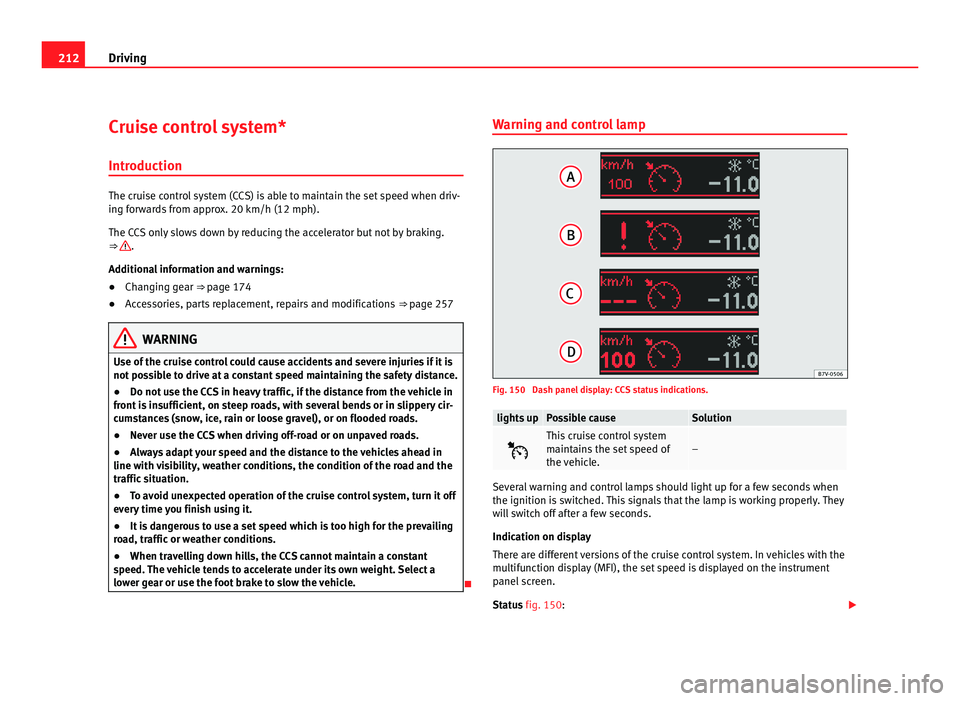
Fig. 150 Dash panel display: CCS status indications.
lights up Possible cause Solution
This cruise control system
maint
ain
s the set speed of
the vehicle. –
Several warning and control lamps should light up for a few seconds when
the ignition is
sw
itched. This signals that the lamp is working properly. They
will switch off after a few seconds.
Indication on display
There are different versions of the cruise control system. In vehicles with the
multifunction display (MFI), the set speed is displayed on the instrument
panel screen.
Status fig. 150:
Page 230 of 385
228
Driving and the environment
Avoid carrying unnecessary loads
The lighter the v
ehicle, the more economical and ecological the driving
style. For example, an additional weight of 100 kg will increase fuel con-
sumption up to 0.3 l/100 km.
Remove any unnecessary objects or loads from the vehicle.
Remove optional equipment and unnecessary accessories
The more aerodynamic the vehicle, the lower the fuel consumption. Option-
al equipment and accessories (such as roof racks or bike carriers) reduce
the aerodynamic benefits of the vehicle.
Therefore, we recommend you remove all optional and unnecessary equip-
ment and racks, especially if you intend to drive at high speeds.
Engine management and exhaust gas
purification sy
stem
Introduction Additional information and warnings:
●
Changing gear ⇒ p ag
e 174
● Refuelling ⇒ pag
e 264
● Fuel ⇒ page 267
● En
gine oil ⇒ pag
e 279
● Vehicle battery ⇒ pag
e 288
● Information stored in the control units ⇒ pag
e 257
● Tow-starting and towing away ⇒ pag
e 340 WARNING
The components of the exhaust system reach very high temperatures.
This c
ould cause a fire.
● Always park your vehicle so that no part of the exhaust system can
come in cont
act with flammable materials (such as dried grass).
● Do not apply additional underseal or anti-corrosion coatings to the
exhau
st pipes, catalytic converter, heat shields or the diesel particulate
filter.
Warning lamps lights up Possible cause Solution
Fault in engine management
(Electr
onic
Power Control). Take the vehicle to a Technical
Serv
ic
e as soon as possible and
have the engine checked. Pre-heating a diesel engine
befor
e s
tarting the engine. ⇒ page 170
Fault in catalytic converter. You should reduce speed ac-
cor
din
gly. Drive carefully until
you reach the next qualified
workshop. Have the engine
checked there. Diesel particulate filter
bloc
k
ed Drive for 15 minutes in 4th gear
(manual
g
earbox), or in D (auto-
matic gearbox) at a minimum
speed of 70 km/h (45 mph).
Observe speed limits ⇒ .
If the w arnin
g lamp remains lit
up, take the vehicle to a Techni-
cal Service ⇒ page 229.
Page 235 of 385
233
Trailer towing
Driving with a trailer Tec hnic
al requirements If the car is supplied with a
factor
y-fitted tow hitch it will already have the
necessary technical modifications and meet the statutory requirements for
towing a trailer.
Only use an approved trailer hitch for the gross trailer weight rating. The tow
hitch must be suitable for both the vehicle and trailer and must be securely
fitted to the vehicle chassis. Only use a tow hitch with a removable ball
joint. Always check and take into account the tow hitch manufacturer's in-
structions. Never fit a trailer tow hitch “that distributes the load” or “balan-
ces the load”.
Bumper mounted tow hitch
Never fit a tow hitch or its attachments to the bumper. A tow hitch should
never interfere with the bumper performance. Do not modify the exhaust
system and brake system. Regularly check the tow hitch to ensure it is firmly
fitted.
Engine cooling system
Driving with a trailer increases the load on the engine and cooling system.
The cooling system should always have sufficient coolant and to be able to
cope with the vehicle and trailer.
Electric trailer brake
If the trailer has its own braking system, please note the relevant legal re-
quirements. The trailer braking system should never be connected to the ve-
hicle braking system.
Trailer cable
Always use a cable between the vehicle and the trailer ⇒ page 235.Trailer rear lights
The rear lights
of a trailer must fulfil the corresponding standards
⇒ page 235.
Never connect the trailer's rear lights directly to the vehicle electric system.
In case of any doubt about the electrical connection of the trailer, ask a spe-
cialist workshop. SEAT recommends visiting a Technical Service.
Wing mirrors
When the field of vision behind the trailer cannot be seen using the stand-
ard wing mirrors of the towing vehicle, additional wing mirrors are required
according to the legal requirements of each country. The wing mirrors must
be fitted before driving and must provide a sufficient field of vision behind.
Trailer electricity consumption
Never exceed the specifications: Electrical consumer Maximum power
Position lights and rear lights 50 Watts
Indicator (each side) 54 Watts
Brake lights (total) 84 Watts
Reversing lights (total) 42 Watts
Rear fog light 42 Watts
WARNING
If the tow hitch is badly fitted or unsuitable, the trailer may separate from
the v ehic
le causing an accident with serious consequences. Safety First Operating instructions Practical tips Technical Data
Page 236 of 385
234
Trailer towing CAUTION
● If the rear lights of the trailer are not correctly connected, the vehicle
el ectr
onics may be damaged.
● If the trailer absorbs excessive electric current, the vehicle electronics
may
be damaged.
● Never connect the trailer's electric system to the electrical connections
of the re
ar lights or any other power sources. Only use suitable connections
for providing electric current to the trailer. Note
● Towing a trailer places additional demands on the vehicle. At SEAT, we
r ec
ommend additional services between the normal inspection intervals if
the vehicle is used frequently for towing a trailer.
● In some countries, an additional fire extinguisher is required if the trailer
weight i
s more than 2500 kg
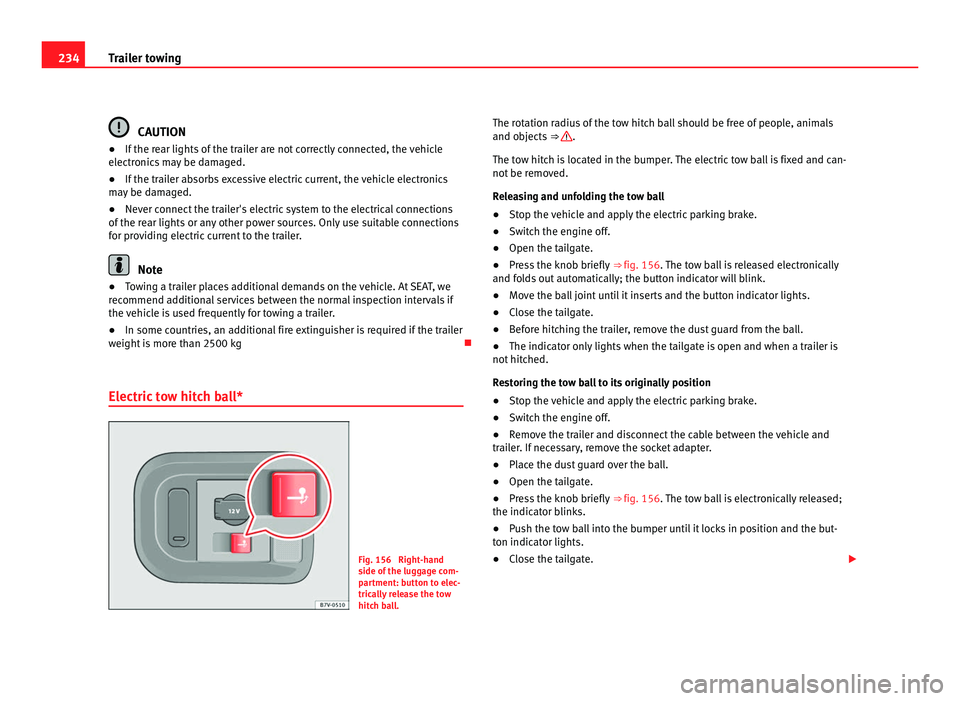
Electric tow hitch ball* Fig. 156 Right-hand
side of
the lug
gage com-
partment: button to elec-
trically release the tow
hitch ball. The rotation radius of the tow hitch ball should be free of people, animals
and obj
ects ⇒ .
The to w hit
ch is located in the bumper. The electric tow ball is fixed and can-
not be removed.
Releasing and unfolding the tow ball
● Stop the vehicle and apply the electric parking brake.
● Switch the engine off.
● Open the tailgate.
● Press the knob briefly ⇒ fig. 156. The to
w ball is released electronically
and folds out automatically; the button indicator will blink.
● Move the ball joint until it inserts and the button indicator lights.
● Close the tailgate.
● Before hitching the trailer, remove the dust guard from the ball.
● The indicator only lights when the tailgate is open and when a trailer is
not hitc
hed.
Restoring the tow ball to its originally position
● Stop the vehicle and apply the electric parking brake.
● Switch the engine off.
● Remove the trailer and disconnect the cable between the vehicle and
trail
er. If necessary, remove the socket adapter.
● Place the dust guard over the ball.
● Open the tailgate.
● Press the knob briefly ⇒ fig. 156. The to
w ball is electronically released;
the indicator blinks.
● Push the tow ball into the bumper until it locks in position and the but-
ton indicat
or lights.
● Close the tailgate.