weight Seat Alhambra 2011 Owner's Guide
[x] Cancel search | Manufacturer: SEAT, Model Year: 2011, Model line: Alhambra, Model: Seat Alhambra 2011Pages: 385, PDF Size: 7.92 MB
Page 238 of 385
236
Trailer towing
Trailer electric socket
The electric c
onnection between vehicle and trailer is a 13-pin socket. If the
trailer plug has seven pins, an adapter cable must be used.
Trailer rear lights
Check the trailer rear lights to ensure they work correctly and remain legal.
Ensure that the trailer does not use more than the maximum power
⇒ page 233.
Trailer connected to the antitheft alarm:
● When a vehicle comes from the factory fitted with an antitheft alarm and
tow hit
ch.
● When the trailer is connected to the vehicle using the socket.
● When the vehicle and trailer electrical systems work correctly and are
not dam
aged.
● When the vehicle is locked using the vehicle key and the antitheft alarm
is t
urned on.
When the vehicle is locked, the alarm is triggered when the electrical con-
nection between the vehicle and the trailer is removed.
Always turn off the anti-theft alarm system before connecting or disconnect-
ing a trailer. Otherwise, the tilt sensor may erroneously activate the alarm. WARNING
Erroneous or unsuitable connection of electric cables may supply energy
to the tr ai
ler causing an anomaly in the vehicle electronics that could re-
sult in an accident with serious consequences.
● All work on the electrical system must be carried out only by a spe-
cia
list workshop.
● Never connect the trailer's electric system to the electrical connec-
tions of
the rear lights or any other power sources. CAUTION
Do not leave the trailer connected to the vehicle when parked; places on its
sup por
t wheel or its supports. For example, when changing the load or a
puncture, the vehicle will be pushed up or down. The force acting on the
tow hitch and the trailer could damage the vehicle or the trailer. Note
● In case of a fault in the vehicle or trailer electrical system or in case of
pr o
blems with the antitheft alarm system, have the system checked by a
specialist workshop.
● If the trailer accessories use energy from the socket when the engine is
stop
ped, the battery will be discharged.
● For technical reasons, trailers fitted with rear LED lights cannot be con-
nected to the antithef
t alarm system.
● If the vehicle battery is running low, the electrical connection with the
trail
er is automatically cut.
● With the engine running, the electrical equipment on the trailer will con-
sume pow
er.
Loading the trailer Trailer weight / drawbar load
The trai
l
er weight is the load that the vehicle can pull ⇒ . The drawbar
loa d i
s the vertical weight of the trailer hitch on the tow hitch ball
⇒ page 240.
The figures for trailer weights and draw bar weights given on the data plate
of the towing bracket are for values of this model only. The correct figures
for your specific vehicle, which may be lower than these figures for the tow
hitch, are given in the registration documents. The instructions in the offi-
cial vehicle documents take precedence.
Page 239 of 385
237
Trailer towing
For the sake of road safety, SEAT recommends using the maximum allowed
dra wb
ar load. The handling of the combined vehicle and trailer will be poor
if the drawbar load is too low.
The drawbar load increases the weight on the rear axle, reducing the vehicle
carrying capacity.
Gross combination weight
This figure refers to the combined weight of the loaded vehicle and loaded
trailer.
Loading the trailer
The combined vehicle and trailer must be balanced. Use the maximum
drawbar load authorised and do not overload the front or the rear of the
trailer:
● Distribute loads in the trailer so that heavy objects are as near to the
axle a
s possible or even above it.
● Correctly secure the trailer load.
Tyr
e pressure
Inflate the trailer tyres according to the manufacturer's instructions.
Inflate the towing vehicles tyres to the maximum ⇒ page 293.WARNING
Exceeding the maximum authorised axle load, drawbar load or the gross
comb in
ation weight of the towing vehicle and trailer could cause a seri-
ous accident with severe consequences.
● Never exceed the specifications.
● With the actual load on the front and rear axles, the maximum axle
load shou
ld never be exceeded. The weight on the front and rear should
never exceed the gross vehicle weight. WARNING
If the load moves, the stability and safety of the vehicle and trailer com-
bin ation w
ill be seriously affected and this could result in a serious acci-
dent.
● Always correctly load the trailer.
● Always secure loads correctly with suitable and undamaged attach-
ment rope or s
traps.
Driving with a trailer Adjusting the headlights
When to
w
ing a trailer, the front of the vehicle may rise and so the dipped
beam headlights may blind other drivers. Use the headlight range control to
lower the cone of light. If you do not have headlight range control, have the
headlights adjusted by a qualified dealership. Vehicles with high-intensity
discharge lamps adapt automatically and do not require adjustment.
Details of driving with a trailer
● If the trailer has an overru
n brake, apply the brakes gently at first and
then, firmly. This will prevent the jerking that can be caused by the trailer
wheels locking.
● As of the combined vehicle and trailer mass, braking distances will be
great
er.
● Select a low gear before driving down a steep hill to use the engine
brakin
g effect to slow down the vehicle. Otherwise, the braking system
could overheat and fail. Safety First Operating instructions Practical tips Technical Data
Page 240 of 385
238
Trailer towing
●The vehicle centre of gravity and handling change because of the trailer
lo a
d and because of the increased combined mass of the vehicle and trail-
er.
● If the towing vehicle is empty and the trailer loaded then the load distri-
bution is
incorrect. If you must travel in these conditions, drive carefully and
reduce your speed accordingly.
Hill starts with a trailer
Depending on the hill and the gross combined weight, it is possible that the
combined vehicle and trailer move backwards slightly when starting.
For a hill start with a trailer, proceed as follows:
● Press and hold the brake pedal.
● Press the button once to turn off the electric parking brake
⇒ p ag
e 183.
● Press and hold the button to hold the vehicle and trailer combination
us in
g the parking brake.
● With a manual gearbox: press the clutch pedal to the floor.
● Engage first gear or the gear range D ⇒ page 174, Ch
anging gear.
● Release the brake pedal.
● Move off slowly. To do this, gently release the clutch pedal (for manual
gearbo
x).
● Release the button only when the engine provides sufficient power
to mo v
e the vehicle and trailer combination. WARNING
Jerking the trailer in an unsuitable manner could cause loss of vehicle
contr o
l with the subsequent serious consequences.
● Driving with a trailer and transporting heavy or a large objects will
chan
ge the vehicle handling and braking distances. WARNING (Continued)
● Antic ipate traffic and be extremely cautious. Brake early.
● Adju
s
t your speed and driving style to visibility, road, traffic and
weather c
onditions. Reduce your speed, especially on steep hills.
● Accelerate gently and carefully. Avoid brusque manoeuvres and sud-
den brakin
g.
● Always take the following precautions seriously. Reduce your speed
immediately
if you observe the trailer rocking from side to side.
● Never try to stop the “snaking” by increasing speed.
● Always take the speed limits for vehicles with and without trailers in
each c
ountry into account.
Stabilising the vehicle and trailer combination Stabilisation of the vehicle and trailer combination is an extension of the
electr
onic
stability control ESC (ESP) and helps, with the assistance of the
trajectory control, to reduce trailer “snaking”.
Stabilisation of the vehicle and trailer combination is active when the ESC
(ESP) indicator on the dashboard remains lit for about two seconds more
than the ABS indicator.
Requirements for stabilising the vehicle/trailer combination
● An original tow hitch is fitted by the manufacturer or a compatible model
is r
etrofitted.
● The ESC (ESP) is on. The warning indicator in the control panel is not
lit
.
● The trailer is connected to the vehicle using the socket.
● The vehicle is driven faster than 60 km/h.
● The maximum drawbar load is used.
Page 242 of 385
240
Trailer towing
247 mm (10 inches)
596 mm (23 inche s)
1097 mm (43 inc
hes)
1102 mm (43 inches) WARNING
Erroneous or unsuitable connection of electric cables may cause anoma-
lies in the
vehicle electronics that could result in an accident with serious
consequences.
● Never connect the trailer's electric system to the electrical connec-
tions of
the rear lights or any other unsuitable power sources. Only use
suitable connectors to connect a trailer.
● Visit a specialist workshop if you wish to retrofit a tow hitch to the
vehicl
e. WARNING
If the tow hitch is badly fitted or unsuitable, the trailer may separate from
the v ehic
le while driving. This could result in serious accident. Note
Use only tow hitches approved by SEAT for the vehicle.
Maximum gross trailer weight The instructions in the official vehicle documents take precedence. All the
tec
hnic
al data provided in this documentation is applicable to the basic
model. The vehicle data label in the Maintenance Programme or the vehicle
documents show which engine is installed in your vehicle. E F
G
H The figures may be different depending on if additional equipment is fitted,
for diff
er
ent models and for special vehicles. WARNING
Exceeding the maximum trailer weight indicated could cause a serious
acc ident
.
● Never exceed the indicated trailer weight. CAUTION
Exceeding the maximum trailer weight indicated could cause damage to the
vehic l
e.
● Never exceed the indicated trailer weight.
Gross combined vehicle weight rating The instructions in the official vehicle documents take precedence. All the
tec
hnic
al data provided in this documentation is applicable to the basic
model. The vehicle data label in the Maintenance Programme or the vehicle
documents show which engine is installed in your vehicle.
The figures may be different depending on if additional equipment is fitted,
for different models and for special vehicles.
The maximum combined weights listed are only applicable for altitudes up
to 1000 m above sea level. The weight of the car and trailer must be re-
duced by about 10% for every further 1000 m (or part thereof). WARNING
Exceeding the maximum weight indicated could cause a serious accident.
● Never exceed the gross combined weight rating.
Page 243 of 385
241
Trailer towing CAUTION
Exceeding the maximum gross combined weight rating indicated could
cau se d
amage to the vehicle.
● Never exceed the gross combined weight rating. Safety First Operating instructions Practical tips Technical Data
Page 265 of 385
263
Accessories, parts replacement and modifications
The vehicle should not be lifted using lifting platforms with lift pads con-
tainin g fluid.
When r
aising a vehicle using a platform or jack, a series of precautionary
measures are required. Never raise the vehicle with a lifting platform or jack
unless you have received training in how to do so and know how to lift the
vehicle safely.
Notes on raising the vehicle with a jack ⇒ page 309. WARNING
The improper use of the lifting platform or the jack when raising the vehi-
cl e m
ay result in accidents or serious injury.
● Before raising the vehicle, please observe the manufacturer's instruc-
tions f
or the platform or jack, and the legal requirements, where applica-
ble.
● There should not be anyone inside the vehicle when it is being raised
or once it i
s in the air.
● Only use the jacking points indicated in the figures ⇒ fig. 160
and
⇒ fig. 161 when raising the vehicle. If the vehicle is not lifted at the indi-
cated points, it may fall from the platform while the engine or gearbox is
being dismounted, for example.
● The jacking points should be centrally aligned and firmly positioned
on the platf
orm support plates.
● Never start the engine when the vehicle is raised! The vehicle may fall
from the pl
atform due to the engine vibrations.
● If it is necessary to work underneath the vehicle while it is raised, you
should c
heck that the supporting stands have an adequate load capacity.
● Never climb onto the lifting platform.
● Always make sure that the weight of the vehicle does not exceed the
lifting p
latform load capacity. CAUTION
● Never raise the vehicle at the engine oil sump, the gearbox or the rear or
fr ont
axles.
● Always use an intermediat
e rubber support to prevent damage to the
vehicle underbody. Check that the arms of the lifting platform are able to
move with obstruction.
● The arms should not come into contact with the side running boards or
other parts
of the vehicle. Safety First Operating instructions Practical tips Technical Data
Page 272 of 385
270
Checking and refilling levels CAUTION
● The vehicle is not pr epared for the use of biodiesel. Under no circum-
stances should this fuel be used. It could damage the fuel system and sub-
sequently lead to engine faults!
● The addition of biodiesel to diesel by the diesel producer according to
Standar
d EN 590 or other equivalent (DIN 51628 in Germany, for example)
is authorised and causes no type of damage to the engine or the fuel
system.
● The diesel engine has been designed for to use diesel fuel exclusively.
Therefor
e, never use petrol, fuel oil or other unsuitable fuels. The composi-
tion of these fuels may significantly damage the fuel system and the en-
gine.
● The use of diesel fuels with a high sulphur percentage could considera-
bly r
educe the service life of the diesel particulate filter. Your qualified work-
shop will be able to tell you which countries have diesel with a high sulphur
content.
Information on fuel consumption The consumption and emission values indicated do not refer to one specific
vehic
l
e. They are only to be used to compare the values of the different ve-
hicle versions. The fuel consumption and CO 2 emissions of a vehicle not on-
ly depend on the effective use of fuel. They also depend on your driving
style and other non-technical factors.
Calculating fuel consumption
Fuel consumption and emission values are determined according to the cur-
rent version of the 715/2007/EC or 80/1268/EEC regulation and are valid
for the vehicle kerb weight. The specifications do not refer to an individual
vehicle. Two measuring cycles are carried out on a rolling road test bed. The
test criteria are as follows: Urban cycle Measurement of the urban cycle starts with an engine cold
st
ar
t. City driving is then simulated at between 0 and 50 km/
h. Road cycle In the road cycle simulation, the car undergoes frequent ac-
cel
er
ation and braking in all gears, as in normal everyday
driving. The road speed ranges from 0 to 120 km/h. Combined The average combined consumption is calculated with a
weightin
g of
around 37 % for the urban cycle and 63 % for
the road cycle. CO
2 emis-
s ion
s of the
combination The exhaust gases are collected during both driving cycles
to c
alc
ulate carbon dioxide emissions (urban and road). The
gas composition is then analysed to evaluate the CO 2 con-
tent and other emissions. Note
● The kerb weight may vary according to the vehicle equipment. This
c ou
ld raise consumption and the CO 2 emissions slightly.
● In practice, consumption values could be different to the values calcula-
ted ba
sed on the 715/2007/EC or 80/1268/EEC regulations.
Page 346 of 385
344
General notes on the technical data
Technical Data
Genera l
notes on the technical data
Outstanding information
Important All data in the official vehicle documents take precedence
ov
er
this data.
All data provided in this manual are valid for the standard model in Spain.
The vehicle data card included in the Inspection and Maintenance Plan in
the vehicles registration documents show which engine is installed in the
vehicle.
The figures may be different depending on if additional equipment is fitted,
for different models, for special vehicles and for other countries.
Additional information and warnings:
● Transporting ⇒ page 13
● E
cological driving ⇒ page 225
● F
uel ⇒ page 267
● Engine oi
l ⇒ page 279
● En
gine coolant ⇒ page 283
● Wheel
s and tyres ⇒ page 293
● Not
es for the user ⇒ page 255 Abbr
eviations used in the Technical Data section Abbrevia-
tion Meaning
kW Kilowatt, engine power measurement.
PS Pferdestärke (horsepower), formerly used to denote engine
pow
er
. rpm Revolutions per minute - engine speed.
Nm Newton metres, unit of engine torque.
l/100 km Fuel consumption in litres per 100 km.
g/km Carbon dioxide emissions in grams per km travelled.
CO
2 Carbon dioxide
CN Cetane number, indication of the diesel combustion power.
RON Research octane number, indication of the knock resistance
of petr
o
l. WARNING
Failure to observe requirements for weight, loads, dimensions and maxi-
mum speed m a
y lead to severe accident.
Page 347 of 385
345
General notes on the technical data
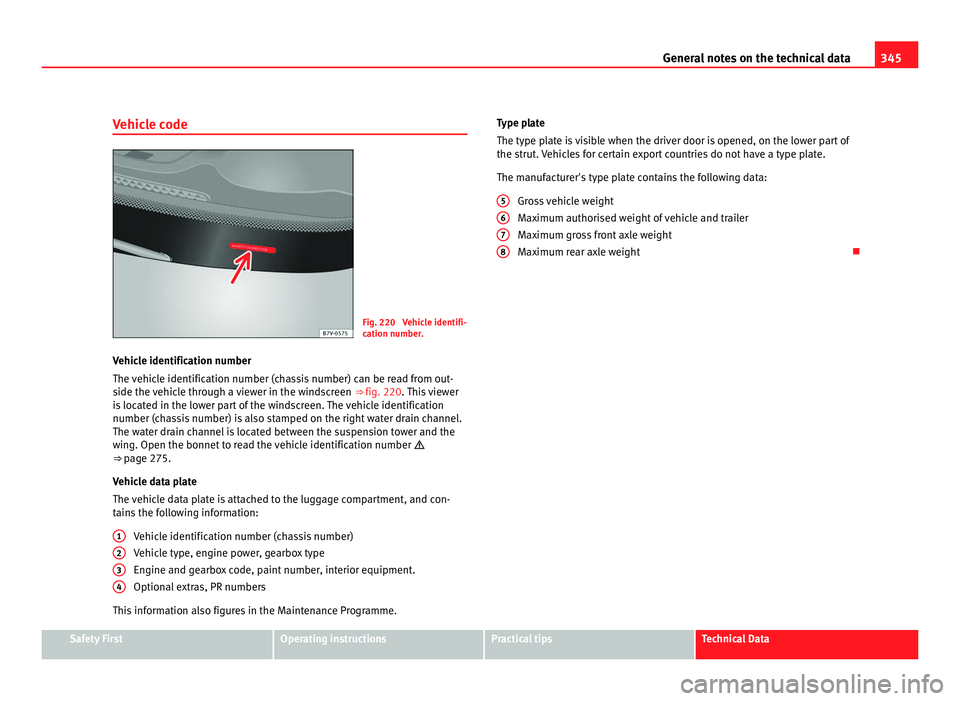
Vehicle code Fig. 220 Vehicle identifi-
cation number
.
V
ehicle identification number
The vehic
le identification number (chassis number) can be read from out-
side the vehicle through a viewer in the windscreen ⇒ fig. 220. This viewer
is located in the lower part of the windscreen. The vehicle identification
number (chassis number) is also stamped on the right water drain channel.
The water drain channel is located between the suspension tower and the
wing. Open the bonnet to read the vehicle identification number
⇒ page 275.
Vehicle data plate
The vehicle data plate is attached to the luggage compartment, and con-
tains the following information:
Vehicle identification number (chassis number)
Vehicle type, engine power, gearbox type
Engine and gearbox code, paint number, interior equipment.
Optional extras, PR numbers
This information also figures in the Maintenance Programme. 1 2
3
4 Type plate
The type pl
at
e is visible when the driver door is opened, on the lower part of
the strut. Vehicles for certain export countries do not have a type plate.
The manufacturer's type plate contains the following data:
Gross vehicle weight
Maximum authorised weight of vehicle and trailer
Maximum gross front axle weight
Maximum rear axle weight 5
6
7
8
Safety First Operating instructions Practical tips Technical Data
Page 348 of 385
346
General notes on the technical data
Data on fuel consumption
Fuel c
onsumption The consumption and emission details shown on the vehicle
data
s
ticker differ from one vehicle to another.
The fuel consumption, CO 2 emissions and actual kerb weight of the vehicle
are noted on the vehicle data sticker.
The fuel consumption and emissions figures given are based on the vehicle
weight category, which is determined according to the engine/gearbox
combination and the equipment fitted.
The consumption and emission figures are calculated in accordance with
the EC test requirements 1999/100/EC. These test requirements specify a
realistic test method based on normal everyday driving.
The following test conditions are applied: Urban cycle The urban cycle starts with an engine cold start. City driving
is
then s
imulated. Extra urban
cyc
l
e In the extra urban cycle simulation the vehicle frequently ac-
cel
er
ates and brakes in all gears, as in normal everyday driv-
ing. The road speed ranges from 0 to 120 km/h. Total con-
sumption The average total consumption is calculated with a weight-
ing of
ar
ound 37% for the urban cycle and 63% for the extra
urban cycle. CO
2 emis-
s ion
s The exhaust gases are collected during both driving cycles
to c
alc
ulate carbon dioxide emissions. The gas composition
is then analysed to evaluate the CO 2 content and other
emissions. Note
● Actual consumption may vary from quoted test values, depending on
per son
al driving style, road and traffic conditions, the weather and the vehi-
cle condition.
Weights Kerb weight refers to the basic model with a fuel tank filled to 90% capacity
and without
option
al extras. The figure quoted includes 75 kg to allow for
the weight of the driver.
For special versions and optional equipment fittings or for the addition of
accessories, the weight of the vehicle will increase ⇒ .
WARNING
● Please note that the centre of gravity may shift when transporting
he avy
objects; this may affect the vehicle's handling and lead to an acci-
dent. Always adjust your speed and driving style to suit road conditions
and requirements.
● Never exceed the gross axle weight rating or the gross vehicle weight
rating. If
the allowed axle load or the allowed total weight is exceeded,
the driving characteristics of the vehicle may change, leading to acci-
dents, injuries and damage to the vehicle.